Pulmonology billing has become more complex in the U.S. as more than 35 million Americans are reported to be living with chronic lung disease. This growing burden of respiratory conditions continues to increase patient volumes, diagnostic testing, and long-term disease management.
On top of that, according to the CDC, more than 16 million adults have been diagnosed with COPD alone, along with ongoing cases of asthma, sleep disorders, and lung cancer. This means every patient encounter generates multiple billing touchpoints. That increases the risk of billing errors.
In fact, the Medscape Physician Compensation Report shows that the denial rate for pulmonary practices is 18%, much higher than the median of 5-10%.

Breakdowns like this are exactly why you should read this guide to nail pulmonology medical billing and coding. This guide explains the steps, challenges, and best practices, including how a specialized firm provides pulmonology billing services to help you get paid in full and on time.
What Is Pulmonology Billing?
Pulmonology billing is the process of recording, submitting, and managing insurance claims for services provided by pulmonologists and pulmonary care practices.
It covers billing for pulmonary office visits, bronchoscopy, pulmonary function tests (PFTs), sleep studies, COPD, asthma, lung cancer care, and other respiratory services.
Pulmonology medical billing requires knowledge of respiratory procedures, payer guidelines, CMS regulations, and specialty-specific CPT and ICD-10 coding. Accurate billing helps pulmonary practices reduce claim denials, improve reimbursement, and maintain steady cash flow.
What Are Common Pulmonology Billing Services?
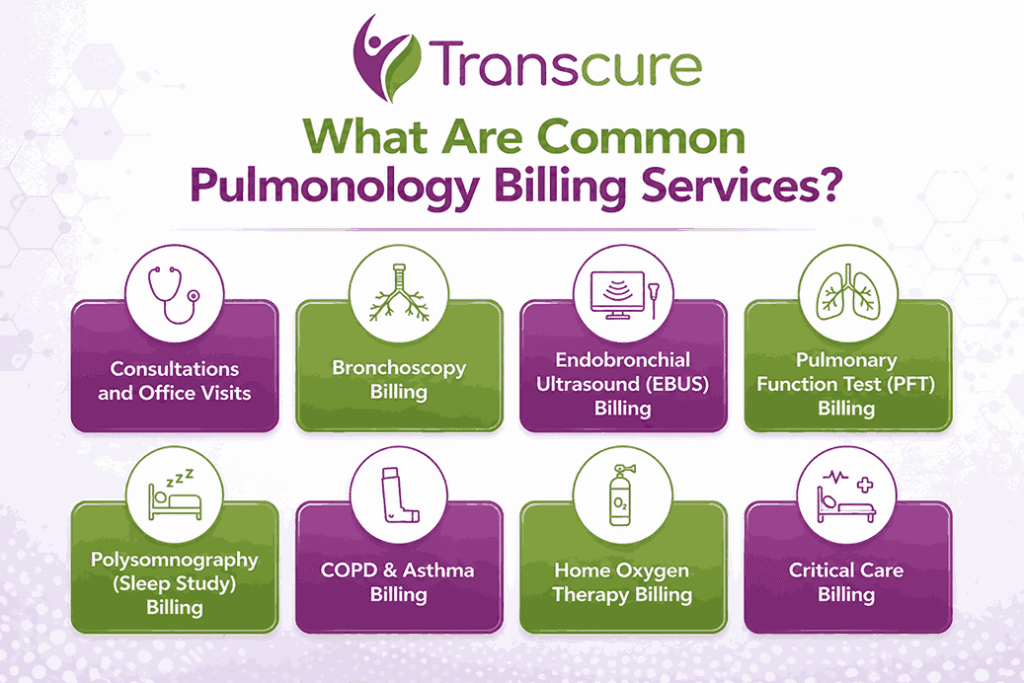
Here are the common pulmonology billing services that you might encounter in your pulmonary practice:
- Consultations and Office Visits: Billing for new patient, follow-up, and respiratory evaluation services.
- Bronchoscopy Billing: Coding and reimbursement for diagnostic and therapeutic bronchoscopy procedures.
- Endobronchial Ultrasound (EBUS) Billing: Billing for EBUS-guided biopsies and related pulmonary interventions.
- Pulmonary Function Test (PFT) Billing: Claims for spirometry, lung volume measurement, diffusion capacity, and other respiratory function tests.
- Polysomnography (Sleep Study) Billing: Billing for diagnostic sleep studies and sleep-related respiratory evaluations.
- COPD & Asthma Billing: Coding and claim management for chronic obstructive pulmonary disease and asthma treatment.
- Home Oxygen Therapy Billing: Claims for oxygen therapy management, monitoring, and related respiratory services.
- Critical Care Billing: Billing for pulmonary critical care services provided in hospital and intensive care settings.
Why RCM Matters for Pulmonology Practices
Effective revenue cycle management (RCM) is critical for pulmonologists because it ensures steady cash flow and regulatory compliance. Advanced billing systems and expert coding can reduce denials and accelerate collections, so providers aren’t left waiting months for reimbursement. Moreover, RCM safeguards compliance with U.S. laws and payer rules.
For instance, HIPAA imposes strict data privacy standards, and violations can incur large fines. It can cost practices up to $2,190,294 per violation category per year under OCR’s 2026 penalty structure, with unintentional violations starting at $145 per incident.
Medicare’s own statutes (Social Security Act) forbid payment of any claim that “lacks the necessary information to process the claim.” In practice, this means every pulmonary function test (PFT), E/M note, and equipment order must be fully documented, or the claim is denied.
Plus, CMS’s Merit-based Incentive Payment System (MIPS) now includes a Pulmonary Value Pathway (2025) focused on COPD, asthma, sleep apnea, etc. This means accurate coding now affects incentive payments. In short, a streamlined pulmonology RCM is the backbone of financial health, as it preserves revenue and ensures compliance.
Common Billing Challenges in Pulmonology and Their Solutions
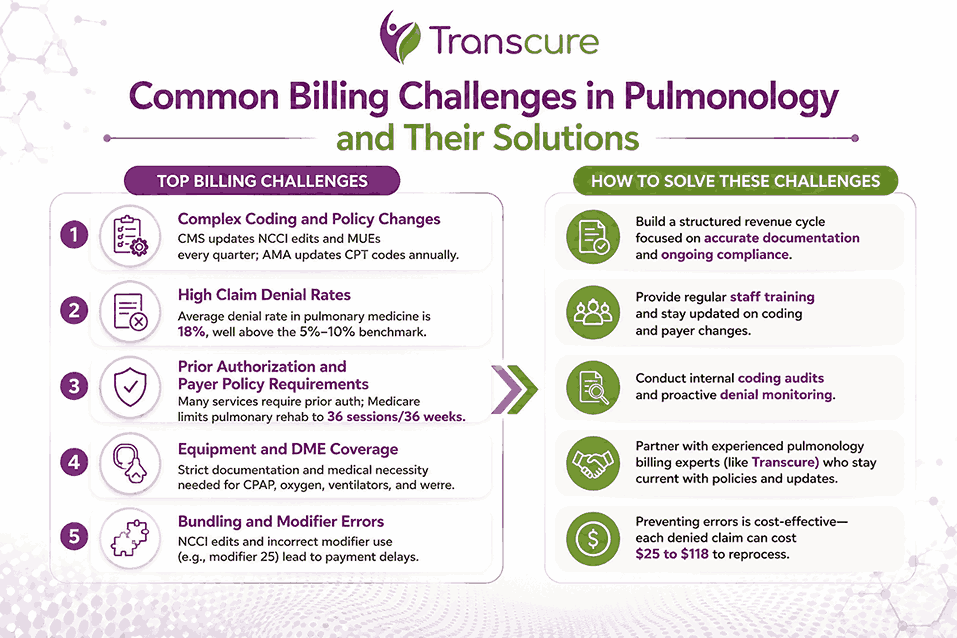
Pulmonology practices face several specialty-specific billing hurdles that can delay reimbursements and disrupt cash flow. Here are the most common challenges and how practices can address them.
Complex Coding and Policy Changes
Pulmonary diagnostics involve a wide range of CPT and ICD-10 codes for bronchoscopy, pulmonary function tests (PFTs), sleep studies, and critical care services. In addition, CMS updates NCCI edits and Medically Unlikely Edits (MUEs) every quarter, while the AMA releases annual CPT code changes.
High Claim Denial Rates
Even small documentation errors can result in claim denials. Pulmonary medicine has an average claim denial rate of nearly 18%, much higher than the healthy benchmark of 5% to 10%. The leading cause of these rejected claims is missing documentation, incorrect diagnosis codes, and modifier errors.
Prior Authorization and Payer Policy Requirements
Many pulmonary services, including sleep studies, advanced imaging, and home oxygen therapy, require prior authorization before treatment. In addition, Medicare limits pulmonary rehabilitation to 36 sessions within 36 weeks for eligible patients under current coverage guidelines.
Equipment and DME Coverage
Billing for CPAP machines, oxygen therapy, ventilators, and other durable medical equipment (DME) requires detailed documentation and strict medical necessity criteria. Missing sleep study reports, physician orders, or compliance documentation can delay or prevent reimbursement.
Bundling and Modifier Errors
Many pulmonary procedures are subject to National Correct Coding Initiative (NCCI) edits and require the correct modifiers. For example, an office visit performed on the same day as spirometry typically requires modifier 25 when the E/M service is separately identifiable. Incorrect modifier usage remains a common reason for payment delays.
How to Solve Common Pulmonary Billing Challenges?
The best way to reduce billing errors is to build a structured revenue cycle process that prioritizes accurate documentation and ongoing compliance. In addition, regular staff training, internal coding audits, and proactive denial monitoring can significantly improve first-pass claim acceptance.
Many practices also partner with experienced pulmonology billing companies, like Transcure, that stay current with updates, policies, and coding changes. Preventing billing errors is far more cost-effective, as each denied claim can cost between $25 and $118 to reprocess, according to the Journal of AHIMA.
The Complete Pulmonology Medical Billing and Coding Process
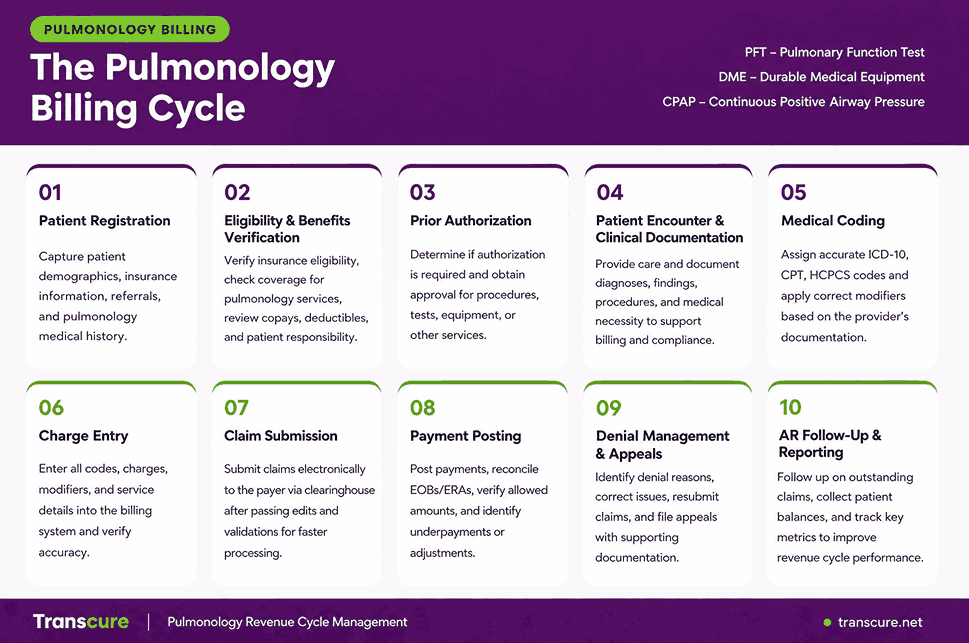
The pulmonology billing cycle consists of several connected steps that work together to move a claim from patient registration to final payment. This workflow will help you reduce claim denials, improve reimbursement, and maintain compliance with CMS and payer requirements.
Let’s break down each stage of the process.
Step 1: Patient Registration & Insurance Check
Patient registration and insurance check are the first step in any billing workflow, especially for pulmonary practices. Here, the administrative staff collects the information needed to create an accurate patient record before the appointment. Even a small mistake at this stage can lead to claim denials, payment delays, or duplicate records later in the revenue cycle.
Collecting Patient Information
The first task is recording the patient’s personal and insurance details. This includes the patient’s full name, date of birth, address, contact information, insurance policy, and emergency contact. If another physician has referred the patient, the referral details should also be recorded to meet payer requirements.
Returning patients should also have their records reviewed because insurance plans, addresses, and contact information often change from one visit to the next.
Recording the Reason for the Visit
After registration, the practice documents why the patient is visiting the clinic. For pulmonology practices, this may include respiratory symptoms, chronic lung conditions, or scheduled procedures.
For instance, patients may visit for:
- Bronchoscopy
- Pulmonary Function Tests (PFTs)
- Sleep studies
- COPD or asthma management
- Home oxygen therapy follow-up
- Pulmonary rehabilitation
Creating an Accurate Patient Record
Finally, the patient’s record is created or updated in the EHR or practice management system. This record becomes the foundation for every step that follows, including insurance verification, coding, claim submission, and payment posting.
Accurate records help reduce duplicate patient files and make it easier to track the patient’s treatment history over time.
Step 2: Eligibility & Benefits Verification
Next up is the verification of the patient’s insurance eligibility and benefits. This confirms that the insurance policy is active, identifies the services covered under the plan, and helps you understand the patient’s financial responsibility before care.
Transcure automates this step through its ELIXA, an AI-powered eligibility verification agent. It verifies patient insurance coverage in as little as 4 seconds.
Is the Patient’s Insurance Active?
The billing staff logs in to the payer portal or uses an electronic eligibility verification system to verify the patient’s insurance. They confirm that the policy is active on the date of service, verify the patient’s member ID, and make sure the insurance details match the patient’s records.
If the policy or the information is incorrect, the issue is resolved before the appointment. You can prevent claims from being rejected by simply fixing these problems early.
Which Pulmonary Services are Covered?
After confirming the active coverage, the billing team reviews the patient’s insurance benefits to see if the planned services are covered. This may include bronchoscopy, PFTs, sleep studies, home oxygen therapy, or CPAP equipment.
The staff also needs to check for visit limits, coverage restrictions, and services that require prior authorization.
What Will the Patient Pay?
Insurance rarely covers the entire cost of care. Before the visit, the billing team checks the patient’s deductible, copayment, coinsurance, and remaining out-of-pocket balance.
Sharing this information in advance allows patients to understand their financial responsibility. It also gives the practice an opportunity to collect copayments or outstanding balances during check-in.
Step 3: Prior Authorization
After verifying insurance, the billing team determines if the planned pulmonology service requires prior authorization. Many insurance companies require approval before they agree to pay for certain procedures, tests, or medical equipment.
Performing a service without the required authorization can lead to automatic claim denials, even when the procedure was medically necessary.
Does This Procedure Need Prior Authorization?
Not every pulmonology service requires prior authorization, but many high-cost or specialty procedures do. The billing staff reviews the patient’s insurance policy and payer guidelines to identify any authorization requirements before the appointment.
Services that commonly require prior authorization include:
- Bronchoscopy
- Sleep studies (Polysomnography)
- Advanced chest imaging
- Pulmonary rehabilitation
- Home oxygen therapy
- CPAP and BiPAP equipment
- Biologic therapies for severe asthma
What Information Is Sent to the Insurance Company?
If authorization is required, your team submits the necessary clinical documents to the insurance company. These documents help demonstrate that the procedure is medically necessary and meets the payer’s coverage requirements.
This usually includes physician notes, patient diagnosis, previous treatment history, diagnostic test results, and supporting medical records.
Has the Request Been Approved?
Once the request is submitted, the billing team tracks its status until the insurance company makes a decision. If the authorization is approved, the authorization number, approved services, and validity dates are recorded in the patient’s EHR.
However, if the request is denied, the team reviews the reason, submits additional documentation, or works with the provider to determine the next steps.
For this step, Transcure uses an AI prior authorization agent called PRIA. This agent automates authorization requests and payer follow-ups.
Step 4: Patient Encounter & Clinical Documentation
Once insurance requirements have been completed, the patient arrives for the appointment and receives care. During the visit, the provider documents every service performed, diagnosis made, and procedure completed.
These SOAP notes become the foundation for accurate coding, claim submission, and reimbursement.
What Should the Provider Document?
The provider records the patient’s symptoms, medical history, examination findings, diagnosis, treatment plan, and any procedures performed during the visit. Every service billed to the insurance company must be supported by clear clinical documentation.
For pulmonology visits, documentation may include:
- Respiratory symptoms and medical history
- Physical examination findings
- Spirometry or PFT results
- Bronchoscopy findings
- Sleep study interpretation
- Treatment recommendations
- Follow-up plan
Why Is Medical Necessity Important?
Insurance companies only reimburse services they consider medically necessary. The provider must clearly explain why a procedure was performed and how it relates to the patient’s condition.
For instance, if a pulmonary function test is ordered, the documentation should explain the patient’s respiratory symptoms or diagnosis that justified the test. Without clear medical necessity, Medicare can deny the claim, leaving you to appeal the decision or absorb the lost reimbursement.
Step 5: Medical Coding
Next, the patient’s record moves to the medical coding team. Their job is to translate every diagnosis, procedure, and service into standardized medical codes that insurance companies understand.
It is a time-consuming process, so Transcure uses CODIN, an AI coding agent, to recommend accurate codes. These are then checked by certified coders for accuracy.
Which Codes Are Assigned?
Medical coders review the provider’s documentation and assign the appropriate ICD-10 codes, CPT codes, and HCPCS codes based on the services performed. For a pulmonary visit, this may include:
- ICD-10 codes for COPD, asthma, sleep apnea, or other respiratory conditions.
- CPT codes for bronchoscopy, pulmonary function tests (PFTs), sleep studies, or critical care services.
- HCPCS codes for CPAP machines, oxygen therapy, and other durable medical equipment (DME).
Coders also check NCCI edits and LCDs to make sure the services can be billed together. This helps improve first-pass claim acceptance and reduces costly rework later.
Are the Correct Modifiers Used?
Some pulmonology services require modifiers to explain how or why a procedure was performed. Medical coders review the documentation to determine if modifiers should be added before the claim is submitted.
For example, modifier 25 may be required when a separately identifiable office visit is performed on the same day as spirometry. Likewise, other modifiers may be needed when multiple pulmonary procedures are performed during the same encounter.
Step 6: Charge Entry
After coding is complete, the coded services are entered into the practice management or billing system. This process is known as charge entry. It converts the provider’s documentation and assigned codes into a billable claim that can be submitted to the insurance company.
Even correctly coded services can result in denied claims if incorrect charges are entered into the billing system.
What Information Is Entered?
The billing team enters all billable information into the practice management software. This includes the diagnosis codes, procedure codes, modifiers, provider information, units of service, and charge amounts.
The entered information must exactly match the provider’s documentation and the medical coder’s work.
Are All Services Captured?
Before finalizing the charges, your team verifies every billable service has been included. Missing a procedure, diagnostic test, or supply can reduce reimbursement even though the service was performed.
Step 7: Claim Submission
At this step, the claim is ready to be submitted to the insurance company. Most pulmonology practices submit claims electronically through a clearinghouse, which reviews the claim for formatting errors before forwarding it to the payer.
Submitting clean claims the first time is one of the most effective ways to improve cash flow and reduce payment delays.
Where Is the Claim Sent?
The billing software sends the completed claim to a clearinghouse. It performs an initial review to identify formatting errors, missing information, or invalid codes before sending the claim to the insurance company.
In this step, Transcure uses CLAIR (AI agent) to perform automated claim scrubbing to identify coding errors, missing modifiers, or incomplete documentation.
What Does the Insurance Company Review?
The insurance company reviews the claim for eligibility, medical necessity, coding accuracy, prior authorization, and policy compliance. Then, the payer decides to either approve, deny, or request additional documentation.
This review determines how much the insurance company will reimburse for the services provided.
Step 8: Payment Posting
Next, the insurance company sends the payment along with an Electronic Remittance Advice (ERA) or Explanation of Benefits (EOB). The billing team records these payments in the practice management system and verifies that the payer reimbursed the correct amount.
Payment posting is more than recording deposits. It also helps identify underpayments, denials, and outstanding balances that require follow-up.
How Does the Practice Know It Has Been Paid?
Most insurance companies send an ERA after processing the claim. The ERA explains if the claim was paid in full, partially paid, denied, or adjusted.
The billing team reviews this report before posting the payment to ensure it matches the submitted claim.
Was the Correct Amount Paid?
After receiving the payment, your team compares the reimbursement with the contracted payer rates. If the insurance company pays less than expected, they investigate why the reduction was caused by a contractual adjustment or processing error.
Moreover, any remaining patient responsibility is calculated. This may include deductibles, copayments, coinsurance, or non-covered services. The remaining balance is transferred to the patient’s account.
Step 9: Denial Management & Appeals
Not every claim gets paid the first time. When a claim is denied or rejected, you need to investigate the reason, correct any errors, and resubmit the claim or file an appeal. Quick response helps recover revenue and prevent accounts from aging.
Why Was the Claim Denied?
The first step is reviewing the payer’s denial reason. Most pulmonology denials occur because of missing documentation, incorrect diagnosis codes, modifier errors, expired prior authorizations, or services that don’t meet the payer’s medical necessity requirements.
If you understand the root cause of the denial, you can prevent the same mistake from happening again.
Transcure goes a step above and uses DEXA, a denial management AI agent, to identify denial patterns, recommend the appropriate correction, and assist with appeal preparation.
Can the Claim Be Corrected?
Many denied claims don’t require a formal appeal. For instance, if the denial resulted from a simple coding error, missing modifier, or incomplete documentation, your billing team can correct the issue and resubmit the claim.
When Is an Appeal Necessary?
When you completely believe that the denial was incorrect, ask your billing team to prepare an appeal. This usually includes physician documentation, medical records, diagnostic reports, and any additional evidence that supports medical necessity.
A well-prepared appeal gives the payer a stronger reason to overturn the denial and approve payment.
Step 10: Accounts Receivable (A/R) Follow-Up & Reporting
In the end, the time comes to follow up on unpaid claims and monitor the overall health of the revenue cycle.
The in-house team then reviews outstanding accounts and contacts insurance companies when payments are delayed. They also track key performance indicators to identify key areas of improvement.
How Are Outstanding Claims Followed Up?
For unpaid claims, your team needs to contact the insurance company to determine why payment has not been issued.
They may request status updates, provide additional documentation, or resolve outstanding issues that are preventing reimbursement. Regular follow-up keeps claims moving through the payment process.
At Transcure, we have automated AR follow-up. Our AI-powered agent, ARIA, automates payer follow-ups, prioritizes outstanding claims, and reduces reimbursement delays.
Is the Revenue Cycle Performing Well?
Practices also monitor key revenue cycle metrics to measure billing performance. These reports help identify trends, recurring problems, and opportunities to improve collections. Common KPIs include:
- Clean claim rate: 95% or higher
- Claim denial rate: Below 5%
- Days in Accounts Receivable (A/R): Less than 40 days
- First-pass claim acceptance rate: 90% or higher
- Net collection rate: 95% or higher
How Does Tele-Pulmonology Billing Work?
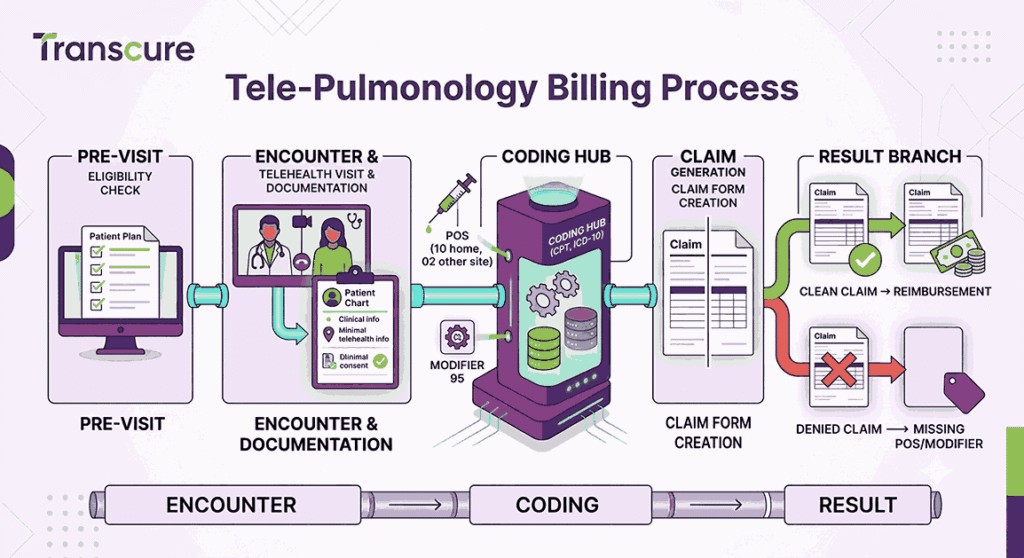
Tele-pulmonology billing follows the same revenue cycle as an in-person visit. However, providers must also meet telehealth billing requirements established by CMS and commercial insurance companies.
These requirements determine if the visit qualifies for reimbursement and which codes, modifiers, and documentation must appear on the claim.
Can the Visit Be Billed Through Telehealth?
The first step is confirming that the scheduled service is eligible for telehealth reimbursement. Medicare covers hundreds of telehealth services, but commercial insurers often follow different policies.
Before the appointment, the practice needs to review the patient’s benefits to confirm telehealth coverage and check if the planned service qualifies for virtual care.
Some services commonly performed through telehealth include routine follow-up visits for COPD, asthma, sleep apnea, medication management, CPAP compliance, smoking cessation, or PFT results.
What Should the Provider Document?
The medical record should contain the same clinical information required for an office visit. It should clearly describe the patient’s condition, diagnosis, treatment plan, and medical decision-making.
Telehealth visits also require additional documentation. CMS recommends documenting that the service was delivered through telecommunication technology, recording the patient’s location, and obtaining patient consent when required by the payer.
Which Codes Are Used for Tele-Pulmonology?
After the visit, services are coded using standard CPT and ICD-10 codes, with telehealth-specific billing information added before submission.
Medicare requires established E/M codes paired with a place-of-service code and modifier, rather than the newer 98000-98016 telehealth-specific CPT code set. This means the same virtual visit can require different coding depending on which payer is billed.
For most Medicare telehealth claims, providers use:
- POS 10 when the patient receives the service from home.
- POS 02 when the patient receives the service from another approved location.
- Modifier 95 when required by the payer to identify a real-time audio-video telehealth service.
If a facility fee applies for an originating site, Medicare pays 80% of the lesser of the actual charge or $31.85 for CY 2026 (HCPCS Q3014), up from $31.01 in 2025.
Why Are Some Tele-Pulmonology Claims Denied?
Most telehealth claim denials happen because required billing elements are missing. Common issues include incorrect POS codes, missing telehealth modifiers, and services not covered by the patient’s health plan.
Many payers also review the documentation to confirm that the visit met their telehealth requirements before processing payment.
Recent CMS Updates Affecting Pulmonology Billing
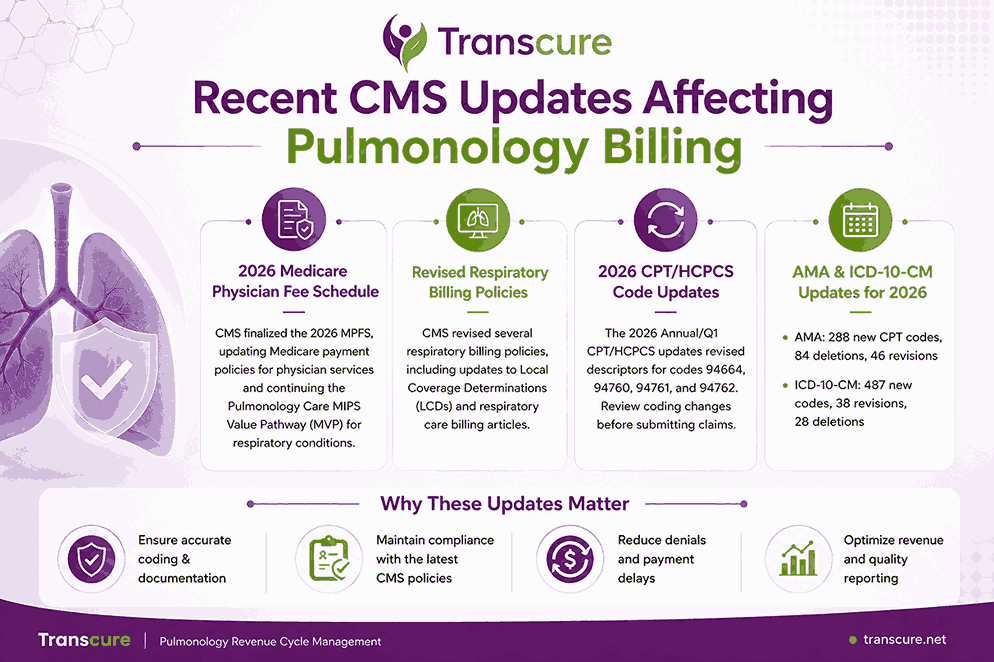
In 2026, CMS finalized the Medicare Physician Fee Schedule (MPFS), which updated Medicare payment policies for physician services. It also continued the Pulmonology Care MIPS Value Pathway (MVP) to support quality reporting for COPD, asthma, sleep apnea, and other respiratory conditions.
CMS also revised several respiratory billing policies this year, including updates to Local Coverage Determinations (LCDs) and respiratory care billing articles.
In addition, the 2026 Annual/Q1 CPT/HCPCS updates revised the descriptors for codes 94664, 94760, 94761, and 94762. This makes it important for practices to review coding changes before submitting claims.
Beyond CMS, the AMA updates billing requirements every year. For 2026, the AMA introduced 288 new CPT codes, 84 deletions, and 46 revisions. Meanwhile, the FY 2026 ICD-10-CM update added 487 new diagnosis codes, revised 38, and deleted 28 existing codes.
In-House vs. Outsourced Pulmonology Billing: Which Should You Choose?
An in-house team gives you direct control over operations, while outsourcing pulmonary billing provides access to specialized billing expertise and advanced technology. You also get dedicated denial management without the overhead of hiring and training staff.
Here’s how they both differ based on different factors:
Signs Your In-House Billing is Underperforming
A denial rate creeping above 10-15% is one of the clearest indicators that claims aren’t being coded or documented the first time correctly. Moreover, days in A/R exceeding 45-60 days indicate slow follow-up or payment posting that’s falling behind.
Another sign could be about your team capacity. If no one on staff has dedicated coding experience, they will miss the specialty-specific rules that drive denials, things like EBUS modifier accuracy, PFT component bundling, or the pulmonary rehab session cap.
Finally, if your team is spending more time reworking denied claims than submitting new ones, that’s usually the clearest sign the current setup has stopped scaling.
Which Option Is Better?
Outsourcing pulmonology billing is the more cost-effective option for most pulmonary practices. Let’s understand why.
If you hire a single experienced medical biller, it can cost $60,000 to $88,000+ per year before benefits and software expenses, which can end up being more than 15% of your collections. In contrast, most billing companies charge only 4 to 8% of monthly collections while handling the entire RCM.
One such company is Transcure, offering billing services at as low as 5% of the collections. We handle the entire RCM with AI agents and certified billers to increase your collection by 30% and above.
How To Choose the Right Pulmonology Medical Billing Partner?

The company you hire will directly influence your collections, compliance, and patient experience. So, it’s important to evaluate both its expertise and the way it works with your practice. Here are the key areas to evaluate before making a decision:
Pulmonology Expertise
Pulmonology billing involves specialty-specific procedures, complex coding, and changing payer policies. That’s why you should choose a billing partner with proven experience in handling pulmonary services, including bronchoscopy, PFTs, and chronic respiratory conditions.
Transparent Pricing
A reputable billing company should clearly explain its pricing model before you sign a contract. Ask about service fees, contract terms, and any additional charges for credentialing, prior authorizations, software, or denial appeals.
HIPAA Compliance & Data Security
Your billing partner will handle sensitive patient information every day. To avoid unexpected penalties, confirm that the company follows HIPAA regulations, uses secure systems, and maintains clear compliance policies to protect patient data.
Dedicated Account Management
Strong communication is just as important as accurate billing. Look for a company that assigns a dedicated account manager who understands your practice, provides regular performance updates, and responds promptly to billing issues.
Industry Reputation
Take time to review client testimonials, case studies, and independent reviews before making a decision. A company with a strong reputation and long-term client relationships is more likely to deliver consistent results and reliable support.
Top Tips to Improve Your Pulmonology RCM
Since your Pulmonology practice’s smooth functionality depends completely on an optimized RCM, here are a few tips to achieve it:
Create a Pulmonology Billing Codes Cheat Sheet
In the absence of a billing partner, we recommend building an in-house quick reference for your team. List commonly used CPT and ICD codes (as above) and update them annually. Because CPT codes frequently change, this cheat sheet should be a living document.
To make it more helpful, you can include reminders, such as adding modifier 25 if E/M + PFT on the same day, to prevent common errors. An important piece of advice here is to review it regularly when new code books or payer policies are released.
Implement a Billing Feedback Loop
The key to ensuring your billing process runs smoothly is to continually monitor performance metrics and make adjustments. Track key indicators such as claim denial rate, days in A/R, and payment speed. Additionally, regularly pull denial reports to identify common errors, such as missing pre-auth and incorrect codes. After getting this data, use the feedback to train staff and improve processes.
For instance, if many claims are denied due to missing modifiers, reinforce that rule during team meetings. Industry guidance recommends analyzing denial trends and “monitoring key performance indicators like claim denial rates, reimbursement rates, and time from services to final bill.” This loop of measurement and improvement steadily boosts RCM health.
Do Regular Pulmonology Practice Audits
You should conduct periodic audits, even if you are using a third-party billing partner. Check a sample of charts for each provider and verify if documentation supports every code billed. This is an important tip because audits can catch under-billing and over-billing issues early.
Many billing partners, including Transcure, offer complimentary audits before signing up. Auditing ensures that even detailed requirements, like documentation for prolonged ventilator management or pulmonary rehab eligibility, are met. In this way, practices can catch small issues before they become large revenue losses or audit flags.
Summing Up
If you’ve made it this far, you already know that pulmonology billing involves much more than submitting claims. Every step, from documentation and coding to payer compliance and denial management, has a direct impact on your revenue.
As billing requirements continue to evolve, staying informed and making the right decisions today will put your practice in a much stronger position tomorrow.
Frequently Asked Questions about Pulmonology Medical Billing
What Is the CPT Code for a 60-Minute Walk Test?
94620 covers pulmonology stress testing, which includes the six-minute walk test along with blood pressure and pulse oximetry monitoring during the walk. A more detailed version, cardiopulmonary exercise testing (CPET), is billed separately under 94621 and requires documentation matching that higher complexity.
Are Pulmonology Procedures Bundled Together for Billing?
Yes, several pulmonology procedures are subject to NCCI bundling edits. It means some services can’t be billed separately unless a modifier proves they were genuinely distinct. Billing bundled services incorrectly is a common cause of both denials and compliance audits.
What Are the Five Common CPT Codes?
The five most frequently billed pulmonology CPT codes are 94010 (spirometry), 94060 (spirometry with bronchodilator), 94729 (DLCO/diffusion capacity testing), 94729 (diagnostic bronchoscopy), and 95810 (attended polysomnography/sleep study). These cover the core diagnostic categories, breathing tests, airway visualization, and sleep evaluation.
Does Medicare Limit Pulmonary Rehabilitation Coverage?
It does. Medicare covers up to 36 one-hour pulmonary rehab sessions over 36 weeks. Additional sessions beyond that require the KX modifier and documented medical necessity to be covered.
What Are the Main Pulmonary Diseases?
The primary conditions pulmonologists treat and bill for include COPD, asthma, obstructive sleep apnea, pulmonary fibrosis, pneumonia, lung cancer, pulmonary hypertension, and bronchiectasis. COPD and asthma together account for the largest share of recurring E/M and PFT billing volume.
Can 94010 and 94060 be Billed Together?
No, CPT 94060 and 94060 cannot be billed together. The former already includes the baseline spirometry that would otherwise be billed as 94010, since 94060 covers spirometry performed both before and after the bronchodilator. The NCCI edits will flag if you bill both codes for the same session on the same date, as it’s a bundling error.
What Are Category 2 CPT Codes Used For?
Category II CPT codes are supplemental tracking codes used for performance measurement and quality reporting. They are never used for payment or reimbursement. These codes are identifiable by a letter “F” at the end (e.g., 3074F), and their purpose is to document if specific clinical actions were performed.