Robotic Process Automation (RPA) in medical billing refers to software bots that handle repetitive, rule-based revenue cycle tasks with speed and consistency. It is now a core layer in modern billing operations, helping practices reduce manual workload while improving accuracy and turnaround times.
The most common use cases include eligibility verification, claim submission, payment posting, denial management, prior authorization, and charge entry. These are high-volume processes with structured data, making them ideal for automation. Bots can log into payer portals, extract and validate patient data, submit claims, post ERA payments, flag denials, and trigger rework workflows without human intervention.
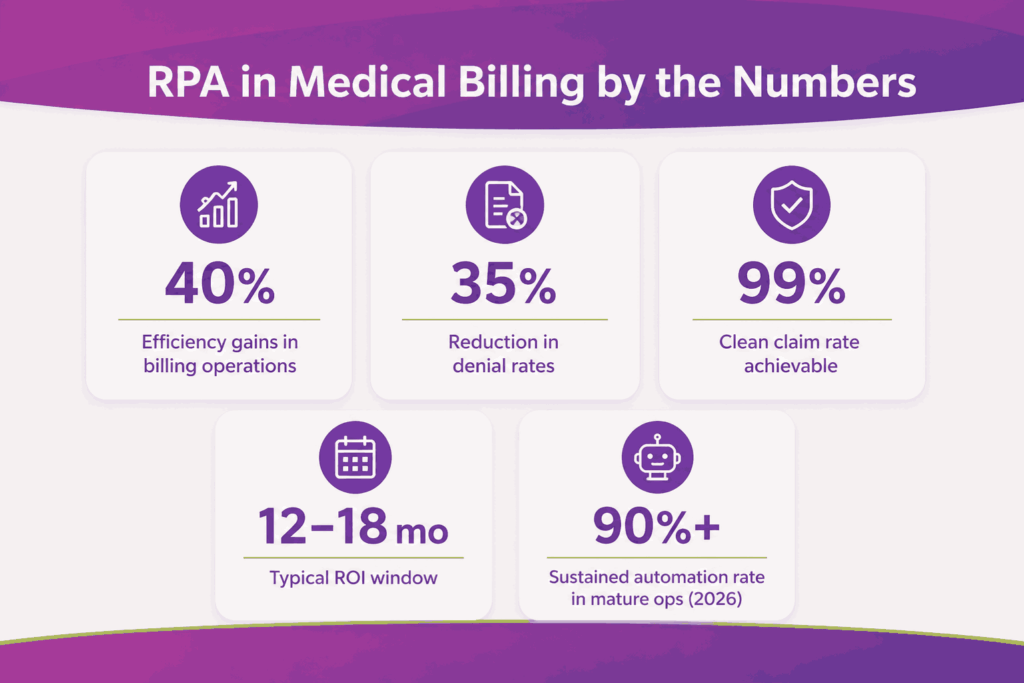
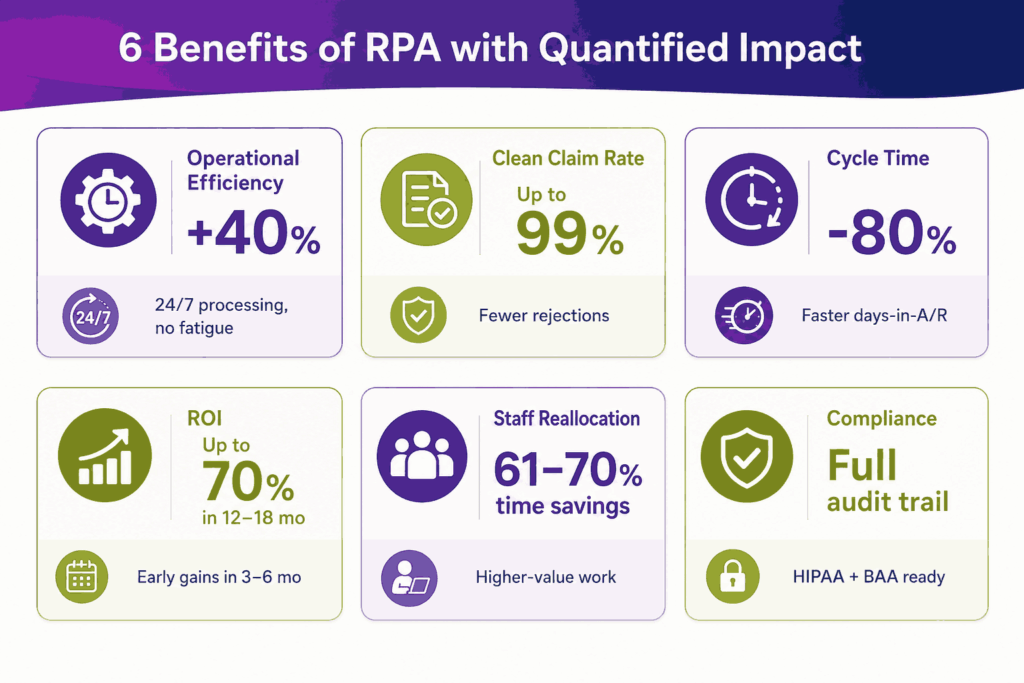
Healthcare organizations using RPA report up to 40% efficiency gains, a 35% reduction in denials, and clean claim rates approaching 99%. Most implementations reach ROI within 12 to 18 months by lowering labor costs, accelerating reimbursements, and reducing rework.
In 2026, RPA is evolving beyond basic task automation. With the rise of agentic AI, bots are becoming more adaptive and capable of handling semi-structured workflows. Automation rates across mature billing operations are now sustained above 90%, making RPA a foundational component of scalable, compliant revenue cycle management.
What is RPA in Medical Billing?
Robotic Process Automation (RPA) in medical billing uses software bots to handle repetitive, rule-based tasks across the revenue cycle. These bots follow predefined rules to complete processes such as eligibility verification, claim submission, payment posting, and denial management without manual input.
RPA works by interacting with existing billing systems the same way a human user would. It can log into payer portals, enter data, extract information, and move tasks forward across multiple systems. This allows billing teams to automate high-volume workflows without changing their current software.
The key difference from traditional billing automation is flexibility. Older automation relies on system integrations and APIs, which require development effort and system compatibility. RPA does not depend on these connections. It operates at the user interface level, mimicking human actions, which makes it faster to deploy and easier to scale across different platforms.
How Does RPA Work in a Medical Billing Environment?
RPA operates by automating rule-based tasks that follow clear logic and structured inputs. In medical billing, bots are configured to handle workflows such as verifying eligibility, entering charges, submitting claims, posting payments, and routing denials. They follow predefined rules, validate data at each step, and execute tasks consistently without fatigue or variation.
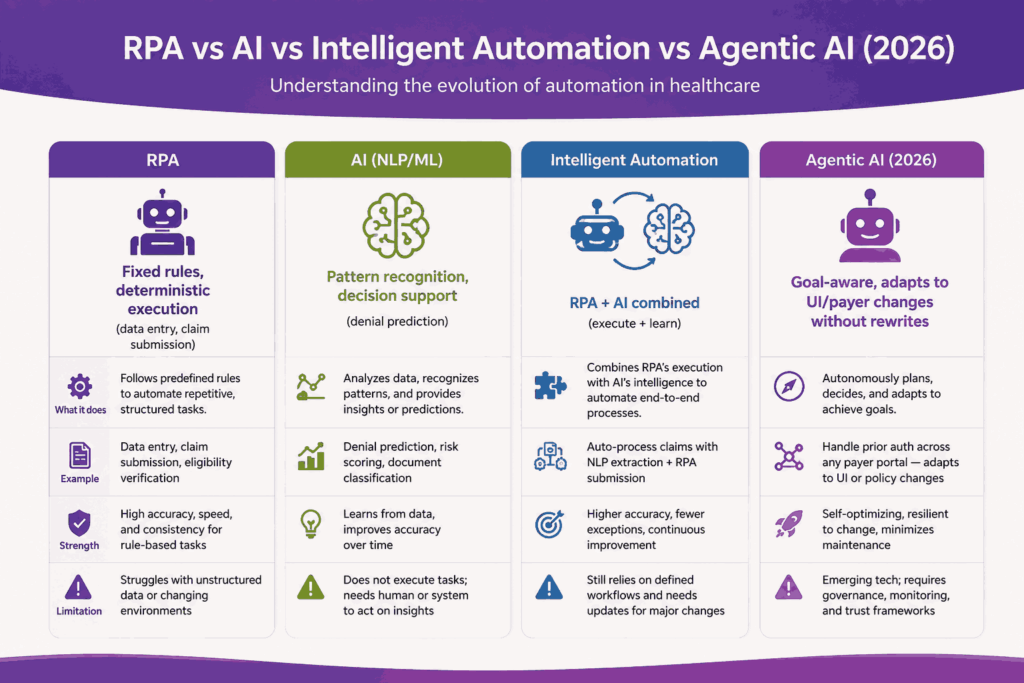
It is important to separate RPA from AI and intelligent automation. RPA focuses on deterministic, rules-driven processes. AI introduces decision-making by analyzing patterns in data, such as predicting denials. Intelligent automation combines both, allowing bots to not only execute tasks but also adapt based on data insights. In billing environments, RPA handles execution while AI supports optimization.
From a technical standpoint, RPA uses a bot architecture that works across existing systems without requiring deep integrations. Bots interact with practice management systems, EHRs, and payer portals through the user interface. They can trigger workflows, move data between systems, and maintain audit trails. This approach allows organizations to automate processes without replacing their current infrastructure.
Rule-Based Task Automation
Rule-based task automation uses predefined rules and decision trees to execute structured billing tasks without manual input. In medical billing, RPA bots follow step-by-step logic to complete processes consistently.
These bots can log in to payer portals, extract and copy data between systems, validate required fields, and submit claims based on set conditions. Every action is driven by rules, which ensure accuracy and repeatability across high-volume workflows.
The best candidates for RPA are tasks that are high in volume, repetitive, rule-driven, and have a low exception rate. Examples include eligibility checks, charge entry, and payment posting, where inputs and outputs follow a predictable format.
RPA deployments typically use two types of bots. Attended bots are triggered by staff and assist with tasks in real time, such as during claim review. Unattended bots run on schedules or events, handling processes like overnight claim submissions or batch payment posting without human involvement.
RPA vs AI vs Intelligent Automation
RPA, AI, and intelligent automation differ in how they execute and adapt tasks. RPA follows fixed rules, AI adds data-driven decision-making, and intelligent automation combines both to handle more complex workflows.
Basic RPA executes predefined scripts. It performs tasks like data entry, claim submission, and payment posting exactly as configured. AI introduces capabilities such as natural language processing (NLP) and machine learning (ML), which allow systems to interpret unstructured data, detect patterns, and make decisions. As a modern alternative to these rigid scripts, AI agents for medical billing are transforming revenue cycle management by introducing autonomous, multi-step reasoning.
Unlike deterministic bots that break when a payer portal alters its layout, these cognitive agents can understand high-level task objectives, dynamically adjust to interface changes, cross-examine unstructured clinical charts, and execute complex workflows without requiring a human developer to rewrite code. This reduces maintenance overhead and increases automation stability.
In 2026, agentic AI is extending this model. Bots are no longer limited to static scripts. They can understand task objectives, adjust workflows, and respond to changes such as payer portal updates without requiring full developer rewrites. This reduces maintenance overhead and increases automation stability.
The progression is clear. It starts with RPA handling structured, rule-based tasks. It advances to RPA combined with OCR and NLP to process documents and unstructured inputs. It then evolves into agentic AI-powered automation, where systems can plan, adapt, and execute billing workflows with minimal human intervention.
Bot Architecture and System Integration
Bot architecture refers to the structure and design of how RPA bots are built, deployed, and managed across billing workflows. It defines how bots execute tasks, interact with systems, and coordinate with each other.
In a medical billing environment, bots operate at the user interface level. They interact with EHR or EMR systems, practice management software, payer portals, clearinghouses, and billing platforms the same way a human user would. Bots can log in, navigate screens, extract and input data, and move information between systems without modifying the underlying applications.
The main advantage is that no backend API integrations or system changes are required. This allows organizations to automate processes using their existing infrastructure, reducing implementation time and avoiding disruption to core systems.
Bot orchestration platforms manage how these bots run. They handle scheduling, trigger-based execution, workload distribution, error handling, and audit logging. This ensures that processes run reliably, exceptions are tracked, and every action is recorded for compliance and performance monitoring.
What are the Key Use Cases of RPA in Medical Billing?
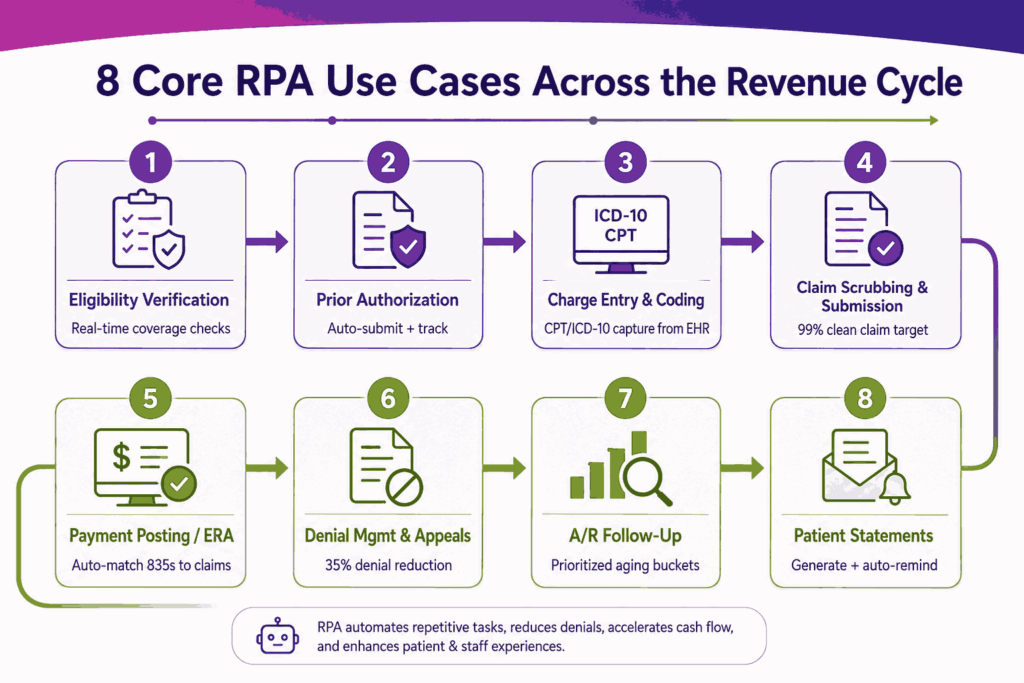
RPA in medical billing is applied across the revenue cycle to reduce manual work, improve accuracy, and speed up reimbursement. The key use cases include:
- Patient Eligibility Verification
Bots check patient coverage in real time by logging into payer portals, validating benefits, and flagging coverage issues before services are rendered. - Prior Authorization Automation
RPA automates the submission and tracking of prior authorization requests by extracting clinical and demographic data and sending it to payer systems with minimal manual effort. - Charge Entry and Coding Assistance
Bots help enter charge data from clinical documentation into billing systems and can validate coding consistency to reduce entry errors. - Claim Scrubbing and Submission
RPA reviews claims against payer rules, identifies missing or incorrect fields, and submits clean claims to clearinghouses for processing. - Payment Posting and ERA Processing
Bots automatically retrieve electronic remittance advice (ERA), match payments to patient accounts, and post them into billing systems accurately. - Denial Management and Appeals
RPA identifies denied claims, categorizes denial reasons, and initiates correction or appeal workflows based on predefined rules. - Accounts Receivable Follow-Up
Bots track outstanding claims, follow up with payers through portals or automated queries, and update AR status to reduce aging balances.
1. Patient Eligibility Verification
Patient eligibility verification is the process of confirming a patient’s insurance coverage, benefits, and financial responsibility before or during service delivery. It ensures that claims are submitted correctly and reduces the risk of denials due to coverage issues.
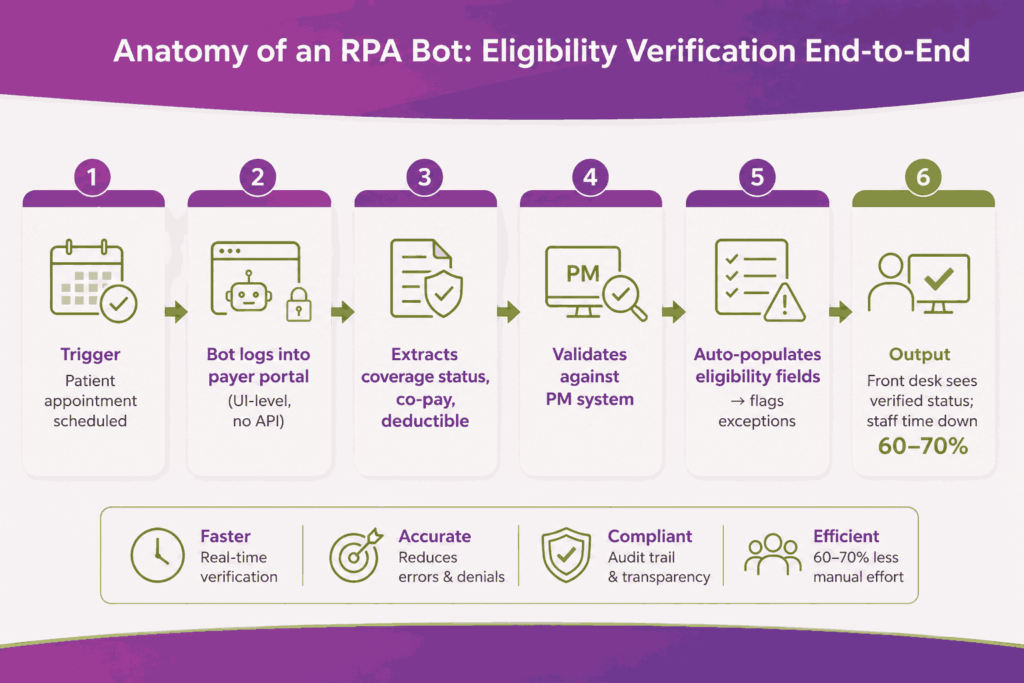
RPA bots automate this by logging into payer portals, extracting patient insurance status, coverage details, co-pay amounts, and deductible information, and then populating this data directly into the practice management (PM) system. This removes the need for manual portal checks and data entry.
Eligibility verification is the highest-frequency and lowest-complexity RPA use case in medical billing. Because it happens for nearly every patient encounter, even small automation gains scale quickly across high volumes, making it one of the fastest areas to generate ROI.
In practical terms, RPA reduces staff time spent per verification by around 60–70%. This allows billing teams to shift focus from repetitive checks to exception handling and higher-value revenue cycle tasks.
2. Prior Authorization Automation
Prior authorization automation is the use of RPA to streamline the process of requesting and managing payer approvals before services are delivered. It reduces the manual work involved in preparing, submitting, and tracking authorization requests.
RPA bots auto-populate prior authorization forms using data from EHR or practice management systems, submit them directly to payer portals, and continuously track authorization status updates. They also retrieve responses and update the billing system so staff can see approval or denial status in real time.
The impact is significant in turnaround time. What traditionally takes several days of manual coordination with payers can often be reduced to a few hours, depending on payer response speed and data completeness.
When exceptions occur, such as missing clinical documentation or complex medical necessity reviews, bots do not attempt to force completion. Instead, they escalate these cases to human reviewers with all relevant context pre-filled. This ensures faster resolution while keeping complex decisions under clinical or administrative oversight.
3. Charge Entry and Coding Assistance
Charge entry is the process of recording billable services, procedures, and diagnoses into the billing system so they can be submitted to payers for reimbursement. It ensures that clinical activity is accurately converted into billable claims.
RPA bots extract procedure codes (CPT) and diagnosis codes (ICD-10) from EHR documentation and automatically populate charge entry fields in the practice management or billing system. This reduces manual transcription of clinical data into billing records.
Before final entry, bots perform a coding validation step by cross-referencing CPT and ICD-10 combinations against NCCI (National Correct Coding Initiative) edits. This helps detect invalid or non-billable code pairings before claims are created.
This automation reduces missed charges caused by manual oversight and significantly lowers data entry errors. The result is more complete billing capture, fewer claim corrections, and improved overall revenue accuracy.
4. Claim Scrubbing and Submission
Claim scrubbing is the process of reviewing claims for errors, missing information, and payer rule violations before they are submitted for reimbursement. It ensures claims are accurate, complete, and compliant with payer requirements.
RPA bots automate this by checking all required fields, validating CPT and ICD-10 codes against payer-specific rules, confirming formatting standards, and then submitting claims electronically to clearinghouses or payer systems. This reduces the need for manual pre-submission review.
With automated scrubbing, practices can significantly improve claim accuracy, with many achieving up to 99% clean claim rates. Fewer errors at submission mean fewer rejections and faster reimbursements.
When a claim fails validation, bots do not discard it. Instead, they route it to a human review queue with detailed error annotations, such as missing modifiers, invalid code combinations, or demographic mismatches. This helps staff correct issues quickly without rechecking the entire claim manually.
5. Payment Posting and ERA Processing
Payment posting is the process of recording payer payments into the billing system and matching them to the correct patient accounts and claims. It ensures financial transactions are accurately reflected in the revenue cycle.
RPA bots automate this by parsing Electronic Remittance Advice (ERA) files, extracting payment details, matching line items to corresponding claims, posting payments into the practice management system, and applying contractual adjustments. They also flag discrepancies such as mismatched amounts or missing claim references.
In high-volume practices processing hundreds of ERAs daily, this automation delivers major time savings by eliminating manual reconciliation work. What once required large billing teams can be handled continuously by bots with consistent accuracy.
Bots also identify underpayments and overpayments during processing. These are automatically flagged for human review, along with supporting details such as expected reimbursement versus actual payment, allowing staff to quickly validate payer behavior and initiate corrections when needed.
6. Denial Management and Appeals
Denial management automation uses RPA to identify, categorize, and resolve denied insurance claims with minimal manual effort. It helps streamline the process of correcting errors, preparing appeals, and resubmitting claims for reimbursement.
RPA bots track denial patterns across payer responses, categorize denial codes (such as eligibility, coding, or authorization issues), and generate standardized appeal letters using claim data and supporting clinical documentation. They then resubmit corrected claims through clearinghouses or payer portals based on predefined rules.
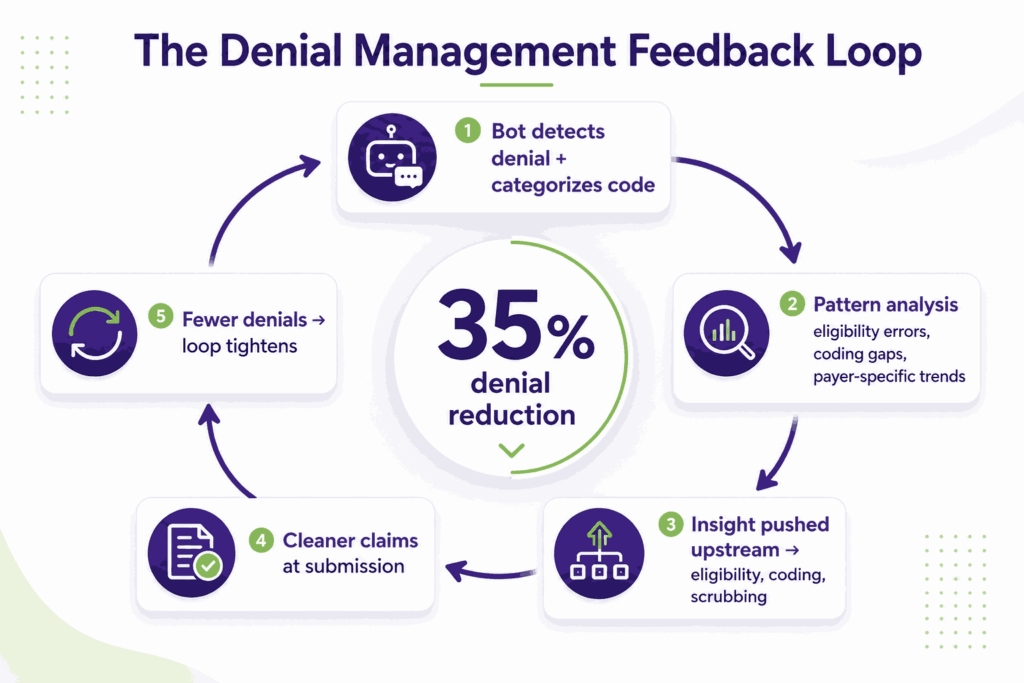
Organizations using RPA in denial workflows report up to a 35% reduction in overall denial rates. This improvement comes from both faster resolution of existing denials and fewer repeat errors during resubmission.
A key advantage is the feedback loop. Bots collect and analyze denial pattern data, which highlights recurring issues such as specific coding errors or payer-specific rejection trends. This insight is fed back into upstream processes like eligibility checks, coding validation, and claim scrubbing to prevent future denials before claims are submitted.
7. Accounts Receivable Follow-Up
Accounts receivable (A/R) follow-up is the process of tracking unpaid claims, checking their status, and ensuring timely reimbursement from payers. It focuses on reducing outstanding balances and improving cash flow.
RPA bots automate this by logging into payer portals, checking claim status, retrieving Explanation of Benefits (EOBs), and updating the billing system with the latest information. This removes the need for manual portal checks and repetitive status inquiries.
Bots apply prioritization logic to improve efficiency. They typically work high-dollar claims and older aging buckets first, ensuring that the most financially impactful claims are addressed before lower-value items.
This structured follow-up reduces days in A/R by accelerating claim resolution and follow-up cycles. It also improves overall collection rates by ensuring no claims are missed or delayed due to manual workload constraints.
8. Patient Statement Generation and Follow-Up
A patient statement is a summary of a patient’s financial responsibility after insurance has processed a claim. It shows what the insurance paid and what the patient still owes.
RPA automates this process by generating statements once insurance adjudication is complete. Bots pull finalized balances from the billing system, format statements, and distribute them through print, email, or patient portals based on patient preferences.
After delivery, RPA also manages follow-up communication. It triggers automated payment reminder sequences at defined intervals, helping reduce delays in patient payments without manual intervention from billing staff.
These bots are often integrated with online payment platforms, allowing patients to pay directly through secure links in statements or reminders. This improves collection speed and reduces friction in the payment process.
What are the Benefits of RPA in Medical Billing?
RPA improves medical billing performance by streamlining repetitive work, improving accuracy, accelerating reimbursements, and strengthening compliance across the revenue cycle.
- Increased Operational Efficiency
RPA reduces manual workload by automating high-volume billing tasks such as eligibility checks, claim submission, and payment posting, allowing processes to run continuously without delays. - Reduced Errors and Higher Clean Claim Rate
By following rule-based logic and validating data before submission, RPA minimizes human entry errors and helps practices achieve higher clean claim rates with fewer rejections. - Faster Revenue Cycle Turnaround
Automation speeds up key workflows like claims processing, denial resolution, and payment posting, reducing overall revenue cycle time and improving cash flow. - Measurable ROI Within 12–18 Months
Organizations typically see a return on investment within 12 to 18 months through reduced labor costs, fewer denied claims, and faster reimbursement cycles. - Staff Reallocation to Higher-Value Tasks
By removing repetitive administrative work, RPA allows billing staff to focus on exception handling, patient support, and complex revenue cycle issues. - HIPAA Compliance and Audit Trail
RPA systems maintain detailed logs of every action performed by bots, improving transparency, supporting audit requirements, and strengthening compliance with HIPAA regulations.
Increased Operational Efficiency
Operational efficiency gains refer to the improvement in how quickly and accurately billing workflows are completed after automation is introduced. It focuses on reducing manual effort while increasing throughput across revenue cycle tasks.
RPA delivers around a 40% increase in operational efficiency in medical billing environments. In addition, organizations report 61–70% staff time savings in mid-cycle workflows such as eligibility checks, claim handling, and payment posting, where repetitive tasks are most concentrated.
A key driver of this improvement is continuous processing. RPA bots operate 24/7 without fatigue, breaks, vacations, or shift limitations. This allows billing operations to run overnight and across peak volumes without bottlenecks, ensuring consistent productivity regardless of staffing constraints.
Reduced Errors and Higher Clean Claim Rate
Error reduction refers to minimizing mistakes in billing workflows by replacing manual data entry and validation with automated, rule-based processing. It ensures that claims are accurate, complete, and compliant before submission.
By eliminating manual entry errors and applying consistent validation rules, RPA helps improve clean claim rates up to 99%. Bots check required fields, verify coding accuracy, and enforce payer-specific rules before claims are submitted.
The downstream impact is significant. Fewer errors lead directly to fewer claim denials, which accelerates reimbursement cycles. It also reduces rework costs because billing staff spends less time correcting and resubmitting rejected claims, allowing more efficient use of operational resources.
Faster Revenue Cycle Turnaround
Faster revenue cycle turnaround refers to reducing the total time it takes for a patient encounter to move from service delivery to final reimbursement. It focuses on accelerating every step of the billing workflow, from claim creation to payment posting.
RPA can cut revenue cycle processing time by up to 80% by automating repetitive, time-sensitive tasks such as eligibility checks, claim submission, denial handling, and payment posting. By removing manual delays and queue bottlenecks, each stage of the cycle moves faster and more consistently.
This acceleration has a direct impact on days in A/R, which decreases as claims are processed and resolved more quickly. It also shortens time-to-payment, improving how fast revenue is realized after service delivery. As a result, cash flow becomes more predictable, with fewer delays caused by manual backlog or processing inconsistencies.
Measurable ROI Within 12–18 Months
ROI timeline refers to the period within which organizations recover their investment in RPA through cost savings, efficiency gains, and revenue improvements. In medical billing, ROI is typically realized progressively rather than all at once.
Organizations report up to 70% ROI within 12–18 months, with early returns often visible within 3–6 months as automation reduces manual workload and accelerates claims processing. These early gains usually come from labor savings and reduced rework before broader cycle improvements fully mature.
RPA ROI is calculated by combining multiple financial drivers. The main components include labor savings from reduced manual effort, revenue recovery from fewer denials, improved clean claim rates, and efficiency gains from faster processing cycles. These benefits are then offset against implementation costs such as software licensing, bot development, infrastructure setup, and ongoing maintenance.
Staff Reallocation to Higher-Value Tasks
Staff reallocation refers to shifting billing teams away from repetitive administrative work toward more complex, judgment-based revenue cycle activities. It happens when RPA takes over routine tasks that previously consumed most of their time.
By automating eligibility checks, claim processing, payment posting, and follow-ups, RPA frees staff to focus on higher-value work such as complex denial appeals, patient communication, payer issue resolution, and revenue optimization strategies. These are areas where human judgment and problem-solving are more important than repetitive data handling.
This shift also reduces overtime costs because fewer manual backlogs accumulate during peak billing periods. At the same time, employees experience improved job satisfaction since their roles move away from repetitive data entry and toward more meaningful, skill-based work with greater impact on revenue outcomes.
HIPAA Compliance and Audit Trail
Compliance benefits refer to how RPA strengthens regulatory adherence by ensuring billing processes are secure, traceable, and consistently executed according to defined rules. It reduces compliance risk by limiting manual handling of sensitive data.
RPA bots automatically generate detailed audit trails for every action they perform, including logins, data access, claim updates, and payment postings. This creates a complete, time-stamped record of activity that supports HIPAA compliance requirements and simplifies audit preparation by making all system interactions fully traceable.
RPA platforms also include built-in security controls such as encryption of data in transit and at rest, role-based access permissions, and user authentication layers. These safeguards ensure that only authorized users and bots can access sensitive patient information, reducing the risk of data breaches and improving overall compliance posture.
What are the Challenges of RPA in Medical Billing?
RPA in medical billing delivers strong efficiency gains, but its implementation comes with operational, technical, and organizational challenges that must be managed for long-term success.
- High Upfront Investment and Licensing Costs
Initial setup costs can be significant, including software licensing, bot development, infrastructure, and training before savings are realized. - Integration Complexity with Legacy Systems
Many healthcare organizations still rely on outdated EHR and billing systems, which can make seamless automation difficult without careful configuration at the interface level. - Staff Resistance and Change Management
Employees may resist automation due to fear of job displacement or changes in workflow, requiring structured training and transition planning. - HIPAA and Data Security Concerns
Handling protected health information requires strict compliance controls, encryption, and access management to avoid data privacy risks. - Bot Maintenance and Exception Handling
Bots require ongoing updates when payer rules, system interfaces, or workflows change, and exceptions must be properly routed to humans. - Workflow Complexity and Exception Rate
Highly variable or exception-heavy processes are harder to automate effectively, reducing efficiency gains and increasing dependency on human oversight.
High Upfront Investment and Licensing Costs
Cost challenges refer to the significant initial financial outlay required to implement RPA in a medical billing environment. These costs are incurred before measurable efficiency gains are fully realized.
Upfront expenses typically include software licensing fees, implementation and configuration services, change management efforts, and staff training to support adoption. In many cases, organizations also invest in process redesign to ensure workflows are suitable for automation.
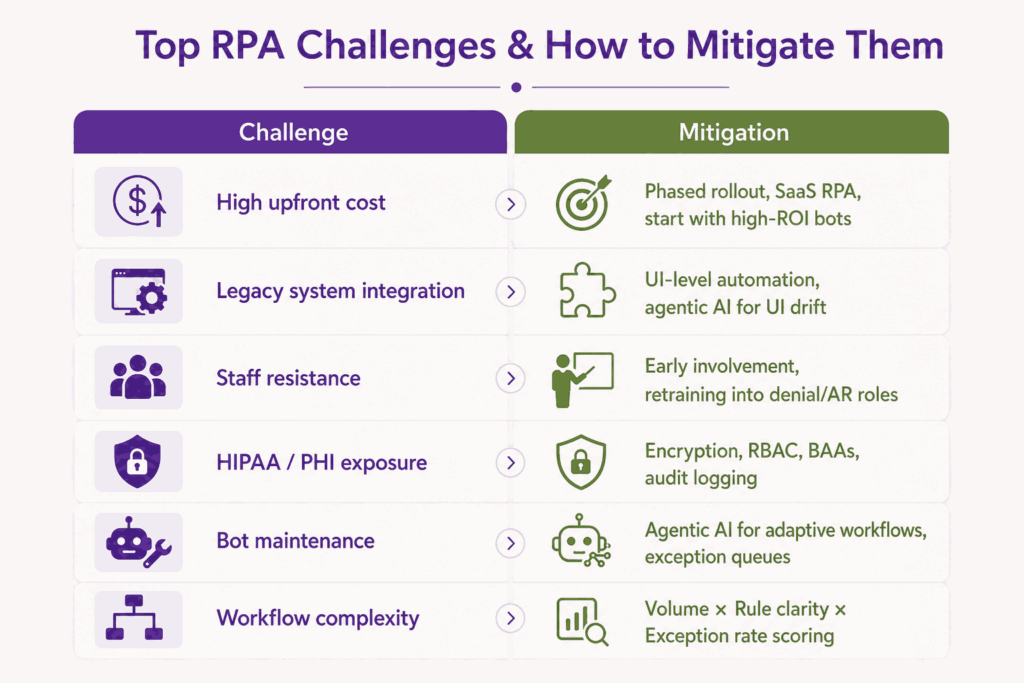
This can be a barrier for smaller practices with limited cash flow, especially when ROI is not immediate. However, costs can be managed through phased rollouts that start with high-impact use cases, adopting SaaS-based RPA models to reduce infrastructure expenses, and gradually scaling automation as savings begin to materialize.
Integration Complexity with Legacy Systems
Integration complexity refers to the challenges of deploying RPA across outdated or non-standard healthcare systems that were not designed for automation. It becomes a barrier when systems lack consistency or modern interoperability features.
Many medical billing environments rely on legacy EHR and practice management systems, as well as payer portals with inconsistent interfaces and proprietary billing platforms. Since RPA operates through the user interface rather than direct system integration, bots must be carefully configured for each system’s layout and workflow, which increases setup effort and fragility.
A key maintenance challenge occurs when payer portal interfaces change. Even minor updates to screen layouts, button placements, or field structures can break bot workflows. Before agentic AI capabilities, these changes often required manual bot reconfiguration or redeployment, creating ongoing maintenance overhead for IT and automation teams.
Staff Resistance and Change Management
Staff resistance and change management refer to the human and organizational challenges that arise when RPA is introduced into existing medical billing workflows. It focuses on how employees react to automation and how organizations guide the transition.
Common concerns include fear of job displacement, disruption of established workflows, and reduced control over daily tasks. These concerns can slow adoption if not addressed early, especially in teams heavily dependent on manual billing processes.
Effective change management reduces resistance by involving staff early in the automation design process, communicating clearly about how roles will evolve, and emphasizing that RPA removes repetitive work rather than replacing people. Retraining programs help shift employees into higher-value roles such as denial management, revenue analysis, and patient communication, making adoption smoother and more sustainable.
HIPAA and Data Security Concerns
Security concerns refer to the risks associated with automating workflows that involve Protected Health Information (PHI) across multiple healthcare systems. Since RPA bots access sensitive patient and financial data, improper controls can increase exposure risk if not properly secured.
These risks arise when bots move between EHR systems, billing platforms, and payer portals, all of which contain PHI. Without strong safeguards, automated access could lead to unauthorized data exposure, credential misuse, or compliance violations under HIPAA requirements.
To mitigate these risks, RPA deployments require strict security controls. This includes end-to-end encryption of data in transit and at rest, role-based access management to restrict bot and user permissions, and detailed audit logging of all bot activity. In addition, healthcare organizations must establish Business Associate Agreements (BAAs) with RPA vendors to ensure legal accountability and HIPAA compliance across all handled data.
Bot Maintenance and Exception Handling
Bot maintenance and exception handling refer to the ongoing effort required to keep RPA systems functioning correctly when processes, systems, or rules change. It ensures bots continue to operate accurately and exceptions are properly managed instead of causing workflow breakdowns.
Traditional RPA bots are sensitive to changes in system interfaces. When payer portals update layouts, rename fields, or modify navigation paths, bots can fail because they rely on fixed UI elements. These changes require manual updates or reconfiguration of the bot logic, which creates ongoing maintenance work.
In 2026, agentic AI reduces this limitation by allowing bots to interpret UI changes and adjust workflows more dynamically without full redevelopment. This improves resilience when systems evolve, especially in payer environments that change frequently.
Even with advanced automation, ongoing oversight is still required. Organizations must monitor bot performance, manage error queues where failed transactions are captured, and maintain clear human escalation protocols. Complex or ambiguous cases are routed to staff to ensure accuracy and compliance while maintaining workflow continuity.
Workflow Complexity and Exception Rate
Workflow complexity and exception rate refer to how often a process deviates from standard rules and requires human judgment. High exception rates make automation harder because bots depend on consistent, predictable inputs.
RPA performs best in rule-based workflows where decisions are straightforward, and exceptions are rare. When processes involve frequent variations such as missing data, inconsistent payer responses, or complex clinical scenarios. Pure RPA becomes less effective and requires intelligent automation or human oversight to handle edge cases.
To evaluate suitability for automation, organizations typically use a simple assessment framework: volume, rule clarity, and exception rate. High-volume, clearly defined, and low-exception workflows score highest for RPA suitability, while low-volume or highly variable processes are better handled with human intervention or AI-assisted automation.
How to Implement RPA in Medical Billing?
To implement RPA in medical billing, organizations need a structured approach that moves from identifying the right processes to scaling automation across the revenue cycle while continuously monitoring performance.
- Identify and Prioritize Automation Candidates
Assess billing workflows to find high-volume, rule-based, and low-exception tasks such as eligibility verification, claim submission, and payment posting. - Select an RPA Platform
Choose an RPA solution that fits your technical environment, security requirements, and scalability needs, with support for healthcare systems and HIPAA compliance. - Design and Build Bot Workflows
Map existing processes in detail, define rules, and configure bots to interact with EHR, PM systems, and payer portals through structured workflows. - Pilot, Measure, and Scale
Start with a controlled pilot on a single use case, measure performance improvements like time savings and error reduction, then expand automation to additional workflows. - Monitor, Maintain, and Optimize
Continuously track bot performance, handle exceptions, update workflows when systems change, and optimize processes to improve efficiency and ROI over time.
1. Identify and Prioritize Automation Candidates
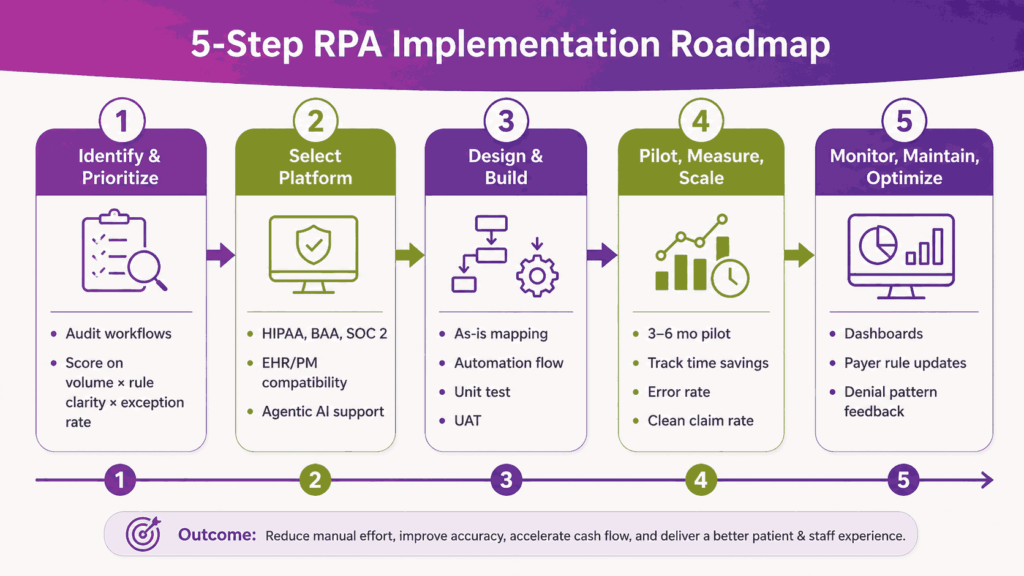
This step involves auditing end-to-end billing workflows to identify tasks that are repetitive, high-volume, and rule-based. The goal is to pinpoint processes where manual effort is high, but decision-making is predictable, such as eligibility checks, claim scrubbing, and payment posting.
Once workflows are mapped, organizations prioritize candidates using a simple matrix that evaluates ROI potential, implementation complexity, and business impact. High-ROI, low-complexity, and high-impact processes are selected first because they deliver faster value with lower deployment risk.
Most implementations start with eligibility verification or claim scrubbing. These use cases are ideal first-bot candidates because they are frequent, structured, and directly impact downstream outcomes like denial rates and clean claim performance.
2. Select an RPA Platform
Selecting an RPA platform involves evaluating vendors based on their ability to support healthcare billing workflows securely, efficiently, and at scale. Common platforms include UiPath, Automation Anywhere, Blue Prism, and healthcare-focused solutions like Olive AI and CareCloud RPA.
Evaluation typically focuses on several key criteria. These include HIPAA compliance, compatibility with EHR and practice management systems, scalability for high-volume billing environments, support for advanced capabilities like agentic AI, and overall pricing structure (licensing vs. subscription models). Healthcare organizations also assess how easily the platform handles payer portals and legacy system interactions without requiring heavy customization.
Security and compliance are critical in vendor selection. Platforms must support Business Associate Agreements (BAAs) to legally handle protected health information, and SOC 2 certification is often required to validate strong security controls, including data protection, access management, and audit logging.
3. Design and Build Bot Workflows
Designing and building bot workflows starts with documenting the current (“as-is”) billing process step by step. This includes mapping every action performed by staff, from data entry and payer interactions to approvals and exception handling. Once the workflow is fully mapped, it is redesigned into a structured automation flow that includes decision points, rule-based logic, exception paths, and error handling steps so the bot can operate consistently across scenarios.
The development process follows a clear pipeline: build, unit test, user acceptance testing (UAT), and pilot deployment. In the build phase, bots are configured based on the designed workflow. Unit testing validates individual bot actions, while UAT ensures the workflow performs correctly in real-world conditions with actual billing data. A controlled pilot is then used to test performance at scale before full deployment.
Billing subject matter experts (SMEs) play a critical role throughout this process. They validate that bot logic aligns with payer-specific rules, coding requirements, and operational policies. Their input ensures that automation reflects real billing scenarios accurately and reduces the risk of claim errors or compliance issues after deployment.
4. Pilot, Measure, and Scale
This step involves deploying one or two RPA bots in a controlled environment to validate performance before full rollout. The pilot focuses on a limited set of workflows, such as eligibility verification or claim scrubbing, to reduce risk and measure real-world impact.
During the pilot phase, key performance indicators (KPIs) are tracked, including time savings, error rate reduction, clean claim rate improvement, and denial reduction. These metrics help determine whether the automation is delivering expected operational and financial benefits.
The pilot typically runs for 3–6 months, allowing enough time to observe performance across different billing cycles and payer behaviors. During this period, workflows are continuously refined based on exception logs, edge cases, and user feedback to improve accuracy and stability.
Once the pilot demonstrates consistent results, scaling begins in a phased manner. Additional workflows are added incrementally, followed by expansion to more payers and billing scenarios. This controlled scaling approach ensures stability while gradually increasing automation coverage across the revenue cycle.
5. Monitor, Maintain, and Optimize
This stage focuses on continuously tracking RPA performance to ensure bots operate reliably and deliver expected outcomes. Organizations monitor bots using dashboards that track key metrics such as throughput, error rate, exception rate, and uptime to identify performance issues early and maintain operational stability.
Maintenance is performed on a recurring cadence to account for changes in the healthcare environment. This includes updates triggered by payer portal interface changes, EHR or billing system patches, and evolving payer rules or coding requirements. Without regular maintenance, even stable workflows can degrade over time.
Optimization is driven by continuous feedback loops. Denial pattern analysis helps identify upstream issues in eligibility, coding, or claim submission, while bot performance data highlights bottlenecks or recurring exceptions. These insights are used to refine workflows, improve automation logic, and gradually increase efficiency and accuracy across the revenue cycle.
How does RPA in medical billing connect to other revenue cycle and billing workflows?
RPA acts as a cross-cutting automation layer across the entire revenue cycle, connecting fragmented billing and clinical systems into one continuous workflow. It operates from patient registration through final payment posting, ensuring that data moves consistently and accurately between each stage of the medical billing process within a billing framework.
In practice, RPA links upstream clinical documentation with downstream financial workflows. It extracts structured and unstructured data from EHR systems, validates it against payer and billing rules, and passes it into claim creation, scrubbing, submission, and payment posting processes. This creates a direct operational bridge between clinical activity and financial reimbursement, which is a core requirement in modern billing services delivery.
Because it sits across multiple systems rather than inside a single application, RPA amplifies the efficiency of every workflow it touches. Eligibility verification improves registration accuracy, clean claim submission reduces downstream denials, and automated payment posting accelerates reconciliation. The result is a connected revenue cycle where improvements in one stage positively impact all subsequent stages, reducing delays, rework, and revenue leakage.
For organizations looking to modernize, deploying medical billing services with RPA creates an enterprise-wide automation layer that protects cash flow and scales administrative output without a corresponding spike in headcount.
How does RPA automate the claim form submission process?
RPA automates the claim form submission process by extracting patient, provider, and encounter data from EHR and practice management systems, then using that data to automatically populate CMS-1500 (professional) and UB-04 (institutional) claim forms.
Once the data is pulled, bots validate required fields such as patient demographics, CPT/ICD-10 codes, modifiers, payer information, and service details to ensure completeness and compliance with payer rules. After validation, the claims are formatted and submitted electronically through EDI (Electronic Data Interchange) channels or directly via clearinghouses.
This automation significantly reduces claim form errors that typically occur with manual entry, such as missing fields, incorrect codes, or mismatched patient details. As a result, organizations see fewer rejections at the submission stage and a higher rate of first-pass clean claims, improving overall billing efficiency.
How does RPA improve the clearing house transmission process?
RPA improves the clearing house transmission process by automating pre-submission validation, formatting, and real-time monitoring of claim files before and after they are sent within a clearing house workflow in medical billing operations.
Bots pre-validate claims against clearing house edit rules to catch errors such as missing data, invalid codes, or formatting issues before transmission. They also auto-correct common formatting problems (such as field alignment or required segment structure) to reduce rejection risk at the clearing house stage.
After submission, RPA monitors clearing house acknowledgment reports (TA1, 999, 277 responses) to identify rejections or warnings. When issues are detected, bots can immediately flag them or trigger predefined correction workflows, reducing manual follow-up delays.
This enables faster clearing house turnaround because rejections are handled in near real time instead of waiting for manual review cycles. As a result, claims move more smoothly from submission to acceptance, improving first-pass acceptance rates and accelerating downstream reimbursement in the clearing house process.
How does RPA interact with payment posting workflows?
RPA interacts with payment posting workflows by automatically processing electronic payment data and updating billing systems with accurate financial transactions.
Bots parse 835/ERA (Electronic Remittance Advice) files, extract payment details, and match each line item to the corresponding claim in the practice management system. They then apply contractual adjustments, post payer payments, and assign patient responsibility amounts based on predefined rules.
When discrepancies occur, such as missing claim matches, underpayments, or unexpected adjustments, bots flag these variances for human review with supporting details to speed up resolution.
This automation significantly reduces manual payment posting errors, especially in high-volume practices handling large volumes of daily ERA files. It ensures faster, more accurate reconciliation while minimizing the risk of misapplied payments and data entry mistakes.
How does RPA support medical billing vs medical coding accuracy?
RPA supports medical billing and coding accuracy by validating coded clinical data against payer and regulatory rules before claims are submitted.
RPA bots cross-reference CPT and ICD-10 codes against NCCI edits, LCD/NCD policies, and payer-specific billing rules to detect invalid code combinations, missing modifiers, and non-compliant billing patterns. This helps catch coding errors that human billers or coders may overlook during high-volume processing.
By enforcing these validations before claim submission, RPA bridges the gap between medical coding accuracy and billing execution quality. It ensures that correctly coded clinical information is translated into clean, payable claims, reducing downstream rework, denials, and reimbursement delays.
How does RPA enhance EMR software billing integration?
RPA enhances EMR software billing integration by acting as a bridge between clinical systems and billing platforms when native connectivity is limited or unavailable.
RPA bots extract clinical data such as diagnoses, procedures, and encounter details from EMR systems and then populate billing software fields through UI automation. This allows information to flow from documentation to billing, even when systems do not support direct API integration or structured data exchange.
This is especially valuable for practices using legacy EMRs that cannot be easily replaced due to cost, disruption risk, or operational constraints. Instead of rebuilding infrastructure, RPA enables these systems to connect indirectly with modern billing workflows, improving data transfer speed, reducing manual entry, and enhancing overall billing accuracy.