Colorado medical billing laws sit across four bodies of authority. Title 10 of the Colorado Revised Statutes governs commercial carriers. Title 25.5 and 10 CCR 2505-10 govern Medicaid. Title 7 CCR 1101-3 governs workers’ compensation billing.
The financial exposure is documented. A 2022 CFPB report cited by the Colorado Attorney General found Coloradans held more than $1.3 billion in medical debt. More than 12% of Coloradans had medical debt in collections.
Colorado also enforces deadlines in both directions. Carriers face a 20% penalty for claims unresolved after 90 days. Providers face a 365-day Medicaid filing limit and a 120-day workers’ compensation limit. This guide covers each statute and regulation, the deadlines each one sets, and the controls that keep your practice compliant.

Why Is Colorado Medical Billing Compliance Different?
Colorado billing compliance is different because most state rules reach only state-regulated plans. Three separate agencies enforce the rest. Your practice needs to know which regulator governs each claim before applying any deadline.
Which Health Plans Do Colorado Billing Laws Cover?
Colorado billing laws cover plans regulated by the Colorado Division of Insurance. This excludes self-funded employer plans governed by the federal Employee Retirement Income Security Act (ERISA).
The distinction changes which rules apply:
- State-regulated Plans: Colorado prompt pay, recoupment limits, arbitration, and prior authorization rules apply.
- Self-funded ERISA Plans: The federal No Surprises Act and federal independent dispute resolution apply instead.
- Medicaid and Workers’ Compensation: Separate rule sets apply, with separate deadlines and appeal paths.
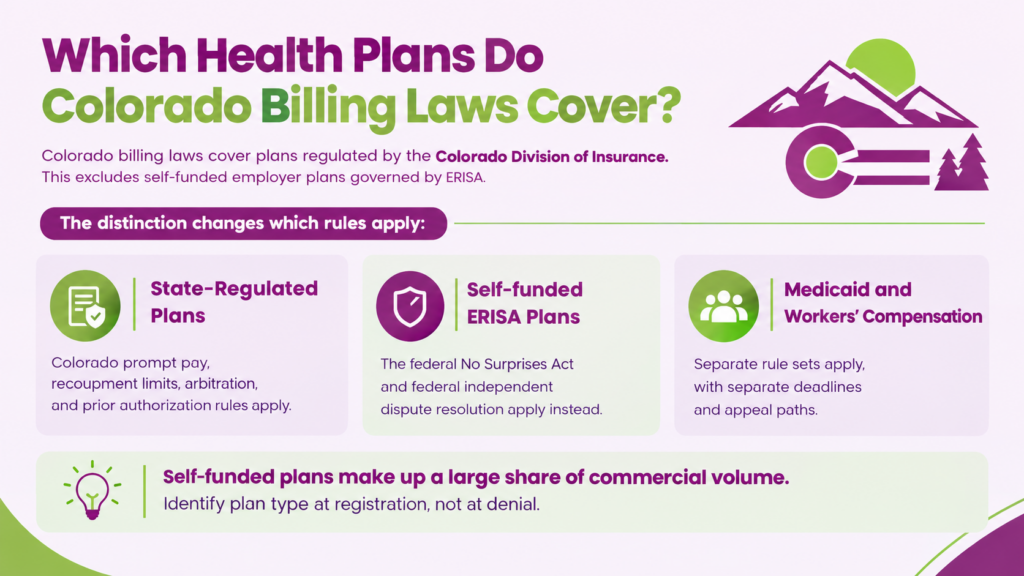
Self-funded plans make up a large share of commercial volume. Identify plan type at registration, not at denial.
Which Agencies Enforce Colorado Billing Laws?
Four agencies enforce Colorado billing rules. Each one handles a different payer category:
| Agency | What It Enforces | Applies To |
|---|---|---|
| Division of Insurance | Prompt pay, recoupment, arbitration, prior authorization | State-regulated commercial carriers |
| Health Care Policy and Financing (HCPF) | Timely filing, audits, overpayment recovery | Health First Colorado (Medicaid) |
| Division of Workers’ Compensation | Rules 16, 17, and 18 | Workers’ compensation payers and providers |
| Attorney General | Deceptive trade practices, Medicaid False Claims Act | Providers, facilities, and debt collectors |
Senate Bill 23-093 added a fifth layer of exposure. Violating Colorado billing, surprise billing, or balance billing provisions is a deceptive trade practice, which opens Attorney General enforcement.
What Are Colorado’s Prompt Pay Rules for Health Insurers?
Colorado’s prompt pay law requires carriers to pay, deny, or settle clean claims within 30 days for electronic submissions and 45 days for all other submissions. The rule sits in C.R.S. § 10-16-106.5.
What Counts as a Clean Claim in Colorado?
A clean claim is a claim submitted on the uniform claim form adopted under C.R.S. § 10-16-106.3, with every required field completed correctly and every required document attached.
Two conditions disqualify a claim:
- Missing Information: a claim requiring additional information is not a clean claim.
- Premium Delinquency: expenses incurred during a period of delinquent premiums fall outside the clean claim definition.
Receipt dates matter for the clock. Electronic claims are presumed received on the date of electronic verification, and carriers must confirm receipt within one business day.
How Fast Must Carriers Pay, Deny, or Request More Information?
Carriers face four separate deadlines under § 10-16-106.5. The following table lists each one:
| Claim Stage | Deadline | Who Acts |
|---|---|---|
| Clean claim, electronic | 30 calendar days | Carrier pays, denies, or settles |
| Clean claim, non-electronic | 45 calendar days | Carrier pays, denies, or settles |
| Request for additional information | 30 calendar days from receipt | Carrier explains what is needed |
| Provider response to that request | 30 calendar days | Provider submits information |
| All other claims, absent fraud | 90 calendar days | Carrier pays, denies, or settles |
A carrier may deny a claim when the provider misses the 30-day information deadline. The claim remains eligible for resubmission or appeal.
What Interest and Penalties Apply to Late Claims in Colorado?
Late clean claims carry 10% annual interest on the total amount allowed. Interest accrues from the date payment was due. A second penalty applies at 90 days.
A carrier that fails to pay, deny, or settle a claim within 90 days owes a penalty equal to 20% of the total amount allowed. The penalty applies on the 91st day. Carriers may pay penalties quarterly or once aggregate penalties for a provider exceed $10.
How Do Charge Audits Affect Hospital Claim Payments?
A carrier planning a prospective charge audit must still pay most of the claim by day 45. The amounts differ by network status:
- Participating Institutional Providers: At least 85% of the contracted rate, less patient cost sharing.
- Nonparticipating Institutional Providers: At least 60% of the amount due, less patient cost sharing.
- Audit Completion: The carrier finishes the audit and pays any balance by day 90.
A charge audit checks whether the medical record documents the services billed. It is not a medical necessity review, and institutional providers must give reasonable record access within the audit window.
When Can Carriers Adjust or Recoup Paid Claims in Colorado?
Colorado treats all paid claims as final unless the carrier adjusts them within the windows in C.R.S. § 10-16-704(4.5). The standard window is 12 months. Two categories run on different clocks.
What Is Colorado’s 12-Month Claim Adjustment Rule?
Claim adjustments follow the period set in the provider contract, and that period cannot exceed 12 months from the date of the original explanation of benefits. Where no contract exists, the 12-month limit applies directly.
In addition, the window is symmetrical. The adjustment period must be the same length for the provider and the carrier, so your practice has the same lookback the payer does.
Which Adjustments Have Different Deadlines?
Two adjustment categories fall outside the 12-month rule. The following table compares all three windows:
| Adjustment Type | Deadline | Measured From |
|---|---|---|
| Standard claim adjustment | 12 months | Date of original explanation of benefits |
| Risk assumption or risk sharing settlement | 6 months | Last date of service in the reconciled period |
| Coordination of benefits with Medicare or Medicaid | 36 months | Date of service |
The 36-month coordination of benefits window creates the longest exposure. Practices with heavy Medicare secondary volume carry recoupment risk three years out.
When Are Retroactive Denials Prohibited in Colorado?
Colorado bars retroactive denials in two specific situations:
- Verified Eligibility: A carrier cannot retroactively adjust a claim based on eligibility when the provider verified eligibility within 2 business days before delivering services.
- Preauthorized Treatment: Benefits cannot be retrospectively denied after preauthorization, except for fraud and abuse.
The eligibility protection has one exception. It does not apply when the policyholder notified the carrier of the individual’s ineligibility under § 10-16-103.5(1). Document every eligibility check with a date and reference number.
What Must a Colorado Recoupment Notice Include?
A recoupment notice must contain a complete, specific explanation of the adjustment plus information about the carrier’s provider dispute resolution process. Where the adjustment creates patient liability, the carrier notifies the patient too.
Coordination of benefits adjustments carry an extra duty. On the provider’s request, the carrier supplies all available information about the party responsible for payment. Practices comparing top medical billing companies in Colorado should test how each one handles recoupment tracking.
How Does Colorado Protect Patients From Surprise and Balance Bills?
Colorado protects patients through House Bill 19-1174, which created state surprise billing rules, and House Bill 22-1284, which aligned those rules with the federal No Surprises Act. The protections appear in C.R.S. § 10-16-704.
Which Services Are Protected Under Colorado and Federal Law?
Protection applies to emergency services and to covered ancillary services delivered by out-of-network providers at in-network facilities. Section 10-16-704(19) defines ancillary services as:
- Diagnostic services, including radiology and laboratory.
- Emergency medicine, anesthesiology, pathology, radiology, and neonatology.
- Services from assistant surgeons, hospitalists, and intensivists.
- Any service where no in-network provider can furnish the needed care at the facility.
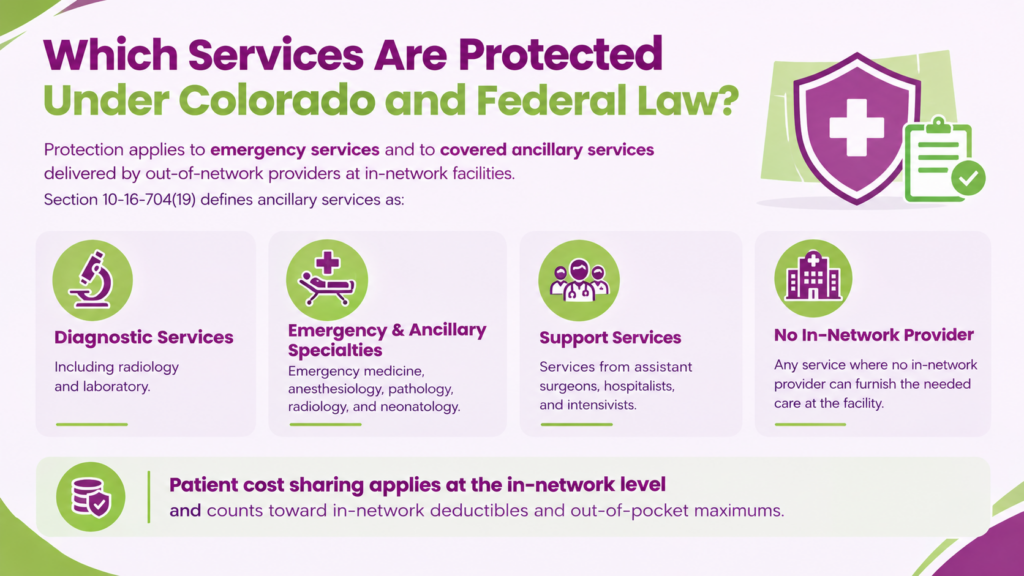
Patient cost sharing applies at the in-network level and counts toward in-network deductibles and out-of-pocket maximums. Colorado’s approach differs from Florida’s state-level billing statutes, which run their own balance billing bans alongside the federal law.
How Much Must Carriers Pay Out-of-Network Providers in Colorado?
Colorado sets statutory payment floors rather than leaving rates to negotiation. The rates differ for professionals and facilities:
| Payment Situation | Carrier Must Pay the Greater Of |
|---|---|
| Out-of-network Provider at an In-network Facility | 110% of the carrier’s median in-network rate, or the 60th percentile of prior-year in-network rates from the all-payer claims database |
| Emergency Services at out-of-network Facility | 105% of the carrier’s median in-network facility rate, or the prior-year median from the all-payer claims database |
| Denver Health and Hospital Authority Facilities | The carrier’s median rate, 250% of Medicare, or the all-payer database median |
Payment at these rates counts as payment in full, apart from patient cost sharing. Carriers pay out-of-network providers directly. Nothing stops a carrier and provider from negotiating an independent rate first.
When Can Patients Consent to Out-of-Network Billing?
Patients can waive protection only through the notice and consent process in C.R.S. § 12-30-112 or § 25-3-121, matching federal No Surprises Act requirements. Consumer advocates note that providers must supply the paperwork at least 72 hours in advance.
Consent does not apply to ancillary services on the protected list. Post-stabilization services also stay protected unless the patient can travel safely, receives proper notice, and gives informed consent.
Are Ground Ambulance Bills Protected in Colorado?
Ground ambulance bills carry a narrower protection. Section 10-16-704(5.5)(d) excludes ambulance service agencies from the emergency payment rules that cover other out-of-network care.
The commissioner adopts a separate payment method for private ambulance agencies. That method must hold consumers harmless apart from cost sharing and rest on a cost-based model with direct payment. Publicly funded fire agencies fall outside it.
House Bill 25-1088 would have banned out-of-network ambulance balance billing and set rates at local levels or 325% of Medicare. The Governor vetoed the bill on May 29, 2025, so the gap remains open.
How Does Out-of-Network Arbitration Work in Colorado?
Colorado runs its own binding arbitration process for out-of-network payment disputes under C.R.S. § 10-16-704(15). The Division of Insurance appoints the arbitrator. Self-funded ERISA plans use federal independent dispute resolution instead.
Step 1: Who Can File for Arbitration, and by When?
A provider or health care facility files when it believes payment was insufficient given the complexity and circumstances of the services. The filing deadline is 90 days after receiving payment for that claim.
The request goes to both the commissioner and the carrier. Missing the 90-day window forfeits the state arbitration path.
Step 2: What Happens at the Informal Settlement Teleconference?
The commissioner may arrange an informal settlement teleconference within 30 days of the arbitration request. The teleconference happens only when the carrier and the provider both request it.
The parties report the outcome to the commissioner. After notice that the teleconference failed, the commissioner appoints an arbitrator and notifies both sides.
Step 3: How Are Final Offers Submitted?
Each party submits a written final offer and supporting argument within 30 days after the commissioner appoints the arbitrator. Qualified arbitrators must meet three standards:
- Independence: no affiliation with any carrier, facility, provider, or their professional associations.
- No Conflicts: no personal, professional, or financial conflict with any party.
- Relevant Experience: documented experience in health care billing and reimbursement rates.
Step 4: How Does the Arbitrator Decide?
The arbitrator selects one of the two submitted amounts, with no authority to split the difference. The written decision is due within 45 days of appointment and binds both parties. The arbitrator weighs the circumstances and complexity of the case, including:
- The provider’s training, education, experience, and specialization.
- Any previously contracted rate, when a contract with the carrier ended or expired within the prior year.
When the decision requires additional payment, the carrier pays under the prompt pay rules in § 10-16-106.5. The carrier cannot recalculate the patient’s cost sharing based on the award.
Step 5: Who Pays Colorado Arbitration Costs?
The party whose final offer the arbitrator rejects pays the arbitrator’s fees and expenses. Parties who settle after appointment but before the decision split the costs equally unless they agree otherwise.
This loser-pays structure raises the cost of a weak submission. Build the offer around documented complexity and comparable rates before filing.
What Did Senate Bill 26-017 Change in 2026?
Senate Bill 26-017 requires carriers to send a remittance advice with every payment to a provider. The Governor signed the act on May 28, 2026, and it took effect August 12, 2026. Each remittance advice must identify two things:
- Whether the associated health benefit plan is state-regulated
- Whether payment covers services from an out-of-network provider or facility
The remittance advice must also state the carrier’s median in-network reimbursement rate for out-of-network claims. That figure is the benchmark providers need when weighing an arbitration filing.
What Are Colorado’s Self-Pay Estimate and Price Transparency Rules?
Colorado caps how far a self-pay bill can exceed the estimate the provider gave. The rule sits in C.R.S. § 25-49-106 and applies on top of the federal Good Faith Estimate.
How Far Can a Final Bill Exceed a Colorado Self-Pay Estimate?
The final cost cannot exceed the self-pay estimate by more than 15% or $400, whichever is less. House Bill 25-1317, signed June 4, 2025, corrected the earlier statutory language and clarified that the $400 figure caps the overage, not the total charge.
Two conditions modify the cap:
- Emergencies and Unforeseen Circumstances: the final cost may exceed the estimate by more than 15% or $400, and the “whichever is less” language does not apply.
- Deceptive Trade Practice: violating the self-pay estimate provisions triggers Attorney General enforcement under § 6-1-105.
A patient requests the estimate from the billing or patient services staff representing the provider or facility. Build a documented estimate workflow before the first self-pay visit of the day.
How Does the Federal Good Faith Estimate Fit In?
The federal Good Faith Estimate runs in parallel with Colorado’s self-pay estimate rule. Under the No Surprises Act, uninsured and self-pay patients receive a written estimate of expected charges, including related tests, drugs, equipment, and facility fees.
A patient can dispute a federal estimate when the bill exceeds it by $400 or more. Your practice satisfies both rules with one estimate only when the document meets the stricter Colorado threshold.
Can Hospitals Collect If They Violate Price Transparency Rules?
No. House Bill 22-1285, signed June 8, 2022, bars hospitals from pursuing collection actions while they are out of compliance with federal hospital price transparency requirements.
Colorado passed the law after the Centers for Medicare and Medicaid Services issued its first price transparency penalties. Hospital revenue cycle teams verify posted machine-readable files and shoppable service lists before any account moves to collections.
What Are Colorado’s Prior Authorization Rules?
Colorado sets prior authorization deadlines in C.R.S. § 10-16-112.5 and deems requests granted when carriers miss them. House Bill 24-1149 added transparency and exemption requirements that took effect January 1, 2026.
How Fast Must Carriers Decide Prior Authorization Requests?
Carriers and private utilization review organizations face two decision windows. The following table shows each deadline and the deemed-approval trigger:
| Request Type | Carrier Deadline | Result of Missing It |
|---|---|---|
| Non-urgent Service | 5 business days from receipt | Request deemed granted |
| Non-urgent, After Additional Information | 5 business days from receipt of that information | Request deemed granted |
| Urgent Service | 2 business days, no more than 72 hours | Request deemed granted |
| Urgent, After Additional Information | 2 business days, no more than 72 hours | Request deemed granted |
Deemed approval has one provider-side condition. When a carrier asks for more information, the provider submits it within 2 business days. Missing that 2-day window removes the deemed-approval protection.
How Long Does a Colorado Prior Authorization Last?
An approved prior authorization stays valid for at least one calendar year and continues for the full authorized course of treatment. A coverage or criteria change does not affect a patient who received authorization before the change, for the rest of the plan year.
Five situations end that protection:
- Approval obtained through fraud
- Services never performed
- Services that do not match what the carrier authorized
- Coverage that ended on or before the date of service
- Benefit maximums reached on or before the date of service
What Did House Bill 24-1149 Change in 2026?
House Bill 24-1149 added public reporting and provider exemption requirements. Carriers now post approval and denial data on a public-facing site, broken out by provider specialty, medication or procedure, reason for denial, and denials overturned on appeal.
The law also created gold-card style alternatives. A carrier may exempt a provider with at least an 80% prior authorization approval rate over the preceding 12 months. Carriers reexamine that status at least annually and inform the provider of the data used.
Colorado Insurance Regulation 4-2-101 sets the reporting templates and took effect January 1, 2026. Front-end patient benefits and eligibility verification catches authorization requirements before scheduling.
Which Rules Govern Prescription Drug Prior Authorization?
Prescription drug prior authorization follows C.R.S. § 10-16-124.5 and Colorado Insurance Regulation 4-2-49, not the service deadlines above. Amended Regulation 4-2-49 took effect March 30, 2025.
The drug rule requires a standardized request form, set processing timelines for urgent and non-urgent requests, and an exception process for non-formulary drugs in non-grandfathered individual and small group plans.
Must Colorado Insurers Pay Telehealth at In-Person Rates?
Yes. Colorado requires carriers to reimburse participating providers for telehealth on the same basis as the same service delivered in person. The requirement appears in C.R.S. § 10-16-123.
What Does Colorado’s Telehealth Payment Parity Require?
Payment parity covers diagnosis, consultation, and treatment delivered through telehealth by a treating or consulting participating provider. Three related rules apply:
- Cost sharing: telehealth copayments, coinsurance, and deductibles cannot exceed the in-person amounts for the same service by the same provider.
- Annual maximums: carriers cannot impose a telehealth-specific dollar maximum.
- Transmission costs: carriers include reasonable compensation to the originating site, excluding costs for care delivered to a patient’s home or private residence.
Which Telehealth Restrictions Are Carriers Barred From Imposing?
Colorado bars carriers from imposing four restrictions on telehealth coverage:
- Requiring in-person contact for services appropriately delivered through telehealth
- Limiting which HIPAA-compliant technologies a provider uses, including audio or live video
- Requiring a previously established patient-provider relationship for medically necessary telehealth
- Adding certification, location, or training requirements as a condition of reimbursement
Providers do not document a barrier to in-person care to trigger coverage. A provider still decides when telehealth is inappropriate for a patient.
Does Telephone-Only Care Qualify for Reimbursement in Colorado?
No, with one exception. A plan is not required to pay for consultation by telephone or facsimile unless the consultation runs through HIPAA-compliant interactive audio-visual communication or a HIPAA-compliant application on a cellular telephone.
The parity rules also exclude short-term travel, accident-only, limited or specified disease, and individual conversion policies. Medicare-eligible coverage falls outside them too.
What Payer Contracting Protections Do Colorado Providers Have?
Colorado gives providers two contracting protections that directly affect revenue: credentialing deadlines in C.R.S. § 10-16-705.7 and payment method rules in C.R.S. § 10-16-121.3.
How Fast Must Carriers Credential Physicians in Colorado?
Carriers must conclude credentialing within 60 calendar days after receiving a complete application. Three earlier deadlines apply first:
| Stage | Carrier Deadline |
|---|---|
| Written or Electronic Receipt of Application | 7 calendar days |
| Notice That an Application is Incomplete | 10 calendar days |
| Credentialing Decision on a Complete Application | 60 calendar days |
| Notice of the Credentialing Outcome | 10 calendar days after conclusion |
Missing the 7-day receipt deadline on a complete application carries a penalty. The carrier must treat the applicant as a participating physician no later than 53 calendar days after receiving the application.
Carriers also cannot deny a claim for a medically necessary covered service delivered by a network physician who completed credentialing. Practices use medical credentialing services to document submission dates and hold carriers to these windows.
Can Colorado Carriers Force Virtual Credit Card Payments?
No. For contracts entered into, amended, or renewed on or after August 7, 2023, carriers must offer at least one payment method that carries no fee to the provider. Three related duties apply when a carrier uses or switches to electronic funds transfer, including virtual credit cards:
- Fee Disclosure: Notify the provider of any fee tied to a payment method.
- Alternative Methods: List available methods with clear instructions for switching.
- Remittance: Send an explanation of benefits with each payment.
Carriers cannot charge a fee solely to transmit a health care electronic funds transfer unless the provider consents. The Division of Insurance enforces the section and can impose penalties.
What Are Colorado’s Medical Debt Laws?
Colorado regulates medical debt through four laws: the six-year statute of limitations, Hospital Discounted Care, Senate Bill 23-093, and House Bill 23-1126. Each binds a different set of parties.
How Long Can Providers Sue Over Unpaid Medical Bills in Colorado?
Colorado gives creditors six years to sue on a liquidated debt under C.R.S. § 13-80-103.5. Contract claims for genuinely unliquidated amounts get three years under § 13-80-101.
Hospital debt falls in the six-year category. In Portercare Adventist Health System v. Lego (2012), the Colorado Supreme Court held that an implied contract for hospital services contains a liquidated debt when the amount is ascertainable by adding predetermined rates for the services provided.
What Does Colorado’s Hospital Discounted Care Law Require?
House Bill 21-1198, known as Hospital Discounted Care, requires hospitals to screen every uninsured patient, and any insured patient who requests it, for coverage and discount programs.
The screening covers Health First Colorado, Child Health Plan Plus, Medicare, Emergency Medicaid, and financial assistance. Patients at or below 250% of the Federal Poverty Guidelines qualify for discounted care.
Three consequences follow for billing teams:
- Capped Charges: Qualifying patients are billed at rates set by HCPF.
- Professional Services Included: Limits also apply to providers working in hospitals and emergency departments.
- Income-based Payment Plans: Qualifying patients receive plans tied to income.
The rules cover medically necessary services in general acute and critical access hospitals and free-standing emergency departments. Patients do not need lawful presence or Colorado residency to qualify.
What Protections Did Senate Bill 23-093 Add?
Senate Bill 23-093, signed May 4, 2023, added six medical debt protections. The following table maps each protection to the party it binds:
| Protection | Rule | Who It Binds |
|---|---|---|
| Interest Cap | 3% per year on medical debt | Creditors, collectors, collection agencies |
| Itemized Statement | Stop collection on written request until the itemized statement is provided | Debt collectors and collection agencies |
| Payment Plan Documentation | Written plan within 7 days for debts payable in 4 or more installments | Debt collectors and collection agencies |
| Appeal Pause | No collecting, credit reporting, or debt sales during an insurance appeal | Debt collectors and collection agencies |
| Litigation Evidence | Name the original creditor, itemize charges, and prove the debt before default judgment | Creditors, collectors, collection agencies |
| Self-pay Estimate | Provide an estimate on request, subject to the 15% or $400 cap | Providers and facilities |
The interest cap is the provision with the widest reach. It applies to medical debt from health care services, products, or devices, and excludes debt charged to a credit card.
Can Medical Debt Appear on Colorado Credit Reports?
No. House Bill 23-1126 prohibits consumer reporting agencies from including adverse medical debt information in consumer reports, with limited exceptions. The law also amended the Colorado Fair Debt Collection Practices Act. Two collector duties come from the same law:
- No Misrepresentation: Collectors cannot state that medical debt will appear in a consumer report or credit score.
- Compelled Disclosure: The first written notice must state that Colorado law prohibits credit bureaus from reporting medical debt or factoring it into a credit score.
A trade group challenged the law in ACA International v. Fulford, filed November 5, 2025, in the U.S. District Court for the District of Colorado. The state moved to dismiss on July 8, 2026. House Bill 23-1126 remains in effect while the case proceeds.
What Are Health First Colorado’s Billing Rules?
Health First Colorado, Colorado’s Medicaid program, requires claims within 365 days of the date of service. HCPF also requires 60-day resubmission cycles after that window closes.
What Are Health First Colorado’s Timely Filing Deadlines?
Providers always have at least 365 days from the date of service to submit a claim. A claim counts as filed when the fiscal agent documents receipt, and correspondence with the fiscal agent is not proof of timely filing. The following table lists the deadlines that govern each scenario:
| Scenario | Deadline | Requirement |
|---|---|---|
| Original Claim | 365 days from date of service | Submit even when the result is a denial |
| Resubmission After 365 Days | Every 60 days | Reference the most recent internal control number (ICN) |
| Medicare as Primary Payer | 120 days from the Medicare explanation of benefits | Include the EOB date on the claim |
| Third-party Payment or Denial Delay | 60 days from that payment or denial | Attach the voucher or denial letter |
| Retroactive Member Eligibility | 60 days from the county load letter | Attach the letter to the claim |
Staffing changes and vendor or clearinghouse problems are not acceptable reasons for late filing. Set an internal filing target well inside the 365-day limit.
How Does Third-Party Liability Affect Colorado Medicaid Billing?
Health First Colorado is always the payer of last resort. Providers bill any third-party liability coverage first and submit the Medicaid claim with the primary payer’s decision.
Providers no longer attach the explanation of benefits to electronic claims when Medicare or another insurer paid. The claim must carry the EOB date instead, and the provider keeps the EOB and supporting documentation on file.
Do NCCI Edits Apply to Health First Colorado Claims?
Yes. Health First Colorado applies National Correct Coding Initiative (NCCI) edits, and HCPF publishes quarterly NCCI update notices in its provider bulletins. Three denial triggers recur in HCPF bulletins and manuals:
- Billing the wrong payer, such as fee-for-service instead of the correct regional accountable entity
- Missing ordering, referring, or prescribing NPI on applicable claims
- Claims submitted outside the timely filing window without a waiver or prior ICN
How Do Health First Colorado Audits and Overpayment Appeals Work?
Health First Colorado gives providers two separate 30-day tracks to contest an overpayment. Both appear in 10 CCR 2505-10 § 8.050. Missing both deadlines lets HCPF recoup the funds.
How Do Providers Contest a Colorado Medicaid Overpayment Finding?
A provider whose notice of adverse action results from an overpayment determination files a written request for informal reconsideration with HCPF within 30 calendar days of the notice date. That path sits in § 8.050.6.
The formal path runs in parallel. Under § 8.050.3, a provider files a written appeal with the Office of Administrative Courts within 30 calendar days from the date on the notice of adverse action. The appeal states the basis for contesting the action, and the filing date is the date the court receives it.
Providers under post-payment review get 45 days to gather requested documentation before the notice issues. A periodic medical billing audit surfaces the documentation gaps that drive these findings.
What Penalties Apply Under the Colorado Medicaid False Claims Act?
The Colorado Medicaid False Claims Act imposes a civil penalty of $5,500 to $11,000 per claim, plus three times the damages the state sustains. Those limits rise automatically with federal False Claims Act inflation adjustments.
Liability under C.R.S. § 25.5-4-305 attaches to several acts:
- Knowingly presenting a false or fraudulent claim for payment
- Knowingly using a false record or statement material to a false claim
- Knowingly using a false record material to an obligation to pay the state
- Retaining an overpayment, which the statute treats as an obligation
Private whistleblowers, called relators, may file civil actions on the state’s behalf under § 25.5-4-306. The Attorney General investigates violations and may bring its own action.
What Are Colorado’s Workers’ Compensation Billing Rules?
Colorado workers’ compensation billing follows Rule 16 for utilization standards and Rule 18 for the medical fee schedule, both in 7 CCR 1101-3. Providers bill within 120 days. Payers pay within 30 days.
What Are the Workers’ Compensation Billing and Payment Deadlines?
Providers submit bills within 120 days of the date of service, or the payer may deny the bill. All bills are due and payable under the medical fee schedule within 30 days after the payer receives them. Three enforcement mechanisms back these deadlines:
- Interest: Payers owe 8% annual interest on sums not paid timely, paid at the same time as the delinquent amount.
- Division Review: The Division reviews compliance with Rules 11, 16, 17, and 18 within 30 days of receiving complete documentation.
- Director’s Orders: Confirmed violations can produce an order citing the specific rule breached.
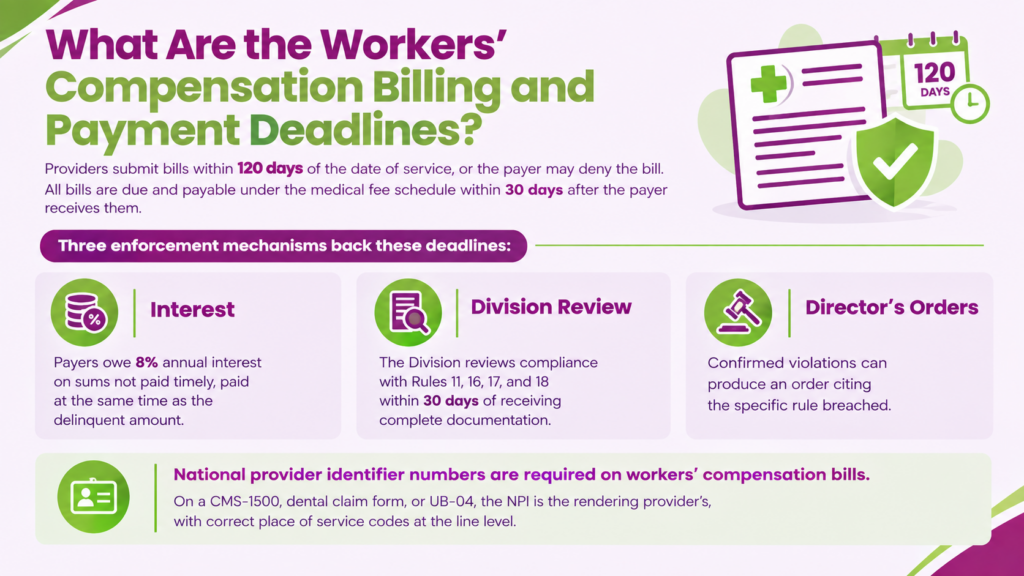
National provider identifier numbers are required on workers’ compensation bills. On a CMS-1500, dental claim form, or UB-04, the NPI is the rendering provider’s, with correct place of service codes at the line level.
What Changed With Colorado’s 2026 E-Billing Mandate?
Since January 1, 2026, workers’ compensation medical bills must be submitted and processed in a HIPAA-compliant electronic format. The Division adopted HIPAA X12 standards for Rule 16, and payers must accept electronic bills under Rule 16-8-1.
The e-billing mandate did not change the filing deadline. Providers still submit bills within 120 days of the date of service, electronically or otherwise.
Which Colorado Workers’ Compensation Changes Are Pending?
The Division proposed further changes to Rule 16 and Rule 18 and held a rule hearing on August 27, 2026. Rule 18 was also rewritten for clarity and accessibility rather than redlined.
House Bill 25-1300, signed June 4, 2025, expands injured workers’ choice of treating physician. The main effective date for expanded physician choice is January 1, 2028.
How Do HIPAA and Colorado Breach Laws Affect Medical Billing?
HIPAA sets the federal baseline for billing data. Colorado adds a 30-day breach notification deadline in C.R.S. § 6-1-716, which is shorter than the federal 60-day window.
What Does Colorado’s 30-Day Breach Notification Law Require?
Colorado requires notice to affected residents in the most expedient time possible and no later than 30 days after determining that a security breach occurred. Two additional notice thresholds apply:
- Attorney General Notice: Required when a breach affects 500 or more Colorado residents, within the same 30-day window.
- Consumer Reporting Agency Notice: Required when the entity notifies more than 1,000 Colorado residents.
Notice is not required when a prompt, good-faith investigation determines that misuse of personal information has not occurred and is not likely to occur.
Does HIPAA Compliance Satisfy Colorado’s Breach Law?
Colorado deems a covered entity compliant when it follows breach notification procedures set by its state or federal regulator, provided those procedures match Colorado’s timing requirements. Two carve-outs remain for HIPAA-regulated entities.
They still meet Colorado’s 30-day individual notice deadline rather than HIPAA’s 60-day deadline. They also notify the Colorado Attorney General in the circumstances described above. Update business associate agreements so vendors report breaches fast enough to hit the 30-day clock.
How Can Providers Stay Compliant With Colorado Medical Billing Laws?
Colorado compliance depends on tracking deadlines across four payer categories at once. Commercial, Medicaid, workers’ compensation, and self-pay each run on separate clocks with separate regulators.
What Should a Colorado Billing Compliance Calendar Track?
Build one calendar that carries every deadline in this guide. The following entries cover the highest-risk items:
- Prompt pay: 30-day electronic and 45-day paper windows, plus 10% interest and the 20% penalty at day 91.
- Recoupment Limits: 12-month standard adjustments, 6-month risk-sharing settlements, and 36-month coordination of benefits.
- Prior Authorization: 5-business-day non-urgent and 2-business-day urgent decisions, plus the 2-day provider response.
- Arbitration: the 90-day filing window measured from receipt of payment.
- Medicaid Filing: 365-day original claims and 60-day resubmission cycles referencing the prior ICN.
- Workers’ Compensation: 120-day provider filing and 30-day payer processing.
- Breach Response: the 30-day individual and Attorney General notice deadlines.
Reconcile interest and penalties monthly. Carriers do not always pay them without a provider-side audit trail. Your practice can also compare results against medical billing services in Colorado built around these state deadlines.
How Should Practices Prepare When Colorado Laws Change?
Colorado bills enacted without a safety clause take effect 90 days after the General Assembly adjourns. Bills from the 2026 session, including Senate Bill 26-017, took effect August 12, 2026. Track three sources between sessions:
- Division of Insurance regulation and bulletin filings
- HCPF provider bulletins, which carry timely filing and NCCI updates
- Division of Workers’ Compensation rule hearings for Rules 16 and 18
Train staff and document the training before each effective date. Documentation of training is itself evidence during an audit.
Frequently Asked Questions About Colorado Medical Billing Laws
What Is the Statute of Limitations on Medical Debt in Colorado?
Colorado gives creditors six years to sue on a liquidated medical debt under C.R.S. § 13-80-103.5. In Portercare Adventist Health System v. Lego (2012), the Colorado Supreme Court held that hospital debt priced at predetermined rates qualifies as liquidated. Contract claims for genuinely unliquidated amounts get three years under C.R.S. § 13-80-101.
Is Balance Billing Illegal in Colorado?
Balance billing is illegal in Colorado for emergency services and for covered ancillary services delivered by out-of-network providers at in-network facilities. Patients pay in-network cost sharing only, and carriers pay out-of-network providers directly at statutory rates. Ground ambulance services fall outside these protections, and the veto of House Bill 25-1088 left that gap open.
How Long Do Colorado Insurers Have to Pay a Clean Claim?
Colorado insurers have 30 calendar days to pay, deny, or settle a clean claim submitted electronically and 45 days for claims submitted by other means. Late clean claims carry 10% annual interest. A claim unresolved after 90 days triggers an added penalty equal to 20% of the total amount allowed on the claim.
How Far Back Can a Colorado Insurer Recoup a Payment?
Colorado limits standard claim adjustments to 12 months from the original explanation of benefits, and the window is the same for the carrier and the provider. Risk-sharing settlements run on a 6-month window. Coordination of benefits adjustments involving Medicare or Medicaid run 36 months from the date of service.
What Is the Interest Cap on Medical Debt in Colorado?
Colorado caps interest on medical debt at 3% per year under Senate Bill 23-093, signed May 4, 2023. The cap applies to debt from health care services, medical products, or devices. Debt charged to a credit card falls outside the definition of medical debt for purposes of the cap.
What Is Colorado Hospital Discounted Care?
Hospital Discounted Care, created by House Bill 21-1198, requires hospitals to screen uninsured patients for public coverage and discount programs. Patients at or below 250% of the Federal Poverty Guidelines qualify for capped billing at rates set by HCPF. The caps also apply to providers delivering care in hospitals and emergency departments.