
This guide is a complete ICD-10 coding reference for urology coders and billers. It organizes ICD-10-CM codes across every high-volume urology diagnosis category. Each entry lists the code, its description, the documentation requirement, and the linked CPT procedure. The data reflects CY2026 guidelines published by CMS and the AMA. New codes take effect every October 1 as part of the annual ICD-10-CM update cycle.
Categories below cover BPH, prostate cancer, kidney and ureter stones, UTI, male genital disorders, female urology, bladder cancer, kidney cancer, erectile dysfunction, chronic kidney disease, and screening Z-codes. Readers can use this blog page to find the exact code they need and confirm how it links to urology procedure billing.
Urology ICD-10 Codes Table: Full Reference by Category
Each table below lists the codes billed most often within that urology sub-specialty. Codes are grouped by category rather than alphabetically. This mirrors how coders actually search during a live encounter.
| ICD-10 | Description | Documentation Requirement | Linked CPT |
|---|---|---|---|
| N40.0 | BPH without LUTS | No LUTS documented | 52000, 55700 |
| N40.1 | BPH with LUTS | LUTS: nocturia, frequency, urgency | 52601, 52649, 0714T |
| N42.0 | Calculus of prostate | Prostate stone confirmed | 52601 |
| N42.32 | Prostatic intraepithelial neoplasia (HGPIN) | HGPIN found on biopsy | 55700 |
| N41.0 | Acute prostatitis | Acute symptoms with culture | 87070, 87086 |
| N41.1 | Chronic prostatitis | Symptoms lasting over three months | 87086 |
N40.1 is the most billed BPH code. It supports medical necessity for TURP, HoLEP, UroLift, and Rezum procedures.
Prostate Cancer and Related Codes
| ICD-10 | Description | HCC Flag | Linked CPT |
|---|---|---|---|
| C61 | Malignant neoplasm of prostate | Yes (HCC 12) | 55866, 55840 |
| D07.5 | Carcinoma in situ of prostate | No | 55700 |
| R97.21 | Rising PSA after treatment | N/A | 55866, 78815 |
| Z12.5 | Screening for prostate cancer | N/A | G0102, G0103 |
| Z85.46 | History of prostate cancer | Yes (HCC 22) | 99213-99215 |
C61 is the primary code for active prostate cancer. Z85.46 applies once treatment ends and surveillance begins. Rising PSA after treatment uses R97.21 to support biochemical recurrence workup.
Kidney and Ureter Stones
| ICD-10 | Description | Documentation Requirement | Linked CPT |
|---|---|---|---|
| N20.0 | Calculus of kidney | Confirmed by imaging | 50590, 74176 |
| N20.1 | Calculus of ureter | Location within ureter noted | 52353, 52356 |
| N20.9 | Urinary calculus, unspecified | Location not specified | 50590 |
| N23 | Unspecified renal colic | Symptom without confirmed stone | 74176 |
| R31.0 | Gross hematuria | Visible blood in urine | 52204, 74176 |
Stone location documentation drives medical necessity for lithotripsy, ureteroscopy, and PCNL billing. Vague location coding is a common cause of denials in this category.
UTI, Cystitis, and Pyelonephritis
| ICD-10 | Description | Documentation Requirement | Linked CPT |
|---|---|---|---|
| N39.0 | UTI, site not specified | Common ambulatory diagnosis | 87086 |
| N30.00 | Acute cystitis without hematuria | Confirmed by culture | 87086, 81003 |
| N30.10 | Interstitial cystitis, chronic | IC/BPS documented per AUA criteria | 52260-52265 |
| N10 | Acute pyelonephritis | Confirmed with imaging | 87086, 74176 |
| N15.1 | Renal and perinephric abscess | Confirmed on imaging | 50021, 74176 |
N39.0 remains the most common urology diagnosis code billed. Adding site and chronicity detail supports higher-level E/M and cystoscopy claims.
Male Genital System
| ICD-10 | Description | Documentation Requirement | Linked CPT |
|---|---|---|---|
| N45.3 | Epididymo-orchitis | Combined presentation confirmed | 76870 |
| N47.1 | Phimosis | Present in an adult patient | 54150, 54161 |
| N48.30 | Priapism, unspecified | Emergency presentation | 54235 |
| N50.3 | Cyst of epididymis | Spermatocele confirmed | 54840 |
| N53.14 | Retrograde ejaculation | Common after TURP | Various |
Post-surgical erectile dysfunction and retrograde ejaculation both appear frequently after prostate procedures. Coders should always check for these secondary diagnoses.
Female Urology and Incontinence
| ICD-10 | Description | Documentation Requirement | Linked CPT |
|---|---|---|---|
| N39.3 | Stress urinary incontinence | SUI documented on exam | 57288, 51992 |
| N39.41 | Urge incontinence | Urge UI documented | 64581, 52287 |
| N39.46 | Mixed incontinence | Combined stress and urge | 57288, 64581 |
| N81.10 | Cystocele, unspecified | Grade documentation preferred | 57284, 57240 |
| N82.0 | Vesicovaginal fistula | Post-surgical or obstetric history | 51900 |
Incontinence coding drives billing for sling procedures, sacral neurostimulation, and pelvic floor therapy. Specificity between stress, urge, and mixed types is essential for approval.
Bladder Cancer and Neoplasms
| ICD-10 | Description | HCC Flag | Linked CPT |
|---|---|---|---|
| C67.0 | Trigone bladder cancer | Yes (HCC 11) | 52204, 52234-52240 |
| C67.9 | Bladder cancer, unspecified | Yes (HCC 11) | Various |
| D09.0 | Carcinoma in situ of bladder | Yes (HCC 12) | 52204, 52224 |
| N32.81 | Overactive bladder | No | 52287, 64581 |
| Z85.51 | History of bladder cancer | Yes (HCC 22) | 52204, 52000 |
Bladder cancer coding requires location detail such as trigone, dome, or lateral wall. This detail drives TURBT code selection based on tumor size.
Kidney Cancer and Neoplasms
| ICD-10 | Description | HCC Flag | Linked CPT |
|---|---|---|---|
| C64.1 | Right kidney cancer | Yes (HCC 11) | 50543, 50545 |
| C64.2 | Left kidney cancer | Yes (HCC 11) | 50543, 50545 |
| C65.1 | Right renal pelvis cancer | Yes (HCC 11) | 52351, 52354 |
| D30.01 | Benign right kidney neoplasm | No | 50250 |
| N28.1 | Acquired kidney cyst | N/A | 74176 |
Laterality is required for nearly every kidney cancer code. Missing laterality often causes claim rejection or a request for more documentation.
Erectile Dysfunction
| ICD-10 | Description | Documentation Requirement | Linked CPT |
|---|---|---|---|
| N52.01 | ED due to arterial insufficiency | Vascular workup documented | Various |
| N52.1 | ED secondary to disease | Underlying disease coded first | 54405 |
| N52.31 | ED after radical prostatectomy | Post-surgical timeline noted | 54405, 54660 |
| N52.9 | ED, unspecified | Etiology not specified | Various |
Etiology-specific coding supports medical necessity for PDE5 inhibitors, penile prosthesis placement, and testosterone therapy.
Chronic Kidney Disease
| ICD-10 | Description | HCC Flag | Documentation Requirement |
|---|---|---|---|
| N18.30 | CKD stage 3, unspecified | Yes (HCC 138) | GFR between 30 and 59 |
| N18.31 | CKD stage 3a | Yes (HCC 138) | GFR between 45 and 59 |
| N18.4 | CKD stage 4, severe | Yes (HCC 137) | GFR between 15 and 29 |
| N18.6 | End stage renal disease | Yes (HCC 136) | Dialysis documented |
| Z94.0 | Kidney transplant status | Yes (HCC 186) | Post-transplant status confirmed |
CKD stage specificity directly drives HCC risk adjustment. Accurate GFR documentation is required to support any stage-specific code.
Screening and Preventive Z-Codes
| ICD-10 | Description | Documentation Requirement | Linked CPT |
|---|---|---|---|
| Z12.5 | Prostate cancer screening | Asymptomatic patient | G0102, G0103 |
| Z12.6 | Bladder cancer screening | High-risk patient | 52000, 52204 |
| Z85.46 | History of prostate cancer | Surveillance visit | 84153 |
| Z85.528 | History of kidney cancer | Surveillance visit | 74176 |
Z-code sequencing matters for claim acceptance. Z12.5 is primary for screening visits, while Z85.46 is primary for surveillance visits.
How to Read the Urology ICD-10 Codes?
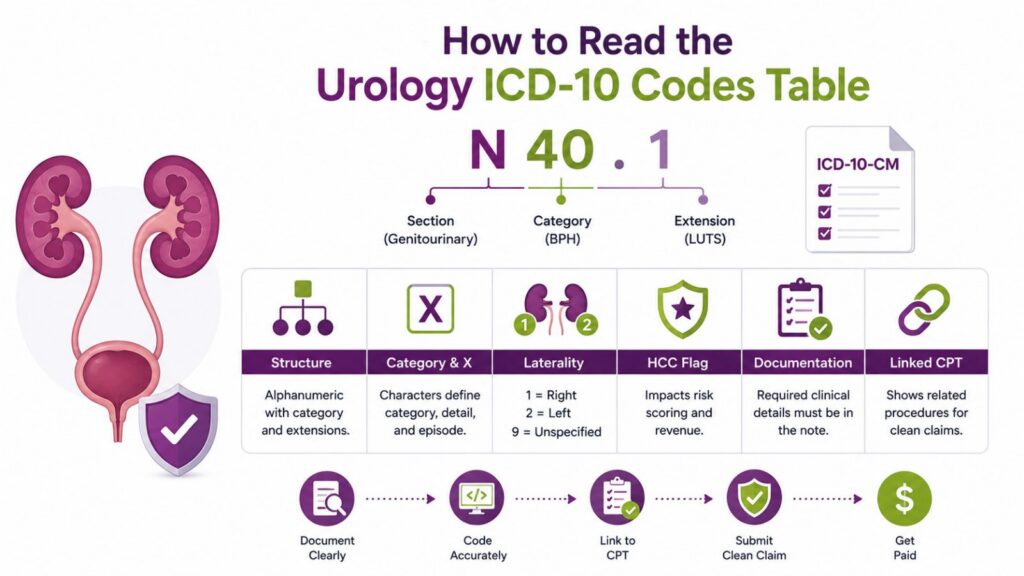
Each column in this table carries a specific coding function. Understanding the structure prevents avoidable denials and supports coding accuracy.
What Is the Structure of an ICD-10-CM Code?
ICD-10-CM codes are alphanumeric with a category letter followed by two to six digits. N40.1 breaks down as Section N for genitourinary conditions. The 40 identifies BPH, and the .1 extension flags LUTS. Each additional character adds more clinical specificity to the diagnosis. Codes with six or seven characters capture anatomic detail, laterality, and episode of care.
What Do Category, Extension, and Placeholder X Mean?
The third character sets the base category, such as N40. The fourth character narrows the sub-category, as seen in N40.1. Fifth and sixth characters add further clinical detail where needed. The seventh character marks the episode of care using A, D, or S. Placeholder X fills empty fifth or sixth positions when a seventh character is required, as in T85.79xA.
How Does Laterality Work in These Codes?
Many urology codes require a laterality designation for accurate billing. Right-sided codes typically end in 1, and left-sided codes typically end in 2. Unspecified laterality usually ends in 9, though exceptions exist. Correct laterality documentation supports modifier 50 billing for bilateral procedures. Missing laterality is a frequent and preventable cause of claim denial.
What Does the HCC Risk Adjustment Flag Mean?
The HCC flag marks codes that affect risk scoring for Medicare Advantage patients. Flagged codes include C61 for prostate cancer and N18.4 for CKD stage 4. These codes directly influence Medicare Advantage capitation revenue and shared savings results. Practices that miss HCC-flagged diagnoses lose measurable revenue every reporting year.
What Does the Documentation Requirement Column Cover?
This column names the clinical detail that must appear in the note. Requirements include laterality, staging, chronicity, and any related complications. Missing documentation is the leading cause of specificity downgrades on claims. Physicians should confirm this detail is captured before the encounter closes.
What Does the Linked CPT Procedures Column Show?
This column lists the procedures commonly billed against each diagnosis code. N40.1 links to TURP, HoLEP, UroLift, and Rezum procedure codes. Correct ICD-10-to-CPT linkage supports clean claim submission on the first pass. Coders should verify this link before submitting any urology claim. Here is a full list of urology CPT codes paired with each diagnosis to help confirm the match before submission.
How to Use the Urology ICD-10 Codes?
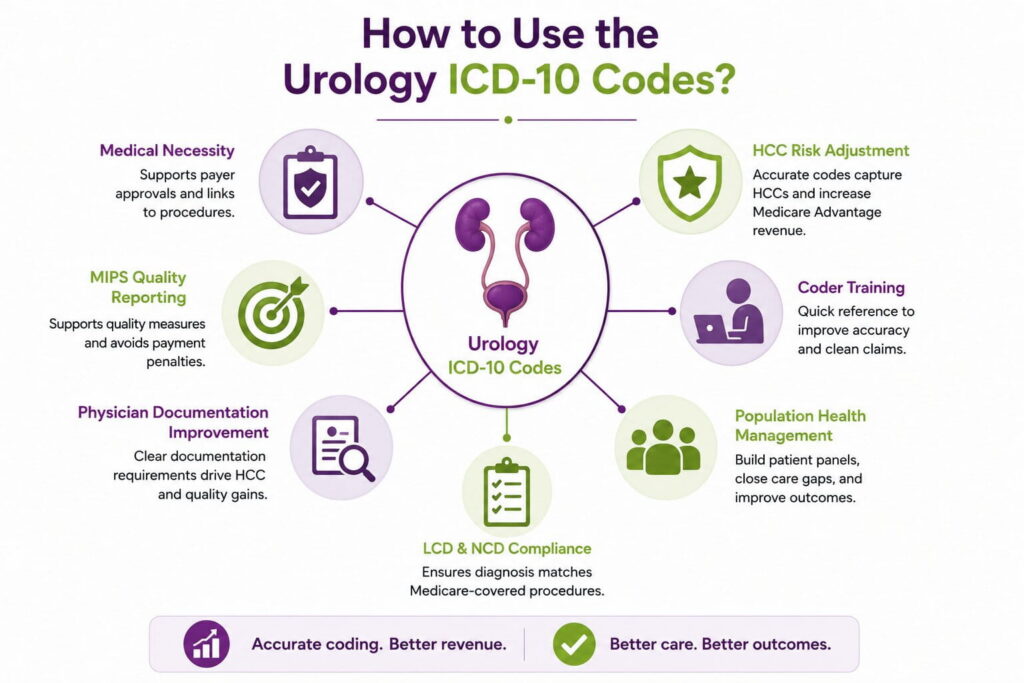
Different urology stakeholders use this table for different operational goals. The sections below outline the most common use cases in practice.
Medical Necessity Support
The table connects each diagnosis to procedures payers require for approval. N40.1 supports TURP billing, and N20.1 supports ureteroscopy billing. Correct linkage prevents avoidable denials tied to missing medical necessity. Practices without an internal coding team often turn to outsourced medical billing services to manage this step.
HCC Risk Adjustment
Codes such as C61, C67, and N18.4 through N18.6 carry major HCC weight. Capturing these codes accurately can raise Medicare Advantage capitation revenue substantially. Practices should audit HCC capture rates on a regular schedule.
MIPS Quality Reporting
Codes like C61 link to specific MIPS quality measures for prostate cancer. Accurate coding supports MIPS scoring and avoids negative Medicare payment adjustments. Payment swings under MIPS can reach nine percent in either direction.
Coder Training and Reference
New and experienced coders both use this table as a quick lookup. Specificity requirements and sequencing notes reduce coder error over time. A shared reference also improves first-pass clean claim rates across a practice.
Physician Documentation Improvement
The documentation column shows physicians exactly what clinical detail coding requires. Structured CDI programs built around this detail often raise case-mix and HCC capture. Most programs report gains between three and eight percent within a year.
LCD and NCD compliance
Medicare coverage determinations require diagnosis codes to match approved procedure lists. This table maps common urology diagnoses to their Medicare-covered procedures directly. Compliance failures here are a leading cause of preventable claim denials.
Population Health Management
Practices use diagnosis codes to build patient panels for proactive outreach. A panel of C61 patients due for surveillance PSA is one clear example. This approach closes care gaps and supports better quality metric performance.
How Often Are Urology ICD-10 Codes Updated?
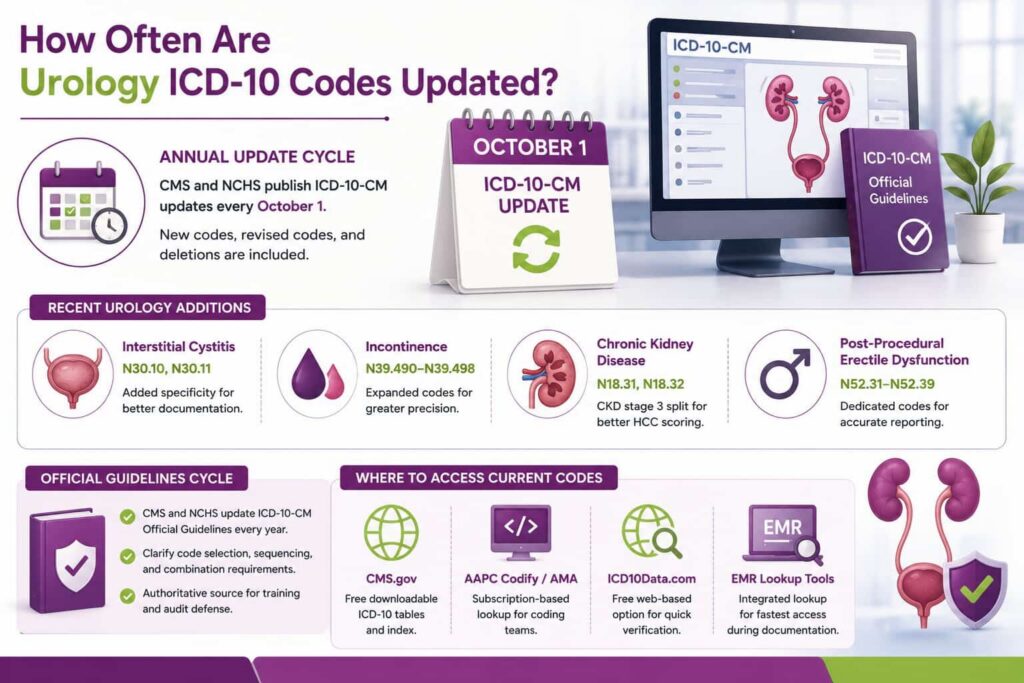
Annual update cycle.
CMS and NCHS publish ICD-10-CM updates every October 1 without exception. Each release includes new codes, revised codes, and codes marked for deletion. Practices must update EMR tables and retrain coders to reflect these changes.
Recent urology additions.
Recent updates added specificity for interstitial cystitis under N30.10 and N30.11. Incontinence codes expanded under N39.490 through N39.498 for greater precision. CKD stage 3 also split into N18.31 and N18.32 for better HCC scoring. Post-procedural erectile dysfunction gained dedicated codes under N52.31 through N52.39.
Official guidelines cycle.
CMS and NCHS also publish updated ICD-10-CM Official Guidelines each year. These guidelines clarify code selection, sequencing rules, and combination coding requirements. They remain the authoritative source for coder training and audit defense.
Where to access current codes.
CMS.gov offers a free downloadable ICD-10 table and index each year. AAPC Codify and AMA tools offer subscription-based lookup for coding teams. ICD10Data.com provides a free web-based option for quick verification. EMR-integrated lookup tools remain the fastest option during live documentation. When outsourcing your billing to a dedicated medical coding service provider, make sure they have the latest tools.
How Should Urology Practices Use ICD-10 Codes to Improve Documentation and Reimbursement?
To use urology ICD-10 codes effectively, practices should follow a structured process.
- Go through the full urology ICD-10 table above. Keep a master copy available to all coding staff. Keep a master copy available to all coding staff, alongside your practice’s urology billing guide for procedure-level context.
- Segment codes by sub-specialty and category. This mirrors how physicians think during documentation.
- Map common diagnosis codes to CPT procedures. This step supports clean claim submission from the start.
- Verify medical necessity alignment with LCD and NCD criteria. Confirm the diagnosis matches the payer’s approved list.
- Train physicians on documentation requirements by code. Target training toward the highest-volume codes first.
- Identify HCC-flagged codes for Medicare Advantage panels. Build a watchlist for your highest-risk patients.
- Track HCC capture rate by physician and practice. Share results regularly to sustain improvement.
- Audit ICD-10-to-CPT linking on submitted claims. Catch mismatches before they become denials.
- Monitor denial rates by ICD-10 category. Missing specificity is a common and fixable denial cause.
- Update the table every October 1 with new additions. Build this into your annual compliance calendar.
- Integrate ICD-10 lookup into EMR encounter templates. This reduces physician search time during visits.
- Align coding with MIPS quality measure requirements. Confirm the diagnosis supports the intended quality measure.
- Review coding accuracy across your urology diagnosis mix regularly. Small errors compound across a full patient panel.
- Consider urology-specialized billing and coding support. A dedicated urology billing partner can close remaining gaps. Consider urology-specialized billing and coding support. Partnering with dedicated urology billing services can close the specificity and denial gaps this table cannot fix alone.

Frequently Asked Questions
What Is the ICD-10 Code for BPH with LUTS?
ICD-10 code N40.1 applies to benign prostatic hyperplasia with lower urinary tract symptoms. It is one of the highest-volume urology diagnosis codes billed today. N40.1 supports medical necessity for TURP, HoLEP, UroLift, and Rezum procedures.
What Is the ICD-10 Code for Prostate Cancer?
C61 is the primary diagnosis code for confirmed malignant prostate cancer. Z85.46 applies during surveillance after treatment concludes. D07.5 applies specifically to carcinoma in situ or high-grade PIN.
What Is the ICD-10 Code for a Kidney Stone?
Kidney stone coding uses N20.0 for the kidney and N20.1 for the ureter. N20.2 applies when stones appear in both locations at once. Clear location documentation supports lithotripsy, ureteroscopy, and PCNL billing decisions.
What Is the ICD-10 Code for a UTI?
N39.0 is the most common ambulatory code for an unspecified urinary tract infection. N30.00 and N30.01 apply to acute cystitis with greater specificity. N10 applies specifically to confirmed acute pyelonephritis.
What Is the ICD-10 Code for Stress Urinary Incontinence?
N39.3 applies to stress urinary incontinence in both female and male patients. This code supports medical necessity for sling procedure and pelvic floor therapy billing.
What Is the ICD-10 Code for Erectile Dysfunction?
Erectile dysfunction coding uses the N52 series based on etiology. N52.01 covers arterial causes, and N52.2 covers drug-induced cases. N52.31 through N52.39 apply to erectile dysfunction following specific prior procedures.
What Is HCC Coding in Urology, and Which Codes Matter Most?
HCC coding assigns risk-adjustment scores to Medicare Advantage patients based on diagnosis. Top urology contributors include C61 prostate cancer and C67 bladder cancer. Advanced CKD stages and kidney transplant status also carry significant HCC weight.
How Do Urology Practices Handle Laterality in ICD-10 Coding?
Many urology codes require laterality, with right typically ending in 1. Left typically ends in 2, and unspecified typically ends in 9. Correct laterality prevents denials and supports modifier 50 billing for bilateral procedures.
When Do Urology ICD-10 Codes Get Updated Each Year?
CMS and NCHS release ICD-10-CM updates every October 1 without exception. These updates include new codes, revised codes, and codes marked for deletion. Practices must refresh EMR tables and retrain staff to match the new set.
What Is the Difference Between ICD-10-CM and ICD-10-PCS in Urology?
ICD-10-CM is the diagnosis code set used for outpatient encounters and physician billing. ICD-10-PCS is a separate procedure code set used only for inpatient hospital claims. Outpatient urology practices rely on ICD-10-CM paired with CPT codes for billing.