Florida’s PIP law, Section 627.736, still requires $10,000 in coverage in 2026. Initial care must start within 14 days of the crash. Most providers must bill within 35 days. Insurers can cap payment at 80% of 200% of Medicare.
Florida’s PIP law is Section 627.736 of the Florida Statutes. Section 627.736 controls how auto insurers pay medical providers after a motor vehicle crash. Personal injury protection pays 80% of reasonable medical expenses up to $10,000. The limit drops to $2,500 when a provider finds no emergency medical condition.
Initial care must begin within 14 days of the accident. Most providers must bill within 35 days of each service. Insurers can limit payment through a Medicare-based fee schedule. PIP was not repealed in 2026, so these rules apply to every PIP claim your practice submits today.

What Is Florida’s PIP Law?
Florida’s PIP law is Section 627.736, the benefits and claims section of the Florida Motor Vehicle No-Fault Law. The No-Fault Law runs from Section 627.730 through Section 627.7405. Most owners of vehicles registered in Florida must carry personal injury protection, known as PIP.
PIP is first-party coverage, so the injured person’s own auto policy pays regardless of fault. That design is why Florida is called a no-fault state. Your practice usually bills the PIP insurer directly under an assignment of benefits. PIP is one of several medical billing laws in Florida that shape how practices bill.
Is PIP Still Required in Florida in 2026?
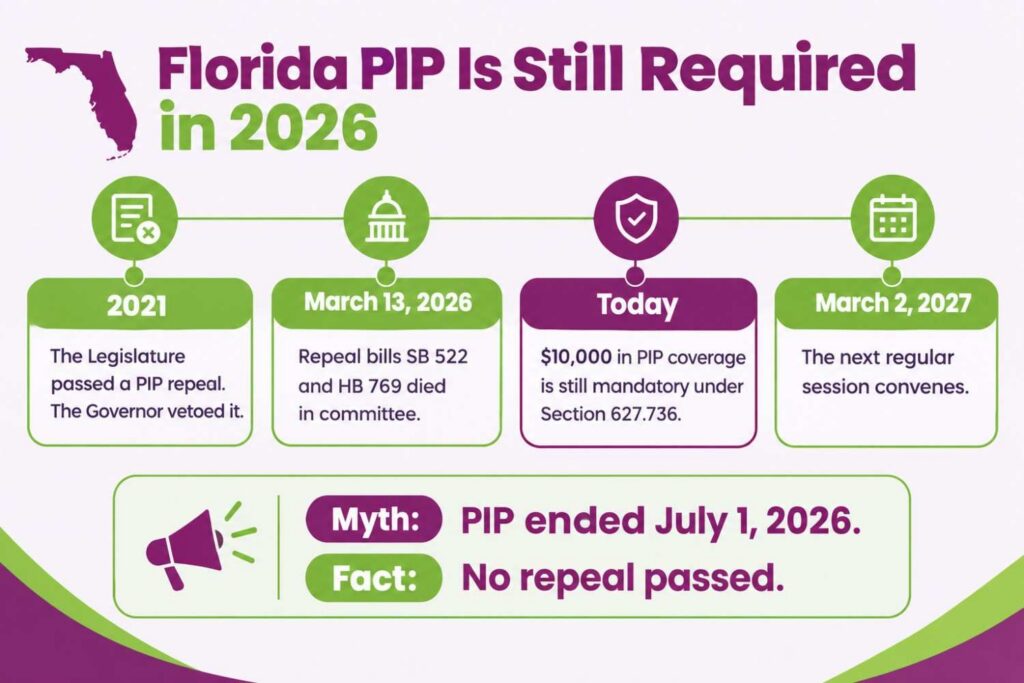
Yes, PIP is still required in Florida in 2026. The 2026 repeal bills, SB 522 and HB 769, died in committee on March 13, 2026. Pages claiming PIP ended on July 1, 2026, are wrong. A repeal passed the Legislature in 2021 and was vetoed. The next regular session convenes on March 2, 2027.
What Does Florida PIP Cover for Medical Treatment?
Florida PIP covers 3 benefit types under Section 627.736(1), with medical benefits paid at 80% of reasonable expenses. The table lists each benefit, what PIP pays, and the services excluded by statute.
| Benefit | What PIP Pays |
|---|---|
| Medical | 80% of reasonable expenses for medically necessary medical, surgical, X-ray, dental, and rehabilitative services, plus prosthetic devices, ambulance, hospital, and nursing services |
| Disability | 60% of lost gross income and earning capacity, plus the cost of replacement household services |
| Death | $5,000 per person, paid in addition to medical and disability benefits |
| Combined limit | $10,000 in medical and disability benefits, or $2,500 for medical care without an EMC finding |
| Excluded | Massage therapy and acupuncture, regardless of who provides the service |
X-rays count as medically necessary X-ray services, so imaging billed inside the patient’s benefit limit is payable. Licensed massage therapists and acupuncturists cannot be reimbursed under PIP for any service.
Is PIP Primary Over Health Insurance, Medicare, and Medicaid?
Yes, PIP pays first for accident-related care in Florida. Section 627.736(4) makes PIP benefits primary. Workers’ compensation benefits are credited against PIP, so a work-related crash reduces what the PIP insurer owes.
- Florida Medicaid: If Medicaid pays first, the PIP insurer must repay Medicaid in full within 30 days of notice.
- Medicare: Federal Medicare Secondary Payer rules make Medicare secondary to no-fault insurance, including Florida PIP.
- Billing order: Your practice bills the PIP insurer first, then bills secondary coverage after PIP pays or runs out.
What Is Florida’s 14-Day PIP Rule?
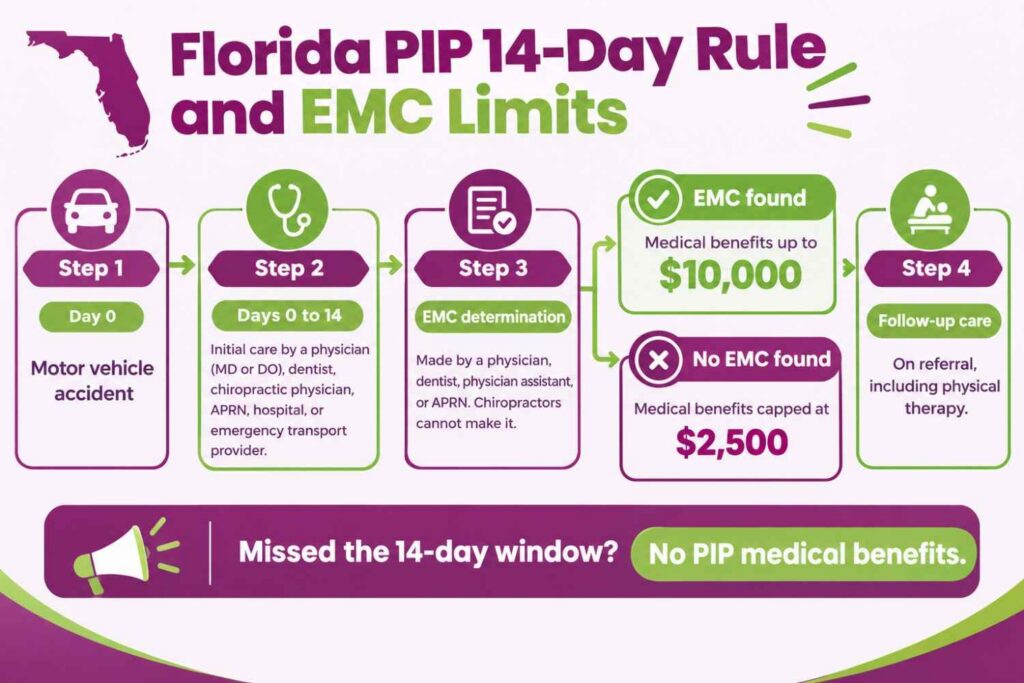
Florida’s 14-day PIP rule requires initial services and care within 14 days of the motor vehicle accident. A patient who misses that window loses PIP medical benefits for the crash. The rule applies to initial care only. Follow-up care depends on a referral from an initial-care provider.
Which Providers Can Deliver Initial Care Within 14 Days?
Section 627.736(1)(a)1 limits initial PIP care to 6 provider groups. Care from any other provider does not satisfy the 14-day rule.
- Physicians licensed under Chapter 458 (MD) or Chapter 459 (DO)
- Dentists licensed under Chapter 466
- Chiropractic physicians licensed under Chapter 460
- Advanced practice registered nurses registered under Section 464.0123
- Hospitals, or facilities that own or are wholly owned by a hospital
- Licensed emergency transportation and treatment providers under Chapter 401
Physical therapists and massage therapists cannot deliver initial PIP care. A physical therapist bills PIP only after a referral, as a follow-up provider.
Who Can Provide Follow-Up Care Under PIP?
Follow-up care requires a referral from an initial-care provider. The care must match the diagnosis made during initial treatment. Section 627.736(1)(a)2 lists 6 groups that can provide, supervise, order, or prescribe follow-up care.
- Physicians, chiropractic physicians, dentists, and APRNs, plus supervised physician assistants and APRNs
- Hospitals and ambulatory surgical centers licensed under Chapter 395
- Entities wholly owned by those practitioners, alone or with a spouse, parent, child, or sibling
- Entities that own, or are wholly owned by, a hospital
- Physical therapists licensed under Chapter 486, on referral
- Licensed health care clinics that are accredited, or that meet three tests in the statute
The tests are a qualifying medical director, over 3 years of continuous licensure, and at least 4 of 8 specialties. A publicly traded owner can stand in for the licensure test.
Does a Florida Clinic Need a License to Bill PIP?
Yes, unless an exemption applies. Section 627.736(5)(h) treats an entity excluded from the clinic definition as a clinic for PIP. That entity must hold a license under Part X of Chapter 400 to receive reimbursement. The exemptions include practices wholly owned by a physician, dentist, or chiropractor, plus hospitals, ASCs, and hospital-owned entities.
How Does the Emergency Medical Condition Rule Change the PIP Limit?
The emergency medical condition rule decides whether PIP medical benefits reach $10,000 or stop at $2,500. Benefits reach $10,000 when a physician, dentist, physician assistant, or APRN determines an emergency medical condition (EMC).
Benefits stop at $2,500 when a listed provider determines the patient has no EMC. Section 627.732(16) defines an EMC as acute symptoms, including severe pain, serious enough that delayed care could cause harm.
The statute names 3 outcomes that qualify as harm from delayed care:
- Serious jeopardy to the patient’s health
- Serious impairment to bodily functions
- Serious dysfunction of any bodily organ or part
Write the EMC determination into the medical record in plain words. The benefit limit controls every bill that follows the first visit.
Can a Chiropractor Make an EMC Determination?
No, a chiropractic physician can provide initial PIP care but cannot determine an emergency medical condition. The statute limits that finding to physicians, dentists, physician assistants, and APRNs. A chiropractic-only patient needs one of those providers to make the EMC finding before benefits exceed $2,500.
Does the EMC Determination Have to Happen Within 14 Days?
No, the 14-day deadline in Section 627.736(1)(a) applies to initial services and care. The statute sets no separate deadline for the emergency medical condition determination itself. Documenting the finding early still protects your practice, since the benefit limit controls every bill after the first visit.
What Is the Florida PIP Fee Schedule?
The Florida PIP fee schedule lets an insurer limit payment to 80% of a statutory schedule of maximum charges. Most tiers are tied to Medicare. The insurer can use the schedule only if the policy gives notice of that option at issuance or renewal.
Section 627.736(5)(a)1 sets 7 tiers. The table shows the maximum charge for each tier before the insurer applies the 80% limit.
| Service | Maximum Charge Before the 80% Limit |
|---|---|
| Emergency transport and treatment (Chapter 401 providers) | 200% of Medicare |
| Hospital emergency services and care | 75% of the hospital’s usual and customary charges |
| Physician or dentist emergency services in a Chapter 395 facility | Usual and customary charges in the community |
| Hospital inpatient services, non-emergency | 200% of the Medicare Part A prospective payment for that hospital |
| Hospital outpatient services, non-emergency | 200% of the Medicare Part A Ambulatory Payment Classification for that hospital |
| All other services, supplies, and care | 200% of the Medicare Part B participating physicians fee schedule (Part B for ASCs and labs; DMEPOS schedule for durable medical equipment) |
| Services Medicare does not reimburse | 80% of the workers’ compensation maximum under Section 440.13 |
The insurer pays 80% of each tier, not the full 200%. Services that neither Medicare nor workers’ compensation reimburses are not payable at all.
How Do You Calculate a Florida PIP Payment?
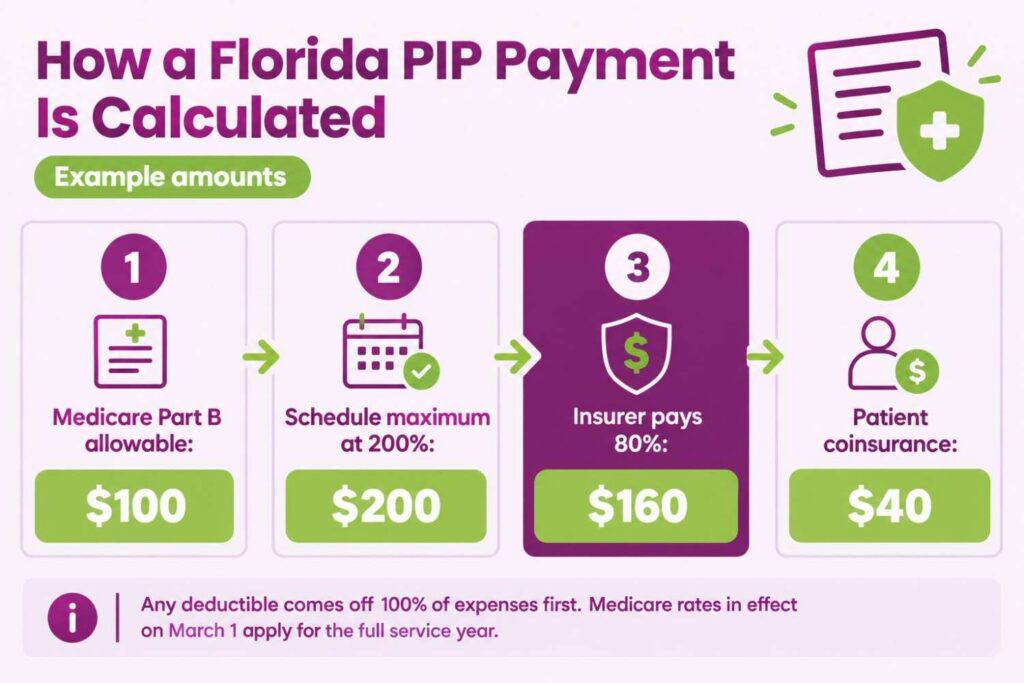
A PIP payment equals 80% of the schedule maximum, after any deductible. The steps below use an example Medicare Part B participating allowable of $100.
- Start with the Medicare allowable for the service: $100.
- Double it for the schedule maximum: $100 × 2 = $200.
- Apply the 80% limit for the insurer payment: $200 × 0.80 = $160.
- Subtract to find the patient coinsurance: $200 − $160 = $40, which your practice can bill the insured.
- Subtract any deductible first, since the deductible applies to 100% of expenses before the 80% limit.
The same math runs on every line item until the patient reaches the $10,000 or $2,500 limit.
Which Medicare Fee Schedule Year and Locality Apply?
PIP uses the Medicare fee schedule in effect on March 1 of the service year. A service year runs from March 1 through the end of February. The current service year runs from March 1, 2026, to February 28, 2027.
Medicare changes made after March 1 do not change PIP rates for that service year. No PIP amount can fall below the 2007 Medicare Part B allowable. The schedule applies by area, and First Coast Service Options publishes Florida’s 3 Medicare localities.
| Locality | Area | Counties |
|---|---|---|
| 03 | Fort Lauderdale | Broward, Collier, Indian River, Lee, Martin, Palm Beach, St. Lucie |
| 04 | Miami | Miami-Dade, Monroe |
| 99 | Rest of Florida | All other counties |
The same CPT code carries a different PIP maximum in Miami-Dade than in Tampa, because Medicare rates differ by locality. Price each claim against the locality where the service took place.
Can an Insurer Pay 80% of a Charge Below the Fee Schedule?
Yes, if the policy says so. The Florida Supreme Court decided Allstate Insurance Co. v. Revival Chiropractic in 2024. The court held that an insurer may pay 80% of a submitted charge below the schedule maximum. The ruling builds on MRI Associates of Tampa v. State Farm (2021).
A practice that charges less than 200% of Medicare can be paid less than the schedule allows. A charge below the schedule maximum caps the payment at 80% of that charge. Review charge levels against current locality rates before each March 1 service year.
Can a Provider Bill the Patient for the Amount PIP Does Not Pay?
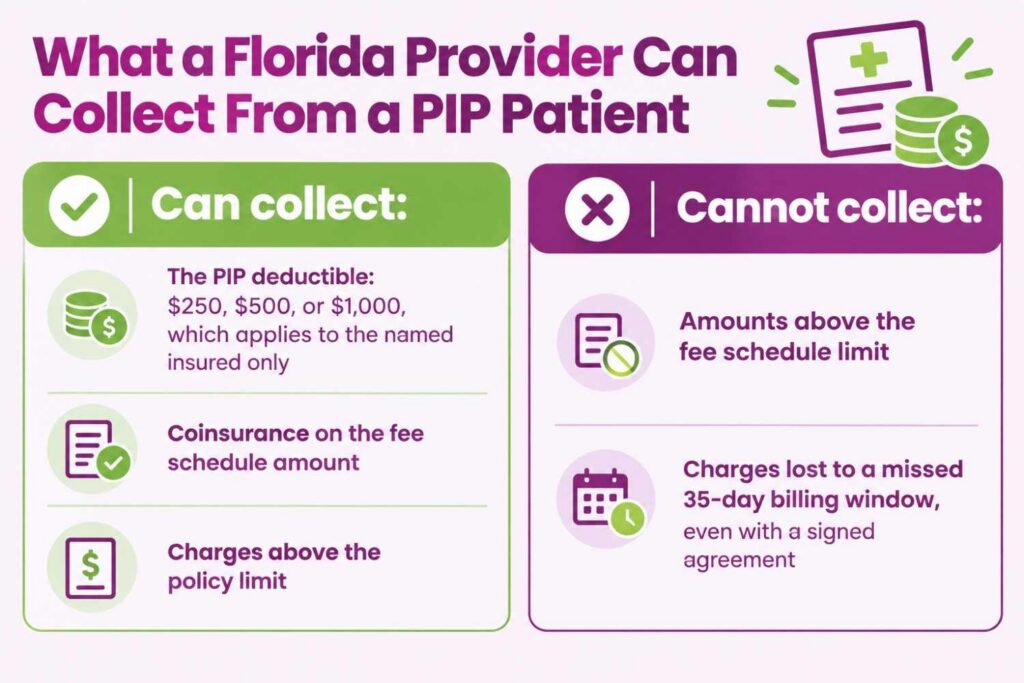
No, not above the fee schedule limit. When an insurer limits payment under the schedule, Section 627.736(5)(a)4 bars the provider from billing the insured for the excess. Your practice can still bill the coinsurance and charges above the policy limits. Health plans follow separate balance billing rules in Florida under Sections 627.64194 and 641.3154.
How Does the PIP Deductible Affect Provider Payment?
The PIP deductible comes off 100% of covered expenses before the insurer pays benefits. Section 627.739 requires insurers to offer deductibles of $250, $500, and $1,000.
- Who it covers: The deductible applies only to the named insured and, if elected, resident dependent relatives.
- Who it skips: Passengers and other covered people receive benefits without the named insured’s deductible.
- What your practice does: Collect the deductible from the patient and confirm the election with the PIP insurer.
What Are Florida’s PIP Billing Rules and Deadlines?
Florida PIP billing rules set a short billing window, a required claim format, and a signed first-visit patient form. Each rule sits in Section 627.736(5). A missed rule can make a bill unpayable even when the care was necessary.
A medical billing audit that tests PIP claims against these rules finds the errors before the insurer does. Each of the four rules below can stop payment on its own.
What Is the 35-Day PIP Billing Rule?
The 35-day PIP billing rule bars charges for services rendered over 35 days before the bill’s postmark or transmission date. Section 627.736(5)(c) sets the rule and 3 exceptions.
| Situation | Billing Window | Condition |
|---|---|---|
| Standard rule | 35 days | Counted back from the postmark or transmission date |
| Notice of initiation of treatment | 75 days | The notice reaches the insurer within 21 days of the first examination or treatment |
| Patient gave the wrong insurer | 35 days from the correct information | Proof of reliance, plus a denial letter from the wrong insurer or proof of timely mailing |
| Hospital emergency department or ambulance | No 35-day limit | The bill must identify the emergency department or ambulance as the place of service |
Past-due amounts billed on time can be rebilled later. Charges lost to a missed window cannot be billed to the patient, and any agreement saying otherwise is unenforceable. Hence, when selecting a medical billing provider in Florida, make sure they have a full grasp of local laws.
Which Claim Form and Codes Does a PIP Bill Require?
A PIP bill must use a CMS-1500 for professional services or a UB-04 for institutional services. The statute still names the UB 92, which the UB-04 replaced.
- Codes: CPT, HCPCS, and ICD-10-CM codes in effect for the year of service.
- License number: Non-hospital providers enter their professional license number in the signature box.
- Licensure: A bill cannot include services from anyone without a required license.
- Coding errors: Upcoded or unbundled charges are not payable.
- Recoding: The insurer can recode only after contacting your practice or making a documented attempt.
- Downcoding: Systematic downcoding by the insurer to deny payment is prohibited.
An incomplete claim form does not count as notice of the loss. The 30-day payment clock never starts on an incomplete bill.
What Is the PIP Disclosure and Acknowledgment Form?
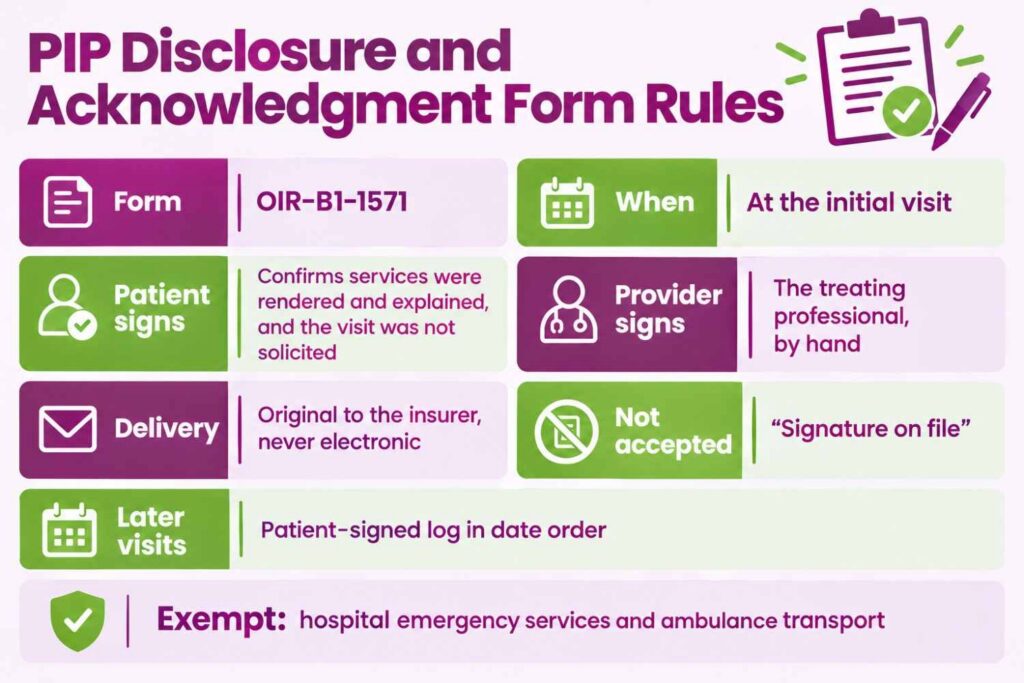
The PIP disclosure and acknowledgment form is the patient attestation your practice must collect at the initial visit. Providers use Form OIR-B1-1571, adopted under Rule 69O-176.013 of the Florida Administrative Code.
- The patient countersigns that the services were rendered and explained.
- The patient confirms that no one solicited the visit.
- The treating professional signs the form by hand.
- The original goes to the insurer and cannot be sent electronically.
- A “signature on file” notation does not count as a countersignature.
- Later visits require a patient-signed log in date order.
Hospital emergency services and ambulance transport are exempt. Services performed outside the patient’s presence, such as reading a diagnostic test, need no countersignature.
What Records Can a PIP Insurer Request?
A PIP insurer can request records, an examination, and sworn statements before paying. Section 627.736(6) and (7) set the limits on each request.
- Written report: Your practice sends a report and a sworn statement that the treatment was reasonable and necessary.
- Costs: The insurer pays the reasonable costs of producing the records.
- Payment timing: A request within 30 days of notice pushes the due date to 10 days after receipt, if later.
- Independent medical examination: An insurer stops paying a treating physician only with a valid report from a same-chapter Florida physician.
- Examination under oath: The insured must comply, since it is a condition of receiving benefits.
What Happens When a PIP Insurer Pays Late or Denies a Claim?
A Florida PIP insurer that pays late owes interest on the overdue amount. Your practice must send a demand letter before filing suit. The overdue rules, the demand letter, attorney fees, and benefit exhaustion each follow separate statutory steps.
When Is a PIP Payment Overdue?
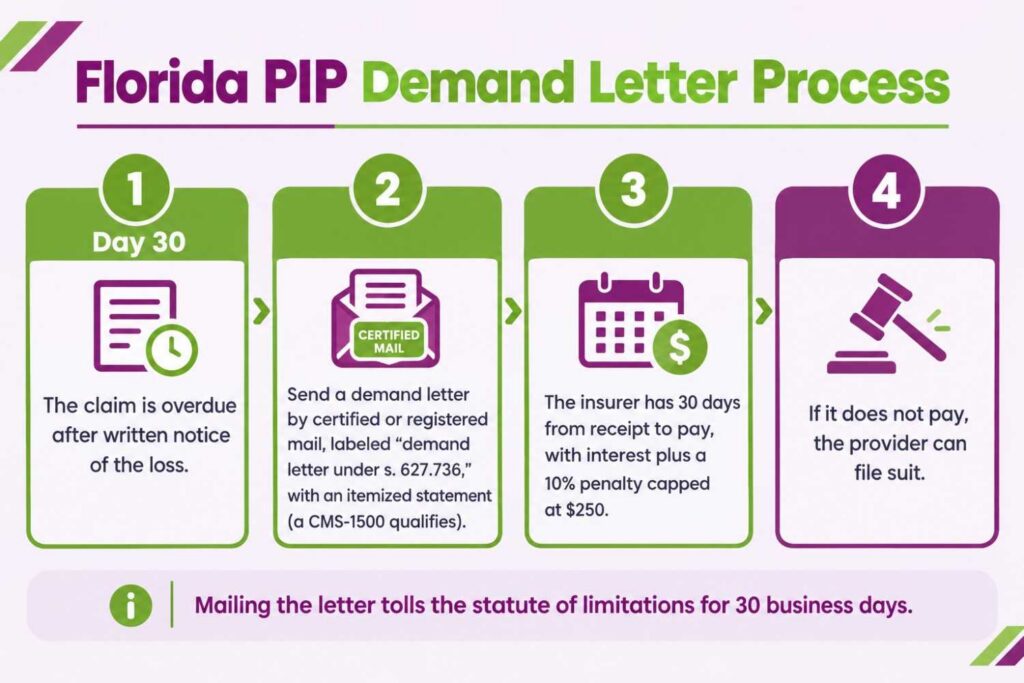
A PIP payment is overdue 30 days after the insurer receives written notice of the covered loss and its amount.
- Interest: Overdue payments bear simple interest at the Section 55.03 rate or the policy rate, whichever is greater.
- Partial payment or denial: The insurer must send an itemized explanation of each reduced or denied item.
- Revised claim: After a denial for a claim error, your practice has 15 days to submit a revised claim.
- Fraud review: The insurer must notify within 30 days and must pay or deny within 90 days of submission.
- Later challenges: The insurer can dispute relatedness, necessity, or reasonableness at any time, even after paying.
How Does the PIP Demand Letter Work?
A PIP demand letter is required before your practice files suit. The letter can be sent only after the claim is overdue. Section 627.736(10) sets 5 requirements.
- Label the notice as a “demand letter under s. 627.736.”
- Name the insured, the claim or policy number, and the treating provider.
- Attach an itemized statement; a completed CMS-1500 qualifies.
- Send the notice by certified or registered mail, return receipt requested.
- Address the notice to the person and address the insurer filed with the Office of Insurance Regulation.
An insurer that pays within 30 days, with interest and a 10% penalty up to $250, avoids suit. Mailing the demand letter tolls the statute of limitations for 30 business days.
Can Providers Recover Attorney Fees in PIP Lawsuits After 2023?
Generally no, for policies issued or renewed after March 24, 2023. HB 837 repealed Section 627.428, the one-way attorney fee statute that let winning providers recover fees. Bills to restore fees for providers, HB 1437 and SB 1840, died on June 16, 2025. Narrow routes remain, such as offers of judgment under Section 768.79.
What Happens When PIP Benefits Are Exhausted?
PIP benefits run out when payments reach the $10,000 or $2,500 limit. Accident-related bills then move to the patient’s health coverage or Medicare as the secondary payer.
- Exhaustion notice: On request, the insurer must tell the insured or assignee within 15 days that limits are reached.
- Emergency reserve: For 30 days after accident notice, the insurer must hold $5,000 for emergency and inpatient physicians and dentists.
- Single lawsuit: All claims for the same provider and patient must be brought in one action.
How Do Patient Brokering and Fraud Rules Affect PIP Claims?
Patient brokering and fraud rules can void a PIP claim and expose a provider to an insurer lawsuit. Section 627.736(12) and (17) tie the No-Fault Law to Florida’s brokering, fraud, and kickback statutes.
- Brokering: Claims generated by patient brokering under Section 817.505 are not reimbursable.
- Civil action: Insurers can sue anyone convicted of, or pleading guilty or no contest to, a related offense.
- Related offenses: These include insurance fraud under Section 817.234 and kickbacks under Section 456.054.
- Insured fraud: Proven fraud by the insured voids all PIP coverage for that claim.
- Billing tips: A person who reports improper billing in writing receives 20% of the reduction, up to $500.
How Does Transcure Support PIP Billing for Florida Practices?
Transcure runs PIP and no-fault billing for Florida practices from its Oviedo office. Three problems block PIP payment under Section 627.736: late bills, incomplete claim forms, and overdue claims left unchased.
- Late bills: Our billers track the 35-day and 75-day windows on every claim from the first visit.
- Incomplete forms: CLAIR, our claim scrubbing AI agent, scrubs each CMS-1500 for coding and form errors before submission.
- Overdue claims: ARIA, our A/R agent, tracks every open PIP claim past its 30-day due date for follow-up.
The result for your practice is PIP bills that reach the insurer complete and on time. That workflow is part of Transcure’s medical billing services in Florida, which cover PIP, no-fault, and personal injury claims.
Is PIP Billing the Same as Billing Under a Letter of Protection?
No, PIP is first-party auto insurance that pays providers under Section 627.736. PIP billing follows a fee schedule, a 35-day billing window, and a demand-letter process. A letter of protection is an arrangement to be paid from a future judgment or settlement. Section 768.0427 controls how letter of protection bills are valued as evidence.
Florida’s PIP law rewards providers who bill fast and document precisely. The 14-day rule, the EMC finding, the fee schedule, and the 35-day window each decide whether a claim gets paid. These rules sit alongside the other medical billing laws in Florida that govern every practice.
Frequently Asked Questions About Florida’s PIP Law
Can You Opt Out of PIP in Florida?
No, most owners of vehicles registered in Florida must carry PIP. The named insured can choose a $250, $500, or $1,000 deductible. The named insured can also exclude lost-wage coverage, which lowers the premium.
How Much PIP Can You Get in Florida?
PIP pays up to $10,000 in combined medical and disability benefits, plus a $5,000 death benefit. Medical benefits stop at $2,500 when a provider determines the patient has no emergency medical condition.
What Is the New PIP Law in Florida?
Florida passed no new PIP law in 2026. The repeal bills died on March 13, 2026. The most recent change affecting providers was the 2023 repeal of one-way attorney fees under HB 837.
Does Florida PIP Cover Massage Therapy?
No, section 627.736 excludes massage therapy and acupuncture from PIP medical benefits, regardless of who provides them. Licensed massage therapists and acupuncturists cannot be reimbursed under PIP for any service.
How Long Does a PIP Insurer Have to Pay a Claim in Florida?
A PIP insurer has 30 days after written notice of the covered loss and its amount. Late payments bear interest. Claims under a fraud review must be paid or denied within 90 days of submission.
Does PIP Pay for X-Rays in Florida?
Yes, PIP medical benefits cover 80% of reasonable expenses for medically necessary X-ray services. Payment follows the fee schedule and stops at the patient’s $10,000 or $2,500 benefit limit.