Obesity ICD-10 coding sits in category E66, and one wrong character changes payment outcomes. Since October 2024, E66.811, E66.812, and E66.813 report class 1, 2, and 3 obesity. Outside pregnancy, obesity diagnoses need a matching Z68 BMI code whenever BMI is documented.
Choosing E66.9 when the chart supports class 3 obesity can erase HCC 48 capture. Wrong specificity also triggers denials for intensive behavioral therapy and bariatric surgery authorization requests. The Medicare GLP-1 Bridge, running through December 2027, requires an E66-family diagnosis on prescriptions.
CMS posted the FY 2027 ICD-10-CM update, applying to encounters from October 1, 2026. This guide follows NCHS and CMS ICD-10-CM Official Guidelines, explaining every billable E66 code. Transcure’s internal medicine billing experts help practices apply these rules without repeated claim denials.
What Are the Key Obesity ICD-10 Codes?
Obesity ICD-10 coding sits in category E66, with Z68 reporting the matching BMI value. The table below summarizes each key code, its description, and the rule that matters. NCHS and CMS maintain ICD-10-CM Official Guidelines, which require provider-documented obesity diagnoses before coding.
| Code | Description | Key Rule |
|---|---|---|
| E66.811 | Obesity, class 1 | Report E66.811 only when the provider documents class 1 obesity, usually with BMI 30–34.9. |
| E66.812 | Obesity, class 2 | Report E66.812 only when the provider documents class 2 obesity, usually with BMI 35–39.9. |
| E66.813 | Obesity, class 3 | Report E66.813 for class 3 obesity, BMI 40 or higher, which supports HCC 48. |
| E66.01 | Morbid (severe) obesity due to excess calories | Use E66.01 when the provider documents morbid or severe obesity without a documented class. |
| E66.09 | Other obesity due to excess calories | Use E66.09 when the provider links non-morbid obesity to excess calories without a class. |
| E66.1 | Drug-induced obesity | Report E66.1 with an additional T-code that identifies the drug causing the weight gain. |
| E66.2 | Morbid (severe) obesity with alveolar hypoventilation | Report E66.2 for obesity hypoventilation syndrome, which stays separate from sleep apnea code G47.33. |
| E66.89 | Other obesity not elsewhere classified | Use E66.89 for documented obesity types that no other specific E66 code fully describes. |
| E66.9 | Obesity, unspecified | Avoid E66.9 when the chart supports a class, because unspecified obesity weakens risk capture. |
| E66.3 | Overweight | Report E66.3 only for documented overweight, which is not the same diagnosis as obesity. |
| Z68.- | Body mass index [BMI] | Report Z68 codes only as secondary diagnoses beside a provider-documented weight or obesity diagnosis. |
Which Codes Report Obesity Severity?
Class codes E66.811, E66.812, and E66.813 report obesity severity based on current provider documentation. These ICD-10-CM class codes took effect October 1, 2024, giving coders direct severity options. Class 1 generally covers BMI 30–34.9, while class 2 covers BMI 35–39.9 in adults.
Class 3 obesity, reported with E66.813, generally means BMI 40 or higher in adults. Provider documentation of the class, not the BMI value alone, drives final code selection. Class 3 obesity E66.813 maps to HCC 48 under the CMS risk adjustment model.
Which Codes Report Cause or Type?
Cause and type codes describe why obesity developed or which form the provider documented. E66.01 reports morbid obesity due to excess calories, and E66.09 reports other excess-calorie obesity.
Drug-induced obesity E66.1 requires an additional T-code identifying the medication that caused weight gain. Code E66.2 reports morbid obesity with alveolar hypoventilation, also called obesity hypoventilation syndrome (OHS).
Obstructive sleep apnea G47.33 is a separate diagnosis, so it never replaces code E66.2. Use E66.89 for other specified obesity types; reserve E66.9 for charts lacking any detail. Choosing E66.9 over a supported class code can erase HCC capture and trigger denials.
Which Codes Add Context?
Context codes add weight-related detail that supports medical necessity, risk adjustment, and payer review. E66.3 reports overweight, which differs from obesity and may need comorbidities for payer coverage.
Z68 BMI codes report adult or pediatric body mass index and never stand alone. A provider must document the associated condition, such as obesity, before coders add Z68. Clinicians such as nurses and dietitians may document BMI, but the provider documents obesity.
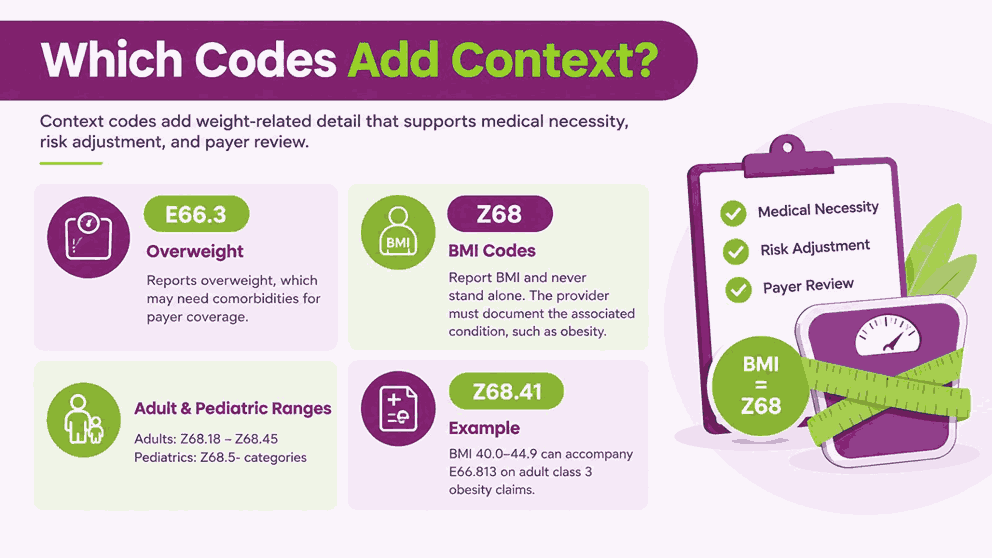
Adult codes run from Z68.18 to Z68.45, while pediatric codes use percentile-based Z68.5- categories. Z68.41, for BMI 40.0–44.9, can accompany code E66.813 on adult class 3 obesity claims.
What Is the ICD-10 Code for Obesity?
The ICD-10 code for obesity starts in category E66, Overweight and obesity, within ICD-10-CM. Coders must report a full E66 subcode because the three-character category cannot be billed. Provider documentation, not a BMI value, decides which obesity code a claim finally carries.
Internal medicine practices report E66.9, E66.811, E66.812, E66.813, and E66.01 on many obesity claims. Use ICD-10 codes for internal medicine to select diagnoses accurately across common clinical conditions.
Which Chapter and Category Covers Obesity?
ICD-10-CM places obesity in Chapter 4, Endocrine, nutritional and metabolic diseases, E00 through E89. Within that chapter, block E65 through E68 covers overweight, obesity, and other hyperalimentation conditions.
Category E66 then separates obesity by cause, severity, and special clinical presentation for coders. Parent codes E66, E66.0, E66.8, and E66.81 need more digits; billing them invites denials.
Can Coders Assign Obesity From BMI Alone?
Coders cannot assign obesity from BMI alone, because only a provider can diagnose it. ICD-10-CM Official Guidelines from NCHS and CMS require provider documentation for every diagnosis code. A chart listing BMI 32 without an obesity statement cannot support any E66 code.
Z68 BMI codes supplement a provider-documented diagnosis and never serve as the first-listed code. Nurses and dietitians may record BMI, but the provider must document the obesity diagnosis. When BMI reaches 30 without a diagnosis, coders should query the provider before coding.
How Is Overweight Different From Obesity?
Overweight and obesity are separate diagnoses, and ICD-10-CM gives each one its own code. Code E66.3 reports overweight, which generally corresponds to adult BMI between 25 and 29.9. Z68.25 through Z68.29 report those specific adult BMI values alongside the documented overweight diagnosis.
Obesity codes like E66.9 or E66.811 apply only when the provider documents obesity itself. Coding E66.9 for a patient documented as overweight misstates the diagnosis and invites audits. Payers apply separate BMI and diagnosis criteria to overweight, so E66.3 needs careful documentation.
What Is the Complete E66 Code List?
The complete E66 code list contains ten billable codes plus four non-billable parent codes. Billable status matters because claims containing a parent code can face rejection at clearinghouses.
Use the table below to confirm each code, its description, and its billable status. Confirm every code against the current ICD-10-CM tabular list published by CMS and NCHS.
| Code | Description | Billable? |
|---|---|---|
| E66 | Overweight and obesity | No (parent) |
| E66.0 | Obesity due to excess calories | No (parent) |
| E66.01 | Morbid (severe) obesity due to excess calories | Yes |
| E66.09 | Other obesity due to excess calories | Yes |
| E66.1 | Drug-induced obesity | Yes |
| E66.2 | Morbid (severe) obesity with alveolar hypoventilation | Yes |
| E66.3 | Overweight | Yes |
| E66.8 | Other obesity | No (parent) |
| E66.81 | Obesity class | No (parent) |
| E66.811 | Obesity, class 1 | Yes |
| E66.812 | Obesity, class 2 | Yes |
| E66.813 | Obesity, class 3 | Yes |
| E66.89 | Other obesity not elsewhere classified | Yes |
| E66.9 | Obesity, unspecified | Yes |
Which E66 Codes Are Not Billable?
Four codes in the E66 family act as headers: E66, E66.0, E66.8, and E66.81. Each header branches into more specific codes, so claims must report the complete subcode. Category E66.0 splits into E66.01 and E66.09, while E66.8 splits into E66.81 and E66.89.
Then E66.81 splits again into the three obesity class codes, E66.811, E66.812, and E66.813. Submitting E66.8 for class 2 obesity would fail because the code lacks needed specificity. Practice management systems and EHR code pickers should block header codes before claim submission.
What Changed in October 2024?
The CDC and NCHS added obesity class codes to ICD-10-CM effective October 1, 2024. Codes E66.811, E66.812, and E66.813 report class 1, class 2, and class 3 obesity. The same update also created E66.89 for other obesity not elsewhere classified, replacing E66.8.
Before that date, coders could report obesity severity mainly through morbid obesity code E66.01. Since April 2025, guidelines assign E66.813 alone for documented class 3 and morbid obesity.
What Changed in FY2027?
CMS posted the FY 2027 ICD-10-CM files, effective for encounters from October 1, 2026. That code set applies to all HIPAA-covered entities for encounters through September 30, 2027. FY 2027 adds adult BMI codes Z68.18 and Z68.19 for BMI values below twenty. Z68.1 becomes a header in FY 2027, so claims must use Z68.18 or Z68.19.
New endocrine codes E89.830 and E89.838 track hypoglycemia occurring after bariatric and other surgeries. Billers should verify every E66 entry against the CMS addenda before updating practice templates. Payers apply FY 2027 edits on October 1, so outdated templates can cause denials.
How Do Obesity Class Codes Work?
Obesity class codes convert provider-documented severity into three E66.81- subcodes that payers can review. Each class code replaces unspecified reporting and supports cleaner ICD-10-CM data for risk adjustment. Coders need provider documentation because NCHS and CMS guidelines bar assigning obesity based on BMI.
What BMI Ranges Match Each Class?
Adult obesity classes follow standard BMI bands, and each band maps to one E66.81- code. The table below pairs each class with its range and the rule that matters.
| Class | Adult BMI | Code | Key Rule |
|---|---|---|---|
| Class 1 | 30–34.9 | E66.811 | Report E66.811 only when the provider documents class 1 obesity, not only a BMI. |
| Class 2 | 35–39.9 | E66.812 | Report E66.812 only when the provider documents class 2 obesity, not only a BMI. |
| Class 3 | 40 or higher | E66.813 | Report E66.813 when documented, because it maps to HCC 48 in CMS risk adjustment. |
Class 1 obesity matches adult BMI 30 to 34.9 and is reported with E66.811. Class 2 obesity matches adult BMI 35 to 39.9 and is reported with E66.812. Class 3 obesity matches adult BMI 40 or higher and is reported with E66.813.
Pediatric patients use percentile-based BMI, so adult cutoffs do not apply directly to children. Report pediatric class codes with Z68.5- percentile categories only when the provider documents obesity. Clinical BMI cutoffs guide providers, but ICD-10-CM codes follow the diagnosis the provider documents.
When Is E66.813 Used Instead of E66.01?
Use E66.813 when the provider documents class 3 obesity, even if morbid obesity appears. Official guidelines assign E66.813 alone when providers document both class 3 and morbid obesity. Use E66.01 when providers document morbid or severe obesity without also documenting a class.
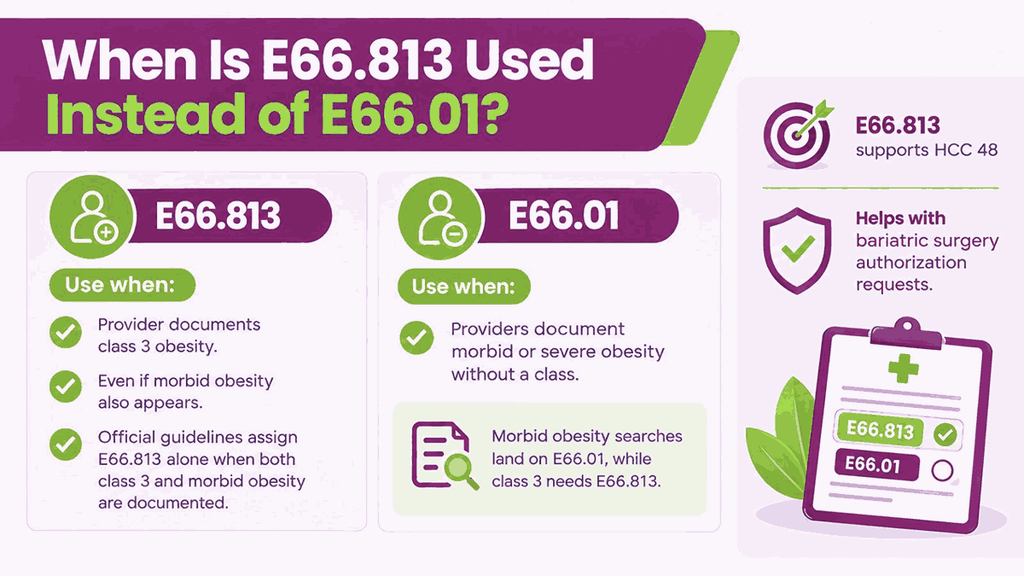
E66.01 follows morbid or severe wording, while E66.813 follows the provider’s documented obesity class. Morbid obesity ICD-10 searches land on E66.01, but class 3 documentation requires E66.813 instead. Class 3 obesity coded with E66.813 supports HCC 48 and bariatric surgery authorization requests.
Can E66.811 and E66.812 Be Used Without BMI?
Yes, providers can document class 1 or class 2 obesity without a BMI value. ICD-10-CM does not require a Z68 code for E66.811 or E66.812 to be valid. Guidelines direct coders to report Z68 only when a provider documents an associated diagnosis.
Report Z68.41 beside E66.813 when BMI 40.0 to 44.9 is documented during the encounter. Many payers require BMI for medical necessity, including GLP-1 prior authorization and bariatric reviews. Document the BMI anyway, so claims survive denials tied to missing payer weight criteria.
Which Code Fits Special Obesity Types?
Special obesity types use cause-specific or condition-specific codes instead of a plain severity class. The table below matches each scenario to its code and the main sequencing rule.
| Scenario | Code | Key Rule |
|---|---|---|
| Morbid Obesity | E66.813 or E66.01 | Use E66.813 for documented class 3 obesity and E66.01 for morbid obesity without class. |
| Drug-induced Obesity | E66.1 plus T-code | Add an adverse-effect T-code with fifth or sixth character 5 to name the drug. |
| Obesity Hypoventilation Syndrome | E66.2 | Report E66.2 for obesity hypoventilation syndrome, and add G47.33 only when providers document it. |
| Pediatric Obesity | E66.811–E66.813 plus Z68.5- | Pair the documented obesity code with a percentile-based Z68.5- code for children and teens. |
| Obesity in Pregnancy | O99.21- first | Sequence O99.21- first, add the E66 code, and never add Z68 codes during pregnancy. |
What Is the ICD-10 Code for Morbid Obesity?
Morbid obesity ICD-10 coding depends on whether providers document class 3 or morbid wording. E66.01 reports morbid or severe obesity, even when providers do not mention excess calories. E66.813 reports documented class 3 obesity, which generally means adult BMI 40 or higher.
Official guidelines assign E66.813 alone when providers document both class 3 and morbid obesity. Add Z68.41 through Z68.45 to show the matching adult BMI of 40 or more. Morbid obesity supports HCC 48 under the CMS risk adjustment model, so specificity matters. Bariatric surgery authorization requests usually need the morbid obesity code plus a documented BMI.
What Is the Code for Drug-Induced Obesity?
Drug-induced obesity ICD-10 coding uses E66.1 together with an adverse-effect T-code naming the drug. The T-code uses a fifth or sixth character 5, which marks an adverse effect. For example, glucocorticoid-related weight gain pairs E66.1 with T38.0X5A for the initial treatment encounter.
The provider must document that the medication caused the weight gain, rather than coincidence. Add the matching Z68 code when BMI is documented, because payers review weight criteria.
What Is the Code for Obesity Hypoventilation Syndrome?
Obesity hypoventilation syndrome ICD-10 coding uses E66.2, which reports morbid obesity with alveolar hypoventilation. Providers may call this OHS or Pickwickian syndrome, and both terms point to E66.2. Obstructive sleep apnea G47.33 is a separate diagnosis, so it never replaces code E66.2.
Report G47.33 beside E66.2 only when the provider also documents obstructive sleep apnea separately. Add the matching Z68 code whenever the chart documents a BMI during the encounter. Query the provider when the chart suggests hypoventilation without a clearly documented OHS diagnosis.
How Is Pediatric Obesity Coded?
Pediatric obesity ICD-10 coding pairs E66.811, E66.812, or E66.813 with percentile-based Z68.5- BMI codes. Children aged 2 through 19 use BMI-for-age percentiles instead of the fixed adult cutoffs. CDC pediatric guidance pairs E66.811 with Z68.54, E66.812 with Z68.55, and E66.813 with Z68.56. For children, CDC advises replacing E66.01, E66.09, E66.8, and E66.0 with these class codes.
Z68.51, Z68.52, and Z68.53 cover lower percentiles and do not support an obesity diagnosis. The provider must document obesity, because a BMI percentile alone cannot create E66 codes. Class codes for children depend on provider documentation, so confirm payer policy before billing.
How Is Obesity in Pregnancy Coded?
Obesity in pregnancy coding starts with O99.21-, obesity complicating pregnancy, childbirth, and the puerperium. The final character shows the trimester, childbirth, or puerperium, ranging from O99.210 through O99.215. Chapter 15 codes sequence first, so O99.21- precedes the E66 code on the claim.
Use an additional E66 code to identify the obesity class or type, like E66.813. Do not assign Z68 BMI codes during pregnancy, and consider Z3A for gestational weeks. Providers should document pre-pregnancy or first-visit BMI, while still documenting the obesity diagnosis clearly.
How Do BMI Z68 Codes Work?
BMI Z68 codes report body mass index and always supplement a provider-documented weight diagnosis. Adult codes run from Z68.1 to Z68.45, while pediatric codes use percentile-based Z68.5- categories. The table below lists adult Z68.25 through Z68.45 values for overweight and obesity claims.
| Adult BMI | Z68 Code | Usual Pairing |
|---|---|---|
| 25.0–29.9 | Z68.25–Z68.29 | E66.3 overweight |
| 30.0–34.9 | Z68.30–Z68.34 | E66.811 class 1 |
| 35.0–39.9 | Z68.35–Z68.39 | E66.812 class 2 |
| 40.0–44.9 | Z68.41 | E66.813 class 3 |
| 45.0–49.9 | Z68.42 | E66.813 class 3 |
| 50.0–59.9 | Z68.43 | E66.813 class 3 |
| 60.0–69.9 | Z68.44 | E66.813 class 3 |
| 70 or greater | Z68.45 | E66.813 class 3 |
Review the following table for pediatric BMI percentiles, which now include Z68.54 through Z68.56. Pediatric Z68.54 reports BMI at or above the 95th percentile.
| Pediatric BMI Percentile | Z68.5- Code | Usual Pairing |
|---|---|---|
| Below 5th percentile | Z68.51 | None |
| 5th to below 85th percentile | Z68.52 | None |
| 85th to below 95th percentile | Z68.53 | E66.3 overweight |
| 95th percentile to below 120% of the 95th | Z68.54 | E66.811 class 1 |
| 120% to below 140% of the 95th | Z68.55 | E66.812 class 2 |
| 140% or more of the 95th | Z68.56 | E66.813 class 3 |
Pediatric Z68.54, Z68.55, and Z68.56 report severity as percentages of the 95th percentile BMI. Z68.51 through Z68.53 cover lower percentiles and never replace a documented obesity diagnosis code.
Can Z68 Be Billed Alone?
No, Z68 codes cannot be billed alone, because they only describe a simple measurement. Official Guidelines from NCHS and CMS require an associated provider-documented condition, such as obesity. List the E66 code first, then report the matching Z68 code right after it.
Z68.41 alone lacks a documented diagnosis, so risk adjustment audits can reject HCC 48. Medicare G0447 claim lines must carry a Z68.30–Z68.45 BMI code beside the E66 diagnosis.
Who Can Document the BMI?
Nurses, dietitians, and medical assistants may document the BMI value in the patient chart. The treating provider must still document the associated diagnosis, such as obesity or overweight. Code Z68 from clinician notes only when the provider documents the related weight diagnosis. Conflicting BMI entries between the provider and clinician should trigger a provider query first.
How to Code Obesity Step by Step?
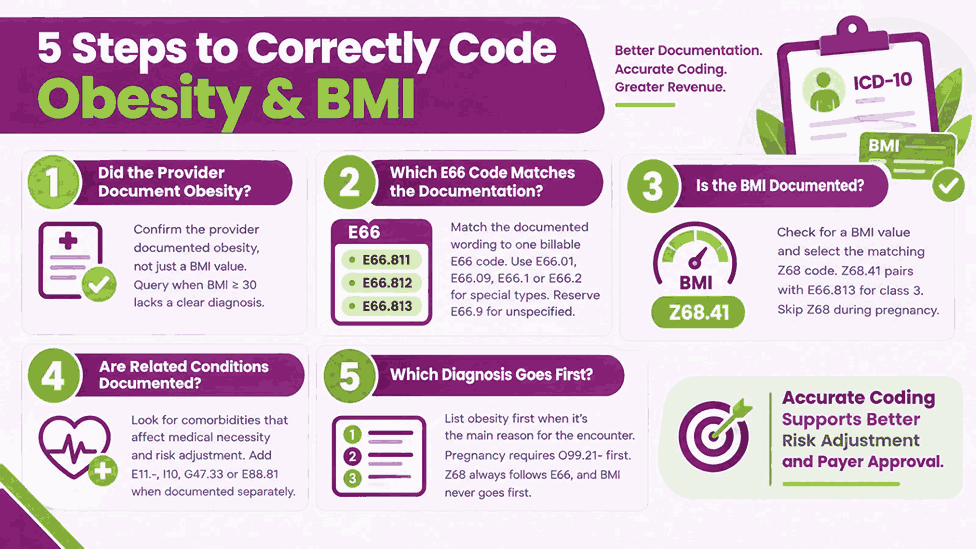
An ICD-10 coding guide can help coders verify documentation, sequencing rules, and code updates. Follow these five steps to code obesity from the chart to a clean claim. Each step reflects ICD-10-CM Official Guidelines published by NCHS and CMS for coding obesity.
Step 1: Did the Provider Document Obesity?
Start by confirming the provider documented obesity itself, not merely a listed BMI value. A chart showing BMI 32 without an obesity statement cannot support any E66 code. Query the provider whenever BMI reaches 30 and the note lacks a clear diagnosis.
Step 2: Which E66 Code Matches the Documentation?
Match the documented wording to one billable E66 code, never a non-billable parent header. Class 1, class 2, and class 3 obesity map to E66.811, E66.812, and E66.813. Use E66.01, E66.09, E66.1, or E66.2 when the provider documents the cause or special type. Reserve E66.9 for charts lacking class or type detail; unspecified obesity weakens risk capture.
Step 3: Is the BMI Documented?
Check whether the encounter documents a BMI value, then select the matching Z68 code. Adult BMI 40.0 to 44.9 reports Z68.41, which pairs with E66.813 for class 3. Many payers require BMI for GLP-1 prior authorization and bariatric surgery medical necessity reviews. Skip Z68 codes during pregnancy, because Official Guidelines prohibit BMI codes for pregnant patients.
Step 4: Are Related Conditions Documented?
Next, review the note for comorbidities that affect medical necessity, severity, and risk adjustment. Add E11.-, I10, G47.33, or E88.81 when the provider documents those linked conditions separately. Do not assume a causal link between obesity and a comorbidity without provider documentation.
Step 5: Which Diagnosis Goes First?
Finally, sequence diagnoses according to the reason for the encounter and ICD-10-CM Official Guidelines. List obesity first when the provider treats or evaluates it as the main reason. Pregnancy changes that order, because the O99.21- code must precede any listed E66 code.
Z68 always follows its E66 code, and BMI never serves as the first-listed diagnosis. Secondary obesity codes still count for risk adjustment when the provider documents them clearly.
How to Code Obesity With Comorbidities?
Comorbidities change medical necessity and risk adjustment, so each condition needs separate provider documentation. The table below shows common pairings, with the code order that coders usually follow. Class 3 obesity E66.813 supports HCC 48 even when comorbidities appear on the claim.
| Condition | Code | Key Rule |
|---|---|---|
| Type 2 diabetes | E11.- | Report the specific E11 code beside E66 and Z68 when the provider documents both. |
| Hypertension or CKD | I10, I12.-, N18.- | Hypertension with CKD uses I12.- plus an N18.- stage code, and never I10 alone. |
| Sleep apnea | G47.33 | Report G47.33 only when the provider documents obstructive sleep apnea, separate from E66 coding. |
| Metabolic syndrome | E88.81 | Report E88.81 when documented, and add codes for each associated condition the provider lists. |
Obesity With Type 2 Diabetes?
Type 2 diabetes with obesity uses an E11.- code plus the documented E66 code. Add the matching Z68 code, and use Z79.4 only when insulin therapy is documented. Long-term GLP-1 injectable use for diabetes reports Z79.85 alongside the matching E11 diabetes code. Never assume diabetes is obesity-related unless the provider documents that connection clearly in writing.
Obesity With Hypertension or CKD?
Hypertension and CKD each need provider documentation before coders add I10, I12.-, or N18.-. ICD-10-CM presumes a causal link between hypertension and CKD, so I12.- applies by default. Transcure’s hypertension and CKD ICD-10 guides explain those combination codes in much greater detail.
Obesity With Sleep Apnea?
Obstructive sleep apnea reports G47.33, and it never replaces any E66 obesity diagnosis code. Report both codes when the provider documents obesity and sleep apnea in the encounter. Obesity hypoventilation syndrome uses E66.2, while G47.33 requires separate documentation of obstructive sleep apnea.
Obesity With Metabolic Syndrome?
Metabolic syndrome reports E88.81 and may appear beside obesity, hypertension, or type 2 diabetes. The E88.81 tabular note instructs coders to add codes for each documented associated condition. Do not code metabolic syndrome from lab values, because only providers can diagnose it.
What Are the Excludes and Sequencing Rules?
Excludes notes, code-first instructions, and sequencing rules decide how obesity codes appear on claims. ICD-10-CM Official Guidelines from NCHS and CMS govern both topics for every covered entity.
Which Conditions Are Excluded From E66?
Category E66 carries Excludes2 notes for conditions that are not included in obesity codes.
| Excluded Condition | Code | Key Rule |
|---|---|---|
| Prader-Willi syndrome | Q87.11 | Report Q87.11 for Prader-Willi syndrome, and add E66 codes only when obesity is documented. |
| Adiposogenital dystrophy | E23.6 | Report E23.6 for adiposogenital dystrophy, and add E66 codes only when obesity is documented. |
| Lipomatosis, including Dercum disease | E88.2- | Report E88.2- for lipomatosis or Dercum disease, and add E66 only when obesity coexists. |
Excludes2 means the listed condition is not included, so both codes may be reported. E66.01 carries its own Excludes1 note, which bars reporting hypoventilation code E66.2 beside it. Practice EHR code pickers should flag E66.01 with E66.2 before claims ever reach clearinghouses.
When Does Obesity Go First?
Sequence obesity first only when the provider evaluates or treats it at the visit. Intensive behavioral therapy claims list E66, and Medicare requires a Z68 code on G0447. Medicare intensive behavioral therapy under G0447 requires a documented BMI of 30 or higher.
When another condition drives the visit, list it first and report obesity as secondary. Pregnancy reverses that order, because the O99.21- code must always precede the E66 code. Z68 always follows its E66 code, and BMI never serves as the first-listed diagnosis.
What Documentation Supports Obesity Codes?
Obesity codes survive audits only when the chart shows clear provider-documented diagnosis and severity. The table below summarizes what each code group needs before coders submit the claim.
| Code Group | Codes | Key Rule |
|---|---|---|
| Class and Morbid Obesity | E66.811, E66.812, E66.813, E66.01 | Document the obesity class or morbid obesity wording in the provider note each visit. |
| Drug-induced Obesity | E66.1 plus T-code | Document the causal drug and provider statement linking that drug to the weight gain. |
| Obesity Hypoventilation Syndrome | E66.2 | Document obesity hypoventilation syndrome and the supporting evidence, such as elevated carbon dioxide levels. |
| BMI and Medical Necessity | Z68.- | Record the measured BMI, height, weight, and date, because payers review these weight criteria. |
What Must Support Class and Morbid Obesity Codes?
Class and morbid obesity codes need a provider statement naming the class or severity. A BMI of 40 or higher alone cannot support E66.813 without matching provider documentation. Record clinical reasons for severity, such as comorbidities, functional limits, or failed weight management.
Bariatric surgery authorization requests usually need BMI, comorbidities, and prior supervised weight loss attempts. Documenting both class 3 and morbid obesity still results in E66.813 alone, per official guidelines.
What Must Support E66.1 and E66.2?
Drug-induced obesity needs documentation naming the medication and stating that it caused weight gain. Coders then add the adverse-effect T-code, which identifies the drug class responsible for the gain. Obesity hypoventilation syndrome needs a provider diagnosis, not just obesity plus low oxygen readings.
Supporting evidence may include daytime hypercapnia, sleep study results, and documented clinical respiratory symptoms. Report G47.33 beside E66.2 only when providers clearly and separately document obstructive sleep apnea.
What Supports Z68 and Medical Necessity?
Z68 codes need a documented BMI plus a provider-documented weight diagnosis from that visit. Medical necessity follows payer criteria, so notes should show BMI, comorbidities, and treatment plans. GLP-1 prior authorization often asks for BMI, weight history, comorbidities, and lifestyle intervention attempts.
The Medicare GLP-1 Bridge requires an E66-family diagnosis on prescriptions, so specificity protects coverage. Intensive behavioral therapy under G0447 requires documented BMI of 30 or higher, per Medicare.
Which CPT Codes Pair With Obesity?
Obesity codes pair with CPT and HCPCS codes for visits, counseling, nutrition, and surgery. Review CPT codes for internal medicine when selecting services for evaluation, management, and care. The table below lists common obesity service codes, with the diagnosis and payer rule.
| Service | Code | Key Rule |
|---|---|---|
| Office E/M Visit | 99202–99215 with modifier 25 | Append modifier 25 when a significant, separate E/M accompanies counseling or procedures that day. |
| Preventive Counseling | 99401–99404 | Time-based counseling codes need documented minutes, topics discussed, and the supporting obesity diagnosis code. |
| Medicare Behavioral Counseling | G0447 | Report G0447 for Medicare counseling with a Z68.30–Z68.45 code showing BMI 30 or higher. |
| Group Behavioral Counseling | G0473 | Report G0473 for 30-minute group counseling with a Z68.30–Z68.45 code, per current Medicare rules. |
| Medical Nutrition Therapy | 97802–97804 | Medical nutrition therapy codes often need a referral, documented diagnosis, and payer-specific coverage checks. |
| Bariatric Surgery | 43644, 43775 | Bariatric surgery claims need documented BMI, comorbidities, and payer-specific prior authorization before the procedure. |
Modifier 25 prevents denials when counseling and a separate evaluation occur during one visit. Code 43644 reports laparoscopic gastric bypass with Roux-en-Y, while 43775 reports laparoscopic sleeve gastrectomy.
Link every obesity-related service line to the E66 code and the matching Z68 code. G0447 and G0473 follow Medicare coverage rules, so confirm current national coverage determination requirements.
What Are Common Denial Patterns?
Most obesity claim denials trace back to a few repeatable documentation and coding errors. Choose endocrinology medical billing services for support with complex coding, claims, and payer requirements. The table below lists each issue, its root cause, and the fix coders apply.
| Issue | Root Cause | Fix |
|---|---|---|
| E66.9 Billed Despite Documented Class | Template defaults to unspecified obesity | Update templates to prompt for class, then report E66.811, E66.812, or E66.813 when documented. |
| Z68 Billed without Obesity Diagnosis | BMI recorded by clinical staff only | Query the provider for a documented obesity diagnosis before billing any Z68 BMI code. |
| Parent Code Submitted (E66.8, E66.81) | Code picker allows header codes | Block non-billable header codes in the EHR and require a complete billable E66 subcode. |
| Missing BMI on GLP-1 or Bariatric Request | Weight not documented at the visit | Record height, weight, and BMI at every visit, and attach them to authorization requests. |
| E66.3 Billed for an Obesity-only Policy | Provider documented overweight, not obesity | Confirm the provider documented obesity itself, and never convert overweight into an obesity code. |
| G47.33 Replaces E66.2 | Obesity hypoventilation confused with sleep apnea | Report E66.2 for obesity hypoventilation syndrome, and add G47.33 only for separately documented apnea. |
| E/M Denied with Counseling | Modifier 25 omitted by billing | Append modifier 25 when a separate evaluation accompanies counseling or another billable same-day service. |
Denial Scenario: A Medicare patient with BMI 42 receives counseling, but the claim lists only E66.9. Medicare denies G0447 with CARC 167 because the claim lacks a qualifying Z68 code. The coder confirms the documented BMI of 42, then adds Z68.41 to the claim. The coder also queries the provider because a documented class would replace unspecified E66.9.
How Do GLP-1 Claims Use E66?
GLP-1 claims depend on a documented obesity diagnosis, recorded BMI, and matching payer criteria. Payers compare the diagnosis code against coverage criteria, so E66 specificity can affect approval.
Which Diagnosis Supports Prior Authorization?
Prior authorization for weight-loss GLP-1 drugs usually needs an E66-family diagnosis with documented BMI. Class codes E66.811, E66.812, and E66.813 show severity, which plans compare against BMI thresholds. E66.9 may still pass some reviews, but it gives reviewers less proof of need.
Overweight code E66.3 may need documented comorbidities, such as prediabetes or hypertension, for coverage. Document BMI, weight history, comorbidities, and prior lifestyle attempts in the note supporting authorization. Diabetes GLP-1 prescriptions use E11.- codes instead, so avoid obesity codes for diabetes-only therapy.
What Does the Medicare GLP-1 Bridge Require?
Through December 2027, the Medicare GLP-1 Bridge requires an E66-family diagnosis code on prescriptions. Prescribers should list the most specific documented E66 code, rather than defaulting to E66.9. Keep BMI, comorbidities, and the obesity diagnosis documented in the chart for program review.
CMS publishes program rules, so confirm eligibility and covered drugs on its current page. Prescriptions must also carry the note SEND TO BRIDGE FOR WEIGHT MANAGEMENT, per CMS. Patients with type 2 diabetes, moderate-to-severe sleep apnea, or MASH go through Part D.
How Does Obesity Affect Risk Adjustment?
Obesity codes affect risk adjustment because only severe obesity maps to a payment-relevant HCC. The table below compares codes that capture HCC 48 with codes that do not.
| Code | Description | HCC 48 Capture | Key Rule |
|---|---|---|---|
| E66.813 | Obesity, class 3 | Yes | Report E66.813 when the provider documents class 3 obesity, because it supports HCC 48. |
| E66.01 | Morbid (severe) obesity due to excess calories | Yes | Report E66.01 when the provider documents morbid obesity, which also supports HCC 48 capture. |
| E66.811 | Obesity, class 1 | No | E66.811 reports class 1 obesity, which does not map to HCC 48 by itself. |
| E66.812 | Obesity, class 2 | No | E66.812 reports class 2 obesity, which also does not map to HCC 48 alone. |
| E66.9 | Obesity, unspecified | No | E66.9 reports unspecified obesity, which gives risk models almost no severity detail to score. |
| Z68.41 | BMI 40.0–44.9, adult | Yes | Z68.41 through Z68.45 map to HCC 48, but audits still expect a provider diagnosis. |
Risk adjustment reviews diagnoses yearly, so providers must document obesity class at face-to-face visits. Correcting E66.9 to E66.813 when charts support class 3 restores lost HCC 48 capture.
CMS applies the CMS-HCC model to Medicare Advantage, so coding accuracy affects plan payments. Unsupported HCC codes create audit exposure, so never upcode obesity class without provider documentation.
What Do Coders Often Ask?
Coders ask these five questions most often, and each answer follows official ICD-10-CM guidance.
ICD-10 Code for BMI Over 40?
BMI of 40 or higher uses Z68.41 through Z68.45, depending on the measured value. Add E66.813 when the provider documents class 3 obesity, or E66.01 for morbid obesity.
Is E66.9 Billable?
Yes, E66.9 is billable, but it reports unspecified obesity and weakens risk adjustment capture. Use it only when the provider documents obesity without a class, cause, or type.
Does E66.01 Still Apply in 2026?
Yes, E66.01 remains a billable code for morbid or severe obesity in FY 2027. Use E66.813 instead when the provider documents class 3 obesity, which is more specific.
Can Z68 Replace an Obesity Diagnosis?
No, Z68 codes never replace an obesity diagnosis, because they only report measured BMI. The provider must document obesity, and coders then add Z68 as a secondary diagnosis.
ICD-10 Code for Class 2 Obesity?
Class 2 obesity reports E66.812, which generally matches adult BMI between 35 and 39.9. Add Z68.35 through Z68.39 to show the documented adult BMI on the same claim.