Urology practices run on precision. Cystoscopy findings, prostate biopsy results, and PSA trends all demand exact documentation. A generic electronic health record cannot keep pace with this level of detail.
This is where a urology EMR changes the equation. It gives urologists purpose-built tools for the procedures, labs, and billing codes unique to the specialty.
More than 90 percent of urology practices in the United States now use a certified EHR. That adoption is not optional. MIPS payment adjustments of up to 9 percent are tied directly to EMR-driven quality reporting.
This guide covers everything a urology practice needs to know. It walks through core features, leading software vendors, certification requirements, integrations, pricing, and a full selection framework.

What is a Urology EMR?
A urology EMR is a specialty-configured EHR platform. It supports the clinical, documentation, workflow, and billing needs specific to urology practices.
It differs from a generic EHR in several ways. A urology EMR comes with pre-built templates for cystoscopy, prostate biopsy tracking, urodynamic testing, and TURP or HoLEP procedures.
It also supports testosterone replacement therapy management and PSA or PSMA imaging tracking. These are not add-ons. They are core to how urologists document care. If you want more information on how Urology billing works, this guide is definitely a good read.
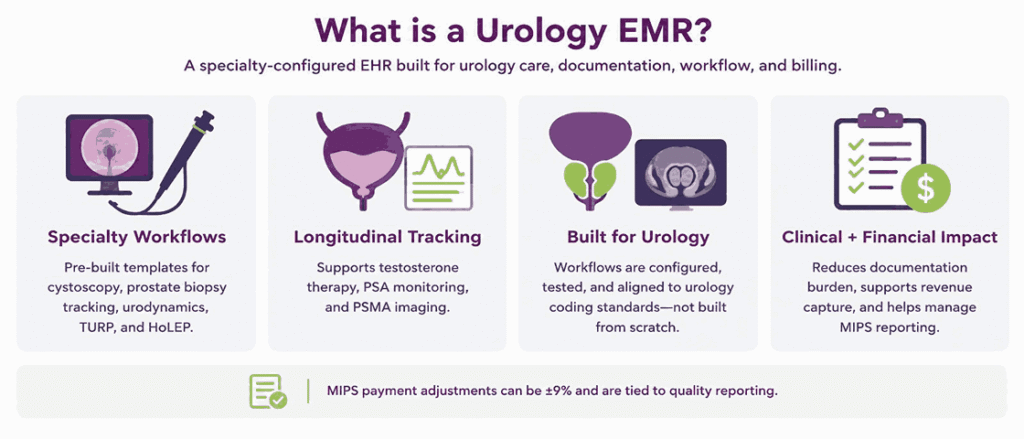
A generic EHR forces clinicians to build these workflows from scratch. A specialty EMR ships with them already configured, tested, and aligned to urology coding standards. The stakes are financial as well as clinical. MIPS payment adjustments of plus or minus 9 percent are tied directly to EMR-driven quality reporting.
Practices that select the wrong system often struggle with both documentation burden and revenue capture. The right urology EMR reduces both risks simultaneously.
What Features Does a Urology EMR Include?
Specialty EMRs distinguish themselves through features that generic ambulatory systems simply do not offer. The following capabilities separate a true urology EMR from a repurposed general platform.
1. Urology-Specific Encounter Templates
A urology EMR provides pre-built templates for the most common visit types. These include BPH evaluation, prostate cancer surveillance, kidney stone workup, hematuria evaluation, UTI management, erectile dysfunction, incontinence assessment, and testosterone therapy monitoring.
Practices using these templates typically reduce documentation time by 30 to 50 percent compared to generic EHR templates.
2. Cystoscopy Documentation and Imaging Capture
Structured cystoscopy documentation includes bladder mapping diagrams and lesion location capture. Image and video integration links directly to the encounter note. This supports both clinical continuity and billing documentation for CPT codes 52000, 52204, 52224, and 52234 through 52240.
3. Prostate Biopsy Tracking and PSA Trending
A urology EMR tracks both systematic and MRI-fusion prostate biopsies. It records Gleason scores by core, along with PIN findings, ASAP results, and the post-biopsy plan. PSA trending charts calculate velocity, doubling time, and PSA density. Automated flags alert clinicians when PSA changes exceed clinical thresholds.
3. Urodynamic Device Integration
Integration with devices from Laborie, Medstar, and Andromeda auto-captures cystometrogram, uroflowmetry, EMG, and voiding pressure data. This connection reduces manual data entry by 60 to 80 percent. It also improves billing accuracy for CPT codes 51725 through 51798.
4. TRT Management
Testosterone replacement therapy modules include dosing calculators and injection scheduling. They track testosterone levels and monitor hematocrit over time. DEA-compliant electronic prescribing supports Schedule III controlled substances. Automated reminders prompt follow-up labs and PSA monitoring per AUA guidelines.
5. Kidney Stone and Ureteroscopy Workflow
Stone analysis tracking pairs with 24-hour urine metabolic panel results. Dietary counseling documentation and ureteroscopy or lithotripsy procedure tracking round out the workflow. Stone recurrence prevention protocols integrate directly into the encounter process.
6. Integrated CPT and ICD-10 Coding
Urology-specific codes for cystoscopy, TURP, ureteroscopy, and prostatectomy connect directly to the documentation. ICD-10 codes such as N40 for BPH, C61 for prostate cancer, and N20 for stones link automatically. This integration reduces coder rework by 40 to 60 percent and drives higher first-pass clean claim rates.
7. Patient Portal Access
Urology-focused portals support secure messaging and PSA or lab result review. Patients can schedule appointments, request refills, and manage TRT scheduling. Portal adoption among 30 to 60 percent of active patients reduces phone call volume and supports MIPS Promoting Interoperability scoring.
8. MIPS Quality Reporting
Urology-relevant measures include prostate cancer follow-up under Measure 102, BPH quality of life, and controlled substance monitoring. Since MIPS reporting directly affects Medicare payment adjustment, EMR-driven reporting functions as a direct revenue lever rather than a compliance afterthought.
What are the Top Urology EMR Software Products?
Several vendors have built genuine urology-specific depth. Here is how the leading options compare.
1. Modernizing Medicine EMA Urology
Modernizing Medicine EMA Urology is one of the most widely used urology-specific EMRs on the market today. It runs on an iPad-native, touch-based workflow built specifically for urology encounters. The platform includes integrated practice management, a patient portal, and revenue cycle management in one suite.
Because Modernizing Medicine also serves dermatology, orthopedics, and ophthalmology, its specialty focus gives EMA Urology unusual depth. Many practices choose it for its modern interface and strong urology template library.
2. gMed
It is now owned by Modernizing Medicine and focuses specifically on urology and gastroenterology practices. It offers deep specialty templates built around procedure-heavy workflows and structured endoscopy documentation.
The platform includes integrated practice management to support billing and scheduling in one system. gMed suits mid-size to large practices that handle high procedure volume on a regular basis. Since the acquisition, gMed customers have a defined migration path toward the newer EMA Urology platform.
3. Nextech
Nextech Urolog provides structured cystoscopy documentation alongside direct urodynamic device integration for clinical workflows. The platform also includes integrated practice management, connecting clinical documentation with billing and scheduling.
Nextech is a common choice for mid-size urology practices seeking specialty depth without sacrificing cloud flexibility. Its urology-specific modules cover the core procedures most practices need daily. Practices often select Nextech when they want a balance of specialty focus and manageable implementation timelines.
4. NextGen
NextGen Urology delivers a specialty-tuned configuration built on top of the NextGen Enterprise EHR platform. It combines urology-specific templates with practice management integration and enterprise-level scalability.
Large urology groups and health system-affiliated practices typically select this option for its ability to scale. NextGen supports multi-location deployments and complex organizational structures common among larger groups. Its enterprise architecture makes it a frequent choice for practices tied to hospital systems or regional networks.
5. eClinicalWorks (eCW)
eClinicalWorks (eCW) for Urology offers urology-specific templates and workflow tools within its broader ambulatory EHR platform. The system pairs strong practice management integration with the Healow patient portal for communication.
Telehealth capability is also built directly into the platform, supporting virtual visits without added software. Competitive pricing makes eCW popular among small-to-mid urology practices watching their technology budget closely. Its broad functionality appeals to practices wanting one platform for clinical and administrative needs.
6. AdvancedMD
It is a cloud-based EMR built with urology-specific templates and integrated revenue cycle management tools. The platform combines clinical documentation, practice management, and billing in a single cloud environment.
AdvancedMD targets small to mid-size urology practices that want an all-in-one solution. Its cloud architecture reduces the need for on-site infrastructure or dedicated IT support staff. Strong billing integration is often cited as a key reason practices choose this platform.
7. Meditab IMS
It offers a urology-specific configuration of its Intelligent Medical Software platform with customizable templates. The system supports specialty workflows tailored to urology documentation, coding, and clinical decision support needs.
Meditab is positioned at mid-market pricing, making it accessible to practices with moderate technology budgets. It suits practices seeking specialty depth without the higher cost of enterprise-level platforms. Customization options allow practices to adjust templates as their workflows evolve.
8. Athenahealth
It runs urology-tuned workflows within the broader athenaClinicals cloud EHR platform. The system is known for strong claim scrubbing and network-driven benchmarking against similar practices. Athenahealth offers a percent-of-collections pricing model, which some urology groups prefer for aligned incentives.
This structure ties vendor revenue directly to practice collections rather than flat subscription fees. Groups focused on revenue cycle performance often find this alignment appealing during vendor evaluation.
9. WRS Health
WRS Health Urology is a cloud EMR built specifically for small urology practices from the ground up. It combines urology-specific templates, a patient portal, and integrated practice management in one platform.
WRS is positioned as an affordable cloud alternative for solo and small-group urology practices. Its pricing structure and implementation scope are designed around smaller practice needs and budgets. Practices with limited administrative staff often find its streamlined setup easier to manage.
10. Epic EMR
It is an enterprise EHR commonly used by health-system-affiliated urology practices and large groups. Urology templates are configured within the broader enterprise platform rather than built specifically for the specialty.
The system provides the deepest integration with hospital ancillaries, labs, and imaging departments. However, they generally lack the specialty-first workflow depth found in dedicated urology EMRs. Practices tied to hospital systems often use them despite this workflow tradeoff.
Why Does ONC Certification Matter for Urology EMR?
ONC certification is not a technicality. It determines whether a practice can participate fully in Medicare programs and interoperability initiatives.
The Office of the National Coordinator for Health IT certifies EHR software against interoperability, security, and clinical documentation standards. The 2015 Edition Cures Update is the current baseline. ONC-certified EHRs are required for MIPS Promoting Interoperability reporting and Medicare Advantage participation.
The 21st Century Cures Act requires vendors to provide patient access to structured health data through FHIR APIs. It also prohibits information blocking and supports price transparency. Choosing a Cures-compliant EMR ensures patient-facing API access and regulatory alignment.
FHIR APIs, short for HL7 Fast Healthcare Interoperability Resources, expose patient data for exchange and third-party app integration. For urology practices, this supports connections to prostate biopsy tracking apps, urodynamic devices, and clinical decision support tools.
HIPAA and HITECH compliance covers privacy, security, and breach notification requirements. This includes encryption at rest and in transit, role-based access control, audit logging, and business associate agreements.
EPCS certification, which stands for Electronic Prescribing of Controlled Substances, is essential for urology practices prescribing testosterone. Testosterone is a Schedule III controlled substance, and EPCS requires two-factor authentication, DEA compliance, and full audit logging. All major urology EMRs now support it.
MIPS Promoting Interoperability scoring accounts for 25 percent of the total MIPS score. It requires EMR-driven attestation of e-prescribing, patient portal access, health information exchange, and public health reporting. Practices using ONC-certified systems meet these requirements and avoid negative payment adjustments.
What Integrations Does a Urology EMR Need?
An EMR is only as useful as the systems it connects to. These are the integrations that matter most for urology workflows.
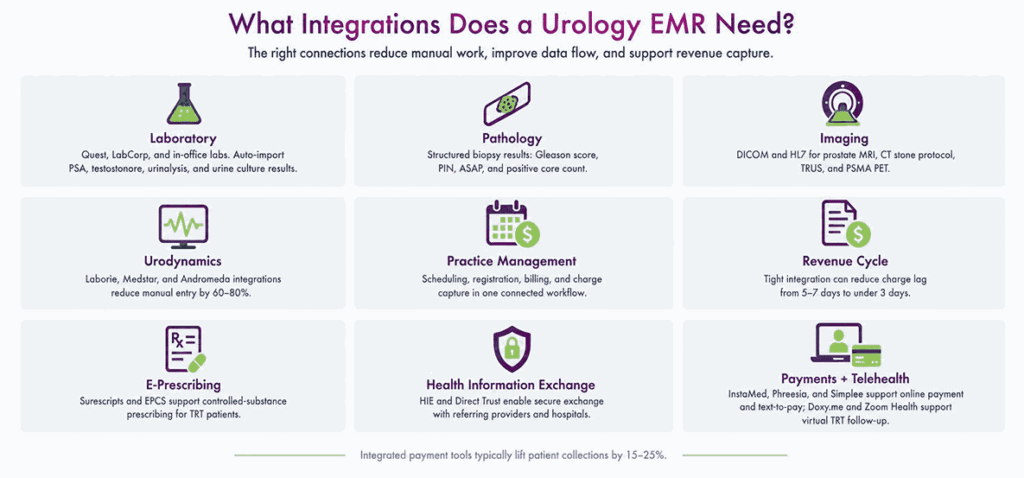
- Laboratory interfaces with Quest and LabCorp pull PSA, testosterone, urinalysis, and urine culture results automatically. In-office lab integration also auto-populates the encounter note.
- Pathology integration delivers structured biopsy results, including Gleason score, PIN, ASAP, and positive core count, directly into the record.
- Imaging integration via DICOM and HL7 brings MRI prostate, CT stone protocol, transrectal ultrasound, and PSMA PET results into the encounter. This is essential for PI-RADS scoring and MRI-fusion biopsy planning.
- Urodynamic device integration with Laborie, Medstar, and Andromeda equipment reduces manual data entry by 60 to 80 percent.
- Practice management and revenue cycle integration connects scheduling, registration, and billing directly to charge capture. Tight integration reduces charge lag from 5 to 7 days down to under 3 days.
- E-prescribing and EPCS integration through Surescripts supports controlled substance prescribing for TRT patients.
- Health information exchange and Direct Trust messaging enable secure data exchange with referring providers and hospitals.
- Patient payment integration with platforms like InstaMed, Phreesia, or Simplee supports online payment, text-to-pay, and Good Faith Estimates. Integrated payment tools typically lift patient collections by 15 to 25 percent.
- Telehealth integration through platforms like Doxy.me or Zoom Health supports virtual TRT follow-ups and post-op checks, with billing tied to CPT codes 99202 through 99215 using modifier 95.
Revenue cycle strength depends heavily on how well the EMR talks to billing systems. Many urology practices pair their EMR with dedicated Urology medical billing services to close the gap between clinical documentation and clean claim submission, since even a well-integrated EMR still needs coding and claims expertise behind it.
How Much Does a Urology EMR Cost?
Pricing varies widely depending on deployment model and vendor.
A complete, accurate table containing all 10 urology EMR platforms covers each system’s pricing:
| EMR / EHR Platform | Deployment Model | Estimated Subscription / Recurring Cost | Typical Implementation & Setup Fee | Urology Workflow & Pricing Notes |
|---|---|---|---|---|
| Modernizing Medicine (EMA Urology) | Cloud SaaS (iPad-native) | $500 – $800+ / provider / mo | $5,000 – $15,000 / provider | Touch-based specialty UI; price scales when adding integrated PM, patient portal, and RCM services. |
| gMed / gGastro (ModMed) | Cloud SaaS / Hybrid | $450 – $750 / provider/mo | $5,000 – $12,000 / provider | Geared toward high-volume procedural centers & ASCs; includes deep procedural reporting modules. |
| Nextech Urology | Cloud SaaS | $350 – $600 / provider/mo | $5,000 – $12,000 / provider | Specialized cystoscopy & urodynamic charting integrations; core clinical tier scales up with full PM. |
| NextGen Healthcare | Cloud SaaS / Enterprise | $300 – $600+ / provider / mo | $5,000 – $20,000 / provider | Enterprise scalability tuned for large groups; incorporates clinical review and MIPS compliance engines. |
| eClinicalWorks (eCW) | Cloud SaaS | $449 – $599 / provider/mo | $3,000 – $8,000 / provider | $449/mo (EHR only) or $599/mo (EHR + PM with Healow portal); optional RCM available at ~2.9% of collections. |
| AdvancedMD Urology | Cloud SaaS | $429 – $729 / provider/mo | $2,000 – $6,000 / provider | Modular pricing: ~$429 for standalone PM/billing, ~$729 bundled for EHR + PM with specialty urology templates. |
| Meditab IMS Urology | Cloud SaaS / On-Prem | $200 – $450 / provider/mo | $3,000 – $8,000 / provider | Mid-market competitive pricing; strong out-of-the-box urology templates and custom workflows without enterprise overhead. |
| athenahealth (athenaClinicals) | Cloud SaaS | 4% – 8% of net collections (or ~$400–$600 flat) | $3,000 – $10,000 / provider | All-in-one EHR, PM, and billing suite; total cost flexes directly alongside practice collections volume. |
| WRS Health (Urology-Cloud) | Cloud SaaS | $200 – $450 / provider/mo | $2,500 – $7,000 / provider | Purpose-built for solo and small practices; affordable entry tier including procedure notes and billing workflows. |
| Epic / Oracle Health (Cerner) | Enterprise Hosted / Hybrid | $1,200 – $2,500+ / provider/mo (or custom annual licensing) | $20,000 – $75,000+ / provider | Enterprise health-system solutions; premier hospital/ancillary interoperability, though lacking boutique urology agility. |
Core Cost Factors & Add-Ons
- Implementation & Onboarding: Small independent urology practices typically average $5,000 to $10,000 per provider for workflow customization, data migration, and staff training over a 3- to 6-month ramp-up window.
- Specialty Add-Ons: Dedicated patient portals, telehealth modules, and automated MIPS/MACRA compliance tracking generally add $50 to $200 per provider per month if not packaged in an all-inclusive tier.
- Volume Discounts: Multi-provider practices (10+ physicians) can typically negotiate 15% to 30% off list SaaS pricing.
How to Select the Right Urology EMR?
A structured evaluation process prevents costly mismatches between practice needs and software capability.
- Urology specialty depth. A demo built around real urology use cases, such as cystoscopy documentation and prostate biopsy tracking, reveals more than a generic sales pitch.
- Cloud versus on-premise deployment. Cloud is now the market standard, offering lower upfront cost and faster implementation. On-premise is only justified by strict data residency needs.
- Integration ecosystem. Existing integrations with labs, imaging, and urodynamic devices can save 3 to 6 months of custom integration work.
- MIPS and APM reporting capability. Since MIPS scoring affects Medicare payment by up to 9 percent, this is a direct revenue consideration.
- User interface and usability. iPad-native interfaces suit some clinicians, while traditional keyboard-based systems suit others.
- Practice management and revenue cycle integration. All-in-one platforms simplify workflow, though best-of-breed configurations preserve more flexibility.
- Vendor financial stability and roadmap. Consolidation, such as ModMed acquiring gMed, can shift long-term product direction.
- Support and training quality. Reference checks with similarly sized urology practices reveal the truth behind marketing claims.
- Total cost of ownership. The cheapest EMR is rarely the best value. Specialty depth and productivity gains usually drive stronger long-term ROI.
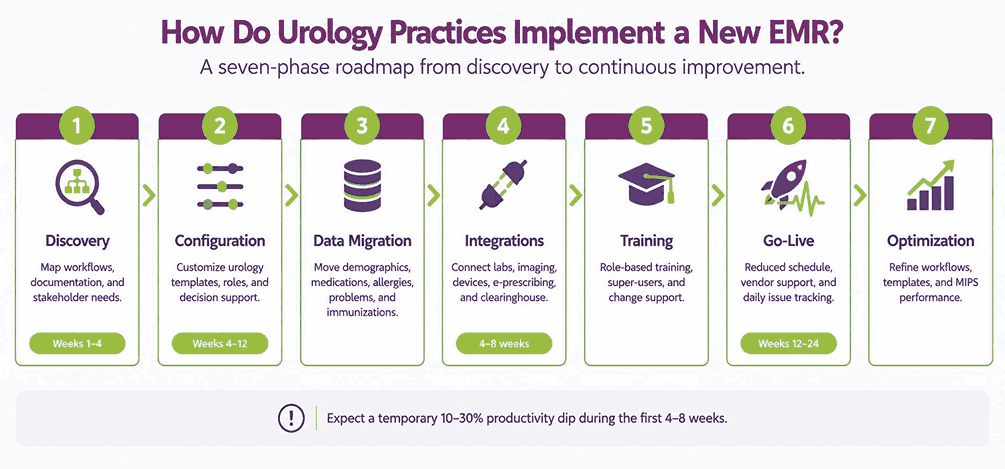
How Do Urology Practices Implement a New EMR?
Implementation follows a predictable sequence, and understanding each phase helps practices set realistic expectations.
Phase 1: Discovery and Workflow Analysis (Weeks 1-4)
Captures current workflows, documentation patterns, and stakeholder requirements. Thorough discovery reduces surprises later in the project.
Phase 2: Configuration and Customization (Weeks 4-12)
Covers urology template customization, user role setup, and clinical decision support tuning. Vendor teams typically lead this work through weekly workshops.
Phase 3: Data Migration
Moves patient demographics, active problem lists, medication history, allergy history, and immunization records from the legacy system. The choice between full historical migration and a limited lookback period significantly affects both timeline and cost.
Phase 4: Integration Setup
Connects lab HL7 interfaces, imaging DICOM feeds, urodynamic devices, e-prescribing networks, and the clearinghouse. Integration testing typically takes 4 to 8 weeks depending on complexity.
Phase 5: Training and Change Management
It includes role-based curricula for physicians, nurses, front-office staff, and billing teams. Identifying super-users and using peer training reduces resistance and speeds adoption.
Phase 6: Go-Live and Stabilization (Weeks 12-24)
Involves a reduced schedule, on-site vendor support, and daily issue tracking. Most practices see a 10 to 30 percent productivity dip during the first 4 to 8 weeks before returning to baseline.
Phase 7: Optimization and Continuous Improvement
It covers workflow refinement, template tuning, and MIPS scoring optimization. Ongoing optimization typically drives 20 to 30 percent productivity improvement over the following 12 to 18 months.
Frequently Asked Questions
What is the best urology EMR software?
Modernizing Medicine EMA Urology, gMed, Nextech, and NextGen Urology are consistently ranked among the top options. The right choice depends on practice size, workflow needs, and budget. Mid-size practices often favor ModMed EMA Urology or Nextech, while large groups tend toward NextGen or Athenahealth.
How Much Does a Urology EMR Cost?
Cloud pricing runs $200 to $500 per provider per month, with implementation costs of $5,000 to $25,000 per provider. Percent-of-collections pricing, typically 4 to 8 percent of collections, is offered by vendors such as Athenahealth.
Is a Urology EMR Different From a Generic EHR?
Yes, A urology EMR includes cystoscopy documentation, prostate biopsy tracking, urodynamic integration, and TRT management that generic EHRs lack. This reduces documentation time by 30 to 50 percent and improves first-pass clean claim rates by 5 to 15 percent.
Does a Urology EMR Support EPCS for Testosterone Prescribing?
All major urology EMRs support EPCS, which is required for prescribing testosterone and other Schedule III controlled substances. It requires two-factor authentication, DEA compliance, and audit logging.
How Long Does it Take to Implement a Urology EMR?
Implementation typically takes 3 to 6 months for small practices and 6 to 12 months for large groups. Post-go-live productivity usually dips 10 to 30 percent for 4 to 8 weeks before exceeding baseline.
What is the Best Urology EMR for a Small Practice?
WRS Health, AdvancedMD, eClinicalWorks, and Meditab IMS are frequently used by practices with 1 to 5 providers, offering competitive cloud pricing and specialty templates.
What is the Best Urology EMR for a Large Group?
NextGen, ModMed EMA, Athenahealth, and Epic are common choices for groups with 10 or more providers, offering enterprise scalability and multi-location support.
Cloud Versus On-Premise Urology EMR: Which is Better?
Cloud is now the market standard, offering lower upfront cost, faster implementation, automatic upgrades, and reduced IT overhead. On-premise remains relevant only for practices with strict data residency requirements.
What percentage of urology practices use a certified EMR?
More than 90 percent of urology practices in the United States use a certified EHR, driven largely by MIPS payment adjustments and Medicare Advantage participation requirements.
Does a urology EMR integrate with practice management and billing?
Most urology EMRs offer tightly integrated practice management and revenue cycle modules. Charges flow automatically from encounters to claims, reducing charge lag from 5 to 7 days down to under 3 days.
Final Thoughts
Choosing a urology EMR is a decision with long-term clinical and financial consequences. Specialty depth, certification compliance, integration strength, and total cost of ownership all deserve careful evaluation before signing a contract.
Practices that treat this as a strategic decision, rather than a checkbox exercise, tend to see faster documentation, cleaner claims, and stronger MIPS performance within the first year.