
The Centers for Medicare & Medicaid Services (CMS) released the Calendar Year 2027 Medicare Physician Fee Schedule proposed rule on July 14, 2026. The rule sets payment policy for neurology, neurodiagnostics, and related specialties starting January 1, 2027. Comments closed on September 14, 2026, and CMS is expected to issue a final rule in November.
This proposed rule touches nearly every part of neurology billing. It changes the conversion factor, restructures the E/M visit complexity add-on, and rewrites remote monitoring rules. It also sets a firm timeline for retiring traditional MIPS reporting.
Neurology groups, EEG and EMG labs, epilepsy monitoring programs, and pain management practices tied to neurology referrals all have exposure here. This article breaks down each proposed change. It also flags which provisions are likely to survive the final rule and which ones practices should start preparing for now.
Note: this is a proposed rule, not final law. CMS can adjust any provision before the final rule publishes. This article will be updated once that happens.
Neurology Payment Under CY2027: The Real Number Behind “0% Change”
CMS projects a 0% net change in total payments to neurology as a specialty for 2027. That figure sounds stable. It is not the full picture, and practices modeling next year’s revenue need the context behind it.
The 0% estimate excludes one major fact. A temporary 2.5% conversion factor increase from the One Big Beautiful Bill Act expires at the end of 2026. Without Congressional action to extend it, neurology practices face a real cut in the base conversion factor.
Here is what the two 2027 conversion factors look like under the proposed rule:
| Conversion Factor Type | 2027 Proposed Rate | Change from 2026 |
|---|---|---|
| Qualifying APM Participant (QP) | $33.1693 | -1.19% |
| Non-Qualifying APM Participant | $32.8409 | -1.68% |
| Anesthesia CF (QP) | $20.4165 | -0.89% |
| Anesthesia CF (Non-QP) | $20.2143 | -1.38% |
These reductions reflect the loss of the temporary 2.5% bump, offset partly by a 0.53% budget neutrality adjustment. They also include the statutory MACRA updates of 0.75% for QPs and 0.25% for non-QPs.
The Medicare Access and CHIP Reauthorization Act (MACRA) sets these baseline annual updates by law. CMS cannot change them through rulemaking. Only Congress can extend the temporary 2.5% increase, and that decision remains unresolved as of this writing.
For neurology practices, this means two planning scenarios matter equally. One assumes Congress extends the temporary increase again, similar to prior years. The other assumes it expires, producing a real percentage cut regardless of what CMS finalizes elsewhere in the rule.
The American Academy of Neurology has flagged this exact risk in its own analysis of the proposed rule. Practices should not treat the “0% change” headline as a guarantee. It is a projection built on assumptions that Congress has not yet confirmed.
G2211 Is Being Replaced: What MOD1 and MOD2 Mean for Neurology E/M Billing
CMS previously finalized separate payment for HCPCS code G2211, an add-on code tied to visit complexity for office and outpatient E/M services. For 2027, CMS proposes eliminating G2211 as a standalone code entirely.
In its place, CMS proposes a new modifier called MOD1. The agency’s reasoning is that longitudinal care complexity is inherent to the visit itself. A modifier, in CMS’s view, values that work more accurately than a separate line-item code.
MOD1 would apply under the same circumstances G2211 currently applies:
- Ongoing care for a patient’s single, serious condition
- Care serving as the continuing focal point for all health needs
- Visits tied to a complex condition requiring longitudinal management
- Both new and established office, outpatient, home, or residence E/M visits
MOD1 would pay at 16% of the base E/M code value. This replaces G2211’s flat-rate structure with a percentage tied directly to the visit code billed. For higher-level E/M visits, this could mean a larger dollar add-on than the current flat rate.
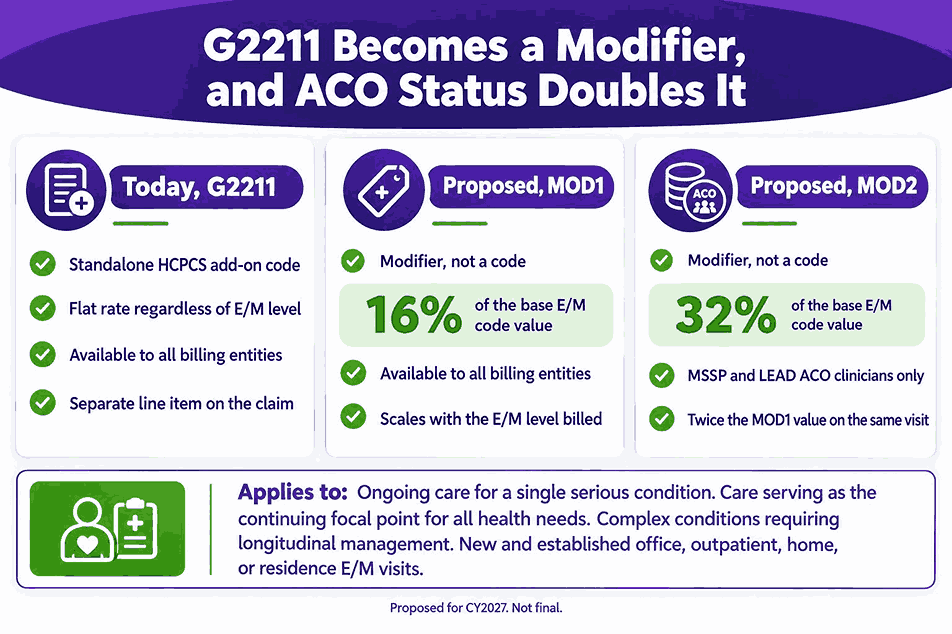
CMS also proposes a second modifier, MOD2, exclusive to Accountable Care Organization (ACO) participants. MOD2 would pay at 32% of the base E/M code value, twice the MOD1 rate for non-ACO physicians.
This creates a real financial incentive tied to ACO participation. Neurology groups affiliated with a health system’s Medicare Shared Savings Program (MSSP) ACO would see double the add-on value compared to independent practices billing the same visit type.
Three practical steps neurology billing teams should take now:
- Map current G2211 usage across E/M codes to estimate MOD1 revenue impact
- Confirm ACO participation status for each billing entity in the practice
- Update claims scrubbing and coding software logic before the effective date
The shift from a flat code to a percentage-based modifier changes more than terminology. It changes how coding software calculates expected reimbursement, and it changes how billing teams audit claims for accuracy.
Neurodiagnostic and Procedure Coding Changes Neurology Practices Should Track
The CY2027 proposed rule includes coding changes specific to neurodiagnostic services and procedures common in neurology. These affect EEG labs, autonomic testing programs, sleep medicine-adjacent neurology practices, and procedure-heavy subspecialties.
New or revised code sets are proposed for rotational vestibular assessment, autonomic nervous system function testing, and unattended sleep studies. Practices offering these services should review the proposed code descriptors closely once finalized.
A separate reclassification affects phrenic nerve stimulation. CMS reviewed claims data for roughly 75 low-volume HCPCS codes as part of this rule. Based on that review, phrenic nerve stimulation CPT codes 33277 through 33281 and 33287 through 33288 would be crosswalked to the cardiac electrophysiology specialty rather than neurology.
Here is a summary of the neurodiagnostic and procedural coding changes proposed for 2027:
| Coding Area | Proposed Change | Who It Affects |
|---|---|---|
| Vestibular testing | New or revised code set | Vestibular and balance testing programs |
| Autonomic testing | New or revised code set | Autonomic nervous system labs |
| Sleep studies | New or revised code set (unattended) | Sleep-adjacent neurology practices |
| Phrenic nerve stimulation | Crosswalked to cardiac EP specialty | Neuromuscular and pulmonary-adjacent programs |
| Modifier -25 pairing | Lower-value service paid at 50% | Same-day procedure and E/M billing |
The modifier -25 change deserves particular attention. Modifier -25 identifies a separately identifiable E/M service billed on the same day as a procedure. Under current rules, both services generally receive full payment when correctly documented.
CMS proposes a different payment structure for 2027. When a physician bills a same-day E/M visit alongside a 0-, 10-, or 90-day global period procedure, only the higher-value service pays at 100%. The other service pays at 50%.
This directly affects common neurology workflows. Botox injections for chronic migraine, EMG and nerve conduction studies, and nerve block procedures often occur alongside a same-day E/M visit. Practices running these workflows should model the revenue impact before the final rule locks this in.
The American Medical Association has already signaled opposition to this specific proposal. Its argument is that many procedure codes were valued to exclude E/M-level work already, making this change effectively a double reduction for office-based procedural care.
Remote Monitoring Overhaul: RPM and RTM Changes That Hit Neurology Hardest
Remote physiologic monitoring (RPM) and remote therapeutic monitoring (RTM) programs face some of the most far-reaching proposed changes in the entire rule. Neurology practices running chronic disease monitoring for epilepsy, Parkinson’s disease, multiple sclerosis, or post-stroke recovery have direct exposure here.
CMS has required RPM services to be furnished only to established patients since 2021. For 2027, CMS proposes extending that same established-patient requirement to RTM services. New patients would no longer qualify for RTM billing at service onset.
The proposed rule adds several new operational requirements for RPM and RTM billing:
- A separately reportable initiating visit is required at the start of monitoring
- Clinical staff performing RPM or RTM must be employed by the practice
- Contracted or outsourced monitoring staff would no longer qualify for payment
- RTM services must be furnished only to established patients, matching RPM rules
The employed-staff requirement is the biggest operational change for many practices. A number of neurology groups currently use third-party remote monitoring vendors to staff these programs. Under this proposal, that staffing model would no longer generate billable RPM or RTM revenue.
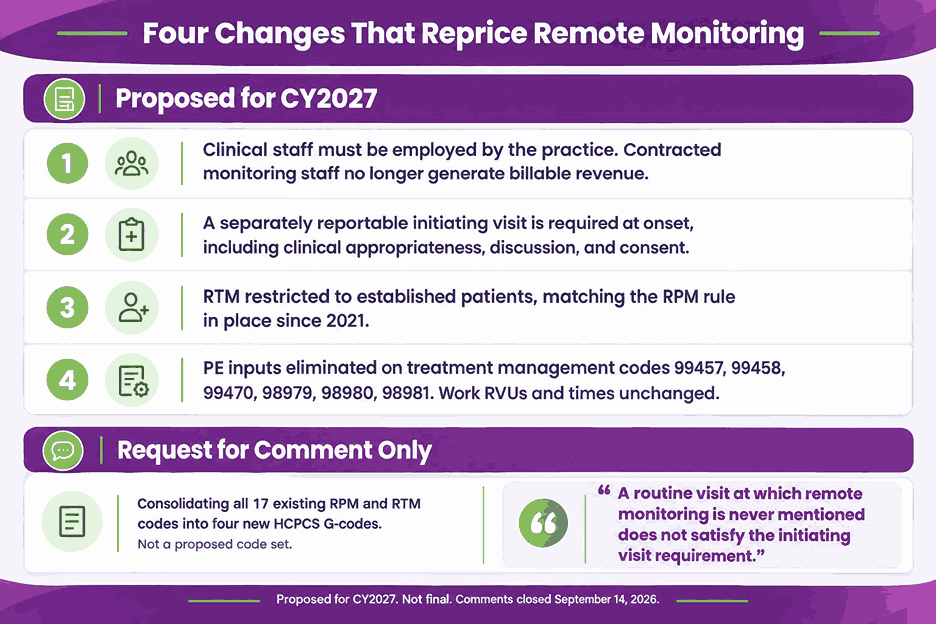
CMS also proposes reducing practice expense relative value units (PE RVUs) for several RPM and RTM codes. The agency’s stated reasoning cites a lack of clear data on typical devices used, which CMS believes has led to overpayment in some cases.
Normally, payment reductions are limited to 19% per year under a statutory phase-in cap. CMS is not bound by that cap for new codes, so the agency proposes bundling existing RPM and RTM CPT codes into four new HCPCS G-codes for 2027.
This bundling approach means the payment reduction takes effect immediately rather than phasing in gradually. Practices with significant RPM or RTM revenue should model this cut now rather than waiting for the final rule. This is exactly the kind of before-and-after revenue modeling neurology billing services run routinely whenever CMS restructures RVUs or bundles codes.
The Health Care Professionals Advisory Committee’s RUC is scheduled to re-examine RPM codes in January 2028. RTM codes may follow in 2030 once more claims data becomes available, according to the American Medical Association’s summary of the proposed rule.
MIPS Is Sunsetting: What Neurology Practices Need to Know About the MVP Transition
CMS confirmed a firm timeline for retiring traditional MIPS reporting in this proposed rule. Traditional MIPS would sunset after the CY2028 performance period, with a full transition to MIPS Value Pathways (MVPs) by 2029.
This is not a new idea. CMS has signaled this direction for several years. What changed in this proposed rule is the specificity of the timeline and the scope of changes to the MVP structure itself.
Three new MVPs are proposed for the 2027 performance year:
- Diabetic Disease MVP
- Hypertension MVP
- Hospitalist MVP
None of these three are neurology-specific. However, CMS also proposes modifying all 27 existing MVPs, including those covering episodic neurological conditions and stroke care coordination. These modifications add core measure selections and expand clinical concepts within each pathway.
A more significant change involves how quality measures get selected within MIPS and MVPs. CMS proposes replacing the current outcome or high-priority measure requirement with a mandatory core measure requirement, starting with the 2027 performance year.
Eligible clinicians would need to report one core measure among their six required MIPS measures. Within an MVP, one core measure would be required among four measures. Small practices are exempt from this specific requirement.
CMS has proposed designating 78 MIPS quality measures as core measures. Practices that fail to report a core measure, and are not classified as a small practice, would receive zero points on one required measure unless they attest that no applicable core measure exists.
Category weights remain unchanged for the 2027 performance year:
| MIPS Category | Weight |
|---|---|
| Quality | 30% |
| Cost | 30% |
| Improvement Activities | 15% |
| Promoting Interoperability | 25% |
The performance threshold to avoid a penalty stays at 75 points through the CY2028 performance year. CMS finalized this stability policy previously, following advocacy from the American Medical Association and specialty societies including the AAN.
Electronic prior authorization reporting also changes under this proposal. The measure becomes optional with bonus points available in 2027, then becomes mandatory starting in 2028. A related prescription drug ePA measure is proposed as newly attestation-based starting in 2028.
Neurology practices should treat 2027 as the year to audit their current MIPS reporting against the MVP structure. Waiting until MVPs become mandatory leaves little room to correct reporting gaps before penalties apply.
The Ambulatory Specialty Model: Why Pain Management and Neurosurgery Should Pay Attention
General neurology is not included in the Ambulatory Specialty Model (ASM). This matters enough to state clearly, since the model directly affects specialties that neurology practices frequently refer to and collaborate with.
CMS finalized the ASM as a mandatory payment model in the 2026 rule. It runs for five years starting January 1, 2027, through December 31, 2031, across 240 geographic areas.
Two clinical tracks make up the ASM, each targeting a different specialist group:
- Heart failure track: cardiologists treating 20 or more heart failure patients
- Low back pain track: neurosurgeons, orthopedic surgeons, physiatrists, anesthesiologists, and pain management physicians treating 20 or more relevant patients
Specialists meeting the patient volume threshold must participate. There is no opt-out based on practice size or preference under the current proposal.
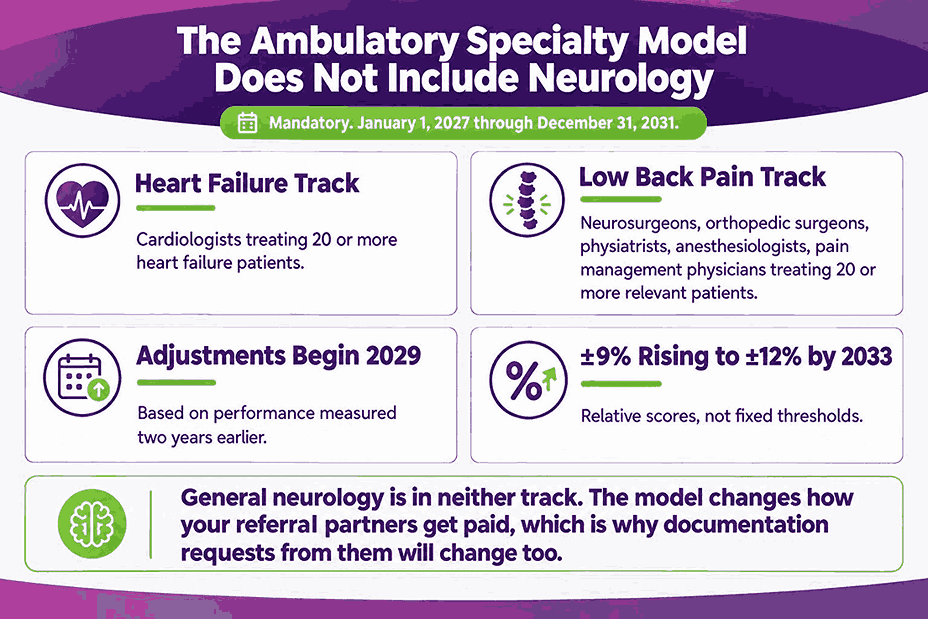
Payment adjustments under ASM begin in 2029, based on performance scores measured two years earlier. Adjustments start at plus or minus 9% and grow to plus or minus 12% by 2033. These are relative scores, not fixed thresholds.
This tournament-style structure creates a specific financial reality. CMS built the model around an 85% redistribution percentage. That means the majority of participating physicians receive a payment reduction, regardless of how well they perform against absolute quality standards.
The American Medical Association has pushed back strongly on this design. Its recommendation is a 100% redistribution rate, paired with fixed performance thresholds set in advance so physicians know what target avoids a penalty.
CMS proposes several technical refinements to ASM for 2027, some responsive to AMA feedback. A specialty group practice could use one Collaborative Care Agreement covering all specialists in the group, rather than requiring individual agreements per physician.
Cardiologists can also request exemption if their primary specialty is cardiac electrophysiology, cardiac surgery, interventional cardiology, or a related subspecialty rather than general cardiology. This exemption request must be submitted directly to CMS.
For neurology practices with referral relationships to pain management or neurosurgery, this model changes how those referral partners get paid starting in 2027. Understanding ASM helps explain shifting referral patterns or documentation requests from those partners.
Telehealth Rules for 2027: What’s Extended and What’s Still Temporary
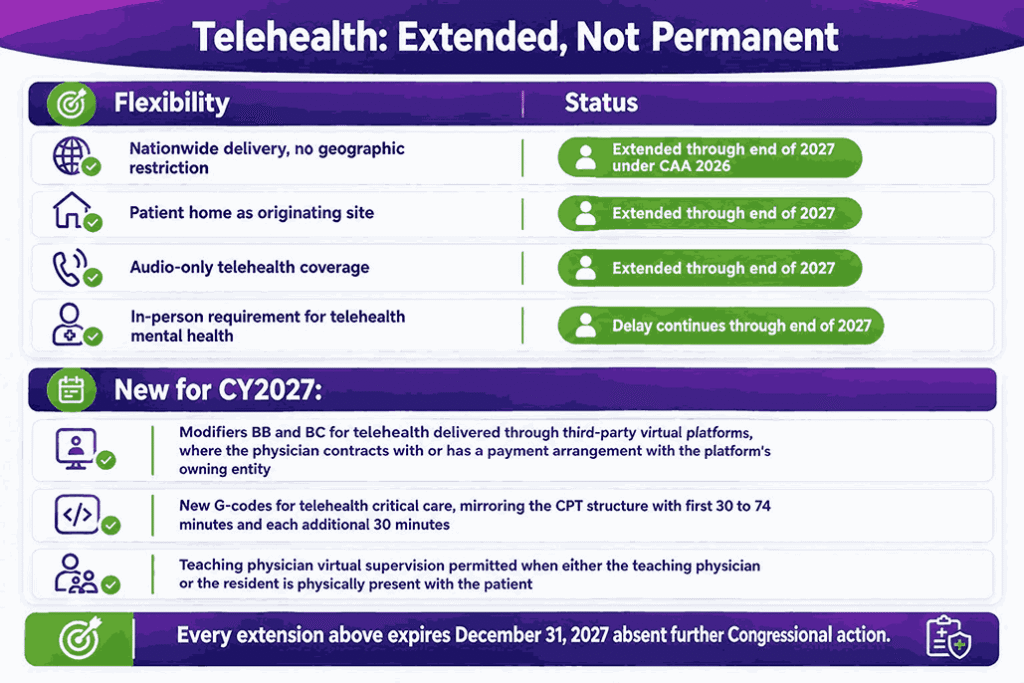
Telehealth flexibility remains a recurring legislative question rather than a settled policy. The Consolidated Appropriations Act (CAA) of 2026 extended several pandemic-era flexibilities through the end of 2027.
Here is what stays in place under the current extension:
- Telehealth services can be delivered nationwide, not limited by geography
- Patients can receive telehealth visits from their home
- Audio-only telehealth services remain covered
- In-person visit requirements for telehealth mental health services stay delayed
None of these flexibilities are permanent. Congress has extended them multiple times since the COVID-19 public health emergency ended, and further action will be needed again before the end of 2027.
The CAA 2026 also requires CMS to create new modifiers for telehealth delivered through third-party virtual platforms. CMS proposes modifiers BB and BC for physicians who contract with or have a payment arrangement with the platform’s owning entity.
CMS additionally proposes new G-codes for telehealth critical care services. These would mirror the existing CPT structure, with separate codes for the first 30 to 74 minutes and each additional 30-minute increment.
Teaching physician supervision rules are also changing. The current policy requires the teaching physician, resident, and patient to be in three separate locations for virtual supervision billing. That requirement created real scheduling friction in academic neurology settings.
CMS proposes simplifying this rule for 2027. Teaching physicians could bill for resident-involved services when either the teaching physician or the resident is physically present with the patient. Both no longer need to be in separate locations from the patient simultaneously.
Neurology residency programs and academic neurology departments should watch this change closely. It directly affects how virtual supervision gets documented and billed for resident-involved patient encounters.
Advance Care Planning: New Codes That Matter for Progressive Neurological Conditions
CMS proposes two new HCPCS codes for advance care planning (ACP) services delivered by clinical staff under a physician’s direct supervision. This is a meaningful addition for neurology practices managing progressive or serious conditions.
Current ACP codes limit billing to time personally spent by the billing physician or qualified health professional. The new codes would allow clinical staff, working under supervision, to bill for ACP conversations separately.
This matters for neurology in a specific way. Conditions like ALS, advanced Parkinson’s disease, and progressive dementia often require repeated advance care conversations over time, not a single visit.
CMS frames this proposal around recognizing ACP as a longitudinal, team-based service. That framing fits how neurology practices already manage these conversations in practice, even before the coding caught up to the clinical reality.
The CPT Coding Governance Question CMS Is Raising
Beyond specific payment changes, CMS included a request for information (RFI) that neurology practices should understand. It examines the Current Procedural Terminology (CPT) code set itself, along with how that code set gets built and priced.
CPT codes are licensed and maintained by the American Medical Association (AMA). The RUC, a physician-led advisory committee, recommends physician work values that CMS typically uses to set Medicare payment rates for each code.
CMS is now questioning that arrangement directly. The RFI asks about the AMA’s licensing control over CPT, potential conflicts of interest in RUC valuation recommendations, and whether alternative code sets like ICD-10-PCS could work instead.
This RFI does not propose an immediate change. It signals CMS may be considering a longer-term shift in how physician services get coded and valued across every specialty, including neurology.
Neurodiagnostic and procedural coding in neurology depends heavily on CPT’s current structure. EEG, EMG, nerve conduction studies, and the newer vestibular and autonomic testing codes discussed earlier all rely on CPT descriptors and RUC-driven valuation.
A shift away from that structure, even years out, would affect how neurology procedures get priced. Practices should treat this RFI as an early signal rather than an immediate concern, but one worth tracking through future rulemaking cycles.
What Neurology Practices Should Do Before the Final Rule Publishes
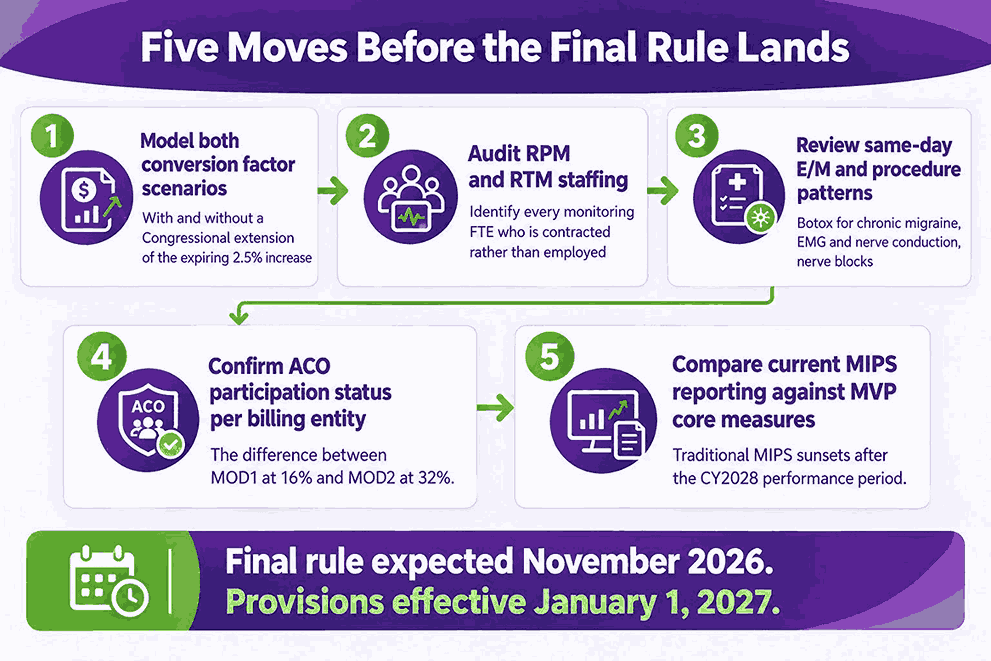
The CY2027 proposed rule remains open to change until CMS issues the final rule, expected in November 2026. Practices should start preparing now rather than waiting for that publication date.
Five practical steps to take before the final rule lands:
- Model both conversion factor scenarios, with and without Congressional extension
- Audit RPM and RTM staffing arrangements against the employed-staff requirement
- Review same-day procedure and E/M billing patterns affected by the modifier -25 change
- Confirm ACO participation status to estimate MOD1 versus MOD2 revenue impact
- Compare current MIPS reporting against MVP core measure requirements
Billing and coding software vendors typically build final rule updates into year-end releases. Practices should confirm update timelines with their vendor now, especially for G2211 replacement logic and RPM/RTM bundling changes.
Documentation training deserves attention as well. The modifier -25 change and the MOD1/MOD2 shift both require clear documentation to support the higher-value service determination on same-day claims. Given the compliance lift across MOD1/MOD2 mapping, RPM/RTM restaffing, and the MIPS-to-MVP transition, many practices bring in neurology billing companies at this stage rather than stretching internal coding teams thin.

Frequently Asked Questions About the CY2027 Neurology Payment Rule
Is The CY2027 Medicare Physician Fee Schedule Rule Final?
No. CMS published this as a proposed rule on July 14, 2026. The comment period closed September 14, 2026. CMS is expected to issue a final rule in November 2026, which may adjust or remove provisions covered in this article.
What Is MOD1 And How Does It Replace G2211?
MOD1 is a proposed modifier replacing HCPCS code G2211. It pays 16% of the base E/M code value for visit complexity tied to longitudinal or complex condition care, applied to the same E/M visits G2211 currently covers.
Does The Ambulatory Specialty Model Apply To General Neurologists?
No. The ASM’s low back pain track applies to neurosurgeons, orthopedic surgeons, physiatrists, anesthesiologists, and pain management physicians. General neurology is not included in either ASM track under the current proposal.
How Does The RPM And RTM Change Affect Epilepsy Monitoring Programs?
Programs using outsourced or contracted monitoring staff would lose billing eligibility under the employed-staff requirement. New patients would also no longer qualify for RTM billing at service onset, matching current RPM rules.
When Does Traditional MIPS Reporting End?
CMS proposes sunsetting traditional MIPS after the CY2028 performance period, with a full transition to MIPS Value Pathways by 2029. The 75-point performance threshold stays unchanged through CY2028.
This article reflects the CY2027 Medicare Physician Fee Schedule proposed rule as published by CMS on July 14, 2026. Provisions may change in the final rule. Check back after the November 2026 release for updated figures and finalized policy language.