CareCloud billing is the set of revenue cycle functions a practice runs inside CareCloud’s practice management platform: charge entry, claim generation, CollectiveIQ scrubbing, electronic submission, ERA posting, and denial and A/R follow-up. Billing capability is gated by plan. CareCloud Central and CareCloud Complete give a practice the tools to bill for itself. CareCloud Concierge hands the work to CareCloud’s own staff. A third option exists and is often missed: an outside partner can bill inside a practice-owned CareCloud instance.
What Is CareCloud Billing?
CareCloud billing is revenue cycle work performed inside CareCloud’s practice management module, and the term covers three different arrangements that are worth separating before anything else. CareCloud is cloud practice management software from CareCloud Inc., a US public company (NASDAQ: CCLD), with billing built as a module of the platform rather than sold as a bolt-on. For what sits alongside billing on the platform, see the full breakdown of CareCloud features.
The three arrangements are: self-billing on CareCloud Central or CareCloud Complete, outsourcing to CareCloud Concierge, or outsourcing to a third-party partner working inside the practice’s own CareCloud instance. Billing functionality is plan-gated, which the next section breaks down in full. For the workflow itself, see our guide on billing inside your EHR.
Is CareCloud Billing Software or a Billing Service?
CareCloud is both, and the distinction decides who does the work, who holds the data, and what the practice pays.
| Arrangement | Who performs the billing | Who owns the instance and data | Cost basis |
|---|---|---|---|
| CareCloud Central / Complete (software) | Practice staff | Practice | Per provider per month |
| CareCloud Concierge (service) | CareCloud’s own RCM staff | Practice, operated by CareCloud | Percentage of collections |
| Third-party partner in your instance | Partner staff | Practice | Partner’s own fee basis |
CareCloud’s revenue cycle arm does not require the client to run CareCloud practice management software (THIRD-PARTY-REPORTED), a fact that dates from the MTBC era. The inverse holds too: running CareCloud’s platform does not oblige a practice to buy CareCloud’s billing labor. Row three is the arrangement most practices do not know exists. It is covered in full below.
How Is CareCloud Different From CareCloud MD and Similarly Named Billing Vendors?
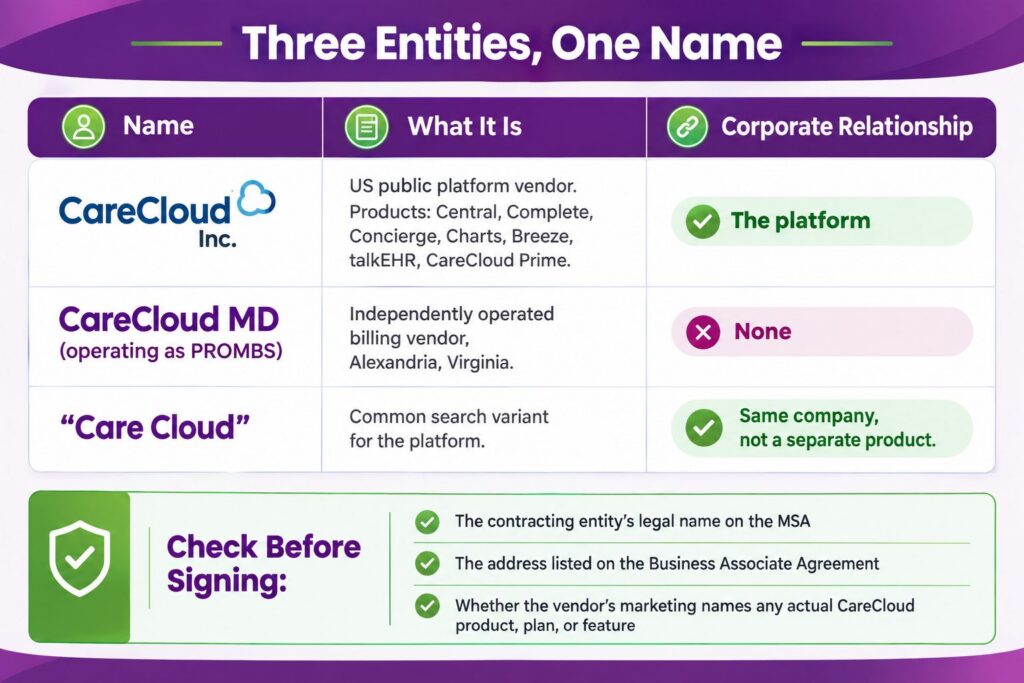
Several billing vendors trade under names close to CareCloud, and at least one ranks for CareCloud billing queries while having no corporate relationship to the platform.
CareCloud Inc. is the platform vendor: a US public company with product lines CareCloud Central, Complete, Concierge, Charts, Breeze, plus talkEHR and CareCloud Prime. CareCloud MD, operating as PROMBS out of Alexandria, Virginia, is an independently operated billing vendor with no corporate tie to CareCloud Inc. “Care Cloud” written as two words is a common search variant for the same platform, not a separate product. Practices sourcing a PM/EHR replacement often run this same evaluation against eClinicalWorks. See our carecloud vs ecw comparison for how the two stack up on billing workflow specifically.
Before signing anything, check three things:
- The contracting entity’s legal name on the MSA
- The address listed on the Business Associate Agreement
- Whether the vendor’s marketing names any actual CareCloud product, plan, or feature
Did CareCloud Billing Change After the MTBC Acquisition?
Yes. MTBC acquired CareCloud in 2020 and later adopted the CareCloud name for the combined company, merging two billing operations and two technology stacks. The most consequential change for billing buyers is structural: CareCloud’s revenue cycle services are sold independently of its practice management software, so a practice can buy the labor without the platform, or the platform without the labor.
What Is the CareCloud Billing Workflow, Step by Step?
A claim moves through CareCloud in six stages, and a practice’s clean-claim rate is decided at the first two.
- Eligibility check: verifying coverage before the visit
- Charge entry: coding the encounter and keying the claim
- Scrub: CollectiveIQ tests the claim against payer and coding rules
- Electronic submission: the claim batches into an EDI 837 file
- Acknowledgment and rejection handling: the clearinghouse confirms or bounces the file
- ERA posting and follow-up: payment posts and exceptions route to a work queue
Most practices lose money at stages one and two, before the claim ever reaches a payer. The four sections below expand the stages that determine most of a practice’s clean-claim rate.
How Does Charge Entry Work in CareCloud?
Charge entry in CareCloud runs through two paths: encounter-driven auto-population where CareCloud Charts is in use, or manual and batch entry where an external EHR or a paper superbill feeds the claim instead. Either path offers real-time CPT and ICD-10-CM lookup with error alerting at the point of entry.
Eligibility should be checked before the visit through a 270/271 transaction; skipping it moves the cost downstream into a denial instead of a five-minute check. Three charge-entry failures generate most of the downstream denials:
- A missing or mismatched modifier
- A unit count that does not match the documented service
- A diagnosis-to-procedure mismatch (medical necessity)
How Does CareCloud Submit Claims to the Clearinghouse?
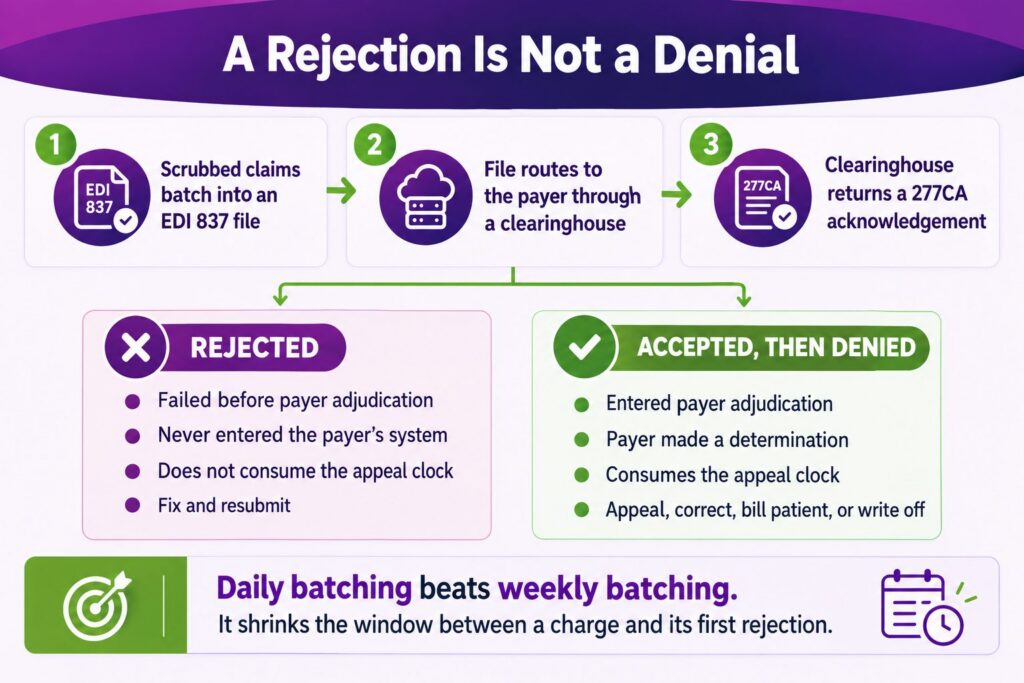
Scrubbed claims batch into an EDI 837 file and route to the payer through a clearinghouse, where a claim can fail before a payer ever adjudicates it. Daily batching outperforms weekly batching because it shrinks the window between a charge and its first rejection.
The clearinghouse returns a 277CA acknowledgement confirming the file was accepted or flagging a front-end problem. A rejection is not a denial. A rejection never entered payer adjudication and does not consume the appeal clock; a denial did, and does. CareCloud markets a mix of clearinghouse connections and direct payer submission.
How Are ERAs and Payments Posted in CareCloud?
Electronic remittance advice files post automatically against open claims, and the work that remains is the exception queue. Auto-posting handles the clean matches; partial payments, contractual adjustments that miss the fee schedule, and payer takebacks land in exceptions for manual review.
CARC and RARC codes on the remittance are the routing signal for what happens next: appeal, correct, bill the patient, or write off. Credit balances created by overpayment are a compliance exposure, not just a bookkeeping item. Paper EOBs and patient payments still post manually.
How Are Patient Statements and Balances Handled in CareCloud Breeze?
Patient balances move through CareCloud Breeze, the patient-facing layer that handles statement generation, secure messaging, and online bill payment (VENDOR-DESCRIBED). Statements go out on a set cadence, and online payment capture, including card-on-file, speeds up collection of the patient-owed portion.
The patient balance is consistently the slowest dollar in the cycle. Two things a practice actually controls: collecting at the point of service and giving the patient an accurate estimate before the visit, not after.
Can a Practice Bill in CareCloud Without Using CareCloud Charts?
Yes. CareCloud Central is reported to include practice management, billing, scheduling, and reporting while excluding clinical charting (THIRD-PARTY-REPORTED), which means a practice can run billing in CareCloud while keeping a different clinical system. The trade-off shows up at charge entry: without an integrated encounter feeding the claim, charges are keyed or interfaced, and both routes add a failure point that integrated charge capture removes.
Which CareCloud Plans Include Billing?
CareCloud does not publish list pricing, so every figure below is third-party-reported as of 2026 and should be treated as a starting point for a quote, not a rate card.
| Plan | Billing capability included | Reported 2026 cost | Who does the work |
|---|---|---|---|
| CareCloud Central | PM + billing, no charting | $349 per provider per month (THIRD-PARTY-REPORTED) | Practice staff |
| CareCloud Complete | PM + billing + EHR/charting | $629 per provider per month (THIRD-PARTY-REPORTED) | Practice staff |
| CareCloud Concierge | Outsourced RCM | 3% to 7% of monthly collections (THIRD-PARTY-REPORTED) | CareCloud staff |
What actually drives a quote: provider count, specialty, claim volume, and billing complexity. Implementation is billed separately and is reported to start at roughly $1,000, varying with practice size (THIRD-PARTY-REPORTED).
What Does CareCloud Central Include for Billing?
CareCloud Central is the practice management and billing tier, reported at $349 per provider per month in 2026 (THIRD-PARTY-REPORTED), and it is the plan a practice buys when it intends to bill for itself.
- In: scheduling, registration, charge entry, claims, CollectiveIQ scrubbing, reporting
- Out: clinical charting
Central fits practices with in-house billing staff, or practices using a third-party partner inside their own instance.
What Does CareCloud Complete Add?
CareCloud Complete adds the clinical layer to Central, reported at $629 per provider per month in 2026 (THIRD-PARTY-REPORTED). The delta is EHR, charting, e-prescribing, and task management.
The billing-relevant consequence: integrated charge capture straight from the encounter, removing the keying step described above under charge entry. That delta runs roughly $280 per provider per month against Central.
What Does CareCloud Concierge Cover?
CareCloud Concierge is the outsourced arrangement: CareCloud’s own back-office team performs claim submission, payment posting, denial work, and A/R follow-up, priced at a reported 3% to 7% of monthly collections (THIRD-PARTY-REPORTED). The model includes a dedicated account manager.
CareCloud states an average 33 percent reduction in days in A/R for Concierge clients (VENDOR-CLAIMED). That figure is vendor-reported, unaudited, and will vary by specialty and payer mix. Concierge fits smaller practices with no billing staff and no appetite to hire.
Does CareCloud Require a Three-Year Contract?
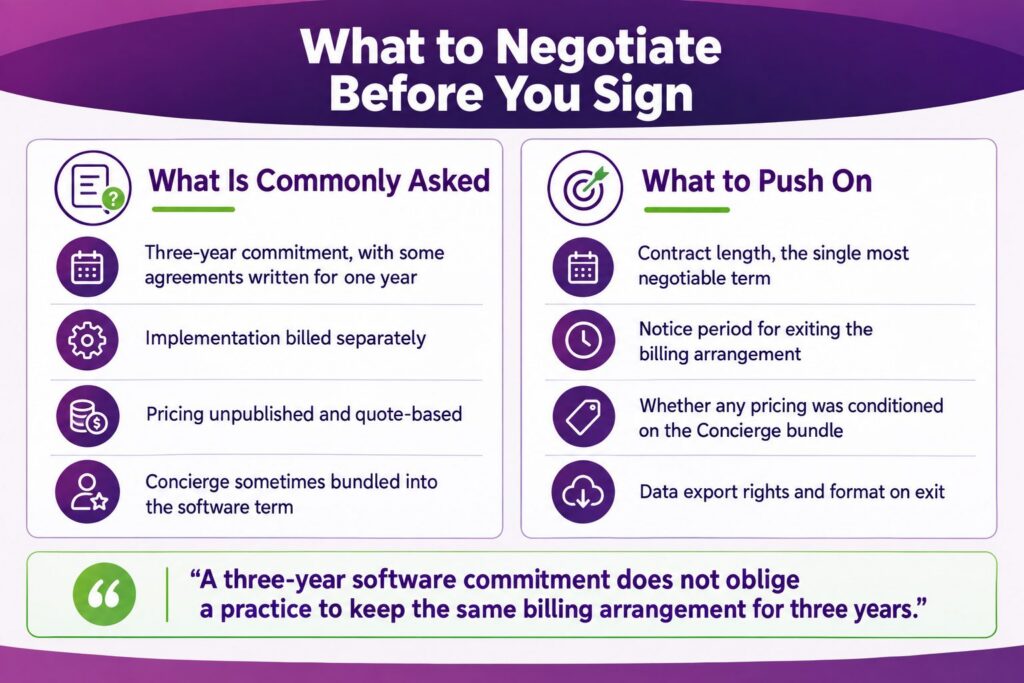
Frequently, yes. Independent 2025 and 2026 reviews report that CareCloud commonly asks for a three-year commitment, with some agreements written for one year, and implementation fees starting at roughly $1,000 (THIRD-PARTY-REPORTED). Contract length is negotiable in principle and is the term most worth pushing on, because a three-year software commitment does not oblige a practice to keep the same billing arrangement for three years.
How Does CareCloud Claim Scrubbing Work?
CareCloud scrubs claims through CollectiveIQ, a rules engine embedded in the practice management system that tests each claim against payer and coding rules before it is transmitted. The scrub sits between charge entry and submission in the six-stage workflow above.
An error caught pre-submission costs minutes. The same error caught post-adjudication costs a denial, a rework cycle, and days of A/R. That gap is the economic case for scrubbing at all.
What Is CollectiveIQ?
CollectiveIQ is CareCloud’s automated billing rules platform, integrated into the practice management system rather than sold separately (VENDOR-DESCRIBED). Being integrated rather than bolt-on matters practically: edits fire at entry, not at batch time.
CollectiveIQ is not a coder, and it is not a payer-policy subscription. Rules engines degrade as payer policies change, so a maintenance question: how often does the rule set update: is worth asking any vendor selling one.
Which Claim Errors Does CareCloud Catch Before Submission?
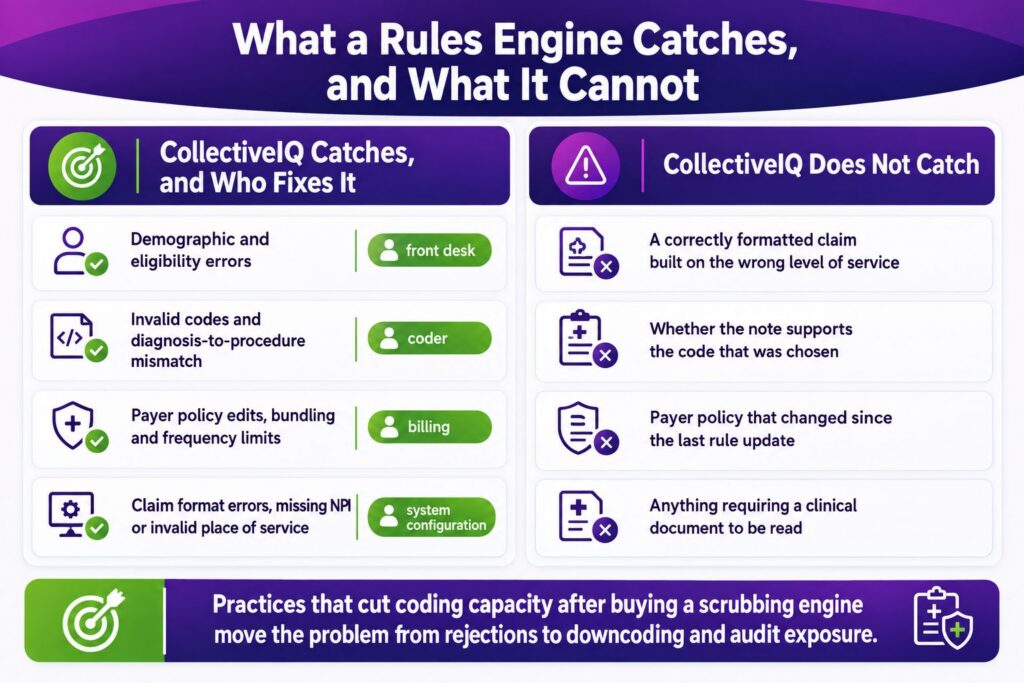
Pre-submission edits fall into four classes, and the classes matter more than the individual rules because they map to who has to fix the problem.
- Demographic and eligibility errors: front desk owns the fix
- Coding errors, such as an invalid code or a diagnosis-to-procedure mismatch: the coder owns the fix
- Payer-specific policy edits, such as bundling or frequency limits: billing owns the fix
- Claim-format errors, such as a missing NPI or invalid place of service: system configuration owns the fix
Mapping the owner to the error class is what reduces repeat errors, not the rule count.
How Is First-Pass Resolution Rate Measured in CareCloud?
First-pass resolution rate is the share of claims paid on first submission without rework, and the definition varies enough between vendors that the number is only comparable within one definition. The formula: claims paid on first submission divided by total claims submitted, over a period. Vendors diverge on whether front-end rejections count and whether zero-pay contractual adjustments count.
CareCloud states that CareCloud Central clients see a 97 percent effective resolution rate (VENDOR-CLAIMED). The denominator is not disclosed. Measure your own rate from your own data before and after any change, rather than importing the vendor figure as a baseline.
Does CareCloud’s Scrubbing Replace a Certified Coder?
No, A rules engine tests a claim against known edits after the codes have been chosen; it does not read a clinical note and decide what was documented. CollectiveIQ will catch an invalid code pairing and will not catch a correctly formatted claim built on the wrong level of service. Practices that cut coding capacity after buying a scrubbing engine typically move the problem from rejections to downcoding and audit exposure.
How Are Denials and A/R Managed in CareCloud?
Denials arrive in CareCloud as remittance data and become work items, and the difference between a practice that recovers them and one that writes them off is queue discipline, not software. Every denial faces a triage question: appeal, correct and resubmit, bill the patient, or write off. The timely filing clock is the constraint that makes queue age the metric that matters, more so than dollar value alone.
How Are Denials Worked Inside the CareCloud Worklist?
Denied claims land in a work queue keyed by CARC and RARC codes, and how that queue is sorted determines how much gets recovered.
Sorting by dollar value catches the biggest write-offs first. Sorting by age wins near a filing deadline, because a large denial past the deadline recovers nothing. Root-cause tagging prevents the same denial from recurring. Working a denial (fixing the cause) is a different action from resubmitting it (repeating the claim), and conflating the two is a common source of repeat denials.
What Does cirrusAI Appeals Automate?
cirrusAI Appeals is CareCloud’s automated appeal-generation tool, part of the cirrusAI suite the vendor expanded through 2025 and 2026 (VENDOR-DESCRIBED, 2026). It drafts the appeal letter from the denial and the claim record.
It does not decide whether an appeal is winnable, gather clinical documentation, or track the payer’s response. Generated appeals help most with volume; they help least with medical-necessity denials that turn on documentation the tool cannot see. cirrusAI Appeals, the billing-side tool, is distinct from cirrusAI Notes, which is clinical documentation and has nothing to do with billing.
Which Reports Track Days in A/R and Denial Rate in CareCloud?
Five numbers tell a practice whether its billing is working, and all five are available from standard practice management reporting.
| Metric | What it answers | How often to pull it |
|---|---|---|
| Days in A/R | How long cash is tied up after a claim goes out | Monthly |
| A/R over 90 days | Share of receivables at risk of write-off | Monthly |
| Clean-claim rate | Share of claims accepted without correction | Monthly |
| Denial rate by payer | Where the friction concentrates | Monthly |
| Net collection rate | Percentage of allowed charges actually collected | Monthly |
Pull all five monthly and segment by payer. A single blended number hides the one payer actually causing the problem.
What Does a Six Percent Denial Rate Actually Cost a Practice?
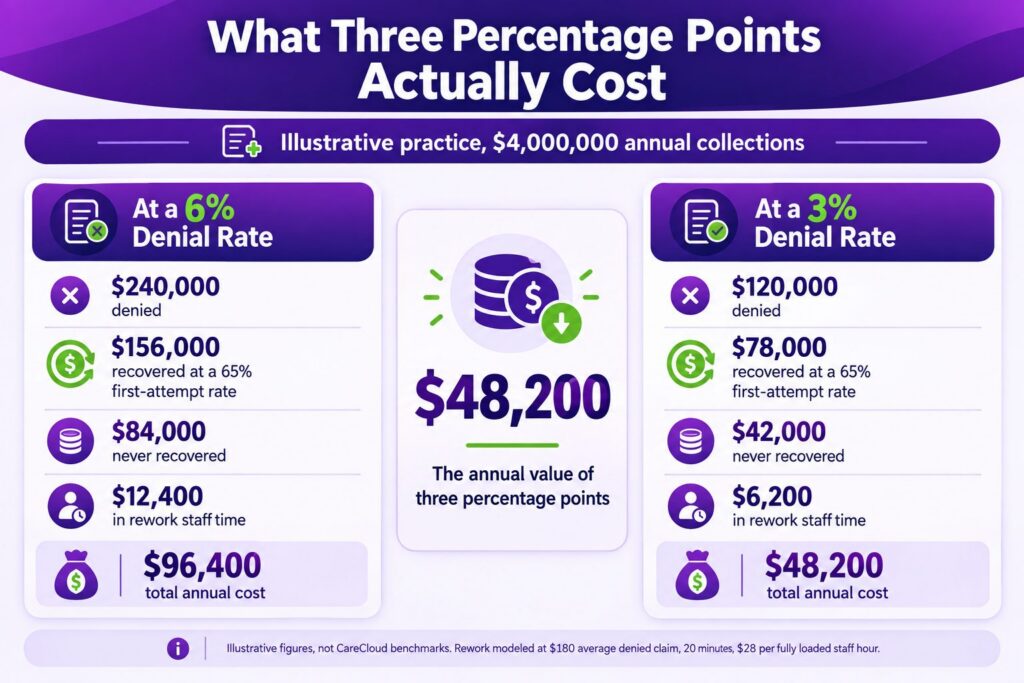
The following example uses illustrative figures, not CareCloud benchmarks, to show how a denial rate converts into dollars.
Worked example: a $4,000,000 annual-collections practice:
- Step 1: Denied charges: 6% × $4,000,000 = $240,000 denied for the year
- Step 2: Recovered at a 65% first-attempt recovery rate: $240,000 × 0.65 = $156,000 recovered
- Step 3: Never recovered: $240,000 − $156,000 = $84,000 written off
- Step 4: Rework cost: at an average denied claim of $180, that is roughly 1,333 denials. At 20 minutes and $28 per fully loaded staff hour, rework runs about $12,400 in staff time
- Step 5: Total annual cost of the denial rate: $84,000 + $12,400 = $96,400
At a 3% denial rate, the same practice writes off $42,000 and spends about $6,200 in rework. The three percentage points between 3% and 6% are worth roughly $48,200 a year for this practice. All inputs here are illustrative, not CareCloud-published figures.
What Changed in CareCloud Billing in 2026?
Three changes matter to billing operations as of September 2026.
- cirrusAI Appeals moved appeal-letter generation into the platform itself
- stratusAI Desk Agent now handles front-desk calls, touching billing indirectly through eligibility accuracy and scheduling
- Interoperability work across CareCloud Charts, talkEHR, and CareCloud Prime, relevant to practices charging entry from an external system (per CareCloud’s 2025 year-end review)
What has not changed: pricing is still unpublished, and contract terms are still reported rather than disclosed.
How Should a Practice Choose Between CareCloud Concierge and a Third-Party Billing Partner?
The choice comes down to three variables: collections volume, the fee basis, and who controls the instance.
Concierge genuinely wins for a small practice with no billing staff, no hiring appetite, and a preference for one vendor to hold accountable. A third-party partner wins where collections volume makes a percentage fee a large absolute number, where specialty complexity outpaces a generalist billing queue, or where a practice wants to keep the instance and the data under its own control. In-house billing wins at high volume with a stable payer mix and existing billing leadership already in place.
What Does CareCloud Billing Cost Compared With In-House Billing?
The same illustrative $4,000,000 practice, with four providers, costed three ways.
Option A: CareCloud Concierge
- At the reported 3% floor: $4,000,000 × 0.03 = $120,000/year
- At the reported 7% ceiling: $4,000,000 × 0.07 = $280,000/year
Option B: In-house billing on CareCloud Central
- Software: 4 providers × $349 × 12 = $16,752/year
- Staff: 2.5 billing FTE × $58,000 fully loaded = $145,000/year
- Total: $161,752/year, before turnover, leave coverage, and management time
Option C: Third-party partner in the practice’s own instance
- Software: $16,752/year, paid by the practice
- Partner fee at an illustrative 4% of collections: $160,000/year
- Total: $176,752/year, with the percentage as the negotiable variable
| Option | Annual cost (illustrative) |
|---|---|
| Concierge (3%–7%) | $120,000 – $280,000 |
| In-house on Central | $161,752 |
| Third-party partner (4% illustrative) | $176,752 |
At the 3% end, Concierge is the cheapest option on paper. The comparison only shifts when collections rise, when a partner’s percentage is negotiated down, or when the value of controlling the instance and the data is priced in. These figures use illustrative rates, not Transcure’s pricing.
Which Specialties Strain CareCloud’s Default Billing Setup?
Any practice management system bills a straightforward office visit well. The configuration work concentrates in four places.
- Ambulatory surgery centers: multiple-procedure discounting, implant and device billing, and place-of-service coding for ASC billing
- Pain management: modifier stacking across injections and bilateral procedures, plus frequency edits
- Nephrology: monthly capitated dialysis logic that does not fit an encounter-per-claim model
- Behavioral health: time-based units, telehealth place-of-service, and payer-specific authorization tracking
This is a configuration observation, not a claim that CareCloud cannot handle these specialties. Every PM system needs the same tuning.
What Is Required to Give a Third-Party Billing Partner Access to CareCloud?
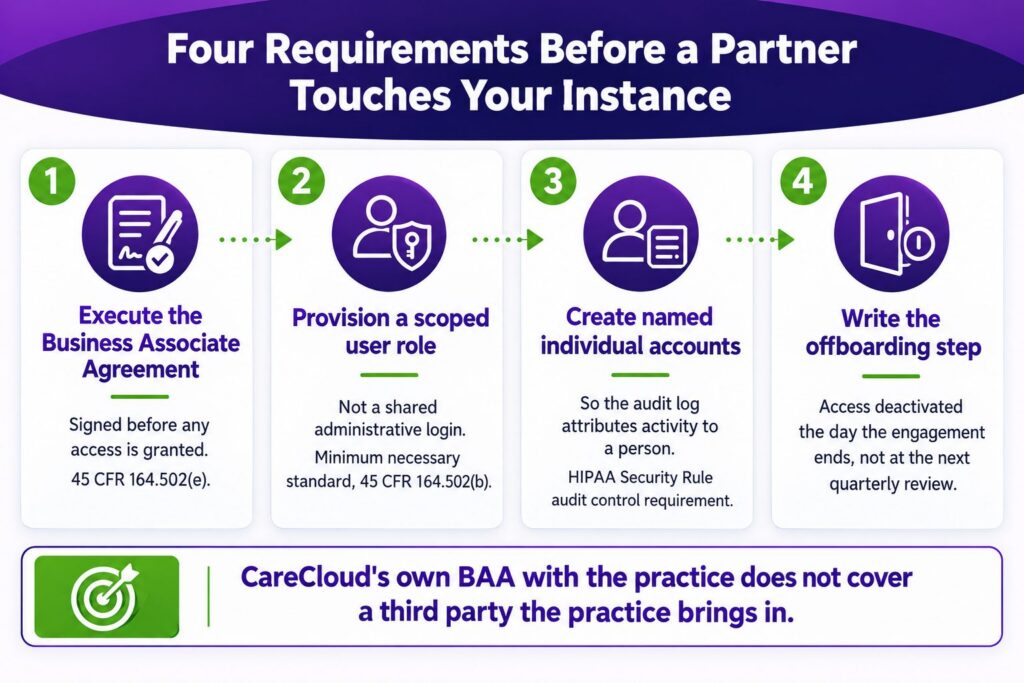
Letting an outside billing partner work inside a practice-owned CareCloud instance is a HIPAA business-associate arrangement, and it has four requirements.
- An executed Business Associate Agreement before any access is granted, per 45 CFR 164.502(e) (PRIMARY-SOURCE, hhs.gov)
- A scoped user role rather than a shared administrative login, per the minimum necessary standard at 45 CFR 164.502(b) (PRIMARY-SOURCE)
- Named individual accounts so the audit log attributes activity to a person, consistent with the HIPAA Security Rule’s audit control requirement
- A written offboarding step that deactivates access the day the engagement ends, not at the next quarterly review
None of this is legal advice. It states the requirement and its regulatory source.
Does a Billing Partner Need a BAA to Work Inside CareCloud?
Yes. A billing partner that creates, receives, maintains, or transmits protected health information on a practice’s behalf is a business associate under HIPAA, and 45 CFR 164.502(e) requires a written agreement before that access begins. The agreement is between the practice and the partner. CareCloud’s own business associate agreement with the practice does not cover a third party the practice brings in.
How Does Transcure Support Billing on CareCloud?
Transcure’s carecloud billing services operate inside a practice’s own CareCloud instance rather than migrating the practice to a different platform.
- Access: BAA executed, scoped user roles provisioned in the practice’s own instance, per the requirements above
- Baseline: current denial rate, days in A/R, clean-claim rate, and A/R over 90 days measured from the practice’s own CareCloud reports before anything changes
- Operate: charge entry review, coding, submission, ERA posting, and denial work performed inside the practice’s instance, with the practice retaining the software relationship and the data
- Report: the same five metrics above, reported monthly against the baseline
Can a Practice Keep CareCloud and Change Billing Vendors?
Yes, in most cases. The software subscription and the billing-labor arrangement are separate commitments, even when they appear on the same invoice. A practice under a multi-year CareCloud Central or Complete agreement keeps the platform, the historical data, and the workflows it has built, and changes only who performs the billing work inside it. The practical constraints are contractual rather than technical: check whether the agreement bundles Concierge into the software term, what notice period applies, and whether any pricing was conditioned on the bundle. Those questions belong in front of the contract, not in front of the software.
Conclusion:
CareCloud billing is decided less by the software than by the arrangement around it. The platform’s mechanics stay consistent across plans: charge entry, CollectiveIQ scrubbing, electronic submission, ERA posting, denial work. What changes between CareCloud Central, CareCloud Complete, and CareCloud Concierge is who performs that work and on what fee basis. A practice that measures its own denial rate, days in A/R, and clean-claim rate before it changes anything will know which of the three arrangements it is actually paying for.