
Arizona medical billing laws operate across 3 regulatory tracks. DIFI, the Arizona Department of Insurance and Financial Institutions, enforces Title 20 rules for commercial plans.
AHCCCS, the Arizona Health Care Cost Containment System, administers Title 36 Medicaid rules. Workers’ compensation claims follow Title 23 under the Industrial Commission of Arizona.
In 2022, DIFI received 427 surprise bill dispute requests, and enrollees saved $860,241.72. Volume fell to 166 requests in 2023 after the federal No Surprises Act took effect.
HB 2175 became operative July 1, 2026. Under HB 2175, medical directors review medical necessity denials individually. SB 1291 took effect April 1, 2026. Under SB 1291, credentialing closes within 60 days, and insurers cannot deny compliant claims filed within 1 year as contractually untimely.

This guide explains the statutes and rules governing claim payment, prior authorization, surprise billing, timely filing, appeals, and compliance in Arizona. Each section cites the governing statute or regulation.
Why Do Arizona Medical Billing Rules Need Separate Attention?
3 legal tracks govern Arizona claims, and each track sets distinct deadlines, regulators, and appeal paths.
What Are the 3 Legal Tracks Behind Arizona Billing Rules?
Commercial insurance claims follow Title 20, with A.R.S. § 20-3102 as the prompt pay law. Medicaid claims run through Title 36 and the AHCCCS provider billing manuals. Industrial injury bills follow Title 23 and the Industrial Commission fee schedule.
The table below compares the 3 tracks by governing law, regulator, and claim type.
| Track | Governing law | Regulator | Claims covered |
|---|---|---|---|
| Commercial insurance | Title 20, A.R.S. § 20-3102 | DIFI | Commercial health plans and HMOs |
| Medicaid | Title 36, AHCCCS billing manuals | AHCCCS | Fee-for-service and managed care plan claims |
| Workers’ compensation | Title 23, A.R.S. § 23-1062.01 | Industrial Commission of Arizona | Work injury claims billed under the Physicians’ and Pharmaceutical Fee Schedule |
Payer type determines the deadline, dispute path, and regulator on every claim.
Who Enforces Arizona Medical Billing Rules?
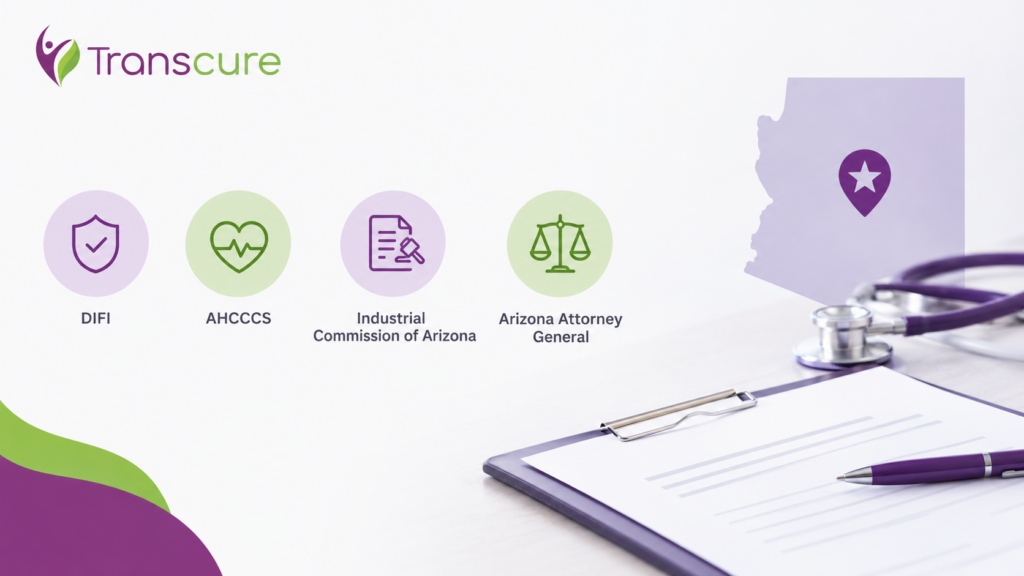
4 agencies enforce Arizona medical billing rules: DIFI, AHCCCS, the Industrial Commission of Arizona, and the Arizona Attorney General. DIFI oversees insurance claim payments, surprise bill disputes, and external independent review.
AHCCCS handles provider claim disputes and payment suspensions, and the AHCCCS Office of Inspector General (OIG) investigates provider fraud. Fee schedule adoption and bad faith claim investigations belong to the Industrial Commission of Arizona.
The Medicaid Fraud Control Unit in the Arizona Attorney General’s office prosecutes Medicaid provider fraud. Knowing the regulator for each track routes a denial, dispute, or complaint to the correct authority.
What Does the Arizona Prompt Pay Law (A.R.S. § 20-3102) Require?
A.R.S. § 20-3102 requires insurers to adjudicate clean claims within 30 days and pay the approved portion within 30 days of adjudication. DIFI guidance summarizes the law in a Timely Pay and Grievance brochure for health care providers.
How Does the 30 + 30 Day Payment Structure Work?
2 steps govern clean claim payment: 30 days to adjudicate and 30 days to pay. Adjudication means the insurer’s decision to pay or deny a claim in whole or in part, including the payment amount.
Clean claims require no additional information, such as coordination of benefits details, for processing. Payment timing follows the adjudication date unless a written contract specifies a different period.
Statutory deadlines under A.R.S. § 20-3102 run from receipt to payment.
| Claim stage | Deadline | Clock starts |
|---|---|---|
| Adjudicate a clean claim | 30 days | Insurer receives the clean claim |
| Request additional information on a claim that is not clean | 30 days | Insurer receives the claim |
| Pay the approved portion | 30 days | Adjudication date |
| Interest accrues | Legal rate (10% per annum per DIFI) | Payment due date |
Both 30-day clocks run separately, so a claim adjudicated on day 29 carries a full 30 days to pay unless a contract period applies.
What Happens When a Claim Is Not Clean?
Insurers send a written request for additional information within 30 days of receiving a claim that is not clean. Requests list the specific reasons the insurer cannot adjudicate the claim. After receipt of the requested information, the insurer has 30 days to adjudicate.
Reasonable justification is the statutory standard for delaying payment or paying less than the contracted amount.
How Is Interest Calculated on Late Clean Claim Payments?
Late clean claim payments accrue interest at the legal rate. Brochures published by DIFI state the rate is 10% per annum unless a contract specifies a different amount. Interest begins accruing on the payment due date, not the claim receipt date.
Tracking the payment due date sets the correct interest start for aging accounts receivable. Billing teams using medical billing services in Arizona track adjudication date, payment due date, and interest start date for every claim.
How Do Claim Adjustments Work Under Arizona Law?
Neither an insurer nor a provider may request a claim adjustment over 1 year after the insurer pays or denies the claim. Contracts may set a different adjustment period, provided the limit applies equally to insurer and provider.
How Does Arizona Resolve Surprise Out-of-Network Bill Disputes?
Dispute resolution for surprise out-of-network bills runs through the DIFI Surprise Out-of-Network Billing Dispute Resolution (SOONBDR) program, as defined in A.R.S. §§ 20-3111 to 20-3119. Administrative Code sections R20-6-2401 to R20-6-2406 supply the procedures.
Surprise out-of-network bills arise when an out-of-network provider bills an enrollee for unpaid amounts after care at an in-network facility.
Example figures from DIFI show the gap: an in-network hospital and an out-of-network doctor each bill $1,000, and the health plan pays $400 to each.
In-network hospitals bill patients only for copays, deductibles, and coinsurance. Doctors outside the plan network may bill cost-sharing plus any other amount the plan did not pay.
How Does the Surprise Bill Dispute Process Work in Arizona?
Every Arizona surprise bill dispute starts with an enrollee request submitted to DIFI on the prescribed form. Arbitration follows only when informal settlement fails, and the enrollee pays no fee.
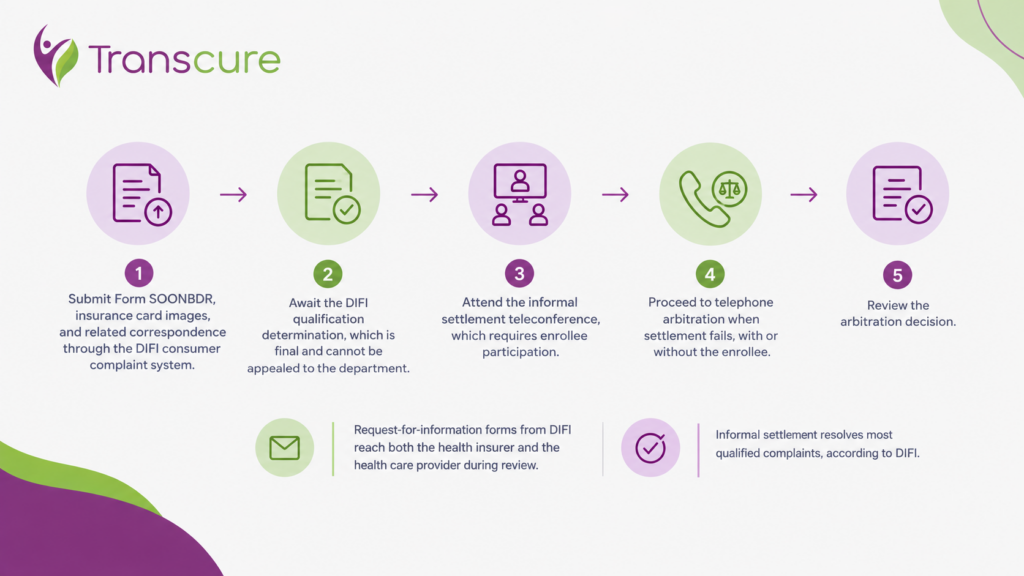
5 steps move a dispute from request to decision:
- Submit Form SOONBDR, insurance card images, and related correspondence through the DIFI consumer complaint system.
- Await the DIFI qualification determination, which is final and cannot be appealed to the department.
- Attend the informal settlement teleconference, which requires enrollee participation.
- Proceed to telephone arbitration when settlement fails, with or without the enrollee.
- Review the arbitration decision.
Request-for-information forms from DIFI reach both the health insurer and the health care provider during review. Informal settlement resolves most qualified complaints, according to DIFI.
Which Surprise Bills Qualify for Arbitration in Arizona?
Qualifying surprise out-of-network bills cover services provided on or after January 1, 2019, and total at least $1,000 after cost-sharing and the insurer’s allowable reimbursement. Totals combine all related bills from the same provider. SOONBDR applies to bills under policies with plan years that began before January 1, 2022. Policies new or renewed on or after that date fall under the federal No Surprises Act.
7 common exclusions remove a bill from the program:
- Policies outside DIFI jurisdiction, such as self-insured employer plans under ERISA, state and federal employee plans, and out-of-state policies
- Care delivered over 1 year before the request, extended by the duration of a pending health care appeal
- Balances of $999.99 or less after cost-sharing
- HMO plans, which carry separate balance billing protections
- Limited benefit coverage
- Treatment under an undecided health care appeal
- Matters previously settled or decided through arbitration
Over half of surprise billing complaints received since 2019 failed eligibility, according to DIFI. Plan type and funding source determine jurisdiction.
How Does the Provider Disclosure Notice Affect Arbitration Rights?
Disclosure notices under A.R.S. § 20-3113 can waive an enrollee’s right to request arbitration. A waiver applies when the notice contains the required information and the final bill stays within the estimated total cost. Notices missing required information do not produce the waiver.
How Does the State Process Interact With the Federal No Surprises Act?
SOONBDR excludes ERISA self-funded employer plans, so the federal No Surprises Act governs surprise bill disputes under such plans. Referral information goes to consumers whose policies fall outside DIFI jurisdiction.
What Rights Does an Enrollee Have After an Arbitration Decision?
Enrollees aggrieved by an arbitration decision may file a civil action in superior court within 1 year of the decision under A.R.S. § 20-3119. The civil action covers the same surprise out-of-network bill.
Annual resolution reports under A.R.S. § 20-3118(A) document request volume and enrollee savings. Reports for 2020 through 2023 show savings of $349,153.87, $487,483.62, $860,241.72, and $184,807.
How Does Arizona Regulate Prior Authorization and Denial Review?
Prior authorization in Arizona follows 3 statutes: A.R.S. § 20-3404 (deadlines), § 20-3407 (denial review), and § 20-2510 (written denials). Prior authorization is approval from the health care services plan or utilization review agent before a service is performed.
What Are the Prior Authorization Deadlines Under A.R.S. § 20-3404?
Urgent requests require notice to the provider within 5 days, and non-urgent requests within 14 days, after the plan receives all necessary information. Receipt acknowledgment in the same format as the request follows each submission of supporting information.
Notifications state whether the request is approved, denied, or incomplete. Incomplete requests allow the provider to submit additional information.
Deadline scenarios under A.R.S. § 20-3404 fall into 4 groups:
| Request type | Deadline | Clock starts |
|---|---|---|
| Urgent | 5 days | Plan receives all necessary information |
| Non-urgent | 14 days | Plan receives all necessary information |
| Incomplete, urgent | 5 days | Provider submits additional information |
| Incomplete, non-urgent | 14 days | Provider submits additional information |
The clock starts when you receive complete information, so incomplete submissions extend the decision period.
Dedicated prior authorization services track the 5-day and 14-day clocks and each receipt acknowledgment for every submission.
What Does Deemed Approval Mean for Prior Authorization in Arizona?
Failure to meet the deadlines or notification requirements causes the request to be deemed granted under A.R.S. § 20-3404(C). Granted and deemed-granted authorizations bind the plan, and enrollees and providers may rely on them.
Rescission or modification is barred after the provider renders authorized services in good faith, unless evidence of provider fraud or misrepresentation exists. Dated records of submission and receipt acknowledgments document the start of each deadline.
What Does HB 2175 Require for Denial Review?
A medical director must review the claim before an insurer denies it on medical necessity grounds or issues a direct prior authorization denial. Denials of claims fall under A.R.S. § 20-3103, and denials of prior authorization fall under A.R.S. § 20-3407.
Independent medical judgment governs each review, and you may not rely solely on another source’s recommendations. Governor Hobbs approved HB 2175 on May 12, 2025, and the provisions became effective July 1, 2026.
The enacted text does not mention artificial intelligence, although earlier House versions contained an AI prohibition. Obligations under the act attach to medical necessity denials only.
What Are the Written Denial Requirements Under A.R.S. § 20-2510?
Written form governs every direct denial of a provider-requested prior authorization based on medical necessity. The written denial must explain why the treatment was denied, and a copy must go to the requesting provider. Since September 26, 2025, the medical director no longer has to sign the denial, but insurers must keep internal records identifying the medical director responsible for each written denial.
You must retain all written denials for department inspection during regular business hours. The director must hold an active, unrestricted Arizona medical license; separate rules apply to dental, optometric, and chiropractic determinations.
What Appeal Rights Apply After a Prior Authorization Denial?
Denied requests carry the review and appeal rights in chapter 15, article 2 of Title 20. Specific denial reasons appear in each notice under A.R.S. § 20-3404(B). Appeals timelines appear in the Appeals and Grievance Rights section of this guide.
How Does SB 1291 Change Credentialing and Claims for Arizona Providers?
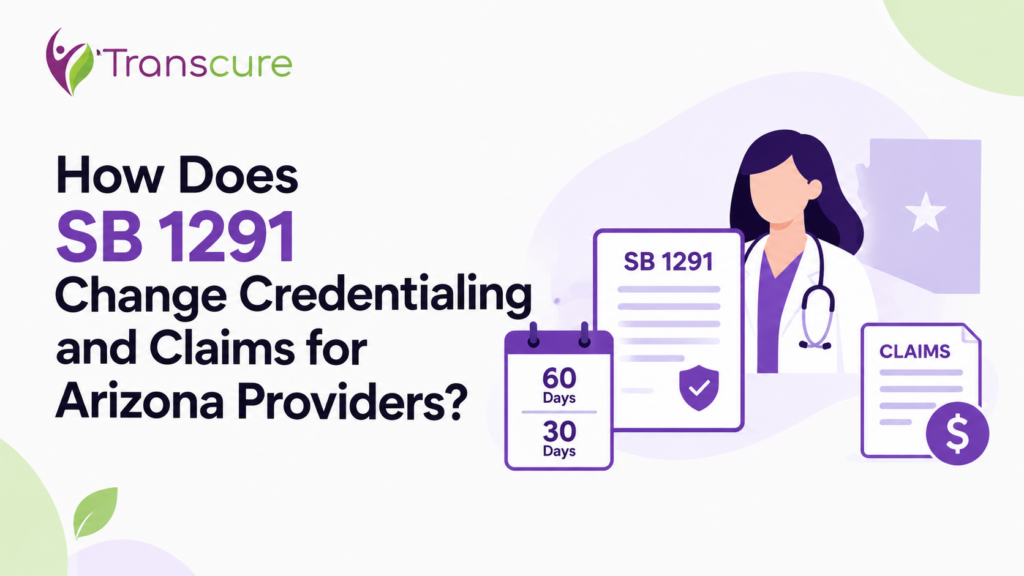
Senate Bill 1291 sets a 60-calendar-day credentialing deadline and a 30-calendar-day billing system loading deadline, counted from a complete application. Chapter 97 of the 2025 session laws amended A.R.S. §§ 20-3451, 20-3453, 20-3454, and 20-3459 and replaced § 20-3456.
What Counts as a Complete Credentialing Application?
Complete credentialing applications include all information, required supporting documentation, and a current authorization to access electronic documentation. The insurer must acknowledge receipt and notify you of any incomplete application within 7 calendar days, with a detailed list of missing items.
Missed notice deadlines cause the application to be deemed complete. Tolling suspends the credentialing clock while the insurer awaits missing items, up to 3 times. Withdrawal may be declared after 30 calendar days without a response to an incomplete notice.
What Notices and Contracts Follow Credentialing Approval?
Electronic or written notice of approval or denial follows within 7 calendar days after credentialing concludes. Proposed contracts, complete and ready for execution, go to the applicant upon receipt of a complete application.
Delegated credentialing agreements with licensed facilities shift the loading timeline to 10 calendar days after the insurer receives a roster of demographic changes.
Can Providers Bill Retroactively During Credentialing?
Retroactive payment applies to services provided between the complete application notice date and execution of the network participation contract. Conditions for in-network processing number 3 under A.R.S. § 20-3456(A):
- Applied for credentialing and rendered a covered service to an eligible health plan member on the date of service.
- Rendered the service on or after the date of the complete application notice.
- Withheld the claim until a fully executed network participation contract exists and the insurer approved the credentials.
Claims submitted within 1 year after the date of service cannot be denied as contractually untimely when compliant with the section. Reimbursement at the in-network rate is not required when the application is denied, or the provider declines to contract on mutually acceptable terms.
What Patient Disclosure Applies to Providers Who Are Not Credentialed?
Patients receive a written, dated disclosure within a reasonable period before service in a network facility. Content of the disclosure covers 3 items:
- Name of the billing health care provider
- Estimated total cost to be billed by the provider or the provider’s representative
- Statement that the provider is not credentialed and is not a contracted provider
Section 20-3456(D) contains the disclosure duty.
Who Enforces SB 1291 and What Penalties Apply?
The DIFI director has enforcement authority, and insurers that fail to comply face civil penalties under A.R.S. § 20-456. Multiple provider complaints about one insurer trigger an examination under the applicable insurance examination statute.
Good faith compliance gives insurers civil immunity for reviewing and approving credentialing applications. The governor signed it on May 2, 2025, and it took effect on April 1, 2026.
What Are the Timely Filing Limits in Arizona for AHCCCS, Medicare, and Commercial Payers?
Timely filing limits in Arizona range from 6 months for initial AHCCCS claims to 24 months for workers’ compensation billings.
Filing windows by payer type appear in the table below:
| Payer | Initial filing window | Corrected or clean claim window | Authority |
|---|---|---|---|
| AHCCCS fee-for-service | 6 months from date of service | 12 months from date of service | AHCCCS Fee-For-Service Provider Billing Manual |
| AHCCCS managed care | 6 months from date of service or eligibility posting | 12 months from date of service or eligibility posting | ACOM Policy 203, A.R.S. § 36-2904(G) |
| Commercial payers | Set by provider contract | Set by provider contract | Participation agreement |
| Medicare Part B | 1 calendar year from date of service | Same 1 calendar year period | 42 CFR § 424.44 |
| Workers’ compensation | 24 months from service or from the date the provider knew or should have known | Corrected billing does not restart the period | A.R.S. § 23-1062.01 |
Program type sets the filing clock for every claim.
What Is the AHCCCS Fee-for-Service Timely Filing Limit?
Initial fee-for-service claims are timely when AHCCCS receives the claim within 6 months of the date of service. Replacement claims achieve clean claim status within 12 months of the date of service, provided the original claim met the 6-month requirement.
Hospital inpatient claims use the discharge date as the service date. Retro-eligibility claims run 6 months from the eligibility posting date. IHS and 638 facility claims carry a 12-month initial window.
Reference to the original claim number on a replacement claim proves timely filing. Omission produces a timely filing denial.
What Is the AHCCCS Managed Care Timely Filing Limit?
Policy 203 of the AHCCCS Contractor Operations Manual (ACOM) states both limits. Contractors do not pay claims submitted more than 6 months after the date of service or eligibility posting, whichever date comes last.
Exclusion also applies to clean claims submitted over 12 months after that date under A.R.S. § 36-2904(G).
Recouped claims carry a separate window for refiling with the responsible contractor. Submit to the responsible contractor within 60 days of recoupment, 12 months of service, or 12 months of eligibility posting, whichever date comes last.
Reversed decisions on appeal open a 90-day window to submit a clean claim, and untimely filing denials are barred within that window.
Do Commercial Payers in Arizona Set Their Own Timely Filing Limits?
Participation agreements set commercial payer filing limits, as A.R.S. § 20-3456(B) refers to the contractually required time period. 1 protection from SB 1291 covers credentialing period claims submitted within 1 year after the date of service.
What Is the Medicare Part B Timely Filing Limit?
Medicare Part B claims must be filed within 1 calendar year after the date of service under 42 CFR § 424.44. Federal regulation, not Arizona statute, sets the Medicare limit.
Exceptions include administrative error by a Medicare contractor and retroactive Medicare entitlement.
What Is the Workers’ Compensation Billing Limit in Arizona?
Carriers and self-insured employers owe no payment for billings received over 24 months after the service date. Knowledge dates apply instead when the provider knew or should have known of the service after the service date.
Corrected or subsequent billings do not restart the limitations period under A.R.S. § 23-1062.01. Editions of the Physicians’ and Pharmaceutical Fee Schedule from 2011 through the 2026/2027 staff recommendation carry the same 24-month limit.
What Are the AHCCCS Billing Requirements for Claim Disputes, Payment Standards, and Other Insurance?
Registered providers follow 3 AHCCCS rule sets: claim disputes, managed care payment standards, and payer-of-last-resort rules.
How Do AHCCCS Claim Disputes Work?
Deadlines for an AHCCCS claim dispute run 12 months from the ending date of service or eligibility posting. An adverse action on a timely claim opens a 60-day window from that date.
FFS disputes go in writing to the AHCCCS Office of the General Counsel, or through the AHCCCS Solution Center. Office of the General Counsel issues a Notice of Decision after review. Unfavorable decisions carry 30 days from receipt to request a state fair hearing.
Special 60-day windows apply when action on a timely clean claim occurs within 60 days before the 12-month deadline or after the deadline.
Managed care contractors run their own claim dispute processes. Overturned disputes are reprocessed and paid within 15 business days of the decision. Original clean claim receipt dates start interest on disputed claims instead of dispute filing dates.
What Are the AHCCCS Managed Care Payment Standards and Interest Rules?
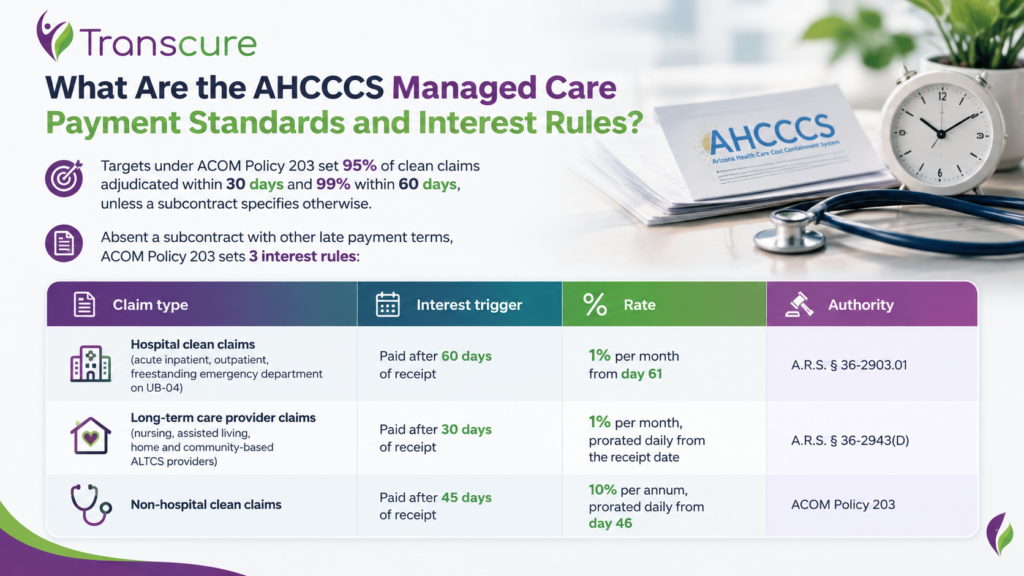
Targets under ACOM Policy 203 set 95% of clean claims adjudicated within 30 days and 99% within 60 days, unless a subcontract specifies otherwise.
Absent a subcontract with other late payment terms, ACOM Policy 203 sets 3 interest rules:
| Claim type | Interest trigger | Rate | Authority |
|---|---|---|---|
| Hospital clean claims (acute inpatient, outpatient, freestanding emergency department on UB-04) | Paid after 60 days of receipt | 1% per month from day 61 | A.R.S. § 36-2903.01 |
| Long-term care provider claims (nursing, assisted living, home and community-based ALTCS providers) | Paid after 30 days of receipt | 1% per month, prorated daily from the receipt date | A.R.S. § 36-2943(D) |
| Non-hospital clean claims | Paid after 45 days of receipt | 10% per annum, prorated daily from day 46 | ACOM Policy 203 |
Quick pay discounts of 1% apply to hospital claims paid within 30 days of clean claim receipt.
How Does AHCCCS Treat Medicare and Other Insurance Payments?
Other coverage pays first, which makes AHCCCS the payer of last resort. Delays in Medicare or other insurance payment do not extend the 6-month initial filing window for AHCCCS fee-for-service claims.
You must resubmit with the Medicare or other insurance remittance within 12 months of the date of service.
Crossover of denied or adjusted Medicare claims is not automatic. Adjustment claims with the remittance reflect other insurance payment received after billing.
What Does Arizona Law Require After a Data Breach Involving Patient Billing Information?
Affected individuals receive notice within 45 days after a person determines a security system breach occurred, under A.R.S. § 18-552. HIPAA covered entities and business associates fall outside the article under subsection N(2).
What Counts as Personal Information Under A.R.S. § 18-551?
Personal information combines a first name or initial and last name with a specified data element. Coverage extends to unencrypted and unredacted computerized data in a database about multiple individuals.
Specified data elements relevant to billing records include 4 items:
- Health insurance identification numbers
- Information about medical or mental health treatment or diagnosis by a health care professional
- Social Security numbers
- Financial account numbers with required access codes
What Does A.R.S. § 18-552 Require After a Security System Breach?
Investigation of a security incident comes first, and notification follows within 45 days of a breach determination. Breaches requiring notice to over 1,000 individuals trigger 2 additional notices.
Recipients include the 3 largest nationwide consumer reporting agencies, the Attorney General, and the director of the Arizona Department of Homeland Security.
Law enforcement requests can delay notice, and the 45 days run from the agency’s confirmation.
Individual notices carry 4 required elements:
- Approximate date of the breach
- Brief description of the personal information included
- Toll-free numbers and addresses for the 3 largest nationwide consumer reporting agencies
- Contact details for the Federal Trade Commission or another federal agency assisting with identity theft
Delivery by written notice, email, or direct telephone contact satisfies the requirement. Substitute notice applies when cost exceeds $50,000, the affected class exceeds 100,000 individuals, or contact information is insufficient.
Does Arizona’s Breach Law Apply to HIPAA Covered Entities and Billing Vendors?
Subsection N(2) of A.R.S. § 18-552 excludes HIPAA covered entities and business associates, as defined in 45 CFR 160.103. Business associate functions under that regulation include claims processing, utilization review, and billing.
Medical billing companies in Arizona that process claims for practices meet the business associate definition. Practices that use outsourced RCM services enter into a business associate agreement with the vendor. Persons that follow a primary federal regulator’s breach procedures are deemed compliant with the individual notice requirement under subsection I.
What Does HIPAA Require After a Breach of Protected Health Information?
Covered entities notify affected individuals without unreasonable delay and within 60 calendar days after discovering a breach of unsecured protected health information. Vendors that are business associates notify the covered entity within 60 calendar days of discovery.
HHS receives reports within 60 calendar days for breaches affecting 500 or more individuals. Smaller breaches are logged and reported to HHS within 60 days after the end of the calendar year.
Media notice applies when a breach affects more than 500 residents of a state or jurisdiction. Entity type determines the breach notification framework: A.R.S. § 18-552 requires notification within 45 days, while HIPAA requires notification within 60 days.
Who Enforces A.R.S. § 18-552 and What Penalties Apply?
Only the Attorney General enforces A.R.S. § 18-552, and a knowing and willful violation is an unlawful practice. Penalties are limited to $10,000 per affected individual and to the economic loss sustained, with a $500,000 cap per breach or series of related breaches.
Private enforcement is unavailable because only the Attorney General may enforce a violation. Restitution for affected individuals remains available to the Attorney General.
What Billing Rules Apply to Auto Accident Claims and Provider Liens in Arizona?
Fault-based liability governs Arizona auto accident claims, and no state no-fault or personal injury protection system applies. Statutes at A.R.S. §§ 33-931 to 33-937 secure provider payment from third-party recoveries.
What Are Arizona’s At-Fault System and Minimum Liability Limits?
Minimum liability limits under A.R.S. § 28-4009 are 25/50/15: $25,000 for bodily injury per person, $50,000 for bodily injury per accident, and $15,000 for property damage per accident. Legislation signed in June 2019 (SB 1087) raised the limits from 15/30/10, effective July 1, 2020.
Older 15/30/10 limits remain applicable to certain self-insurance certificate holders. Uninsured and underinsured motorist coverage is optional, but insurers must offer it in writing. Pure comparative negligence under A.R.S. § 12-2505 reduces recovery by the claimant’s percentage of fault.
How Do Providers Perfect a Health Care Provider Lien in Arizona?
Recording of a verified statement with the county recorder perfects a lien under A.R.S. § 33-932. Non-hospital providers record before or within 30 days after the patient receives services relating to the injuries. For hospitals, the 30-day recording period starts at discharge.
Verified statements name the patient, provider, service dates, and amount claimed. Statements from non-hospital providers also identify liable parties and their carriers. Mailing by first-class mail within 5 days after recording sends a copy to the injured person.
Unrecorded non-hospital liens are invalid and cannot be enforced through the statutory cause of action. Ambulance and hospital liens recorded after the deadline stay effective when recorded 30 days before the settlement or judgment payment.
Customary charges above $250 qualify for liens by non-hospital providers and private ambulance companies. Perfected hospital liens take priority over all other provider liens.
Release within 30 days of payment is required under A.R.S. § 33-936, with a $100 penalty plus actual damages for failure.
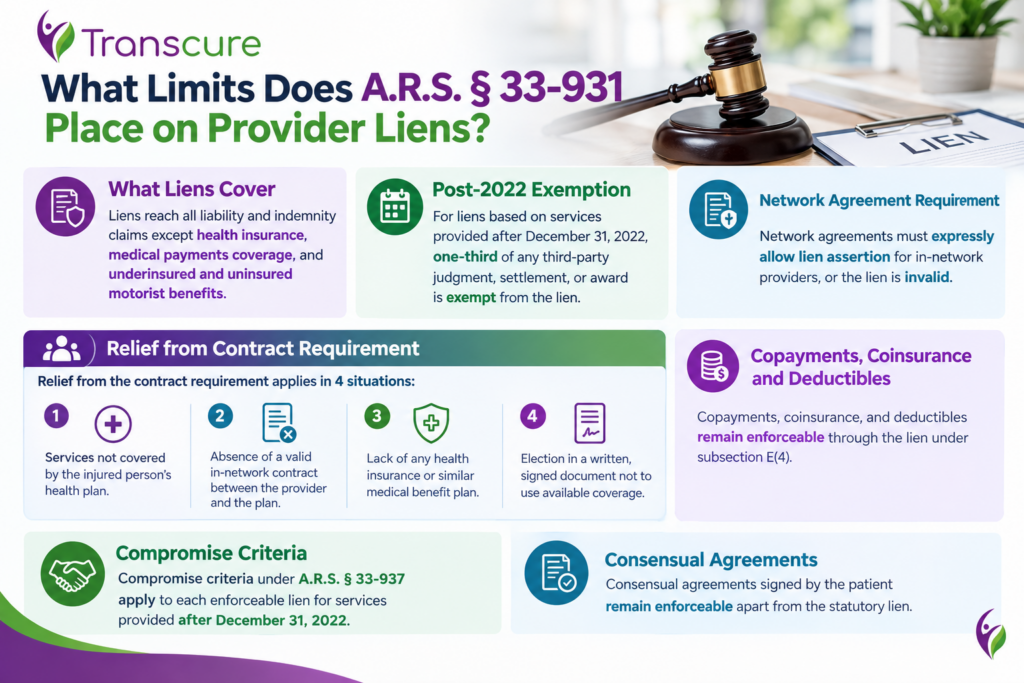
What Limits Does A.R.S. § 33-931 Place on Provider Liens?
Liens reach all liability and indemnity claims except health insurance, medical payments coverage, and underinsured and uninsured motorist benefits. For liens based on services provided after December 31, 2022, one-third of any third-party judgment, settlement, or award is exempt from the lien.
Network agreements must expressly allow lien assertion for in-network providers, or the lien is invalid. Relief from the contract requirement applies in 4 situations:
- Services not covered by the injured person’s health plan
- Absence of a valid in-network contract between the provider and the plan
- Lack of any health insurance or similar medical benefit plan
- Election in a written, signed document not to use available coverage
Copayments, coinsurance, and deductibles remain enforceable through the lien under subsection E(4). Compromise criteria under A.R.S. § 33-937 apply to each enforceable lien for services provided after December 31, 2022. Consensual agreements signed by the patient remain enforceable apart from the statutory lien.
How Does Federal Medicaid Law Limit Liens Against AHCCCS-Paid Services?
Acceptance of AHCCCS or contractor payment as payment in full binds registered providers under A.A.C. R9-22-702(B). Regulation 42 CFR 447.15 supports the rule, and an Arizona Court of Appeals decision held that federal law preempts balance billing liens on AHCCCS-paid services.
A separate prohibition appears in A.R.S. § 36-2903.01(K) against billing AHCCCS members for covered services.
What Are the Workers’ Compensation Billing Rules in Arizona?
Timeframes, denial criteria, and maximum reimbursement values define workers’ compensation billing in Arizona under A.R.S. § 23-1062.01 and the Industrial Commission Fee Schedule.
What Does the Industrial Commission Fee Schedule Set?
Maximum reimbursement values for injured worker services come from the Arizona Physicians’ and Pharmaceutical Fee Schedule, unless a separate contract governs fees. The 2026 edition is effective May 1, 2026 through April 30, 2027.
The 2026/2027 edition is effective May 1, 2026 through April 30, 2027. [Confirm which CPT and HCPCS year, NCCI edits, ASA values, and FAIR Health data the 2026/2027 edition incorporates, then list them here. Codes unique to Arizona, marked with an AZ identifier, control when conflicts arise with CPT or HCPCS.
Amendments in 2025 extended fee setting to durable medical equipment and dental services. A.R.S. § 23-908(K)(1) bars reimbursement reductions for physical therapy assistant services.
Mid-level providers receive 85% of the fee schedule, except 100% for incident-to services that meet the supervision and treatment plan criteria. Narratives justify level 4 or 5 evaluation and management services billed by treating physicians.
Daily payment limits allow 1 professional visit unless the submitted report demonstrates need for an additional visit. Routine office treatment principally by injection of drugs other than antibiotics requires carrier authorization for each series of 10 after the first series.
Transportation fees for ground ambulances follow the Arizona Department of Health Services rate schedule, not the Fee Schedule.
What Is the Payment Clock Under A.R.S. § 23-1062.01?
Determinations on medical bills are due within 30 days, and approved portions are payable within 30 days after the determination. Decision periods start on claim acceptance when the bill arrives before acceptance, or on bill receipt when the bill arrives after acceptance.
Legal rate interest runs from the payment due date on unpaid approved portions. A denial justification must be reasonable, and payer publications are not reasonable justification unless the Fee Schedule incorporates them.
Accepted claims leave the injured worker owing nothing on covered bills or disputed portions. Written contracts between providers and carriers can set their own payment periods. If the contract has no remedy for late payment, the statutory interest penalty still applies. Commission jurisdiction excludes contract disputes between providers and payers.
What Billing, Coding, and Review Rules Apply to Workers’ Compensation Bills?
Bills contain 5 required elements under A.R.S. § 23-1062.01:
- Demographic data for the patient, with the claim number if known
- Identification of the billing provider by name, address, telephone number, and federal taxpayer identification number
- Procedure coding with dollar amounts, units, and descriptions clearly stated
- Clearly printed dates of service
- Legible medical reports for each date of service of direct treatment
Downcoding, the replacement of a billed code with a code for a reduced service level, is prohibited under the Fee Schedule. Unsupported codes allow a payment adjustment when the payer provides documentation justifying the adjustment and outlines the appeal process.
Explanations of review identify 7 data points:
- Injured worker name
- Names of the payer and third party administrator
- Reviewer name, telephone number, and address for each reviewing entity
- Signed contract holder name, telephone number, and address when a contract allows different rates
- Billed amount
- Contractual reduction amount
- Amount paid
Complaints about peer-to-peer reviews by unqualified or unlicensed reviewers trigger Commission investigation and possible penalties under A.R.S. § 23-930.
Who Directs Medical Care in Arizona Workers’ Compensation Claims?
Private self-insured employers have sole authority to direct care under A.R.S. § 23-1070(A). Employees of all other employers choose their own healthcare provider, and public self-insured employers fall in that group.
Conduct that limits provider choice can support a bad faith complaint under A.R.S. § 23-930. One documented example is telling a claimant that non-network care is not authorized.
How Do State Disclosure Notices, the Federal No Surprises Act, and AHCCCS Rules Differ on Balance Billing?
Charges to patients beyond cost-sharing follow 3 rule sets. State notices apply to DIFI-regulated commercial plans, federal law applies to group and individual coverage, and AHCCCS rules apply to Medicaid members.
Comparison of 3 frameworks across 4 features appears below:
| Feature | Arizona state rules | Federal No Surprises Act | AHCCCS |
|---|---|---|---|
| Coverage scope | DIFI-regulated commercial plans; SOONBDR excludes self-insured employer plans, government employee plans, out-of-state policies, and HMO plans | Group health plans and group or individual health insurance coverage | AHCCCS members served by registered providers |
| Protected services | Emergency and related inpatient services by out-of-network providers at in-network facilities; non-emergency services by out-of-network providers at in-network facilities without a disclosure | Emergency services, non-emergency services by out-of-network providers at in-network facilities, and air ambulance services; ground ambulance excluded | All AHCCCS-covered services; AHCCCS or contractor payment is payment in full |
| Waiver or notice | Written, dated A.R.S. § 20-3113 disclosure with provider name, out-of-network status, estimated total cost, and a statement that signing is not required | Notice and consent for post-stabilization and some non-emergency services; ancillary services stay protected | Signed advance statement for out-of-network services the contractor does not cover; copayments permitted |
| Dispute path | SOONBDR arbitration for qualifying bills of at least $1,000 | Federal independent dispute resolution between providers and plans | Claim dispute and state fair hearing |
Membership in a commercial plan, a self-funded plan, or AHCCCS selects the governing framework.
What Does the Arizona Disclosure Notice Require?
Form requirements under A.R.S. § 20-3113 cover 4 items:
- Identity of the billing health care provider
- Out-of-network status of the provider
- Projected total cost to be billed by the provider or the provider’s representative
- Assurance that signing the disclosure is not required to obtain services
Non-emergency bills qualify for arbitration when the provider did not give the enrollee the written, dated disclosure.
How Does the Federal No Surprises Act Protect Patients?
Since January 1, 2022, the No Surprises Act bans balance billing for emergency services, certain non-emergency services at in-network facilities, and air ambulance services. Protected coverage includes group health plans and group or individual health insurance.
Ancillary providers at in-network facilities cannot balance bill or ask patients to waive protections. Categories covered include emergency medicine, anesthesia, pathology, radiology, laboratory, neonatology, assistant surgeon, hospitalist, and intensivist services.
Consent can waive protections for post-stabilization services and some non-emergency services, but ancillary services stay protected. Air ambulance providers fall within the Act, while ground ambulance providers do not.
IDR, the federal independent dispute resolution process, addresses payment disputes between out-of-network providers and plans.
What Does AHCCCS Prohibit?
Full-payment acceptance binds registered providers under A.A.C. R9-22-702(B), and A.R.S. § 36-2903.01(K) prohibits billing AHCCCS members for covered services. Permitted charges to members cover copayments under R9-22-711, cases of withheld or inaccurate eligibility information, and signed advance notice for out-of-network services.
Under federal law, QMB dual eligible members cannot be balance billed for Medicare cost sharing.
How Do HMO Enrollees Differ for Balance Billing?
Contracted rates cap hospital charges to a health care services organization enrollee under A.R.S. § 20-1072(F). Equivalence between health care services organizations and HMOs rests on an Arizona Court of Appeals holding. Distinct protections explain why DIFI excludes HMO plans from the SOONBDR program.
What Appeal and Grievance Rights Do Arizona Providers Have?
Rights to challenge payment decisions follow 3 paths: DIFI appeals, AHCCCS claim disputes, and insurer grievance systems.
How Does the Commercial Health Plan Appeals Process Work?
Levels of review run from the initial appeal, through an optional voluntary internal appeal, to external independent review. Standard initial appeals conclude within 30 days for services not yet provided.
Rejected claims carry 60 days, or 30 days when the plan uses a voluntary internal appeal level. Voluntary internal appeal requests are due within 60 days of the initial appeal decision, and treating providers may submit the requests.
External independent review requests are due within 4 months after the final internal adverse determination. In medical necessity cases, the insurer has 5 business days to send the case file to DIFI, and DIFI then has 5 days to forward it to the independent review organization. The organization issues a written determination within 21 days.
Expedited external independent reviews receive an independent reviewer decision within 72 hours. Hearing requests to the Arizona Office of Administrative Hearings are due within 30 days of the DIFI determination on a coverage question.
No fee applies to providers or enrollees at any appeal level, and no minimum claim value applies.
How Do AHCCCS Provider Appeals Work?
Challenges to AHCCCS payments or denials begin with a claim dispute and continue to a state fair hearing. Windows of 12 months or 60 days after denial control filing, as explained in the AHCCCS billing requirements section.
Fair hearing requests are due within 30 days of receiving an unfavorable Notice of Decision.
What Is the Prompt Pay Grievance Process Under A.R.S. § 20-3102(F)?
A.R.S. § 20-3102(F) requires health care insurers to maintain internal grievance systems. Records list the provider, grievance type, receipt date, and resolution date. The insurer sends semiannual summaries of the records to the DIFI director.
A significant number of unresolved grievances allow the director to examine the insurer. Director authority excludes adjudication of individual contracts or claims. Address changes for claim or grievance filing trigger a 90-day grace period.
Fiscal year 2026 highlights from DIFI show 21,209 grievances received, a 21-day average resolution time, and 20.89% overturned in providers’ favor.
Scope limits remove Medicare, AHCCCS, federal plans, self-funded plans, health share ministries, out-of-state plans, and workers’ compensation grievances from DIFI assistance.
Post-payment adjustments have a 1-year limit, except for fraud. Recoupments or adjusted payments made within 30 days of the adjustment date carry no interest.
What Coding Compliance and Fraud Laws Apply to Arizona Billing?
Coding compliance in Arizona rests on 3 layers: civil penalties, agency enforcement, and criminal statutes.
What Coding Risk Areas Do AHCCCS Fraud Materials Identify?
Training materials from the AHCCCS Office of Inspector General list 6 examples of fraud:
- Kickbacks
- Nonexistent services billed to the program
- Pricing that is illegal or inaccurate
- Unnecessary drugs, procedures, devices, or medical equipment billed to the program
- Upcoding
- Unbundling
National Correct Coding Initiative edits, multiple procedure reductions, and global day E/M bundling govern managed care claim payment under ACOM Policy 203.
Under the federal False Claims Act, treble damages and civil penalties of $14,308 to $28,619 per false claim apply. DOJ set these amounts effective July 3, 2025, and they remain unchanged for 2026.
What Civil Penalties Apply Under A.R.S. § 36-2918?
Violations of A.R.S. § 36-2918(A) carry civil penalties up to $2,000 per item or service claimed, plus an assessment up to twice the amount claimed.
Prohibited claims cover services not provided as claimed, false or fraudulent claims, and claims for non-members on the date of service. Liability attaches when the person knows or has reason to know a claim is false.
The AHCCCS director or designee assesses penalties, and compromise follows the rules.
Who Enforces Medicaid Billing Compliance in Arizona?
Inspector General investigations of provider fraud lead to credible allegation of fraud (CAF) payment suspensions. AHCCCS must suspend payments once it makes a credible allegation of fraud determination. May 2023 payment suspensions reached over 100 registered behavioral health providers.
AHCCCS’s May 2024 year-in-review report counted 304 provider payment suspensions since May 2023. Suspended providers may submit evidence for OIG review and may request a State Fair Hearing. Attorney General prosecutions since 2023 have resulted in 140 indicted individuals and entities.
Which Criminal Statutes Apply to Healthcare Billing Fraud?
Class 2 felony status attaches under A.R.S. § 13-2310(A) to fraudulent schemes that knowingly obtain a benefit through pretenses, representations, promises, or material omissions. Benefits of $100,000 or more bar suspended sentence, probation, pardon, and early release until the sentence is served.
Concealing a material fact or using a false document in state agency business is a class 5 felony under A.R.S. § 13-2311. Reliance by any person is not an element of the offense under § 13-2310(B).
What Specialty-Specific Billing Considerations Apply in Arizona?
Behavioral health, orthopedics and pain management, urgent care and emergency medicine, and telehealth each carry distinct Arizona billing rules.
What Billing Risks Affect Behavioral Health Providers in Arizona?
AHCCCS applies heightened screening, prepayment review, and payment suspension authority to behavioral health billing. High-risk enrollment status applies to Behavioral Health Residential Facilities, Integrated Clinics, and Behavioral Health Outpatient Clinics.
Application fees, fingerprint-based criminal background checks, and site visits are required at initial application and revalidation. Enrollment moratoria covered 5 provider types from June 9, 2023 through December 9, 2024. After the moratoria expired on December 9, 2024, the high-risk enrollment requirements remained in place.
Prepayment review scenarios include multiple providers billing the same client on the same day for similar services, excessive hours per day, and patient age. System changes ended providers’ ability to bill on behalf of others.
Residential per diem claims for Provider Type B8 use HCPCS H0018, and included services cannot be billed separately. Mental health assessment and therapeutic behavioral services sit inside the per diem rate under AMPM Policy 320-V.
What Billing Rules Apply to Orthopedics and Pain Management?
Auto accident lien rules, work injury fee schedules, and the 24-month billing limit shape orthopedic and pain management billing. Injection series after the first 10 require carrier authorization under the Fee Schedule.
Evaluation and management services at level 4 and 5 require a treating physician narrative. Protection for non-hospital provider claims against third-party recoveries depends on recording the lien within 30 days of services.
What Billing Rules Apply to Urgent Care and Emergency Medicine?
Emergency services from out-of-network providers fall under the federal No Surprises Act and, for qualifying bills, the Arizona surprise bill rules. Post-stabilization services carry a consent exception under federal rules. Ground ambulance services fall outside the federal Act.
A.R.S. § 20-3113 disclosure requirements govern non-emergency bills from out-of-network providers at in-network facilities.
What Billing Rules Apply to Telehealth Under Workers’ Compensation?
Telehealth bills carry modifier 95 and the place-of-service code from the incorporated AMA and CMS guidelines. Non-facility rates apply to telehealth services, regardless of the place-of-service code.
A.R.S. Title 36, chapter 36 governs telehealth services.
What Common Compliance Mistakes Do Arizona Practices Make?
6 recurring mistakes cause avoidable denials, lost revenue, and missed appeal rights in Arizona billing.
Which Deadline Mistakes Cause Lost Revenue in Arizona?
Treating the 6-month AHCCCS initial filing window as a 1-year window produces timely filing denials. 12 months applies only to achieving clean claim status after an original claim met the 6-month window.
Missing the 24-month workers’ compensation limit forfeits payment, and corrected billings do not restart the period. Fraud is the only exception to the 1-year adjustment bar under A.R.S. § 20-3102(J).
Which Authorization and Lien Mistakes Weaken Arizona Claims?
Ignoring deemed approval rights on late prior authorization decisions leaves a binding authorization unused. Expired recording windows void non-hospital provider liens, while hospital and ambulance liens preserve a late-recording path.
Which Disclosure Mistakes Expose Arizona Practices?
Weak disclosure documentation for out-of-network services removes the basis for arbitration waiver and exposes practices to balance billing disputes. The key documents include the A.R.S. § 20-3113 disclosure, the federal notice and consent form, and the SB 1291 non-credentialed provider disclosure.
What Practical Steps Keep Practices Compliant With Arizona Billing Laws?
Payer-specific tracking, statute-based appeals, and quarterly legislative review help practices stay compliant with Arizona billing laws.
How Do Practices Build a Payer Reference System?
Sheets split by AHCCCS and commercial plans list the filing limit, payment clock, prior authorization deadlines, and appeal levels for each payer. Renewals of participation agreements update the commercial entries, since agreements set filing limits and payment periods.
Work injury entries add the 24-month limit and the 30-day determination clock. Third-party recovery entries add the lien recording deadline of 30 days from first service.
How Do Practices Tie Each Appeal to a Statute?
Governing authorities for common denial and delay scenarios appear below:
| Situation | Authority | Deadline or action |
|---|---|---|
| Late clean claim payment | A.R.S. § 20-3102 | 30 days to adjudicate, 30 days to pay, legal rate interest |
| Late prior authorization decision | A.R.S. § 20-3404(C) | Deemed granted |
| Medical necessity denial | A.R.S. §§ 20-3103, 20-3407, 20-2510 | Individual medical director review and written denial with explanation |
| Commercial plan denial | Title 20, chapter 15, article 2 | Initial appeal, then external review within 4 months |
| Surprise out-of-network bill | A.R.S. §§ 20-3111 to 20-3119 | SOONBDR request for bills of at least $1,000 |
| AHCCCS claim denial | A.R.S. § 36-2903.01, A.A.C. R9-34-401 et seq. | Claim dispute within 12 months or 60 days after denial |
| Workers’ compensation late payment | A.R.S. § 23-1062.01 | 30-day determination, 30-day payment, legal rate interest |
| Data breach | A.R.S. § 18-552 or 45 CFR 164.400 to 164.414 | 45 days or 60 days |
Named statutes give every appeal a stated legal basis, rather than a general complaint.
What Does a Quarterly Arizona Compliance Review Cover?
Quarterly reviews track 5 change sources:
- Implementation status of HB 2175 and SB 1291
- Updates to the Industrial Commission fee schedule, effective each May 1
- Revisions to the AHCCCS Contractor Operations Manual and billing manuals
- Bulletins and annual grievance reports from DIFI
- Changes to federal No Surprises Act and HIPAA rules
Regulatory tracks under DIFI, AHCCCS, and the Industrial Commission set the deadlines for every Arizona claim. Mapping each claim to its governing statute prevents lost revenue from avoidable denials, missed filing windows, and expired appeal deadlines.
Working with a dedicated medical billing company that tracks Arizona statutes, AHCCCS rules, and Industrial Commission standards reduces claims lost to state-specific technicalities. Transcure, founded in 2002, maintains a 98% first-pass clean claims rate and employs AAPC-certified billers and coders.
Frequently Asked Questions
How Long Does an Insurer Have to Pay a Clean Claim in Arizona?
Prompt-pay timelines under A.R.S. § 20-3102 give insurers 30 days to adjudicate a clean claim and 30 days to pay, unless a written contract specifies a different period.
What Is the AHCCCS Timely Filing Limit?
AHCCCS fee-for-service claims have a 6-month limit for the initial claim and a 12-month limit for clean claim status.
What Happens if a Prior Authorization Decision Is Late?
Deemed approval results when a plan misses the 5-day urgent or 14-day non-urgent deadline, and the authorization then binds the plan.
Can an Arizona Patient Dispute a Surprise Bill?
Yes, if the bill falls under a DIFI-regulated policy with a plan year that began before January 1, 2022, the enrollee can request SOONBDR when the bill totals at least $1,000 and the service occurred within the prior year. Policies new or renewed on or after January 1, 2022 fall under the federal No Surprises Act.
How Long Does a Workers’ Compensation Carrier Have to Pay?
Under A.R.S. § 23-1062.01, carriers have 30 days to decide and 30 days to pay accepted workers’ compensation medical bills, with legal interest on late payment.