Dental ICD-10-CM codes classify conditions involving teeth, gums, jaws, and other oral structures. The K00-K14 range covers diseases of the oral cavity and salivary glands, including many common conditions affecting the teeth, gums, and other oral structures.
Dental disorders also generate significant healthcare utilization. CDC data show an average of 1.94 million emergency department visits for tooth disorders each year from 2020 through 2022. The figure highlights the volume of dental conditions documented across U.S. healthcare settings.

This guide covers the major dental ICD-10-CM codes and classifications used for these conditions. It explains the K00-K14 categories, common diagnosis codes, related conditions, and ICD-10-CM versus CDT coding.
What Are Dental ICD-10-CM Codes?
Dental ICD-10-CM codes identify and classify diagnoses involving the teeth, gums, jaws, oral tissues, and related structures. ICD-10-CM is the U.S. clinical modification of ICD-10 and is used to report medical diagnoses.
The main dental categories appear within K00-K14, covering conditions such as tooth development disorders, dental caries, periodontal disease, jaw disorders, and diseases of the tongue.
Dentists and other healthcare providers use diagnosis codes to document the conditions identified during patient care. The diagnosis supports the medical record and helps establish the condition associated with a reported service.
Dental practices may also encounter CDT codes, which describe dental procedures. ICD-10-CM describes the diagnosis, while CDT describes the dental procedure performed.
Which ICD-10 Chapters Cover Dental Diagnoses?
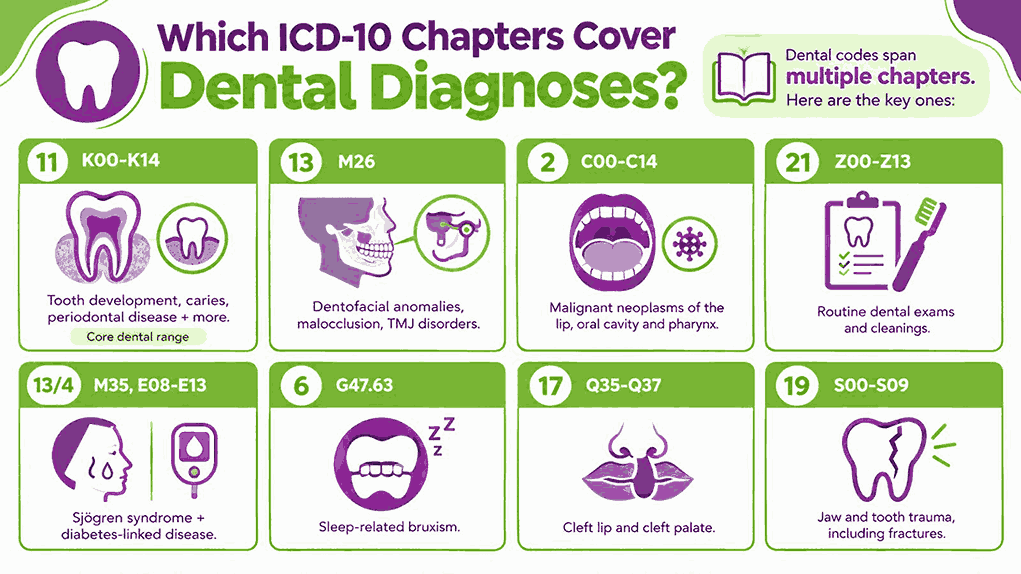
Dental diagnoses span multiple ICD-10 chapters. Most dental codes fall within K00-K14, but conditions involving jaw structure, systemic disease, trauma, and routine care also draw from several other chapters.
- Chapter 11 (K00-K14): Tooth development disorders, dental caries, periodontal disease, pulp and periapical disease, jaw disorders, and tongue/oral mucosa conditions — the core dental range.
- Chapter 13 (M26): Dentofacial anomalies, malocclusion, and TMJ disorders.
- Chapter 2 (C00-C14): Malignant neoplasms of the lip, oral cavity, and pharynx.
- Chapter 21 (Z00-Z13): Encounter and screening codes for routine dental exams and cleanings.
- Chapter 13 (M35): Systemic connective tissue disorders that may affect the oral cavity.
- Chapter 4 (E08-E13): Diabetes mellitus and related endocrine conditions that may affect dental care.
- Chapter 6 (G47.63): Sleep-related bruxism.
- Chapter 17 (Q35-Q37): Cleft lip and cleft palate.
- Chapter 19 (S00-S09): Jaw and tooth trauma, including tooth fracture.
How Is a Dental ICD-10-CM Code Structured?
Dental ICD-10-CM codes become more specific as additional characters are added. The first three characters identify the general category, while the characters after the decimal point add detail about site, type, and severity.
What Does Each Character in a Dental ICD-10 Code Means?
Every dental ICD-10-CM code starts with a three-character category, followed by up to four additional characters that add clinical specificity.
- Character 1: Always a letter. Most dental codes start with “K” (Chapter 11, Diseases of the digestive system), though dental-relevant codes also appear under “M” (musculoskeletal), “Z” (encounter/screening), and others.
- Characters 2-3: Numbers that narrow the category (e.g., K02 = dental caries, K05 = gingivitis and periodontal disease).
- Character 4 (after the decimal): Often identifies subtype, site, or a major clinical distinction (e.g., acute vs. chronic, localized vs. generalized).
- Characters 5-6: Add further detail such as surface, depth, or laterality.
- Character 7 (where present): Usually severity or an unspecified-vs-specified marker.
Not every code uses all seven characters. A code stops adding characters once it reaches full specificity for that condition.
Examples of How Dental ICD-Code Is Structured
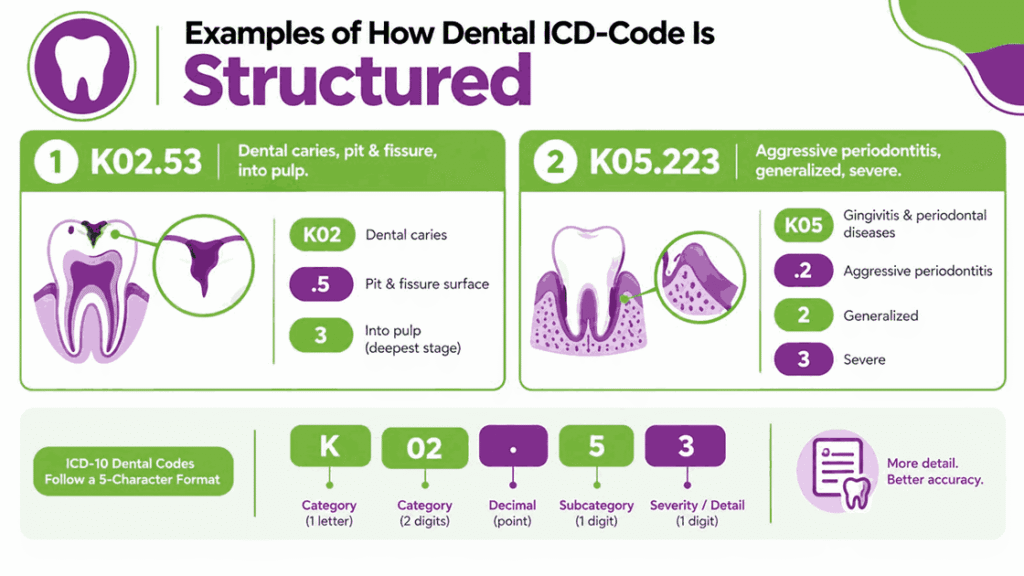
K02.53 reports dental caries on a pit and fissure surface penetrating into the pulp.
- K02 = the base category, dental caries
- .5 = pit and fissure surface (as opposed to .6, smooth surface, or .7, root surface)
- 3 = the depth of penetration into the pulp, the deepest and most clinically significant stage (compare to K02.51, limited to enamel, and K02.52, penetrating into dentin)
K05.223 reports aggressive periodontitis, generalized, severe.
- K05 = the base category, gingivitis and periodontal diseases
- .2 = aggressive periodontitis (as opposed to .1, chronic gingivitis, or .3, chronic periodontitis)
- 2 (fourth character) = generalized distribution (as opposed to 1, localized)
- 3 (fifth character) = severe (the scale runs 1-slight, 2-moderate, 3-severe, 9-unspecified severity)
What Makes a Dental ICD-10-CM Code Billable?
A billable code contains all characters required to report the specific diagnosis. Some three-character categories are not billable because they require additional characters.
For instance, K02 identifies the dental caries category but does not provide the specificity required for a complete diagnosis code. K02.51 provides a more specific diagnosis and can be reported when the documentation supports that code.
How Do You Code Dental Diagnoses Correctly?
To code a dental diagnosis correctly, review three key documentation details before submitting the claim. If a definitive diagnosis has been established, if multiple conditions need to be reported together, and if a second code is required to fully capture the patient’s condition.
These details support medical necessity and reduce claim denials. Accurate diagnosis coding gives your billing team a stronger foundation for clean claim submission and follow-up.
For practices that need additional support, professional dental billing services can help manage coding, claims, denials, and reimbursement workflows.
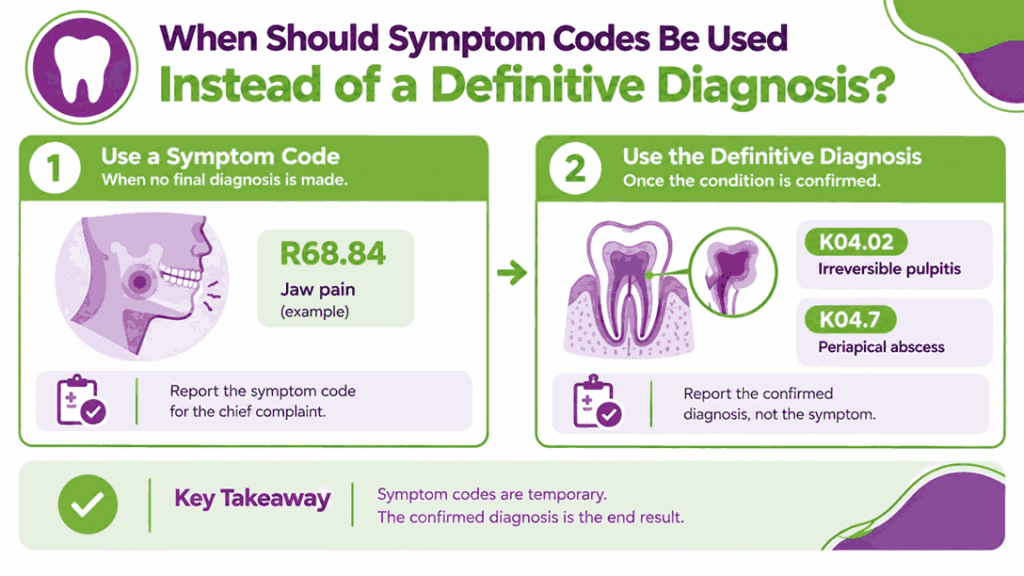
When Should Symptom Codes Be Used Instead of a Definitive Diagnosis?
ICD-10-CM symptom codes are reported only when the dentist has not established a definitive diagnosis by the end of the encounter. Once the underlying condition is confirmed, the diagnosis code replaces the symptom code.
For example, R68.84 (jaw pain) or a general oral pain symptom code may be appropriate when documenting a patient’s chief complaint.
However, if the dentist confirms a condition such as irreversible pulpitis (K04.02) or a periapical abscess (K04.7) during the same encounter, report the confirmed diagnosis rather than the presenting symptom.
Can More Than One Dental ICD-10 Code Be Reported Together?
Yes. Dental patients commonly present with multiple conditions that each affect treatment and medical necessity. When each condition is documented separately, ICD-10-CM allows multiple diagnosis codes to fully describe the patient’s clinical picture.
For example, a patient presenting with dental caries (K02.53), irreversible pulpitis (K04.02), and a periapical abscess (K04.7) may require all three diagnoses to support the procedures performed during that visit.
Every reported code should represent a documented condition that influenced the dentist’s evaluation or treatment.
Which ICD-10 Codes Cover the Most Common Dental Conditions?
Most dental diagnoses fall within K00-K14, the ICD-10-CM range for diseases of the oral cavity and salivary glands. These categories cover conditions affecting tooth development, caries, periodontal tissues, jaws, salivary glands, oral mucosa, and the tongue.
The sections below organize these codes by category. Each section explains what the category covers and lists commonly relevant codes with their official descriptions.
K00-K01: Tooth Development, Eruption, and Impacted Teeth
The K00 and K01 categories cover several conditions involving tooth development and eruption. K00 focuses on developmental problems affecting the formation, structure, size, and eruption of teeth. K01 covers teeth that remain embedded or become impacted instead of erupting normally.
According to the FY2026 ICD-10-CM classification, nine codes belong in the K00 category and two codes in the K01 category.
K00: Disorders of Tooth Development and Eruption
K00 includes conditions affecting the development and eruption of teeth. The category covers abnormalities involving the number, size, form, structure, and formation of teeth. It also includes conditions involving delayed or otherwise abnormal tooth eruption.
The individual codes provide more detail about the specific developmental problem. For example, K00.0 identifies anodontia, while K00.1 identifies supernumerary teeth. Other codes describe abnormalities of tooth size and form, disturbances in tooth formation, hereditary structural changes, and eruption disorders.
| ICD-10-CM Code | Description |
|---|---|
| K00.0 | Anodontia |
| K00.1 | Supernumerary teeth |
| K00.2 | Abnormalities of size and form of teeth |
| K00.3 | Mottled teeth |
| K00.4 | Disturbances in tooth formation |
| K00.5 | Hereditary disturbances in tooth structure, not elsewhere classified |
| K00.6 | Disturbances in tooth eruption |
| K00.7 | Teething syndrome |
| K00.8 | Other disorders of tooth development |
| K00.9 | Disorder of tooth development, unspecified |
K01: Embedded and Impacted Teeth
The category contains two codes, K01.0 for embedded teeth and K01.1 for impacted teeth. These codes should be selected according to the diagnosis documented by the provider. The classification therefore separates two related eruption problems.
| ICD-10-CM Code | Description |
|---|---|
| K01.0 | Embedded teeth |
| K01.1 | Impacted teeth |
K02: Dental Caries
The codes within K02 provide more detail than simply identifying the presence of caries. They distinguish conditions such as arrested caries, dental caries limited to enamel, dentin, or cementum, and other documented forms.
The category also includes codes that require specific documentation to support accurate reporting. For example, K02.3 identifies arrested dental caries, while other K02 codes distinguish caries affecting enamel, dentin, or cementum.
| ICD-10-CM Code | Description |
|---|---|
| K02.3 | Arrested dental caries |
| K02.51 | Dental caries on pit and fissure surface limited to enamel |
| K02.52 | Dental caries on pit/fissure surface penetrating into pulp |
| K02.53 | Dental caries on pit/fissure surface penetrating into dentin with pulp exposure |
| K02.61 | Dental caries on smooth surface limited to enamel |
| K02.62 | Dental caries on smooth surface penetrating dentin |
| K02.63 | Dental caries on smooth surface penetrating pulp |
| K02.64 | Dental caries on smooth surface penetrating dentin with pulp exposure |
| K02.7 | Dental caries on smooth surface penetrating cementum |
| K02.9 | Dental caries, unspecified |
K03-K04: Hard Tissues, Pulp, and Periapical Conditions
K03 and K04 cover diseases affecting different internal and external structures of the tooth. K03 focuses on the hard tissues of teeth, including conditions caused by wear, erosion, resorption, and structural changes.
These categories include several conditions that can appear alongside dental caries or other dental diagnoses.
K03: Other Diseases of Hard Tissues of Teeth
K03 covers conditions affecting the hard tissues of teeth outside the dental caries category. These conditions can involve excessive tooth wear, abrasion, erosion, resorption, deposits, and color changes.
The individual codes help distinguish the underlying type of hard-tissue condition. For example, K03.0 identifies excessive attrition, while K03.1 identifies abrasion of teeth. K03.2 identifies erosion, and K03.3 identifies pathological resorption.
| ICD-10-CM Code | Description |
|---|---|
| K03.0 | Excessive attrition of teeth |
| K03.1 | Abrasion of teeth |
| K03.2 | Erosion of teeth |
| K03.3 | Pathological resorption of teeth |
| K03.4 | Hypercementosis |
| K03.5 | Ankylosis of teeth |
| K03.6 | Deposits [accretions] on teeth |
| K03.7 | Post-eruptive color changes of dental hard tissues |
| K03.81 | Cracked tooth |
| K03.89 | Other specified diseases of hard tissues of teeth |
| K03.9 | Disease of hard tissues of teeth, unspecified |
K04: Diseases of Pulp and Periapical Tissues
K04 covers conditions involving the dental pulp and tissues around the tooth root. These diagnoses include pulp necrosis, pulp degeneration, abnormal tissue formation, apical periodontitis, periapical abscesses, and radicular cysts.
The codes distinguish conditions based on the affected tissue and documented diagnosis. For example, K04.1 identifies necrosis of the pulp, while K04.4 identifies acute apical periodontitis of pulpal origin.
| ICD-10-CM Code | Description |
|---|---|
| K04.1 | Necrosis of pulp |
| K04.2 | Pulp degeneration |
| K04.3 | Abnormal hard tissue formation in pulp |
| K04.4 | Acute apical periodontitis of pulpal origin |
| K04.5 | Chronic apical periodontitis |
| K04.6 | Periapical abscess with sinus |
| K04.7 | Periapical abscess without sinus |
| K04.8 | Radicular cyst |
| K04.9 | Other and unspecified diseases of pulp and periapical tissues |
K05-K06: Gingival and Periodontal Conditions
K05 focuses on gingivitis and periodontal diseases, including acute, chronic, and unspecified periodontal conditions. Meanwhile, K06 covers other disorders involving the gingiva and edentulous alveolar ridge.
These categories help separate inflammatory periodontal diseases from other gingival or alveolar ridge disorders.
K05: Gingivitis and Periodontal Diseases
K05 includes diagnoses involving gingival inflammation and periodontal disease. The category distinguishes different periodontal conditions based on the documented diagnosis.
It includes acute and chronic gingivitis, aggressive and chronic periodontitis, periodontosis, and other periodontal diseases. The codes within K05 help identify the type of periodontal condition being treated or evaluated.
| ICD-10-CM Code | Description |
|---|---|
| K05.0 | Acute gingivitis |
| K05.1 | Chronic gingivitis |
| K05.2 | Aggressive periodontitis |
| K05.3 | Chronic periodontitis |
| K05.4 | Periodontosis |
| K05.5 | Other periodontal diseases |
| K05.6 | Periodontal disease, unspecified |
K06: Other Disorders of Gingiva and Edentulous Alveolar Ridge
K06 covers gingival and edentulous alveolar ridge conditions that do not fall within the main gingivitis and periodontal disease category. These diagnoses can involve gingival recession, gingival enlargement, and lesions associated with trauma.
The distinctions within K06 help describe the particular gingival or alveolar ridge problem documented during the encounter.
| ICD-10-CM Code | Description |
|---|---|
| K06.0 | Gingival recession |
| K06.1 | Gingival enlargement |
| K06.2 | Gingival and edentulous alveolar ridge lesions associated with trauma |
| K06.8 | Other specified disorders of gingiva and edentulous alveolar ridge |
| K06.9 | Disorder of gingiva and edentulous alveolar ridge, unspecified |
K08: Other Disorders of Teeth and Supporting Structures
K08 covers disorders affecting teeth and the structures that support them. These conditions include tooth loss, retained dental roots, changes to the alveolar ridge, and problems involving dental restorations.
K08.0 addresses exfoliation caused by systemic conditions, while K08.1 covers complete loss of teeth. K08.2 and K08.3 address changes involving the edentulous alveolar ridge and retained dental roots.
K08.4 covers partial loss of teeth and provides further classification based on the documented cause. K08.5 addresses unsatisfactory dental restorations, including open margins, fractured restorative material, and other restoration problems.
| ICD-10-CM Code | Description |
|---|---|
| K08.0 | Exfoliation of teeth due to systemic causes |
| K08.2 | Atrophy of edentulous alveolar ridge |
| K08.3 | Retained dental root |
| K08.101 | Complete loss of teeth, unspecified cause, class I |
| K08.102 | Complete loss of teeth, unspecified cause, class II |
| K08.103 | Complete loss of teeth, unspecified cause, class III |
| K08.104 | Complete loss of teeth, unspecified cause, class IV |
| K08.109 | Complete loss of teeth, unspecified cause, unspecified class |
| K08.401 | Partial loss of teeth, unspecified cause, class I |
| K08.402 | Partial loss of teeth, unspecified cause, class II |
| K08.403 | Partial loss of teeth, unspecified cause, class III |
| K08.404 | Partial loss of teeth, unspecified cause, class IV |
| K08.409 | Partial loss of teeth, unspecified cause, unspecified class |
| K08.411 | Partial loss of teeth due to trauma, class I |
| K08.421 | Partial loss of teeth due to periodontal diseases, class I |
| K08.431 | Partial loss of teeth due to caries, class I |
| K08.491 | Partial loss of teeth due to other specified cause, class I |
| K08.51 | Open restoration margins of tooth |
| K08.52 | Unrepairable overhanging of dental restorative materials |
| K08.530 | Fractured dental restorative material without loss of material |
| K08.531 | Fractured dental restorative material with loss of material |
| K08.539 | Fractured dental restorative material, unspecified |
| K08.55 | Allergy to existing dental restorative material |
| K08.56 | Poor aesthetics of existing restoration of tooth |
| K08.59 | Other unsatisfactory restoration of tooth |
| K08.81 | Primary occlusal trauma |
| K08.82 | Secondary occlusal trauma |
| K08.89 | Other specified disorders of teeth and supporting structures |
| K08.9 | Disorder of teeth and supporting structures, unspecified |
K09-K10: Oral Cysts and Other Oral/Jaw Conditions
K09 and K10 cover cystic conditions of the oral region and diseases affecting the jaws. K09 focuses on oral and jaw cysts, including developmental cysts. K10 covers developmental, inflammatory, and other diseases of the jaws.
K09: Cysts of Oral Region, Not Elsewhere Classified
K09 covers cysts that affect the oral region and are not classified elsewhere. The category separates developmental cysts from other specified and unspecified oral cysts.
The codes identify cysts based on their documented type and origin. This distinction helps prevent different cystic conditions from being grouped under one broad diagnosis.
| ICD-10-CM Code | Description |
|---|---|
| K09.0 | Developmental odontogenic cysts |
| K09.1 | Developmental (nonodontogenic) cysts of oral region |
| K09.8 | Other cysts of oral region, not elsewhere classified |
| K09.9 | Cyst of oral region, unspecified |
K10: Other Diseases of Jaws
K10 covers other diseases affecting the jaws. These conditions include developmental disorders, giant cell granuloma, inflammatory jaw conditions, and alveolitis.
The category also provides specified and unspecified options for other jaw diseases. The documented diagnosis should support the level of specificity reported on the claim.
| ICD-10-CM Code | Description |
|---|---|
| K10.0 | Developmental disorders of jaws |
| K10.1 | Giant cell granuloma, central |
| K10.2 | Inflammatory conditions of jaws |
| K10.3 | Alveolitis of jaws |
| K10.8 | Other specified diseases of jaws |
| K10.9 | Disease of jaws, unspecified |
K11-K14: Salivary Glands, Oral Mucosa, and Tongue Conditions
K11 through K14 cover conditions involving salivary glands, oral mucosa, lips, and the tongue. These categories address disorders beyond teeth, gums, and supporting structures.
The codes distinguish conditions based on the affected oral structure and documented diagnosis. This helps ensure the reported diagnosis matches the condition evaluated during the encounter.
K11: Diseases of Salivary Glands
The K11 category is used for diseases affecting the salivary glands and their normal function. The category includes inflammation, abscesses, fistulas, stones, secretion disorders, and other gland conditions.
The specific codes identify different salivary gland disorders based on the documented condition. For example, K11.2 identifies sialoadenitis, while K11.5 identifies sialolithiasis.
| ICD-10-CM Code | Description |
|---|---|
| K11.0 | Atrophy of salivary gland |
| K11.1 | Hypertrophy of salivary gland |
| K11.2 | Sialoadenitis |
| K11.3 | Abscess of salivary gland |
| K11.4 | Fistula of salivary gland |
| K11.5 | Sialolithiasis |
| K11.6 | Mucocele of salivary gland |
| K11.7 | Disturbances of salivary secretion |
| K11.8 | Other diseases of salivary glands |
| K11.9 | Disease of salivary gland, unspecified |
K12: Stomatitis and Related Lesions
K12 covers stomatitis and related conditions affecting the mouth. These diagnoses include recurrent oral aphthae, other forms of stomatitis, and cellulitis or abscess of the mouth.
The category separates inflammatory oral lesions from infectious conditions involving deeper oral tissues. The diagnosis documented by the provider should support the selected code.
| ICD-10-CM Code | Description |
|---|---|
| K12.0 | Recurrent oral aphthae |
| K12.1 | Other forms of stomatitis |
| K12.2 | Cellulitis and abscess of mouth |
K13: Other Diseases of Lip and Oral Mucosa
K13 covers other conditions affecting the lips and oral mucosa. These disorders include lip conditions, oral epithelial changes, leukoplakia, granulomatous lesions, and mucosal hyperplasia.
The category provides several options for distinguishing specific oral mucosal findings. For instance, K13.2 covers leukoplakia and other disturbances of oral epithelium, including the tongue.
| ICD-10-CM Code | Description |
|---|---|
| K13.0 | Diseases of lips |
| K13.1 | Cheek and lip biting |
| K13.2 | Leukoplakia and other disturbances of oral epithelium, including tongue |
| K13.3 | Hairy leukoplakia |
| K13.4 | Granuloma and granuloma-like lesions of oral mucosa |
| K13.5 | Oral submucous fibrosis |
| K13.6 | Irritative hyperplasia of oral mucosa |
| K13.7 | Other and unspecified lesions of oral mucosa |
K14: Diseases of Tongue
K14 covers disorders affecting the tongue. These conditions include glossitis, geographic tongue, changes to tongue papillae, plicated tongue, and glossodynia.
The category distinguishes different structural and inflammatory tongue conditions. The selected code should correspond to the condition documented in the patient’s record.
| ICD-10-CM Code | Description |
|---|---|
| K14.0 | Glossitis |
| K14.1 | Geographic tongue |
| K14.2 | Median rhomboid glossitis |
| K14.3 | Hypertrophy of tongue papillae |
| K14.4 | Atrophy of tongue papillae |
| K14.5 | Plicated tongue |
| K14.6 | Glossodynia |
| K14.8 | Other diseases of tongue |
| K14.9 | Disease of tongue, unspecified |
M26: Dentofacial Anomalies and Related Dental Conditions
M26 covers dentofacial anomalies involving the relationship, position, and alignment of teeth and jaws. These conditions are classified outside the K00-K14 dental disease range.
The category includes dental arch relationship problems, tooth position abnormalities, and dental alveolar anomalies. These codes can provide greater specificity for orthodontic and dentofacial conditions.
M26.2: Anomalies of Dental Arch Relationship
M26.2 covers abnormalities involving the relationship between dental arches. The category includes unspecified and other anomalies of dental arch relationship.
M26.20 identifies an unspecified anomaly of dental arch relationship. M26.29 identifies other anomalies of dental arch relationship. The documented arch relationship should support the selected code.
M26.3: Anomalies of Tooth Position
M26.3 covers abnormalities involving the position of fully erupted teeth. The category distinguishes crowding, spacing, and other tooth position abnormalities.
| ICD-10-CM Code | Description |
|---|---|
| M26.30 | Unspecified anomaly of tooth position of fully erupted tooth or teeth |
| M26.31 | Crowding of fully erupted teeth |
| M26.32 | Excessive spacing of fully erupted teeth |
| M26.36 | Insufficient interocclusal distance of fully erupted teeth (ridge) |
| M26.37 | Excessive interocclusal distance of fully erupted teeth |
| M26.39 | Other anomalies of tooth position of fully erupted tooth or teeth |
M26.7: Dental Alveolar Anomalies
M26.7 covers dental alveolar anomalies involving the structures surrounding and supporting the teeth. The documented condition should support the use of this category. Coders should verify the current Tabular List before reporting the diagnosis.
Other ICD-10-CM Codes Used for Dental Diagnoses
Dental diagnoses can also appear outside the K00-K14 range. These codes cover cancer, examinations, dental devices, aftercare, caries risk, and procedure status. The other ICD-10-CM codes used for dental diagnosis are:
C00-C14
C00-C14 covers malignant neoplasms involving the lip, oral cavity, and pharynx. These codes apply when a malignant neoplasm affects an oral or related anatomical site. The specific code depends on the documented site and diagnosis.
| ICD-10-CM Code | Description |
|---|---|
| C00-C06 | Malignant neoplasms of the lip and oral cavity |
| C09-C10 | Malignant neoplasms of the tonsil and oropharynx |
| C11-C14 | Malignant neoplasms of the nasopharynx, hypopharynx, and other pharyngeal sites |
Z00-Z13
Z00-Z13 includes codes for routine examinations and screening encounters. Z01.2 covers dental examination and cleaning, including encounters with and without abnormal findings. Z13.84 identifies encounters for screening for dental disorders.
| ICD-10-CM Code | Description |
|---|---|
| Z01.20 | Encounter for dental examination and cleaning without abnormal findings |
| Z01.21 | Encounter for dental examination and cleaning with abnormal findings |
| Z13.84 | Encounter for screening for dental disorders |
Z46
Z46 includes encounters for fitting and adjusting certain dental devices. Z46.3 applies to dental prosthetic devices, while Z46.4 applies to orthodontic devices. These codes describe encounters focused on device fitting or adjustment.
Z48
Z48.814 applies to surgical aftercare following surgery on the teeth or oral cavity. It can be used when the encounter involves routine aftercare following qualifying oral surgery. The documentation should support the purpose of the visit.
Z91.84
Z91.84 includes codes that identify a patient’s documented risk for dental caries. The classification distinguishes low, moderate, high, and unspecified caries risk. These codes can provide additional information about the patient’s dental risk status.
| ICD-10-CM Code | Description |
|---|---|
| Z91.841 | Risk for dental caries, low |
| Z91.842 | Risk for dental caries, moderate |
| Z91.843 | Risk for dental caries, high |
| Z91.849 | Unspecified risk for dental caries |
Z98
Z98 includes codes describing certain dental procedures and restoration statuses. These codes reflect a patient’s documented dental status rather than an active disease.
The category includes Z98.810 for dental sealant status, Z98.811 for dental restoration status, and Z98.818 for other dental procedure status. The appropriate code should reflect the specific dental status documented in the patient’s record.
Other Conditions That May Affect Dental Coding
Dental care can also involve conditions classified in other ICD-10-CM chapters. These codes may describe systemic diseases, congenital conditions, sleep disorders, or injuries that affect dental care.
M35
M35 includes systemic connective tissue disorders such as Sjögren syndrome. Sjögren syndrome can affect oral health through reduced salivary function and associated oral symptoms. The documented systemic condition should support the selected diagnosis.
E08-E13
E08-E13 covers diabetes mellitus and its different classifications. Diabetes can be relevant when it affects oral health or periodontal conditions. The documented diabetes type and any associated condition should guide code selection.
G47.63
G47.63 identifies sleep-related bruxism. This condition involves teeth grinding or clenching during sleep. It may be relevant when dental findings are associated with documented sleep-related bruxism.
Q35-Q37
Q35-Q37 covers congenital cleft conditions involving the lip and palate. These codes describe congenital abnormalities rather than acquired dental conditions. The specific code depends on the documented type and location of the cleft.
| ICD-10-CM Code | Description |
|---|---|
| Q35 | Cleft palate |
| Q36 | Cleft lip |
| Q37 | Cleft palate with cleft lip |
S00-S09
S00-S09 covers injuries involving the head, face, and related structures. Dental and jaw trauma can fall within these injury categories when caused by an external event. The specific injury code depends on the documented injury, location, and circumstances.
| ICD-10-CM Code | Description |
|---|---|
| S00-S01 | Superficial injuries and open wounds of the head |
| S02 | Fractures of the skull and facial bones, including jaw fractures |
| S03 | Dislocation and sprain of joints and ligaments of the head |
| S04-S09 | Other injuries involving nerves, blood vessels, muscles, and other head structures |
How to Choose the Correct Dental ICD-10-CM Code
Choosing the correct dental ICD-10-CM code starts with the diagnosis documented in the patient’s record. The code should match the condition evaluated or treated during the encounter. Use the most specific code supported by the available documentation.
Start With the Documented Diagnosis
First, identify the specific dental condition documented by the provider. Do not select a code based only on the patient’s symptoms or treatment performed. For example, documented periodontal disease should be coded according to its specific type when supported.
Use the Most Specific Code Available
Review the available characters and subcategories before selecting an unspecified code. Some dental conditions require additional characters to identify the cause, type, or classification. The final code should contain all characters required for the documented diagnosis.
Verify the Code in the Tabular List
After locating a potential code, verify it in the Tabular List before reporting it. Review inclusion terms, Excludes notes, and other coding instructions linked to the code. This step helps confirm that the selected code accurately represents the documented condition.
Avoid Symptom Codes When a Diagnosis Is Established
Symptom codes should generally be used when a definitive diagnosis has not been established. Once the provider confirms the underlying dental condition, the confirmed diagnosis should generally replace the symptom code. The final code selection should always follow the documentation and applicable ICD-10-CM guidelines.
Common Dental ICD-10-CM Coding Mistakes to Avoid
Dental ICD-10-CM coding errors often occur when documentation and code selection do not fully match. Small differences in diagnosis details can change the appropriate code. The table below highlights common mistakes and how to avoid them.
| Common Mistake | Why It Happens | How to Avoid It |
|---|---|---|
| Using unspecified codes too quickly | The coder selects a broad code without reviewing available details. | Review the full category and use the most specific code supported by documentation. |
| Coding symptoms instead of a diagnosis | The symptom is reported even after the provider establishes the underlying condition. | Report the confirmed diagnosis when the documentation supports it. |
| Skipping the Tabular List | The coder stops after finding a potential code in the Alphabetic Index. | Verify the code in the Tabular List and review applicable instructions. |
| Reporting unsupported diagnoses | The selected code includes details that are not documented. | Code only conditions and details supported by the patient’s record. |
| Confusing diagnosis and procedure codes | ICD-10-CM and CDT codes are used for different coding purposes. | Use ICD-10-CM for diagnoses and CDT codes for dental procedures. |
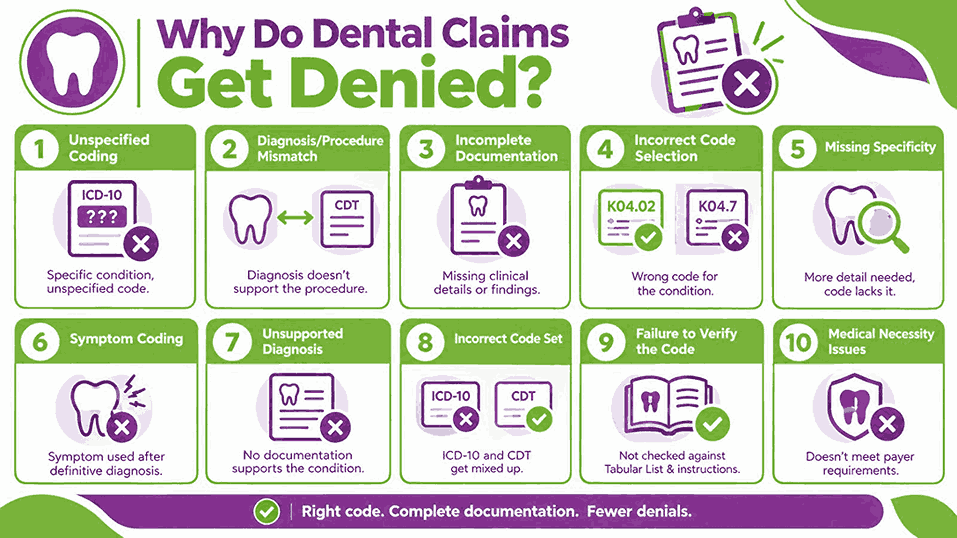
Why Do Dental Claims Get Denied?
Dental claims can be denied when the diagnosis does not support the reported service or when documentation lacks the required specificity. Common coding and billing issues include:
- Unspecified Coding: A specific dental condition is documented, but an unspecified ICD-10-CM code is submitted instead.
- Diagnosis and Procedure Mismatch: The ICD-10-CM diagnosis does not reasonably support the CDT procedure reported on the claim.
- Incomplete Documentation: The record does not clearly establish the dental condition, clinical findings, or reason for treatment.
- Incorrect Code Selection: A similar dental condition is assigned the wrong ICD-10-CM code.
- Missing Specificity: The documentation supports a more specific condition, but the submitted code does not capture that detail.
- Symptom Coding: A symptom is coded when the provider has already established a definitive dental diagnosis.
- Unsupported Diagnosis: A diagnosis appears on the claim without sufficient documentation supporting that condition.
- Incorrect Code Set: ICD-10-CM diagnosis codes are confused with CDT procedure codes.
- Failure to Verify the Code: The selected code is not checked against the current Tabular List and applicable coding instructions.
- Medical Necessity Issues: The diagnosis submitted does not meet the payer’s requirements for the reported dental service.
CMS now requires an ICD-10 code on Medicare dental claims submitted through the 837D or 2024 ADA claim form. This makes accurate diagnosis reporting especially important for applicable Medicare dental claims.
How Do You Reduce Dental Claim Denials?
To reduce dental claim denials, focus on accurate diagnosis selection, complete documentation, and proper code verification. Review the patient’s record before submitting the claim, and confirm that the diagnosis supports the reported service.
- Use Specific Codes: Select the most specific code supported by the documentation.
- Verify Every Code: Check the Alphabetic Index and Tabular List before reporting the diagnosis.
- Review Documentation: Confirm that the record supports the selected diagnosis.
- Separate Code Sets: Use ICD-10-CM for diagnoses and CDT codes for dental procedures.
- Check for Missing Details: Look for documented causes, classifications, and other required specificity.
If your team needs additional support, experienced dental billing providers can help improve claim accuracy, denial follow-up, and overall revenue cycle management.
Dental ICD-10 Codes FAQs
Are Dental ICD-10-CM Codes Only Used by Dentists?
No, dental diagnoses can be documented by dentists, physicians, oral surgeons, and other healthcare professionals when applicable. The appropriate code depends on the condition documented and the setting in which care is provided.
Can More Than One ICD-10-CM Code Be Reported for a Dental Encounter?
Yes, multiple diagnosis codes may be appropriate when the patient has multiple documented conditions relevant to the encounter. Each diagnosis should have a clear connection to the services provided. Additional codes should not be added simply to increase the number of diagnoses on a claim.
Where Should You Check for the Most Current Dental ICD-10-CM Codes?
Use the ICD-10-CM code set for the applicable fiscal year. Code descriptions and requirements can change with annual updates, so older code lists should not be used as the sole reference for current claims.
What ICD-10 Code Is Used When a Patient Has No Natural Teeth?
Complete loss of teeth is represented within the K08 category. The appropriate code depends on the circumstances and classification documented in the patient’s record. Documentation should support whether the tooth loss is complete and whether additional classification details apply.
What ICD-10 Code Is Used for Tooth Pain?
Tooth pain may be reported using a symptom code when no definitive diagnosis has been established. Once the provider documents an underlying condition causing the pain, the confirmed condition should generally be considered for coding instead. The documentation should determine the appropriate diagnosis.