New York runs one of the most heavily regulated medical billing environments in the country. The Department of Financial Services has levied close to seven million dollars in fines against insurers and HMOs for prompt pay violations since the law took effect in 1998. In one enforcement round alone, the department received over 13,000 prompt pay complaints in a single year.
Insurers face strict payment deadlines. Providers face strict authorization timelines, often as short as three business days for a standard prior authorization determination.
Patients face specific protections against surprise charges, protections New York put in place years before the federal No Surprises Act existed. A billing team that does not track these rules loses revenue through avoidable denials, missed appeal windows, and payer disputes that drag on for months.
This guide walks through the state laws and regulations that shape how claims move from submission to payment in New York. Each section includes the statute or regulation behind the rule, not just a general summary.

Why New York Medical Billing Rules Carry More Weight Than Most States
New York layers two separate legal frameworks over health insurance billing, and a real enforcement history backs both frameworks with financial penalties for violations.
Two Statutes, One Compliance Burden
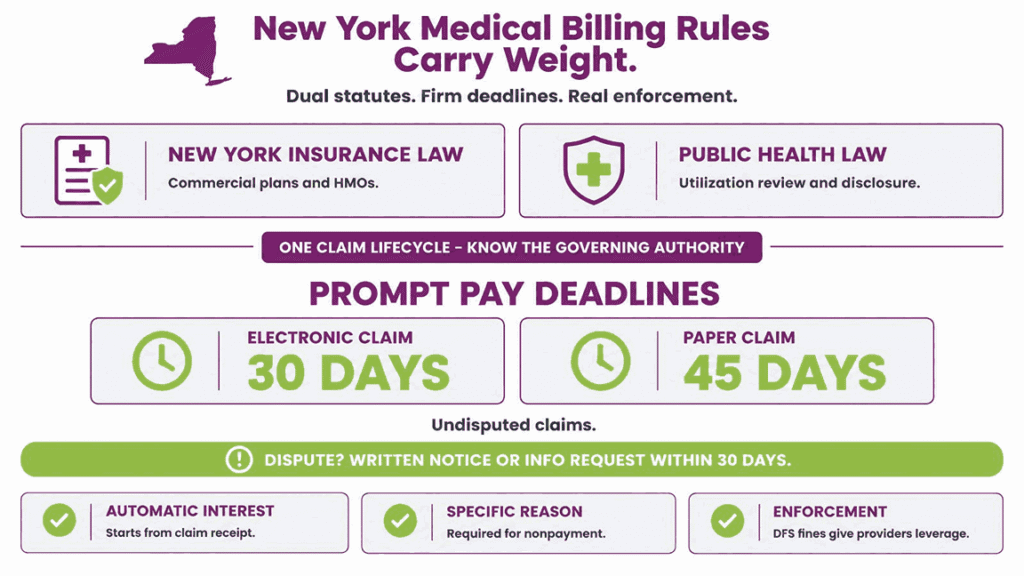
New York regulates health insurance through two separate bodies of law. The New York Insurance Law governs commercial health plans and HMOs. The New York Public Health Law governs utilization review, disclosure, and certain provider obligations. Many billing rules exist in both statutes with matching or near-matching language, because the legislature amended both when a reform passed.
This dual structure matters for billing staff. A claim payment dispute might reference Insurance Law Section 3224-a. A prior authorization dispute might reference Public Health Law Section 4903. Knowing which statute governs which part of the claim lifecycle helps a biller cite the correct authority when appealing a denial or reporting a violation to the Department of Financial Services.
A Track Record of Enforcement
New York also enforces its rules through fines. The Department of Financial Services has issued fines exceeding six million dollars total against insurers and HMOs for prompt pay violations since the law took effect in 1998. That enforcement history gives providers real leverage when a payer sits on a clean claim past the statutory deadline.
The New York Prompt Pay Law and Claim Payment Deadlines
Insurance Law Section 3224-a sets exact payment deadlines for insurers, and it also defines what happens the moment a payer disputes a claim.
Payment Deadlines by Claim Type
Insurance Law Section 3224-a, known as the Prompt Pay Law, sets firm deadlines for how fast insurers must pay claims. Insurers must pay electronic claims within 30 days of receipt. Paper claims must be paid within 45 days of receipt. These deadlines apply to any claim the insurer does not dispute in good faith.
What Happens When a Payer Disputes a Claim
If a payer disputes a claim, it must notify the provider in writing within 30 days and state the specific reason for nonpayment. The payer can instead request additional information needed to determine liability. If neither notice nor request happens within that window, the claim is treated as undisputed and becomes payable under the standard timeline.
Interest on Late Payments
When a payer misses the deadline on an undisputed claim, interest becomes payable automatically. The interest calculation starts from the original date the claim was received, not from the date of any later appeal. This detail matters for revenue cycle teams tracking aging accounts receivable, because it means providers can recover more than the original claim amount on late payments.
Practices working with a Medical billing services partner in New York benefit from having someone track these deadlines claim by claim across every payer contract, since manual tracking across dozens of plans becomes unmanageable at scale.
The Emergency Medical Services and Surprise Bills Law
New York’s surprise billing law protects patients from unexpected out-of-network charges through strict disclosure rules and a formal dispute resolution process.
What Counts as a Surprise Bill
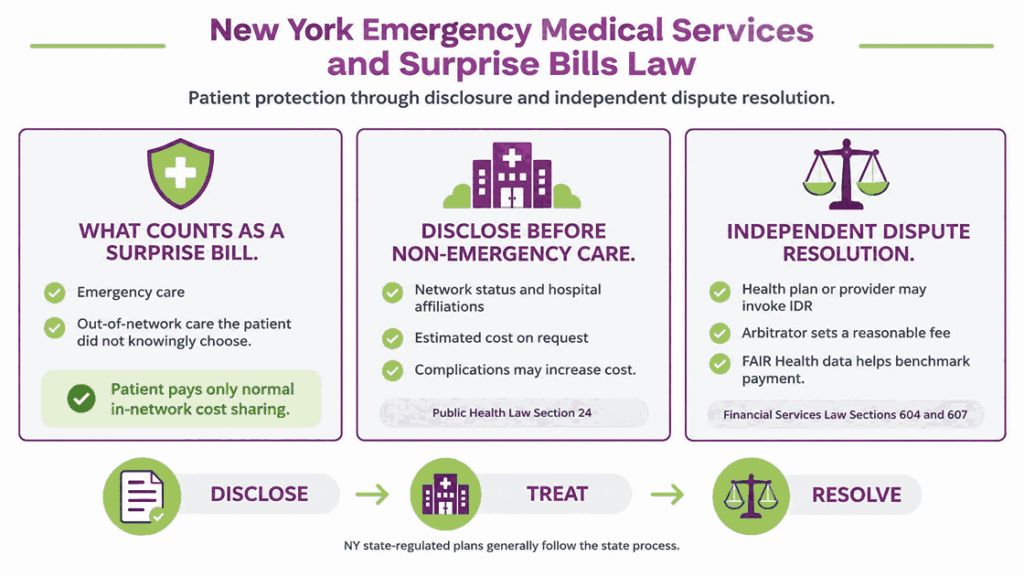
New York passed one of the earliest and most comprehensive state surprise billing laws in the country, effective April 2015. The law protects patients from unexpected out-of-network charges in two main scenarios: emergency care and non-emergency care where the patient did not knowingly choose an out-of-network provider.
Under this law, patients responsible for a surprise bill owe no more than their standard in-network copayment, coinsurance, or deductible.
Disclosure Requirements Under Public Health Law Section 24
Public Health Law Section 24 requires providers to disclose their network participation and any hospital affiliations, in writing or on their website, before rendering non-emergency services.
Providers must also disclose estimated costs upon request and warn patients that costs could increase if complications arise during treatment. The provider must accept an assignment of benefits form from the patient and pursue payment directly from the health plan instead of billing the patient the balance.
Independent Dispute Resolution
When a payment dispute remains unresolved, either the health plan or the non-participating provider can invoke independent dispute resolution under Financial Services Law Section 607. An independent arbitrator sets the reasonable fee using factors listed in Financial Services Law Section 604, along with benchmarking data from the FAIR Health database.
This process runs separately from the federal No Surprises Act, and state-regulated plans in New York generally still follow the state process rather than the federal one.
New York’s Prior Authorization Rules Under Public Health Law 4903
Public Health Law Section 4903 sets fixed turnaround times for prior authorization decisions, and standard, urgent, and inpatient rehabilitation requests each follow different clocks.
Standard, Urgent, and Inpatient Rehab Timelines
Prior authorization delays cost practices real revenue through canceled appointments, treatment delays, and denied claims tied to missing or expired authorizations. New York regulates this process through Public Health Law Section 4903 and the matching Insurance Law Section 4903.
Under current standards, a utilization review agent must issue a determination on a standard prior authorization request within three business days of receiving all necessary clinical information.
For urgent requests, where delay would place the patient’s health in serious jeopardy, the timeline shortens to 24 hours. Inpatient rehabilitation authorization requests following a hospital admission carry their own one business day standard.
Clinical Review Standards
These timelines apply to both approvals and denials, and the notice must go to the patient or the patient’s designee and to the treating provider, delivered by telephone and in writing. Utilization review agents must also base medical necessity decisions on recognized, evidence-based clinical review criteria rather than internal guidelines without peer-review support.
Pending Reform Bills
Lawmakers in Albany have introduced multiple bills in recent sessions aimed at tightening these standards further, including proposals for standardized electronic prior authorization submission. Practices that rely on dedicated prior auth services often see fewer denials tied to authorization timing errors, because a dedicated team can flag approaching deadlines and escalate stalled requests before the treatment date arrives.
Timely Filing Limits for Medicaid and Commercial Payers in New York
Every payer active in New York enforces its own timely filing window, and missing that window turns an otherwise valid claim unenforceable.
Medicaid Filing Windows Through eMedNY
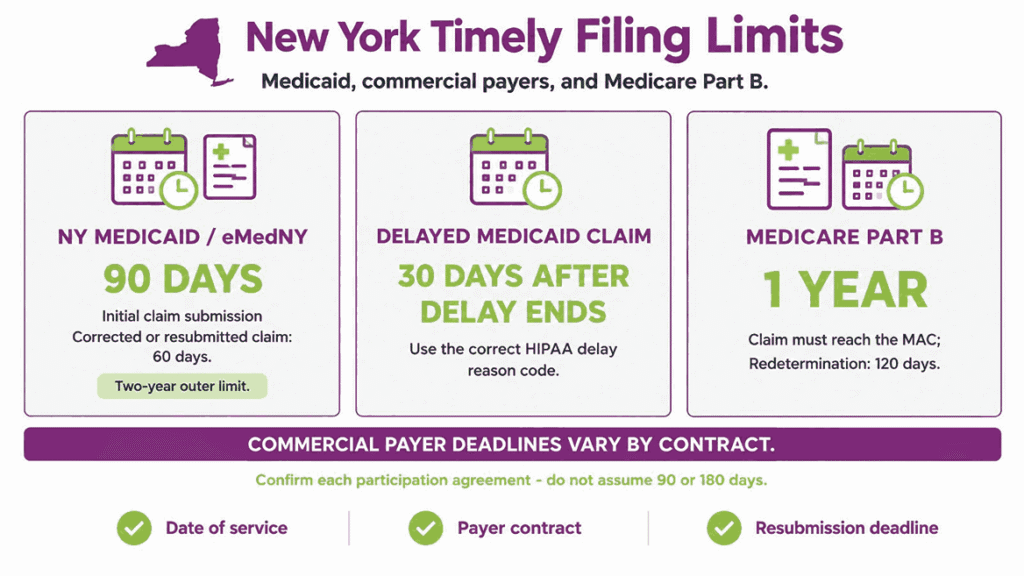
Timely filing rules determine how long a provider has to submit a claim after the date of service. Miss the deadline and the claim becomes unenforceable, regardless of medical necessity or documentation quality. New York Medicaid, administered through eMedNY, requires initial claim submission within 90 days of the date of service.
Claims delayed by circumstances outside the provider’s control, such as a third-party processing delay or an eligibility determination delay, must be submitted within 30 days of the delay ending, using the correct HIPAA delay reason code.
Corrected or resubmitted claims following a rejection must go back to Medicaid within 60 days of the notification. All claims must reach the fiscal agent within two years of the date of service to remain valid.
Commercial Payer Variability
Commercial payer timelines in New York vary by contract, since state law does not set a single statewide deadline for private plans the way federal law sets one for Medicare. Providers should confirm the specific filing window in each participation agreement rather than assuming a standard 90-day or 180-day rule applies across every payer.
Medicare Part B Deadlines
Medicare Part B claims must reach the Medicare Administrative Contractor within one calendar year of the date of service under federal rule 42 CFR 424.44. Redetermination requests following a denial must go in within 120 days of the initial determination. These federal deadlines apply in New York the same way they apply nationally, since Medicare timely filing is not a state-level rule.
New York SHIELD Act and Patient Data Protection in Billing
The SHIELD Act layers state-specific data security obligations on top of HIPAA, and billing vendors handling New York claims fall under it too.
What the SHIELD Act Requires
The New York SHIELD Act, which took full effect in 2020, expanded data security obligations for any business handling private information belonging to New York residents, including medical billing operations.
The law requires reasonable administrative, technical, and physical safeguards for protected health and financial data, and it broadened the definition of a reportable breach beyond what earlier law covered. For billing departments, this means encrypted transmission of claim data, access controls limiting who can view patient financial records, and a documented breach notification process.
SHIELD Act vs HIPAA
HIPAA still governs the baseline privacy and security rules for protected health information nationally, and the SHIELD Act does not replace it. Instead, the SHIELD Act adds New York-specific breach notification timing and expands coverage to private information that HIPAA does not always address, such as certain account numbers tied to patient billing.
Practices running billing through outsourced RCM services should confirm data handling agreements meet these state-specific requirements, not just federal HIPAA standards.
No-Fault Insurance Billing Rules for Auto Accident Claims
New York’s no-fault system runs on its own payment timeline and interest rate, separate from the general Prompt Pay Law standards.
Payment Timeline and Proof of Loss
New York operates under a no-fault insurance system for motor vehicle accidents, governed by Insurance Law Article 51, also called the Comprehensive Motor Vehicle Insurance Reparations Act. Insurance Law Section 5106 sets the payment timeline for these claims separately from the general Prompt Pay Law.
No-fault insurers must pay claims within 30 days of receiving proof of the loss and its amount. If a claim is only partially supported by proof, the supported portion becomes overdue if unpaid within 30 days of that partial proof being submitted.
Interest on Overdue No-Fault Claims
Overdue no-fault payments accrue interest at two percent per month, a notably higher rate than the general prompt pay interest calculation. Providers billing for injuries treated after a car accident need separate tracking for no-fault claims, since the submission requirements, required forms, and payment timeline differ from standard health insurance billing.
Missing the no-fault-specific proof of loss requirements is one of the more common reasons these claims get delayed past the 30-day mark.
Workers’ Compensation Billing Requirements in New York
Workers’ compensation claims follow the state Board’s own fee schedule and dispute process, separate from standard commercial or Medicare billing rules.
Fee Schedule and Coding Requirements
Workers’ compensation claims in New York follow the New York State Workers’ Compensation Board fee schedule rather than standard commercial or Medicare fee schedules. Providers must bill using the Board’s specific forms and must use CPT and diagnosis codes consistent with the accepted body part and injury on the claim.
Authorization and Dispute Process
The Board sets its own timely filing and payment standards separate from the Insurance Law Prompt Pay provisions, and disputes go through the Board’s own administrative process rather than through a commercial payer appeal.
Providers treating occupational injuries should confirm authorization status with the employer’s carrier before treatment when possible, since workers’ compensation claims carry a higher denial rate tied to disputed causation and body part coverage than standard commercial claims.
Accurate claim submission on the Board’s required forms, matched to the accepted body part, prevents many of these denials before they start.
Balance Billing Restrictions and Patient Cost-Sharing Protections
New York restricts balance billing tightly in surprise bill scenarios, but the restriction depends entirely on whether proper disclosure occurred beforehand.
When Balance Billing Is Prohibited
Balance billing, where a provider bills a patient for the difference between the charged amount and what insurance pays, faces significant restriction in New York for the surprise bill scenarios described earlier. Under Financial Services Law Section 606, once a patient assigns benefits for a surprise bill to a non-participating physician, that physician cannot bill the patient beyond the applicable copayment, coinsurance, or deductible.
When Balance Billing Is Still Allowed
This restriction does not eliminate balance billing. A patient who knowingly and voluntarily chooses an out-of-network provider, after receiving the required disclosures under Public Health Law Section 24, can still be balance billed for that choice.
The protection exists specifically for situations where the patient did not have a meaningful choice, such as an anesthesiologist assigned during a scheduled in-network surgery. Billing staff need clear documentation showing whether a disclosure and consent process occurred before the service, since that documentation determines whether balance billing is permitted or prohibited on a given account.
Appeals and Grievance Rights Under New York Insurance Law
Providers and patients both hold formal appeal rights in New York, and the process splits depending on whether Medicaid or a commercial plan is involved.
Internal and External Appeals
When a payer denies a claim or reduces payment below the contracted rate, providers and patients both have appeal rights under New York law.
Commercial plans regulated by the Department of Financial Services must maintain an internal appeal process, and denials tied to medical necessity typically qualify for an external appeal through New York’s external appeal program once internal appeals are exhausted.
External appeals in New York go through independent, state-certified external appeal agents rather than through the courts, which usually resolves disputes faster than litigation.
Medicaid Appeal Process
For Medicaid claims, appeals follow a separate administrative process through the New York State Office of Temporary and Disability Assistance or through the Medicaid managed care plan’s own grievance procedure, depending on how the claim was originally submitted. Practices without an internal appeals team often route this work through outsourced medical billing services in New York that track appeal deadlines across every payer type.
Coding Compliance and Fraud Prevention Under New York Law
New York enforces coding compliance through both Medicaid fraud statutes and general insurance fraud law, with active audit oversight standing behind each one.
Common Coding Risk Areas
New York enforces healthcare fraud provisions through both the Social Services Law, which governs Medicaid fraud specifically, and the general Penal Law provisions covering insurance fraud. Common compliance risks in New York billing include upcoding evaluation and management visits, billing incident-to services without meeting the supervision requirements, and submitting claims with modifiers that do not match the documentation.
Specialties like oncology and gastroenterology face additional scrutiny around drug administration codes and biopsy-related CPT codes, given the higher reimbursement amounts attached to those services.
Oversight Bodies
The Office of the Medicaid Inspector General audits provider billing patterns and can recover overpayments tied to incorrect coding, unbundling, or billing for services not rendered. Vendors handling this work should stay current with New York-specific Medicaid coding guidance, since state Medicaid coding rules occasionally diverge from Medicare guidance on code selection and documentation requirements.
Specialty-Specific Billing Considerations in New York
Certain specialties face additional New York-specific requirements beyond the general framework, tied closely to licensure, treatment setting, and diagnostic coding rules.
Hospice, Urology, and Gastroenterology
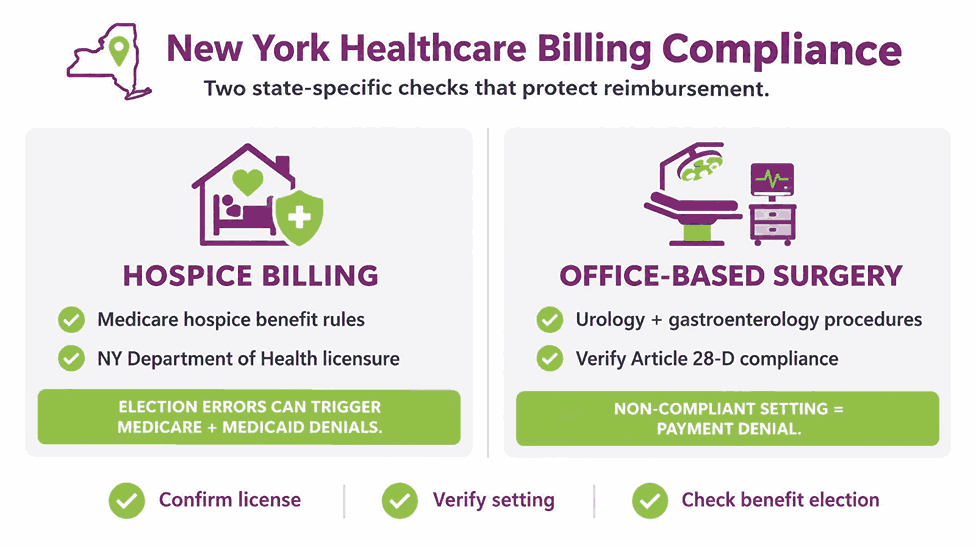
Hospice providers in New York must follow both Medicare hospice benefit rules and state licensure requirements tied to the New York Department of Health, and billing errors around the election of hospice benefit can trigger overlapping claim denials from Medicare and Medicaid simultaneously.
Urology and gastroenterology practices billing for procedures performed in an office-based surgery setting need to confirm the setting meets New York’s office-based surgery regulations under Public Health Law Article 28-D, since procedures performed in a non-compliant setting can face payment denial regardless of medical necessity.
Neurology and Diagnostic Testing
Neurology practices billing for diagnostic testing, such as EMG or nerve conduction studies, should watch for payer-specific prior authorization requirements that differ from the general Public Health Law 4903 timelines, since some commercial plans apply additional utilization management specifically to high-volume diagnostic codes. Specialty-specific coding services help catch these differences before a claim goes out, rather than after a denial arrives.
Common Compliance Mistakes New York Practices Make
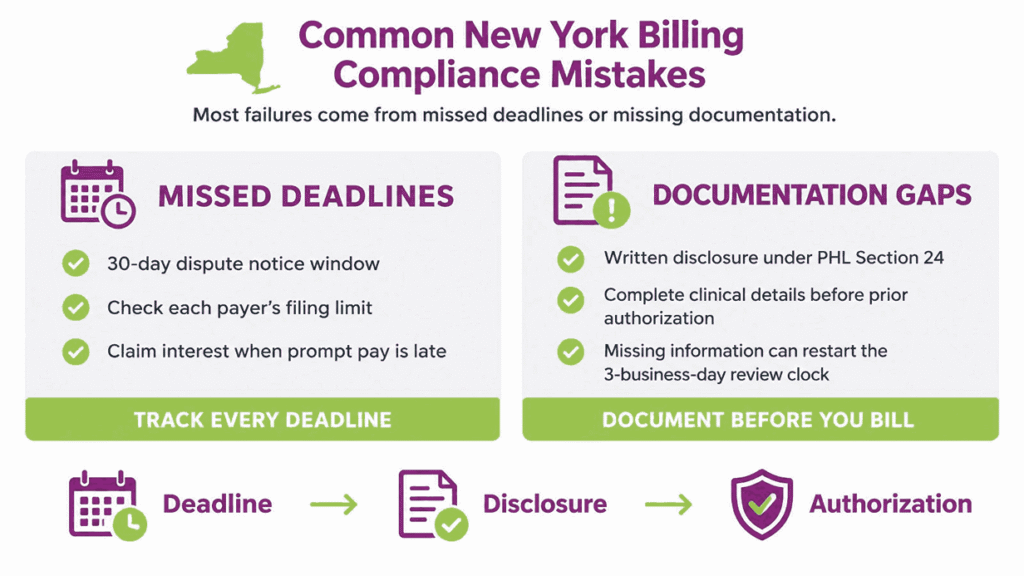
Most compliance failures in New York billing trace back to missed deadlines or missing documentation, not to a lack of medical necessity.
Missed Deadlines and Interest Claims
Several errors show up repeatedly across New York billing audits. Practices miss the 30 day dispute notification window and then fail to claim the interest they are entitled to when the payer misses the prompt pay deadline.
Other practices track a single generic timely filing deadline across all payers instead of confirming the deadline in each contract, which leads to avoidable denials on claims that were otherwise clean.
Documentation and Authorization Gaps
Practices skip the written disclosure required under Public Health Law Section 24 and then get caught balance billing a patient who never received proper notice.
Some practices also submit prior authorization requests without confirming the clinical information the utilization review agent requires, which restarts the three-business-day clock and delays the determination further.
Practical Steps to Stay Compliant With New York Billing Laws
Staying compliant across every rule in this guide comes down to two habits: tracking payer-specific terms and tying every appeal to a named statute.
Build a Payer Reference System
Start by building a payer-specific reference sheet listing the timely filing limit, prompt pay deadline, and prior authorization contact for every contracted plan. Update it whenever a contract renews, since payers do change these terms.
Confirm disclosure documentation exists for every out-of-network referral before the claim goes out, since that single document determines whether balance billing restrictions apply.
Tie Every Appeal to a Statute
Track every denied or delayed claim against the relevant statute, whether that is Insurance Law 3224-a, Public Health Law 4903, or the Medicaid 90-day rule, so appeals cite the correct legal basis rather than a general complaint.
Review coding compliance quarterly against current Medicaid Inspector General guidance rather than relying only on annual CPT updates, since state-specific guidance can shift between annual code releases.
Working with a dedicated Medical billing company that understands New York’s statutes, rather than a generalist vendor applying national defaults, reduces the number of claims lost to state-specific technicalities that a standard compliance checklist would miss.
The underlying requirement across every rule in this guide is the same: know the specific New York statute governing each part of the claim lifecycle, and build the workflow around it rather than around a generic national standard.