Most billing teams in New York have a claim that sits unpaid long past a fair deadline. The claim was clean, the payer confirmed receipt, and still nothing arrived in the account. New York has a law that gives providers real power in this situation. Insurance Law Section 3224-a sets firm payment deadlines for health insurers operating in New York.
Late payment triggers interest, and providers can act to collect what the insurer owes. This guide explains the deadlines, the exceptions, the interest math, and the steps to enforce your rights. It also includes a demand letter template, a follow-up calendar, and specialty examples.

What Is the New York Prompt Pay Law?
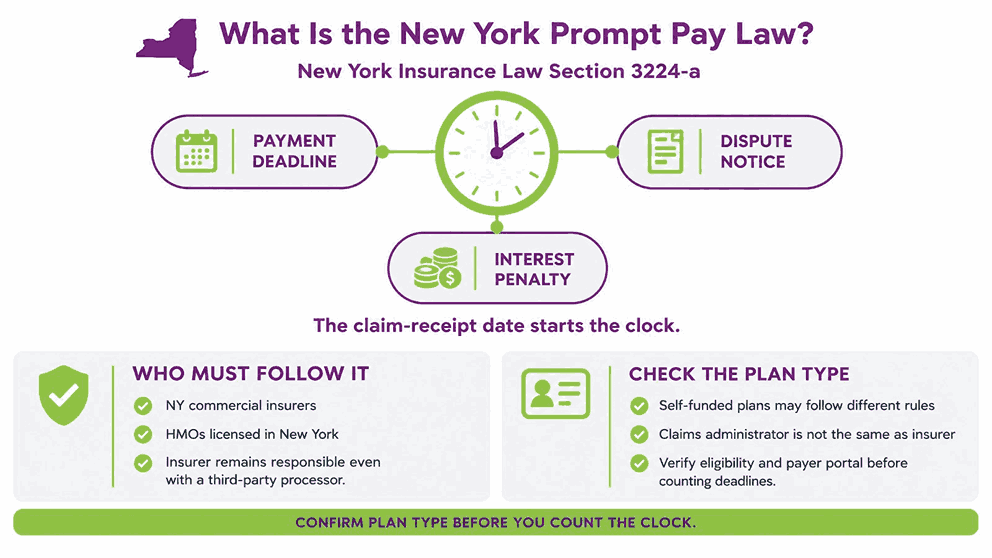
The Prompt Pay Law is found in New York Insurance Law Section 3224-a. The legislature passed it to protect patients and providers from slow claim payment. It sets a clock that starts when the insurer receives your claim.
The insurer must act before the clock runs out, or it owes interest. The law gives your team a specific date to act on for every claim. Three parts matter most: the payment deadline, the dispute notice, and the interest penalty.
Who Must Follow the Law
The law applies to commercial health insurers and health maintenance organizations, known as HMOs, licensed in New York. Insurers remain responsible even when they hand claims processing to a third party. A delegated vendor does not remove the insurer’s duty to pay on time.
Who Falls Outside the Law
Some plans follow different rules, so confirm the plan type before you count any deadline. Eligibility checks and the payer portal can show whether a plan is fully insured or self-funded.
Self-funded plans often use a New York insurer only as a claims administrator. Their ID cards may show the same brand as fully insured plans.
| Payer Type | Covered by Section 3224-a? | Notes |
|---|---|---|
| Commercial insurers licensed in New York | Yes | Standard deadlines apply |
| HMOs | Yes | Same deadlines apply |
| Self-funded employer plans | No | Federal ERISA law governs |
| Original Medicare | No | Federal payment timing rules apply |
| Medicare Advantage and Medicaid managed care | Varies | Program rules and contracts also apply |
| Motor vehicle no-fault claims | Separate law | Insurance Law Section 5106 applies |
Payment Deadlines Under Section 3224-a
Insurers must pay undisputed claims within 30 days when the claim is sent electronically. Claims sent by paper or fax give the insurer 45 days to pay. Electronic submission is the faster route, so send every claim electronically when the payer allows it.
| Submission Method | Payment Deadline |
|---|---|
| Internet or email (electronic) | 30 days from receipt |
| Paper or fax | 45 days from receipt |
When the Clock Starts
The clock starts on the date the insurer receives the claim, not the date of service. Proof of receipt matters, so keep clearinghouse acceptance reports and payer acknowledgment files for every claim. A claim rejected for format errors at the clearinghouse may not count as received by the insurer.
Check the 277CA acknowledgment report to confirm the payer actually accepted the claim into its system. Corrected claims create a gray area, so save both the original and corrected submission records.
Disputed Claims and the 30 Day Notice
Payers do not always have to pay in full within the standard window. The law allows a delay when the duty to pay is not reasonably clear. The doubt must come from a good faith dispute over one of several listed issues.
- Whether the patient is eligible for coverage
- Whether another insurer is liable for all or part of the claim
- The amount of the claim
- Whether the service is a covered benefit
- How the services were accessed or provided
Even then, the insurer must pay any undisputed part of the claim within the required time frame. It must also send written notice within 30 days explaining why it is not liable or requesting more information. The notice must state specific reasons, so a bare denial code alone may fall short.
| Insurer Action | Deadline | What It Must Include |
|---|---|---|
| Payment of undisputed amount | 30 or 45 days from receipt | The full amount owed |
| Written denial notice | 30 days from receipt | Specific reasons for denial |
| Request for more information | 30 days from receipt | All items needed to decide the claim |
Timing after an information request gets technical, so review your payer contract and current DFS guidance.
Weak Notice vs Strong Notice
Providers should compare every denial notice against the specific reasons standard before they accept it. A weak notice gives you grounds to challenge the denial in writing.
| Weak Notice | Strong Notice |
|---|---|
| Service not covered | CPT 43239 excluded under a named policy section |
| Additional records needed | Operative report and pathology report requested for the listed date of service |
| Pending review | Prior authorization number missing, with the response deadline stated |
Interest When the Insurer Pays Late
An insurer that misses the deadline owes the amount of the claim plus statutory interest to the provider. The exact amount owed depends on your contract and the allowed amount. Interest runs at the greater of two rates, and the 12 percent yearly rate sets the floor.
- The rate the state tax commissioner sets for corporate tax underpayments
- Twelve percent per year
Interest counts from the date the payment was due, not from the date you discover the delay. The insurer does not owe interest when the amount is under two dollars.
A Practical Example
Picture a Buffalo gastroenterology practice that submits 40 colonoscopy claims electronically on March 1. Most of the claims use CPT 45378 for diagnostic colonoscopy or CPT 45385 for snare polypectomy. The contract value totals $48,000, and the payer pays on April 30.
| Item | Value |
|---|---|
| Submission date | March 1 |
| Payment deadline (30 days) | March 31 |
| Actual payment date | April 30 |
| Days late | 30 |
| Total owed under contract | $48,000 |
| Interest at 12 percent | About $473.42 |
The math uses simple interest at the 12 percent floor, and the real rate may be higher. One late claim produces small interest, but hundreds of late claims add up.
Build the Formula Into Your Tracker
Use one formula for every late claim so your demand letters stay consistent. Interest equals claim amount times the yearly rate times days late divided by 365. In a spreadsheet, place the claim amount in column B and days late in column C.
=B2*0.12*C2/365
Change 0.12 to the state tax rate when that rate is higher.
How the Law Affects Each Specialty
High-dollar claims and prior authorization disputes make deadline tracking more valuable in some specialties.
| Specialty | Example Codes | What to Watch |
|---|---|---|
| Gastroenterology | CPT 45378, 45385, 43239 | Pathology records and repeat screening disputes |
| Oncology | CPT 96413, HCPCS J9271 | High drug charges raise interest exposure |
| Neurology | CPT 95816, 64615, HCPCS J0585 | Prior authorization and medical necessity denials |
| Urology | CPT 52000, 55700 | Records requests after office procedures |
A single infusion visit can carry thousands of dollars in drug charges, so each late day costs more. At 12 percent, a $250,000 batch of oncology claims paid 20 days late earns about $1,643.84 in interest.
No Fault Claims Follow Separate Rules
Auto accident claims fall under Insurance Law Section 5106 and Regulation 68, not Section 3224-a. The deadline is 30 days for every claim, and the interest rate is far higher.
| Feature | Section 3224-a | No Fault (Section 5106) |
|---|---|---|
| Payment deadline | 30 days electronic, 45 days paper | 30 days after proof of claim |
| Interest rate | Greater of tax rate or 12 percent per year | 2 percent per month, simple |
| Attorney fees | Not set by the statute | Set by regulation |
| Information requests | Notice due within 30 days | Verification requests pause the 30-day window |
Under Regulation 68, interest above $5 must be paid to the assignee provider without a demand. Providers generally must submit no-fault bills within 45 days of the date of service, so check current rules.
Retroactive Denials and Overpayment Recovery
Insurance Law Section 3224-b limits how insurers take money back after they have paid a claim. It applies to insurers licensed in New York, and contract lookback terms cannot extend its 24-month limit.
| Requirement | Detail |
|---|---|
| Written notice before recovery | 30 days |
| Notice contents | Patient name, service date, payment amount, proposed adjustment, specific explanation |
| Time limit | 24 months from the original payment |
| No time limit | Fraud, intentional misconduct, abusive billing, self-insured plan requests, government program requirements |
| Duplicate payments | Exempt from the 30-day notice rule |
Bills have been introduced to shorten the 24-month window, so confirm the current rule before relying on it.
How to Respond to a Recoupment Letter
- Compare the original payment date with the date on the recoupment letter to check the 24-month limit.
- Confirm the letter lists the patient, service date, payment amount, and a specific explanation.
- Review the claim file and dispute errors in writing within the 30-day notice period.
- Ask whether the insurer plans to hold back future payments, and request that it wait for your response.
Your Enforcement Options
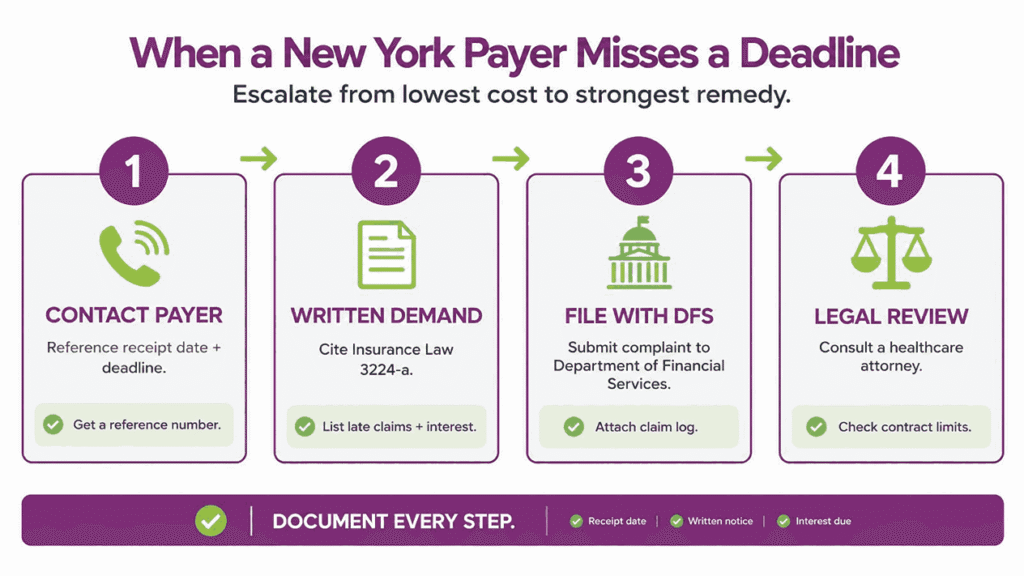
Providers have four practical ways to act when a payer misses a deadline. Start with the lowest cost step and move up only when needed.
Step 1: Contact the Payer
Call the provider relations line and reference the receipt date and the statutory deadline. Ask for a written response and a reference number for every call.
Step 2: Send a Written Demand
Send a letter that cites Insurance Law Section 3224-a and lists the late claims. Attach a table with claim numbers, patient initials, dates of receipt, amounts, and interest. Use the minimum patient information needed, and send the letter through a secure channel.
Dear Provider Relations Team,
We submitted the claims listed below electronically, and your system accepted them on the dates shown. Insurance Law Section 3224-a requires payment or written notice of a dispute within 30 days of receipt. As of today, we have received neither payment nor a written notice stating specific reasons. Please pay each claim in full, plus the statutory interest calculated in the attached table. Please confirm the payment date in writing within ten business days of this letter. If we do not receive payment, we will file a complaint with the Department of Financial Services.
Sincerely,
[Name and practice]
Step 3: File a Complaint with DFS
You can file a complaint with the New York Department of Financial Services. The department enforces the law through audits and investigations. An insurer that meets the law on 98 percent of claims in a year may avoid a state penalty.
That protection applies to violations the state finds through its own review. It does not remove the insurer’s duty to pay interest to you. Attach the same claim log so the reviewer sees the pattern quickly.
Step 4: Consider Legal Action
Courts have recognized a private right of action under the Prompt Pay Law. Talk to a healthcare attorney before you file, because contract terms can limit your options.
Common Reasons Claims Miss the Deadline
Most late payments trace back to a small set of causes. Fixing them early protects your cash flow.
| Cause | Provider Action |
|---|---|
| Missing or invalid claim data | Scrub claims before submission |
| Payer system errors | Escalate with proof of receipt date |
| Slow reply to information requests | Respond within the payer’s stated window |
| Coordination of benefits issues | Verify primary and secondary coverage before the visit |
| Claim lost after receipt | Keep acknowledgment reports |
| Paper submission | Switch to electronic claims |
A DFS opinion addressed a claim denied because of an insurer processing error. The department said interest should run from the original receipt date, not the appeal date. Your receipt records support that argument.
Mistakes Providers Make
- Waiting for the payer to act, instead of following up when the deadline passes
- Mailing paper claims, which gives the insurer 15 extra days to pay
- Skipping interest requests because each amount looks small, though totals grow across thousands of claims
- Failing to keep proof of the receipt date, which weakens every dispute
- Missing the payer’s response window when the insurer asks for additional documents
A 45 Day Follow-Up Workflow
A simple calendar keeps your team ahead of every deadline. Adjust the steps to fit your claim volume.
| Day | Action | Note |
|---|---|---|
| Day 0 | Submit claim electronically | Save the submission record |
| Day 1 to 3 | Confirm payer acceptance | Fix any rejection at once |
| Day 15 | Check claim status | Log the payer response |
| Day 25 | Review unpaid claims | Prepare for escalation |
| Day 30 | Electronic payment and notice deadline | Escalate any unpaid claim |
| Day 45 | Paper claim deadline | Escalate any unpaid paper claim |
| Day 46 and later | Send written demand | Include your interest calculation |
High-volume practices often give daily follow-up to Medical billing services in New York, not front desk staff. That setup keeps deadline reviews on a fixed schedule instead of squeezing them between patient calls.
Documentation Checklist
Strong records make payment disputes easier to win, so keep these items for every late claim.
- Claim submission confirmation with date and time
- Clearinghouse acceptance report
- Payer acknowledgment file (277CA)
- Remittance advice or denial letter
- Written notices from the insurer
- Notes from each payer call with the representative name and reference number
If you work with a Medical Billing Company, request the acknowledgment reports and payer call logs every month. Missing records are hard to rebuild once a dispute begins, so collect them as claims move.
Metrics to Track
Weekly numbers show which payers miss deadlines most often and which claims need escalation first.
| Metric | Formula | Why It Matters |
|---|---|---|
| On-time payment rate | Claims paid by deadline ÷ claims submitted | Shows payer reliability |
| Average days to pay | Total days to payment ÷ paid claims | Shows cash flow speed |
| Late claim count by payer | Claims past deadline, grouped by payer | Guides escalation |
| Interest owed | Amount × rate × days late ÷ 365 | Supports demand letters |
| Interest collected | Interest paid ÷ interest owed | Shows the recovery gap |
| Notice compliance | Denials with specific reasons ÷ all denials | Flags weak notices |
Start with your largest New York payers, such as Empire BlueCross BlueShield, EmblemHealth, Fidelis Care, and MVP Health Care. Payer speed reports often sit inside broader RCM Services, so ask your team or vendor for these numbers monthly.
Key Terms in Plain Words
| Term | Plain Meaning |
|---|---|
| Undisputed claim | A claim the insurer agrees it owes |
| Good faith dispute | A real, documented disagreement about coverage or amount |
| Remittance advice | The payer’s explanation of payment or denial |
| Clearinghouse | A service that routes electronic claims to payers |
| Recoupment | The insurer taking back money it paid earlier |
| Coordination of benefits | Rules that decide which plan pays first |
Frequently Asked Questions
Does the Law Cover Medicare Claims?
Section 3224-a does not cover Original Medicare, which follows federal payment timing and interest rules. Medicare Advantage plans add another layer, because federal rules and your contract both apply. Federal rules set a 30-day standard for clean claims from providers without a contract.
Contracted providers follow the payment terms in their agreement, so read those terms first. Medicaid managed care plans can carry extra program rules, so confirm which timing rules apply.
How Is Prompt Pay Different From Timely Filing?
Timely filing limits how long you have to submit a claim to the payer. Prompt pay limits how long the payer has to pay after receiving it. Timely filing limits come from your payer contract, and each payer sets its own window.
A denial for late filing generally must still follow the statutory notice timing. Track both dates in your billing system so neither deadline slips past your team.
Will the Insurer Add Interest Automatically?
Do not assume the insurer will add interest to a late payment on its own. Check the remittance advice for an interest line, and compare the payment date with your deadline. If interest is missing, calculate the amount and request it in writing.
Remember that insurers do not owe interest under Section 3224-a when the amount is below two dollars. No-fault claims work differently: interest above $5 must be paid without a demand.
What If the Insurer Asks for More Information?
Respond quickly and keep proof of what you sent, including the date and the method. The insurer must list all the information it needs within 30 days of receiving the claim.
Repeated requests for items missing from the first list may signal a violation. Log each request with its date, and raise the pattern in your written follow-up. Ask the insurer to follow up on the claim status and the new decision date in writing.
Can My Payer Contract Set a Different Deadline?
Read the contract for payment terms and dispute steps before you rely on the statute alone. Some contracts require written notice, internal appeals, or arbitration before a provider can sue. Payer manuals and policy updates may also become part of the agreement.
Ask an attorney whether the contract can waive Section 3224-a rights in your situation. Keep every amendment and signed rate sheet in one folder so your attorney can review them quickly.
What Should I Do If Only Part of a Claim Is Disputed?
The insurer must still pay the undisputed part of the claim on time. Check the remittance advice to confirm the payment matches the amount the insurer admits it owes.
If the insurer paid the undisputed part late, calculate interest on that amount. Then appeal the disputed part, and use the specific reasons in the notice to guide your response.
What Happens When I Send a Corrected Claim?
Payers often treat a corrected claim as a new receipt, which restarts the payment clock. Save both the original and corrected submission dates in your tracker for every affected claim.
If the payer caused the error, argue in writing that the original receipt date controls. A DFS opinion supports that approach when a processing error caused the denial.
How Do I File a Complaint With DFS?
Use the complaint process on the New York Department of Financial Services website. Include your claim log, proof of receipt dates, the denial or remittance notices, and your demand letter.
Group late claims by payer so the reviewer sees the pattern at once. Send only the minimum patient information needed, and use a secure channel.
Should I Send a Demand Letter for Every Late Claim?
Prioritize by balance and by pattern, not by claim count alone, when you choose targets. Group late claims from one payer into a single monthly letter with one interest table.
Escalate single claims only when the balance is large, or the denial notice is weak. Repeat offenders deserve a call with the payer’s provider relations manager before the letter goes out.
Your 30 Day Action Plan
| Week | Task | Result |
|---|---|---|
| Week 1 | Pull 90 days of claims and payment dates | Baseline of late claims |
| Week 2 | Add deadline and interest columns to your tracker | Automatic late flags |
| Week 3 | Send demand letters for the largest late balances | Written record of disputes |
| Week 4 | Review payer metrics and assign follow-up owners | Fixed weekly routine |