Testicular torsion is one of the few urology diagnoses where the clock decides everything. The patient arrives with sudden, severe pain. The surgeon has a few hours to save the testis. And somewhere behind all of that, a biller has to turn the chart into a clean claim.
That last part gets less attention than it should. A rushed emergency case often produces rushed documentation, and rushed documentation leads to vague diagnosis codes. Vague codes lead to denials, delays, and awkward calls with payers.
So let me walk through the testicular torsion ICD-10 code set the way a biller actually needs it. We will look at each code, the documentation behind it, the procedures that usually follow, and the mistakes that cost practices money. If your practice uses outside urology billing services, this guide also gives you a checklist for judging how well those claims are being handled.
What Testicular Torsion Actually Is?
The spermatic cord carries blood to the testis. In torsion, that cord twists, and the blood supply gets choked off. Think of a garden hose with a kink in it. Water stops flowing, and pressure builds behind the kink.
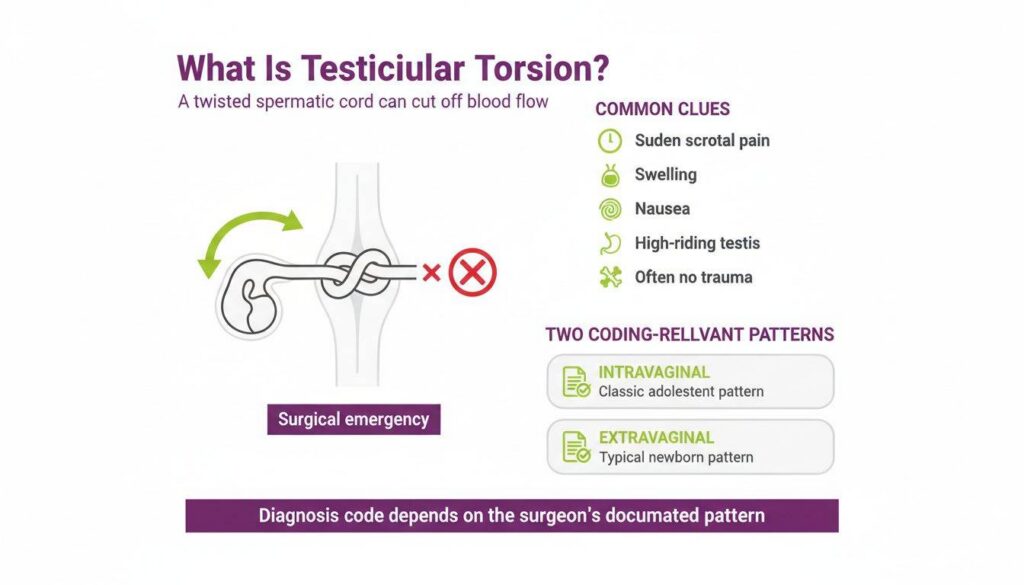
Without blood, the testis starts to die. That is why torsion counts as a surgical emergency.
Most cases happen in boys and young men, with a peak around puberty. Some newborns have it too. Symptoms usually include sudden scrotal pain, swelling, nausea, and a testis that sits higher than normal. Pain often comes without any trauma at all, sometimes waking the patient from sleep.
Two anatomical patterns matter for coding:
- Intravaginal torsion. The cord twists inside the tunica vaginalis. This is the classic teenage presentation, often linked to a bell clapper deformity.
- Extravaginal torsion. The cord and the tunica twist together. This pattern is typical in newborns and sometimes appears before birth.
The ICD-10 code set separates these two patterns. So your diagnosis code depends on whether the surgeon wrote down which one they found.
The Testicular Torsion ICD-10 Code Family
All torsion codes sit under category N44.0 in ICD-10-CM. The category is called torsion of testis, and it splits into five billable codes.
Here is the full list.
| ICD-10 Code | Description | When It Fits |
|---|---|---|
| N44.00 | Torsion of testis, unspecified | Torsion is confirmed, but the type is not documented |
| N44.01 | Extravaginal torsion of spermatic cord | Twist outside the tunica vaginalis, common in neonates |
| N44.02 | Intravaginal torsion of spermatic cord | Twist inside the tunica vaginalis, often bell clapper |
| N44.03 | Torsion of appendix testis | Twist of the small testicular appendage |
| N44.04 | Torsion of appendix epididymis | Twist of the small epididymal appendage |
Notice something. None of these codes carry laterality. There is no right or left version. That surprises people who are used to codes like N50.811 for right testicular pain. For torsion, the side gets reported through procedure modifiers and the documentation, not through the diagnosis code.
N44.00 and Why It Gets Overused
N44.00 is the default when the provider writes only “testicular torsion.” It is valid. It is also the code most likely to draw attention during an audit.
Payers know that surgeons see the cord during exploration. If the operative note describes a twisted cord inside the tunica, the note supports N44.02. Leaving the claim at N44.00 is not wrong, but it leaves detail on the table. Specific codes show medical necessity more clearly and support cleaner data.
N44.01 and N44.02 for the Main Torsion Types
These two carry most of the real torsion volume. Intravaginal torsion in a teenager is the textbook case, and N44.02 is the code for it. Extravaginal torsion in a newborn falls under N44.01.
The surgeon does not need to use the word “intravaginal” in a fancy way. A line such as “spermatic cord twisted within the tunica vaginalis, bell clapper anomaly noted” gives a coder enough to work with.
If you handle many procedures, it helps to keep a reference list of urology ICD-10 codes next to the charge entry screen. Torsion is only one small corner of a much larger set.
N44.03 and N44.04 for Appendage Torsion
Appendage torsion is the quiet cousin. The appendix testis and the appendix epididymis are tiny remnants. When one twists, the pain can look a lot like true torsion, although the treatment is usually conservative.
This matters because the billing path is different. Appendage torsion often resolves with rest and anti-inflammatory care. No detorsion surgery follows. If the claim carries N44.00 or N44.02 by mistake, the payer may expect a matching procedure that never happened.
Choosing the Right Code From the Chart Note
Coders do not diagnose. They read what the provider wrote. That sounds obvious, but it is where many torsion claims go sideways.
Here is a simple way to think about it. Start with the final diagnosis in the provider note. Then check the operative report if surgery happened. Then compare the two. If the ultrasound report says “findings concerning torsion” and the surgeon later confirms torsion, the confirmed diagnosis wins.
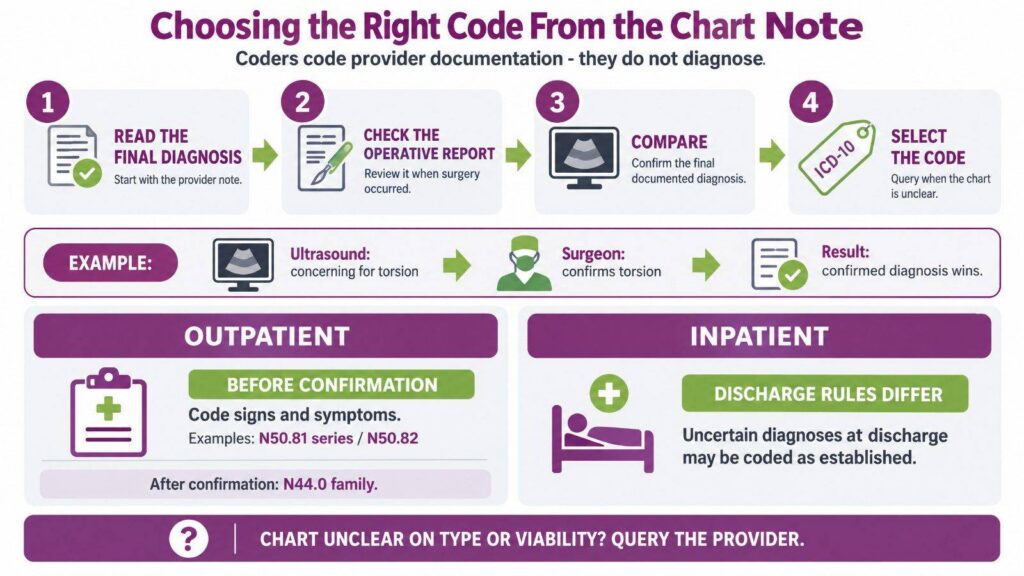
In an outpatient setting, the coding rules matter. You do not code a diagnosis as “probable” or “suspected” on a professional outpatient claim. Instead, you code the signs and symptoms. So before confirmation, you might report testicular pain (N50.81 series) or scrotal pain (N50.82). After confirmation, you move to the N44.0 family.
Inpatient rules differ. Uncertain diagnoses at discharge can be coded as if they were established. Urology practices that bill both the facility side and the professional side need to keep these two rule sets apart in their heads.
If the chart does not settle the type or the viability of the testis, send a query to the provider. A short question today saves a long appeal later.
Related Diagnosis Codes That Often Appear Beside Torsion
Torsion rarely travels alone on a claim. Other diagnoses show up, either because they were ruled out or because they were found together.
- N50.811, N50.812, N50.819. Right, left, or unspecified testicular pain. Useful before a confirmed diagnosis.
- N50.82. Scrotal pain.
- N45.1. Epididymitis, a common lookalike.
- N45.3. Epididymo-orchitis, another lookalike. Use the code title exactly as your code set lists it.
- N43.3. Hydrocele, unspecified.
- Q53 series. Undescended testicle, which raises torsion risk in some patients.
- R10.2. Pelvic and perineal pain, sometimes recorded when the location is unclear.
CPT Codes for Torsion Surgery and Imaging
Diagnosis codes explain why. Procedure codes explain what was done. For torsion, the procedure side is short but has sharp edges.
Practices that want a wider view of urology CPT codes will find torsion sits among a large group of scrotal and testicular procedures. Here are the ones you will meet most often with torsion.
| CPT Code | Description | Typical Use |
|---|---|---|
| 54600 | Reduction of torsion of testis, surgical, with or without fixation of contralateral testis | Detorsion, the main torsion procedure |
| 54620 | Fixation of contralateral testis (separate procedure) | Fixing the healthy side, when not bundled |
| 54640 | Orchiopexy, inguinal approach, with or without hernia repair | Fixation in select cases |
| 54520 | Orchiectomy, simple | When the testis is not salvageable |
| 76870 | Ultrasound, scrotum and contents | Diagnostic imaging |
| 93976 | Duplex scan of arterial inflow, limited study | Flow assessment, used with ultrasound in some settings |
Confirm every code against the current CPT book before you bill. Code descriptions and payer policies change, and this table is a starting point, not a final source.
Detorsion Is the Main Event
CPT 54600 covers surgical reduction of the torsion. It also includes fixation of the other testis, done with or without that extra step. This is a detail people miss. Because 54600 already describes “with or without fixation of contralateral testis,” billing 54620 alongside it can trigger a bundling edit.
So if the surgeon fixes the healthy side during the same session, read the descriptor carefully. Most of the time, that work is already inside 54600.
When the Testis Cannot Be Saved
Sometimes the surgeon opens the scrotum and finds dead tissue. Orchiectomy follows, and the code changes to 54520. The diagnosis stays N44.0x because the torsion caused the loss. Some coders wonder whether a separate code is needed for the necrosis. Follow your provider documentation and the official coding guidelines, and ask for a query when the note is unclear.
Imaging and Evaluation Codes
Many patients get a scrotal ultrasound first, reported with 76870. Vascular duplex codes carry their own rules, so check edits before pairing them. Emergency visits fall into 99281 through 99285. A urologist who decides on surgery during an E/M visit may need modifier 57.
Modifiers and Global Period Traps
Modifiers save or sink a torsion claim. Here are the ones that matter.
- Modifier 57. Decision for surgery. It applies to an E/M service that leads to a major procedure with a 90-day global period.
- Modifier 22. Increased procedural services. Use it only when the note shows unusual difficulty, such as a delayed presentation with heavy scarring.
- Modifier 78. Unplanned return to the operating room during a global period. This can apply if a patient returns for a complication.
- Modifier 79. Unrelated procedure during a global period.
- Modifiers LT and RT. Some payers want the side reported, since the diagnosis code does not carry laterality.
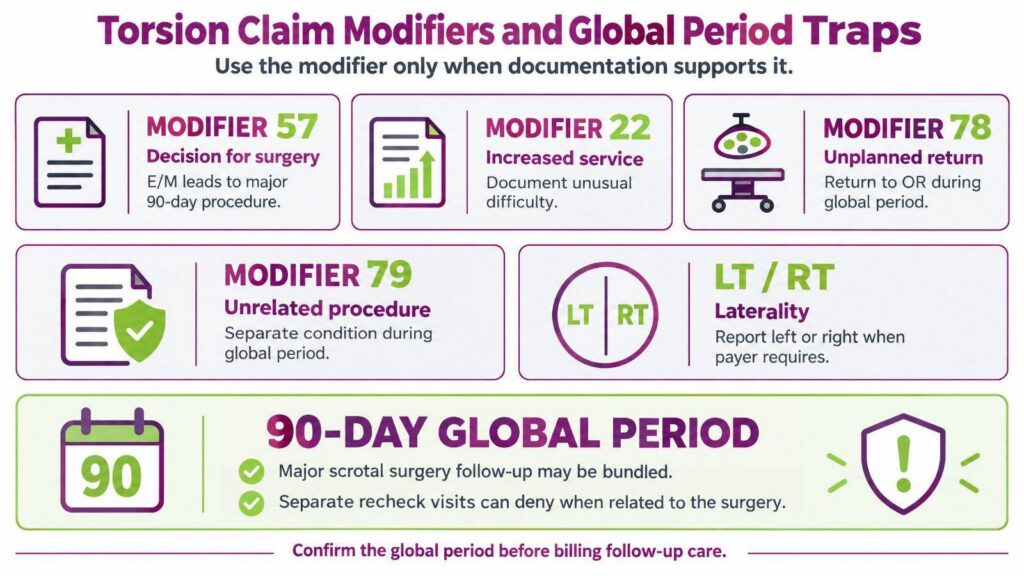
Global periods are another trap. Major scrotal surgeries typically carry a 90-day global window. That means follow-up visits for the same problem are bundled into the surgical payment. Practices that bill a recheck visit separately get denials they did not expect.
Always confirm the global period for your exact code and payer. Medicare sets its own values, and commercial plans sometimes differ.
Time Matters, Clinically and Financially
Timing affects the procedure performed, and the procedure drives the claim. Commonly cited figures put the salvage rate very high when surgery happens within about six hours of symptom onset. After that, it drops sharply. These are approximate ranges from the literature, and real outcomes vary by patient and by degree of twisting.
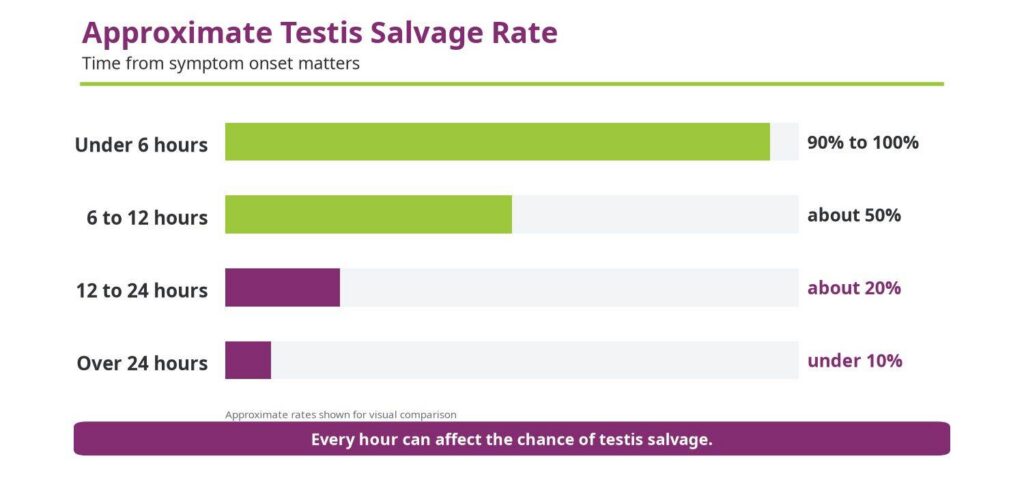
What does this mean for billing? Early cases often end in detorsion and fixation, which means a 54600 claim. Late cases more often end in orchiectomy, which means 54520. Neither is a billing choice. The clinical picture decides, and your documentation has to record the timeline faithfully.
Write the onset time down. Write the arrival time down. Write the time of incision down. These three timestamps tell the payer a story: the patient came in urgently, the team moved fast, and the procedure was medically necessary. That story is your best defense if a claim is ever reviewed.
Common Denial Reasons for Torsion Claims
Even with perfect codes, denials happen. Here are the ones urology offices see most.
Unspecified diagnosis on a surgical claim. N44.00 paired with 54600 sometimes triggers a review. The fix is a provider query, then a corrected claim.
Bundled fixation. As covered earlier, billing 54620 with 54600 is a classic edit hit.
Missing modifier. Claims without 57 or 78 when they apply tend to fail quickly.
Medical necessity questions. A claim with only “pain” as the diagnosis and surgery as the procedure will confuse an automated reviewer.
A busy practice rarely has time to chase every one of these. That is why many groups hand the work to a medical billing company that already knows where these edits sit. The right partner tracks denial patterns by payer, not just by code, and feeds that information back to the clinical team.
A Practical Documentation Checklist
Good billing starts before the claim. It starts in the note. Here is a short list you can share with your surgeons and scribes.
- Onset time of symptoms and arrival time
- Physical exam findings, including cremasteric reflex, high-riding testis, and horizontal lie
- Imaging results and the exact wording of the radiologist
- Type of torsion found in surgery: intravaginal, extravaginal, or appendage
- Bell clapper anomaly, if noted
- Viability of the testis after detorsion
- Whether the contralateral testis was fixed
- Whether orchiectomy was required, and why
- Which side was affected
- Postoperative plan and follow-up timing
Some practices also record a clinical risk score, such as TWIST, to show the reasoning behind urgent imaging or surgery. That score does not change the ICD-10 code, but it helps the medical necessity story.
Code sets also change each October, so review your torsion codes once a year.
What Is the ICD-10 Code for Testicular Torsion?
Testicular torsion falls under category N44.0, which has five billable codes from N44.00 to N44.04. N44.02 fits intravaginal torsion, the common teenage case. N44.01 fits an extravaginal torsion, which is typical in newborns. N44.00 applies only when the type is not documented.
Does the Torsion Code Show the Right or Left Side?
No. None of the N44.0 codes carry laterality. The side is shown through the documentation and, where payers ask for it, through modifiers such as LT and RT on the procedure code.
Can I Code Torsion When the Provider Only Suspects It?
On a professional outpatient claim, you should not code a suspected diagnosis. Report the signs and symptoms instead, such as testicular pain (N50.81 series) or scrotal pain (N50.82). Once torsion is confirmed, move to the N44.0 family. Inpatient rules differ, so keep the two settings separate.
Which CPT Code Is Used for Testicular Torsion Surgery?
CPT 54600 describes surgical reduction of torsion of the testis, with or without fixation of the other testis. If the testis cannot be saved, the procedure is usually an orchiectomy, reported with 54520. Always confirm against the current CPT book.
Can I Bill 54620 Together With 54600?
Usually not. The descriptor for 54600 already includes fixation of the contralateral testis, so adding 54620 often triggers a bundling edit. Read the descriptor and your payer policy before billing both.
How Long Is the Global Period for Torsion Surgery?
Major scrotal procedures such as 54600 typically carry a 90-day global period. Follow-up care for the same problem is usually included in that payment. Confirm the exact period for your code and payer, since commercial plans can differ from Medicare.
Is Appendage Torsion Coded the Same Way?
No. Torsion of the appendix testis uses N44.03, and the appendix epididymis uses N44.04. Treatment is often conservative, so a surgical code on the same claim may raise questions. Always match the code to the operative note.
Conclusion
Testicular torsion billing looks simple from a distance. Five diagnosis codes, a handful of procedure codes, a few modifiers. Up close, it is full of small choices that add up.
Pick the most specific N44.0 code the chart supports. Match it to the right procedure. Watch the bundling rules around 54600 and 54620. Use modifiers with purpose, and record the timeline in the note.
If your team is stretched thin, outside help can make sense. A reliable partner offering medical billing services can review your torsion claims, find the pattern behind repeated denials, and train your staff on the documentation gaps. The goal is not fancy software or long reports. It is getting an honest claim paid, the first time, for work that was done well under pressure.