
A patient visits an in-network hospital for a scheduled procedure. Weeks later, an anesthesiologist who never joined the health plan sends a separate bill. Many Massachusetts residents pay such a bill without question, because the rules behind the charge are hard to find. Massachusetts medical billing laws work in layers, and no single statute covers every situation. Federal law contributes to the No Surprises Act, the Affordable Care Act, the Fair Debt Collection Practices Act, and IRS rules for nonprofit hospitals. Massachusetts law adds M.G.L. c. 176O and the Patients First Act of 2020.
The Health Safety Net under M.G.L. c. 118E and Attorney General debt collection regulations complete the state layer. Each layer protects patients at a different moment, from the day of care to the day a collector calls. The sections below explain what each law covers, which agency enforces the law, and which deadlines apply. A short section addresses providers and billing offices, and a seven-step process shows how to dispute a bill. This guide is helpful before you acquire the medical billing services in Massachusetts.

How Do Federal and Massachusetts Laws Work Together to Regulate Medical Billing?
Federal and Massachusetts laws regulate medical billing in two stacked layers. Federal law sets a national minimum for surprise bills, hospital charity care, and debt collection. Massachusetts law adds rules on network status, price notices, low-income hospital coverage, and collector conduct. Therefore, one medical bill can fall under several laws at once.
Which Federal Laws Protect Patients From Medical Billing Problems?
Four federal laws shape Massachusetts medical billing, and each one addresses a different stage of the billing process. The list below names each law, its effective year, and the core protection the law delivers to patients in every state, including Massachusetts:
- No Surprises Act (effective January 1, 2022): bans balance billing for emergency care, out-of-network providers at in-network facilities, and air ambulances.
- Affordable Care Act (2010): requires internal appeals and external review, and caps annual out-of-pocket costs for covered services.
- Fair Debt Collection Practices Act (1977): limits how third-party collectors contact, pressure, and disclose information about consumers.
- Internal Revenue Code section 501(r) (2010): requires nonprofit hospitals to maintain financial assistance policies and restricts their collection actions.
Which Massachusetts Laws Add Protection?
Four Massachusetts authorities supplement federal law. Moreover, each authority answers a question that federal law leaves open. Examples include how a low-income patient pays a hospital bill and how many times a collector may call. The list below summarizes the four authorities:
- M.G.L. c. 176O: sets insurer network rules, balance billing limits (section 6(a)(4)), and member grievance rights.
- Patients First Act (Chapter 260 of the Acts of 2020): requires network status and price notices under M.G.L. c. 111, section 228.
- Health Safety Net (M.G.L. c. 118E, sections 64 to 69): pays hospitals and community health centers for care delivered to eligible low-income residents.
- Attorney General debt collection regulations (940 CMR 7.00): restrict how creditors and collectors pursue consumer debt, including limits on phone contact.
Which Law Covers Which Billing Situation?
The table below matches common billing situations to the governing law and the agency that accepts complaints. Patients can use the table as a starting map before reading the detailed sections that follow. Each row names one situation, one governing law, and one enforcing agency.
| Billing Situation | Governing Law | Enforcing Agency |
|---|---|---|
| Emergency care from an out-of-network provider | No Surprises Act; M.G.L. c. 176O | Division of Insurance; CMS |
| Out-of-network anesthesiologist at an in-network hospital | No Surprises Act | Division of Insurance; CMS |
| Air ambulance transport | No Surprises Act | CMS; Division of Insurance |
| Uninsured patient with scheduled care | No Surprises Act (45 CFR 149.610, 149.620) | CMS |
| Network status and price notice for non-emergency care | Patients First Act (M.G.L. c. 111, § 228) | Department of Public Health |
| Hospital bills for low-income residents | M.G.L. c. 118E, §§ 64-69; 101 CMR 613.00 | Health Safety Net Office |
| Charity care at a nonprofit hospital | IRC § 501(r) | IRS |
| Harassing collection calls | FDCPA; 940 CMR 7.00; M.G.L. c. 93A | CFPB; Attorney General |
| Denied insurance claim | ACA; M.G.L. c. 176O; 211 CMR 52.00 | Division of Insurance; Office of Patient Protection |
Every row in the table points to a specific agency, so a patient with a billing problem knows where to send the first complaint. Consequently, the table also shows providers which regulators can review a disputed charge in each situation.
What Counts as a Surprise Medical Bill in Massachusetts?
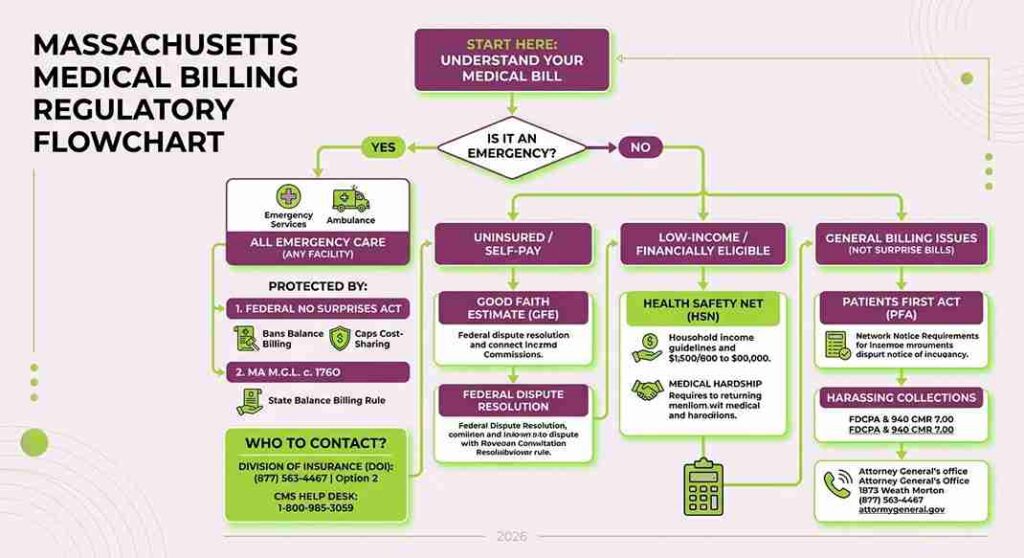
A surprise medical bill is an unexpected charge from an out-of-network provider that exceeds the patient’s in-network cost-sharing. The Massachusetts Division of Insurance uses this definition. Two sources supply Massachusetts surprise billing protections: the federal No Surprises Act and the state balance billing rule in M.G.L. c. 176O, section 6(a)(4).
Which Situations Qualify for Surprise Billing Protection?
Three situations qualify. Emergency care at any facility qualifies, including out-of-network emergency rooms and freestanding emergency departments. Non-emergency care from an out-of-network provider at an in-network hospital or surgery center also qualifies. Finally, out-of-network air ambulance transport qualifies. Each situation caps the patient’s cost at the in-network amount.
The table below lists example billing codes for each protected service and shows whether a waiver can apply. The codes come from the CPT and HCPCS code sets, and the ranges show where each service type appears on a claim form.
| Service | Example Billing Codes | Balance Billing Ban | Waiver Allowed? |
|---|---|---|---|
| Emergency department visit | CPT 99281 to 99285 | Yes | No |
| Anesthesia at an in-network facility | CPT 00100 to 01999 | Yes | No |
| Radiology at an in-network facility | CPT 70010 to 79999 | Yes | No |
| Pathology and laboratory at an in-network facility | CPT 80047 to 89398 | Yes | No |
| Air ambulance, fixed wing | HCPCS A0430 | Yes | No |
| Air ambulance, rotary wing | HCPCS A0431 | Yes | No |
| Ground ambulance, ALS emergency | HCPCS A0427 | No | Not applicable |
| Ground ambulance, BLS emergency | HCPCS A0429 | No | Not applicable |
Anesthesia, radiology, and laboratory services carry the strongest protection, because providers cannot ask patients to waive the ban for these ancillary services. In contrast, ground ambulance codes A0427 and A0429 fall outside the federal ban entirely, so those charges remain open to balance billing.
What Can a Patient Be Charged for a Protected Service?
A patient owes in-network cost-sharing only: the copayment, coinsurance, or deductible that the health plan would apply to an in-network provider. Those payments count toward the in-network deductible and out-of-pocket maximum. The provider and the health plan resolve any remaining payment dispute between themselves through federal independent dispute resolution.
Which Health Plans Fall Under the Protections?
The protections apply to coverage issued through an employer, the Massachusetts Health Connector, or a health insurance company licensed in Massachusetts. Both fully insured and self-funded employer plans qualify. MassHealth, Medicare, TRICARE, Indian Health Service, and Veterans Health Administration coverage fall outside the No Surprises Act, although other laws restrict balance billing there.
Are Ground Ambulances Covered?
The No Surprises Act does not cover ground ambulances. As a result, an out-of-network ground ambulance company can bill a patient for the difference between the company’s charge and the health plan payment. Massachusetts has no statewide ground ambulance balance billing ban as of September 2026, although lawmakers are considering legislation in the 2026 session.
What Is a Consent Waiver, and Must a Patient Sign One?
A consent waiver is a written form that gives up No Surprises Act protection, and no patient must sign one. Providers cannot request a waiver for emergency care, for ancillary services such as anesthesia or radiology, or for unforeseen urgent needs. A patient who declines a waiver can seek care from an in-network provider instead.
Where a waiver is permitted, the form must arrive on a separate document. For fully insured plans, the provider must also disclose an available in-network alternative at least 72 hours before the service. Consequently, a waiver presented at check-in for a non-emergency procedure deserves a careful second look.
What Price Transparency and Patient Notice Rules Apply in Massachusetts?
Two rules govern price transparency in Massachusetts. Federal law requires good faith estimates for uninsured and self-pay patients. The state Patients First Act requires providers to disclose network status and expected charges for non-emergency care. Enforcement of the state notice rules by penalty begins January 1, 2027.
What Is a Good Faith Estimate, and Who Receives One?
A good faith estimate is a written, itemized forecast of expected charges that providers must give every uninsured or self-pay patient before scheduled care. The delivery deadline depends on how far ahead the patient books, as the table below shows. Co-providers send expected charges to the convening provider, who assembles one estimate:
| When Care Is Scheduled | Estimate Deadline |
|---|---|
| 10 or more business days ahead | Within 3 business days of scheduling |
| 3 to 9 business days ahead | Within 1 business day of scheduling |
| Patient requests an estimate before scheduling | Within 3 business days of the request |
| Fewer than 3 business days ahead | No estimate required |
Earlier bookings give the provider more time to compile charges, and shorter bookings trigger a faster deadline. Services scheduled fewer than 3 business days ahead carry no estimated requirement, so those patients benefit from asking for a written price in advance.
A patient billed $400 or more above the estimate from any single provider can start federal patient-provider dispute resolution. The patient must file within 120 calendar days of the bill and pay a $25 administrative fee. The reviewer’s decision binds both sides.
What Does the Patients First Act Require?
The Patients First Act requires providers to disclose network status and expected charges for non-emergency care under M.G.L. c. 111, section 228. The Act does not cover emergency services, although a provider must answer truthfully when a patient asks about network status. The table below summarizes the notice duties by provider status.
| Provider Status | Required Notice | Timing |
|---|---|---|
| In-network | Allowed amount and facility fees on request; estimated maximum if the billing code is unknown | Within 2 days of the request |
| Out-of-network, scheduled more than 7 days ahead | Verbal and written notice of non-participation, plus the charge and facility fees | At scheduling, at least 7 days before the service |
| Out-of-network, scheduled 7 days or fewer ahead | Verbal notice of non-participation, then written notice on arrival | At scheduling and on arrival |
A provider that skips the required out-of-network notice cannot bill the patient beyond in-network cost-sharing. In addition, a provider that refers a patient within the same provider organization must say so. Consequently, network status questions at scheduling protect both the patient and the practice from later billing disputes.
When Does Enforcement of the Patients First Act Begin?
Enforcement of the Patients First Act begins on January 1, 2027. The Department of Public Health states that on that date the Department starts accepting and investigating complaints. Penalties reach up to $2,500 per instance of noncompliance. The legislature moved the date from January 1, 2022 to January 1, 2025, then to 2027.
How Can Low-Income Patients Get Help With Hospital Bills in Massachusetts?
Low-income patients in Massachusetts have two hospital bill relief options. The first is the state Health Safety Net, and the second is the financial assistance policy of a nonprofit hospital. The programs operate separately, so a patient can apply to both. Applications carry deadlines, and therefore early action protects the most coverage.
Who Qualifies for the Health Safety Net?
The Health Safety Net pays acute care hospitals and community health centers for care delivered to uninsured and underinsured Massachusetts residents. Eligibility depends on household income measured against the federal poverty level (FPL), as the table below shows. Medical Hardship follows a separate test, which the paragraph after the table explains:
| Household Income | Health Safety Net Category | Deductible |
|---|---|---|
| 0% to 150% of FPL | Full coverage | None |
| Above 150% to 300% of FPL | Partial coverage | Annual deductible applies |
| Any income level | Medical Hardship | One-time payment; patient contribution applies |
Medical Hardship works differently from standard eligibility. The program covers bills from the prior 12 months when allowable medical expenses exceed a set percentage of countable income. That percentage rises with income: 20% for 305.1% to 405% of FPL, 30% for 405.1% to 605%, and 40% above 605%.
The Health Safety Net applies only at acute care hospitals and community health centers. Physician groups often bill separately, and the program may not cover those charges. Coverage generally begins on the tenth day before the application date, so prompt filing matters.
What Financial Assistance Must Nonprofit Hospitals Provide?
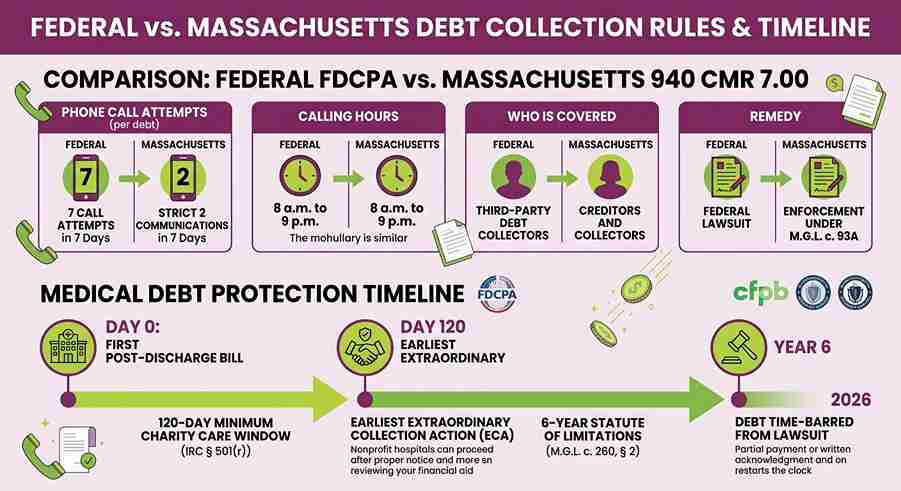
Nonprofit hospitals must publish a written financial assistance policy under IRC section 501(r). Eligible patients pay no more than the amounts generally billed to insured patients. Extraordinary collection actions cannot start until 120 days after the first post-discharge bill and 30 days after written notice. The application window lasts at least 240 days.
How Does a Patient Apply for Hospital Financial Assistance?
A patient applies for Massachusetts hospital financial help in six steps. Each step below begins with an action verb, so the list works as a checklist. Hospital billing offices and the Health Safety Net Office each request income and residency proof, so one set of documents serves both applications:
- Gather proof of Massachusetts residency and photo identification.
- Collect recent pay stubs, a tax return, or other proof of household income.
- Request the hospital’s financial assistance application from the billing office, or file a Health Safety Net application through the Massachusetts Health Connector.
- Ask the hospital in writing to pause collection activity while the application is pending.
- Submit every requested document before the deadline on the application.
- Keep the approval letter, because the Health Safety Net issues no member card.
How Do Medical Debt, Collections, and Credit Reporting Rules Work in Massachusetts?
Massachusetts patients hold protections against medical debt collection under federal law, Attorney General regulations, and a six-year statute of limitations. However, a statewide ban on medical debt credit reporting remains a proposal as of September 30, 2026. The sections below describe each rule and its current status.
What Limits Apply Before a Hospital Sends a Bill to Collections?
Nonprofit hospitals face specific limits, because IRC section 501(r) blocks extraordinary collection actions for 120 days after the first post-discharge bill. Extraordinary collection actions include lawsuits, wage garnishment, credit reporting, and debt sales. A complete financial assistance application also pauses these actions while the hospital reviews the request.
What Rights Does the Fair Debt Collection Practices Act Provide?
The Fair Debt Collection Practices Act gives consumers a written validation notice within 5 days of a collector’s first contact. A written dispute sent within 30 days of that notice halts collection until the collector mails verification. Massachusetts adds stricter rules through 940 CMR 7.00, which also bind original creditors.
| Rule | Federal (FDCPA and Regulation F) | Massachusetts (940 CMR 7.00) |
|---|---|---|
| Phone contact limit | 7 call attempts in 7 days per debt | 2 phone communications in 7 days per debt |
| Calling hours | 8 a.m. to 9 p.m. | 8 a.m. to 9 p.m. |
| Who is covered | Third-party debt collectors | Creditors and collectors |
| Remedy | Federal lawsuit for violations | Enforcement under M.G.L. c. 93A |
The Massachusetts call limit is stricter than the federal limit, so a call log becomes direct evidence of a violation. Consequently, a patient who receives collection calls benefits from logging the date, time, and caller name. The log supports a complaint to the Attorney General.
How Long Can a Collector Sue Over Medical Debt?
A collector has six years to sue over medical debt under M.G.L. c. 260, section 2. A partial payment or a written acknowledgment of the debt can restart the six-year clock. An expired debt still exists, but a court dismisses the lawsuit once the patient raises the limitations defense.
What Insurance-Related Billing Rights Do Massachusetts Patients Have?
Massachusetts patients hold three insurance-related billing rights: appeal a denied claim, receive faster prior authorization decisions, and access coverage that meets state standards. The Division of Insurance regulates fully insured plans, and the Office of Patient Protection runs external review.
How Do Insurance Appeals and External Review Work?
An insurance appeal in Massachusetts has two stages. The first stage is an internal grievance with the insurer, and the second is an external review through the Office of Patient Protection (OPP). The table below lists the key deadlines and fees for the external stage, and the reviewer’s decision binds the insurer.
| Item | Rule |
|---|---|
| Filing deadline | 4 months from the final adverse determination letter |
| Fee | $25 per review, capped at $75 per year; waived for financial hardship |
| Refund | Full refund if the review is resolved in the patient’s favor |
| Standard decision time | 45 days from the reviewer’s receipt of the case |
| Expedited decision time | 72 hours |
| Effect of decision | Final and binding on the insurer |
Patients with self-funded employer plans file external review requests with the U.S. Department of Labor instead. In addition, appeals about No Surprises Act compliance move to the federal HHS external review process. OPP forwards those requests to a federal contractor.
How Do You Read and Dispute a Medical Bill in Massachusetts?
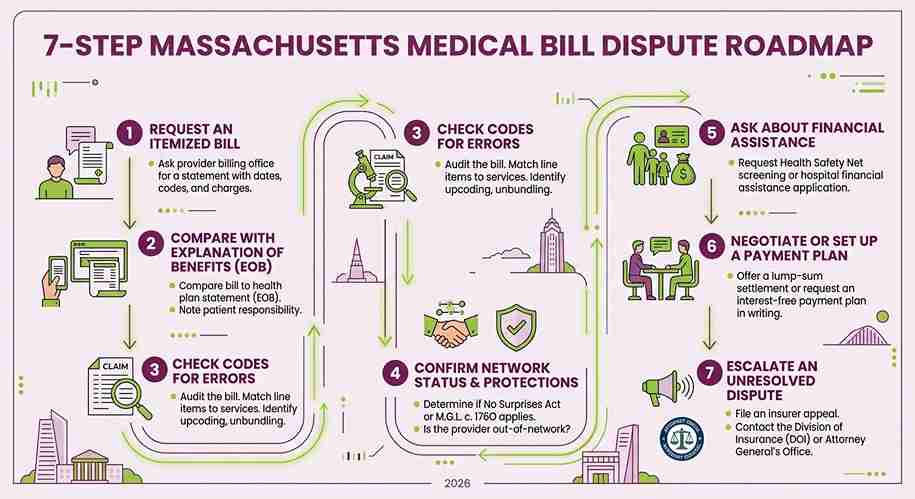
Disputing a Massachusetts medical bill takes seven steps, and each step builds on the one before. Work through the steps in order, and keep copies of every letter, call note, and receipt. A dated record supports any later appeal or complaint, because agencies ask for documentation.
- Request an itemized bill. Ask the provider’s billing office for a statement that lists every service, date, billing code, and charge.
- Compare the bill with the Explanation of Benefits. The health plan issues this statement, and the statement shows the allowed amount, the plan payment, and the patient responsibility.
- Check the codes for errors. Match each line item to the services received, using the error table below.
- Confirm network status and protections. Determine whether the No Surprises Act or M.G.L. c. 176O bars the charge.
- Ask about financial assistance. Request a Health Safety Net screening or the hospital’s financial assistance application.
- Negotiate or set up a payment plan. Offer a lump-sum settlement or request a written, interest-free payment plan.
- Escalate an unresolved dispute. File an insurer appeal or a complaint with the agencies.
Frequently Asked Questions
What Are the Best Companies for Outsourcing Medical Billing in Massachusetts?
Some of the best medical billing companies in Massachusetts nationwide include Transcure, known for AI-powered RCM that improves claim accuracy and reimbursement speed. Prospa Billing, Analytix Healthcare Solutions, and Medisys Data Solutions each offer specialized coverage for practices with narrower billing needs.
Can a Massachusetts Hospital Bill Me for an Out-of-Network Emergency?
No. Under the No Surprises Act and M.G.L. c. 176O, a hospital or emergency physician can bill only in-network cost-sharing for emergency care. A patient with a larger bill can call the Division of Insurance at (877) 563-4467, Option 2. The CMS No Surprises Help Desk at 1-800-985-3059 also takes complaints.
Does Massachusetts Ban Balance Billing?
Yes, for most situations. M.G.L. c. 176O, section 6(a)(4), and the No Surprises Act bar balance billing for emergency care, ancillary services at in-network facilities, and air ambulances. Ground ambulances and services covered by a signed consent waiver remain exceptions. The federal law expands the state protections, according to the Division of Insurance.
Can Medical Debt Affect My Credit in Massachusetts?
Yes, for now. The Department of Public Health proposed regulations in June 2026 to bar licensed providers and their collectors from reporting medical debt. The rules are not final as of September 30, 2026. The national credit bureaus already exclude paid medical collections, collections under $500, and collections less than one year old.
Who Do I Call About a Billing Error?
Call the provider’s billing office first and request an itemized bill. Next, call the health plan to review the Explanation of Benefits. If neither call resolves the error, contact the Division of Insurance at (877) 563-4467, Option 2. For collection problems, call the Attorney General’s consumer hotline at (617) 727-8400.
When Does the Massachusetts Patients First Act Take Effect?
Enforcement of the Patients First Act begins on January 1, 2027. On that date the Department of Public Health starts accepting and investigating complaints, and penalties reach up to $2,500 per instance. The notice duties under M.G.L. c. 111, section 228, remain part of the law during the delay.