A letter of protection in Florida lets a provider treat now and get paid from a settlement or judgment. Section 768.0427 limits how those bills are valued in court. It also requires coded bills and disclosure of any sale or referral.
A letter of protection (LOP) promises a provider payment from a personal injury settlement or judgment. Florida regulates LOPs through Section 768.0427 of the Florida Statutes. HB 837 created that section on March 24, 2023, as part of Florida’s tort reform law.
Section 768.0427 changes what an LOP receivable is worth in court. Juries can now hear Medicare-based values, health plan rates, and the price a buyer paid for the account. Claimants must also disclose coded bills, sales, and attorney referrals. Each rule changes how your practice bills LOP care.

What Is a Letter of Protection in Florida?
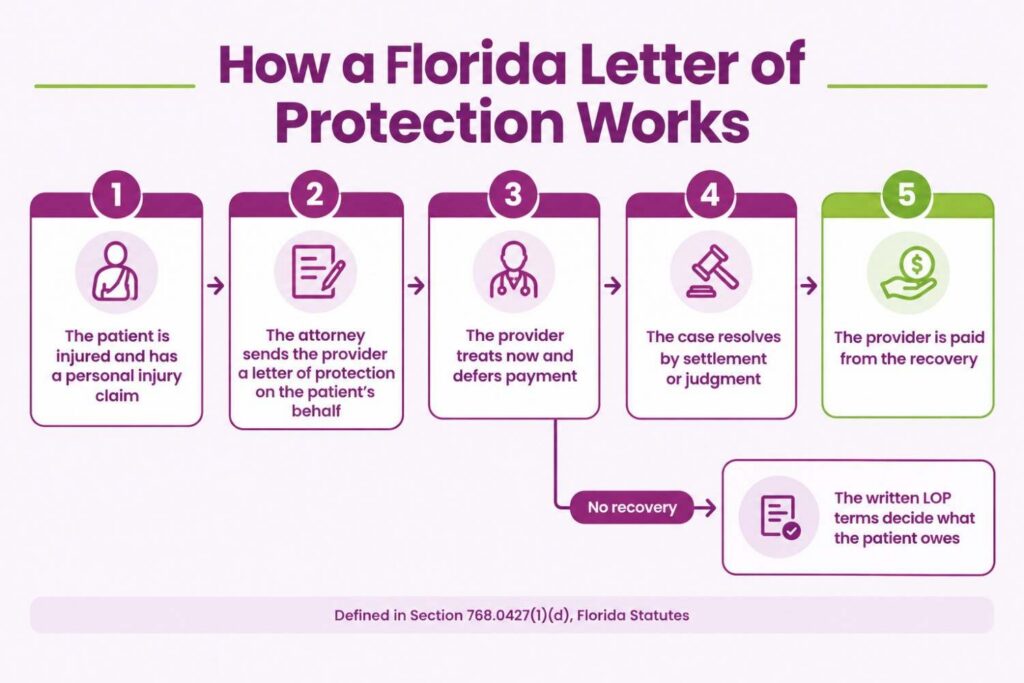
A letter of protection in Florida is a promise to pay a provider from a personal injury judgment or settlement. The provider treats the patient now in exchange for that promise. Section 768.0427(1)(d) applies the definition to any such arrangement, whatever the document is called.
The statute defines a health care provider broadly. The definition covers practitioners licensed under Section 456.001 and providers licensed by the Agency for Health Care Administration (AHCA). It also covers CLIA-certified labs, federally qualified health centers, and pharmacies. LOP rules sit alongside the other medical billing laws in Florida.
Florida courts describe an LOP as a document an attorney sends to a provider on the client’s behalf. In practice, the paperwork varies from a one-page letter to a signed assignment. Section 768.0427 treats every version the same way once the payment depends on a recovery.
Is a Letter of Protection Legally Binding?
Yes, as a contract, when its terms are enforceable. Florida Bar Ethics Opinion 02-4 notes that letters of protection vary widely in form and terms. The written terms decide whether the patient owes the bill when the case produces no recovery.
An attorney who is a party to the LOP must honor it. A lawyer who owes the provider a legal duty must also hold disputed settlement funds in trust. Florida Bar Rule 5-1.1(f) sets that trust account duty.
Why Do Florida Providers Treat Patients Under Letters of Protection?
Florida providers accept letters of protection when other payment sources fall short. Four payment gaps lead providers to accept LOP arrangements.
- PIP coinsurance: Personal injury protection (PIP) pays 80% of covered expenses, leaving a balance.
- PIP limits: PIP medical benefits stop at $10,000, or at $2,500 when a provider finds no emergency medical condition.
- No health insurance: An uninsured patient has no health plan to bill.
- No statewide lien: Florida has no statewide medical lien statute, so a contract ties the bill to the recovery.
What Is the Difference Between a Letter of Protection and a Medical Lien?
A letter of protection is a private contract, while a Florida hospital lien comes from a county ordinance. The table compares the two on 4 attributes.
| Attribute | Letter of Protection | Hospital Lien |
|---|---|---|
| Legal source | Contract between the parties | County ordinance, where one exists |
| Who can use it | Any health care provider | Hospitals in counties with a valid lien ordinance |
| Statewide statute | Not required | Florida has no statewide lien statute |
| Terms | Negotiated in the agreement | Set by the ordinance, including notice and filing rules |
In Shands Teaching Hospital v. Mercury Insurance Co. (2012), the Florida Supreme Court struck down a hospital lien created by special act. The court upheld the county ordinance that granted the same lien rights.
How Does Section 768.0427 Change the Value of LOP Medical Bills?
Section 768.0427 limits the evidence a jury hears about medical expenses and caps medical damages. Satisfied past bills are proven only by the amount actually paid, from any source. Unpaid and future bills are proven through listed evidence types. The rules apply in personal injury and wrongful death actions.
What Evidence of Past Unpaid Medical Expenses Is Admissible?
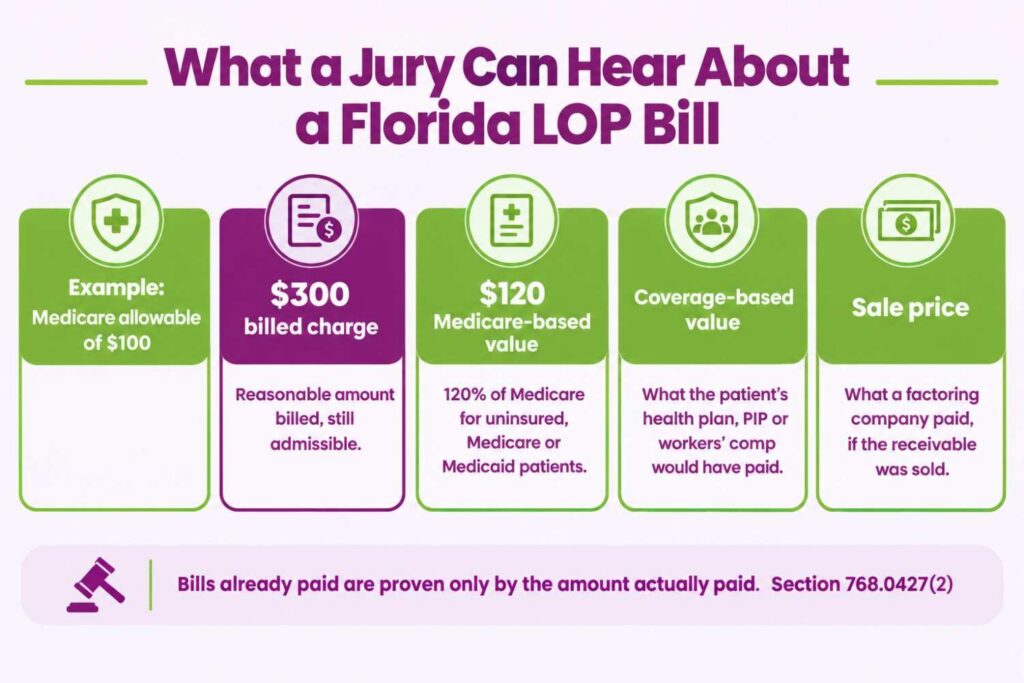
Section 768.0427(2)(b) lists 5 types of evidence for past bills that remain unpaid. The claimant’s coverage at the time of treatment decides which types apply.
| Claimant Situation | Admissible Evidence |
|---|---|
| Has health care coverage other than Medicare or Medicaid | What that coverage must pay, plus the claimant’s share |
| Has coverage but treats under an LOP or skips the coverage | What that coverage would have paid, plus the claimant’s share |
| Uninsured, or covered by Medicare or Medicaid | 120% of the Medicare rate on the date of service; if none, 170% of the Florida Medicaid rate |
| Provider sold the LOP receivable | The amount the buyer paid or agreed to pay |
| Any claimant | Reasonable amounts billed for medically necessary care |
The statute says this evidence “includes, but is not limited to” these types. A jury can weigh more than one figure for the same bill.
What Evidence of Future Medical Expenses Is Admissible?
Section 768.0427(2)(c) lists 3 types of evidence for future medical care. Past evidence uses the rate on the date of service. Future evidence uses the rate in effect at the time of trial.
- Covered or eligible claimants: What coverage other than Medicare or Medicaid would pay, plus the claimant’s share.
- Uninsured, Medicare, or Medicaid claimants: 120% of the Medicare rate at the time of trial, or 170% of the Medicaid rate.
- Any claimant: Reasonable future amounts to be billed for medically necessary care.
Can a Jury Still See a Provider’s Billed Charges?
Yes, section 768.0427(2)(b)5 keeps evidence of reasonable amounts billed for medically necessary treatment admissible. The jury hears the billed charge alongside the Medicare-based or coverage-based figure. No party must seek a reduction it is not contractually entitled to. Contracts between providers and commercial insurers or HMOs are not discoverable or admissible.
What Medical Damages Can a Claimant Recover Under Section 768.0427?
Section 768.0427(4) caps medical damages at the evidence admitted under subsection (2). Recoverable medical damages also cannot exceed the sum of 3 amounts.
- Amounts actually paid to providers by or for the claimant
- Amounts needed to satisfy charges still unpaid at trial
- Amounts needed for reasonable and necessary future care
The recovery that funds an LOP payment comes from these capped damages. A lower admitted value shrinks the pool your practice is paid from.
Does Section 768.0427 Apply to Cases Filed Before March 24, 2023?
No, Section 30 of Chapter 2023-15 applies HB 837 to causes of action filed after March 24, 2023. In Wolf v. Williams (2024), Florida’s Fifth District Court of Appeal held that Section 768.0427 does not apply to earlier-filed cases. The filing date controls, not the accident date.
What Must Be Disclosed When Treatment Is Under a Letter of Protection?
Section 768.0427(3) makes 5 disclosures a condition precedent to claiming medical expenses for LOP treatment. A claimant who skips them cannot assert those medical expenses.
- A copy of the letter of protection
- All medical bills, itemized and coded
- The buyer’s name and purchase price, including any discount, if the receivable was sold
- Whether the claimant had health care coverage at the time of treatment, and its identity
- Whether the claimant was referred for LOP treatment, and by whom
The claimant makes the disclosures, but your practice produces the bills. Incomplete or uncoded records can block the claim your payment depends on.
How Must LOP Medical Bills Be Itemized and Coded?
Section 768.0427(3)(b) sets the code sets by billing level. Each level uses the codes in effect on the date of service, except inpatient bills.
| Billing Level | Required Codes |
|---|---|
| Provider level | CPT or HCPCS in effect on the date of service |
| Facility, clinical or outpatient (including APC or EAPG billing) | ICD diagnosis codes and, if applicable, CPT, in effect on the date of service |
| Facility, inpatient (including DRG billing) | ICD diagnosis and procedure codes in effect on the discharge date |
Accurate medical coding services keep each LOP bill matched to the code set its billing level requires.
Why Does the Attorney Referral Disclosure Matter to Providers?
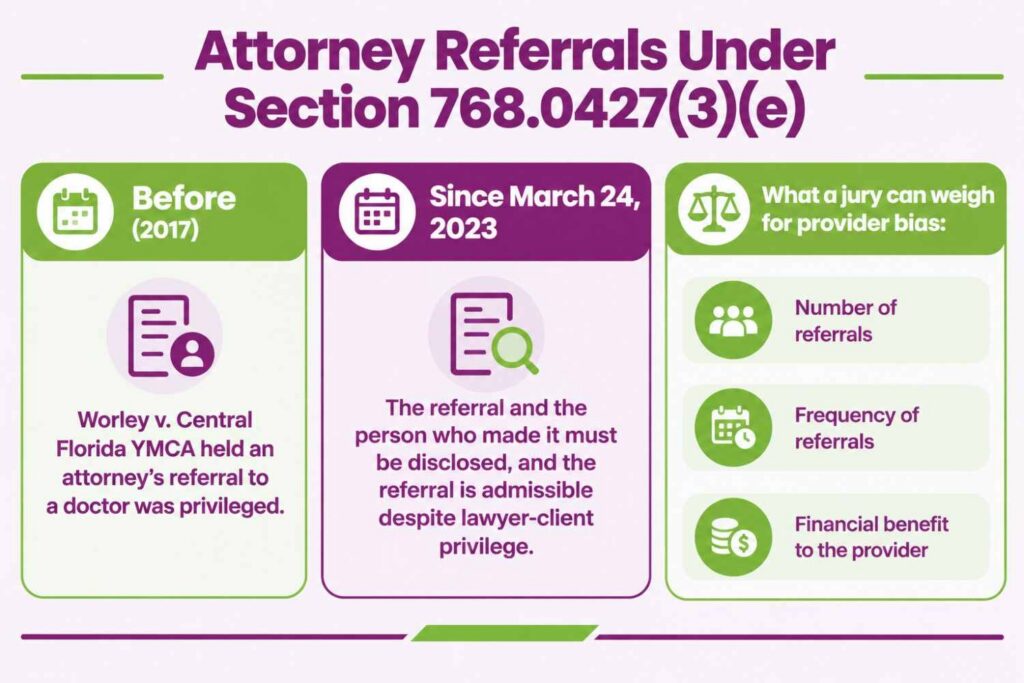
The attorney referral disclosure exposes the financial ties between a law firm and a treating provider. In Worley v. Central Florida YMCA (2017), the Florida Supreme Court held that an attorney’s referral to a doctor was privileged.
Section 768.0427(3)(e) reversed that result. An attorney referral is now disclosable and admissible despite the lawyer-client privilege in Section 90.502. The statute makes the firm-provider financial relationship relevant to a testifying provider’s bias.
- Referral count: the number of referrals from the firm
- Referral frequency: how often the firm sends patients
- Financial benefit: what the provider gains from the relationship
Heavy referral volume from one firm becomes cross-examination material when your provider testifies.
How Do PIP, Health Insurance, Medicare, and Medicaid Affect LOP Bills?
A patient’s coverage at the time of treatment decides which value a jury hears for an LOP bill. Section 768.0427 treats PIP, health plans, workers’ compensation, and government programs as health care coverage. Medicare patients also bring federal billing rules into every LOP account.
What Happens When an Insured or PIP-Covered Patient Treats Under an LOP?
Section 768.0427(1)(b) defines health care coverage broadly. The definition includes health plans, state and federal programs, workers’ compensation, and personal injury protection.
A covered patient can treat under an LOP instead of using that coverage. The jury can then hear what the coverage would have paid. Treating an insured patient under an LOP does not keep the plan rate out of court. Auto cases also run through Florida PIP billing rules before any LOP balance.
How Does Workers’ Compensation Coverage Affect an LOP Bill?
Workers’ compensation counts as health care coverage under Section 768.0427(1)(b). An injured worker who treats under an LOP instead of the workers’ compensation claim gets the same coverage-based test. Evidence of what workers’ compensation would have paid becomes admissible, plus any share the claimant would owe.
Florida workers’ compensation pays providers under the state reimbursement manual and fee schedule. Those rates are set by the state, not by the practice’s own charges. An LOP on a work injury therefore carries the same valuation risk as an LOP on an insured patient.
How Does the 120% of Medicare Rule Work?
The 120% of Medicare rule sets one admissible value for uninsured, Medicare, and Medicaid claimants. The example below uses an illustrative Medicare allowable of $100.
- Start with the Medicare allowable on the date of treatment: $100.
- Multiply by 1.20 for the Medicare-based value: $120.
- Add the provider’s reasonable billed charge, for example $300, as separate evidence.
- Let the jury weigh both figures against the rest of the record.
Where Medicare has no rate for a service, the admissible figure becomes 170% of the Florida Medicaid rate.
Can a Provider Hold a Medicare Patient’s Bill Under an LOP?
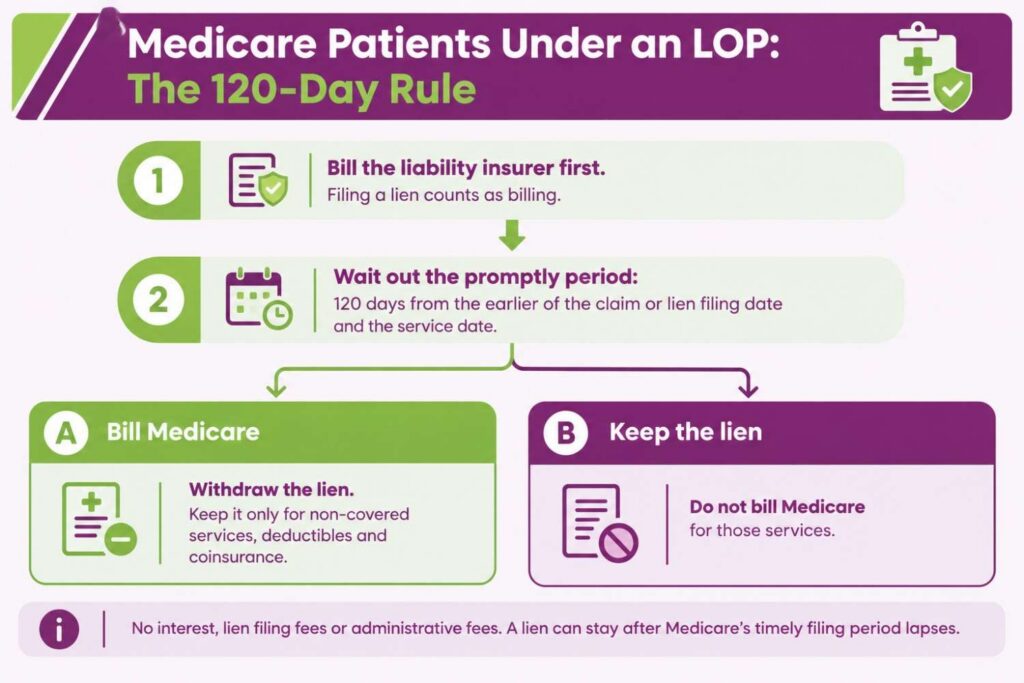
Yes, within the federal Medicare Secondary Payer rules. Providers must bill liability insurance before Medicare. Filing a lien against a liability settlement counts as billing the liability insurer.
The promptly period runs 120 days from the earlier of the claim or lien filing date and the service date. After that period, Medicare rules set 2 paths and 2 limits.
- Bill Medicare: Withdraw the lien, keeping it only for non-covered services, deductibles, and coinsurance.
- Keep the lien: Stay with the settlement and do not bill Medicare for those services.
- Timely filing: CMS now allows a provider to keep the lien after Medicare’s timely filing period lapses.
- Fees: Providers cannot charge interest, lien filing fees, or administrative fees against the lien.
What Happens When a Provider Sells an LOP Receivable?
A provider that sells an LOP receivable must have the sale disclosed, and the price becomes evidence. Section 768.0427(1)(a) defines a factoring company as a buyer of receivables at a discount below invoice value.
The claimant must disclose the buyer’s name and the purchase price, including the discount. The amount the buyer paid is admissible evidence of past unpaid medical expenses. A deep discount on the receivable can lower the damages that fund the payoff.
The illustrative figures below show how a sale enters the evidence:
- Your practice bills $10,000 for treatment under an LOP.
- A factoring company buys the receivable for $4,000.
- The claimant discloses the buyer’s name and the $4,000 price.
- The defense offers the $4,000 as evidence of the bill’s value.
- The jury weighs that figure against the $10,000 billed charge.
The sale moves collection risk to the buyer. The price it pays also becomes part of the case record.
How Should Florida Practices Bill and Manage LOP Accounts?
Florida practices protect LOP revenue by building each account to survive disclosure. The 7 steps below follow Section 768.0427 and federal Medicare rules.
- Get the LOP in writing before treatment, with clear terms on patient liability if there is no recovery.
- Record the patient’s health coverage, PIP, and Medicare status at intake.
- Bill PIP first for auto cases, then hold the remaining balance under the LOP.
- Itemize every charge with the code set Section 768.0427(3)(b) requires.
- Track the 120-day promptly period for every Medicare patient.
- Keep LOP balances on a separate A/R aging track tied to case status.
- Document any receivable sale, including the buyer and the price.
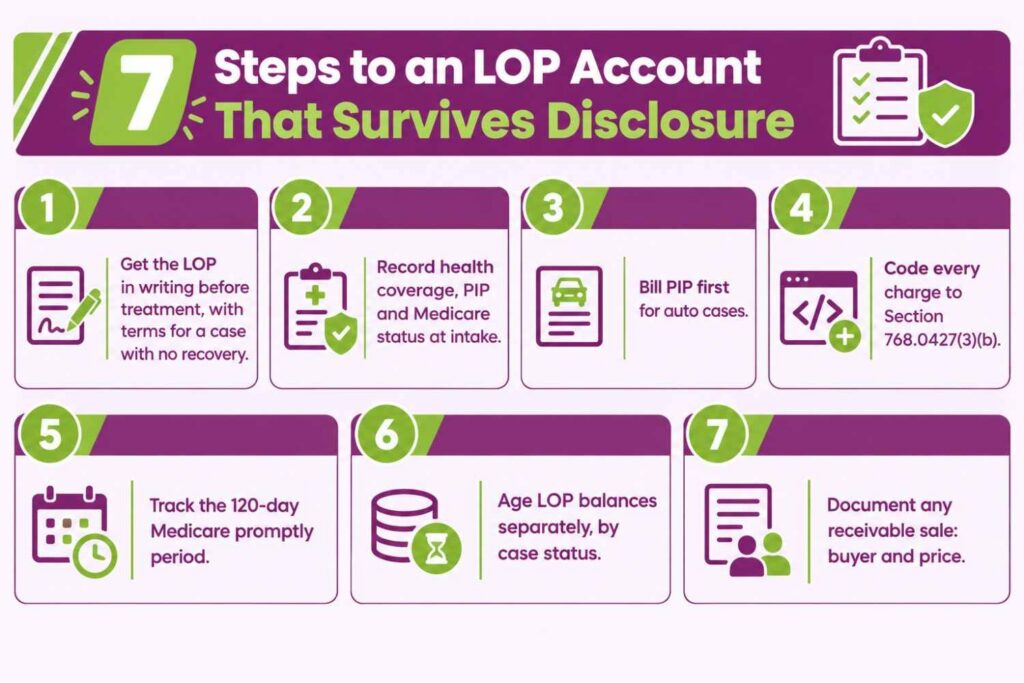
These records decide whether the claimant can assert your LOP bill at all. Steps 2 and 4 matter most at disclosure, since coverage status and codes are listed requirements. Step 5 protects your Medicare billing rights. Step 6 keeps LOP balances from aging silently while a case runs for years.
How Does Transcure Support LOP and Personal Injury Billing?
Transcure bills personal injury, no-fault, and LOP accounts for Florida practices from its Oviedo office. LOP bills fail when codes, coverage status, or case tracking are missing.
- Coding errors: CLAIR, our claim scrubbing AI agent, checks each LOP bill for coding errors before release.
- Lost balances: ARIA, our A/R agent, tracks every open LOP balance against case status.
- Billing levels: Our certified coders apply the code set each billing level requires under Section 768.0427(3)(b).
The outcome is an LOP bill that holds up when the claimant must disclose it. The same LOP workflow runs inside Transcure’s pain management billing services for interventional procedures.
Has Florida Changed Section 768.0427 Since 2023?
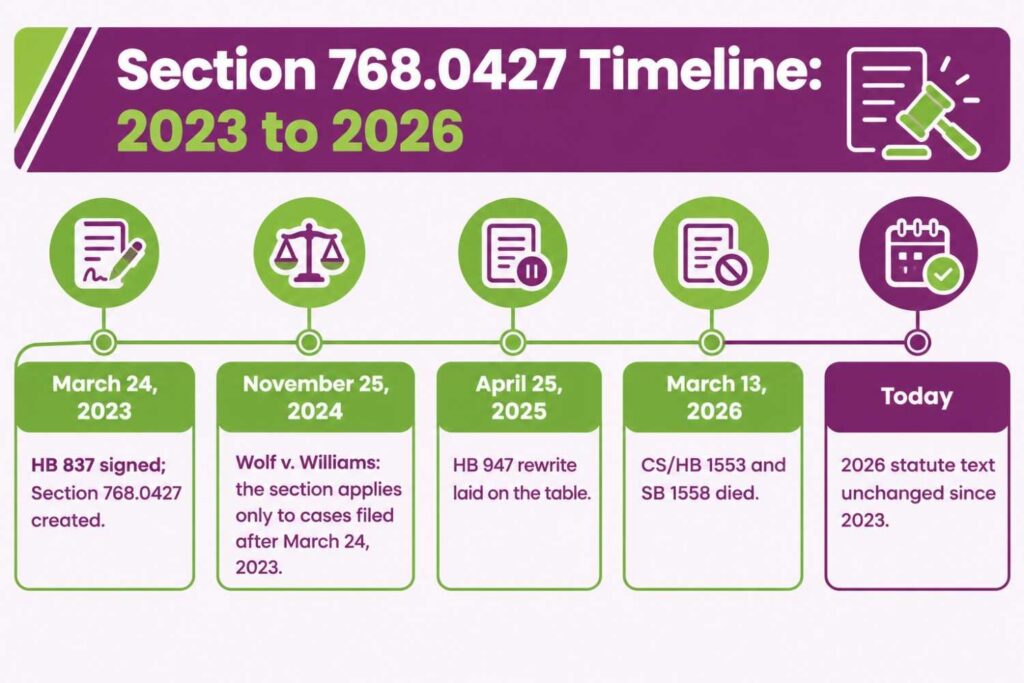
No, the 2026 text of Section 768.0427 matches the version HB 837 created in 2023. In 2025, HB 947 tried to rewrite the evidence rules and was laid on the table on April 25, 2025. In 2026, CS/HB 1553 and SB 1558 proposed amendments. Both bills died on March 13, 2026.
Section 768.0427 turned the letter of protection from a simple promise into a documented, coded, and disclosed receivable. Practices that bill LOP care now face rules on evidence, coding, sales, and referrals. These rules sit alongside the other medical billing laws in Florida that govern practice billing.
Frequently Asked Questions About Letters of Protection in Florida
What Is the Purpose of a Letter of Protection?
A letter of protection lets an injured patient receive care now. The provider waits for payment from a settlement or judgment. In Florida, Section 768.0427 regulates the arrangement with evidence and disclosure rules.
What Does LOP Mean in Medical Billing?
In medical billing, LOP means letter of protection. The provider treats a personal injury patient and defers collection until the case resolves. Florida requires LOP bills to be itemized and coded when a claimant seeks those medical expenses.
Can a Provider Bill the Patient If the Case Is Lost?
It depends on the letter of protection. Florida letters of protection vary in form and terms. The written agreement, and whether it is enforceable, decides what the patient owes when the case produces no recovery.
Who Signs a Letter of Protection?
The parties vary. The patient, the patient’s attorney, or both can be parties to the agreement with the provider. An attorney who is a party must honor the agreement and may have to hold disputed settlement funds in trust.
Is a Letter of Protection the Same as PIP?
No, PIP is auto insurance that pays providers directly under Section 627.736. A letter of protection defers payment until a personal injury case resolves. A patient can move to an LOP after PIP benefits run out.