AdvancedMD and athenahealth serve the same practices. Both target independent ambulatory groups. AdvancedMD runs typical deployments between 2 and 50 providers, and athenahealth serves solo practices through groups above 75.
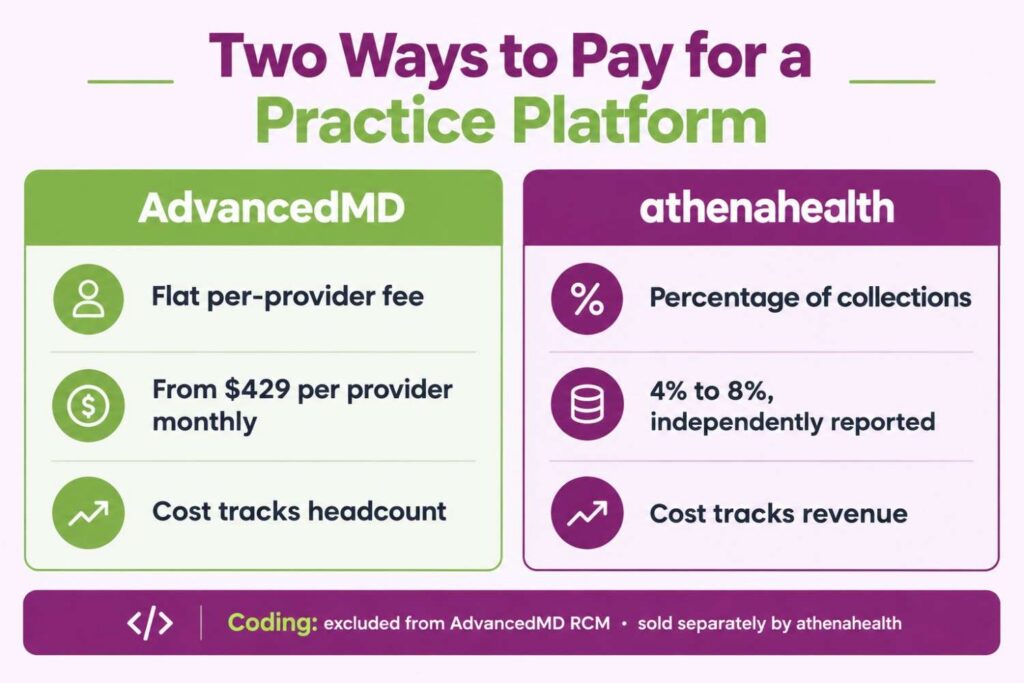
The platforms diverge on commercial model rather than on capability. AdvancedMD sells software at a published per-provider rate. athenahealth charges a percentage of what a practice collects, and bundles revenue cycle work into that fee.

That difference decides who owns the billing rules, who supplies the labor, and how cost behaves as a practice grows. This guide covers pricing structure, claim scrubbing mechanics, and practice fit across both platforms.
What Is AdvancedMD?
AdvancedMD is a cloud practice management and EHR platform for independent outpatient practices. The platform runs on AWS with no on-premise hardware. Practice management, clinical documentation, patient engagement, and payments share one database and one login.
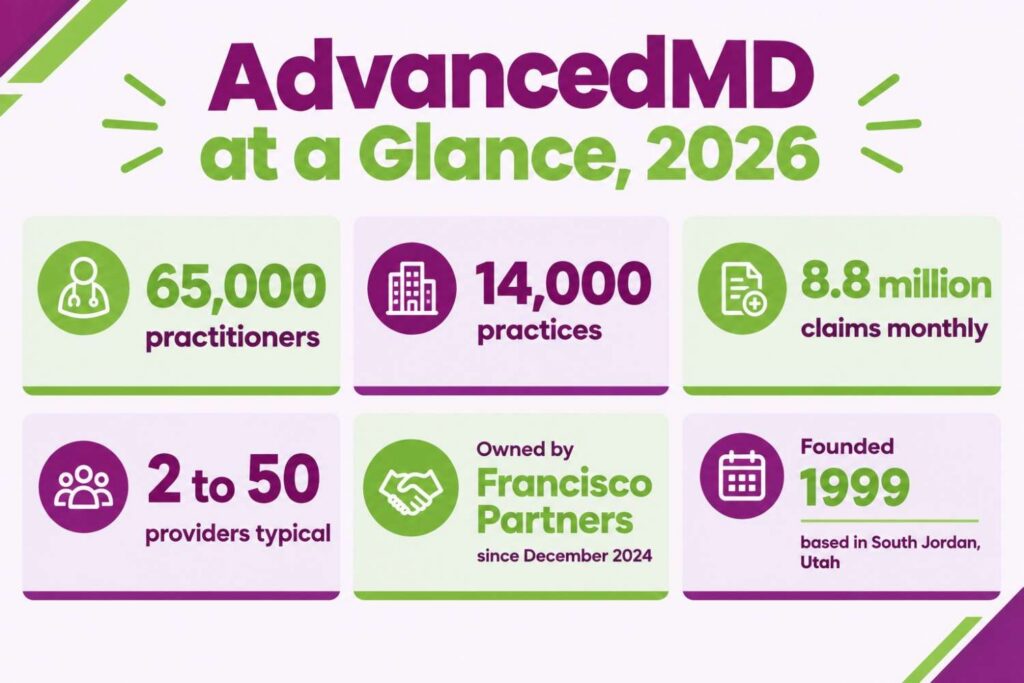
AdvancedMD started as Perfect Practice.MD in 1999 and rebranded the following year. According to AdvancedMD, the platform serves 65,000 practitioners across 14,000 practices and 900 independent billing companies. Those practices process 8.8 million claims monthly.
Who Owns AdvancedMD?
Francisco Partners owns AdvancedMD. The firm acquired the company from Global Payments for $1.125 billion. The deal was announced on 30 October 2024 and closed on 16 December 2024. Amanda Sharp serves as chief executive officer.
AdvancedMD has changed hands five times since 2008. Francisco Partners held it from 2008 to 2011, followed by ADP, Marlin Equity Partners, and Global Payments. The company operates from South Jordan, Utah.
Which Practices Run on AdvancedMD?
AdvancedMD supports five organizational structures across independent outpatient care:
- Solo practitioners and single-physician clinics
- Group practices between 2 and 50 providers
- Multi-location specialty groups
- MSOs, IPAs, and Accountable Care Organizations
Specialty templates cover more than 20 medical specialties. AdvancedMD holds ONC and Drummond certification. Dedicated editions exist for mental health and physical therapy.
Is AdvancedMD Still Owned by ADP?
AdvancedMD is no longer owned by ADP. ADP held AdvancedMD from 2011 to 2015, then sold to Marlin Equity Partners. Global Payments acquired it in 2018, and Francisco Partners repurchased it in December 2024. Several software directories still list ADP as the current owner, which dates their comparison data by more than a decade.
How Does AdvancedMD Pricing Work?
AdvancedMD prices on a published per-provider, per-month subscription. Practice management with billing starts at $429 per provider. EHR plus practice management starts at $729. The full bundle with patient engagement starts at $999 per month.
AdvancedMD Now, a month-to-month tier built for mental health practices, runs $130 per provider. The separate AdvancedMD managed revenue cycle service costs 4% to 8% of monthly collections.
What Do the Per-Provider Tiers Include?
Each tier bundles a defined module set rather than the full platform. The $429 tier covers practice management and claims. The $729 tier adds clinical charting. Practices stack modules individually under a build-a-bundle structure.
Per-encounter licensing exists as an alternative to per-provider pricing. Low-volume practices and groups carrying many part-time providers benefit from that structure. Full tier detail sits in AdvancedMD tier pricing and add-on structure.
Which Costs Sit Outside the Base Subscription?
Several capabilities buyers assume are included carry separate line items. Add-ons cover advanced reporting, appointment reminders, telehealth, patient engagement, API access, and lab interfaces. Electronic faxing bills per transmission.
Implementation and training have historically run $1,995 to $3,995 per account. Feature audits usually happen after go-live, which produces budget surprises at first renewal.
Does AdvancedMD Publish Pricing?
AdvancedMD publishes its tier pricing publicly. Module costs get quoted during the sales process. Buyers still confirm line items against a specific quote, because packaging shifts by contract and practice size. Published tiers make per-provider budget modeling possible before any sales conversation begins.
How Do Billing Rules Work in AdvancedMD?
AdvancedMD billing runs inside the Practice Management module, which connects charge capture, scrubbing, submission, posting, and collections. Charges generate from finalized clinical notes rather than through separate charge entry.
Claims route through a proprietary clearinghouse AdvancedMD acquired from NueMD in 2018, connected directly to 1,800 United States carriers. Rejection feedback returns into Practice Management in near real time.
What Does ClaimInspector Screen Before Submission?
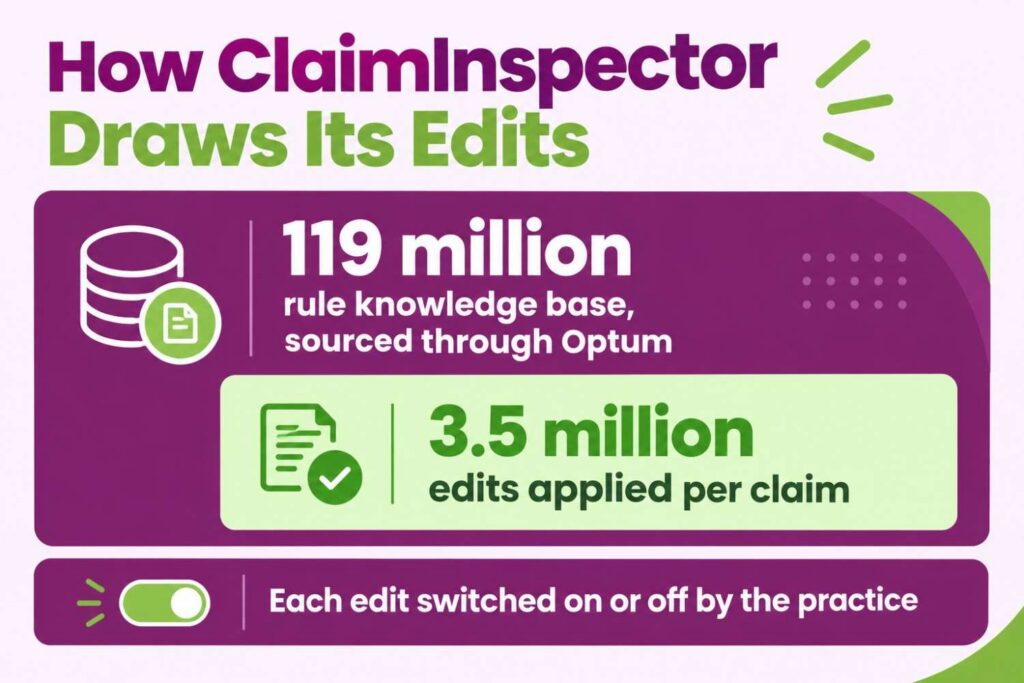
ClaimInspector applies approximately 3.5 million edits to each claim. Those edits draw from a knowledge base of 119 million government and third-party rules that AdvancedMD sources through Optum.
Published reviews frequently conflate the two figures. The 119 million number describes the total rule library. The 3.5 million number describes edits applied per claim. Edit categories span coding pairs, transaction format, medical necessity, and carrier-specific requirements.
Who Configures the Scrubbing Rules?
The practice configures them. Each ClaimInspector edit is individually controlled, so a billing team switches rules on and off against its own payer mix. AdvancedMD supplies the rule library. The practice supplies the judgment about which rules apply.
That control carries a labor cost. Default rule sets never anticipate a specific payer mix, and generic configurations release preventable denials into the clearinghouse. Configuration mechanics appear in how ClaimInspector edits are configured.
Does AdvancedMD Include Coding?
AdvancedMD does not include coding in any tier. The platform supplies coding tools, specialty templates, and bundling edits, but assigns no coders. The AdvancedMD managed revenue cycle service excludes coding as well. Practices staff coding in-house or contract it separately, regardless of which AdvancedMD tier they license.
What Practice Size Does AdvancedMD Fit?
AdvancedMD fits 2 to 50 providers as its typical deployment range. Multi-location Management and the Central Billing Office module handle groups operating across several sites from one login.
A multi-site practice works every location from one login through Central Billing Office. More than 900 independent billing companies already work inside AdvancedMD, so practices that outsource keep a wide choice of billers.
Where Does AdvancedMD Reach Its Ceiling?
AdvancedMD reaches its ceiling on reporting granularity and support responsiveness. Standard reports lack payer-level detail for contract analysis. Certain provider-level metrics require workarounds to build.
Standard accounts receive no dedicated account manager. Groups above roughly 50 providers pull raw data through ODBC or the Data Warehouse option. Both require SQL skills most billing teams lack.
Can a Multi-Location Practice Bill From One Login?
A multi-location practice can bill every site from one AdvancedMD login. Multi-location Management and Central Billing Office consolidate billing across providers and locations. Billing staff move between sites without separate credentials.
What Is athenahealth?
athenahealth is a network-based health technology company serving ambulatory practices. The company was founded in San Diego in 1997 and is headquartered in Boston, Massachusetts.
athenahealth operates differently from a conventional software vendor. The platform combines software, service staffing, and network intelligence into one offering. athenahealth prices all three together as a share of what a practice collects.
Who Owns athenahealth?
Bain Capital and Hellman & Friedman own athenahealth. The two firms acquired the company in February 2022 for approximately $17 billion. Bob Segert serves as chairman and chief executive officer.

What Does athenaOne Include?
athenaOne bundles three components under one contract. athenaCollector handles practice management and revenue cycle. athenaClinicals handles clinical documentation. athenaCommunicator handles patient engagement.
athenaCollector launched in 2000 and remains the platform’s foundation. Interoperability runs through Carequality and CommonWell connections. The athenaPatient mobile application covers patient-side scheduling, results, and payments.
Are athenahealth and athenaOne the Same Thing?
athenahealth and athenaOne are related but not the same thing. athenahealth is the company. athenaOne is the integrated platform that company sells. Buyers encounter both names in sales material and directory listings, which creates persistent confusion. Comparison research should treat athenaOne as the product under evaluation.
How Does athenahealth Pricing Work?
athenahealth prices athenaOne as a percentage of what a practice collects. Independent buyer guides place that percentage between 4% and 8% of net collections. The rate varies by practice size, specialty, and module selection.
athenahealth does not publish a fixed percentage on its own pricing pages. Third-party reporting places an entry point near $140 per provider per month, though that figure carries no vendor confirmation.
How Does the Percentage-of-Collections Model Work?
The model ties vendor revenue to practice revenue. athenahealth earns more when a practice collects more. That aligns vendor incentive with revenue cycle performance in a way flat-fee software does not.
That alignment is real, and it is the model’s strongest argument. Buyer guides note that implementation, data migration, payer enrollment, and template work are typically quoted separately from the collections percentage.
What Happens to Cost as Collections Grow?
Cost rises with success. A percentage fee scales directly with collections, so operational improvement increases the amount paid. A practice collecting $5 million annually pays up to $400,000 per year at the top of the reported range.
Larger groups often negotiate lower effective rates, which softens the curve without flattening it. Practices modeling five-year cost of ownership weigh the variable fee against flat per-provider alternatives at projected collections.
Does athenahealth Publish Pricing?
athenahealth does not publish its collections percentage. The company describes a collections-based model on its cost pages without stating a rate. Procurement teams obtain a scoped quote and model scenarios independently. The 4% to 8% range circulating publicly comes from independent buyer guides rather than from athenahealth.
How Do Billing Rules Work in athenahealth?
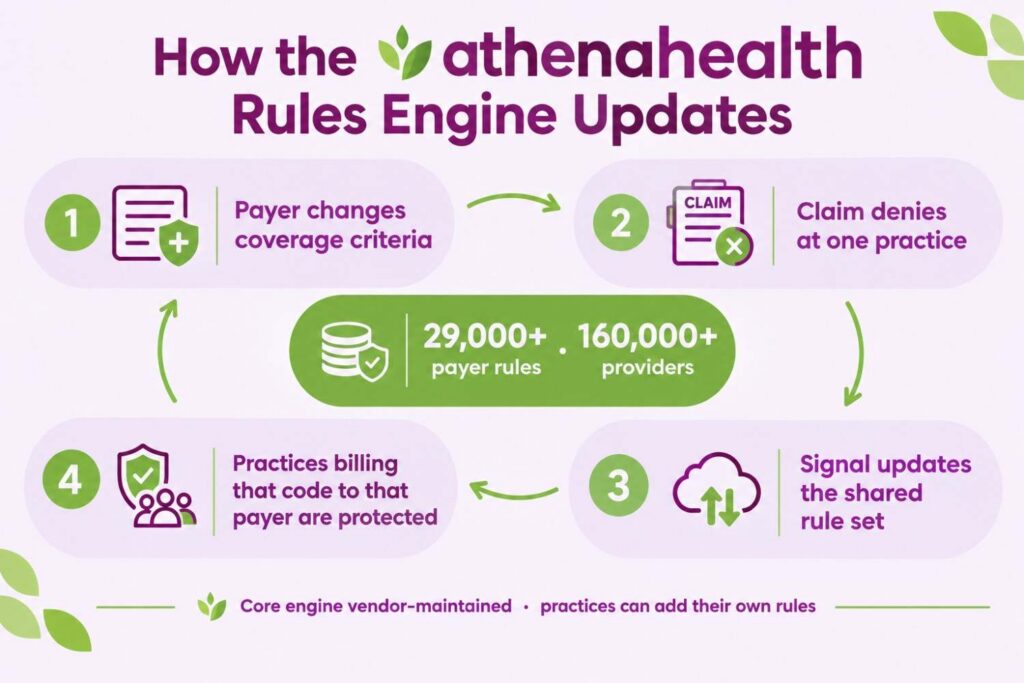
athenahealth billing runs through athenaCollector against a centrally maintained rules engine. The engine carries more than 29,000 payer rules and screens claims before submission.
athenahealth cites a 98.4% first-pass acceptance rate for claims processed through athenaOne. Network data from more than 160,000 providers feeds the engine’s rule updates.
How Does the Network Rules Engine Learn From Denials?
The engine updates from denial signals across every practice on the network. athenahealth spans more than 160,000 providers. A claim failure at one practice informs rule updates for others billing the same code to the same payer.
That mechanism is the platform’s defining feature. A payer changing coverage criteria for a procedure code generates a signal once, then propagates across the network. Static rule sets maintained practice by practice cannot reproduce that behavior. Workflow detail sits in the athenaOne billing workflow.
Who Configures the athenahealth Rules?
athenahealth maintains the core rules engine itself. Network-learned rules update centrally, without practice involvement. According to Business News Daily, practices can add their own rules where the engine misses a payer preference. Practices do not switch the vendor’s core rules on and off.
That model removes most rule-maintenance labor while limiting how far a practice reshapes the engine. Independent reviews flag subspecialty workflows needing granular modifier logic as a documented weak point.
Does athenahealth Include Coding?
athenahealth sells coding as a separate service rather than inside the core collections fee. athenaOne Medical Coding uses AAPC- or AHIMA-certified coders and targets a two-day turnaround. athenahealth reports 99.4% coding accuracy for the service. Practices coding internally use athenahealth’s Express Coding tools instead.
What Practice Size Does athenahealth Fit?
athenahealth fits solo practitioners through groups above 75 providers, with documented concentration between 11 and 75. athenahealth won five 2026 Best in KLAS awards. The five include Ambulatory EHR for independent practices at 11 to 75 physicians, a fifth straight win. athenahealth also won above 75 physicians for the first time.
Practice size overlaps almost entirely with AdvancedMD. Both platforms compete for the same independent ambulatory buyer.
Where Does athenahealth Perform Best?
athenahealth performs best in primary care, multi-site ambulatory groups, and value-based care arrangements. Standardized workflows and network benchmarking carry the most value where patient volume is high, and case complexity is moderate.
Documented weak spots run in the opposite direction. Complex hospital-based billing and subspecialty workflows requiring granular modifiers both underperform. Reviewers through 2025 and 2026 also flag click volume in charting and declining customer success manager quality.
Is athenahealth Suitable for Solo Practices?
athenahealth suits some solo practices, but its economics favor larger groups. A percentage model ties cost to collections, which helps during low-volume periods. Third-party reports of a minimum near $140 per provider monthly limit that benefits. Independent 2026 reviews argue the model works best from roughly 11 physicians upward.
Where Do AdvancedMD and athenahealth Overlap?
AdvancedMD and athenahealth overlap on practice segment and core revenue cycle function, and diverge on commercial model. Both serve independent ambulatory groups. Both capture charges from documentation, scrub claims, post remittances, and route denials.
The divergence is economic rather than functional.
What Do Both Platforms Do Equally Well?
Both platforms deliver six identical revenue cycle functions. Eligibility verification, documentation-driven charge capture, and pre-submission scrubbing come first. Electronic remittance posting, denial routing, and patient-side payment capture complete the set.
Both hold ONC certification. Both support specialty templates, patient portals, and reporting layers. Platform-specific breakdowns sit across the EMR software selection guides.
How Do the Two Scrubbing Engines Actually Differ?
The engines differ on who maintains the rules and who supplies the labor. The table below sets the two models against each other on the factors that move collections.
| Factor | AdvancedMD | athenahealth |
|---|---|---|
| Pricing structure | Published per-provider tiers | Percentage of collections, unpublished |
| Scrubbing engine | ClaimInspector | Network rules engine |
| Vendor-cited rule figures | Claims screened against ~3.5M edits; 119M in the Optum base | 29,000+ payer rules |
| Rule source | Optum, vendor-supplied | Denial signals across 160,000 providers |
| Who configures rules | The practice, edit by edit | athenahealth core engine; practices may add rules |
| Coding | Excluded from managed RCM | Sold separately as athenaOne Medical Coding |
| Practice size band | 2 to 50 providers | Solo to 75+ providers |
Rule configuration is the row that decides staffing. AdvancedMD hands a practice control and expects it to be used. athenahealth carries most of the task and narrows the option.
Why Do Both Managed Services Cost 4 to 8 Percent?
Both land at the same price because both bundle revenue cycle labor into a collections-based fee. AdvancedMD charges 4% to 8% for its managed service. Independent buyer guides place athenahealth in the same 4% to 8% band.
Coding is where the two models part. AdvancedMD’s managed service excludes coding entirely, so practices staff or contract coders separately. athenahealth sells coding as a separate service through athenaOne Medical Coding. The two models converge on price but not on coverage.
What Does Each Model Cost as Collections Grow?
Cost behavior separates the two platforms more than any feature comparison. A flat fee stays fixed while a percentage fee climbs. The gap between them widens as a practice collects more.
The comparison below models a 10-provider practice at four collection levels. Figures assume the AdvancedMD EHR and practice management tier at list price, and the midpoint of the reported athenahealth range.
How Does Flat-Fee Cost Behave at Scale?
Flat-fee cost tracks headcount rather than revenue. Ten providers on the $729 tier cost $87,480 annually in software. That number holds whether the practice collects $1 million or $6 million.
Billing labor sits outside that figure. A practice on flat-fee software staffs its own team, buys the 4% to 8% managed service, or contracts externally.
How Does Percentage-of-Collections Cost Behave at Scale?
Percentage cost tracks revenue rather than headcount. The same 10-provider practice pays 6% of whatever it collects, and that figure moves every month.
| Annual collections | AdvancedMD software | athenahealth at 6% | Difference |
|---|---|---|---|
| $1,000,000 | $87,480 | $60,000 | $27,480 more on AdvancedMD |
| $2,000,000 | $87,480 | $120,000 | $32,520 less on AdvancedMD |
| $4,000,000 | $87,480 | $240,000 | $152,520 less on AdvancedMD |
| $6,000,000 | $87,480 | $360,000 | $272,520 less on AdvancedMD |
Assumptions: 10 providers and EHR plus practice management at $729 list. The athenahealth rate uses 6%, the midpoint of the independently reported 4% to 8% range. Excludes implementation, add-on modules, and billing labor on the AdvancedMD side.
Where Does the Crossover Sit?
The crossover sits near $1.46 million in annual collections for a 10-provider practice. Below that figure, athenahealth costs less on an all-in basis. Above it, the flat-fee model frees a growing amount for billing labor.
The difference column is the real number to work with. At $2 million in collections, roughly $32,500 per year separates the two models, which covers part of a certified biller. At $4 million, the same gap funds a small team. Your own collections figure and provider count change the crossover, so rerun the model rather than adopting these inputs. Configuration and denial work on the flat-fee side is covered under AdvancedMD scrubbing configuration and denial work.
How Does Transcure Support Billing on AdvancedMD and athenahealth?
Certified coders and billers work inside the platform a practice already runs. That work runs under a business associate agreement executed per 45 CFR §164.502(e). No platform change is required, and patient data stays inside the existing environment.
The work splits along the configuration line. On AdvancedMD, default ClaimInspector rules get rebuilt against actual payer mix, edit by edit. On athenaOne, the core rules engine stays vendor-maintained. The work moves to documentation quality, coding accuracy, and denial follow-up inside existing worklists.
Coding sits outside both core fees. AdvancedMD’s managed service excludes it, and athenahealth sells it separately. AAPC-certified coders validate CPT, ICD-10, and HCPCS assignment against bundling edits and frequency limits before charges reach either scrubbing engine. Coverage spans more than 40 specialties across 1,100 certified staff, with billers inside the system within 14 days.
Denial and accounts receivable work follows the same pattern on both platforms. Root causes get traced by CARC and RARC code, and appeals file inside the platform rather than through external tools. Scope on the athenaOne side is set out under athenaOne claims and AR support.
Should a Practice Switch Platforms to Fix a Denial Problem?
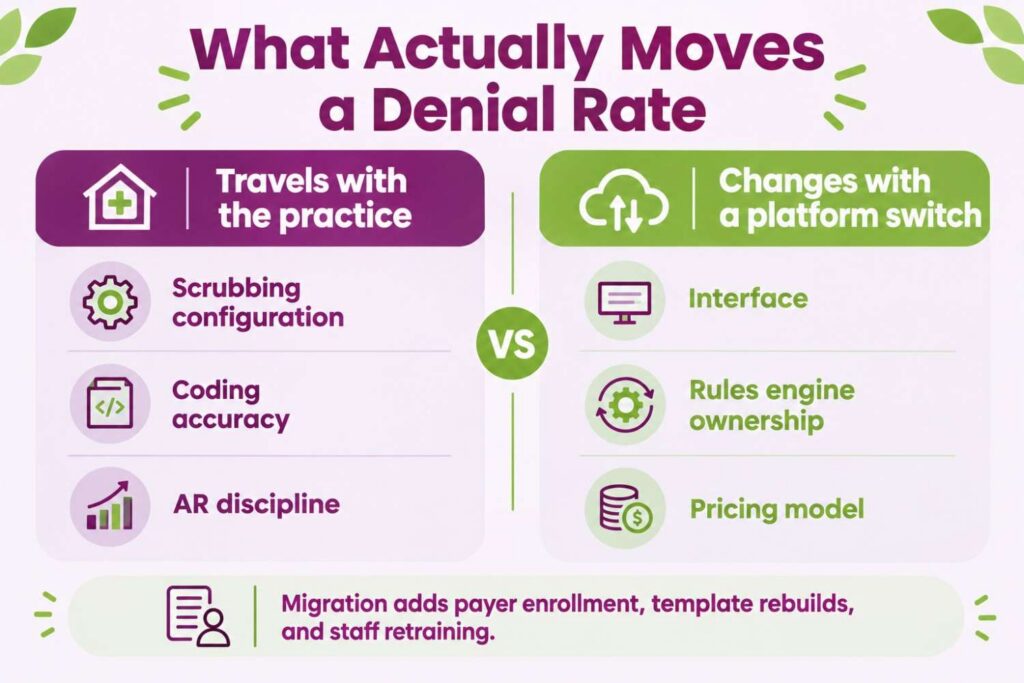
A practice should not switch platforms to fix a denial problem. Denial rates respond to configuration, coding accuracy, and accounts receivable discipline, not to platform choice. Those causes travel with the practice to any new platform.
Migration costs compound the problem. Payer enrollment, template rebuilds, and staff retraining all suppress collections during the transition. Diagnose the root cause on the current platform first. Switch only when the platform itself is the constraint.
Frequently Asked Questions
Which Platform Is Cheaper, AdvancedMD or athenahealth?
Neither platform is cheaper at every collections level. For a 10-provider practice, AdvancedMD costs less above roughly $1.46 million in annual collections. Flat-fee software does not scale with revenue. Below that level, the athenahealth percentage model costs less on an all-in basis.
Does athenahealth Include Medical Coding?
athenahealth sells medical coding as a separate service rather than inside the core collections fee. athenaOne Medical Coding uses AAPC- or AHIMA-certified coders. AdvancedMD’s managed revenue cycle service excludes coding entirely.
Can a Practice Configure the athenahealth Rules Engine?
A practice can add its own rules but does not control athenahealth’s core engine. athenahealth maintains that engine centrally and updates it from denial signals across more than 160,000 providers. AdvancedMD instead lets practices switch individual ClaimInspector edits on and off.
What Percentage Does athenahealth Charge?
Independent buyer guides place athenahealth between 4% and 8% of net collections. athenahealth publishes no fixed percentage on its own pricing pages. Larger groups often negotiate lower effective rates.
Which Platform Suits a Practice That Keeps Billing In-House?
AdvancedMD suits in-house billing teams willing to tune ClaimInspector edits against their own payer mix. athenahealth suits practices that want the vendor to carry rule maintenance and revenue cycle labor inside the collections fee. The tradeoff is control against workload.
How Long Does Implementation Take on Each Platform?
Buyer guides report roughly 11 weeks for new athenahealth practices, extending to 90 to 180 days from server-based systems. Large multispecialty groups run 6 to 9 months. AdvancedMD implementation timelines vary by module scope and provider count.
Which Platform Handles Subspecialty Billing Better?
AdvancedMD gives subspecialty practices more direct modifier control. Independent reviews flag granular modifier logic as a weak point for athenahealth. AdvancedMD allows edit-level configuration, though the practice supplies the labor.