Strep throat is a leading reason children visit pediatric offices, urgent care centers, and primary care practices. Every one of those visits ends with a claim, and ICD-10 code J02.0 anchors that claim. However, the diagnosis code alone does not secure payment. Payers compare J02.0 against the visit level, the rapid strep or culture test, the laboratory’s CLIA status, and the documented symptoms. Therefore, one mismatch triggers a denial, a payment delay, or a medical necessity review.
Moreover, pediatric billing adds age-based rules, shared-custody coverage, and well-child visit conflicts that adult coding guidance ignores. The sections below explain when to report J02.0, which CPT, HCPCS, and modifier combinations pair with it, and how to document each encounter. Furthermore, the guide maps the most common denial reasons to practical fixes. Use the guide below to build a coding workflow that holds up under payer review.

What Is ICD-10 Code J02.0 for Strep Throat?
ICD-10 code J02.0 represents streptococcal pharyngitis, a bacterial throat infection caused by streptococcal bacteria, most often Group A Streptococcus. The code sits in Chapter 10, Diseases of the Respiratory System, within the J00-J06 block of acute upper respiratory infections. Coders report J02.0 as a billable, fully specific diagnosis.
What Does the J02.0 Description Include?
The official title is Streptococcal pharyngitis. The ICD-10-CM index also routes the terms septic pharyngitis and streptococcal sore throat to J02.0. Therefore, a provider note that reads strep sore throat or septic pharyngitis leads to the same code. The parent category J02, Acute pharyngitis, is a header and cannot be billed.
Is J02.0 Valid for FY 2027 Claims?
J02.0 remains billable for dates of service from October 1, 2026 through September 30, 2027. The FY 2027 ICD-10-CM index still maps streptococcal pharyngitis to J02.0. However, the annual update adds, revises, and deletes codes in other chapters. Therefore, coders confirm the active code set version in the claim scrubber before submission.
The table below summarizes the key attributes of J02.0 for quick reference.
| Attribute | Detail |
|---|---|
| Code | J02.0 |
| Official Description | Streptococcal pharyngitis |
| Chapter | Chapter 10, Diseases of the Respiratory System |
| Block | J00-J06, Acute upper respiratory infections |
| Parent Category | J02, Acute pharyngitis (non-billable header) |
| Billable Status | Billable, most specific code in the J02 family |
| Index Terms | Septic pharyngitis; streptococcal sore throat |
| Sibling Codes | J02.8, J02.9 |
| FY 2027 Status | Billable for dates of service October 1, 2026 to September 30, 2027 |
J02.0 is a complete, claim-ready code. Consequently, coders do not append a fifth character or a separate organism code, because the organism is already part of the code title. Coders link J02.0 as the primary diagnosis to the E/M line and to the strep test line.
When Should Coders Use J02.0 Instead of J03.00, J02.9, or Scarlet Fever Codes?
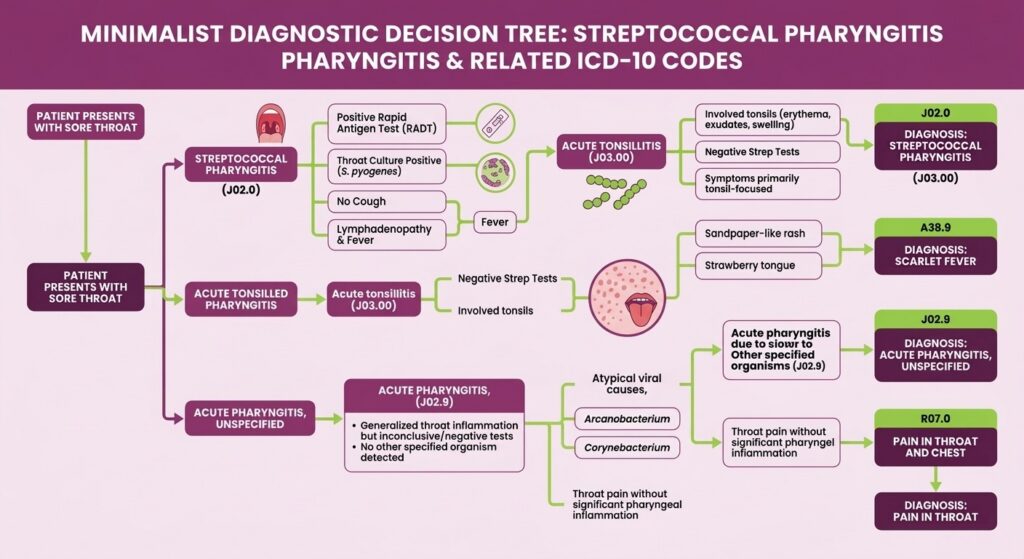
Coders report J02.0 when the provider documents streptococcal infection of the pharynx without tonsillitis or scarlet fever. The correct code depends on the anatomic site, the organism, and the documented rash. Therefore, the provider note drives code selection, and a laboratory result alone never does.
Does a Positive Rapid Strep Test Alone Support J02.0?
A positive rapid strep result alone does not support J02.0. The treating provider must document the diagnosis in the visit note. Moreover, Section IV.H of the ICD-10-CM Official Guidelines prohibits coding probable, suspected, or rule-out diagnoses in outpatient settings. Therefore, coders report symptom codes such as R07.0 until the provider confirms streptococcal pharyngitis.
How Do J02.0 and Neighboring Codes Differ?
The following table compares J02.0 with the six codes most often confused with it.
| Code | Description | Use When | Do Not Use When |
|---|---|---|---|
| J02.0 | Streptococcal pharyngitis | Provider documents strep pharyngitis or strep sore throat | Tonsillitis, scarlet fever, or an unconfirmed diagnosis is documented |
| J03.00 | Acute streptococcal tonsillitis, unspecified | Provider documents strep tonsillitis | Pharyngitis is the only documented site |
| J03.01 | Acute recurrent streptococcal tonsillitis | Provider documents recurrent strep tonsillitis | The note describes a single episode |
| J02.9 | Acute pharyngitis, unspecified | Provider documents pharyngitis with no organism | Strep is documented as the cause |
| J02.8 | Acute pharyngitis due to other specified organisms | Provider documents a non-strep organism | Streptococcus is the documented organism |
| A38.9 | Scarlet fever, uncomplicated | Provider documents scarlet fever with rash | Strep sore throat appears without scarlet fever |
| R07.0 | Pain in throat | Strep is unconfirmed or the test is pending | The provider has confirmed strep pharyngitis |
Scarlet fever deserves special attention. The ICD-10-CM tabular list carries an Excludes1 note at category A38 for streptococcal sore throat (J02.0). Therefore, coders do not report A38 codes and J02.0 together. Moreover, category J03, acute tonsillitis, carries the same exclusion. Consequently, the documented anatomic site decides between J02.0 and J03.00.
What Documentation Supports J02.0 in Pediatric Encounters?
Complete documentation supports J02.0 by proving the diagnosis, the test, and the treatment. Payer reviewers look for three record elements: clinical findings, test results, and the treatment plan. Therefore, each element requires a dated, signed entry in the visit note.
Which Clinical Findings Support a Strep Throat Diagnosis?
The modified Centor (McIsaac) score awards points for fever above 100.4 F, tonsillar swelling or exudate, tender anterior cervical nodes, absence of cough, and age 3 to 14 years. Pediatric notes also record headache, abdominal pain, vomiting, and a scarlatiniform rash. Therefore, documented findings link the diagnosis to the clinical picture.
Which Testing Details Must the Record Include?
The record lists the test type, specimen source, collection time, result, and ordering provider. Furthermore, the practice documents its CLIA certificate type for the testing site. Infectious Diseases Society of America guidance recommends a backup throat culture or molecular test after a negative rapid antigen result in children. Therefore, the note records every follow-up test.
Which Treatment Details Support the Claim?
The note records the antibiotic name, dose, route, and duration. For injections, the note adds the site, lot number, administering staff member, and total units. Moreover, the provider documents return-to-school guidance and follow-up instructions. Therefore, the record supports both the drug billing line and the medical necessity of the visit.
Which Related ICD-10 Codes Pair With J02.0?
J02.0 pairs with additional ICD-10 codes when the provider documents complications, exposures, or a visit type that changes the claim. However, coders do not report symptoms integral to strep throat, such as sore throat, separately. Therefore, only conditions beyond the routine disease process earn a secondary code.
The table below lists eight codes that commonly accompany J02.0 in pediatric records.
| Code | Description | Pairing Purpose |
|---|---|---|
| Z00.121 | Encounter for routine child health examination with abnormal findings | Well-child exam where strep throat is found |
| Z20.818 | Contact with and (suspected) exposure to other bacterial communicable diseases | Household or classroom strep exposure |
| Z86.19 | Personal history of other infectious and parasitic diseases | Prior strep infection relevant to current care |
| E86.0 | Dehydration | Poor oral intake from throat pain |
| H66.90 | Otitis media, unspecified, unspecified ear | Ear infection documented with strep throat |
| R56.00 | Simple febrile convulsions | Febrile seizure during a strep illness |
| J36 | Peritonsillar abscess | Suppurative complication of strep infection |
| I00 | Rheumatic fever without heart involvement | Post-streptococcal complication |
Secondary codes strengthen medical necessity for higher E/M levels. For example, dehydration (E86.0) supports added provider work during a visit. Moreover, complication codes such as J36 and I00 signal conditions that change the treatment plan. Therefore, coders sequence J02.0 first only when strep throat is the main reason for the encounter.
Which CPT Codes Apply to Strep Throat Visits?
Strep throat claims use two CPT code families: evaluation and management codes for the visit, and laboratory codes for the strep test. The provider’s documentation determines the E/M level. The test method determines the laboratory code. Therefore, each claim line needs its own diagnosis pointer to J02.0.
Which E/M Codes Report the Strep Throat Visit?
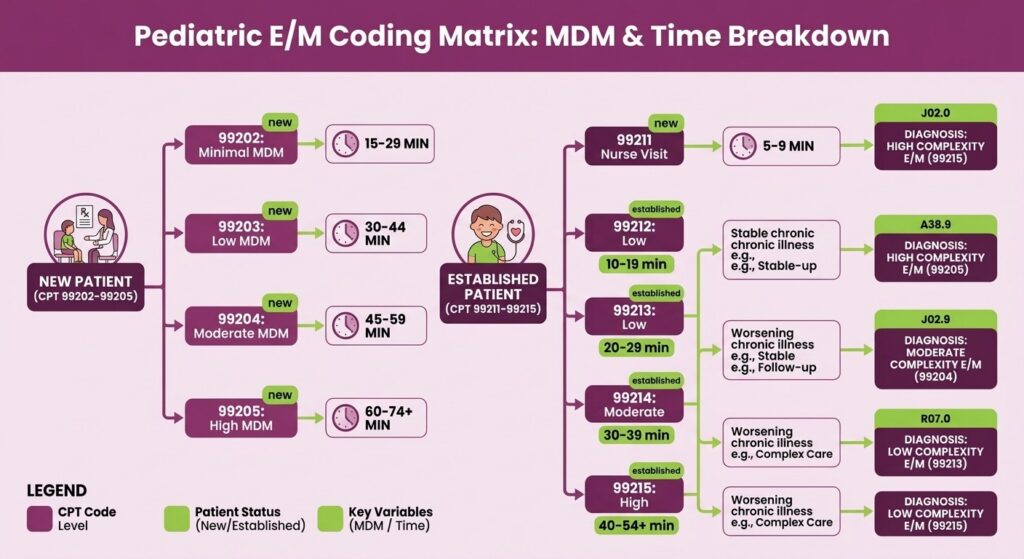
Office visit E/M codes 99202-99205 report new patients, and 99211-99215 report established patients. Providers select the level by medical decision making or total time on the date of the encounter. Uncomplicated strep throat visits for established patients typically fall between 99212 and 99214.
The table below shows the level criteria for each office visit code.
| CPT Code | Patient Status | MDM Level | Minimum Total Time |
|---|---|---|---|
| 99202 | New | Straightforward | 15 minutes |
| 99203 | New | Low | 30 minutes |
| 99204 | New | Moderate | 45 minutes |
| 99205 | New | High | 60 minutes |
| 99211 | Established | Minimal | Not time-based |
| 99212 | Established | Straightforward | 10 minutes |
| 99213 | Established | Low | 20 minutes |
| 99214 | Established | Moderate | 30 minutes |
| 99215 | Established | High | 40 minutes |
A strep throat visit with fever can qualify as an acute illness with systemic symptoms, a moderate problem element. Prescription drug management is a moderate risk element. Therefore, two moderate elements support 99214 when the note documents both. Without fever, an acute uncomplicated illness counts as a low problem element.
Which CPT Codes Report Strep Testing?
Strep testing CPT codes depend on the test method. Rapid antigen tests use 87880, culture uses 87070, and molecular tests use 87651. Moreover, the CLIA complexity of the test decides whether the QW modifier applies. Therefore, billing staff verify the kit’s CLIA category before assigning the code.
The table below compares the six laboratory codes used for Group A strep detection.
| CPT Code | Test Description | Typical Use | CLIA Note |
|---|---|---|---|
| 87880 | Group A strep antigen detection by immunoassay with direct optical observation | Point-of-care rapid strep test | Often CLIA-waived, so QW applies |
| 87430 | Group A strep antigen detection by immunoassay technique (EIA, ELISA, FIA) | Instrument-based immunoassay | Complexity depends on the analyzer |
| 87070 | Bacterial culture, other source, aerobic, with isolation and presumptive identification | Backup throat culture | Moderate complexity, no QW |
| 87081 | Culture, presumptive pathogenic organisms, screening only | Throat culture screen | Moderate complexity, no QW |
| 87650 | Group A strep nucleic acid detection, direct probe technique | Molecular direct probe test | Depends on the kit |
| 87651 | Group A strep nucleic acid detection, amplified probe technique | Molecular amplified test (NAAT) | Some kits are CLIA-waived, so confirm the kit |
The 87880 code covers the common point-of-care test. However, a negative rapid result followed by culture produces two laboratory lines for one visit. Therefore, billing staff link both lines to the same diagnosis and attach QW only to the waived test.
Which HCPCS Codes and Modifiers Apply to Strep Throat Claims?
Injectable antibiotic visits add a CPT administration code and a HCPCS drug code. Oral antibiotics generate no billing line. Modifiers then clarify the relationship between services on the same claim. Therefore, the correct combination prevents bundling denials and supports payment for each separately identifiable service.
Which Injection Codes Report Penicillin for Strep Throat?
A single intramuscular penicillin G benzathine injection treats strep throat when oral therapy is not practical. Practices report the administration with CPT 96372 and the drug with HCPCS J0561. Units follow the amount administered in 100,000-unit increments. For example, a 600,000-unit dose bills as 6 units.
The table below lists the injection and drug codes used for strep throat treatment.
| Code | Type | Descriptor | Billing Note |
|---|---|---|---|
| 96372 | CPT | Therapeutic, prophylactic, or diagnostic injection, subcutaneous or intramuscular | Add modifier 25 to the E/M when billed on the same day |
| J0561 | HCPCS | Injection, penicillin G benzathine, 100,000 units | Units equal the dose divided by 100,000 |
| J0558 | HCPCS | Injection, penicillin G benzathine and penicillin G procaine, 100,000 units | Same unit logic for the combination product |
Administration and drug lines always travel together. However, the E/M line needs modifier 25 only when the provider performs a significant, separately identifiable service. Moreover, many Medicaid programs require the National Drug Code on drug lines. Therefore, charge capture rules attach the NDC automatically.
Which Modifiers Apply to Strep Throat Claims?
Four modifiers apply to pediatric strep throat claims in common scenarios. Each modifier answers a specific payer edit. Therefore, billing teams map modifiers to claim scenarios in the charge master rather than relying on provider memory at the point of care.
The table below defines each modifier and its strep throat use.
| Modifier | Name | Strep Throat Use |
|---|---|---|
| 25 | Significant, separately identifiable E/M service | E/M billed with 96372 or with a preventive visit on the same day |
| QW | CLIA-waived test | Appended to 87880 or another waived strep test |
| 95 | Synchronous telemedicine service | E/M delivered by real-time audio and video |
| EP | Medicaid EPSDT service | Required by some state Medicaid programs on EPSDT visits |
Modifier 25 draws the most audit attention of the four. Therefore, the note must show evaluation work beyond the routine pre-injection assessment. Moreover, payers apply modifier 25 edits differently, so billing teams confirm each payer’s policy before submission. Consequently, a documented history, examination, and medical decision making protect the separate E/M payment.
How Do Pediatric-Specific Rules Affect Strep Throat Billing?
Pediatric billing differs from adult billing in age-based testing rules, preventive visit overlap, dual-coverage logistics, and Medicaid requirements. Moreover, these differences create denial risk on strep throat claims. Therefore, front-desk, clinical, and billing teams share the same pediatric rule set. Each rule below addresses one common pediatric claim problem.
How Does Patient Age Affect Strep Testing and Coverage?
Streptococcal pharyngitis is most common in children aged 5 to 15 years and uncommon in children under 3 years. Clinical guidelines therefore advise against routine strep testing in children under 3 unless risk factors exist. Consequently, payers can question testing claims for toddlers. The note documents the exposure or risk factor that justified the test.
How Do Providers Code a Strep Throat Visit During a Well-Child Exam?
A well-child exam and a sick visit for strep throat can share one date of service. Providers report the preventive code, 99391-99394 for established patients, and the problem-oriented E/M with modifier 25. Moreover, Z00.121 leads the preventive line, and J02.0 links to the sick visit line. Therefore, the note shows separate documentation for each service.
How Does Coordination of Benefits Work for Children With Two Insurance Plans?
Children covered by both parents’ plans trigger coordination of benefits rules. The birthday rule names the plan of the parent whose birthday falls earlier in the calendar year as primary. However, a court order for divorced parents overrides the birthday rule. Therefore, front-desk staff verify both plans and the custody arrangement at check-in.
How Does Telehealth Change Strep Throat Billing?
Telehealth visits evaluate strep throat symptoms, but a rapid test requires specimen collection in person. Therefore, a video visit without a confirmed diagnosis supports a symptom code such as R07.0 rather than J02.0. Moreover, payers set their own modifier and place of service rules, commonly modifier 95 with place of service 02 or 10.
How Do Payers Evaluate Medical Necessity for J02.0 Claims?
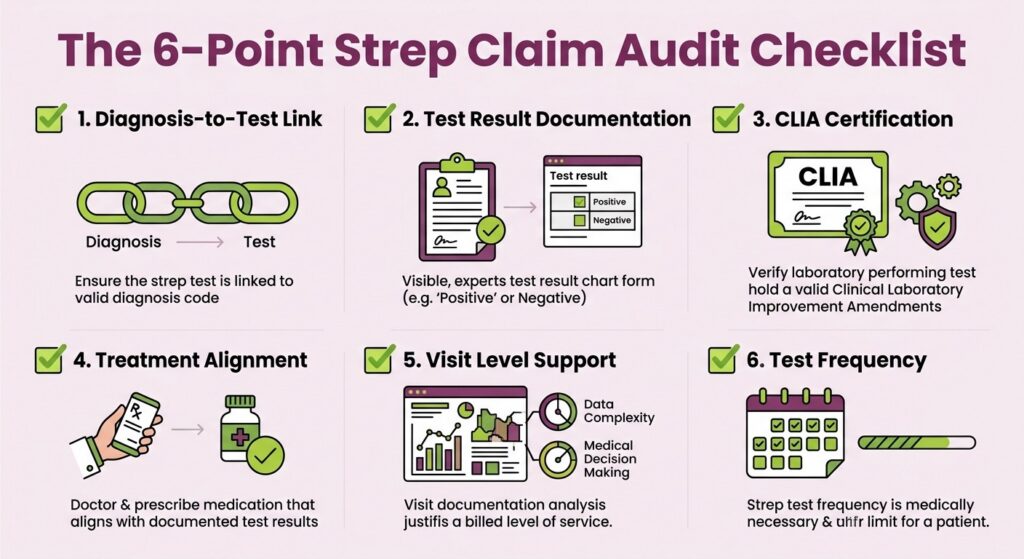
Payers evaluate medical necessity by matching the diagnosis, the test, the treatment, and the visit level. A claim passes review when every line supports the same clinical picture. Therefore, a mismatch on any line triggers a denial or a records request.
The table below lists six checkpoints that payer edits apply to strep throat claims.
| Checkpoint | Payer Expectation | Claim Element |
|---|---|---|
| Diagnosis-to-Test Link | The strep test links to J02.0 or a documented symptom code | Diagnosis pointer |
| Test Result Documentation | The note records the result with date and method | Laboratory line support |
| CLIA Certification | A valid CLIA number appears on the claim for laboratory services | CMS-1500 Item 23 or 837P Loop 2300 REF |
| Treatment Alignment | The drug and route match the documented plan | Drug and administration lines |
| Visit Level Support | MDM or time supports the E/M level | E/M line |
| Test Frequency | The same test is not repeated without a clinical reason | Laboratory line |
Each checkpoint maps to a specific claim field, which makes pre-submission scrubbing practical. Moreover, practices that build these six checks into the claim scrubber catch errors before the payer does. Consequently, first-pass acceptance rises and rework falls. Laboratory lines carry strict edits because CLIA status controls payment.
What Are the Most Common J02.0 Claim Denials and How Are They Fixed?
Eight denial reasons recur on strep throat claims. Each has a claim adjustment reason code (CARC) and a direct fix. Therefore, billing teams track these eight reasons in denial reports and correct root causes in charge capture. Moreover, root cause fixes prevent repeat denials, while resubmission alone recovers only one claim.
The table below pairs each denial reason with its CARC, cause, and fix.
| Denial Reason | CARC | Typical Cause | Fix |
|---|---|---|---|
| Not medically necessary | 50 | Test linked to an unsupported diagnosis, or J02.0 billed with unconfirmed strep | Correct the diagnosis link, add documentation, and appeal with the visit note |
| Missing information | 16 | CLIA number or NDC absent from the claim | Add the missing field and resubmit |
| Modifier inconsistent or missing | 4 | QW missing on a waived test | Append the modifier and send a corrected claim |
| Bundled service | 97 | E/M billed with an injection and no modifier 25 | Add modifier 25 with supporting documentation |
| Diagnosis inconsistent with procedure | 11 | Test line points to an unrelated diagnosis | Correct the diagnosis pointer |
| Duplicate claim | 18 | Claim resubmitted while the original is pending | Check claim status before resubmitting |
| Timely filing | 29 | Claim held for a culture result past the deadline | Track payer deadlines and set a maximum hold period |
| Coordination of benefits | 22 | Wrong primary plan billed for a child | Verify the birthday rule or court order and bill the correct primary |
Most of these denials trace to errors at charge entry. Therefore, front-end edits prevent more denials than back-end appeals recover. Moreover, a medical necessity appeal attaches the visit note, the test result, and the documented clinical findings. Consequently, the appeal answers the payer’s exact objection.
What Does a Correctly Coded Strep Throat Claim Look Like?
A correctly coded claim links every line to the right diagnosis and attaches the right modifier. The four scenarios below show common pediatric strep throat visits. Therefore, billing teams use them as training examples for new coders. Each scenario assumes the provider documents the diagnosis and the payer follows standard CPT guidance.
The table below presents four scenarios with their code sets.
| Scenario | ICD-10-CM | CPT and HCPCS | Modifiers |
|---|---|---|---|
| Established child, positive rapid test, oral antibiotic | J02.0 | 99213 or 99214; 87880 | QW on 87880 |
| Established child, negative rapid test, culture sent, provider documents acute pharyngitis | J02.9, or J02.0 once the culture result is documented | 99213; 87880; 87070 | QW on 87880 |
| Established child, positive rapid test, intramuscular benzathine penicillin 600,000 units | J02.0 | 99213 or 99214; 87880; 96372; J0561 x 6 units | 25 on the E/M; QW on 87880 |
| Established child, well-child exam plus strep throat | Z00.121, J02.0 | 99393 or 99394; 99213; 87880 | 25 on 99213; QW on 87880 |
Scenario 2 shows why timing matters. Some practices hold the claim until the culture result returns, while others bill the diagnosis documented at the visit. However, every practice stays inside the payer’s timely filing limit. Therefore, the practice policy names a maximum hold period.
Which Billing Best Practices Protect Strep Throat Revenue?
Strep throat is a high-volume, low-complexity visit, so small errors repeat across every claim of that type. Best practices therefore target charge capture, claim scrubbing, and code update management. Moreover, each practice below reduces denials at the source instead of correcting them after payment delays.
How Should Practices Build Strep Throat Charge Capture Rules?
Charge capture rules turn a clinical event into the correct claim lines. A strep throat template links J02.0 to the E/M and test lines, adds QW to waived tests, and prompts for modifier 25 when an injection is selected. Therefore, the provider makes clinical choices and the system applies the coding logic.
How Should Practices Audit Strep Throat Claims?
Monthly audits of a sample of strep throat claims reveal pattern errors early. Auditors compare the note, the diagnosis, the E/M level, and the modifiers on each claim. Moreover, they track denial rates for 87880 and 96372 lines separately. Therefore, the audit identifies the workflow step that produces each error.
How Should Practices Handle Annual ICD-10 and CPT Updates?
ICD-10-CM updates take effect every October 1, and CPT updates take effect every January 1. Practices update templates, superbills, and clinical decision support before each effective date. Moreover, a post-update denial review in the first 60 days catches missed changes. Consequently, J02.0 claims stay clean through every code year.
Frequently Asked Questions About Strep Throat ICD-10 Billing
What Is the ICD-10 Code for Strep Throat?
The ICD-10-CM code for strep throat is J02.0, streptococcal pharyngitis. J02.0 is a billable code valid for FY 2027 dates of service. Providers use it when the diagnosis is documented as streptococcal pharyngitis, strep sore throat, or septic pharyngitis.
Can Providers Bill J02.0 After a Negative Rapid Strep Test?
Providers can bill J02.0 after a negative rapid strep test only when the provider documents a confirmed diagnosis, such as a positive backup culture. Otherwise, coders report the documented symptoms or J02.9. Outpatient coding rules prohibit reporting suspected or probable diagnoses.
Which CPT Code Reports a Rapid Strep Test?
CPT 87880 reports a rapid Group A strep antigen test. Practices append modifier QW when the test kit holds a CLIA waiver. Culture uses 87070, and molecular testing uses 87651.
Does a Strep Throat Visit Need Modifier 25?
A strep throat E/M needs modifier 25 when the provider also bills a procedure such as an injection (96372) or a preventive visit on the same date. The rapid strep test alone does not require modifier 25 on most claims, although some payers apply their own edits.
What Is the Difference Between J02.0 and J03.00?
J02.0 reports streptococcal infection of the pharynx, while J03.00 reports acute streptococcal tonsillitis. The documented anatomic site decides between the two codes. Excludes1 notes prevent reporting both codes together for the same condition.
How Long Do Practices Have to File Strep Throat Claims?
Filing limits depend on the payer. Medicare allows 12 months from the date of service, while commercial and Medicaid plans set their own windows, commonly between 90 days and 12 months. Practices confirm the limit in each payer contract.
Does J02.0 Require an Additional Organism Code?
J02.0 does not require an additional organism code because the code title already names the streptococcal organism. Coders report J02.0 alone to identify strep pharyngitis and add secondary codes only for complications or exposures.