Pennsylvania relies on the federal No Surprises Act for surprise billing. The state adds its own rules on prompt pay, retroactive denials, prior authorization, auto and workers’ compensation billing, Medical Assistance claims, privacy, and debt collection.
Pennsylvania medical billing laws are a layered set of state statutes, regulations, and federal rules. They govern how providers bill insurers and patients. They also control how fast payers must pay and how far back payers can recover money.
The stakes for your practice are measurable. A Pennsylvania Senate memo reports that 10.5% of Pennsylvanians carry nearly $1.8 billion in outstanding medical debt. Enforcement is active too. A federal report ranked Pennsylvania’s Medicaid Fraud Control Unit first among states for criminal convictions.
Pennsylvania does not have one broad billing act. The state regulates billing through targeted statutes instead. This guide covers each statute, the deadlines it sets, and the steps that keep your practice compliant.

How Do Surprise Billing Protections Work in Pennsylvania?
Surprise billing protections in Pennsylvania come from the federal No Surprises Act, not a standalone state statute. The Pennsylvania Insurance Department (PID) coordinates the federal law for Pennsylvania patients and accepts balance billing complaints.
Does Pennsylvania Have Its Own Surprise Billing Law?
Pennsylvania has no separate surprise billing statute. Florida is different: Florida’s state-level billing statutes run alongside the federal law. Pennsylvania adds narrower protections instead.
Three Pennsylvania rules reinforce the federal protections:
- Emergency claims: managed care plans, including HMOs and gatekeeper PPOs, cannot deny claims for emergency services.
- No prior authorization for emergencies: emergency care cannot require prior authorization.
- No recoding: an emergency claim cannot be recoded as non-emergency based on the diagnosis code.
Which Services Does the No Surprises Act Protect?
The No Surprises Act protects patients in two situations:
- Emergency care at a hospital, hospital outpatient department, ambulatory surgical center, or by air ambulance.
- Non-emergency care from out-of-network providers working inside an in-network facility.
For the second group, the protected specialties are emergency medicine, anesthesia, pathology, radiology, laboratory, neonatology, assistant surgeons, hospitalists, and intensivists. These providers can bill only in-network cost sharing, and they cannot ask patients to waive the protection. Your practice needs Pennsylvania medical billing services that flag these specialty claims before submission.
Which Patients and Services Fall Outside These Protections?
Medicare, Medicaid, Indian Health Services, VA, and TRICARE patients fall outside the No Surprises Act. Those programs already prohibit balance billing under their own rules.
Ground ambulance services are also outside the Act. That leaves a gap for out-of-network ambulance bills in Pennsylvania.
What Are the Good Faith Estimate Rules in Pennsylvania?
Good Faith Estimate rules in Pennsylvania are federal. Providers must give uninsured and self-pay patients a written estimate of expected charges. The deadline depends on scheduling:
| Scheduling Scenario | Good Faith Estimate Deadline |
|---|---|
| Service scheduled 3 or more business days out | Within 1 business day of scheduling |
| Service scheduled 10 or more business days out | Within 3 business days of scheduling |
| Patient requests an estimate without scheduling | Within 3 business days of the request |
A patient can dispute any bill that exceeds the estimate by $400 or more. Patients with questions can call the PID at 1-877-881-6388.
When Does Pennsylvania Law Ban Balance Billing Outright?
Pennsylvania bans balance billing in three coverage types beyond the No Surprises Act: auto accident injuries, workers’ compensation, and Medical Assistance. Each ban has its own statute and payment rules.
What Are the Billing Limits for Auto Accident Injuries?
The Motor Vehicle Financial Responsibility Law, known as Act 6, sets strict limits in 75 Pa.C.S. § 1797. Providers cannot request or accept more than 110% of the applicable Medicare allowance. If the provider’s usual charge is lower, the usual charge applies.
Where Medicare has no rate for a service, payment cannot exceed 80% of the provider’s usual and customary charge. Act 6 claims follow these rules:
- Bill the insurer: send the claim to the auto insurer, not the injured patient.
- Accept payment in full: the insurer’s payment ends the patient’s liability.
- Collect interest after peer review: when a peer review organization finds treatment reasonable and necessary, the insurer owes 12% annual interest on the withheld amount.
- Bill the patient only after exhaustion: once policy medical benefits run out, the provider can bill the patient or a secondary insurer.
Can Providers Bill Injured Workers in Pennsylvania?
Providers cannot bill injured workers in Pennsylvania for covered treatment. Under 34 Pa. Code § 127.21, a provider cannot bill the employee for the difference between its charge and the insurer’s payment. Act 44 of 1993 created this ban.
Payers have 30 days to process a properly billed claim once they receive the LIBC-9 medical report. The fee schedule for Part B providers uses the 1994 Medicare Fee Schedule as its base.
A provider can dispute payment by filing an Application for Fee Review through the state’s workers’ compensation system (WCAIS). The filing deadline is 90 days from the original billing or 30 days from the dispute notice, whichever is later.
What Does Payment in Full Mean for Medical Assistance Patients?
Payment in full means the Medical Assistance payment plus any required copay is the provider’s total reimbursement for a covered service. The rule sits in 55 Pa. Code § 1101.63(a).
A provider who accepts any extra payment for a covered service must return it. The following table compares balance billing rules across Pennsylvania coverage types:
| Coverage Type | Governing Law | What Providers Can Collect | Who Receives the Bill |
|---|---|---|---|
| Commercial (emergency and in-network facility care) | Federal No Surprises Act | In-network cost sharing only | Health plan |
| Auto accident injury | 75 Pa.C.S. § 1797 (Act 6) | Up to 110% of Medicare allowance | Auto insurer |
| Workers’ compensation | 34 Pa. Code § 127.21 | Fee schedule amount | Employer or insurer |
| Medical Assistance | 55 Pa. Code § 1101.63 | Payment plus required copay | Department or managed care plan |
Commercial surprise billing is the only category where federal law does the work. The other three bans come from Pennsylvania statutes and regulations.
What Is the Statute of Limitations on Medical Bills in Pennsylvania?
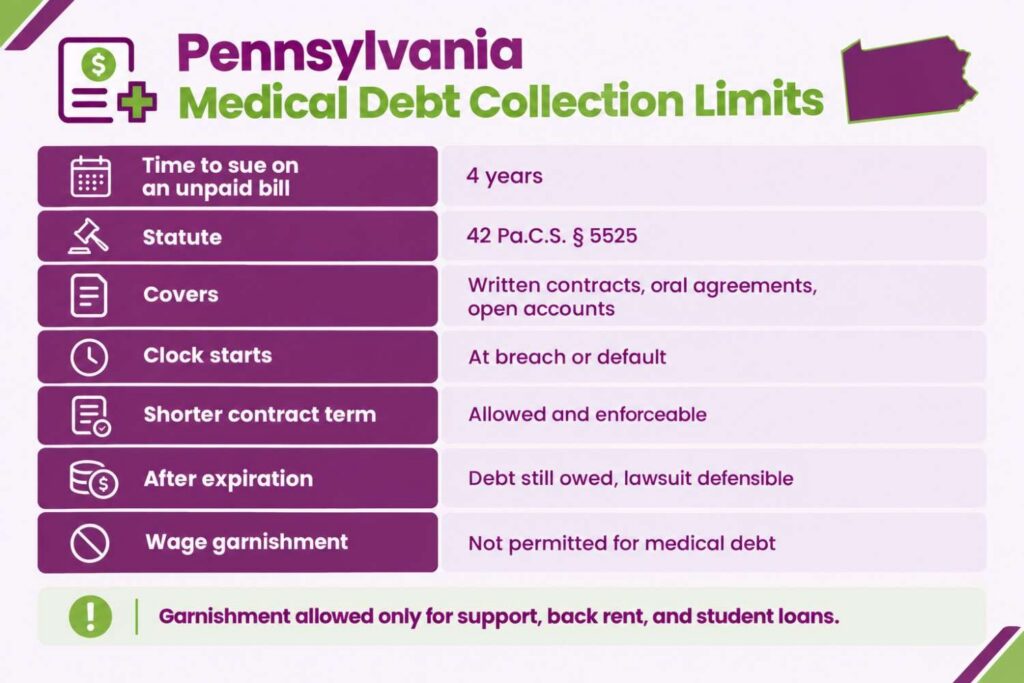
The statute of limitations on medical bills in Pennsylvania is 4 years under 42 Pa.C.S. § 5525. The same 4-year window covers written contracts, oral agreements, and open accounts.
How Long Does a Provider Have to Sue Over an Unpaid Bill?
A provider has 4 years to sue over an unpaid medical bill in Pennsylvania. The clock generally starts at breach or default. A contract can set a shorter limitations period, and a shorter contractual period can bind both parties.
Review the collection terms in your practice’s financial policy against this rule. A shorter contractual period shrinks your collection window without any change in the statute.
What Happens When the Limitations Period Expires?
The patient still owes the debt after 4 years, but the provider loses the right to win a lawsuit. Expiration is an affirmative defense only. The patient must raise it, and no Pennsylvania statute stops a collector from filing suit anyway.
Pending House Bill 1731 would add a separate 3-year limit for consumer debt lawsuits. The House Judiciary Committee reported the bill on June 17, 2026, and it has not passed either chamber.
Can a Provider Garnish a Patient’s Wages in Pennsylvania?
Medical providers cannot garnish a patient’s wages in Pennsylvania. State law allows wage garnishment only for specific debts:
- Child and spousal support
- Back rent on a residential lease
- Student loans
- Other narrow categories named in 42 Pa.C.S. § 8127
Hospitals and other medical creditors with a court judgment still cannot reach a patient’s paycheck. Collection strategy for your practice has to account for this limit.
Can Family Members Be Held Liable for Medical Bills in Pennsylvania?
Family members can be held liable for medical bills in Pennsylvania. The filial support law, 23 Pa.C.S. § 4603, makes a spouse, child, or parent with enough financial ability responsible for an indigent relative’s care. Providers have used the law to recover unpaid nursing home bills in court.
How Have Pennsylvania Courts Applied the Filial Support Law?
Two cases define how providers use the law:
- Health Care & Retirement Corp. v. Pittas (Pa. Super. 2012): the court held a son liable for his mother’s $93,000 nursing home bill. He had net income above $85,000 and could not show inability to pay.
- Melmark, Inc. v. Schutt (Pa. 2019): the Pennsylvania Supreme Court applied the law to New Jersey parents for care given to their adult son in Pennsylvania.
Pittas also held that a provider can pursue one responsible relative without first pursuing other payment sources.
Is Filial Support Reform Pending in Pennsylvania?
House Bill 2094 passed the House unanimously in October 2024. It would have limited relative liability to asset transfers within 5 years or refusal to cooperate with the Medical Assistance process. The bill died when the 2023 to 2024 session ended.
The same sponsor reintroduced relative liability changes as House Bill 65. The bill went to the House Health Committee on January 10, 2025, with no further action.
What Are Pennsylvania’s Prompt Pay Rules for Health Insurers?
Pennsylvania’s prompt pay law, Act 68 of 1998, requires insurers and managed care plans to pay clean claims within 45 days of receipt. The rule appears in 31 Pa. Code § 154.18. It applies to health insurance only, not auto or workers’ compensation.
How Quickly Must Insurers Pay Clean Claims?
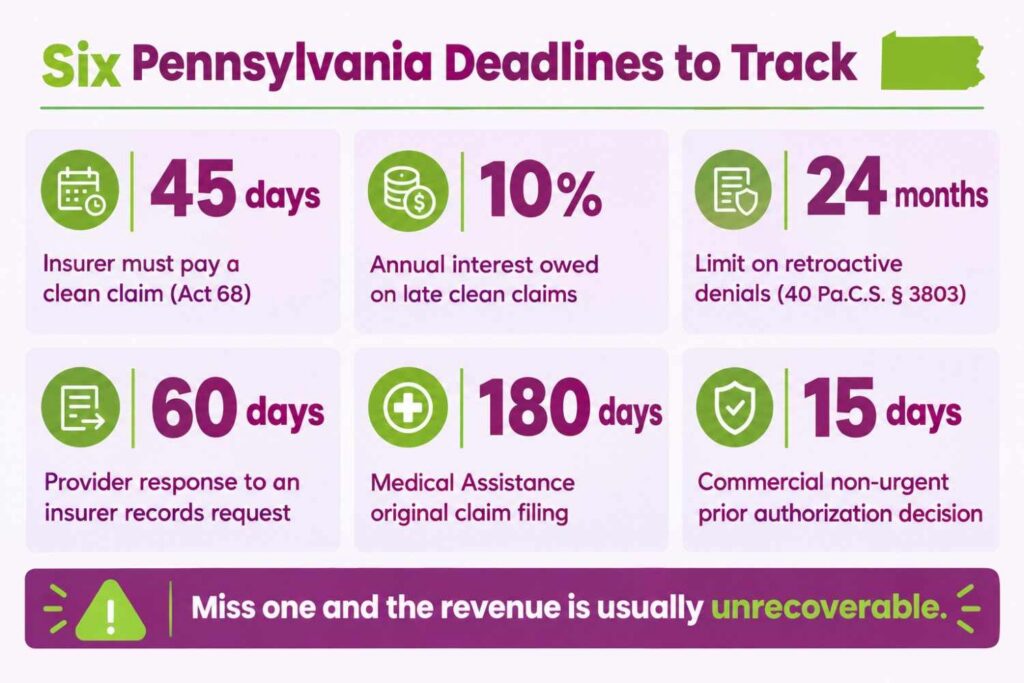
Insurers must pay clean claims, and the uncontested portions of contested claims, within 45 days. Late clean claims carry a 10% interest penalty under Act 68.
Interest payment follows three rules:
- Timing: the insurer pays interest within 30 days of paying the claim.
- Minimum: interest under $2 on a single claim does not have to be paid.
- Format: interest can come on the claim check or a separate check that itemizes each claim.
The following table summarizes the Pennsylvania payer deadlines that affect your practice’s cash flow:
| Deadline | Rule | Source |
|---|---|---|
| 45 days | Pay clean claims and uncontested portions | 31 Pa. Code § 154.18 |
| 30 days | Pay interest owed on late clean claims | 31 Pa. Code § 154.18 |
| 24 months | Latest retroactive denial after initial payment | 40 Pa.C.S. § 3803 |
| 12 months | Rebill the correct payer after a coordination of benefits denial | 40 Pa.C.S. Chapter 38 |
| 60 days | Provider response to an insurer records request | 40 Pa.C.S. Chapter 38 |
The 45-day and 24-month deadlines carry the most revenue risk. Track both in your practice’s claim follow-up queue.
What Makes a Claim Clean Under Act 68?
A clean claim is a claim for a health care service with no defect or impropriety. Missing supporting documentation makes a claim unclean. So does any circumstance that requires special treatment and blocks timely payment.
How Long Can Insurers Take Back Payments in Pennsylvania?
Insurers cannot retroactively deny payment more than 24 months after first paying the provider. Act 146 of 2016 created this cap in 40 Pa.C.S. § 3803. The insurer must also apply the coding guidelines in effect on the date of service and give a written statement explaining the denial.
The 24-month cap does not apply in four situations:
- Fraud, waste, or abuse
- Duplicate claims
- Denials required by a federal or state government plan
- Coordination of benefits with another insurer, Medical Assistance, or Medicare
After a coordination of benefits denial, the provider has 12 months to bill the correct payer. When an insurer requests records, the provider has 60 days to respond, and that time is added to the 24-month window. Do not confuse Act 146 of 2016 with the prior authorization law, which is Act 146 of 2022.
Can Insurers Force Virtual Credit Card Payments?
Insurers cannot force Pennsylvania providers to accept virtual credit card payments. Act 58 of 2024 bars insurers from limiting reimbursement to electronic credit cards. Insurers must offer providers a choice of payment methods, so your practice can avoid card processing fees.
Recoupment tracking and payment method elections both demand clean records. Many practices compare top medical billing companies in Pennsylvania on how each one handles retroactive denials.
How Does Act 146 Change Prior Authorization in Pennsylvania?
Act 146 of 2022 sets deadlines and review standards for prior authorization in Pennsylvania. The law applies to Pennsylvania-regulated insurers, Medical Assistance, and the Children’s Health Insurance Program (CHIP). All provisions have been in effect since January 1, 2024.
Which Plans Must Follow Act 146?
Act 146 covers commercial insurers regulated by Pennsylvania, Medical Assistance managed care plans, and CHIP plans. Each regulated plan must:
- Maintain a provider portal for electronic prior authorization submissions.
- Publish a public list of services that require prior authorization.
- Use qualified reviewers, meaning a licensed provider in the same or a similar specialty, before any denial.
Plans had 18 months from January 1, 2023, to launch their provider portals.
What Are the Prior Authorization Decision Deadlines?
Act 146 decision deadlines depend on plan type and urgency. The following table lists each deadline:
| Request Type | Decision Deadline |
|---|---|
| Medical Assistance or CHIP request | 2 business days after receiving all needed information |
| Commercial urgent service | 72 hours after submission |
| Commercial ongoing urgent service (request at least 24 hours before reduction) | 24 hours |
| Commercial non-urgent service | 15 days after submission |
| Urgent prescription drug or step therapy request | 24 hours |
| Other prescription drug or step therapy request | 2 business days, no more than 72 hours |
The 15-day non-urgent window matters most for scheduled procedures. Submit requests early enough that the full window fits before the service date.
What Other Protections Does Act 146 Give Providers?
Act 146 adds three more protections:
- Emergency care: no prior authorization for emergency services.
- Step therapy: patients and physicians can request exceptions to fail-first requirements.
- External review: PID now has authority over external reviews of benefit determinations.
Providers and patients can file Act 146 complaints with PID. Front-end patient benefits and eligibility verification catches authorization requirements before your practice schedules the service.
What Are the Pennsylvania Medical Assistance Billing Requirements?
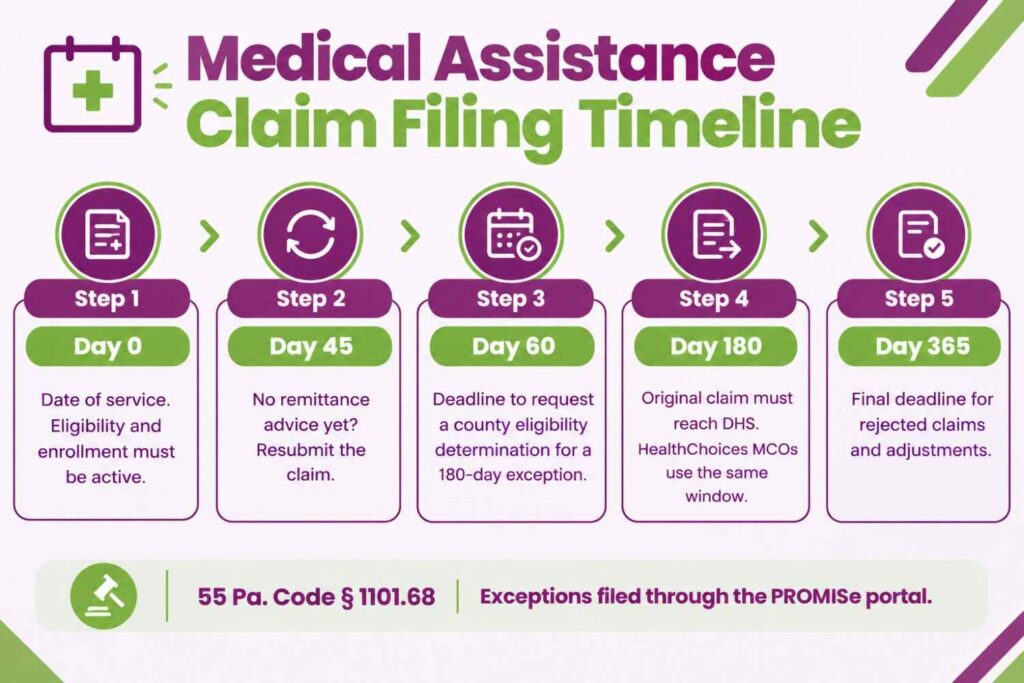
Pennsylvania Medical Assistance requires original claims within 180 days of the date of service and resubmissions within 365 days. The Department of Human Services (DHS) sets these rules in 55 Pa. Code § 1101.68.
What Are the Medical Assistance Claim Filing Deadlines?
Original claims must reach DHS within 180 days after the service date. Rejected claims and adjustments must reach DHS within 365 days. A claim missing from the remittance advice 45 days after submission has to be resubmitted.
DHS grants 180-day exceptions only for listed reasons. One example: the provider requested an eligibility determination from the county assistance office within 60 days of service. Providers can now request exceptions electronically through the PROMISe portal.
How Do HealthChoices Managed Care Claims Differ?
HealthChoices is Pennsylvania’s Medicaid managed care program. HealthChoices managed care organizations (MCOs) require claims within 180 days of service and usually pay within 30 days.
Exact payment terms come from each MCO’s provider agreement. For fee-for-service Medicaid, federal rules require DHS to pay 90% of clean claims within 30 days of receipt.
Can Providers Collect Copays From Medical Assistance Patients?
Providers can collect copays from Medical Assistance patients, but they cannot deny covered care because a patient cannot pay. The patient still owes the copay, and the provider can still try to collect it under 55 Pa. Code § 1101.63(b).
Two other billing rules apply:
- Non-covered services: bill the patient only if the patient was told before the service that Medical Assistance does not cover it.
- Enrollment gaps: keep enrollment current, because DHS does not pay for services after a provider’s termination date.
Gaps in enrollment cost your practice unbillable visits. Specialist medical credentialing services keep enrollments and revalidations on schedule.
What Are the Penalties for Medical Assistance Billing Fraud?
Medical Assistance fraud carries criminal penalties under 55 Pa. Code § 1101.76. The regulation lists these prohibited acts in § 1101.75:
- Presenting false or fraudulent claims
- Billing medically unnecessary services
- Submitting false information to obtain higher payment
- Submitting duplicate claims
- Billing services never rendered
A first conviction is a third-degree felony with a maximum $15,000 fine and 7 years in prison per violation. A repeat offense is a second-degree felony with a maximum $25,000 fine and 10 years. Convicted providers repay excess payments with interest, face up to triple damages, and lose program eligibility for 5 years.
Pennsylvania has no state False Claims Act. House Bill 1697 passed the House 136 to 67 on July 9, 2025, and the Senate version, Senate Bill 38, is pending in committee.
How Do HIPAA and Pennsylvania Privacy Laws Affect Medical Billing?
HIPAA sets the federal baseline for billing data in Pennsylvania. The state adds stricter rules for HIV information, specific rules for mental health and substance use records, and its own breach notification law.
Where Is Pennsylvania Stricter Than HIPAA?
Pennsylvania’s Confidentiality of HIV-Related Information Act, known as Act 148, is stricter than HIPAA. Providers cannot share HIV-related information without the patient’s written permission, except in limited cases. Billing staff must segregate HIV-related records and apply consent checks before any release.
How Did Acts 32 and 33 of 2022 Change Behavioral Health Records?
Acts 32 and 33 of 2022 took effect July 7, 2022. Act 32 amended the Mental Health Procedures Act. Act 33 amended the Drug and Alcohol Abuse and Control Act.
Both acts allow providers and insurers to share records in line with HIPAA. Some older regulations still conflict with the new law, including 4 Pa. Code § 255.5. Confirm your release workflow follows the amended statutes.
What HIPAA Penalties Apply to Pennsylvania Providers?
Federal HIPAA civil penalties follow the inflation adjustment effective January 28, 2026:
| Penalty Element | Amount |
|---|---|
| Minimum per violation (did not know) | $145 |
| Maximum per violation (lower three tiers) | $73,011 |
| Calendar-year cap per identical provision | $2,190,294 |
A single billing breach can trigger federal penalties and a separate state enforcement action.
What Does Pennsylvania’s Breach Notification Law Require?
The Breach of Personal Information Notification Act sets five obligations after the 2024 amendments took effect on September 26, 2024:
- Individual notice without unreasonable delay.
- Attorney General notice when more than 500 Pennsylvania residents are affected, sent at the same time as individual notices.
- Credit bureau notice when notice goes to more than 500 people.
- 12 months of free credit monitoring when Social Security, bank account, driver’s license, or state ID numbers are exposed.
- Substitute notice only when costs exceed $100,000 or more than 175,000 people are affected.
Under Section 5.3, a HIPAA covered entity or business associate that complies with HIPAA is deemed compliant with the Act. The Attorney General alone enforces the Act, under the Unfair Trade Practices and Consumer Protection Law. Filing the Attorney General notice for breaches affecting more than 500 residents remains the conservative practice.
What Are the Medical Debt Collection Rules in Pennsylvania?
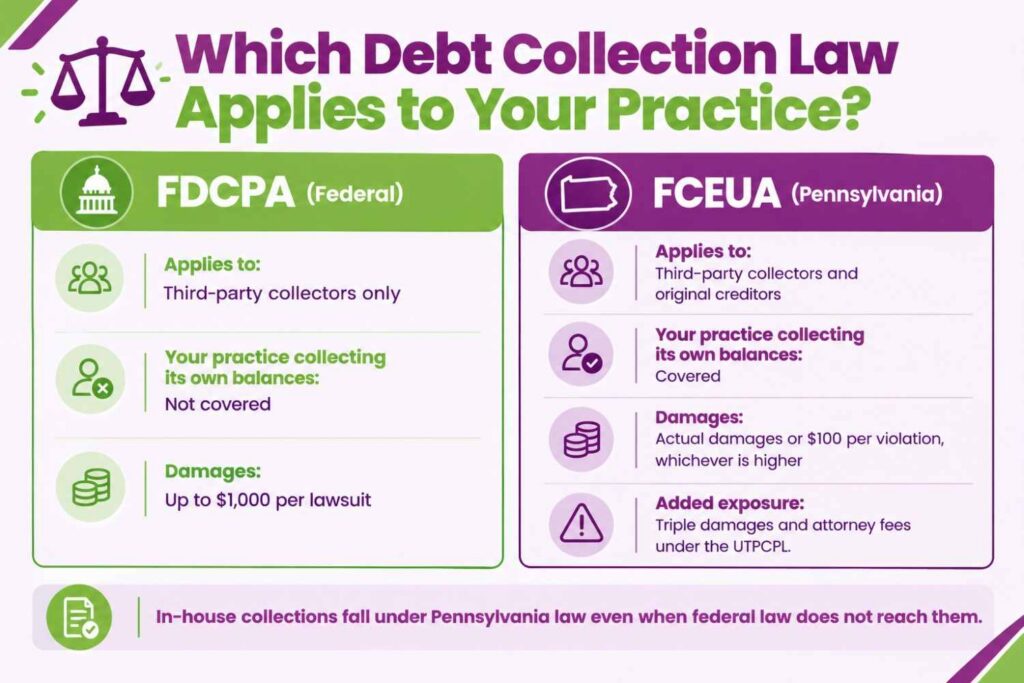
Pennsylvania regulates medical debt collection through the federal Fair Debt Collection Practices Act (FDCPA) and the state Fair Credit Extension Uniformity Act (FCEUA). The FCEUA reaches further than federal law.
Which Laws Govern Medical Debt Collection in Pennsylvania?
The FDCPA covers third-party debt collectors. The FCEUA, 73 P.S. § 2270.1 and following, covers both third-party collectors and original creditors. Your practice falls under the FCEUA when it collects its own patient balances.
A FCEUA violation is also a violation of the Unfair Trade Practices and Consumer Protection Law. Patients can recover actual damages or $100 per violation, whichever is higher. Courts can triple damages and award attorney fees.
Can Medical Debt Appear on Credit Reports in Pennsylvania?
Medical debt can still appear on credit reports in Pennsylvania. The state has no ban on medical debt credit reporting. The federal CFPB rule that would have removed medical debt from credit reports was vacated on July 11, 2025.
The three national credit bureaus still follow their 2023 policy:
- Paid medical debt is removed from credit reports.
- Unpaid medical debt under $500 does not appear.
Do Pennsylvania Hospitals Have to Offer Financial Assistance?
Nonprofit hospitals must follow federal IRS Section 501(r) rules. Each nonprofit hospital needs a written financial assistance policy, must publicize it, and must screen patients before pursuing collections. House Bill 79 would standardize these programs statewide.
Which Pending Bills Could Change Pennsylvania Medical Billing?
Five pending bills could change Pennsylvania billing rules. When a Pennsylvania law names no effective date, it takes effect 60 days after final enactment. The following table tracks each bill:
| Bill | What It Would Change | Latest Status |
|---|---|---|
| HB 79 | Standardized hospital financial aid forms and paused billing while an application is pending | Senate Health and Human Services Committee |
| SB 752 / HB 1469 | Hospital price transparency with facility fees, $2,500 to $15,000 penalties, and no collections by noncompliant hospitals | In committee |
| HB 1731 | 3-year limit on consumer debt lawsuits | House Rules Committee, June 17, 2026 |
| HB 65 | Narrower filial support liability | House Health Committee |
| HB 1697 / SB 38 | State False Claims Act with whistleblower suits | Senate Health and Human Services Committee |
House Bill 1731 and the False Claims Act bills carry the highest financial impact for providers. Watch both before the 2026 session closes.
What Billing Rights Do Patients Have in Pennsylvania?
Pennsylvania patients have billing rights under the hospital Patient’s Bill of Rights in 28 Pa. Code § 103.22. Patients can also file billing complaints with two state agencies and one federal help desk.
What Does the Hospital Patient’s Bill of Rights Say About Billing?
Every Pennsylvania hospital must adopt a Patient’s Bill of Rights that meets minimum standards. Two provisions cover billing directly:
- Section 103.22(b)(18): the right to examine and receive a detailed explanation of the bill.
- Section 103.22(b)(19): the right to full information and counseling on available financial resources for care.
Under 28 Pa. Code § 103.23, hospitals must display these rights prominently or provide copies on request.
Where Can Patients File Billing Complaints in Pennsylvania?
Patients file billing complaints with three offices depending on the issue:
- Pennsylvania Insurance Department: insurance and No Surprises Act complaints, 1-877-881-6388.
- Attorney General Health Care Section: billing dispute mediation, 1-877-888-4877 in state.
- CMS No Surprises Help Desk: federal surprise billing questions, 1-800-985-3059.
A complaint to the Health Care Section does not preserve a patient’s insurance appeal rights. Patients must file the insurer appeal separately.
How Can Providers Stay Compliant With Pennsylvania Medical Billing Laws?
Pennsylvania billing compliance depends on tracking deadlines across commercial, auto, workers’ compensation, and Medical Assistance payers. Your practice needs one written process for each deadline category.
What Internal Processes Keep a Pennsylvania Practice Compliant?
Build these six controls into your billing operation:
- Track payer deadlines: Medical Assistance 180 and 365 days, Act 146 turnaround times, and the 45-day prompt pay window.
- Reconcile prompt pay interest: match late clean claims against interest received under Act 68.
- Log retroactive denials: flag any recoupment attempt past 24 months under 40 Pa.C.S. § 3803.
- Route coverage correctly: send auto claims to Act 6 insurers and workers’ compensation claims with the LIBC-9 form.
- Write collection policies to FCEUA standards: train in-house staff who collect patient balances.
- Maintain a breach response plan: include the concurrent Attorney General notice track.
A periodic medical billing audit tests each control against actual claim data. Audits catch missed interest, expired filing windows, and improper recoupments before they compound.
How Should Practices Respond When Pennsylvania Laws Change?
Pennsylvania’s General Assembly holds a two-year session, and new laws default to a 60-day effective date. Monitor the five pending bills listed above. Update workflows, train staff, and document the training before each effective date.
Frequently Asked Questions About Pennsylvania Medical Billing Laws
What Is the Statute of Limitations on Medical Bills in Pennsylvania?
The statute of limitations on medical bills in Pennsylvania is 4 years under 42 Pa.C.S. § 5525. The same window applies to written and oral agreements. After 4 years, the patient still owes the debt, but the provider loses the right to win a collection lawsuit. The patient must raise the expired deadline as a defense in court.
Is Balance Billing Illegal in Pennsylvania?
Balance billing is illegal in Pennsylvania in several situations. The federal No Surprises Act bans it for emergency care and for out-of-network providers at in-network facilities. State law bans it for auto accident injuries under Act 6, workers’ compensation under 34 Pa. Code § 127.21, and Medical Assistance under 55 Pa. Code § 1101.63.
Can a Hospital Garnish Wages for Medical Debt in Pennsylvania?
A hospital cannot garnish wages for medical debt in Pennsylvania. State law allows wage garnishment only for specific debts, such as child support, spousal support, back rent, and student loans. A hospital or medical creditor with a court judgment still cannot garnish a patient’s wages under 42 Pa.C.S. § 8127.
How Long Do Insurers Have to Pay Claims in Pennsylvania?
Insurers have 45 days to pay clean claims in Pennsylvania under Act 68 and 31 Pa. Code § 154.18. Late clean claims carry a 10% interest penalty. The insurer must pay interest within 30 days of paying the claim, and interest under $2 on a single claim is waived.
Can an Insurer Take Back a Payment After Two Years in Pennsylvania?
Most Pennsylvania insurers cannot take back a payment after two years. Under 40 Pa.C.S. § 3803, insurers cannot retroactively deny payment more than 24 months after first paying the provider. The cap does not apply to fraud, waste, abuse, duplicate claims, government-plan denials, or coordination of benefits. Time a provider spends gathering requested records extends the 24-month window.
Are Adult Children Responsible for a Parent’s Medical Bills in Pennsylvania?
Adult children can be responsible for a parent’s medical bills in Pennsylvania in some cases. The filial support law, 23 Pa.C.S. § 4603, makes adult children with enough financial ability responsible for an indigent parent’s care. In Health Care & Retirement Corp. v. Pittas (2012), a court held a son liable for his mother’s $93,000 nursing home bill.