
Intensity-modulated radiation therapy, or IMRT, shapes radiation beams to match tumor outlines closely. Billing for that treatment depends heavily on how the radiation is actually delivered. CPT code 77386 describes complex IMRT delivery, which is a specific billing category.
Providers who report it correctly get paid, while those who miss details often face denials. Getting this one code right takes more than matching a number to a service. It takes a clear view of the plan, the record, and the payer rules behind the claim.
Transcure works with oncology practices as a Medical Billing Company that handles radiation claims. Many practices find that radiation claims need a separate workflow from routine visits.

What CPT Code 77386 Covers?
CPT code 77386 belongs to the radiation oncology section of the CPT manual. It describes hcilcoulzq intensity-modulated radiation therapy when the treatment plan is complex.
Complexity refers to the way the radiation beams are shaped, timed, and adjusted during treatment. That definition sounds simple, but it asks billing staff to look beyond the diagnosis and the date.
The radiation oncologist and medical physicist shape the plan before treatment begins. Billing staff usually don’t see the plan itself, so clinical notes must show plan complexity. That gap between the plan and the bill is where most coding mistakes start.
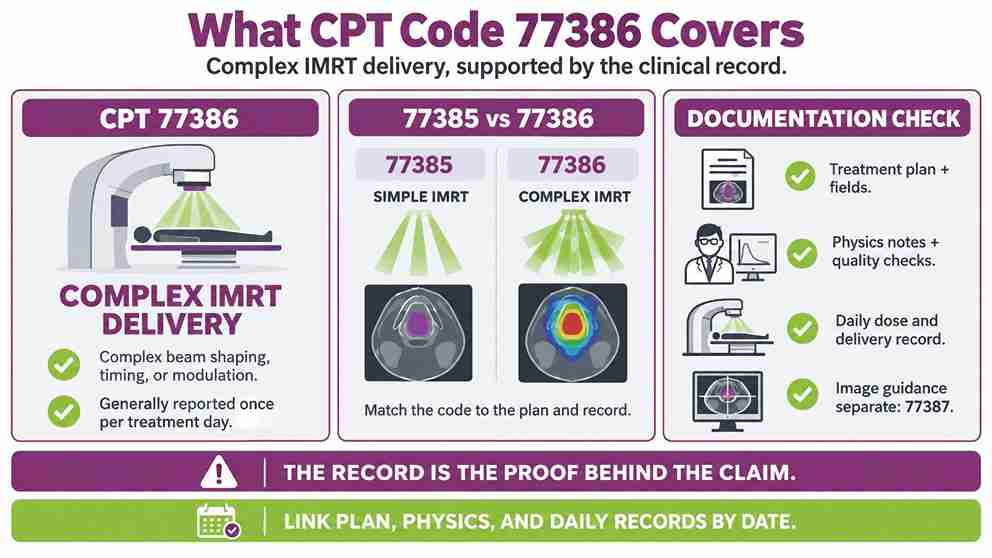
What’s the Difference between Simple Versus Complex IMRT Delivery?
The difference between simple versus complex IMRT delivery involves less complex beam shaping and fewer adjustments during each session. The code for simple delivery is 77385, so it stands apart from 77386. Providers must choose the right code based on the plan and the clinical record. Choosing the wrong one is easy when the notes do not describe the work clearly.
Why Complexity Changes the Claim?
The complexity changes the claim delivery because it takes more planning, more machine time, and more quality checks. Payers view that extra work as a reason to report a different code. Because the difference affects payment, auditors often compare the code with the record. A claim that reads well on paper can still fail if the record tells another story. Think of the record as the proof behind every line on the claim.
When to Report Code 77386?
Report 77386 when the delivered treatment meets the CPT definition of complex IMRT. The code is generally reported once per treatment day, not once per beam. Always check the current CPT manual and each payer policy before billing. Rules can shift from one year to the next, so a yearly review helps.
What’s the Right Documentation That Supports the Claim?
In right documentation that supports the claim should clearly show the planning complexity and the delivery details for each session. The following records usually carry the most weight when an auditor reviews a claim:
- The treatment plan should note the technique and the number of treatment fields.
- Physics notes should explain why the plan needed advanced modulation or additional quality checks.
- Daily treatment records should confirm the date, dose, and any changes made during delivery.
- Image guidance records should stay separate, because 77387 is billed separately from delivery.
Keep these files linked by date so a reviewer can trace each line without guessing.
Comparison of Related IMRT Codes
The table below compares the three codes that often appear together on an IMRT claim.
| Code | Service Described | Billing Focus |
|---|---|---|
| 77385 | Simple IMRT delivery | Used when beam shaping is less complex |
| 77386 | Complex IMRT delivery | Used when planning and delivery require more complexity |
| 77387 | Guidance for localization of target volume for IMRT | Reported separately alongside IMRT delivery |
Each code describes a separate part of the treatment process, so each needs its own support. Staff who manage radiation claims benefit from a current set of oncology CPT codes. Reporting several codes without matching records is a frequent source of denials.
Common Billing Errors With Code 77386
Several errors show up repeatedly in claims for complex IMRT delivery across many practices. Each of these errors has a clear fix when staff reviews claims before submission.
- Billing the simple code when the plan clearly used complex modulation is a common error.
- Reporting delivery codes for each beam instead of once per treatment day creates duplicate charges.
- Missing the diagnosis link that connects the code to a cancer diagnosis causes rejections.
- Failing to match the date of service with the daily treatment record leads to returns.
Payer Rules and Medical Necessity
Payer rules vary, and some plans require prior review for advanced radiation services. Medicare and commercial plans may also ask for proof that complex planning was medically necessary.
That request can arrive after a denial, which makes the answer harder to build. Practices that see repeated rejections often need stronger denial management support for radiation claims.
How Code Pairing Affects Claims
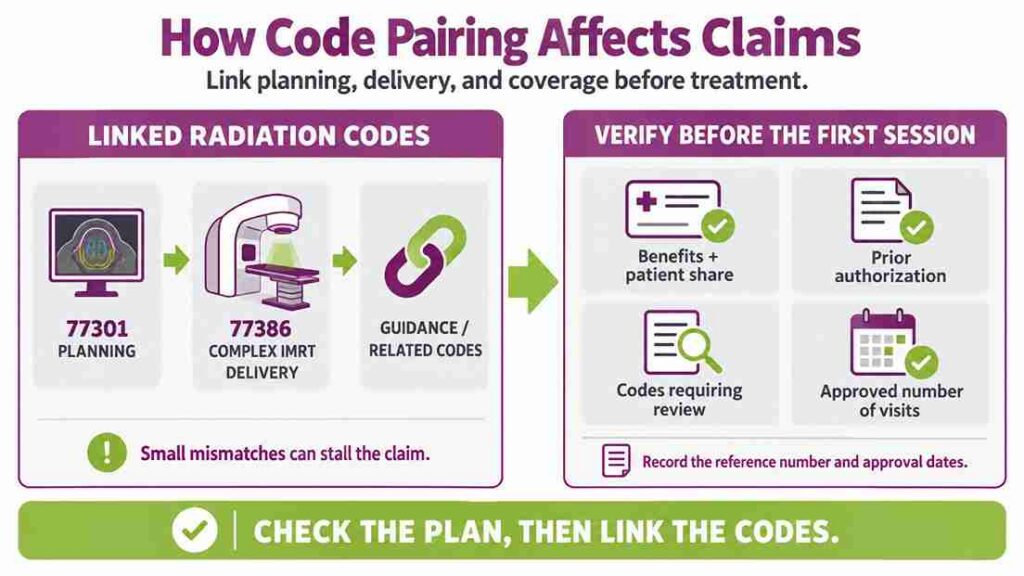
Code pairing affects claims because 77386 rarely appears alone on a radiation oncology claim, as planning and guidance codes travel with it. Planning codes such as 77301 describe the dosimetry work that comes before delivery.
Billing teams that track every linked code often rely on RCM Services to keep claims consistent. Small mismatches between linked codes can stall an entire claim for weeks.
Verifying Coverage Before Treatment
Verifying coverage before the first treatment session prevents surprise denials later in care. A dedicated Insurance Verification service checks benefits, prior approval requirements, and the patient’s share of cost before care starts. For IMRT, that check should go beyond a simple eligibility question.
Staff should confirm whether the plan requires prior authorization for complex delivery, which codes need review, and how many treatment visits the approval covers.
Asking for a reference number and noting the approval dates in the chart saves time during an audit. Staff can then plan the schedule around approvals instead of reacting to them.
Linking ICD-10 Codes to Complex IMRT
Linking ICD-10 codes to complex IMRT must clearly support every radiation service listed on the claim. Staff should select a precise ICD-10 code for the cancer site being treated. A prostate cancer claim, for example, may use code C61 as the primary diagnosis. The diagnosis should match the treatment site in the chart, not a related condition.
Practices that treat many tumor types often benefit from dedicated Oncology billing services. Specialized staff track which diagnosis supports which radiation service across each treatment plan.
What an IMART Sample Claim Looks Like?
An IMART sample looks like you are considering a patient with prostate cancer who receives IMRT over several weeks. The radiation oncologist orders complex IMRT, and the physicist confirms the plan uses advanced modulation. The billing team reviews the plan summary, the daily treatment logs, and the diagnosis on file.
They report 77386 once for each treatment day that includes complex delivery. They report image guidance under 77387 on days when imaging supports the setup.
Each claim line carries the diagnosis code that matches the prostate cancer site. Before submission, a reviewer checks that every date of service has a signed record. This review adds little time but prevents many avoidable rejections later on.
Now consider the same claim going out the door without that final check on dates. The likely result is a rejection for a date mismatch, which then needs a rework cycle. That single missed check can cost the practice weeks of follow-up calls.
Steps That Reduce IMRT Denials
Follow these four steps before every IMRT claim leaves the practice for the payer:
- Confirm the plan complexity with the physics record before coding the visit.
- Match each delivery date with a signed daily treatment record before submitting the claim.
- Attach diagnosis codes that match the treatment site documented in the chart.
- Review denials every week to find repeated causes and correct the underlying workflow gap.
Many practices hand this weekly review to a team that specializes in CPT codes. An outside team can check each denial against payer rules and spot patterns that in-house staff often miss. That outside view often shortens the time between a denial and its correction.
Denial Causes and Fixes
The table below pairs common denial causes with a practical fix before submission.
| Denial Cause | Fix Before Submission |
|---|---|
| Simple code billed for a complex plan | Compare the physics notes with the code selected |
| Delivery billed per beam | Report one delivery unit per treatment day |
| Missing diagnosis link | Attach the diagnosis that matches the treatment site |
| Date mismatch | Match each date with a signed daily record |
Staff who check these four items before submission catch most problems early.
Staff Training Checklist
A short training plan keeps the process steady across providers and staff. Use these points as a starting list:
- Train billing staff on the CPT definition of complex IMRT at least once each year.
- Share a short checklist of documents needed for every complex IMRT claim.
- Hold a monthly meeting to review rejected IMRT claims with clinical staff.
- Record each payer rule change in one shared document that every biller can access.
Why Accurate Coding Matters?
Coding errors affect cash flow in ways that are easy to miss. A denied claim can take months to resubmit, correct, and collect from the payer. During that time, the practice carries the cost of care without payment. Some practices choose full-service medical billing services to protect this process from errors. Accurate coding protects both the practice and the patient from billing confusion.
Correct coding for complex IMRT protects revenue and reduces avoidable rework for the billing team. Staff who know the code definition, the documentation rules, and payer policies avoid most errors. Start with clear records, consistent review, and a steady process for every treatment day.
What Is CPT Code 77386 Used For?
CPT code 77386 reports complex intensity-modulated radiation therapy delivery for a single treatment day. It applies when planning and delivery require advanced beam shaping and multiple adjustments. Plans with less complex beam shaping and fewer adjustments fall under code 77385 instead. Staff should compare the physics notes and plan before selecting this code.
Can 77386 Be Billed More Than Once Per Day?
No, the code is generally reported once per treatment day, not once per beam or field. Each session may include several beams, but the claim still reflects one day. Counting beams or fields separately creates duplicate charges that payers often reject. Payers may have their own policies, so confirm those rules before submitting any claim.
Is 77386 Always Billed With 77387?
No, code 77387 is only reported when image guidance supports the delivery. Image guidance is a separate service that helps position the patient and target accurately. Many complex IMRT courses include both codes, but each needs its own documentation. Payers review the imaging record independently, so missing image logs can deny the guidance line alone.
Does Complex IMRT Require Prior Authorization?
Some payers require prior authorization for advanced radiation services, but rules differ by plan. Requirements may depend on the cancer type, the treatment site, and the number of planned sessions.
Commercial plans and government programs often publish separate criteria, so staff should read each one. Obtain approval before the first session, and record the reference number in the chart.
What Documents Should Support Code 77386?
The treatment plan, physics notes, and daily treatment records form the core file. The plan should show the technique, field count, and modulation approach used for delivery.
Physics notes should explain why the plan needed advanced modulation or extra quality checks. Keep physician orders and simulation records easy to retrieve, since auditors often request them together.
Where Can Practices Find an Oncology Billing Guide?
A practical Oncology billing guide explains radiation codes, modifiers, and documentation habits that billing teams use daily. It helps new staff learn which records support each service before claims go out. Many teams use it as a reference during audits and payer disputes. Reviewing it with clinical staff keeps coding decisions consistent across the practice.
How Often Should Staff Review Coding Rules?
A quick review every quarter catches most rule changes before they cause denials. Staff should check current CPT guidance, payer bulletins, and any policy notices from their payers.
Recording each change in a shared document helps every biller apply it the same way. Teams that skip reviews often find problems only after a batch of claims is denied.