Endocrinology billing is the process of coding, submitting, and collecting payment for diabetes, thyroid, bone, and hormone care. It stands apart because a single patient can need office visits, glucose monitoring, imaging, and chronic care services in one year.
Demand for this care is large. The CDC reports that 38.4 million Americans live with diabetes, and the American Thyroid Association estimates that 20 million have a thyroid condition.
Each claim follows strict rules. CPT 95251 for continuous glucose monitoring has frequency limits, and same-day office visits often need modifier 25 to get paid.

Diagnosis detail also drives payment, since an ICD-10 code like E11.65 must show the exact diabetes complication. A vague code can turn a covered visit into a denial.
This guide covers the core CPT codes, ICD-10 codes, modifiers, denial causes, and compliance rules, and shows when outsourcing to Transcure fits your practice. Transcure maintains a 98% first-pass clean claims rate with 1,100+ certified billers and coders.
What Is Endocrinology Billing?
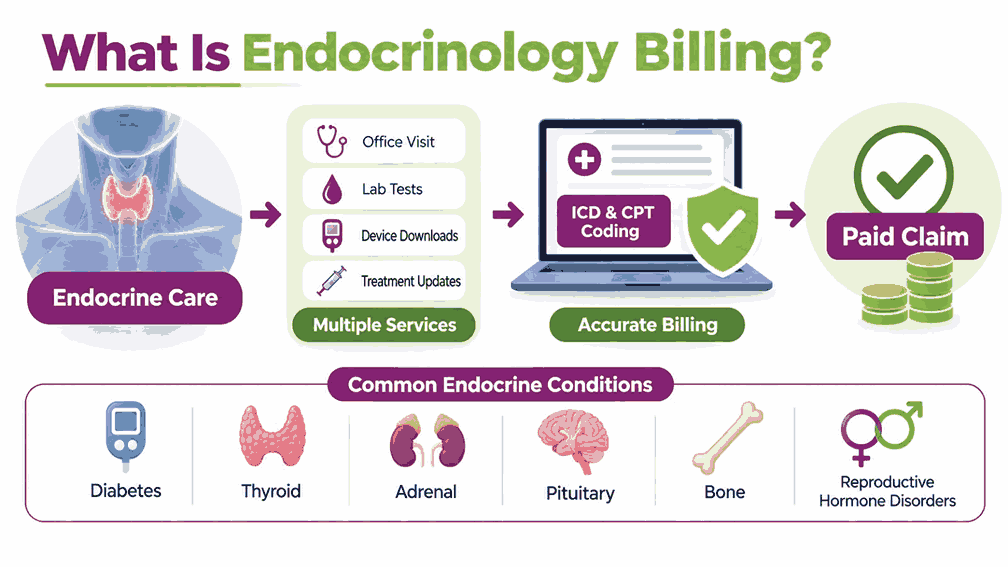
Endocrinology billing is the process of turning endocrine care into paid insurance claims. It covers diabetes, thyroid, adrenal, pituitary, bone, and reproductive hormone conditions, and every service must be coded, documented, and submitted to the right payer.
Lifelong conditions make this work different from single-visit specialties. Patients return for lab reviews, device downloads, and medication changes, so one claim often mixes visit, testing, and monitoring codes.
Four elements set endocrinology billing apart from most specialties.
- Chronic care codes that pay monthly for care management and remote monitoring
- Device and testing services such as CGM, thyroid ultrasound, and bone density scans
- Specific diagnosis coding where ICD-10 detail decides payment
- Frequency limits that cap how often payers cover tests and supplies
What Does an Endocrinology Billing Workflow Cover?
An endocrinology billing workflow follows each claim from scheduling to final payment, and every stage protects revenue in its own way. The table below shows what happens at each one.
| Stage | What Happens | Why it Matters |
|---|---|---|
| Insurance verification | Staff confirm coverage for visits, CGM, and labs | Stops denials for uncovered services |
| Prior authorization | Billers secure approval for devices and select imaging | Protects payment for equipment and tests |
| Coding | Coders assign CPT, ICD-10, and modifiers from the visit note | Keeps claims accurate |
| Charge entry and submission | Billers enter charges and send clean claims to payers | Starts the payment clock |
| Payment posting | Teams match payer remittances to each claim | Shows underpayments |
| Denial and A/R follow-up | Staff appeal denials and chase unpaid claims | Recovers revenue |
ELIXA, Transcure’s AI eligibility agent, verifies coverage before each visit. CLAIR, our AI claim-scrubbing agent, flags coding errors before submission, while ARIA, our AI accounts receivable agent, chases unpaid claims.
How Does Chronic Care Shape Endocrinology Revenue?
Chronic care shapes revenue because diabetes, thyroid, and osteoporosis patients return on set schedules for years. Each return visit creates billable services, so accurate coding protects income across the full patient relationship.
Care management and monitoring codes add recurring monthly revenue between visits.
| CPT Code | Service | Key requirement |
|---|---|---|
| 99490 | Chronic care management, first 20 minutes of clinical staff time | Patient consent and a time log |
| 99454 | Remote monitoring device supply | Readings on 16 days in 30 days |
| 99457 | Remote monitoring management, first 20 minutes | Interactive communication with the patient |
These codes only pay when notes show consent, time logs, and a qualifying diagnosis. Practices that skip those details leave steady monthly revenue unclaimed.
Why Does Revenue Cycle Management Matter for Endocrinology Practices?
Revenue cycle management decides how much of your earned income reaches the bank. Endocrinology care repeats every few months, so one weak step drains revenue for years instead of a single visit.
How Does Revenue Cycle Management Protect Endocrinology Cash Flow?
A tight revenue cycle turns every visit, device review, and care management month into a paid claim on schedule. Steady follow-up also catches underpayments before they age. Transcure clients see a 30% reduction in A/R.
Medicare rules reshape endocrinology payment every year. The 2027 rule replaces G2211 with a modifier and trims some same-day visit payments, so visit coding now directly affects revenue.
Why Do Compliance Rules Put Endocrinology Revenue at Risk?
Medicare law bars payment for services that are not reasonable and necessary for the patient’s condition. Every CGM review, thyroid ultrasound, and bone density scan needs a note that proves the need.
Recurring services add their own proof points, such as consent, time logs, and an initiating visit. One missing element can trigger a denial. Payers can also recoup money after an audit.
Quality reporting also ties into coding accuracy. CMS added a diabetes MIPS Value Pathway in the 2027 rule, and the traditional MIPS option stops after the 2030 performance period.
What Are the Steps in the Endocrinology Billing Process?
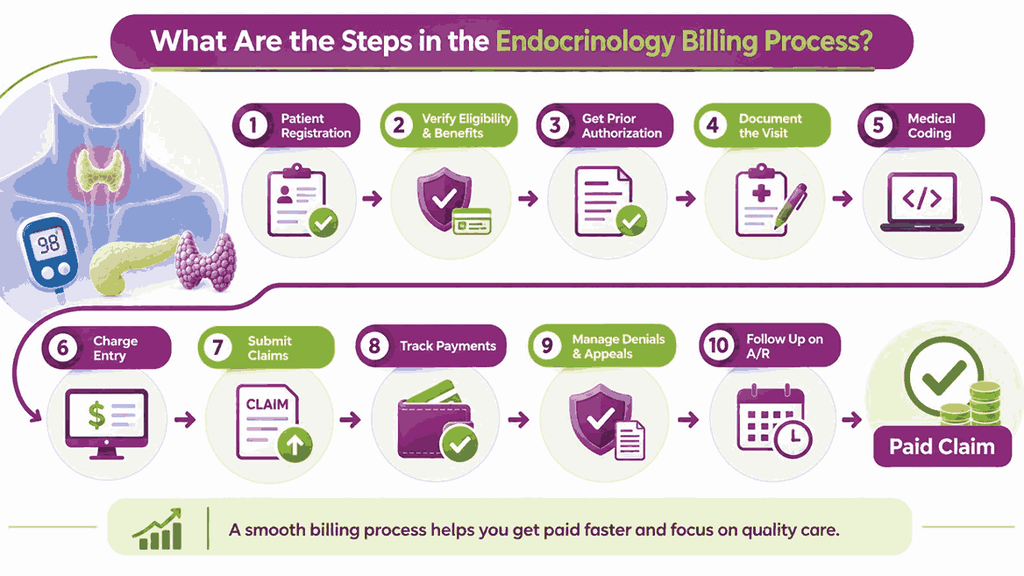
The endocrinology billing process has 10 connected steps from registration to final payment. Each step passes clean data to the next so that an early error can surface as a denial months later.
How Does Patient Registration Set Up a Clean Claim?
Registration builds the record that every later step depends on. Staff collect demographics, insurance details, and referral information, and they flag diabetes, thyroid, and bone patients for the right visit type.
Returning patients need a fresh review at each visit because plans and addresses change often. A wrong member ID at this stage becomes a rejection at submission.
How Does Eligibility and Benefits Verification Work?
Eligibility Verification confirms that coverage is active on the date of service and shows what the plan pays for. Staff checks visit limits, device benefits, and patient cost sharing before the appointment.
At Transcure, ELIXA, an AI eligibility agent, returns results in as little as 4 seconds. Patients then know their deductible and copay before they arrive.
When Do Endocrinology Services Need Prior Authorization?
Approval rules vary by plan, but CGM devices, insulin pumps, advanced imaging, and injectable drugs such as GLP-1 therapies often need prior authorization. Skipping approval can cause a denial even when the care was necessary.
Requests need the diagnosis, recent lab results, and treatment history. Transcure routes them through PRIA, an AI agent that submits authorizations and follows up with payers.
What Should Endocrinologists Document at Each Visit?
Clear notes turn care into billable services. Each note should support the codes and the level of service billed.
- Symptoms, history, and examination findings
- Lab values such as A1c, TSH, and glucose logs
- The diagnosis and the reason for each test or device
- Medication changes and the treatment plan
- Time spent on care management or monitoring
- The follow-up plan and patient consent where required
Notes that tie each service to a lab result or symptom protect the claim during payer review.
How Does Endocrinology Medical Coding Work?
Coders convert the note into CPT, ICD-10-CM, and HCPCS codes, then add modifiers where services share a date. Diabetes claims need combination codes that capture the type and the complication.
CODIN, our AI coding agent, suggests codes from the note, and certified coders review each one. This pairing checks NCCI edits and flags missing modifiers before charges post.
Why Does Charge Entry Matter for Endocrinology Claims?
Charge entry moves coded services into the billing system with units, modifiers, and provider details. A missed CGM interpretation or office procedure means income that never makes it to a claim.
Billers reconcile each day’s encounters against the schedule and the codes. That habit catches unbilled services within hours, not months.
How Do Endocrinology Practices Submit Claims?
Claims travel electronically through a clearinghouse that checks formatting and payer edits. Payers then review eligibility, medical necessity, coding, and authorization before they pay.
CLAIR, our AI claim-scrubbing agent, first checks each claim against payer rules. This step supports a 98% first-pass clean claims rate.
How Does Payment Posting Catch Underpayments?
Remittance advice arrives from the payer to show what was paid, adjusted, or denied. Any remaining balance moves to the patient account, including deductibles and coinsurance.
REMITA, Transcure’s AI payment posting agent, matches each remittance to its claim and flags short payments.
How Should Practices Manage Denials and Appeals?
Reason codes guide every denial response, and each fix should prevent a repeat. Simple errors need a corrected claim, while medical necessity denials need an appeal with notes, labs, and policy language.
DEXA, our AI denial management agent, spots denial patterns and automates appeal preparation.
How Does A/R Follow-Up Keep Revenue Moving?
Unpaid claims need a named owner and a fixed review cycle. Staff contact payers on claims past 30 days and escalate balances that pass 60 days.
ARIA, our AI accounts receivable agent, prioritizes open claims and automates payer follow-up. Reports on clean claim rate, denial rate, and days in A/R, then shows where the cycle needs attention.
What Codes and Modifiers Drive Endocrinology Billing?
Three layers work together on every endocrinology claim. Claims start with endocrinology CPT codes, which describe each service. Endocrinology ICD-10 codes support them by justifying medical necessity. Finally, Modifiers clarify when services share a date.
Here is a quick overview of each in the table below:
| Layer | Role on the claim | Common examples |
|---|---|---|
| CPT codes | Describe the service performed | 99214, 95251, 76536, 77080 |
| ICD-10 codes | Support medical necessity | E11.65, E03.9, M81.0 |
| Modifiers | Clarify same-day services | 25, 59, 76 |
Which E/M Codes Do Endocrinologists Bill Most?
Follow-up visits fill most endocrinology schedules, so 99213, 99214, and 99215 appear on many claims. New patients use 99204 and 99205. Level selection depends on medical decision-making or total time, and the note must support the billed level.
Which Procedure and Testing Codes Are Commonly Used in Endocrinology Billing?
Common in-office services include 76536 for thyroid ultrasound, 10005 for fine needle aspiration with ultrasound guidance, and 77080 for bone density testing. Point-of-care tests such as 83036 for hemoglobin A1c also appear often. Each code requires a documented order and result.
How Is Continuous Glucose Monitoring Billed?
CGM billing splits into setup and interpretation. Code 95250 covers practice-owned device hookup, sensor placement, and removal, while 95249 covers patient-owned equipment and training. Code 95251 covers data interpretation and requires at least 72 hours of recorded data.
Which Chronic Care and Remote Monitoring Codes Apply?
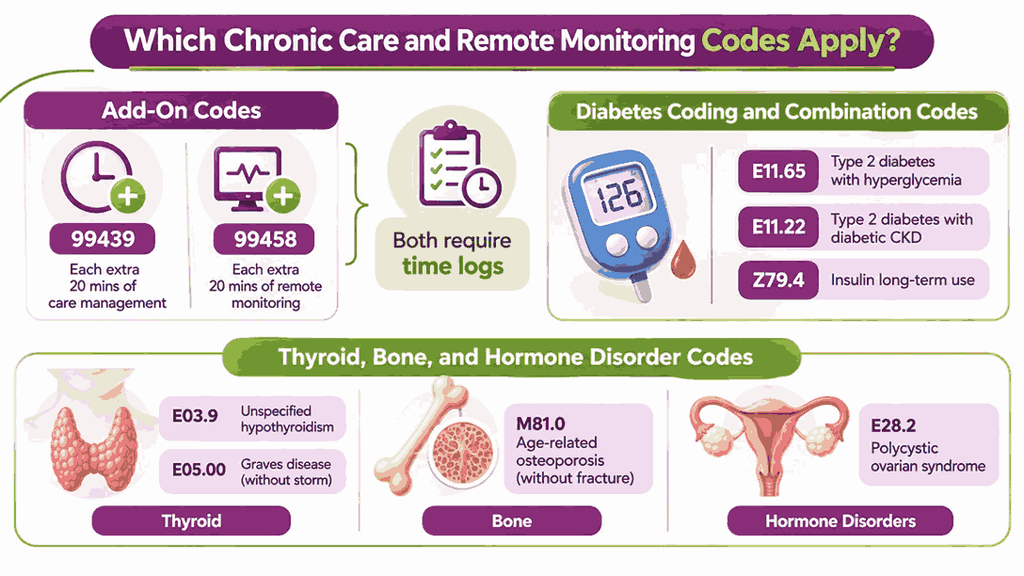
Add-on codes extend the base services. CPT 99439 adds each extra 20 minutes of care management, and 99458 adds each extra 20 minutes of remote monitoring management. Both need time logs that show the minutes billed.
Diabetes Coding and Combination Codes
ICD-10 uses combination codes that merge diabetes type and complication into one code. E11.65 reports type 2 diabetes with hyperglycemia, and E11.22 reports type 2 diabetes with diabetic chronic kidney disease. Z79.4 follows when a patient uses insulin long-term.
Thyroid, Bone, and Hormone Disorder Codes
Thyroid claims often use E03.9 for unspecified hypothyroidism and E05.00 for Graves disease without thyroid storm. Osteoporosis claims commonly use M81.0 for age-related osteoporosis without a current fracture. E28.2 reports polycystic ovarian syndrome.
When Does Modifier 25 Apply?
Modifier 25 flags a significant, separately identifiable E/M service on the same day as a procedure. For example, a visit that includes a medication change and a thyroid ultrasound. The note must show that the visit work stands apart from the procedure.
When Do Modifiers 59 and 76 Apply?
Modifier 59 marks a distinct procedural service that NCCI edits would otherwise bundle. Modifier 76 marks a repeat of the same procedure by the same provider on the same day. Both require documentation explaining why the service was separate or repeated.
What Billing Challenges Do Endocrinology Practices Face?
Frequent rule changes, device coverage limits, and heavy documentation demands shape most billing problems in this specialty. Each may seem small on its own, but together they slow payment across the practice.
How Do Annual Code and Edit Changes Create Billing Risk?
Fixed calendars govern code sets, and a missed update turns a clean claim into a denial. Endocrine claims felt the Oct. 1, 2026 ICD-10-CM update directly. It added E89.830 and E89.838 for hypoglycemia after bariatric and other surgeries.
Quarterly updates to NCCI edits and Medically Unlikely Edits can break claims that cleared the quarter before.
Why Do CGM and DME Claims Need Careful Documentation?
Proof in the chart drives Medicare coverage for CGM. The patient must use insulin or have a history of problematic hypoglycemia. The practitioner must also see the patient within 6 months before the order.
Every 6 months after the first order, the practitioner must hold a follow-up visit in person or through approved telehealth. Medicare allows no grace period for a missed visit.
Supply claims add another layer. Codes A4238 and A4239 carry modifier KX for insulin-treated patients and KS for patients who do not use insulin. A DME supplier usually bills those supplies, so chart notes must support its claim.
How Can Practices Solve These Billing Challenges?
Structured routines solve most of these problems before claims go out. Here’s how you can solve endocrinology billing challenges:
- Review NCCI and MUE updates every quarter and refresh coding cheat sheets
- Build a CGM checklist covering insulin status, visit dates, and the 6-month follow-up
- Audit a sample of charts from each provider every quarter
- Track denial reasons and share them with providers and coders
- Confirm that your EHR carries each new code set before its effective date
Another great option for reducing these billing challenges is hiring a dedicated endocrinology medical billing partner to take these routines off your staff.
Why Do Endocrinology Claims Get Denied?
Endocrinology claims get denied when the record doesn’t support the service, the service exceeds a payer limit, or a required approval is missing. Recurring visits and device-based care create many openings for these gaps, so one weak note can repeat across an entire patient panel.
| Denial Cause | What Triggers It | How to Prevent It |
|---|---|---|
| Medical necessity | Diagnosis does not support the test or visit level | Link each service to a specific ICD-10 code |
| Frequency limits | Test or supply billed inside the payer interval | Check the last service date before booking |
| Missing authorization | CGM or imaging started without approval | Verify payer requirements before the visit |
| Modifier errors | Same-day services bundled by payer edits | Document separate work and apply modifier 25 or 59 |
Why Do Medical Necessity and Documentation Gaps Cause Denials?
Payers deny claims when the note does not show why a service was needed. A thyroid ultrasound billed without a documented nodule or abnormal lab result is a common example. Coders cannot add detail the provider never recorded, so documentation habits decide which claims survive review.
Strong endocrinology notes include these elements:
- The clinical reason for each test ordered
- Lab values or imaging findings that support the diagnosis
- Time spent on chronic care and monitoring services
- Patient consent for care management programs
How Do Frequency Limits on Testing and Supplies Cause Denials?
Medicare and many commercial plans cap how often they pay for certain tests and supplies. Bone density scans, hemoglobin A1c tests, and diabetic testing supplies all carry set intervals. A claim inside that window gets denied even when the service was clinically appropriate.
Front desk staff can stop these denials by checking the date of the last service before booking the patient. A shared tracker for scans and tests keeps that check consistent across providers.
How Do Prior Authorization Failures Lead to Denials?
Missing authorization causes denials that are often difficult to overturn after care is delivered. CGM devices, advanced imaging, and some injectable drugs commonly need approval first. Each request should include the diagnosis, supporting lab results, and prior treatment history.
Transcure handles this step with AI agents. PRIA, our AI prior authorization agent, submits and tracks approval requests before the visit. DEXA, our AI denial management agent, spots denial trends and automates appeals when a claim is still rejected.
What Compliance Rules Affect Endocrinology Billing?
Endocrinology billing falls under Medicare coverage policies, supervision requirements, and federal audit standards. Chronic care services, device billing, and same-day procedures all attract payer review, so each claim needs documentation that matches the rule behind the code.
| Compliance Area | What It Governs | Documentation Needed |
|---|---|---|
| Diabetes training coverage | Who qualifies for self-management and nutrition services | Physician referral and diagnosis |
| CGM coverage | Which patients qualify for device use | Treatment history and visit notes |
| Incident-to billing | When staff services bill under the physician | Initial visit and supervision record |
| Modifier 25 use | Separate visit work on procedure days | Distinct note for each service |
Which Medicare Coverage Rules Apply to Diabetes Services?
Medicare pays for diabetes self-management training and medical nutrition therapy only when a physician or qualified practitioner refers the patient. Both services carry annual hour limits, and the diagnosis on the claim must match the covered condition.
CGM follows its own local coverage policy. Patients generally need a documented treatment regimen and a recent visit that supports continued device use. Notes should state the insulin plan and the reason monitoring is needed.
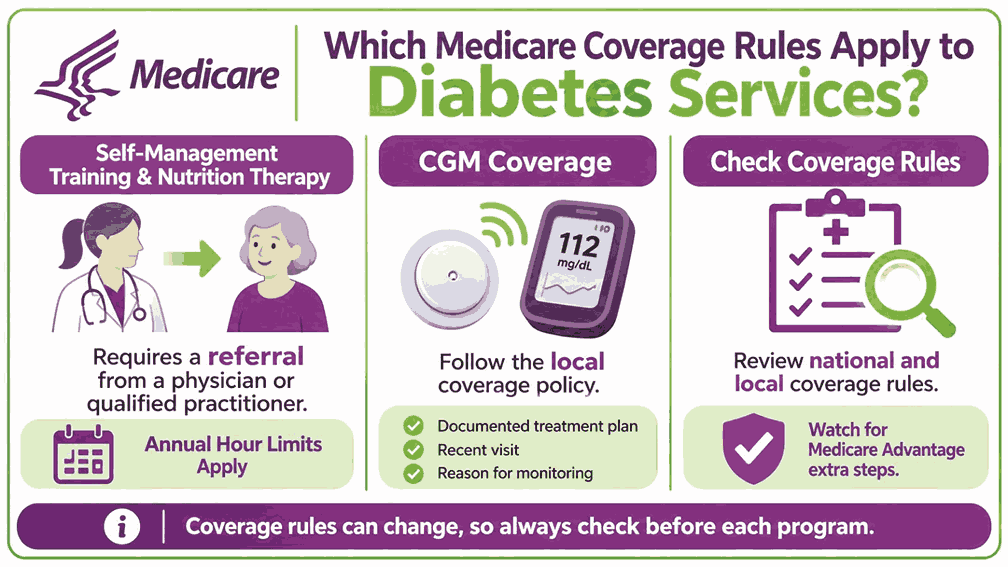
Billers should check the current national and local coverage determinations before each program starts. Coverage language changes often, and Medicare Advantage plans may set additional steps.
How Do Incident-To and Supervision Rules Work?
Incident-to billing lets a practice bill nurse practitioner, physician assistant, or clinical staff services under the supervising physician. Medicare sets strict conditions for this option, and missing one turns the claim into a compliance risk.
Several conditions must hold at the same time.
- The physician performed the initial visit and set the care plan
- The service falls inside that established plan
- A supervising physician is present in the office suite when direct supervision applies
- The note shows who delivered the service
New problems cannot be billed incident-to, because they require a fresh physician visit. Practices that ignore this rule face repayment demands during audits.
CODIN, Transcure’s AI coding and compliance agent, reads clinical notes and flags NCCI and MUE violations before claims go out. That check catches many supervision and bundling issues while the fix is still simple.
How Does Telehealth Billing Work for Endocrinology?
Telehealth billing follows the same revenue cycle as an office visit, with additional coding and documentation rules. Congress extended Medicare telehealth flexibilities through Dec. 31, 2027, but commercial payers set their own terms.
Which Endocrinology Visits Qualify for Telehealth?
Routine diabetes, thyroid, and medication management visits fit virtual care, along with reviews of CGM data. Patients can currently join from home under Medicare without geographic limits through the end of 2027.
What Codes and Modifiers Does a Telehealth Claim Need?
Standard E/M and ICD-10 codes apply to virtual visits, with place-of-service and modifier details added.
- POS 10 when the patient joins from home
- POS 02 when the patient joins from another location
- Modifier 95 when the payer requires it for real-time audio and video
- Modifier 93 for audio-only visits where the payer allows them
Plans differ on these rules, so billers should confirm requirements before the first claim. Charts should also record the patient’s location, the technology used, and consent where the payer requires it.
How Does Remote Monitoring Fit Into Endocrinology Telehealth?
Between visits, remote monitoring tracks glucose readings and supports timely medication changes.
Starting in 2027, practices billing RPM must furnish a separate initiating visit when services begin, and RTM serves established patients only. The requirement that employed clinical staff perform RPM and RTM now starts Jan. 1, 2029 after a CMS delay.
What Recent CMS and AMA Updates Affect Endocrinology Billing?
Several updates reach endocrinology billing directly, from visit complexity payments to shared diabetes visits. Most take effect Jan. 1, 2027. The table below summarizes each one for your billing team.
| Update | Takes Effect | What Endocrinology Practices Should Do |
|---|---|---|
| Modifier B1 replaces G2211 for visit complexity | Jan. 1, 2027 | Move the G2211 charge onto the E/M line |
| Second same-day service paid at 80% when an E/M with modifier 25 meets a 0-day global procedure | Jan. 1, 2027 | Check which in-office procedures carry 0-day globals |
| Remote monitoring requires a separate initiating visit | Jan. 1, 2027 | Add the visit and consent to glucose monitoring workflows |
| Shared medical appointments get separate coding and payment | Jan. 1, 2027 | Review group visit models for diabetes patients |
| New ICD-10-CM codes E89.830 and E89.838 for hypoglycemia after surgery | Oct. 1, 2026 | Add both codes to coding references |
How Does the G2211 Change Affect Endocrinology Visits?
Longitudinal care sits at the center of endocrinology, so the G2211 change matters on nearly every follow-up visit. Modifier B1 replaces add-on code G2211 and raises the E/M payment by 16%.
ACO participants in the Shared Savings Program can append modifier B2 instead, which raises payment by 32%. Billers should confirm that each visit meets the complexity criteria before appending either modifier.
How Does the Modifier 25 Payment Change Affect In-Office Procedures?
Endocrinologists often pair an office visit with a same-day procedure. When an E/M visit billed with modifier 25 shares a date with a 0-day global procedure, Medicare pays one service in full and the other at 80%.
The reduction applies when the same physician, or a physician of the same specialty in one group, furnishes both services. Visits by different specialties in the same group are exempt.
Practices that perform fine needle aspiration in the office should check whether their codes carry a 0-day global period.
How Do Shared Medical Appointments Fit Endocrinology Care?
Group visits suit chronic conditions, and CMS named diabetes as one that fits this model well.
The final rule creates separate coding and payment for shared medical appointments, with an add-on code for additional time. Practices that run group diabetes visits should review how the new code interacts with individual E/M billing.
How Can Endocrinology Practices Improve Revenue Cycle Performance?
Revenue cycle performance depends on how cleanly each stage hands off to the next. Recurring visits mean a small leak repeats every month, so practices that track four core metrics can catch problems early.
The clean claim rate shows how many claims pay on first submission, and a dip points to registration, coding, or scrubbing errors. The denial rate tracks payer rejections, which usually trace back to authorization or documentation gaps.
Days in A/R measures how long payment takes, so a rise signals weak follow-up. The net collection rate compares what was collected with what payers allowed, exposing underpayments at the posting stage.
Which Front-End Steps Protect Clean Claims?
Front-end work decides whether a claim can be paid before the patient reaches the exam room. Staff should confirm coverage and secure approvals at scheduling instead of at checkout, because late fixes rarely recover the full payment.
Verify coverage and plan type at every visit, since diabetes patients often switch plans year to year. Confirm referrals and authorization for CGM and imaging at the same time. Registration should also capture demographics and any secondary insurance, and the schedule should flag tests that fall inside a payer frequency limit.
CLAIR, Transcure’s AI claim-scrubbing agent, screens each claim against payer rules before it leaves the practice. That step supports the 98% first-pass clean claims rate maintained for client practices.
How Should Practices Handle Denials and A/R Follow-Up?
Denial management works best as a loop that sorts rejections by cause and sends each fix back to the front desk and coders. Appeals need the original note, supporting labs, and payer policy language, and each plan sets its own filing deadline.
A/R follow-up needs a consistent routine, such as:
- Review claims still unpaid after 30 days and confirm their payer status
- Assign a named owner to every balance that passes 60 days
- Appeal denials inside the payer filing window with full supporting records
- Feed each denial cause back to the team that can prevent it
Payment posting closes the loop and exposes underpayments. REMITA, Transcure’s AI payment posting agent, matches remittances to claims and flags short payments. ARIA, an AI accounts receivable agent built for follow-up, works the claims that remain open.
Should an Endocrinology Practice Outsource Billing?
Outsourcing makes sense when billing work pulls staff away from patients or claim results stop improving. Endocrinology adds pressure because chronic care codes, device billing, and frequency rules need steady attention that a small in-house team often cannot give every month.
Three signs usually point toward outsourcing.
- Denials repeat for the same causes month after month
- Staff turnover leaves gaps in coding and A/R follow-up
- Chronic care and CGM codes go unbilled for lack of time
Anyone ready to outsource can start with a ranked list of the top endocrinology billing companies.
What Does Outsourcing Endocrinology Billing Cost?
Most billing companies charge a percentage of collected revenue, so the fee follows what the practice actually receives. Transcure charges 5% of collected revenue. That structure ties our income to your payments, and claims that never pay generate no fee.
An in-house team carries salaries, benefits, software, training, and clearinghouse costs regardless of how claims pay. Adding those fixed costs together gives a practice the right baseline for judging any percentage fee.
How Does Transcure Support Endocrinology Practices?
Our team of 1,100+ certified billers and coders has worked with practices since 2002, and we work inside the EMR your practice already uses, including Epic, athenahealth, and Kareo. Coders apply endocrinology CPT, ICD-10, and modifier rules to every claim before submission.
Seven AI agents cover the cycle from eligibility checks to payment posting, which supports a 98% first-pass clean claims rate. Our offices in Farmers Branch, Woodbridge, and Oviedo give practices a team they can reach during business hours.
How Do You Choose an Endocrinology Billing Company?
Your billing partner choice shapes how well your practice captures CGM, chronic care, and visit revenue. Five checks separate a strong fit from a poor one.
Does the Company Know Endocrinology Billing?
Look for proven work with CGM billing, diabetes self-management training, chronic care management, and thyroid and bone procedures. Ask how the team handles the 6-month CGM follow-up rule and the new G2211 modifier.
Request a sample claim review that shows how coders assign diabetes combination codes and apply modifier 25. Founded in 2002, Transcure employs AAPC-certified coders who work inside Epic, athenahealth, and Kareo.
How Clear Is the Pricing?
Reputable companies explain their fee model before you sign a contract. Ask which fee covers CGM and prior authorization work, chronic care billing, and appeals, and which services cost extra. Transcure charges a flat 5% of collected revenue.
What Security and Technology Safeguards Should It Offer?
Billing partners handle glucose logs, lab values, and insurance data every day, so confirm HIPAA compliance, secure systems, and written breach procedures. Transcure follows HIPAA standards and holds ISO 27001 certification.
Tool coverage matters too, so ask which systems automate eligibility checks, claim scrubbing, and denial follow-up. Transcure covers each with a dedicated AI agent.
Will You Get a Dedicated Account Manager?
Communication matters as much as accurate coding. Look for a named contact, regular performance reports, and prompt answers on billing issues. Reports should show CGM, chronic care, and denial trends by provider.
What Does the Company’s Track Record Show?
Read client reviews, case studies, and retention figures before you decide. Ask for results from endocrinology practices of your size. Transcure reports 99% customer retention and serves 500+ physicians.