Anesthesia medical billing turns documented anesthesia care into paid claims using units and modifiers. Each claim multiplies base, time, and modifier units by the payer’s own conversion factor. Modifiers like QK, QX, and QZ decide which provider receives payment and how much.
CMS set the 2026 national Medicare anesthesia conversion factor at $20.4976 for most clinicians. The CY 2027 Medicare Physician Fee Schedule final rule arrived on November 4, 2026. ASA tracks each anesthesia payment change and posts updates for groups on its site.

AANA states Medicare pays for the medical direction of a CRNA at 50% of the case. Missing start times or unsupported medical direction cause denials and underpaid units across claims. This anesthesia billing guide covers units, modifiers, documentation, payer rules, and denials for groups.
What Is Anesthesia Medical Billing?
Anesthesia medical billing is the process of converting documented anesthesia care into paid claims. Each claim reflects base units, anesthesia minutes, modifiers, and the payer’s own conversion factor. Anesthesiology billing depends on an anesthesia record that proves every minute and every service.
Anesthesiologists, CRNAs, and anesthesiologist assistants each submit claims for the anesthesia services they deliver. Teaching physicians report resident services with modifier GC when residents work under their direction.
These claims originate in hospitals, ambulatory surgery centers, office-based practices, and pain management clinics. CMS publishes the base units and conversion factors Medicare uses for each anesthesia claim.
Every anesthesia claim moves through 7 connected stages from case scheduling to final payment. Transcure’s anesthesia billing services assign AI agents to each stage, backed by certified billers. The stages below name the agent, its task, and the anesthesia risk each one addresses.
How Does Anesthesia Billing Differ From Other Specialties?
Payment follows units and time instead of relative value units, which sets anesthesia apart. Medicare prices anesthesia with its own conversion factor, separate from the general physician factor. Modifiers on each claim also decide which provider receives payment and exactly how much.
This table shows how each billing factor changes the claim from documentation to payment.
| Billing Factor | Anesthesia Reality | Billing Consequence |
|---|---|---|
| Units Instead of RVUs | Payment built from base, time, and modifying units | One conversion factor applied to the unit total |
| Time as a Payment Driver | Anesthesia minutes counted in 15-minute units | Claims stalled by missing start or stop times |
| Modifier Sets the Payee | AA, QK, QX, and QZ name who performed the care | Payment split or shifted by the modifier chosen |
| Separate Conversion Factor | A dedicated anesthesia factor, $20.4976 for most Medicare clinicians in 2026 | No overlap with the general fee schedule factor |
| Medicare vs Commercial | National Medicare rate alongside negotiated commercial factors | Different payment for identical cases by payer |
| Anesthesia Record as the Source | Times, medications, and medical direction recorded in one chart | Denials and audit exposure from gaps in the record |
Every factor here traces to the anesthesia record, so accurate documentation drives anesthesia revenue.
How Is Anesthesia Payment Calculated?
Total units multiplied by the conversion factor determine what Medicare pays per anesthesia case. Billers add base units, time units, and modifying units before applying the conversion factor. Payers share this formula yet disagree on several inputs, as the sections below show.
(Base Units + Time Units + Modifying Units) × Conversion Factor
What Are Base Units?
Base units give each anesthesia procedure code a fixed value that reflects its complexity. Files from CMS list these values derived from the 1988 ASA Relative Value Guide. Practices should pull anesthesia base units from that file rather than from secondary guides.
How Are Time Units Counted?
Documented minutes become anesthesia time units at 1 unit per 15 minutes of care. Timing starts when the provider begins preparing the patient and ends at PACU handoff. Breaks in care, such as relief handoffs, need exact minutes in the anesthesia record.
Claims report minutes in CMS-1500 item 24G or its electronic equivalent for unit conversion. Fractions of a time unit count under Medicare, which rounds to one decimal place. Chapter 12 of the Medicare Claims Processing Manual governs Medicare’s time and unit rules.
What Are Modifying Units?
Modifying units add credit for patient condition and special circumstances beyond the surgical procedure. Physical status classes from ASA, P1 through P6, describe the patient’s health before surgery. Qualifying circumstance codes 99100, 99116, 99135, and 99140 add units for extra clinical risk.
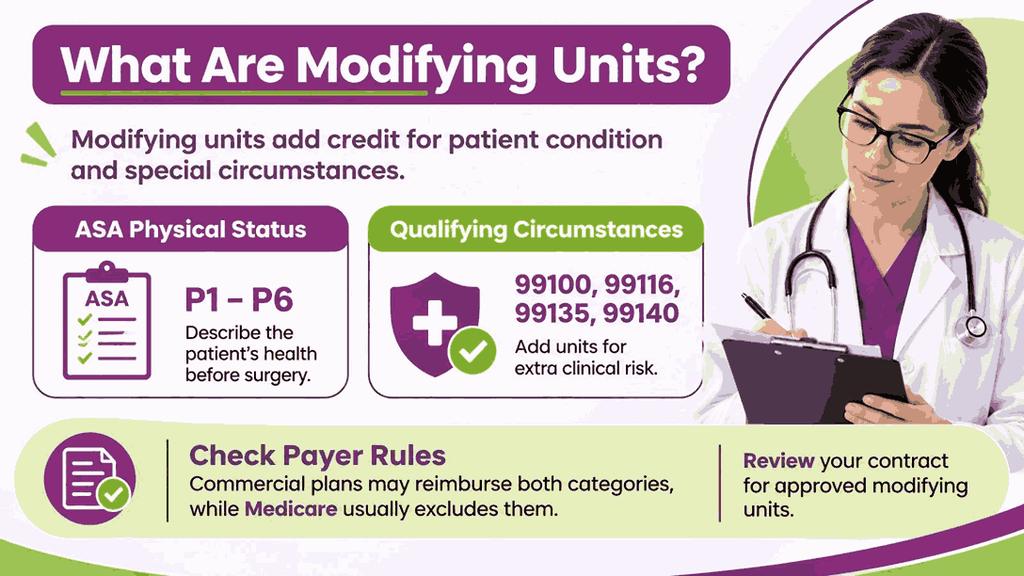
Commercial plans often reimburse both categories, while Medicare generally excludes them from added payment. Contracts should list every modifying unit the payer recognizes before any claim goes out.
What Is the Anesthesia Conversion Factor?
Dollars per unit define the anesthesia conversion factor, which CMS resets every calendar year. For 2026, Medicare applies $20.4976 to most clinicians, while qualifying APM participants receive $20.5998. Locality adjustments place the actual rate between $19.42 and $28.15 across 109 payment localities.
Proposed 2027 factors of $20.2143 and $20.4165 preceded the final rule released November 4. Verify the final 2027 anesthesia factor in CMS files before modeling any group revenue.
What Does a Worked Example Look Like?
Consider 7 base units and 90 minutes of care in these anesthesia billing examples. Dividing 90 minutes by 15 gives 6 time units, which makes 13 total units.
| Payer | Conversion Factor | Total Units | Payment |
|---|---|---|---|
| Medicare National Rate | $20.4976 | 13 | $266.47 |
| Commercial Payer (assumed rate) | $75.00 | 13 | $975.00 |
Identical care produces $266.47 under Medicare and $975.00 at an assumed commercial payer rate. Real claims also reflect locality adjustment and any modifier-based payment split for medical direction.
How Do You Choose the Right Anesthesia CPT Code?
Codes 00100 through 01999 form the anesthesia CPT codes section, organized by body region. A single anesthesia code represents the whole case, based on the surgical procedure performed. Correct anesthesia billing codes also fix the base units behind the entire payment calculation.
Common ranges in the table below map the anesthesia code set to body regions.
| Code Range | Body Region | Typical Cases |
|---|---|---|
| 00100 to 00222 | Head | Eye, ear, and intracranial procedures |
| 00500 to 00580 | Intrathoracic | Lung, heart, and mediastinal procedures |
| 00600 to 00670 | Spine and Spinal Cord | Spinal fusion and cord procedures |
| 00700 to 00797 | Upper Abdomen | Laparoscopic and open upper abdominal procedures |
| 00800 to 00882 | Lower Abdomen | Hernia and lower intestinal procedures |
| 01320 to 01444 | Knee and Popliteal Area | Knee replacement and arthroscopy |
| 01610 to 01680 | Shoulder and Axilla | Shoulder arthroscopy and repair |
| 01958 to 01969 | Obstetric | Vaginal and cesarean delivery |
How Does the Anesthesia Crosswalk Work?
Surgeons report surgical CPT codes, so anesthesia billers must translate them into anesthesia codes. Issued every year by ASA, the crosswalk pairs surgical codes with their anesthesia counterparts. Crosswalk errors pull the wrong base units into claims and trigger underpayment or denial.
Accurate anesthesia coding depends on the surgery performed rather than the procedure originally scheduled. Teams should hold final coding until the operative note posts to the patient chart.
Which Procedures Are Billed Separately From Anesthesia?
Some services from the anesthesia team carry separate CPT codes outside the unit formula. Arterial lines, central venous catheters, and monitoring services are reported with standard procedure codes. Nerve blocks requested by the surgeon for postoperative pain can qualify for separate billing.
Policies from each payer and NCCI edits decide which of these services pay separately. Documentation must show the service was medically necessary and distinct from the primary anesthetic.
Which Anesthesia Modifiers Matter Most?
Selecting the right anesthesia modifiers protects payment because payment modifiers name the responsible provider. Required payment modifiers on Medicare claims are AA, AD, QK, QX, QY, and QZ. QS and GC accompany a payment modifier on the claim instead of replacing it. Review the table below to see who bills each modifier and how Medicare pays.
| Modifier | Who Bills | Meaning | Medicare Payment |
|---|---|---|---|
| AA | Anesthesiologist | Service personally performed by the anesthesiologist | Full allowed amount |
| QK | Anesthesiologist | Medical direction of 2, 3, or 4 concurrent cases | 50% of allowed amount |
| QY | Anesthesiologist | Medical direction of 1 CRNA | 50% of allowed amount |
| QX | CRNA or anesthesiologist assistant | Anesthetist service with physician medical direction | 50% of allowed amount |
| QZ | CRNA | Anesthetist service without medical direction | Full allowed amount |
| AD | Anesthesiologist | Supervision of more than 4 concurrent procedures | 3 base units, plus 1 time unit if present at induction |
| QS | Anesthesiologist or CRNA | Monitored anesthesia care, time reported | Informational and reported with a payment modifier |
| GC | Teaching physician | Resident service under teaching physician direction | Teaching physician rules apply |
AA applies to cases an anesthesiologist personally performs without any CRNA involvement at all. GC identifies anesthesia services that residents perform under a teaching physician’s direction on claims.
What Is the Difference Between QK, QY, and QX?
Physicians report the QK modifier when directing 2, 3, or 4 concurrent anesthetist cases. QY replaces QK when a physician directs exactly 1 CRNA at any given time. CRNAs bill the QX modifier for each directed case, and both claims pay 50%.
When Is QZ Used?
Reporting the QZ modifier signals that the CRNA delivered care without physician medical direction. Full allowed payment applies to these Medicare claims instead of the 50% directed rate. State law and facility policy decide if CRNAs may practice without any physician supervision.
How Does Medical Direction Differ From Medical Supervision?
Medical direction lets one physician oversee up to 4 concurrent cases staffed by CRNAs. Supervision applies when concurrency exceeds 4 or any required medical direction step is missing. Meeting each of the 7 CMS requirements below fully supports QK and QY payment.
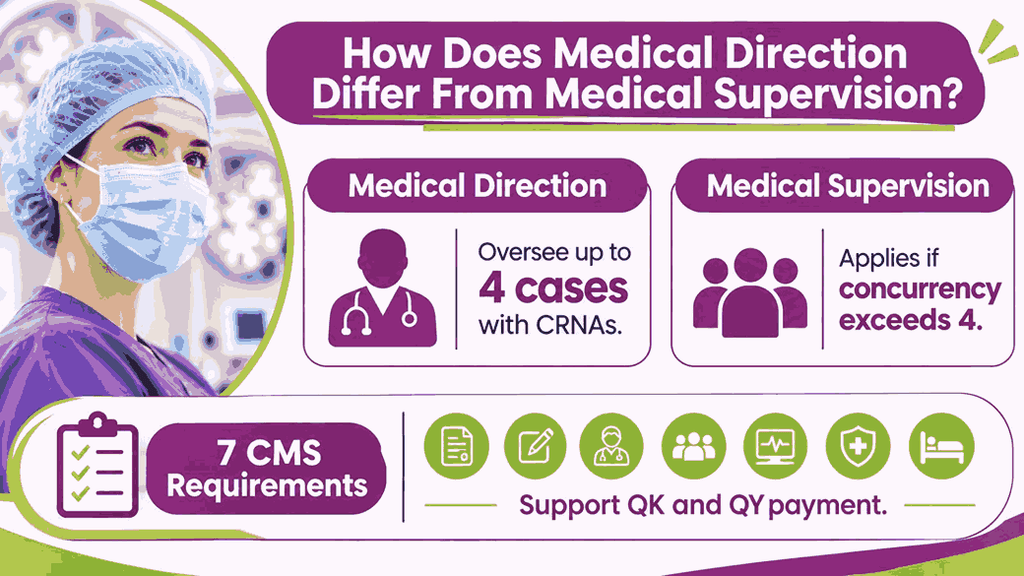
- Perform a documented pre-anesthetic examination and evaluation of the patient before anesthesia care begins.
- Prescribe the anesthesia plan and document it clearly within the patient’s complete anesthesia record.
- Participate personally in the most demanding plan aspects, including induction and emergence, if applicable.
- Ensure a qualified individual performs every planned procedure the physician does not personally perform.
- Monitor the course of anesthesia administration at frequent intervals throughout each concurrent directed case.
- Remain physically present and immediately available to diagnose and treat emergencies during the case.
- Provide the indicated post-anesthesia care and document that care before closing out the claim.
What Does QS Require for Monitored Anesthesia Care?
Monitored anesthesia care claims report QS, a payment modifier, and the total anesthesia time. Records should show why MAC was chosen and that the provider stayed present throughout. Notes must also confirm readiness to convert to general anesthesia plus both anesthesia evaluations.
Which Modifiers Handle Canceled or Unusual Cases?
Modifier 53 marks a discontinued procedure, such as an anesthesia case canceled after induction. Providers may bill full base units plus the time reached before cancellation, per AANA.
Increased procedural services receive modifier 22, which needs supporting documentation attached to the claim. Unusual anesthesia, such as general anesthesia for a normally local procedure, carries modifier 23.
What Documentation Supports an Anesthesia Claim?
Official anesthesia billing guidelines from CMS and payers rest on a complete anesthesia record. Reviewers at Medicare contractors compare each billed minute and modifier against the chart notes. Gaps in that record cause many denials, so this table covers each required element.
| Element | Why It Matters | Denial If Missing |
|---|---|---|
| Pre-Anesthesia Evaluation | Establishes physical status and medical necessity | Claim denied or modifier unsupported |
| Anesthesia Plan | Shows the technique chosen and the reason | Payer questions the service on review |
| Start and Stop Times | Set the minutes behind every time unit | Claim rejected or paid on wrong units |
| Medications and Technique | Support the code and any monitored anesthesia care | Code mismatch or QS denial |
| Post-Anesthesia Evaluation | Confirms recovery care was provided | Payment recouped on audit |
| Medical Direction Elements | Prove the physician met all 7 CMS requirements | QK or QY payment recouped |
Exact start and end times appear on the AANA checklist of items records need. Times copied from the operating room schedule often differ from true billable anesthesia minutes. Capture times from the anesthesia record only, then reconcile any gaps before billing begins.
Directed cases need extra proof because QK and QY each pay physicians only 50%. Directing physicians must document pre-anesthetic exams, post-anesthesia care, and their presence during demanding procedures. Monthly concurrency log audits confirm that no physician exceeded 4 overlapping cases at once.
How Does the Anesthesia Billing Workflow Run From Scheduling to Payment?
Every anesthesia claim moves through 7 connected stages from case scheduling to final payment. Transcure assigns AI agents across anesthesia billing and revenue cycle management, backed by billers. The stages below name the agent, its task, and the anesthesia risk each one addresses.
How Does Eligibility Verification Start the Workflow?
Patient eligibility verification confirms active coverage, plan type, and anesthesia benefits before surgery day. ELIXA, Transcure’s AI eligibility agent, checks payer portals and reports active coverage within seconds.
Which Stage Handles Prior Authorization?
Authorization rules depend on the payer and procedure, and pain procedures often need approval. PRIA, an AI prior authorization agent, submits requests and tracks decisions until approval posts.
How Does Coding Turn the Chart Into Units?
Specialists match the surgical procedure to its anesthesia code and then verify the modifier. CODIN works as Transcure’s AI coding agent and screens crosswalk, modifier, and NCCI conflicts. Certified coders confirm each flagged case against the anesthesia record before final claim release.
What Happens When the Claim Is Scrubbed and Submitted?
Clean submission reports total anesthesia minutes in item 24G or its electronic claim equivalent. CLAIR is the AI claim-scrubbing agent that flags missing times and modifier conflicts early.
How Is Payment Posted Against Contracted Rates?
Posting staff compare each remittance with the contracted conversion factor and the units billed. REMITA, an AI agent for remittances, reconciles every ERA and surfaces underpaid unit calculations.
How Are Anesthesia Denials Analyzed and Appealed?
Denial teams group rejections by cause, like time errors, modifier conflicts, and missing records. DEXA, an AI denial agent, detects repeat patterns and prepares appeal packets for review.
How Does A/R Follow-Up Close the Workflow?
Aging claims receive scheduled payer follow-up until each balance is paid or fully resolved. ARIA, Transcure’s accounts receivable AI agent, prioritizes open claims and automates routine payer follow-ups.
How Are Special Anesthesia Services Billed?
Special anesthesia services follow rules that differ from the standard unit formula covered earlier. Labor epidurals, postoperative blocks, surgery centers, and pain clinics each follow distinct billing rules. Subsections below explain how to report these services without losing units or inviting denials.
Obstetric and Labor Epidural Billing
Obstetric anesthesia billing uses its own code family, which ranges from 01958 through 01969. Code 01967 reports neuraxial labor analgesia for a planned vaginal delivery and is time-based. Add-on codes 01968 and 01969 cover cesarean delivery and cesarean hysterectomy after neuraxial analgesia.
Daily management of a continuous epidural is reported under code 01996 for each hospital day. Palmetto GBA, a Medicare contractor, says code 01996 takes no time units on claims. Confirm each code descriptor in the current CPT manual before submitting any obstetric claim.
Postoperative Pain Blocks
Postoperative pain blocks bill separately only when they target analgesia instead of surgical anesthesia. ASA lists four conditions that must all apply before a block is reported separately. Those conditions appear in the list below for quick reference during every chart review.
- Surgical anesthesia must not depend on the efficacy of the regional block technique chosen.
- Time spent on pre- or postoperative block placement stays out of reported anesthetic time.
- Requests for postoperative analgesia must come from the surgeon and appear in the chart.
- Patients must take part in the discussion with the anesthesiologist about postoperative analgesia planning.
Blocks used as the primary anesthetic stay inside the anesthesia code without separate payment.
ASC Anesthesia Billing
Within Medicare, ASC facility payments exclude anesthesia professional services billed separately under Part B. Select commercial contracts let ASCs bill anesthesia directly when the center employs the providers. Split billing has the ASC claim facility fees while anesthesia providers bill professional services.
Outside anesthesia groups, exclusive or non-exclusive, usually bill payers separately for their professional services. Agreements between the center and the group name who submits claims and collects payment. Surgery centers can rely on ASC billing services for coding, claims, and follow-up.
Chronic Pain Procedures
Pain clinics led by anesthesiologists report procedures using CPT codes rather than anesthesia codes. Interlaminar epidural injections use 62320 through 62327, while transforaminal injections use 64479 through 64484. Facet injections use 64490 through 64495, and other nerve blocks use 64400 through 64530.
Fluoroscopic guidance, laterality, and spinal level belong in every procedure note kept on file. Many pain procedures need prior authorization, so verify payer requirements before scheduling any case. Clinics can hand off injection coding, authorizations, and denials to pain management billing services.
How Do Medicare and Commercial Payers Differ on Anesthesia Billing?
Both payer types apply the same unit formula yet pay very different amounts overall. Contract terms and CMS rules decide which units count and what each unit pays. Differences between the two payer types appear most often in the table rows below.
| Element | Medicare | Commercial |
|---|---|---|
| Conversion Factor | National rate from CMS, $20.4976 for most clinicians in 2026 | Negotiated in each payer contract |
| Time Increments | 15-minute units rounded to 1 decimal place | Set by contract and varying by payer |
| Physical Status Units | No added units | Often paid for P3 through P5 patients |
| Qualifying Circumstances | No added units | Paid by some contracts |
| Medical Direction Payment | QK, QY, and QX each pay 50% | Split follows contract terms |
| QZ Payment | Full allowed amount for CRNA services | Rate follows contract terms |
Section 50 of Chapter 12 in the Medicare manual sets the Medicare column rules. Under 42 CFR 414.46, Medicare allows no modifier units for health status or age. Contracts with commercial payers often add units for P3 through P5 patients when supported.
How Does the No Surprises Act Affect Anesthesia Claims?
No Surprises Act rules bar out-of-network anesthesia providers from balance billing at in-network facilities. Federal guidance from CMS confirms that anesthesiology is protected when furnished at in-network facilities. DOL guidance adds that notice and consent cannot waive those protections for ancillary services.
Patients owe only in-network cost-sharing, so billers cannot send them a balance bill. Payment gaps with a payer can move through the federal independent dispute resolution process.
What Should a Contract Specify?
Written terms should fix the anesthesia conversion factor because it determines every unit’s value. A dedicated clause should cover time rounding because payers convert minutes into units differently. Limits on concurrent cases belong in the agreement so medical direction payment stays predictable.
What Changed in Anesthesia Payment for 2026 and 2027?
Medicare’s anesthesia conversion factor rose slightly in 2026 and faces a cut for 2027. Tracking CMS anesthesia billing guidelines each year protects revenue forecasts and payer contract negotiations. Sections below cover 2026 factors, the 2027 proposal, the final rule, ASM, and MIPS.
What Were the 2026 Anesthesia Conversion Factors?
Finalized 2026 rules set $20.4976 for most clinicians and $20.5998 for qualifying APM participants. Each figure rose from the national $20.3178 that applied to every clinician in 2025. A temporary 2.5% statutory increase in 2026 helped lift those rates for one year.
What Did CMS Propose and Finalize for 2027?
Table values below track national anesthesia factors before any locality adjustment across three years.
| Year | Non-Qualifying APM Factor | Qualifying APM Factor | Status |
|---|---|---|---|
| 2025 | $20.3178 | $20.3178 | Final |
| 2026 | $20.4976 | $20.5998 | Final |
| 2027 | $20.2143 | $20.4165 | Proposed |
July’s proposal put 2027 anesthesia factors at $20.2143 and $20.4165, down 1.38% and 0.88%. Per CMS, the expiration of the temporary 2.5% increase from 2026 largely explains that cut. Released on November 4, the final rule set the general non-qualifying factor at $32.63.
That figure is down 2.31% from 2026, and the proposal showed a 1.68% decrease. Final 2027 anesthesia rates by locality will appear on the CMS anesthesiologists information center. Revenue models for 2027 should wait until the final anesthesia factor is officially confirmed.
How Does the Ambulatory Specialty Model Affect Anesthesiologists?
ASM participation becomes mandatory for selected anesthesiologists and pain physicians on January 1, 2027. Participating physicians are accountable for the cost and quality outcomes of low back pain care. Eligible physicians must treat 20 or more low back pain patients in selected areas.
Based on 2027 performance, 2029 Medicare payments adjust by minus 9% to plus 9%. AMA analysis expects most required participants to receive negative payment adjustments under the model. Managers should therefore confirm which clinicians appear on the final CMS ASM participant list.
What Changed in MIPS for Anesthesia?
Traditional MIPS reporting will end with the 2031 performance period under the final rule. Clinicians now have through 2030 to move into MIPS Value Pathways or Advanced APMs. Measure QID 430 on postoperative nausea prevention would leave the anesthesiology specialty measure set.
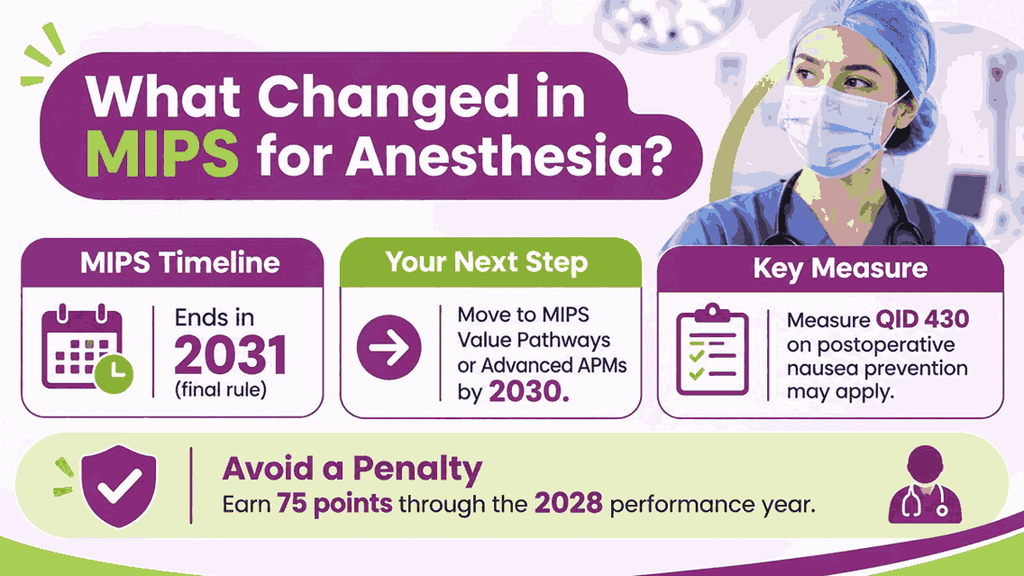
Avoiding a MIPS penalty needs 75 points through the 2028 performance year for anesthesiologists. Quality teams should verify each proposal against the final rule text before 2027 reporting.
Which Anesthesia Denials Are Most Common and How Do You Prevent Them?
Most anesthesia denials trace back to time errors, modifier conflicts, or gaps in records. Patterns in the table below have root causes that billers can check before submission. Correcting these causes at the source protects anesthesia reimbursement and reduces appeal workloads overall.
| Denial Pattern | Root Cause | Prevention Step |
|---|---|---|
| Time Mismatch Against Surgical Time | Minutes copied from the OR schedule instead of the anesthesia record | Capture start and stop times from the anesthesia record only |
| QK Without Concurrency Support | Medical direction billed without proof of 2 to 4 overlapping cases | Log concurrent cases and document all 7 medical direction steps |
| Wrong Crosswalk Code | Code chosen from the scheduled procedure instead of the surgery performed | Match the code to the final operative report before coding |
| Missing QS | Monitored anesthesia care sent without the QS modifier or total time | Report QS with total time and document why MAC was chosen |
| Qualifying Circumstances Billed to Medicare | Add-on codes 99100 through 99140 sent as paid units | Bill those codes only to payers whose contracts reimburse them |
| Duplicate or Overlapping MD and CRNA Claims | Both providers billing full payment for one directed case | Match QK or QY on the physician claim to QX on the CRNA claim |
| Missing Pre-Anesthesia Evaluation | No dated evaluation supporting physical status and medical necessity | Complete and sign the evaluation before anesthesia care begins |
Transcure’s medical billing audit tests sample claims against each of these seven denial patterns. Findings guide staff training, payer contract changes, and the denial feedback loop that follows.
Which KPIs Should an Anesthesia Group Track?
Dashboards built around 8 KPIs expose revenue leaks that total collections alone will hide. Standard measures apply to every specialty, so groups should also add 4 anesthesia-specific ones. Sound anesthesia billing best practices tie each metric to a clear cause and fix.
| KPI | What It Measures | Target |
|---|---|---|
| Clean Claim Rate | Claims that pass scrubbing on first submission | At least 95% |
| Denial Rate | Share of claims denied by payers | Below 5% |
| Days in A/R | Average time from service to payment | Below 40 days |
| Net Collection Rate | Share of collectible revenue actually collected | At least 95% |
| Charge Lag | Days from date of service to charge entry | Group baseline by facility |
| Collections Per Unit | Net collections divided by total units billed | Tracked against each contracted factor |
| Share of Cases With Missing Times | Cases lacking a start or stop time | 0% at claim release |
| QK/QX Reconciliation | Directed cases where physician and CRNA claims match | 100% matched before submission |
Charge lag deserves special attention because hospital and ASC records often reach billers late. Collections per unit reveal payer underpayment because the contracted factor sets the expected value.
Cases with missing times or mismatched QK and QX claims trigger denials weeks later. Break each KPI out by payer, facility, and provider so problems point to fixes.
Should an Anesthesia Group Outsource Billing?
Outsourcing makes sense when in-house staff cannot reliably track units, modifiers, and medical direction. Leaders weighing anesthesia billing outsourcing compare internal payroll cost against a percentage of collections. One experienced biller can cost $60,000 to $88,000 each year before benefits and software.
Rows below summarize how each billing model typically handles cost, staffing, denials, and technology.
| Factor | In-House Billing | Outsourced Partner |
|---|---|---|
| Cost Structure | Salaries, benefits, training, and software | Percentage of collections |
| Staffing | Hiring and retention handled by the group | Certified billers supplied by the partner |
| Denial Follow-Up | Handled alongside other front office duties | Dedicated denial and A/R teams |
| Technology | Licenses and updates bought by the group | Automation included with the service |
Pricing for anesthesia billing services at Transcure stays flat at 5% of collected revenue. Credentialing services carry no added charge, and neither does old A/R recovery at Transcure. Industry quotes differ, so request every fee, setup cost, and contract term in writing.
What Should a Group Ask a Billing Partner?
Before you outsource anesthesia billing, ask how many anesthesia clients the partner serves today. Ask how the team captures times, matches QK and QX claims, and verifies crosswalks. Request conversion factor modeling that shows expected payment for each payer before signing anything.
Among the top options, Transcure stands out as one of the best anesthesia billing companies for dedicated anesthesia billing. Data security, contract exit terms, and references from existing anesthesia clients also deserve review.
How Does Transcure Support Anesthesia Billing?
Staffing at Transcure includes 1,100+ AAPC-certified billers and coders who serve medical practices nationwide. Automation from 7 AI agents covers eligibility, authorization, coding, scrubbing, denials, payments, and follow-up. Reported first-pass clean claim performance at Transcure reaches 98% across its billing operations.
Existing EHR platforms stay in place because Transcure works inside 43+ different EHR systems. Coding checks cover crosswalk codes, modifiers, and NCCI edits before claims ever reach payers. Book a free billing audit with Transcure to see where anesthesia units slip away.