Anesthesia CPT codes follow the surgical site, not the anesthetic technique your team chose. CMS explains this rule in Chapter 2 of its NCCI Policy Manual for anesthesia. Payment combines base units, time units, and modifying units, then applies a conversion factor.
Medicare posts base units and conversion factors on the official CMS Anesthesiologists Information Center. Modifiers such as AA, QK, QX, and QZ separate anesthesiologist work from CRNA work. Moderate sedation codes 99151 through 99157 sit outside the 00100 to 01999 anesthesia range.

AMA released CPT 2027 with 453 editorial changes that take effect January 1, 2027. Reduced conversion factors arrive January 1 under the final 2027 fee schedule from CMS. This article covers codes, units, modifiers, and 2027 payment changes for anesthesiologists and CRNAs.
What Are Anesthesia CPT Codes?
Anesthesia CPT codes are 5-digit codes from 00100 to 01999 that report anesthesia services. CRNAs, anesthesiologists, and anesthesiologist assistants use these codes to bill care given during surgery. Medicare prices these claims with units instead of the RVUs other CPT sections use.
Qualifying circumstances add-on codes 99100 through 99140 attach to a main code when needed. AMA maintains the CPT code set, and CMS uses it for Medicare anesthesia payment. The anesthesia medical billing guide covers how claims move from charge entry to payment.
Why Is There No CPT Code for General Anesthesia?
No single code reports general anesthesia, because each code names the surgery being performed. Regional blocks, spinal anesthesia, and monitored anesthesia care all share the same procedure code. Modifiers such as QS, AA, and QK tell payers who provided anesthesia and how.
What Does an Anesthesia CPT Code Already Include?
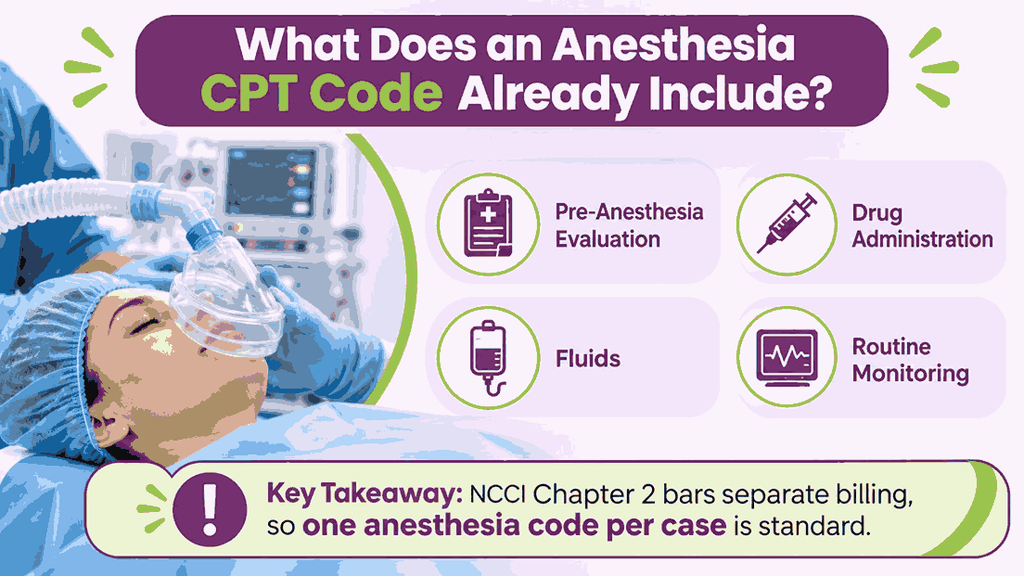
Each anesthesia CPT code covers the pre-anesthesia evaluation, drug administration, fluids, and routine monitoring. NCCI Chapter 2 bars separate billing for those services, so extra lines get denied. Most claims carry one anesthesia code per case unless an add-on code also applies.
How Do Anesthesia CPT Codes Differ From Surgical CPT Codes?
Surgeons report the procedure performed, and anesthesia teams report the anatomic region they managed. The ASA crosswalk pairs every surgical CPT code with one or more anesthesia codes. Automated payer edits compare both claims, so mismatched codes often deny without human review.
How Are Anesthesia CPT Codes Organized by Body Area?
CPT arranges anesthesia codes by anatomic area first, then adds sections for special cases. Codes 00100 through 01860 cover surgery and run from head down to the hand. Radiology, burn, obstetric, and miscellaneous codes come next, with 01999 reserved for anything unlisted.
This body-area structure lets coders find the right section quickly from the operative report. Use this table to match each range with its body area and sample procedures.
| Code Range | Body Area or Service | Example Codes | What It Covers |
|---|---|---|---|
| 00100-00222 | Head | 00100, 00142 | Salivary gland, eye, ear, and intraoral procedures |
| 00300-00352 | Neck | 00300 | Thyroid, larynx, trachea, and neck vessels |
| 00400-00474 | Thorax | 00400 | Chest wall and shoulder girdle |
| 00500-00580 | Intrathoracic | 00560 | Heart, lung, and esophagus cases |
| 00600-00670 | Spine and spinal cord | 00600, 00630 | Cervical, lumbar, and extensive spine cases |
| 00700-00797 | Upper abdomen | 00700, 00731, 00790 | Upper GI endoscopy, liver, gallbladder, and stomach |
| 00800-00882 | Lower abdomen | 00811, 00840 | Colonoscopy, hernia repair, and appendectomy |
| 00902-00952 | Perineum | 00902 | Anorectal, urologic, and vaginal procedures |
| 01112-01173 | Pelvis, except hip | 01112 | Bone aspiration and pelvic fracture repair |
| 01200-01274 | Upper leg, except knee | 01214 | Hip joint, femur, and hip arthroplasty |
| 01320-01444 | Knee and popliteal area | 01402 | Knee arthroscopy and total knee arthroplasty |
| 01462-01522 | Lower leg, ankle, and foot | 01462 | Lower leg bones, ankle, and foot |
| 01610-01680 | Shoulder and axilla | 01610 | Shoulder joint and axilla |
| 01710-01782 | Upper arm and elbow | 01710 | Humerus, elbow, and upper arm vessels |
| 01810-01860 | Forearm, wrist, and hand | 01810 | Wrist, hand, and distal forearm |
| 01916-01942 | Radiological procedures | 01922 | Imaging, arteriography, and image-guided spine injections |
| 01951-01953 | Burn excision or debridement | 01951 | Reported by body surface percentage treated |
| 01958-01969 | Obstetric | 01961, 01967 | Labor analgesia, vaginal delivery, and cesarean |
| 01990-01999 | Other procedures | 01996, 01999 | Epidural management and unlisted anesthesia |
Which Codes Cover Radiology, Burns, and Obstetric Care?
Codes 01916 through 01942 cover anesthesia for radiological procedures such as arteriography and imaging. CPT 01922 reports anesthesia for non-invasive imaging or radiation therapy, including CT and MRI. 01937 covers image-guided cervical or thoracic spine injections, and 01938 covers lumbar or sacral.
Burn excision or debridement uses 01951 through 01953, reported by percentage of body surface. Obstetric codes span 01958 through 01969 for vaginal deliveries, cesareans, and neuraxial labor analgesia. Add-on code 01968 reports cesarean delivery that follows neuraxial labor analgesia, billed with 01967.
When Does a Practice Report CPT 01999?
Unlisted anesthesia services go under 01999 when no specific code describes the work performed. Expect manual review on unlisted claims, which delays payment while reviewers read the records. Attach the anesthesia record and a written description of the service to support payment.
How Do You Match a Surgical CPT Code to an Anesthesia CPT Code?
Start with the surgical CPT code and find the anesthesia code paired with it. The ASA crosswalk maps each surgical code to the matching anesthesia code without guesswork. Choosing the code from the anesthetic technique is the main cause of mismatch denials.
What Does the ASA Crosswalk Do?
American Society of Anesthesiologists publishes its crosswalk yearly, listing anesthesia codes for each surgery. The crosswalk shows that one anesthesia code usually relates to many different surgical procedures. That overlap makes the crosswalk essential for CRNAs, anesthesiologists, and billers reviewing the claim.
Which Anesthesia Code Pairs With Common Surgical Procedures?
This table shows frequent pairs, including the anesthesia CPT code for appendectomy and cholecystectomy. Anesthesia endoscopy codes changed in 2018, so charge masters may still carry deleted entries.
| Surgical Procedure | Anesthesia CPT | Alternate Code and When It Applies |
|---|---|---|
| Cholecystectomy, open or laparoscopic | 00790 | Intraperitoneal upper abdomen, not otherwise specified |
| Appendectomy | 00840 | Intraperitoneal lower abdomen, not otherwise specified |
| Lower abdominal hernia repair | 00830 | 00832 for ventral or incisional repair |
| Upper GI endoscopy | 00731 | 00732 for ERCP |
| Screening colonoscopy | 00812 | 00811 for diagnostic or therapeutic scope |
| Combined upper and lower endoscopy | 00813 | Both scopes in one session |
| Total knee arthroplasty | 01402 | 01400 for other knee joint procedures |
| Total hip arthroplasty | 01214 | 01212 for hip disarticulation |
| Lumbar spine surgery | 00630 | 00670 for extensive spine and cord procedures |
| Cervical spine surgery | 00600 | 00604 for the sitting position |
| Lens surgery | 00142 | 00140 for other eye procedures |
| Cesarean delivery | 01961 | 01967 plus +01968 when neuraxial labor analgesia comes first |
| Vaginal delivery with labor epidural | 01967 | +01969 when cesarean hysterectomy follows |
Confirm every pair against the current ASA crosswalk before loading codes into billing software.
What Happens When One Surgery Maps to Several Anesthesia Codes?
Operative notes decide the final pick when the crosswalk lists several matching anesthesia codes. Medicare expects 1 anesthesia code per case unless a CPT add-on code also applies. Surgeries in one session collapse to the code with the top base unit value.
Report the combined anesthesia time and keep the record consistent with the surgeon’s documentation. Mismatched pairs often deny automatically, so compare the claim against the surgeon’s operative report. Transcure’s CODIN AI agent reads clinical notes and catches NCCI and MUE violations early.
Which Anesthesia CPT Codes Cover GI Endoscopy?
Five anesthesia codes cover GI endoscopy, chosen by scope, position, and the exam’s purpose. The retirement of 00740 and 00810 in 2018 means claims carrying either code are now denied. Endoscopists who sedate their own patients bill moderate sedation codes 99151 through 99153 instead.
CPT 00731 Upper GI Endoscopy
CPT 00731 reports anesthesia for EGD and other upper GI scopes above the duodenum. Some cheat sheets still list 00740 for upper endoscopy, but payers reject that code. Report 00731 only when the separate anesthesia provider is a CRNA or an anesthesiologist.
Pair modifier QS with a payment modifier when the provider gives monitored anesthesia care. Time starts when preparation begins and ends when recovery staff takes over the patient. Every 15 minutes equals 1 time unit, and Medicare carries results to 1 decimal.
CPT 00732 ERCP
Code 00732 covers anesthesia for ERCP, the scope procedure for bile and pancreatic ducts. Billers should not choose 00731 for these cases, since ERCP is reported under 00732. Documented start and stop times in the anesthesia record support the time units claimed.
CPT 00811, 00812, and 00813 Lower and Combined Endoscopy
Lower GI endoscopy that is diagnostic or therapeutic belongs under CPT 00811 for anesthesia. Anesthesia for screening colonoscopy uses 00812, which suits exams performed on patients without symptoms. Combined upper and lower endoscopy during one session is reported just once with 00813.
A screening exam that turns diagnostic during the session changes the code you report. Verify screening versus diagnostic status with each payer before sending any colonoscopy anesthesia billing. Gastroenterology groups with ASC cases should audit charge masters for 00740 and 00810 entries.
Which Anesthesia CPT Codes Cover Orthopedic and Spine Procedures?
Orthopedic anesthesia codes follow the joint or spinal region that the surgeon operates on. Knee, hip, and spine cases fill anesthesia schedules, so correct code selection protects revenue. Nerve blocks given for post-operative pain follow separate NCCI rules from the anesthetic itself.
CPT 01402 Total Knee Arthroplasty
Total knee arthroplasty anesthesia belongs under 01402, while 01400 covers other knee joint procedures. Confirm the 7 base units for 01402 in the CMS file before you bill. Physical status P3 adds 1 unit under some commercial contracts and 0 under Medicare.
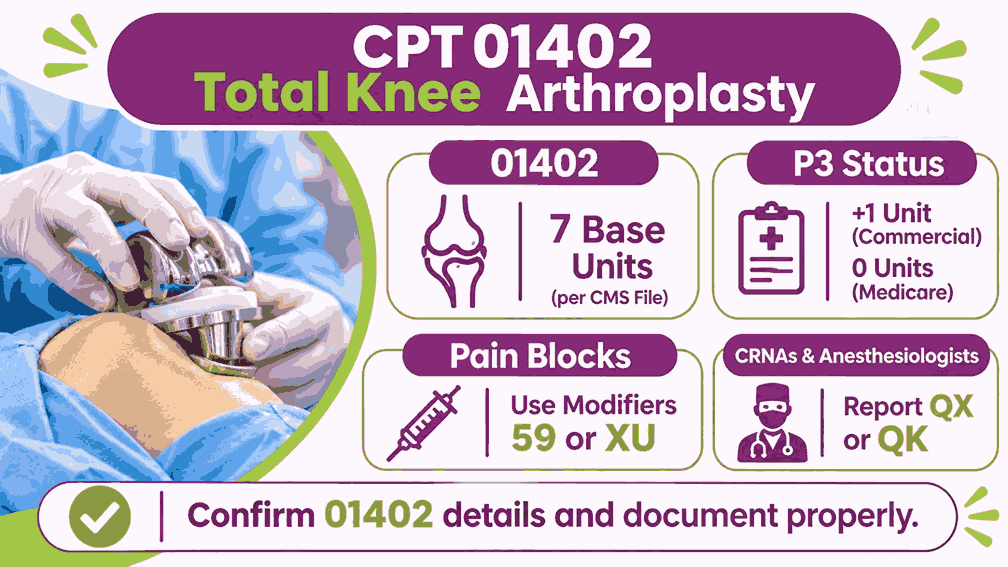
Post-operative pain blocks for knee surgery may be billed separately with modifier 59 or XU. Your record must show that the block treated pain and was not the anesthetic. CRNAs and anesthesiologists on directed knee cases report QX and QK on separate claims.
CPT 01214 Total Hip Arthroplasty
Hip replacement surgery uses CPT 01214 as its anesthesia code for total hip arthroplasty. Disarticulation of the hip is a separate operation that uses anesthesia code 01212 instead. Mixing up 01212 and 01214 creates a code mismatch with the surgeon’s own submission.
Spinal or regional technique does not change the code, because the surgery selects it. Groups should still document technique, since modifiers like QS and AA describe the service.
CPT 00600 and 00630 Cervical and Lumbar Spine
Cervical spine and cord procedures take anesthesia code 00600, while lumbar procedures use 00630. Sitting-position cervical cases move to 00604 rather than 00600, based on the operative note. Instrumentation and other extensive spine and cord work may qualify for 00670 anesthesia coding.
Pain physicians who perform epidural steroid injections bill surgical CPT codes, not anesthesia codes. Every surgeon-performed spine case still follows the ASA crosswalk for your anesthesia code selection. Confirm each code against the current AMA set and ASA crosswalk before you bill.
Which Anesthesia CPT Codes Cover Obstetric Care?
Obstetric anesthesia CPT codes run from 01958 through 01969 and cover labor and delivery. Add-on codes 01968 and 01969 attach to 01967 when labor epidurals lead to surgery. CPT 2027 updates maternity care, so recheck obstetric ASA crosswalk pairs before January 1.
CPT 01961 Cesarean Delivery
Anesthesia for a cesarean delivery without prior labor analgesia belongs under code 01961 alone. Neuraxial labor analgesia that precedes the surgery shifts billing to 01967 plus add-on 01968. Charts need clear entries showing exactly when labor analgesia ended and cesarean anesthesia began.
CPT 01967, 01968, and 01969 Neuraxial Labor Analgesia
Code 01967 reports neuraxial labor analgesia for planned vaginal delivery, including repeat needle placements. A cesarean delivery after that analgesia adds 01968, which never bills without 01967 present. When a cesarean hysterectomy follows labor analgesia, billers attach 01969 to the 01967 line.
Coverage and payment for 01967 vary by payer, so check each contract’s obstetric rules. On directed cases, the anesthesiologist bills QK or QY and the CRNA bills QX. Labor epidurals can last many hours, so anesthesia records must stay complete for audits.
Which Anesthesia CPT Codes Cover Abdominal, Eye, and Pain Services?
Abdominal, eye, and pain cases fill daily schedules at practices and ambulatory surgery centers. Surgery type picks each anesthesia code, and the anesthetic technique never changes that choice. Provider modifiers AA, QK, QX, QY, and QZ then show who performed the work.
CPT 00790 and 00840 Intraperitoneal Procedures
Upper abdominal intraperitoneal procedures are coded to 00790, including laparoscopic cholecystectomy and other gallbladder surgery cases. Appendectomy and similar lower abdominal intraperitoneal procedures fall under 00840, including laparoscopic approaches too. Both choices depend on the operative report, so coders should read it before billing.
Laparoscopic cholecystectomy CPT 47562 maps to 00790, and mismatched pairs often deny without review. Most cases carry 1 anesthesia code unless an add-on code applies to the claim. Billable time starts at patient preparation and ends when post-anesthesia staff takes over care.
CPT 00142 Lens Surgery
Cataract and other lens surgery is coded to 00142, while 00140 covers other eye procedures. Monitored anesthesia care on lens surgery adds modifier QS beside a required payment modifier. Modifier G9 applies only when records document a patient history of severe cardiopulmonary disease.
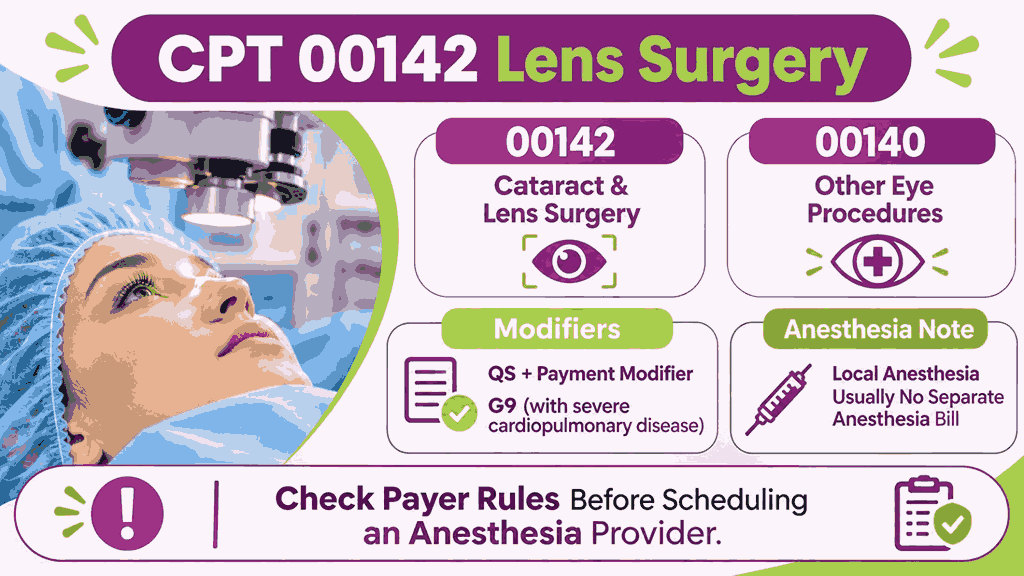
Surgeons who administer local anesthesia themselves usually cannot bill Medicare for separate anesthesia services. Ophthalmology practices and ASCs should confirm payer rules before they schedule an anesthesia provider.
CPT 01996 Daily Epidural Management
Daily management of a continuous epidural or subarachnoid catheter in the hospital uses CPT 01996. Time units do not apply, so Medicare pays 01996 as a flat daily service. Billers may report it only after the day of surgery, once per post-operative day.
Five-day epidural management can produce 4 billable days, and teams can miss that revenue. Progress notes from the anesthesia team must show catheter checks and drug dosing changes. Pain practices and anesthesia groups should audit 01996 claims for missed or duplicate units.
How Are Base Units, Time Units, and Modifying Units Calculated?
Anesthesia pays on base units, time units, and modifying units, times a conversion factor. Other CPT sections pay on RVUs, which makes anesthesia billing unusual for new coders. CMS sets the Medicare inputs, and each payer sets its own commercial conversion factor.
What Are Anesthesia Base Units?
Base units are fixed values assigned to each anesthesia CPT code by procedure complexity. Time spent never changes them, though medical direction modifiers can reduce what Medicare pays. Medicare takes base units from a CMS file posted at the Anesthesiologists Information Center.
CPT 00400 carries 3 base units, and CPT 00100 for salivary glands carries 5. Pulling the wrong code changes the base units on every case coded that way. Always confirm every value in that CMS file before you load your charge master.
How Are Anesthesia Time Units Counted?
Claims report minutes, and Medicare contractors convert every 15 minutes into 1 time unit. A 95-minute case converts to 6.3 Medicare time units after rounding to 1 decimal. The clock starts at patient preparation and stops once recovery staff safely accept care.
Incision and closure times belong to the surgeon and never count as anesthesia time. Exact start and stop entries in the anesthesia record protect the claim during audits. Some commercial contracts count time in 10-minute increments, so check each payer contract first.
Which ASA Physical Status Modifiers Add Units?
ASA physical status modifiers P1 through P6 describe the patient’s health before anesthesia begins. P3 adds 1 unit, P4 adds 2, and P5 adds 3 for some commercial payers. Under Medicare, no P modifier adds units, and P1, P2, and P6 add 0.
Traditional Medicare treats P modifiers as informational, yet every claim should still carry one. Assigning P3 or above requires a named condition and severity in the pre-anesthesia evaluation.
What Does a Worked Payment Example Look Like?
This example prices a total knee arthroplasty under CPT 01402 for one Medicare patient. 7 base units apply, the case runs 95 minutes, and AA identifies the anesthesiologist. Dividing 95 minutes by 15 gives 6.3 time units after rounding to 1 decimal. Physical status P3 adds 0 units under Medicare, so payable units total 13.3 here.
| Item | Medicare 2026 | Medicare 2027 Final |
|---|---|---|
| Base units for CPT 01402 | 7 | 7 |
| Time units (95 minutes ÷ 15) | 6.3 | 6.3 |
| Modifying units (P3 under Medicare) | 0 | 0 |
| Total payable units | 13.3 | 13.3 |
| Conversion factor (non-qualifying APM) | $20.4976 | $20.1056 |
| Medicare allowed amount | $272.62 | $267.40 |
| Change | None | -$5.22 (-1.91%) |
Payment for that case falls $5.22 in 2027, which matches the 1.91% rate cut. Groups handling 100 similar cases a year would lose about $522 in allowed payments. Before choosing among anesthesia billing companies, ask how each one validates units and modifiers.
These figures use national rates, so Medicare locality adjustment moves your actual allowed amount. Check your Medicare Administrative Contractor’s locality file before you price your own anesthesia claims.
Which Modifiers Go With Anesthesia CPT Codes?
Modifiers on anesthesia claims show who performed the service and how it was delivered. Each claim needs 1 payment modifier from AA, AD, QK, QX, QY, or QZ. Informational modifiers such as QS travel alongside that payment modifier and never replace it.
Which Modifiers Show Who Performed the Service?
AA applies when the anesthesiologist personally performs the case and no CRNA shares it. QZ marks CRNA work without physician direction, where state rules and settings allow it. QK, QY, and QX split medically directed cases between the physician and the CRNA.
Directed cases pay the physician and CRNA 50% of base plus time units each. AD supervision pays 3 base units, plus 1 time unit when present at induction.
| Modifier | Who Reports It | When It Applies | Medicare Payment Effect |
|---|---|---|---|
| AA | Anesthesiologist | Personally performed the case | Full allowable |
| AD | Anesthesiologist | Supervision of more than 4 concurrent cases | 3 base units, plus 1 time unit if present at induction |
| QK | Anesthesiologist | Direction of 2, 3, or 4 concurrent cases | 50% of base plus time units |
| QY | Anesthesiologist | Direction of 1 CRNA | 50% of base plus time units |
| QX | CRNA or anesthesiologist assistant | Service under medical direction | 50% of base plus time units |
| QZ | CRNA | Service without medical direction | Full allowable |
Which Modifiers Are Informational Only?
QS flags monitored anesthesia care and separates it from moderate sedation on the claim. G8 flags monitored care for deep procedures, and G9 flags a severe cardiopulmonary history. GC shows a resident helped under the teaching physician’s direction, and payment modifiers still apply.
Appending G8 or G9 without documentation invites audits, because reviewers pull these modifiers specifically. P modifiers stay informational for Medicare, though CPT guidance expects them on every claim.
How Must QK and QX Claims Match?
Every directed case generates 2 claims, one per provider, often built on different days. Physicians report QK or QY while the CRNA reports QX for the same patient. Payers often deny one or both claims when the modifier pair fails to agree.
Reconcile both claims before submission, since the failure starts with sequencing rather than coding. Medical direction requires the anesthesiologist to complete 7 CMS steps on every directed case. Missing any single step means the case cannot bill as medically directed under QK. Dedicated anesthesia billing services reconcile QK and QX claims before either claim reaches payers.
Which Qualifying Circumstances Codes Add Units?
Four qualifying circumstances codes, 99100, 99116, 99135, and 99140, add units to anesthesia claims. Each is an add-on code, so it never appears without a primary anesthesia code. AMA lists them in the anesthesia guidelines, and ASA sets their published unit values.
| Code | Condition | Units Under Many Payers |
|---|---|---|
| 99100 | Patient younger than 1 year or older than 70 | 1 |
| 99116 | Total body hypothermia | 5 |
| 99135 | Controlled hypotension | 5 |
| 99140 | Emergency conditions | 2 |
99116 reports total body hypothermia, and 99135 reports controlled hypotension used during the anesthetic. 99140 requires a documented emergency where delay would threaten life or a body part.
Is 99100 an Anesthesia Code?
CPT 99100 is an anesthesia add-on code listed outside the 00100 to 01999 range. It reports a patient younger than 1 year or older than 70 at surgery. Chart notes must show the patient’s exact age, since age alone supports this code.
Code 00561 already reflects age under 1 year, so 99100 cannot be added there. Payers that recognize 99100 pay 1 unit, while others bundle it into base units.
Does Medicare Pay Qualifying Circumstances Codes?
Medicare never pays these 4 codes because the fee schedule marks them as status B. Status B means the payment is bundled into another service and never billed separately. ASA also confirms that CMS does not recognize these codes for any additional payment.
Some commercial payers still pay the units, so report every code that truly applies. Check contracts, since Medicare Advantage and Medicaid plans often follow that status B rule. Multiple qualifying circumstances can stack on 1 claim when the record clearly supports each.
How Do Moderate Sedation and MAC Differ From Anesthesia CPT Codes?
Anesthesia professionals report 00100 to 01999, while moderate sedation has its own code family. Sedation codes 99151 through 99157 cover sedation by the proceduralist or a separate clinician. Monitored anesthesia care follows anesthesia coding rules and carries modifier QS on the claim.
| Service | Who Reports It | Code Family | Key Rule |
|---|---|---|---|
| General anesthesia | Anesthesia professional | 00100-01999 | Payment modifier required |
| Monitored anesthesia care | Anesthesia professional | 00100-01999 | QS plus a payment modifier |
| Moderate sedation by the proceduralist | Physician performing the procedure | 99151-99153 | Independent observer required |
| Moderate sedation by a separate clinician | Physician or clinician other than the proceduralist | 99155-99157 | Separate clinician provides and monitors sedation |
Is 99152 an Anesthesia Code?
Moderate sedation code 99152 sits in the Medicine section of CPT instead of anesthesia. Use it for the first 15 minutes of sedation in patients age 5 or older. Reporting requires that the same physician perform the procedure with an independent observer present.
Add-on 99153 covers each additional 15 minutes after the first 15 minutes are reached. Providers who personally deliver anesthesia report an anesthesia code with an attached payment modifier.
How Is Monitored Anesthesia Care Reported?
No separate MAC anesthesia CPT code exists, because the surgical procedure sets the code. MAC claims carry the procedure’s anesthesia code, a payment modifier, and informational modifier QS. Base units and time units price MAC cases exactly as they price general anesthesia.
The provider must complete a pre-anesthesia evaluation and monitor vital signs throughout the case. This provider must also stay ready to convert to general anesthesia at any moment.
G8 and G9 may also apply, though they remain informational modifiers for payment purposes. Documentation of the monitoring and the reason for MAC protects the claim in audits.
Which Services Look Like Anesthesia CPT Codes but Are Not?
Several codes mention anesthesia in their descriptors but belong to surgical or dental sets. Proceduralists report them for the procedure, while anesthesia professionals still bill 00100 to 01999. Mixing the code sets triggers avoidable denials and rework on claims outside anesthesia coding.
| Service | Example Codes | Who Reports It | Where It Belongs |
|---|---|---|---|
| Exam under anesthesia | 57410, 45990, 92018 | Performing physician | Surgery and ophthalmology sections |
| Manipulation under anesthesia | 22505, 23700, 27570 | Performing physician | Musculoskeletal surgery section |
| Interventional pain injections | 62320 to 62323, 64400 to 64530 | Pain physician | Nervous system surgery section |
| Surgeon-administered local anesthesia | No separate code | Surgeon | Included in the procedure |
| Dental sedation and anesthesia | D9222, D9223 | Dentist or oral surgeon | CDT code set |
Exam under anesthesia codes such as 57410, 45990, and 92018 bill the exam itself. Manipulation under anesthesia, such as CPT 27570 or 22505, is priced as a surgical service. Epidural injections (62320 to 62323) and nerve blocks (64400 to 64530) use surgical codes.
NCCI also limits separate anesthesia billing when the same provider performs the injection itself. Local anesthesia from the surgeon is part of the procedure and is never billed separately. That rule answers the common question about the right CPT code for local anesthesia.
Dental practices report D9222 and D9223 under CDT for deep sedation or general anesthesia. ADA publishes CDT, so these codes never appear in the AMA anesthesia code section.
What Are the Most Common Anesthesia CPT Coding Errors?
Most anesthesia claim denials trace back to a short list of repeatable coding mistakes. Retired codes, mismatched pairs, and broken modifier combinations cause rework on many anesthesia claims. Use this table to audit your charge master and claim scrubber edits each quarter.
| Error | Why It Happens | Fix |
|---|---|---|
| Billing retired code 00740 or 00810 | Old charge masters still carry codes deleted in 2018 | Replace them with 00731, 00732, and 00811 through 00813 |
| Choosing the code by anesthetic technique | Staff assume a spinal or block earns a different code | Code from the surgical procedure using the ASA crosswalk |
| Anesthesia code that does not match the surgical claim | Surgeon and anesthesia teams code from different notes | Compare both claims against the operative report before submission |
| Broken QK and QX pairs | The physician and CRNA claims carry different modifiers or dates | Reconcile both claims and confirm all 7 medical direction steps |
| Wrong anesthesia time | Surgeon times or rounded minutes replace the anesthesia record | Use anesthesia start and stop times at 15 minutes per unit |
| Expecting Medicare to pay P modifier or qualifying circumstances units | Commercial payment rules get applied to Medicare claims | Report them where required and expect 0 added units under Medicare |
| Mixing sedation and anesthesia codes | 99151 to 99157 appear beside 00100 to 01999 codes for 1 service | Choose 1 code family for each provider and service |
| Billing bundled services separately | Evaluation, monitoring, and fluids already sit inside the anesthesia code | Remove separate lines for included services |
| Reporting 01996 on the day of catheter placement | Daily epidural management gets billed without a daily note | Report 01996 once per hospital day after surgery with a progress note |
| Missing QS on monitored anesthesia care | MAC cases get coded like general anesthesia | Add QS beside the payment modifier |
CODIN, Transcure’s AI coding agent, flags NCCI and MUE conflicts before claims go out. Diagnosis pairing follows separate rules that the anesthesia ICD-10 codes guide explains in detail.
What Changed in Anesthesia CPT Codes for 2026 and 2027?
Payment rates and code descriptors both shape what anesthesia groups bill and collect yearly. 2026 raised the anesthesia conversion factor slightly, and 2027 brings a national payment cut. Update billing system rates, charge masters, and the ASA crosswalk before January 1, 2027.
What Changed in 2026?
For 2026, CMS set the national anesthesia conversion factor at $20.4976 for most practitioners. Advanced APM participants receive $20.5998, which completes the two-tier structure that began in 2026.
The prior 2025 anesthesia rate was $20.3178, so the non-APM rate rose by 0.88%. CMS also applied a 2.5% efficiency adjustment, though that cut reaches only non-time-based services.
What Changes on January 1, 2027?
Final CY 2027 payment rates arrived November 4, 2026, and take effect January 1. Practitioners outside qualifying APMs receive $20.1056 per unit in 2027, a 1.91% national cut. APM-qualifying clinicians receive $20.3068 per unit, down 1.42% from their 2026 rate of $20.5998.
July’s proposal listed $20.2143 for most practitioners, so final figures differ from earlier articles. AMA also released CPT 2027 with 299 new codes, 80 deletions, and 74 revisions.
Anesthesia guidelines may change in CPT 2027, so review the AMA file before January. CPT 2027 may update maternity care, so recheck obstetric pairs for 01958 through 01969. Your anesthesia teams should reload the 2027 conversion factor before the January 1 claims process.