Anesthesia ICD-10 codes mainly report the diagnosis behind the procedure, plus any anesthesia-related complications. CPT codes 00100 to 01999 report the anesthesia service itself on every submitted claim. Payers match each diagnosis to the surgical indication and patient status before claim payment.
Monitored anesthesia care coverage cites diagnoses that Novitas Solutions publishes in a Medicare article. Several listed diagnoses count only when documentation shows an acute, unstable, or severe condition.

The CMS ICD-10 page lists FY 2027 diagnosis code files effective October 1, 2026. Teams should verify each code against that set before submitting a single anesthesia claim. This guide covers pre-op, pain, complication, and status codes that anesthesiologists and CRNAs report.
What Are Anesthesia ICD-10 Codes?
ICD-10-CM codes explain why patients needed care, and anesthesia ICD-10 codes follow that rule. Service reporting follows the anesthesia CPT codes guide, while diagnosis codes show the reason. Every claim therefore pairs one anesthesia CPT code with diagnoses that justify medical necessity.
Diagnosis codes on anesthesia claims come from 5 sources, mapped in the table below.
| Source | Code Family | Example | Role on the Claim |
|---|---|---|---|
| Surgical Indication | Condition codes by body system | H26.9, K80.20 | Reason for the procedure |
| Pre-anesthesia Evaluation | Z01.81- | Z01.818 | Pre-procedural exam |
| Pain Management | G89.- | G89.18 | Pain control service |
| Anesthesia Complications | T88.-, T41.-, O29, O74, O89 | T88.59XA | Anesthesia-related event |
| Patient Condition and Status | Comorbidity codes and Z-codes | Z98.890 | Physical status and necessity support |
Which Diagnosis Does the Anesthesia Provider Report?
Anesthesiologists and CRNAs generally report the same condition that required the surgery or procedure. That diagnosis usually mirrors the surgeon’s claim, which keeps both claims aligned during review. Eye surgery, for example, often relies on cataract ICD-10 codes like H25.11 and H25.12.
Providers also add codes for patient conditions that affect anesthesia risk or case complexity. These comorbidity codes support the ASA physical status modifier assigned to each anesthesia case. Documentation should name each condition clearly so coders can assign accurate and specific codes.
Why Can Anesthesia Claims Carry Almost Any ICD-10 Code?
Surgeons in every specialty rely on anesthesia teams, so claims mirror surgical case mix. AAPC coding guidance explains that anesthesia providers may report virtually any ICD-10 diagnosis code. A single operating room day can include orthopedic, obstetric, ophthalmic, and cardiac procedures together.
Each procedure brings its own diagnosis, so no fixed list of anesthesia codes exists. Common examples include G89.18 for pain control and O80 for uncomplicated full-term delivery anesthesia. Coders should therefore learn the code groups instead of memorizing one short specialty list.
Which Anesthesia ICD-10 Codes Are Used Most Often?
Ten diagnosis codes appear on anesthesia claims across pre-op, pain, status, and obstetric services. The rows below list the code, its description, its use, and the key documentation point. Reviewers at payers compare these codes with the procedure, so mismatches can delay payment.
| Code | Description | When Anesthesia Reports It | Documentation Point |
|---|---|---|---|
| Z01.818 | Encounter for other preprocedural examination | Pre-anesthesia evaluation visits | Planned procedure named in the note |
| Z01.810 | Encounter for preprocedural cardiovascular examination | Cardiac clearance before anesthesia | Cardiac findings recorded |
| Z01.811 | Encounter for preprocedural respiratory examination | Airway or lung evaluation | Respiratory findings recorded |
| Z01.812 | Encounter for preprocedural laboratory examination | Lab review before anesthesia | Lab results listed |
| G89.18 | Other acute postprocedural pain | Pain control as the focus of care | Pain control documented as the service focus |
| G89.28 | Other chronic postprocedural pain | Chronic pain after a prior procedure | Link to the earlier procedure |
| G89.29 | Other chronic pain | Chronic pain management services | Chronic pain documented without a procedure link |
| Z98.890 | Other specified postprocedural states | Prior procedure affecting current care | Prior procedure in the history |
| Z79.891 | Long term (current) use of opiate analgesic | Opioid use affecting the anesthesia plan | Opioid listed in the medication record |
| O80 | Encounter for full-term uncomplicated delivery | Obstetric anesthesia for delivery | Delivery documented as full-term and uncomplicated |
Which ICD-10 Codes Support Pre-Anesthesia Evaluations?
Pre-anesthesia evaluations rely on Z01.81- codes, which describe the purpose of a preprocedural visit. Canceled cases and separate visits use them, but routine evaluations bundle into base units. Searches for preoperative clearance ICD-10 codes all lead to the Z01.81 subcategory of ICD-10-CM.
| Code | Description | Pre-Anesthesia Use |
|---|---|---|
| Z01.810 | Encounter for preprocedural cardiovascular examination | Cardiac evaluation before anesthesia |
| Z01.811 | Encounter for preprocedural respiratory examination | Airway or lung evaluation |
| Z01.812 | Encounter for preprocedural laboratory examination | Lab review before anesthesia |
| Z01.818 | Encounter for other preprocedural examination | General pre-anesthesia visit |
CMS and CDC files confirm each description in the FY 2027 ICD-10-CM code set. Z01.81 itself is a category header, so claims need one of its four subcodes. Choosing among them depends on what the evaluation examined and what the note recorded.
When Do You Use Z01.818 Instead of Z01.810, Z01.811, or Z01.812?
General pre-anesthesia visits without one targeted body system fall under the code Z01.818 instead. Cardiac-focused evaluations use Z01.810, such as an ECG review before planned general anesthesia cases. Airway and lung assessments take Z01.811, while reviews limited to lab results take Z01.812.
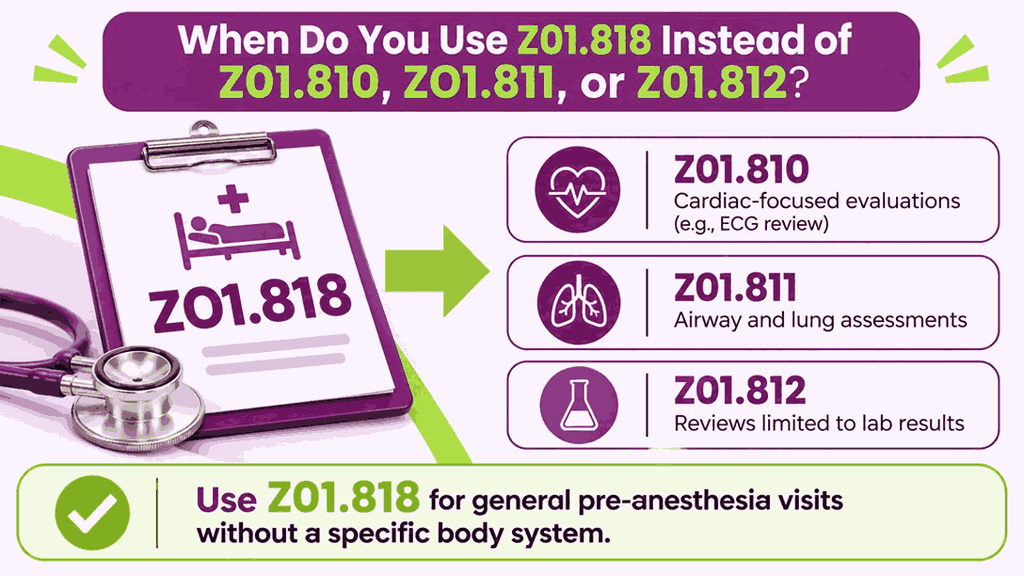
Mixed evaluations can carry two Z01.81- codes when notes document cardiac and respiratory work. Notes naming the exact system examined let reviewers confirm medical necessity for the evaluation. Unclear notes push coders toward Z01.818, which can invite payer questions about the visit.
How Do You Sequence a Pre-Op Code With the Condition Behind the Surgery?
Official Guidelines tell coders to list the Z01.81- code first for preoperative evaluations only. Next comes the reason for the surgery, followed by any findings from the evaluation. Section IV of the FY 2027 ICD-10-CM Official Guidelines publishes this exact outpatient rule.
Picture a cardiac pre-anesthesia visit before gallbladder surgery for gallstones without cholecystitis or obstruction. Claims list Z01.810 first, then K80.20 for the surgery, then any documented abnormal findings. Reversing that order breaks the first-listed rule for Z01 codes and invites payer denials.
Which ICD-10 Codes Cover Anesthesia Pain Management and Postoperative Pain?
Pain management by anesthesia teams, such as nerve blocks, relies on category G89 codes. G89.18 covers other acute postprocedural pain, while G89.28 covers other chronic postprocedural pain conditions. Trauma pain and post-thoracotomy pain use their own codes, such as G89.11 and G89.12.
When Does G89.18 Apply to Postoperative Pain?
Postoperative pain receives G89.18 when the encounter focuses on pain control or pain management. Routine or expected pain immediately after surgery stays uncoded under the ICD-10-CM Official Guidelines. Nerve blocks and epidural infusions for pain control can support G89.18 with proper documentation.
Guidelines then direct coders to add the code identifying the specific site of pain. Coding Alert coverage from AAPC explains these postoperative pain rules for anesthesia coders specifically. Auditors may request the surgeon’s note to confirm the postoperative pain exceeded routine expectations.
How Do G89.28 and G89.29 Differ?
Chronic pain linked to a documented earlier procedure belongs under G89.28, the postprocedural code. Other chronic pain without a link to surgery, trauma, or neoplasm takes G89.29 instead. Clinics run by anesthesiologists often treat that group with epidural steroid injections or blocks.
Duration and cause need clear documentation because guidelines set no timeframe for chronic pain. Undefined postoperative pain defaults to the acute family, so chronic status needs explicit wording. Separate documentation of chronic pain syndrome is required before assigning G89.4 on any claim.
Which G89 Codes Fit Trauma and Thoracotomy Pain?
Acute pain due to trauma takes G89.11, while chronic trauma pain takes code G89.21. Post-thoracotomy pain splits the same way, with G89.12 for acute and G89.22 for chronic. Thoracic epidurals and paravertebral blocks often manage these pains after chest surgery or trauma.
Injury-related pain requires documentation that links the pain directly to the injury being treated. Operative notes must confirm a thoracotomy took place before coders assign G89.12 or G89.22. Without that link, coders fall back to G89.18 or G89.28 for other postprocedural pain.
Which ICD-10 Codes Report Anesthesia Complications?
Complications of anesthesia live in ICD-10-CM category T88, which spans codes T88.2 through T88.59. All T88 codes require a 7th character showing an initial, subsequent, or sequela encounter. Unintended awareness during a procedure follows that rule and uses T88.53XA, T88.53XD, or T88.53XS.
| Code | Description | Anesthesia Scenario | Documentation Point |
|---|---|---|---|
| T88.2XXA | Shock due to anesthesia | Circulatory collapse tied to anesthetic agents | Cause linked to anesthesia in the record |
| T88.3XXA | Malignant hyperthermia due to anesthesia | Hypermetabolic reaction to a triggering agent | Triggering agent and treatment recorded |
| T88.4XXA | Failed or difficult intubation | Airway not secured as planned | Attempts and airway findings recorded |
| T88.51XA | Hypothermia following anesthesia | Low body temperature after the case | Temperature and cause recorded |
| T88.52XA | Failed moderate sedation during procedure | Sedation did not achieve procedural control | Sedation level and failure documented |
| T88.53XA | Unintended awareness under general anesthesia during procedure | Patient recalls events during surgery | Patient report and timing recorded |
| T88.59XA | Other complications of anesthesia | Other events caused by anesthesia | Specific event and cause named |
FY 2027 files from CMS list every T88 code with its available 7th characters. Initial encounter codes cover active treatment, while D covers follow-up and S covers sequela. Expected effects rarely qualify, so the record must state that anesthesia caused the event.
How Do T41 Adverse Effect Codes Pair With T88 Codes?
T88.5 carries a use additional code note pointing to the T41 adverse effect codes. Those codes identify the drug and use a fifth or sixth character of 5. Examples include T41.0X5A for inhaled, T41.1X5A for intravenous, and T41.3X5A for local anesthetic agents.
Adverse effect means the correct drug was given properly and still caused the reaction. Wrong drug or dose events fall under poisoning codes, which sit outside category T88. Anaphylaxis to a properly given anesthetic uses T88.6XXA plus the matching T41 drug code.
How Do You Code Spinal and Epidural Headache?
Headache caused by spinal or epidural anesthesia indexes to T88.59XA in the Alphabetic Index. Reactions to lumbar puncture, headache included, index to G97.1, while fluid leaks use G97.0. Records should state who performed the puncture, the technique used, and when symptoms began.
Aetna’s epidural injection policy covers both G97.1 and T88.59XA for post-dural puncture headache treatment. Obstetric patients use O29.4-, O74.5, or O89.4 depending on pregnancy, delivery, or postpartum timing. Billing staff should confirm payer preferences before submitting claims for epidural blood patch services.
Which Codes Cover Aspiration and Postoperative Respiratory Complications?
Aspiration caused by anesthesia in non-obstetric patients is coded to J95.4, chemical pneumonitis due to anesthesia. Mendelson syndrome and postprocedural aspiration pneumonia sit under that same code as inclusion terms. Vomit aspiration unrelated to anesthesia belongs under J69.0, so the documented cause drives selection.
Postprocedural respiratory failure takes J95.821 when the provider clearly links it to the procedure. J96 codes cover respiratory failure from other causes, while J95.82 holds the postprocedural form. Add a T41 adverse effect code when notes name the specific anesthetic drug involved.
Which Codes Apply to Obstetric Anesthesia Complications?
Pregnancy, delivery, and postpartum timing decide which obstetric code family reports the anesthesia complication. O29 covers pregnancy, O74 covers labor and delivery, and O89 covers the puerperium period. Trimester characters appear only on O29 codes, while O74 and O89 codes skip them.
| Code Family | Setting | Examples | Note |
|---|---|---|---|
| O29.- | Pregnancy | O29.09-, O29.40-, O29.8X- | Trimester character required |
| O74.- | Labor and delivery | O74.0, O74.5, O74.8 | No trimester character |
| O89.- | Puerperium | O89.01, O89.4, O89.6 | No trimester character |
| T88.- | Non-obstetric patients | T88.4XXA, T88.59XA | Excludes2 note lists all three families |
Category T88 holds an Excludes2 note listing O29, O74, and O89 anesthesia complication codes. Meanwhile, J95.4 carries an Excludes1 note, so obstetric aspiration uses O74.0, O29.0-, or O89.01. Excludes1 forbids pairing the codes, while Excludes2 permits both when the patient has both.
What Documentation Supports a Complication Code?
Clinical notes must link the event to anesthesia, since coders cannot assume that connection. Assuming that a condition after surgery equals a complication is discouraged by Official Guidelines. Queries to the provider resolve unclear notes before the claim leaves the billing office.
Strong records name the event, the drug involved, the time, and the treatment given. Malignant hyperthermia notes, for example, should list the triggering agent and dantrolene treatment started. Failed intubation notes should clearly list attempts, devices used, and the final airway outcome.
Which Patient Condition Codes Support Physical Status and Medical Necessity?
Comorbidity codes describe the patient’s health, which shapes anesthesia risk, technique, and payer coverage. Entries include I50.- for heart failure, J44.- for COPD, and N18.- for kidney disease. Sleep apnea (G47.33) and severe obesity (E66.01 with Z68.41) also influence careful airway planning.
How Do Comorbidity Codes Support ASA Physical Status Modifiers?
Physical status modifiers P1 through P6 describe the patient’s overall health before anesthesia begins. P3 means severe systemic disease, P4 a constant threat to life, and P5 moribund. Supporting diagnosis codes should match the class the anesthesia provider assigns to the patient.
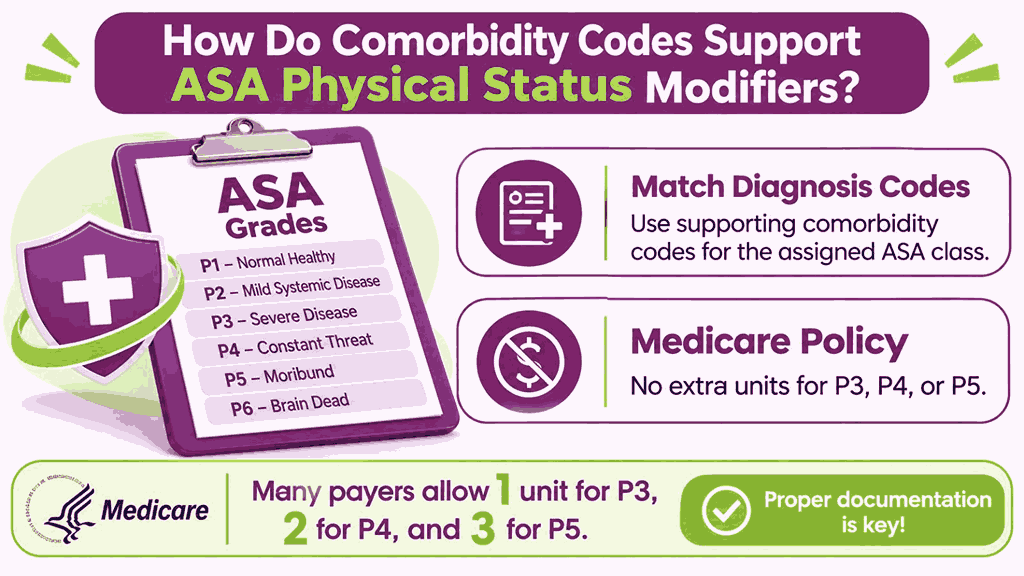
Medicare does not pay additional units for P3, P4, or P5 physical status modifiers. Many payers add 1 unit for P3, 2 for P4, and 3 for P5. Some payers require P3 or above before covering monitored anesthesia care, so documentation matters.
Which Diagnoses Support Monitored Anesthesia Care?
Novitas Solutions publishes a Medicare article listing diagnoses that support monitored anesthesia care claims. Different Medicare contractors publish their own rules, so billers must check local policy first.
Codes I11.0 and I11.9 require documentation of an acute, unstable condition needing multiple medications. Shock codes R57.1 and R57.8 must reflect a documented systolic pressure under 90 mmHg. Thresholds must appear in the chart, so billers should verify values before submitting claims.
Which Status and History Codes Matter on Anesthesia Claims?
Status and history codes record earlier care that shapes the anesthesia plan and risk. They support the claim only as secondary codes behind the reason for the procedure. Document each one in the pre-anesthesia evaluation so reviewers can trace the clinical reasoning.
| Code | Description | Why It Matters to Anesthesia |
|---|---|---|
| Z98.890 | Other specified postprocedural states | Earlier procedures can change anatomy, access, or technique |
| Z79.891 | Long-term (current) use of opiate analgesic | Opioid tolerance affects dosing and pain planning |
| Z92.84 | Personal history of unintended awareness under general anesthesia | Prior awareness shapes the anesthetic plan |
| Z68.41 | Body mass index 40.0 to 44.9, adult | Obesity affects airway planning and dosing |
How Do You Link ICD-10 Codes to Anesthesia CPT Codes and Modifiers?
Surgical procedures select the anesthesia CPT code, while surgical diagnoses justify the billed service. Laparoscopic cholecystectomy 47562, for example, maps to anesthesia code 00790 with gallstone diagnosis K80.20. Qualifying circumstance codes such as 99100 for extreme age follow their own documentation rules.
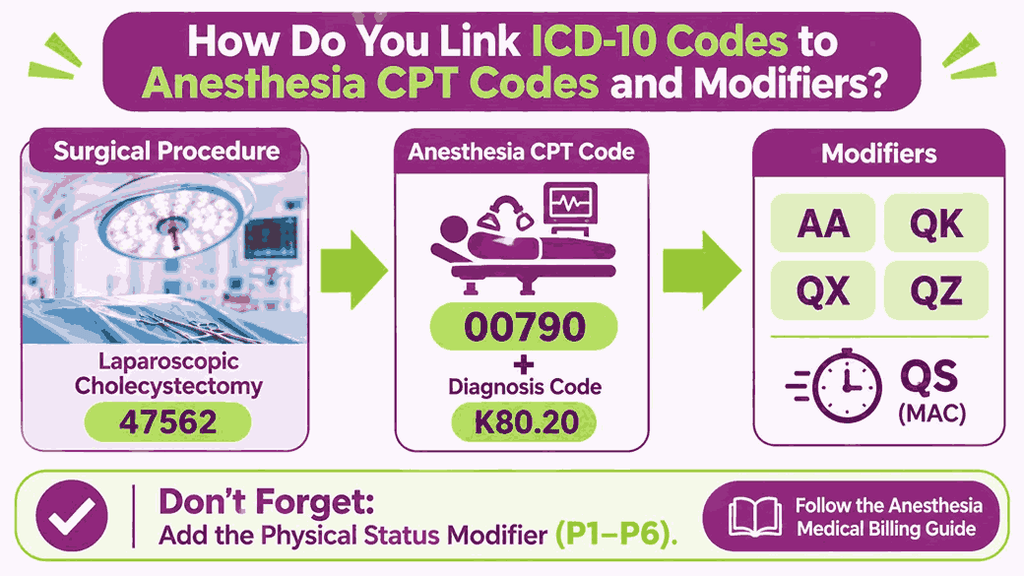
Modifiers then show who delivered the care, such as AA, QK, QX, or QZ. QS marks monitored anesthesia care, and every claim also needs a physical status modifier. Detailed rules for time units and direction are accessible in the anesthesia medical billing guide.
Why Do Anesthesia Claims Get Denied for ICD-10 Reasons?
Numerous ICD-10 denials on anesthesia claims trace back to a few repeatable coding errors. Leaders at Anesthesia Business Consultants name medical necessity documentation as the top denial cause. Seven triggers appear below, each paired with a fix billers can apply before submission.
| Denial Trigger | What Goes Wrong | Fix |
|---|---|---|
| Procedure Mismatch | Diagnosis does not match the surgery billed | Copy the surgical indication from the operative record |
| Unspecified Codes | Nonspecific entries such as R10.9 weaken necessity | Code to the highest specificity the note supports |
| Missing 7th Character | T88 codes sent without A, D, or S | Add the correct 7th character to every T88 code |
| Wrong Encounter Letter | D or S used during active treatment | Use A for active treatment of the complication |
| G89 Misuse | G89.18 reported for routine postoperative pain | Report G89 only when pain control is the service |
| Unsupported MAC | Comorbidity lacks the documented severity threshold | Record the threshold values in the chart |
| Stale Code Set | Prior-year code used for services dated on or after October 1 | Update the EHR and charge master each October 1 |
Pre-bill scrubbers compare the diagnosis, the anesthesia CPT code, and the modifiers before submission. Monthly audits of these triggers catch errors before a payer ever sees the claim. Practices without a dedicated coding team often hire anesthesia billing companies with AAPC-certified coders.
What Changed in the FY 2027 ICD-10-CM Update for Anesthesia Coding?
Encounters from October 1, 2026 through September 30, 2027 use the FY 2027 ICD-10-CM. Totals show 190 new codes, 30 codes no longer billable, and 4 revised descriptions. Altogether, the set now holds 74,879 billable diagnosis codes after these additions and removals.
Cardiac comorbidity entries that anesthesia teams report now require specific child codes for reporting. Dilated cardiomyopathy, other cardiomyopathies, and other arrhythmias moved from billable codes to parent headers. Adult BMI code Z68.1 also became a header, which splits into Z68.18 and Z68.19.
| FY 2026 Code | FY 2027 Requirement | Anesthesia Relevance |
|---|---|---|
| I42.0 Dilated cardiomyopathy | Use I42.00, I42.01, or I42.09 | Cardiac comorbidity supporting physical status |
| I42.8 Other cardiomyopathies | Use I42.81 or I42.89 | Cardiac comorbidity supporting physical status |
| I49.8 Other specified cardiac arrhythmias | Use I49.81, I49.82, or I49.89 | Rhythm risk in the pre-anesthesia evaluation |
| Z68.1 BMI 19.9 or less, adult | Use Z68.18 or Z68.19 | Low BMI affects anesthesia planning |
Published highlights list no changes to T88, G89, or Z01.81 codes, but the addenda decide. Billers should confirm that finding in the official CMS addenda before relying on it. September 2026 services still use FY 2026 codes, even when billed late in October.
How Can Anesthesia Practices Improve ICD-10 Accuracy?
Structured pre-anesthesia evaluation templates should prompt for comorbidities, physical status, and supporting diagnosis codes. Audits before billing should match each diagnosis to the surgical record and CPT code. Annual October updates to the EHR, pick lists, and scrubber rules prevent stale-code rejections.
Training should cover complication wording, pain control documentation, and unspecified code avoidance for providers. Written queries should close documentation gaps before claim submission rather than during payer appeals. Denial reviews sorted by reason code reveal which diagnosis errors repeat across the practice.
Groups needing outside help can use Transcure’s anesthesia billing services with 1,100+ AAPC-certified coders. CODIN, Transcure’s AI-powered coding system, reads anesthesia clinical notes before coders confirm each code. Request an audit to see which diagnosis errors currently cost your anesthesia practice revenue.
Frequently Asked Questions About Anesthesia ICD-10 Codes
What does ICD-10 Code R20.0 Mean, and Is It an Anesthesia Code?
R20.0 stands for anesthesia of skin, which describes numbness as a reported patient symptom. It never reports anesthesia care, which providers bill through CPT codes 00100 to 01999.
Do CRNAs and Anesthesiologists Report the Same ICD-10 Codes?
Shared surgical diagnoses usually appear on both claims, so the ICD-10 codes generally match. Role modifiers such as AA, QK, QX, and QZ separate the two claims instead.
Which ICD-10 code Supports Anesthesia for a Screening Colonoscopy?
Z12.11 supports screening colonoscopy anesthesia because it reports colon cancer screening as the reason. Bills carry CPT 00812, though Medicare uses 00811 with PT when screenings turn diagnostic.
How do you Find Anesthesia Complication Codes in the ICD-10-CM Index?
Look under Complication, anesthesia in the Alphabetic Index to reach the main T88 entries. Verify each suggested code in the Tabular List, where the 7th characters and notes appear.
Is there an ICD-10-PCS Code for General Anesthesia?
ICD-10-PCS lacks a dedicated general anesthesia code, though 3E0 codes describe anesthetic agent introduction. Professional anesthesia services are reported with CPT codes 00100 to 01999, never with ICD-10-PCS.