The D2740 dental code reports a single-unit crown made of porcelain or ceramic. The crown carries no metal substructure. It sits in the Restorative category of the CDT code set.
The American Dental Association (ADA) defines D2740 for all-ceramic and all-porcelain crowns, including zirconia. Payers often downgrade the code on posterior teeth to a metal-crown allowance. The alternate benefit clause drives most patient-cost surprises.
This guide covers the D2740 descriptor, the cost, real clinical scenarios, and the reimbursement rules. Practices that route crown claims through specialist dental billing services lose fewer dollars to downgrades. The sections below map the full billing picture for D2740.
Quick Reference: D2740 Dental Code
The table below summarizes the core attributes of the D2740 dental code for fast lookup.
| Attribute | Detail |
|---|---|
| CDT Code | D2740 |
| Nomenclature | Crown, porcelain/ceramic |
| Category | Restorative (D2000 to D2999), single crowns |
| Material | All-ceramic or all-porcelain, no metal substructure |
| Includes | Zirconia, lithium disilicate, monolithic and layered ceramic |
| Tooth Type | Single natural tooth (not a bridge retainer) |
| Benefit Class | Major restorative, often 50% |
| Replacement Frequency | Once every 5 to 10 years per plan |
| National Average Fee (2026) | About $1,000 to $1,700 |
Reference values follow the ADA CDT 2026 code set and the 2026 ADA Survey of Dental Fees.
What Is the Description of Dental Code D2740?
The D2740 dental code describes a single-unit crown made entirely of porcelain or ceramic. The crown contains no metal coping. It restores a natural tooth with a full-coverage esthetic restoration.
The code follows the material the laboratory delivers. Zirconia, lithium disilicate, monolithic ceramic, and layered ceramic all report under D2740. A crown with any metal substructure uses a different code.
D2740 is defined by an all-ceramic material with no metal underneath.
D2740 applies to a crown on a natural tooth, not a bridge retainer. The retainer crown on a bridge or implant uses D6740. Matching the code to the restoration type prevents a mismatch denial. We recommend keeping a detailed CDT codes guide to ensure these mismatches don’t happen often.
How Does D2740 Differ From D2750, D2790, and D6740?
D2740 differs from its neighbors by material and by the tooth it restores. A metal coping shifts the code to the porcelain-fused-to-metal series. A bridge retainer shifts it to the D6000 series. The table maps each option.
| CDT Code | Crown Type | Distinguishing Feature |
|---|---|---|
| D2740 | Crown, porcelain/ceramic | All-ceramic, no metal, single natural tooth |
| D2750 | Crown, porcelain fused to high noble metal | Porcelain over a high noble metal coping |
| D2751 | Crown, porcelain fused to predominantly base metal | Porcelain over a base metal coping |
| D2790 | Crown, full cast high noble metal | Full metal crown, no porcelain |
| D6740 | Retainer crown, porcelain/ceramic | All-ceramic crown as a bridge or implant retainer |
An all-ceramic crown on a natural tooth is D2740. A porcelain-fused-to-metal crown is D2750. A retainer crown on a bridge is D6740. The material and the tooth type decide the code together.
Is Zirconia Billed Under D2740?
Yes. A zirconia crown is billed under D2740 when it restores a single natural tooth. The code covers monolithic and layered zirconia as all-ceramic materials. A zirconia bridge retainer uses D6740 instead.
What Is the Difference Between D2740 and D2750?
The difference is the presence of metal. D2740 is an all-ceramic crown with no metal, while D2750 is porcelain fused to a high noble metal coping. The code follows the material the laboratory delivers.
What Clinical Situations Call for a D2740 Crown?
A D2740 crown restores a tooth that needs full coverage and an esthetic result. The all-ceramic material suits visible teeth. The situations that support the code appear below.
- A fractured or cracked tooth needing full-coverage protection
- A tooth restored after root canal therapy
- A tooth with large failing restorations that a filling cannot restore
- An esthetic-zone tooth where a metal margin is unacceptable
- A tooth needing a monolithic zirconia crown for strength
The esthetic zone is the common driver for an all-ceramic choice. Anterior teeth show any metal margin. The note records the clinical reason for the full-coverage restoration.
Which Documents Support a D2740 Claim?
Documentation for D2740 must justify the full-coverage crown on the tooth. Radiographs and a narrative carry the case. The seat date confirms completion for the plan.
- A pre-operative radiograph of the tooth
- A narrative describing the fracture, decay, or failed restoration
- The tooth number and the material delivered
- Any root canal treatment noted for the same tooth
- The seat or cementation date of the final crown
Many plans pay a crown on the seat date, not the prep date, so the completion date drives the claim.
Practices with high crown volume centralize eligibility and downgrade checks through outsourced dental billing and coding support. Verified benefits at the source cut the surprise-cost calls after the crown seats.
What Is the Cost of Dental Code D2740?
The cost of D2740 ranges from about $1,000 to $1,700 per crown in 2026. The national average office fee sits near $1,350 to $1,677. Region and provider setting move the final number.
A separate core buildup adds to the total when the tooth needs one. The buildup reports under D2950 on its own line. The crown remains the larger of the two fees.
| Cost Element | Typical 2026 Amount | Notes |
|---|---|---|
| D2740 office fee | $1,000 to $1,700 | Per single all-ceramic crown |
| National average (ADA survey) | About $1,350 to $1,677 | Single crown |
| Core buildup (D2950) | $300 to $450 | Added when the tooth needs one |
| Combined buildup and crown | $1,300 to $1,950 | Common bundled patient estimate |
A crown estimate often shows the buildup and the crown together. The plan pays each on its own line. The alternate benefit clause can lower the crown payment on posterior teeth.
How Do Dental Plans Cover D2740?
Most dental plans cover D2740 as a major restorative benefit at about 50%. Plans pay all-ceramic crowns readily in the esthetic zone. Posterior teeth often trigger an alternate benefit downgrade.
- Coverage runs near 50% for major restorative services
- Annual maximums of $1,000 to $2,000 cap total plan payment
- Esthetic-zone crowns usually pay at the ceramic allowance
- Posterior crowns often pay at the metal-crown allowance
The annual maximum caps how much a crown recovers in one year. A high-fee crown can consume most of the benefit. A predetermination shows the patient the real out-of-pocket cost.
What Factors Change the D2740 Fee?
Provider setting, regional market, and laboratory material move the D2740 fee the most. A specialist office has prices above a general one. The alternate benefit clause changes the paid amount, not the office fee.
- Regional market, since metro fees exceed rural fees
- Provider setting, such as a prosthodontist versus a general office
- Laboratory material and fabrication method
- Plan fee schedules for in-network providers
What Are Example Clinical Scenarios for Dental Code D2740?
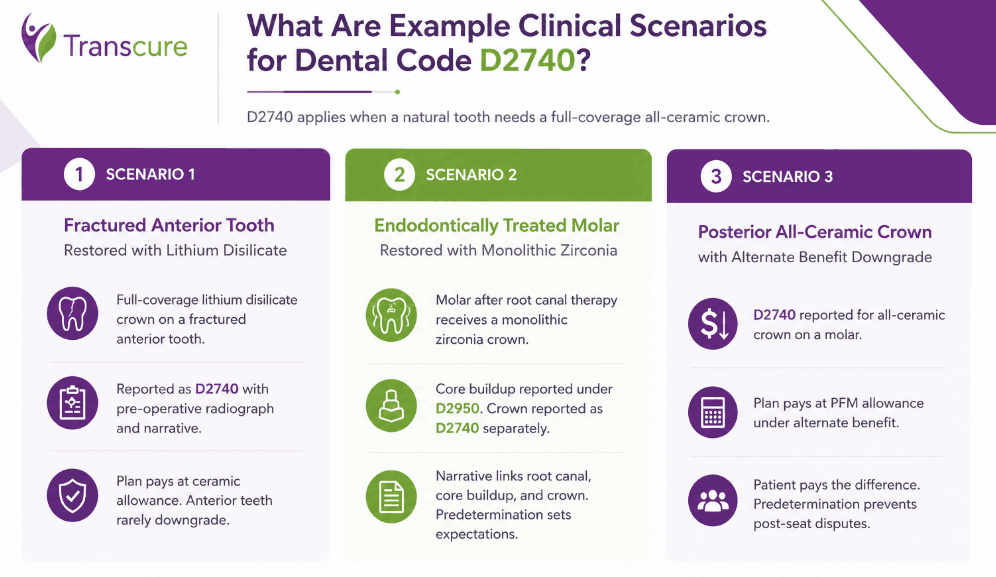
D2740 applies when a natural tooth needs a full-coverage all-ceramic crown. The scenarios below show clean reporting patterns. Each pairs the clinical picture with the coding decision.
Scenario 1: Fractured Anterior Tooth Restored with Lithium Disilicate
A central incisor fractures and needs a full-coverage esthetic crown. The dentist places a lithium disilicate all-ceramic crown. The practice reports D2740 with a pre-operative radiograph and a narrative.
The narrative records the fracture and the esthetic-zone location. The plan pays the crown at the ceramic allowance. An anterior tooth rarely triggers a downgrade.
Scenario 2: Endodontically Treated Molar Restored with Monolithic Zirconia
A lower molar completes root canal therapy and receives a monolithic zirconia crown. The dentist first places a core buildup, reported under D2950. The practice reports D2740 for the zirconia crown on its own line.
The note connects the root canal, the buildup, and the crown. The plan may apply an alternate benefit on the posterior tooth. A predetermination sets the patient’s expectation before the seat.
Scenario 3: Posterior All-Ceramic Crown with an Alternate Benefit Downgrade
A patient chooses an all-ceramic crown on a molar for esthetics. The plan pays at the porcelain-fused-to-metal allowance under its alternate benefit clause. The practice still reports D2740 for the material delivered.
The plan pays the lower allowance, and the patient owes the difference. An in-network dentist bills only the contracted difference. A predetermination prevents the post-seat cost dispute.
What Are the D2740 Rules for Successful Reimbursement?
Successful D2740 reimbursement rests on correct material coding, downgrade planning, and clean documentation. The rules below reduce denials and cost surprises. Each rule targets a known payer behavior.
How Alternate Benefit Downgrades Affect D2740 Payment
Alternate benefit clauses lower D2740 payment on posterior teeth. The plan pays a metal-crown allowance instead of the ceramic fee. The patient owes the difference within the plan rules.
- Run a predetermination for posterior all-ceramic crowns
- Confirm the plan’s posterior downgrade policy in writing
- Set the patient estimate to the downgraded allowance
- Bill only the contracted difference when in network
A predetermination converts a downgrade surprise into a planned cost. The patient sees the real out-of-pocket amount first. That single step removes most post-seat disputes.
Does Insurance Downgrade D2740 on Posterior Teeth?
Yes. Many plans downgrade D2740 on posterior teeth to a metal-crown allowance. The plan judges an all-ceramic crown as an upgrade behind the esthetic zone. The clinical choice stands, but the benefit tops out lower.
Date of Service and Frequency Rules for D2740
Plans pay D2740 on the seat date and limit crown replacement by frequency. Most plans allow replacement once every 5 to 10 years. A crown replaced early needs a strong clinical reason.
- Report the crown on the cementation or seat date
- Confirm the plan’s replacement frequency before treatment
- Document the failure reason for an early replacement
- Attach the radiograph that supports the replacement
An early replacement without documentation draws a frequency denial. The note explains why the prior crown failed. Frequency discipline protects the crown benefit.
How to Prevent D2740 Documentation Denials
Documentation denials on D2740 trace back to a missing radiograph or a weak narrative. Carriers request evidence on high-dollar crown claims. Clean records clear those requests fast.
- Attach the pre-operative radiograph to the claim
- Write a narrative naming the fracture, decay, or failed restoration
- Record the material and the tooth number
- Confirm the seat date on the claim
Practices losing crown revenue to downgrades often compare vendors before outsourcing. A review of the best dental billing companies in the USA helps weigh restorative expertise, downgrade recovery, and reporting. Documentation quality at the source still drives the D2740 outcome.
What Is the Key Takeaway for D2740 Billing?
The D2740 dental code pays when an all-ceramic crown restores a natural tooth with clean documentation. The material coding, the seat date, and the downgrade plan carry the claim. Correct use of D2740 protects both the fee and the patient relationship.