
The D2950 dental code reports a core buildup, including any pins when required. The procedure rebuilds a tooth so a crown can seat and hold. It sits in the Restorative category of the CDT code set.
The American Dental Association (ADA) defines D2950 for teeth that lack the structure to retain a crown. Carriers deny or downcode it when the record fails to prove that need. The distinction from a filler or a base drives most disputes.
This guide covers the D2950 descriptor, the cost, real clinical scenarios, and the reimbursement rules. Practices that route restorative claims through specialist dental billing services recover buildup fees more often. The sections below map the full billing picture for D2950.
Quick Reference: D2950 Dental Code
The table below summarizes the core attributes of the D2950 dental code for fast lookup.
| Attribute | Detail |
|---|---|
| CDT Code | D2950 |
| Nomenclature | Core buildup, including any pins when required |
| Category | Restorative (D2000 to D2999) |
| Purpose | Rebuild coronal structure to retain a crown |
| Clinical Gate | Insufficient tooth structure to retain a crown, often more than 50% missing |
| Pairs With | A crown on the same tooth (D2740, D2750, and related) |
| Benefit Class | Basic or major, plan dependent |
| National Average Fee (2026) | About $300 to $450 per tooth |
| Frequent Denial | Bundled as a base, or coded when a post was placed |
Reference values follow the ADA CDT 2026 code set and the 2026 ADA Survey of Dental Fees.
What Is the Description of Dental Code D2950?
The D2950 dental code describes a core buildup, including any pins when required. The buildup replaces missing coronal structure with restorative material. The tooth then holds a crown that could not seat on the damaged structure alone.
D2950 applies when a tooth loses structure to decay, fracture, or failed restorations. The material packs into the tooth to restore form for a crown prep. Pins anchor the buildup when retention demands them.
D2950 exists to retain a crown, not to fill a cavity or block out an undercut.
The code is adjunctive, so it accompanies a crown on the same tooth. A buildup with no planned crown rarely earns a benefit. The clinical goal is crown retention, and the note states it.
How Does D2950 Differ From D2949, D2954, and D2952?
D2950 differs from its neighbors by purpose and by whether a post is placed. A foundation that only blocks out undercuts is D2949. A post seated in a root canal changes the code entirely. The table maps each option.
| CDT Code | Procedure | When It Applies |
|---|---|---|
| D2950 | Core buildup, including any pins when required | Significant structure missing, crown cannot retain without a buildup |
| D2949 | Restorative foundation for an indirect restoration | Block out undercuts or reshape form on a tooth with adequate structure |
| D2954 | Prefabricated post and core in addition to crown | Stock post seated in an endodontically treated tooth |
| D2952 | Cast post and core in addition to crown | Laboratory-fabricated custom post cemented in a root canal |
| D2951 | Pin retention, per tooth, in addition to restoration | Pins added to retain a direct restoration, not a crown buildup |
A tooth that only needs undercut block-out is D2949, not D2950. A tooth that receives a post routes to D2954 or D2952. Coding the buildup when a post was placed triggers a mismatch denial.
Is D2950 a Filling?
No. D2950 is a crown buildup, not a filling. A filling restores a tooth surface as the final restoration and uses the D2140 to D2394 series. D2950 rebuilds a tooth to retain a crown placed over it.
Does D2950 Include Pins?
Yes. D2950 includes any pins used for retention. The code descriptor covers pins when the buildup requires them. A separate pin code does not report alongside D2950 for the same buildup.
What Clinical Findings Support a D2950 Core Buildup?
A D2950 core buildup rests on documented loss of retentive tooth structure. Most carriers apply a threshold near half of the clinical crown missing or unsupported. The findings that support the code appear below.
- More than half of the clinical crown is missing or unsupported
- Remaining walls cannot retain a crown without added structure
- Extensive decay removal left insufficient coronal tooth structure
- A fracture removed one or more cusps of the tooth
- An endodontically treated tooth needs structural reinforcement
A tooth with two thick cusps and a moderate filling rarely needs a buildup. A payer reviewing that case says so. The note explains why the remaining structure could not hold the crown.
Which Documents Support a D2950 Claim?
Documentation for D2950 must prove that the tooth could not retain a crown without a buildup. Photographs and radiographs carry the case. The narrative connects the loss to the crown plan.
- A pre-operative radiograph showing the structural loss
- A clinical photograph of the prepared tooth where available
- A narrative stating the percentage of structure missing
- The crown claim or crown date on the same tooth
- The cause of the loss, such as fracture, decay, or a failed restoration
A one-line narrative such as “more than 50% of tooth structure missing, buildup required for crown retention” prevents many denials.
Practices with heavy restorative volume centralize this evidence through outsourced dental billing and coding support. Clean buildup notes at the source cut appeals and protect the fee.
What Is the Cost of Dental Code D2950?
The cost of D2950 ranges from about $150 to $450 per tooth in 2026. The national average office fee sits near $300 to $425. The buildup fee stacks on top of the crown fee for the same tooth.
The material rarely changes the fee, since composite and other core materials price similarly. Chair time and regional market drive most of the variation. The crown carries its own, larger fee.
| Cost Element | Typical 2026 Amount | Notes |
|---|---|---|
| D2950 office fee | $150 to $450 | Per tooth, one buildup |
| National average (ADA survey) | About $300 to $425 | Single site |
| Paired crown (D2740 or D2750) | $1,000 to $1,700 | Reported and paid on its own line |
| Combined buildup and crown | $1,300 to $1,950 | Common bundled patient estimate |
A patient estimate often shows the buildup and the crown together. The plan pays each on its own line. Coverage on the buildup varies more than coverage on the crown.
How Do Dental Plans Cover D2950?
Dental plans cover D2950 as a basic or major benefit, often at 50% to 80%. Many plans pay it only when a crown follows on the same tooth. Some plans bundle the buildup into the crown allowance.
- Coverage often requires the crown claim on the same tooth
- Some plans bundle the buildup into the crown fee at adjudication
- Frequency and structure thresholds vary by contract
- A predetermination confirms benefit before treatment
A bundled buildup can look like a denial on the EOB. The plan folded the fee into the crown allowance. A predetermination shows the patient the real out-of-pocket cost first.
What Factors Change the D2950 Fee?
Provider setting and regional market move the D2950 fee the most. Complexity of the buildup and pin placement add smaller amounts. The paired crown remains the larger cost driver overall.
- Regional market, since metro fees exceed rural fees
- Provider setting, such as a specialist versus a general office
- Buildup complexity, including pin placement for added retention
- The paired crown material, which carries its own separate fee
What Are Example Clinical Scenarios for Dental Code D2950?
D2950 applies when a tooth cannot retain a crown without a rebuilt structure. The scenarios below show clean reporting patterns. Each pairs the clinical picture with the coding decision.
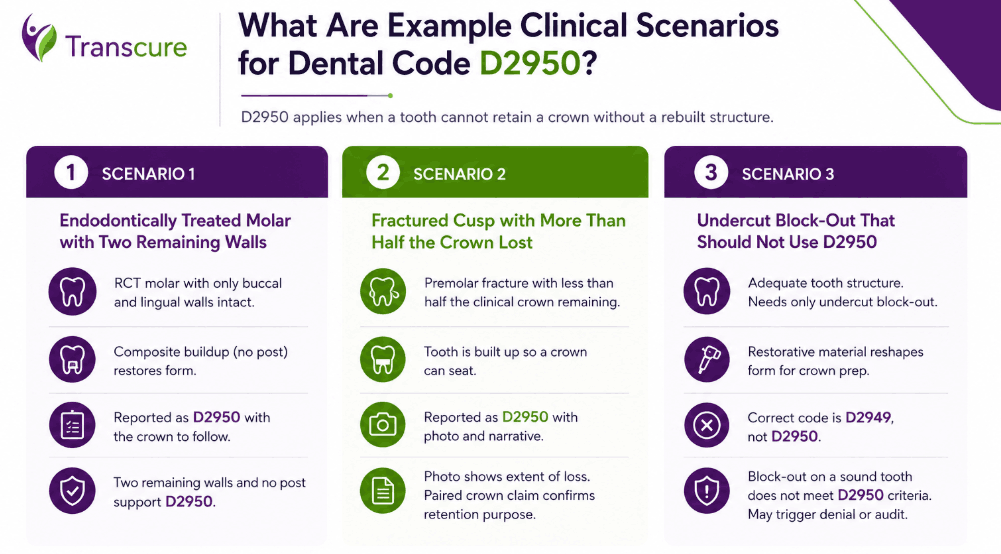
Scenario 1: Endodontically Treated Molar with Two Remaining Walls
A lower molar completes root canal therapy with only the buccal and lingual walls intact. The dentist places a composite buildup, without a post, to restore form. The practice reports D2950 with the crown to follow.
The note records the two remaining walls and the missing structure. The buildup restores enough form to retain the crown. The absence of a post keeps the case in D2950 rather than D2954.
Scenario 2: Fractured Cusp with More Than Half the Crown Lost
A premolar fractures and loses a full cusp, leaving less than half the clinical crown. The dentist builds up the tooth so a crown can seat. The practice reports D2950, supported by a photograph and a narrative.
The photograph shows the extent of the loss before the buildup. The narrative states that the fracture and the structure are missing. The paired crown claim confirms the retention purpose.
Scenario 3: Undercut Block-Out That Should Not Use D2950
A tooth with adequate structure needs only minor block-out of undercuts before a crown prep. The dentist places restorative material to reshape the form. The correct code is D2949, not D2950.
D2950 applies only when the tooth cannot retain a crown without a buildup. A block-out on a sound tooth does not meet that gate. Coding it as D2950 invites a denial or an audit flag.
What Are the D2950 Rules for Successful Reimbursement?
Successful D2950 reimbursement rests on the retention gate, the paired crown, and clean documentation. The rules below reduce denials and downcodes. Each rule targets a known payer behavior.
Why Carriers Deny or Downcode D2950 and How to Prevent It
Carriers deny D2950 when the record fails to prove the tooth needed a buildup for retention. They downcode it to a filling when less than half the structure was lost. Documentation answers both objections.
- State the percentage of structure missing in the narrative
- Attach a pre-operative radiograph and a prep photograph
- Confirm the crown claim on the same tooth
- Avoid using D2950 for a base, a filler, or an undercut block-out
A base under a routine filling is included in that restoration. A block-out is D2949. Reserving D2950 for true retention cases keeps the code payable across the plan.
Can D2950 Be Billed with a Crown?
Yes, D2950 is billed with a crown on the same tooth. The buildup reports on its own line, and the crown reports on another. Many plans require the crown before they pay the buildup.
Does Delta Dental Bundle D2950 with Endodontic Therapy?
Some carriers, including Delta Dental plans, deny D2950 when it accompanies root canal therapy on the same date. The plans cite procedural inclusivity. Separate the buildup from the endodontic phase where the workflow allows.
How to Avoid Overutilization Flags on D2950
Overuse of D2950 across a schedule draws utilization review. Carriers watch practices that append a buildup to nearly every crown. Coding to the clinical gate protects the code long term.
- Bill D2950 only when the retention gate is met
- Document the missing structure on each claim
- Use D2949 for block-out cases and D2954 for post cases
- Run periodic self-audits on buildup-to-crown ratios
Practices facing repeated buildup denials often compare vendors before outsourcing. A review of the best dental billing companies in the USA helps weigh restorative expertise, appeal success, and reporting. Documentation quality at the source still drives the D2950 outcome.
What Is the Key Takeaway for D2950 Billing?
The D2950 dental code pays when the record proves a tooth could not retain a crown without a buildup. More than half the structure missing, a prep photograph, and the paired crown carry the claim. Precise use of D2950 separates a paid buildup from a bundled filling.