The D7210 dental code reports the surgical extraction of an erupted tooth. The procedure removes bone, sections the tooth, or lifts a mucoperiosteal flap. It sits in the Oral and Maxillofacial Surgery category of the CDT code set.
The American Dental Association (ADA) maintains D7210 as a surgical extraction code, not a routine one. Payers downgrade it to D7140 when the clinical note fails to prove surgical technique. Documentation decides whether the claim pays or drops.
This guide covers the D7210 descriptor, the cost, real clinical scenarios, and the reimbursement rules. Practices that route oral surgery claims through specialist dental billing services recover the surgical fee more often. The sections below map the full billing picture for D7210.
Quick Reference: D7210 Dental Code
The table below summarizes the core attributes of the D7210 dental code for fast lookup.
| Attribute | Detail |
|---|---|
| CDT Code | D7210 |
| Nomenclature | Extraction, erupted tooth requiring removal of bone and/or sectioning of tooth, and including elevation of mucoperiosteal flap if indicated |
| Category | Oral and Maxillofacial Surgery (D7000 to D7999), surgical extractions |
| Common Name | Surgical extraction of an erupted tooth |
| Clinical Gate | Bone removal and/or tooth sectioning and/or flap elevation |
| Benefit Class | Oral surgery / basic or major, plan dependent |
| Typical Coverage | 50% to 80% after deductible |
| National Average Fee (2026) | About $400 to $430 per tooth |
| Frequent Denial | Downgrade to D7140 for weak documentation |
Reference values follow the ADA CDT 2026 code set and the 2026 ADA Survey of Dental Fees.
What Is the Description of Dental Code D7210?
The D7210 dental code describes a surgical extraction of an erupted tooth. The full ADA nomenclature reads: extraction, erupted tooth requiring removal of bone and/or sectioning of tooth, and including elevation of mucoperiosteal flap if indicated.
A tooth qualifies for D7210 when a simple forceps removal cannot deliver it. The dentist cuts bone, splits the tooth into segments, or raises a soft tissue flap. Any one of these surgical steps supports the code.
D7210 is defined by surgical technique, not by how hard the tooth felt to remove.
The tooth itself is erupted and visible in the mouth. That fact separates D7210 from the impaction codes. Difficulty alone never converts a routine extraction into a surgical one under ADA guidance.
How Does D7210 Differ From D7140, D7250, and the Impaction Codes?
D7210 differs from its neighbors by surgical technique and by the state of the tooth. The extraction family splits across simple removal, surgical removal, residual roots, and impactions. The table maps each code to its trigger.
| CDT Code | Procedure | Clinical Trigger |
|---|---|---|
| D7140 | Extraction, erupted tooth or exposed root | Elevation and/or forceps removal, no bone cutting or sectioning |
| D7210 | Surgical extraction, erupted tooth | Bone removal and/or sectioning and/or flap elevation |
| D7250 | Removal of residual tooth roots (cutting procedure) | Retained roots removed with cutting of soft tissue and bone |
| D7220 | Removal of impacted tooth, soft tissue | Tooth covered by soft tissue, erupted through bone |
| D7230 | Removal of impacted tooth, partially bony | Part of the crown covered by bone |
| D7240 | Removal of impacted tooth, completely bony | Most or all of the crown covered by bone |
A forceps-only removal is D7140. A residual root removed by cutting is D7250. An unerupted tooth under bone routes to the impaction codes, not to D7210.
Is D7210 a Simple Extraction?
No. D7210 is a surgical extraction, not a simple one. A simple, forceps-based removal of an erupted tooth is D7140. D7210 requires bone removal, tooth sectioning, or flap elevation recorded in the operative note.
Do Sutures Alone Make an Extraction D7210?
No. Placing sutures does not qualify a case as D7210. The code turns on bone removal or tooth sectioning. A dentist who only elevates and sutures an erupted tooth reports D7140, not D7210.
What Clinical Steps Define a D7210 Surgical Extraction?
A D7210 surgical extraction includes at least one defined surgical action beyond forceps delivery. The operative note names the specific technique used. The steps that support the code appear below.
- Removal of alveolar bone to expose or free the tooth
- Sectioning of the tooth into two or more pieces for delivery
- Elevation of a mucoperiosteal flap to reach bone or root
- Removal of tooth structure that resists intact delivery
- Closure of the surgical site, often with sutures
Curved roots, ankylosis, and hypercementosis commonly force sectioning. The note connects the anatomy to the surgical step. That link is what a payer looks for on review.
Which Documents Support a D7210 Claim?
Documentation for D7210 must prove the surgical nature of the extraction. Carriers recode weakly documented claims to D7140 and pay the lower fee. The record connects the tooth, the technique, and the reason.
- A pre-operative periapical radiograph of the treated tooth
- A clinical note that names flap elevation, bone removal, or sectioning
- The clinical reason for the surgical approach, such as curved roots or fracture
- A written narrative that mirrors the D7210 descriptor language
- Intraoral photographs taken during the procedure where available
- The tooth number and quadrant treated
A narrative that states why the surgical technique was needed is the single strongest defense against a downgrade.
Practices with high oral surgery volume often centralize this documentation through outsourced dental billing and coding support. Clean surgical notes at the source cut appeals and speed the surgical fee.
What Is the Cost of Dental Code D7210?
The cost of D7210 ranges from about $250 to $600 per tooth in 2026. The national average office fee sits near $400 to $430. Region, provider type, and anesthesia move the final number.
Oral surgeons charge 30% to 50% more than general dentists for the same erupted surgical case. Intravenous sedation adds $250 to $500. Nitrous oxide and local anesthesia carry smaller separate fees.
| Cost Element | Typical 2026 Amount | Notes |
|---|---|---|
| D7210 office fee (general dentist) | $250 to $450 | Single erupted tooth, surgical technique |
| D7210 office fee (oral surgeon) | $400 to $600 | Provider premium of 30% to 50% |
| National average (ADA survey) | About $400 to $430 | Per tooth, single site |
| IV sedation (D9239 / D9243) | +$250 to $500 | Billed separately when used |
| Nitrous oxide (D9230) | +$50 to $90 | Billed separately when used |
The surgical fee covers the extraction and routine post-operative visits. Sedation, grafting, and imaging carry their own codes. Each added service needs its own documentation.
How Do Dental Plans Cover D7210?
Most dental plans cover D7210 at 50% to 80% after the deductible. Plans classify surgical extractions as oral surgery, a basic or major benefit by contract. The annual maximum caps total plan payment.
- Annual maximums of $1,000 to $2,000 limit the total yearly benefit
- Waiting periods apply to some major-service categories
- Medical insurance may cover the extraction when trauma, infection, or a pathologic condition drives it
- Coordination of benefits applies when a patient carries dual coverage
Medical cross-coding raises the annual ceiling for qualifying cases. A displaced fracture or a cyst can shift the claim to the medical plan. Verify both benefits before treatment.
What Factors Change the D7210 Fee?
Three factors move the D7210 fee the most: provider type, anesthesia, and geography. The same case varies widely by market.
- Provider type, since oral surgeons charge a premium over general dentists
- Anesthesia choice, since IV sedation adds $250 to $500
- Geographic market, since metro fees exceed rural fees
- Tooth complexity, such as curved roots or ankylosis, that extends chair time
What Are Example Clinical Scenarios for Dental Code D7210?
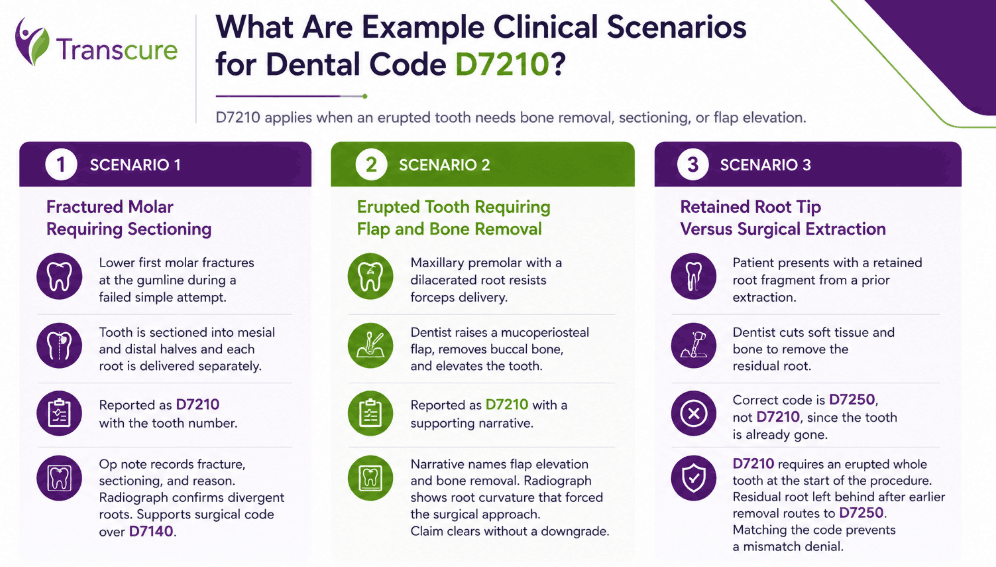
D7210 applies when an erupted tooth needs bone removal, sectioning, or flap elevation. The scenarios below show clean reporting patterns. Each pairs the clinical picture with the coding decision.
Scenario 1: Fractured Molar Requiring Sectioning
A lower first molar fractures at the gumline during a failed simple attempt. The dentist sections the tooth into mesial and distal halves and delivers each root separately. The practice reports D7210 with the tooth number.
The operative note records the fracture, the sectioning, and the reason. A pre-operative radiograph confirms the divergent roots. That evidence supports the surgical code over D7140.
Scenario 2: Erupted Tooth Requiring Flap and Bone Removal
A maxillary premolar with a dilacerated root resists forceps delivery. The dentist raises a mucoperiosteal flap, removes buccal bone, and elevates the tooth. The practice reports D7210 with a supporting narrative.
The narrative names the flap elevation and the bone removal. The radiograph shows the root curvature that forced the surgical approach. The claim clears without a downgrade.
Scenario 3: Retained Root Tip Versus Surgical Extraction
A patient presents with a retained root fragment from a prior extraction. The dentist cuts soft tissue and bone to remove the residual root. The correct code is D7250, not D7210, since the tooth is already gone.
D7210 requires an erupted whole tooth at the start of the procedure. A residual root left behind after earlier removal routes to D7250. Matching the code to the starting anatomy prevents a mismatch denial.
What Are the D7210 Rules for Successful Reimbursement?
Successful D7210 reimbursement rests on documentation, correct code selection, and appeal discipline. The rules below reduce downgrades and denials. Each rule targets a known payer behavior.
Why Carriers Downgrade D7210 to D7140 and How to Prevent It
Carriers downgrade D7210 to D7140 when the note fails to prove surgical technique. The downgrade pays the lower simple-extraction fee. The practice absorbs the difference unless it appeals.
- State the surgical step in the note, such as sectioning or bone removal
- Attach the pre-operative periapical radiograph
- Add a narrative that mirrors the D7210 descriptor
- Reference attached images directly in the note
A downgrade costs hundreds of dollars per claim across a busy schedule. A successful appeal recovers the surgical fee. Never accept a downgrade without reviewing the record first.
How to Appeal a Downgraded D7210 Claim
An appeal on a downgraded D7210 claim resubmits the surgical evidence to the carrier. The packet must directly answer the reason on the Explanation of Benefits. Deadlines apply, often 30 to 60 days.
- Read the Explanation of Benefits (EOB) for the exact downgrade reason
- Gather the pre-operative radiograph and the operative note
- Write a narrative that references flap elevation, bone removal, or sectioning
- Submit through the payer’s required channel before the deadline
- Track the appeal and escalate if the carrier upholds the downgrade
Missing the appeal window forfeits the claim. A tracked workflow protects the deadline. Consistent appeals recover revenue that silent write-offs lose.
Can D7210 Be Reported for Supernumerary Teeth?
Yes. D7210 applies to a supernumerary tooth when the extraction is surgical. The claim reports the supernumerary tooth number using the current ADA claim form convention. Reimbursement stays plan specific.
Bundling and Same-Day Rules for D7210
Some same-day services bundle into D7210, while others report separately. Routine flap closure and minor bone smoothing fall inside the code. Distinct procedures on the same day carry their own codes.
- Routine socket closure and suturing are included in D7210
- Bone grafting reports separately under D7953 with its own documentation
- Sedation reports separately under the anesthesia codes when delivered
- A distinct procedure on a different tooth reports on its own line
Practices that struggle with surgical downgrades often compare vendors before outsourcing. A review of the best dental billing companies in the USA helps weigh oral surgery expertise, appeal rates, and turnaround. Documentation quality at the source still drives the D7210 outcome.
What Is the Key Takeaway for D7210 Billing?
The D7210 dental code pays when the record proves a surgical extraction of an erupted tooth. Bone removal, sectioning, or flap elevation must appear in the note with a reason. Strong documentation on D7210 turns downgrades into paid surgical claims.