CPT codes are standardized medical procedure codes used to describe healthcare services and treatments performed by providers. They convert documented medical services into a uniform coding language that supports consistent reporting across healthcare systems.
The main type of CPT code is Category I, which represents commonly performed medical procedures and services in clinical practice. Selecting the correct CPT code involves three essential steps: reviewing the clinical documentation, identifying the exact procedure performed, and matching the service to the most accurate CPT code description and level.
Some of the most commonly used CPT codes include 99213 for established patient office visits, 93000 for electrocardiogram services, and 36415 for venipuncture. CPT coding is governed by key rules, including using the most specific code available, following National Correct Coding Initiative (NCCI) guidelines, and applying modifiers appropriately when procedures are altered or distinct.
This article explains CPT codes, their primary type, how to select the correct code, commonly used CPT codes, and the essential rules that guide accurate CPT coding.
What Is a CPT Code?
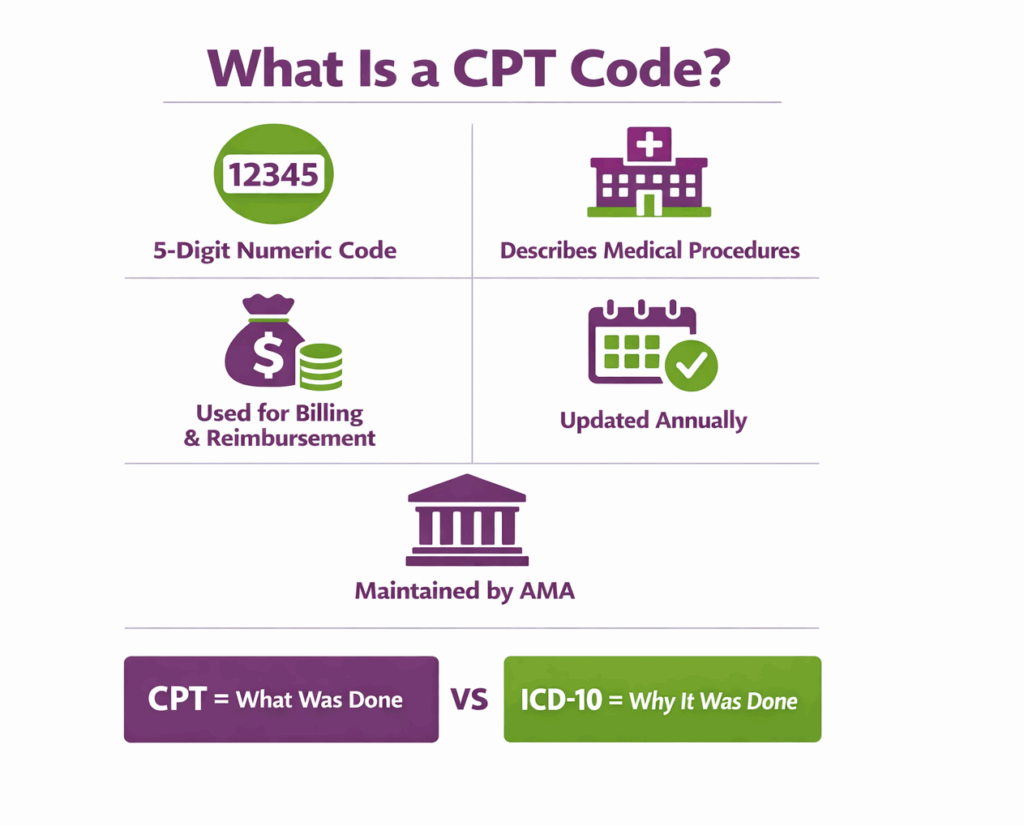
A CPT code is a standardized numeric code used to describe medical procedures, services, and treatments performed by healthcare providers. CPT codes create a uniform system for reporting healthcare services across medical practices, hospitals, and insurance providers.
What Does CPT Mean?
CPT stands for Current Procedural Terminology. It is a medical coding system used to describe procedures and services provided to patients.
Why Is a CPT Code Needed?
A CPT code is needed to clearly identify and report medical procedures and services in a standardized format. It ensures consistency in how healthcare services are documented and communicated.
How Does a CPT Code Help in Reimbursement?
CPT codes help in reimbursement by allowing insurance providers to recognize, process, and evaluate medical services for payment. Claims rely on CPT codes to determine whether a service is payable and at what rate.
What Is the CPT Code Format?
A CPT code is typically a five-digit numeric code. Some CPT codes may include modifiers, which are two-character additions used to provide additional details about how a service was performed.
Why Are CPT Codes Updated?
CPT codes are updated to reflect changes in medical practices, new procedures, emerging technologies, and revised clinical standards. Updates ensure accurate representation of current healthcare services.
How Often Do CPT Codes Change?
CPT codes are updated annually. Changes include new codes, revised code descriptions, and deleted codes.
Who Updates CPT Codes Every Year?
CPT codes are updated every year by the American Medical Association (AMA).
What Documentation Is Required to Support CPT Codes?
CPT codes must be supported by clear clinical documentation, including procedure notes, operative reports, progress notes, and provider signatures. Documentation must accurately describe the service performed to justify the selected CPT code.
What Are the Types of CPT Codes?
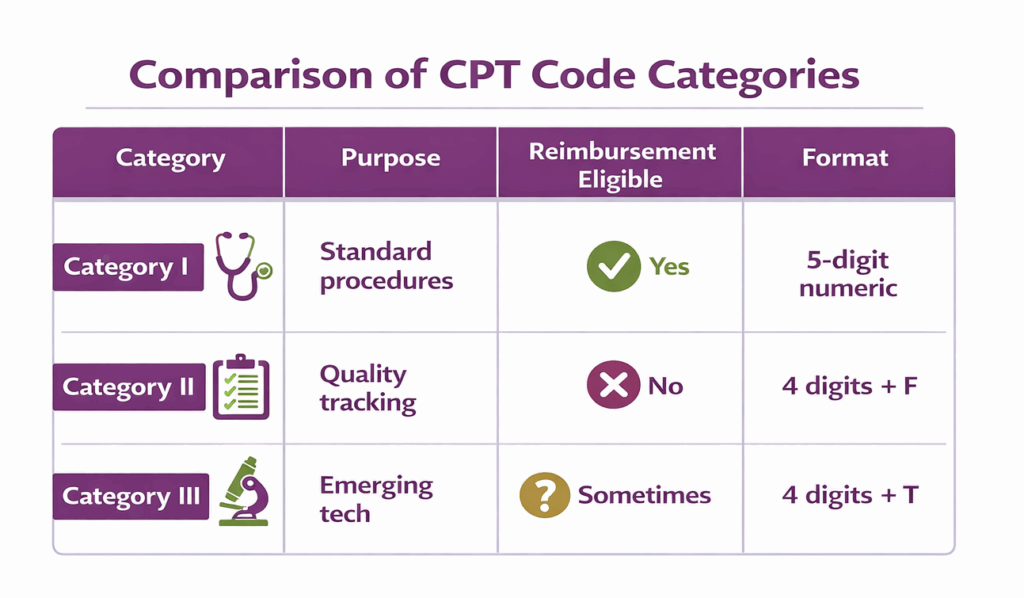
CPT codes are divided into different types based on how they are used to report medical procedures and services. Each type serves a specific purpose within the CPT coding system.
Category I CPT Codes
Category I CPT codes are used to report commonly performed medical procedures and services. These codes are widely accepted for billing and reimbursement and follow a standardized five-digit numeric format.
Category II CPT Codes
Category II CPT codes are optional tracking codes used for performance measurement and quality reporting. These codes help collect data related to patient care and clinical outcomes, but are not used for reimbursement.
Category III CPT Codes
Category III CPT codes are temporary codes used to report emerging technologies, services, and procedures. These codes support data collection for new or experimental medical practices and may not be eligible for reimbursement.
How to Select the Correct CPT Codes?
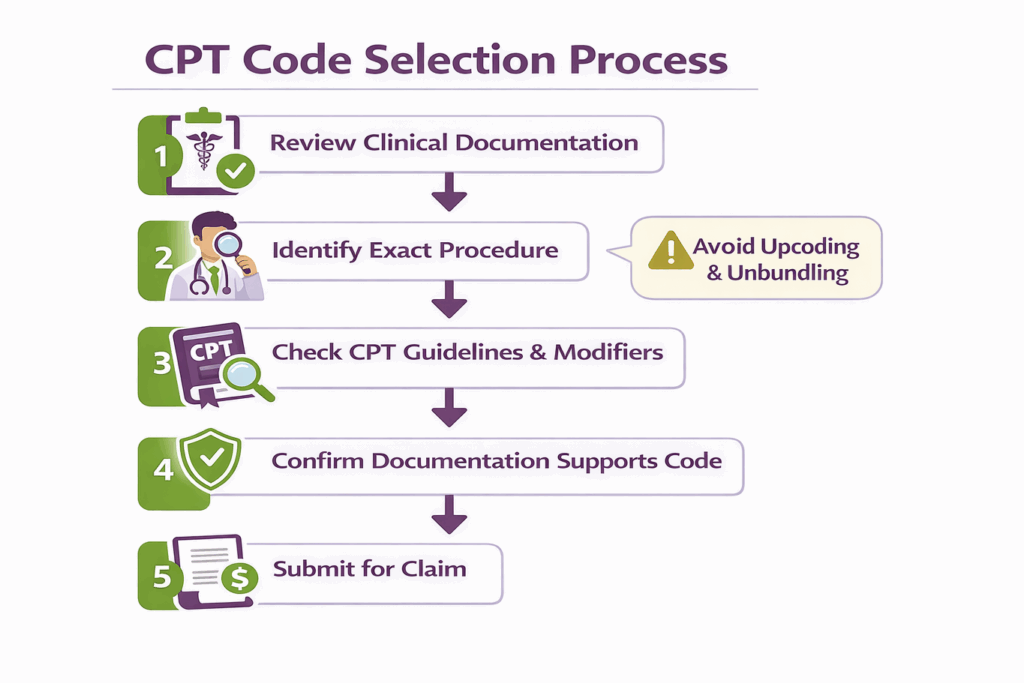
Selecting the correct CPT codes involves following a structured/ process to ensure that medical procedures and services are accurately represented. Proper CPT code selection is based on clinical documentation and official coding guidelines.
Review Clinical Documentation
The first step in selecting a CPT code is reviewing the provider’s clinical documentation, including procedure notes and operative reports. Documentation must clearly describe the service performed.
Identify the Exact Procedure or Service
Coders determine the specific procedure or service provided, including the technique, approach, and extent of the service. This step ensures the correct CPT code description is selected.
Verify Code Guidelines and Modifiers
After identifying the procedure, coders verify CPT guidelines, parenthetical notes, and modifier requirements. This ensures the code is used correctly and reflects any special circumstances of the service.
Confirm Code Accuracy
The final step is confirming that the selected CPT code accurately matches the documented service and complies with coding rules and payer requirements.
How to Find CPT Codes?
CPT codes can be found by searching official CPT coding resources using the documented medical procedure or service. Coders typically locate CPT codes through CPT manuals or authorized coding tools by matching procedure descriptions with the correct code entries.
Accurate code selection requires reviewing CPT code descriptions, guidelines, and related notes to ensure the code aligns with the documented service.
What Is the List of Most Popular CPT Codes?
Popular CPT codes are frequently used procedure codes that represent common healthcare services, especially evaluation and management (E/M) visits.
99214
CPT code 99214 is used for an established patient office or outpatient visit involving moderate to high complexity medical decision-making. It is one of the most commonly billed E/M codes.
99203
CPT code 99203 is used for a new patient office or outpatient visit requiring a moderate level of medical decision-making. It is commonly used for initial patient evaluations.
99213
CPT code 99213 is used for an established patient office or outpatient visit involving low to moderate complexity medical decision-making. It is one of the most frequently reported CPT codes across outpatient practices.
93000
CPT code 93000 is used to report a routine electrocardiogram (ECG/EKG) with interpretation and report. It is commonly used in cardiology and primary care settings.
36415
CPT code 36415 is used for the collection of venous blood by venipuncture. It is widely used in outpatient clinics, laboratories, and diagnostic settings.
Which Is the Most Important CPT Code?
There is no single most important CPT code; however, E/M codes (such as 99202–99215) are considered critical because they are used across nearly all medical specialties and account for a significant portion of outpatient billing.
Which Is the Highest-Value CPT Code?
The highest-value CPT codes are typically associated with complex surgical procedures and carry high RVUs. Examples include:
- 33430: Aortic valve replacement
- 27130: Total hip arthroplasty
- 33533: Coronary artery bypass graft (CABG), single arterial graft
- 19303: Mastectomy, simple, complete
- 47562: Laparoscopic cholecystectomy
Which Is the CPT Code Most Coders Get Wrong?
E/M codes, especially office visit codes like 99213 and 99214, are among the most commonly misused CPT codes. Errors often occur due to incorrect documentation interpretation or improper medical decision-making level selection.
What Are the Rules to Ensure Correct Coding?
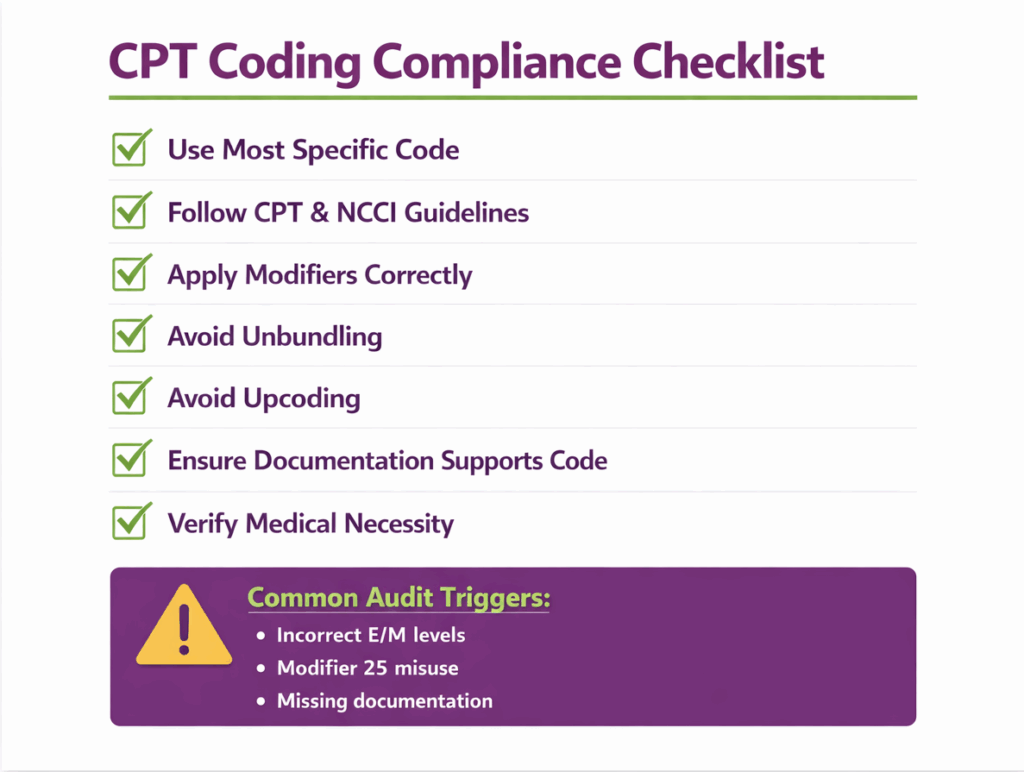
Correct CPT coding follows specific rules that ensure accuracy, compliance, and proper reporting of medical services.
Use the Most Specific CPT Code
Coders must select the CPT code that most accurately describes the service performed. Using unspecified or less detailed codes when a more specific option exists should be avoided.
Follow Official CPT Guidelines and Notes
CPT guidelines, parenthetical notes, and section instructions must be followed exactly. These rules define how and when a code can be reported.
Apply Modifiers Correctly
Modifiers should be used only when appropriate to explain changes or special circumstances related to a procedure. Incorrect modifier use can lead to claim denials or audits.
Avoid Unbundling and Upcoding
Services that are included in a comprehensive CPT code must not be reported separately unless allowed by guidelines. Codes must reflect the actual service performed, without exaggeration.
Ensure Documentation Supports the CPT Code
Every CPT code reported must be fully supported by clinical documentation. Documentation must clearly justify the level, complexity, and nature of the service provided.
What Is the Role of CPT Code in Medical Coding?
CPT codes play a central role in medical coding by translating documented medical services into standardized procedure codes used across healthcare systems. To understand their function clearly, it is important to answer the question, What Is Medical Coding, which is the process of converting diagnoses, medical procedures, healthcare services, and medical supplies documented in patient records into standardized alphanumeric codes that represent clinical information in a uniform format.
The role of CPT codes in medical coding can be clearly understood through the following key functions:
Standardizing Medical Procedures
CPT codes provide a uniform way to describe medical procedures and services. This standardization ensures consistency in how healthcare services are reported by different providers.
Supporting Accurate Billing and Claims
CPT codes are used to report services on medical claims. Accurate CPT coding ensures that billed services match the procedures documented in the medical record.
Determining Reimbursement Levels
CPT codes are directly linked to reimbursement through RVUs and payer fee schedules. The selected CPT code influences how much a provider is paid for a service.
Ensuring Compliance With Coding Guidelines
CPT codes help enforce compliance by requiring services to be reported according to official coding rules, guidelines, and payer policies.
Enabling Data Reporting and Analysis
CPT codes support healthcare data collection, reporting, and analysis. They are used for utilization tracking, quality measurement, and healthcare analytics.
Are CPT Codes the Same for All Specialties?
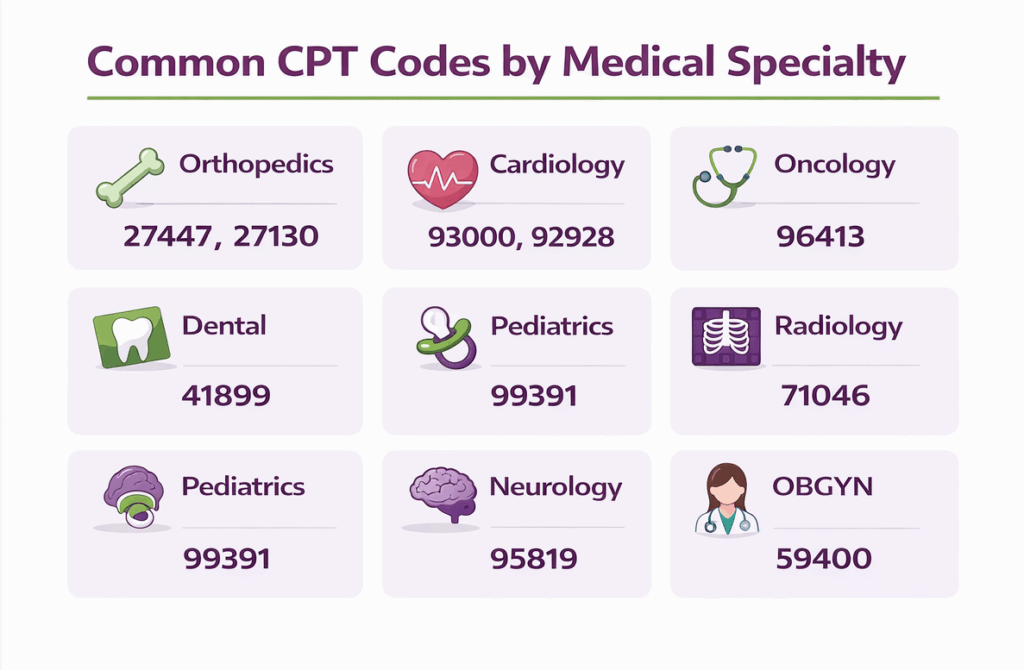
CPT codes are standardized across healthcare, but the codes used vary by specialty based on the services and procedures commonly performed in each field.
What Are the Most Common CPT Codes for Pain Management?
Pain management CPT codes primarily report injections, nerve blocks, and therapeutic procedures.
| CPT Code | Description |
|---|---|
| 62323 | Epidural injection, lumbar/sacral |
| 64483 | Transforaminal epidural injection |
| 64493 | Facet joint injection, lumbar |
| 20552 | Trigger point injection |
| 77003 | Fluoroscopic guidance |
What Are the Most Common CPT Codes for Orthopedics?
Orthopedic CPT codes focus on musculoskeletal surgeries and joint procedures.
| CPT Code | Description |
|---|---|
| 27447 | Total knee arthroplasty |
| 27130 | Total hip arthroplasty |
| 29881 | Knee arthroscopy |
| 20610 | Joint injection |
| 23472 | Total shoulder arthroplasty |
What Are the Most Common CPT Codes for Surgery Centers?
Surgery centers commonly report outpatient surgical procedures.
| CPT Code | Description |
|---|---|
| 47562 | Laparoscopic cholecystectomy |
| 29827 | Arthroscopic rotator cuff repair |
| 66984 | Cataract surgery |
| 43239 | Upper GI endoscopy with biopsy |
| 45378 | Colonoscopy |
What Are the Most Common CPT Codes for Imaging Centers and Radiology?
Radiology CPT codes report diagnostic imaging services.
| CPT Code | Description |
|---|---|
| 71046 | Chest X-ray |
| 74177 | CT abdomen and pelvis |
| 72148 | MRI lumbar spine |
| 77067 | Screening mammography |
| 93306 | Echocardiogram |
What Are the Most Common CPT Codes for Oncology?
Oncology CPT codes commonly report chemotherapy and infusion services.
| CPT Code | Description |
|---|---|
| 96413 | Chemotherapy infusion |
| 96415 | Additional chemotherapy infusion |
| 36561 | Implantable venous access |
| 99214 | Oncology office visit |
| 96372 | Therapeutic injection |
What Are the Most Common CPT Codes for Gastroenterology?
Gastroenterology CPT codes mainly involve endoscopic procedures.
| CPT Code | Description |
|---|---|
| 45378 | Colonoscopy |
| 45380 | Colonoscopy with biopsy |
| 43235 | Upper GI endoscopy |
| 43239 | EGD with biopsy |
| 45385 | Colonoscopy with polypectomy |
What Are the Most Common CPT Codes for Ambulatory Surgery Centers (ASC)?
ASC CPT codes focus on high-volume outpatient procedures.
| CPT Code | Description |
|---|---|
| 66984 | Cataract removal |
| 29881 | Knee arthroscopy |
| 47562 | Laparoscopic gallbladder removal |
| 43239 | Upper endoscopy with biopsy |
| 45385 | Colonoscopy with polypectomy |
What Are the Most Common CPT Codes for Podiatry?
Podiatry CPT codes report foot and ankle procedures.
| CPT Code | Description |
|---|---|
| 11721 | Nail debridement |
| 11056 | Callus trimming |
| 28285 | Hammertoe repair |
| 29540 | Strapping of ankle |
| 73630 | Foot X-ray |
What Are the Most Common CPT Codes for Dental Services?
Dental-related CPT codes are limited and typically used in medical billing scenarios.
| CPT Code | Description |
|---|---|
| 41899 | Unlisted dental procedure |
| 21010 | Tooth extraction |
| 21209 | Dental biopsy |
| 70355 | Dental panoramic X-ray |
| 99202 | Dental-related evaluation |
What Are the Most Common CPT Codes for Pediatrics?
Pediatric CPT codes commonly report preventive and acute care services.
| CPT Code | Description |
|---|---|
| 99391 | Infant preventive visit |
| 99392 | Early childhood preventive visit |
| 99213 | Pediatric sick visit |
| 90460 | Immunization administration |
| 90700 | DTaP vaccine |
What Are the Most Common CPT Codes for Cardiology?
Cardiology CPT codes report diagnostic and interventional heart services.
| CPT Code | Description |
|---|---|
| 93000 | ECG |
| 93306 | Echocardiogram |
| 93458 | Cardiac catheterization |
| 92928 | Coronary stent placement |
| 93224 | Holter monitoring |
What Are the Most Common CPT Codes for OBGYN?
OBGYN CPT codes cover pregnancy care, delivery, and gynecologic services.
| CPT Code | Description |
|---|---|
| 59400 | Routine obstetric care |
| 59510 | C-section with postpartum care |
| 58300 | IUD insertion |
| 76805 | Obstetric ultrasound |
| 88175 | Pap smear |
What Are Most Common CPT Codes?
The most common CPT codes widely used across healthcare include: 99214 (established patient visit), 99203 (new patient visit), 93000 (ECG with interpretation), 36415 (venipuncture), and 93307 (complete echocardiogram). These codes are frequently reported in outpatient visits, diagnostic testing, and routine procedures.
Is 99214 CPT Code Only for Established Patients?
Yes, CPT code 99214 is used only for established patients and represents an office or outpatient visit with moderate to high complexity medical decision-making.
What Is CPT Code 99203?
CPT code 99203 is used for a new patient office or outpatient visit requiring moderate complexity medical decision-making.
What Is CPT Code 80307?
CPT code 80307 is used for presumptive drug testing using instrumented chemistry analyzers.
What Is CPT Code 52310?
CPT code 52310 is used for cystoscopic removal of a ureteral calculus or foreign body without ureteral dilation.
What Is CPT Code 93228?
CPT code 93228 reports external mobile cardiovascular telemetry monitoring with interpretation and report.
What Is CPT Code 93308?
CPT code 93308 is used for a limited transthoracic echocardiogram.
What Is CPT Code 01400?
CPT code 01400 is used to report anesthesia services for procedures on the knee joint.
What Is CPT Code 33208?
CPT code 33208 is used for insertion of a dual-chamber permanent pacemaker.
What Is CPT Code 93307?
CPT code 93307 reports a complete transthoracic echocardiogram.
What Is CPT Code 92960?
CPT code 92960 is used for external electrical cardioversion.
What Is CPT Code 92928?
CPT code 92928 reports percutaneous coronary intervention with stent placement.
What Is CPT Code 52332?
CPT code 52332 is used for cystoscopic insertion of an indwelling ureteral stent.
What Is CPT Code 33249?
CPT code 33249 is used for insertion or replacement of an implantable cardioverter-defibrillator (ICD) system.
What Is CPT Code 95819?
CPT code 95819 reports an electroencephalogram (EEG) performed during awake or sleep states.
What Is CPT Code 51798?
CPT code 51798 is used for measurement of post-void residual urine volume using ultrasound.
What Is CPT Code 93016?
CPT code 93016 reports the physician supervision component of a cardiovascular stress test.
What Is CPT Code 77080?
CPT code 77080 is used for bone density scanning (DEXA) of the axial skeleton.
Can CPT Code 99214 and 90833 Be Billed Together?
Yes, 99214 and 90833 can be billed together when both an E/M service and psychotherapy are provided during the same encounter, and documentation supports each service separately.
What Is the Difference Between CPT and ICD-10?
CPT and ICD-10 are both coding systems used in healthcare, but they serve different purposes.
CPT (Current Procedural Terminology) codes describe medical procedures and services performed by healthcare providers. They are used primarily for billing, reimbursement, and reporting the care delivered.
ICD-10 (International Classification of Diseases, 10th Revision) codes describe diagnoses and medical conditions. They are used to indicate the patient’s health condition, justify medical services, and track disease prevalence.
In short, CPT codes capture “what was done,” while ICD-10 codes capture “why it was done.” Both systems are used together in medical billing to ensure claims are accurate and compliant.
What Is the Difference Between CPT and HCPCS?
CPT and HCPCS are both coding systems used to report medical services, but they have different scopes and purposes.
CPT (Current Procedural Terminology) codes describe medical procedures and services provided by healthcare professionals. They are primarily used for billing, documentation, and reimbursement of physician and outpatient services.
HCPCS (Healthcare Common Procedure Coding System) codes expand on CPT codes to include supplies, equipment, and non-physician services, such as durable medical equipment, ambulance services, and certain drugs. HCPCS has two levels: Level I uses CPT codes, and Level II covers items not included in CPT.
In essence, CPT codes cover procedures, while HCPCS codes cover both procedures and additional healthcare products or services not captured by CPT.