
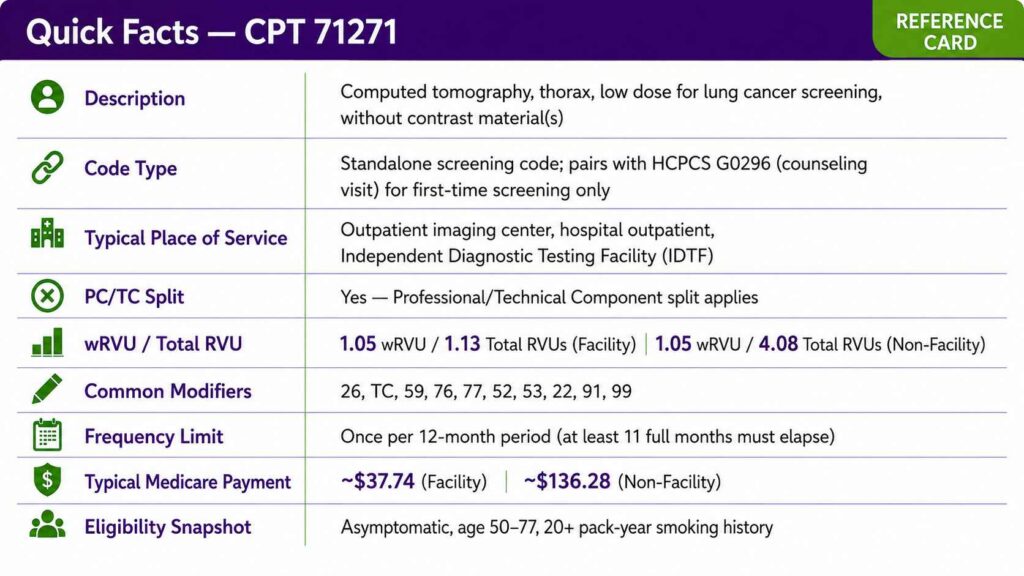
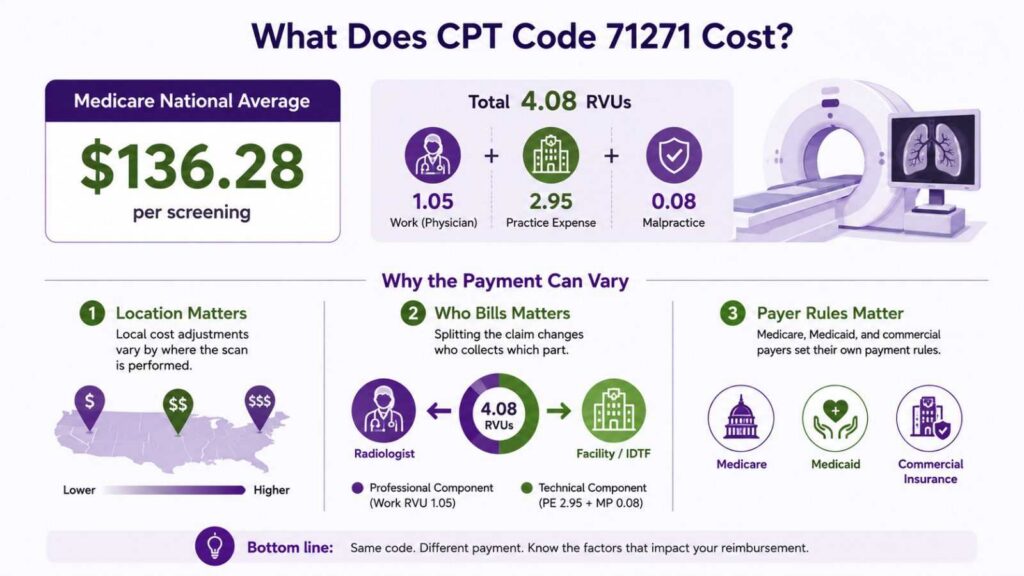
CPT code 71271 is the code used to bill a low-dose CT scan of the chest performed specifically to screen high-risk patients for lung cancer. It carries a work RVU of 1.05, a total RVU of 4.08, and pays a national average of $136.28 in non-facility settings (or ~$37.74 in facility settings) under Medicare, with zero patient cost-sharing when all eligibility rules are met.
Each year, more people die of lung cancer than of colon, breast, and prostate cancers combined, an estimated 124,990 deaths in 2026 alone, according to the American Cancer Society. This is exactly why this screening code exists.
71271 CPT code is one of the many pulmonology CPT codes that practices bill regularly, alongside pulmonary function tests, sleep studies, and bronchoscopy. This guide breaks down 71271 specifically: the descriptor, the full cost breakdown, real billing scenarios, and every coding rule.
What Is the Description of CPT Code 71271?
CPT code 71271 describes a computed tomography scan of the thorax performed at a low radiation dose, specifically for lung cancer screening, without contrast material. It became effective January 1, 2021, and it catches lung cancer early in patients who have no symptoms but carry real risk factors.
The code falls under the Diagnostic Radiology section of the CPT manual and covers chest imaging procedures. It carries a work RVU of 1.05, a practice expense RVU of 2.95, and a malpractice RVU of 0.08. That adds up to a total RVU of 4.08 across both facility and non-facility settings.
The 71271 CPT code can be reported once per patient within a 12-month period and carries a Medically Unlikely Edit limit of 1 unit per date of service.
Is 71271 the Same as a Regular Chest CT?
No, a diagnostic chest CT is billed under a different code (71250) and is used for symptomatic patients or those already being worked up for a specific finding. Treating them as the same is a common, denial-causing mistake.
71271 is reserved exclusively for asymptomatic, high-risk patients being screened, with no signs or symptoms of lung cancer at the time of the scan.
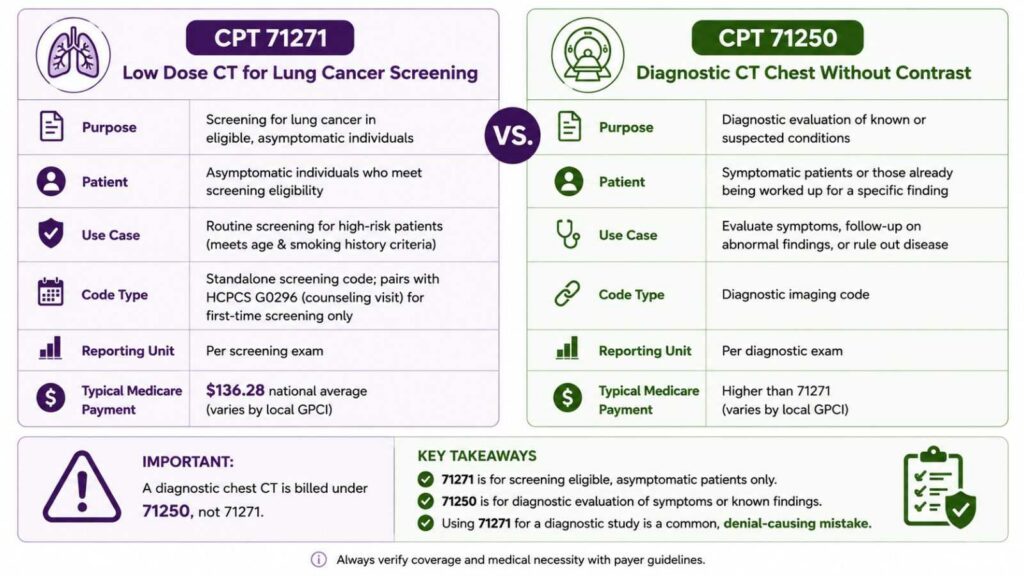
If the medical record describes symptoms but the claim uses 71271, or the record describes a screening but the claim uses a diagnostic code, the mismatch between documentation and the code results in a near-automatic denial.
What Does “Low Dose” Mean in CPT Code 71271?
The “low dose” designation refers to a reduced radiation dose specifically calibrated for annual screening, lower than the dose used in a standard diagnostic CT.
This matters because screening is repeated every year for eligible patients. That’s why minimizing cumulative radiation exposure over years of annual scans is part of the code’s clinical design.
When Was CPT 71271 Created, and What Did It Replace?
CPT 71271 became effective January 1, 2021, replacing the older HCPCS code G0297, which is no longer valid for billing.
Before 71271 existed, providers had to repurpose diagnostic codes such as 71250 to bill screening exams, which frequently led to claim denials and coding confusion. Any claim still referencing G0297 today will be rejected outright.
How Does Lung-RADS Determine If You Bill 71271 or 71250?
The radiologist’s Lung-RADS score on the current scan decides how the next scan gets billed, and getting this wrong is a real, specific denial trigger. The table below shows the Lung-RADS category, the result, and the code used.
| Lung-RADS Category | Result | Next Scan Billed As |
|---|---|---|
| 1 or 2 | Negative screen | 71271 (screening), repeated in 12 months |
| 3 or 4 | Indeterminate or suspicious | 71250 (diagnostic), typically at 3-6 months |
A Lung-RADS 1 or 2 result keeps the patient on the annual screening pathway, so the follow-up stays 71271. A Lung-RADS 3 or 4 result moves the patient into diagnostic surveillance, so the follow-up must be billed as 71250.
Does 71271 Split Into Professional and Technical Components?
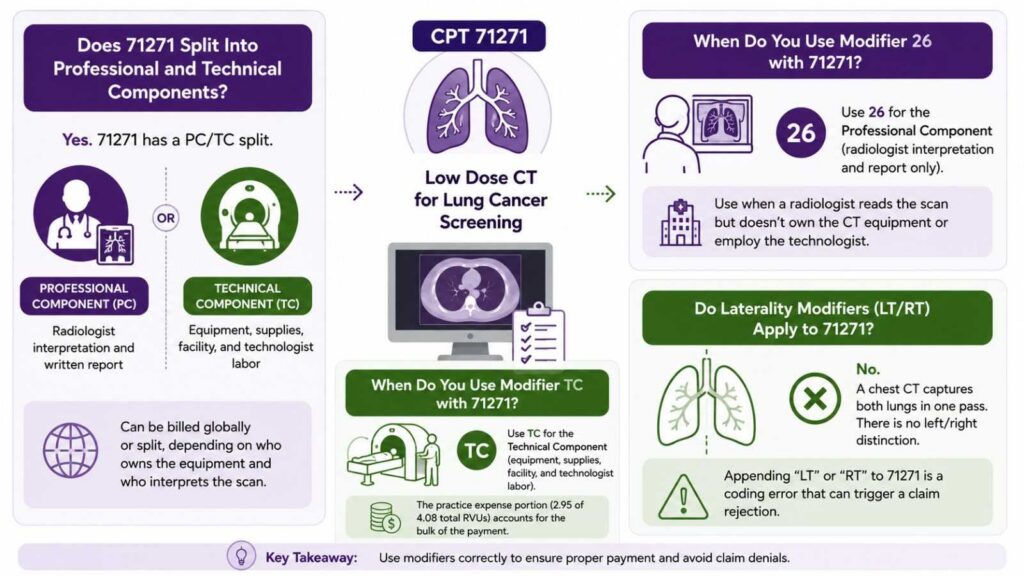
Yes, like most diagnostic imaging codes, 71271 carries a PC/TC split. This means it can be billed globally or split into professional and technical components, depending on who owns the equipment and who interprets the scan.
When Do You Use Modifier 26 with 71271?
Modifier 26 reports only the professional component, which is the radiologist’s interpretation and written report. Use it when a radiologist reads the scan but doesn’t own the CT equipment or employ the technologist who performed it.
This is common when an independent radiology group interprets scans performed at a hospital or an IDTF it doesn’t own.
When Do You Use Modifier TC With 71271?
Modifier TC reports only the technical component, including equipment, supplies, facility space, and technologist labor required to perform the scan. The facility or IDTF that owns the equipment bills this component.
Based on the RVU breakdown, the practice expense portion (2.95 of the 4.08 total RVUs) accounts for the bulk of the payment.
Do Laterality Modifiers (LT/RT) Apply to 71271?
No, a chest CT image shows both lungs in a single pass, so there is no left/right distinction to make. Appending “LT” or “RT” to 71271 is a coding error that can trigger a claim rejection rather than clarify anything for the payer.
How Do IDTFs Bill CPT 71271?
Independent Diagnostic Testing Facilities can perform the LDCT scan, but they cannot bill 71271 on their own. Because the code includes a therapeutic component (smoking-cessation counseling must be available to current smokers), CMS requires that a physician bill the service.
The physician and the IDTF need a formal business arrangement for this part of the benefit, and the IDTF looks to the physician for payment rather than billing Medicare itself. Physicians billing this way also need to comply with the CMS anti-markup provisions governing purchased diagnostic services.
What ICD-10 Codes Must Be Billed With 71271?
Two categories of diagnosis codes have to be billed together:
- The screening code: Z12.2, encounter for screening for malignant neoplasm of the respiratory organs
- A smoking-status code, matched to the patient’s documented history: Z87.891 for a former smoker, or the appropriate F17.21x code for a current smoker (F17.210 uncomplicated, F17.211 in remission, F17.213 with withdrawal, F17.218 or F17.219 for other/unspecified nicotine-induced disorders)
For the full list of respiratory diagnosis codes beyond Z12.2 and the smoking-status codes, see our pulmonology ICD-10 codes guide.
Can You List Both Z87.891 and F17.210 as Primary?
Absolutely not, and doing so can stop the exam before it’s even scheduled. Per real-world scheduling protocols used by hospital imaging departments, listing both the former-smoker code and the current-smoker code as primary is not allowed, since a patient can’t be both simultaneously.
Only one applies based on the patient’s current smoking status, and Z12.2 is listed as the secondary code.
How Does G0296 Pair With 71271?
HCPCS code G0296 covers the counseling and shared decision-making visit CMS requires before a patient’s very first lung cancer screening. This visit must occur and be billed before or on the same date as the initial 71271 scan.
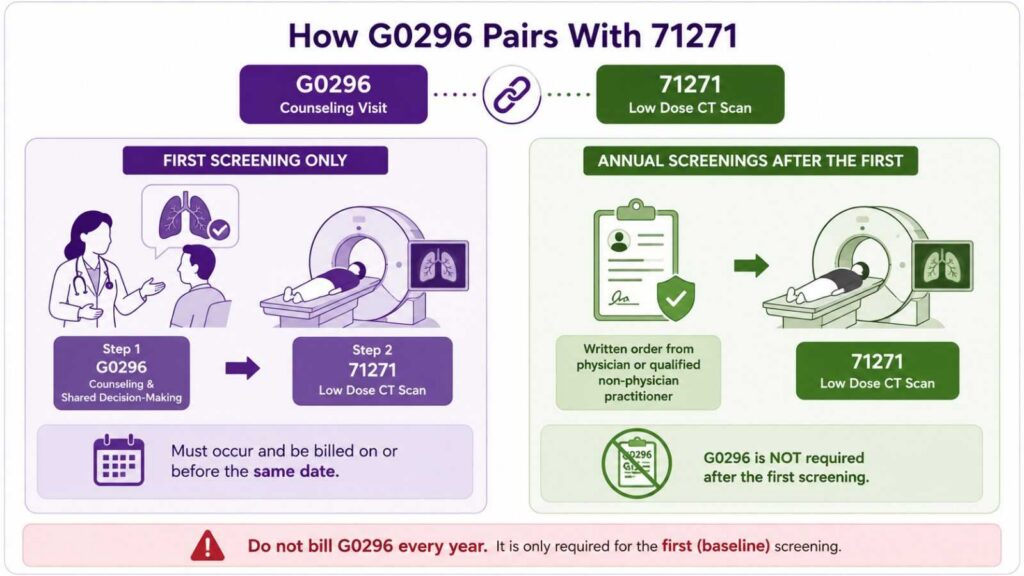
For every annual screening after the first, G0296 is no longer required. The patient only needs a written order from a physician or qualified non-physician practitioner.
Some practices bill G0296 every year, as if it’s required annually like the scan itself. Pulmonology billing specialists can easily prevent these repeat-billing mistakes, especially when Medicare requires the screening only once, before the patient’s first screening.
What Does CPT Code 71271 Cost, and Who Pays for It?
CPT 71271 pays a national average baseline of $136.28 under Medicare when billed as a global service in a non-facility setting. That figure is derived from the code’s non-facility RVU total of 4.08. It combines 1.05 for physician work, 2.95 for practice expense (equipment, technologist labor, and overhead), and 0.08 for malpractice risk.
However, payment changes depending on where the scan happens and who owns the equipment:
- Technical Billing Only (71271-TC): If an imaging center performs the scan but sends it elsewhere for reading, it bills only the equipment and staff component (2.95 RVUs), collecting $98.54.
- Hospital Settings (Facility): When done in a hospital outpatient department, the hospital bills the facility fee separately. The doctor bills only the reading (71271-26), which carries a total of 1.13 RVUs and pays a national Medicare average of $37.74.
Does Medicare cover CPT 71271?
Yes, in full, when all eligibility requirements are met. Medicare classifies 71271 as a preventive service under its lung cancer screening benefit. This means the standard Part B process of applying coinsurance and a deductible doesn’t apply here the way it does for most imaging.
Coverage is Medicare Administrative Contractor (MAC) dependent for some documentation specifics, but the core benefit is nationwide.
Does Commercial Insurance cover CPT 71271?
For most patients, yes, at no cost to them. Under ACA Section 2713, non-grandfathered commercial plans must cover USPSTF Grade B preventive services, which includes lung cancer screening, without any patient cost-sharing.
The exceptions are grandfathered plans, self-insured ERISA employer plans, and short-term limited-duration plans, which can set their own coverage terms.
Prior authorization requirements and the applicability of modifier 33 (preventive service) still vary by payer. So, it’s worth confirming the specific plan’s policy before scheduling the scan.
Does the Patient Owe Any Coinsurance or Deductible?
No, not when the claim is billed correctly as a preventive screening. Patient cost-sharing is $0 under Medicare for this code, and the same zero-cost-sharing rule generally applies to ACA-compliant commercial plans.
If a patient is billed anything out of pocket for a properly coded, eligible screening, that’s usually a sign the claim was billed incorrectly.
Does Reimbursement Differ Between the Global, 26, and TC Billing Methods?
Yes, the global payment covers both the interpretation and the technical work in one amount. When it’s split, the practice expense (technical) side carries the larger share: 2.95 of the code’s 4.08 total RVU comes from practice expense, versus 1.05 for the physician’s work.
In practical terms, this means the entity that owns the CT equipment collects meaningfully more than the radiologist who only interprets the scan.
This is worth knowing when negotiating a business arrangement between a physician group and an imaging facility or IDTF. Getting this split billed correctly on every claim is exactly the kind of detail pulmonology and radiology billing services are built to manage.
How Much Can Local Reimbursement Differ From the National Average?
Medicare’s Geographic Practice Cost Index (GPCI) adjusts the national rate up or down based on local labor, overhead, and malpractice costs.
In high-cost areas (e.g., NYC, D.C., Alaska), the global non-facility rate can reach $150–$170+, while the physician professional-only component scales up from $37.74 to ~$45.00.
High-cost regions like California, New York, Massachusetts, and Washington D.C. typically pay 5% to 15% above the national average. Meanwhile, lower-cost states like Wyoming, Montana, and Mississippi typically pay 5% to 10% below it.
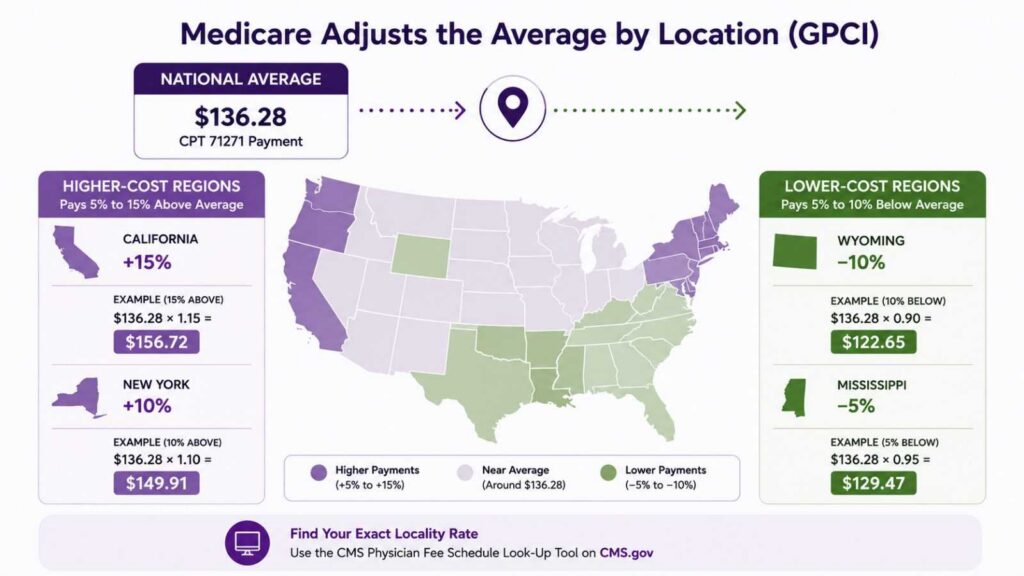
You can find the exact locality rate through the CMS Physician Fee Schedule Look-Up Tool on their website.
What Are Some Real-World Billing Scenarios for CPT 71271?
The coding rules for 71271 only make sense once you see them applied to an actual patient encounter. Here are the four scenarios that billers encounter most often, from a routine first screening to a case where the code changes entirely because of a Lung-RADS finding.
Scenario 1: First-Time Screening with Same-Day Shared Decision-Making Visit
A 61-year-old with a 35-pack-year smoking history, who quit 8 years ago, presents for an annual physical with no respiratory symptoms. The physician confirms this is the patient’s first-ever lung cancer screening, conducts the required counseling visit during the same appointment, and orders the LDCT.
- CPT Codes: G0296 (counseling visit) + 71271 (screening scan, billed separately once performed)
- ICD-10 Codes: Z12.2 (screening encounter) + Z87.891 (personal history of nicotine dependence, former smoker)
- Modifiers: None required if the same entity performs and interprets the scan (global billing)
- Documentation Required: Age, pack-year history, quit date, confirmation of no symptoms, and a signed written order, plus notes confirming the shared decision-making discussion covered benefits, harms, and follow-up implications
Scenario 2: A Current Smoker Whose Screening Is Denied for Missing Documentation
A 55-year-old current smoker with a 22-pack-year history is screened, but the claim comes back denied. The physician’s order simply says “lung cancer screening” without stating the pack-year history or confirming the patient’s current smoking status in the note itself.
- CPT Codes: 71271 (denied on first submission)
- ICD-10 Codes: Z12.2 + F17.210 (nicotine dependence, cigarettes, uncomplicated) submitted, but not enough on their own to support medical necessity without matching documentation
- Modifiers: None relevant to the denial itself
- Documentation Required to Overturn the Denial: The written order must explicitly state the pack-year count and current smoking status. Appending a corrected order or an addendum note that documents both criteria clearly, then resubmitting, is usually enough to reverse this specific denial reason.
Scenario 3: Split Billing Between an Imaging Center and an Independent Radiologist
A patient is scanned at an imaging center that owns its own CT equipment. However, the scan is interpreted by a radiologist from an independent group with no ownership stake in the equipment.
- CPT Codes: 71271 billed twice, once by each party, split by component
- ICD-10 Codes: Z12.2 + the applicable smoking-status code, submitted on both claims
- Modifiers: TC appended by the imaging center (technical component); 26 appended by the radiologist (professional component)
- Documentation Required: A signed radiology report from the interpreting physician; confirmation that the imaging center owns the equipment and the interpreting radiologist has no ownership stake, to support the component split
Scenario 4: Follow-Up Scan After a Lung-RADS 3 Result
A patient’s prior screening returned a Lung-RADS 3 result (probably benign, short-interval follow-up recommended). The ordering physician schedules a follow-up chest CT at 6 months, rather than waiting the full 12 months for the next annual screening.
- CPT Codes: 71250 (diagnostic chest CT), not 71271
- ICD-10 Codes: A diagnosis code reflecting the actual clinical finding (such as R91.1, solitary pulmonary nodule), not Z12.2
- Modifiers: Standard PC/TC modifiers (26/TC) still apply if split between two billing entities
- Documentation Required: The prior Lung-RADS score and the radiologist’s recommended follow-up interval, since this is what justifies billing diagnostic rather than screening, and justifies the shorter-than-12-month interval
What Are the Coding Rules for CPT 71271?
The billing rules for 71271 fall into three groups: who qualifies for it, how often it can be filed, and what happens when a claim is denied and needs to be appealed. Getting any one of these wrong is what turns an eligible, medically appropriate screening into an unpaid claim.
Who Qualifies for CPT 71271 Under Medicare?
A patient qualifies only when all of the following are true and documented in the record. If the patient fails even one, the claim is denied outright, with no partial credit for meeting the rest. The table below shows the requirements for what qualifies and what doesn’t.
| Requirement | What Qualifies | What Doesn’t |
|---|---|---|
| Age | 50 to 77 as of the screening date | 78 or older, even by a matter of weeks |
| Smoking History | At least 20 pack-years (1 pack/day for 1 year) | 18 pack-years or fewer, regardless of clinical judgment |
| Smoking Status | Current smoker, or quit within the past 15 years | Quit more than 15 years ago |
| Symptoms | Fully asymptomatic | Any documented respiratory symptoms (shifts to diagnostic coding) |
| Order | Written order explicitly stating “lung cancer screening” | An order that just says “chest CT” or “screening” generically |
If a patient fails one of these, the scan can still be performed clinically, but it has to be billed as a diagnostic study.
How Often Can CPT 71271 Be Billed?
Once every 12 months, and the MUE (Medically Unlikely Edit) limit confirms this at 1 unit per beneficiary per date of service. Payers define the 12-month window as requiring at least 11 full months to pass since the prior screening before the next one becomes billable.
Scheduling the next annual scan even slightly early, before that window closes, results in a denial for exceeding the frequency limit, regardless of clinical justification.
Do Local Coverage Determinations Add Requirements Beyond the National Rule?
Yes, in some jurisdictions. Z12.2 and the appropriate smoking-status code form the national baseline for every claim. Although individual Medicare Administrative Contractors can publish their own Local Coverage Determinations specifying additional or more particular ICD-10 codes accepted in that jurisdiction.
Checking the local MAC’s LCD prevents denial due to a regional coding preference that the national rule doesn’t capture.
What Is the Appeal Window If a Claim Is Denied?
For Medicare claims, a redetermination request must be filed within 120 days of the date on the denial notice, the first of Medicare’s five appeal levels. The MAC typically decides within 60 days of receiving the request.
Missing the 120-day window generally forfeits the right to appeal, except in rare cases where the MAC finds good cause for the delay.
Why Do CPT Code 71271 Claims Get Denied?
Almost every denial of 71271 is preventable, and nearly all of them trace back to documentation rather than the procedure itself. In the table, you’ll see a list of recurring causes and how you can fix them.
| Denial Cause | What It Looks Like | Quick Fix |
|---|---|---|
| Incomplete Eligibility Documentation | Age, pack-years, or smoking status implied rather than explicitly stated | Restate all three directly in the order and the visit note, not just referenced elsewhere in the chart |
| Missing or Mismatched ICD-10 Pairing | Z12.2 alone, a contradicting smoking-status code, or both smoker codes listed as primary | Pair Z12.2 with exactly one smoking-status code that matches the documented history |
| Filed Before the Frequency Window Closes | Annual repeat scheduled before 11 full months have elapsed | Calendar the next eligible date at the time of the current screening, not from memory |
| Screening Billed as Diagnostic | 71271 used for a symptomatic patient, or kept after a Lung-RADS 3/4 result instead of switching to 71250 | Check the prior Lung-RADS score before coding any follow-up scan |
| Duplicate Component Billing | Facility and radiologist both billing globally instead of splitting TC and 26 | Confirm equipment ownership and the interpreting party before either claim goes out |
| Missing a Local LCD Requirement | National rule met, but a MAC-specific documentation element is missing | Check the local MAC’s LCD in addition to the national coverage rule before submission |
Final Words on CPT Code 71271
This CPT code pays reliably, but only when the documentation around it is airtight. Age, pack-years, smoking status, and the written order must be stated plainly, not implied, and the ICD-10 pairing must match exactly what’s in the chart.
Just keep track of the 12-month window and check the prior Lung-RADS results before coding a follow-up, and confirm who’s billing which component before either claim goes out. Get those habits right, and this code collects cleanly every time.