
CPT code 90471 reports the administration of one injectable vaccine during a single patient encounter. The code covers the provider work of giving the injection, not the vaccine product itself. Practices report the vaccine on a separate product line.
CPT 90471 is one of the highest-volume vaccine administration CPT codes in pediatrics, family medicine, primary care, and pharmacy clinics. Two rules drive most denials on this code. Medicare carves it out for its own preventive vaccines, and patients through age 18 with counseling shift to a different code family.
Those two carve-outs make 90471 a frequent rejection source, which is why many groups route immunization claims through dedicated medical billing services.
What Is the Description of CPT Code 90471?
The 90471 CPT code description, as defined by the AMA, is: “Immunization administration (includes percutaneous, intradermal, subcutaneous, or intramuscular injections); 1 vaccine (single or combination vaccine/toxoid).”
This code captures the act of administering one injectable vaccine, whether single or combination. Procedure code 90471 is the initial administration code, reported once per encounter. Each additional vaccine given in the same visit uses the add-on code 90472.
A single combination vaccine counts as one administration under CPT 90471, regardless of how many antigens it contains. The code is age-neutral on its face, though counseling and payer rules narrow its use in practice.
What Administration Routes and Settings Does CPT Code 90471 Cover?
CPT code 90471 covers four injectable routes only. Oral and intranasal vaccines route to a separate code family.
The covered injection routes are:
- Percutaneous (scratch, puncture, or jet injection)
- Intradermal (into the dermis)
- Subcutaneous (into the fatty layer below the skin)
- Intramuscular (into the muscle)
The code applies across multiple care settings, including the physician office, pediatric clinic, family medicine practice, retail and pharmacy clinic, and public health setting. Oral and intranasal administration is excluded from the 90471 CPT code and is reported with 90473 or 90474 instead.
When to Use CPT 90471 vs. +90472, 90473, and the Oral/Intranasal Pathway
Code selection depends on two factors: the administration route and whether the vaccine is the first or an additional dose at the visit. The route sets the code family. The sequence sets initial versus add-on.
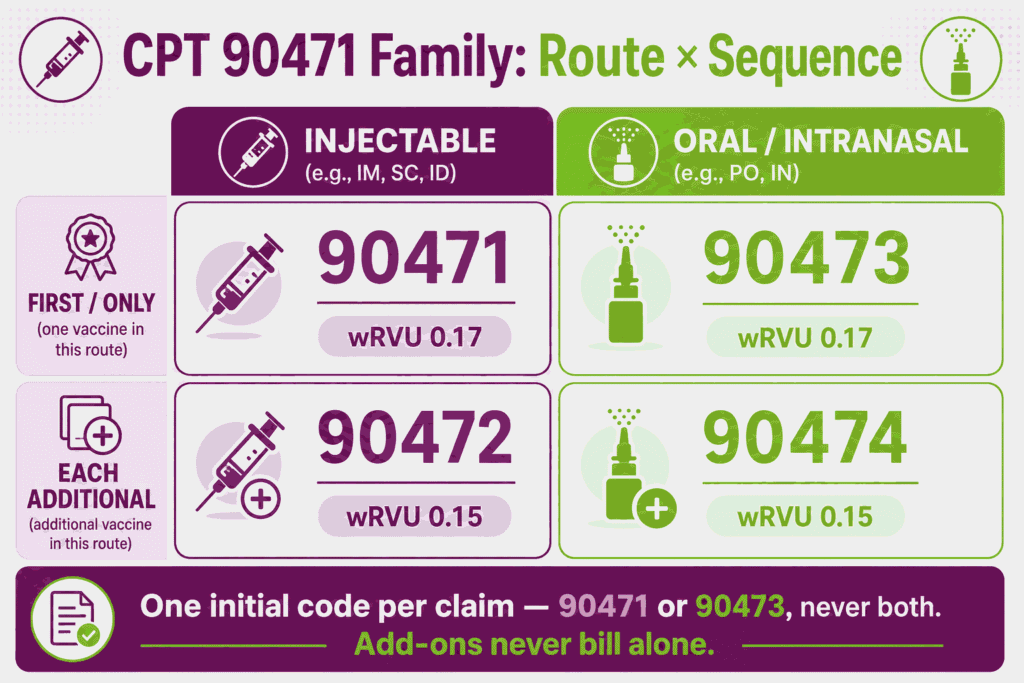
The four core administration codes split by route and order:
- 90471 reports the first or only injectable vaccine (work RVU 0.17)
- 90472 is the add-on for each additional injectable vaccine in the same visit (work RVU 0.15)
- 90473 reports the first or only oral or intranasal vaccine (work RVU 0.17)
- 90474 is the add-on for each additional oral or intranasal vaccine (work RVU 0.15)
Only one initial administration code applies per encounter. A claim carries either 90471 or 90473 as the first administration, never both. When a patient receives both an injectable and an oral or intranasal vaccine, the practice bills one initial code matching the first vaccine given, then add-on codes for the rest.
The add-on codes 90472 and 90474 are never reported alone. Each requires its corresponding initial code on the same claim. A 90472 line without CPT 90471 denies as a missing base code.
Why the Vaccine Product Code Must Be Billed Separately From CPT Code 90471
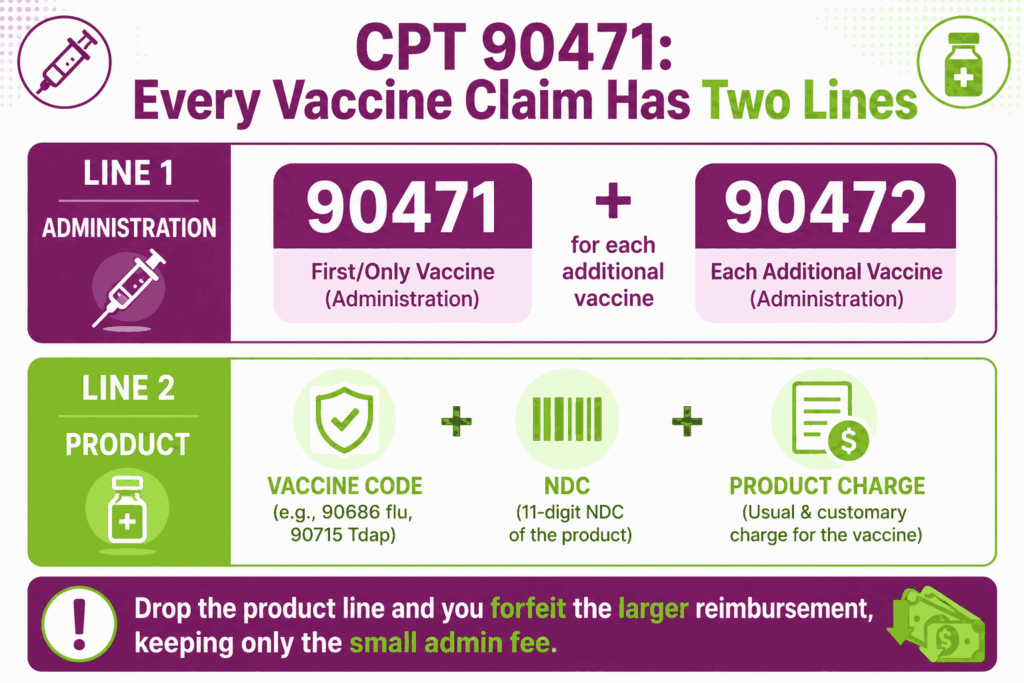
Procedure code 90471 reimburses the administration service only. The vaccine product is a separate revenue line with its own CPT or HCPCS product code. A complete vaccine claim, therefore, contains two lines.
A two-line vaccine claim works like this:
- Administration line: 90471, plus 90472 for each additional vaccine
- Product line: the specific vaccine code, such as 90686 for quadrivalent influenza or 90715 for Tdap
The product line carries the National Drug Code (NDC) and the product charge. Omitting the product line means the practice collects only the small administration fee and forfeits the larger product reimbursement. Both lines belong on every commercial vaccine claim.
Why CPT 90471 Cannot Be Used for Medicare Flu, Pneumococcal, or Hepatitis B Administration (G0008/G0009/G0010)
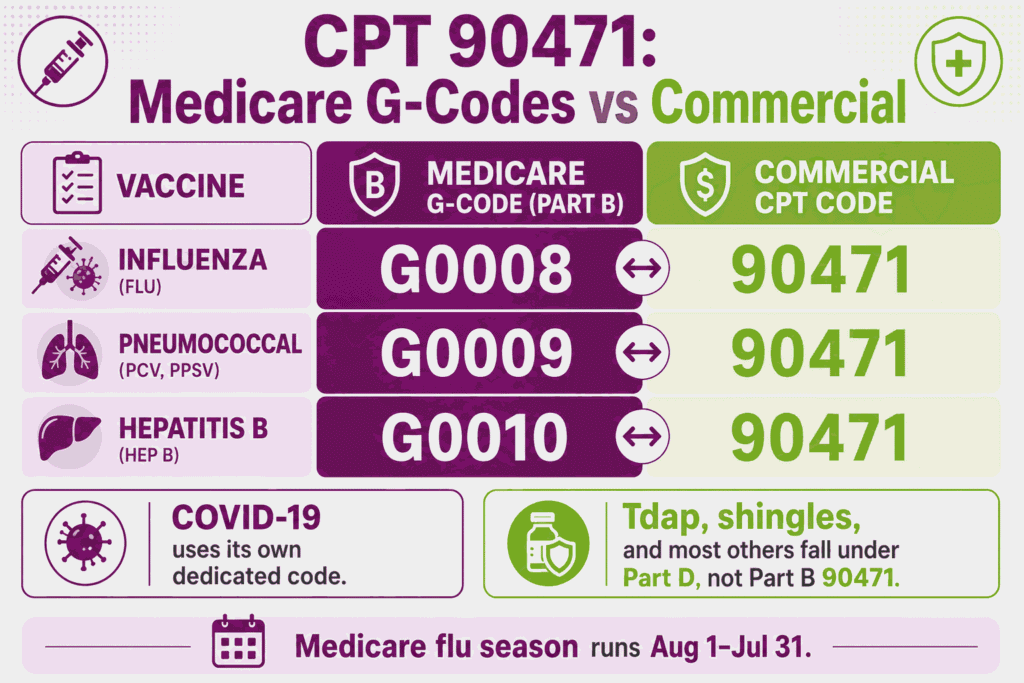
Medicare Part B does not accept CPT code 90471 for the three preventive vaccines it covers directly. Part B requires HCPCS G-codes for influenza, pneumococcal, and hepatitis B administration. Commercial payers accept 90471 for the same vaccines.
Each Part B vaccine maps to its own Medicare administration code:
- Influenza administration uses G0008 for Medicare and 90471 for commercial payers
- Pneumococcal administration uses G0009 for Medicare and 90471 for commercial payers
- Hepatitis B administration uses G0010 for Medicare and 90471 for commercial payers
Two further points govern Medicare immunization billing. COVID-19 vaccine administration carries its own dedicated code rather than 90471 or a G-code. Most other vaccines, such as Tdap and shingles, fall under Medicare Part D rather than Part B, so Part B does not reimburse the 90471 CPT code for them.
Medicare also defines the influenza season as August 1 through July 31, not the calendar year. A patient vaccinated in September and again the following February qualifies for two covered flu administrations under G0008.
When to Use CPT 90471 vs. 90460/90461 for Pediatric Counseling-Based Administration
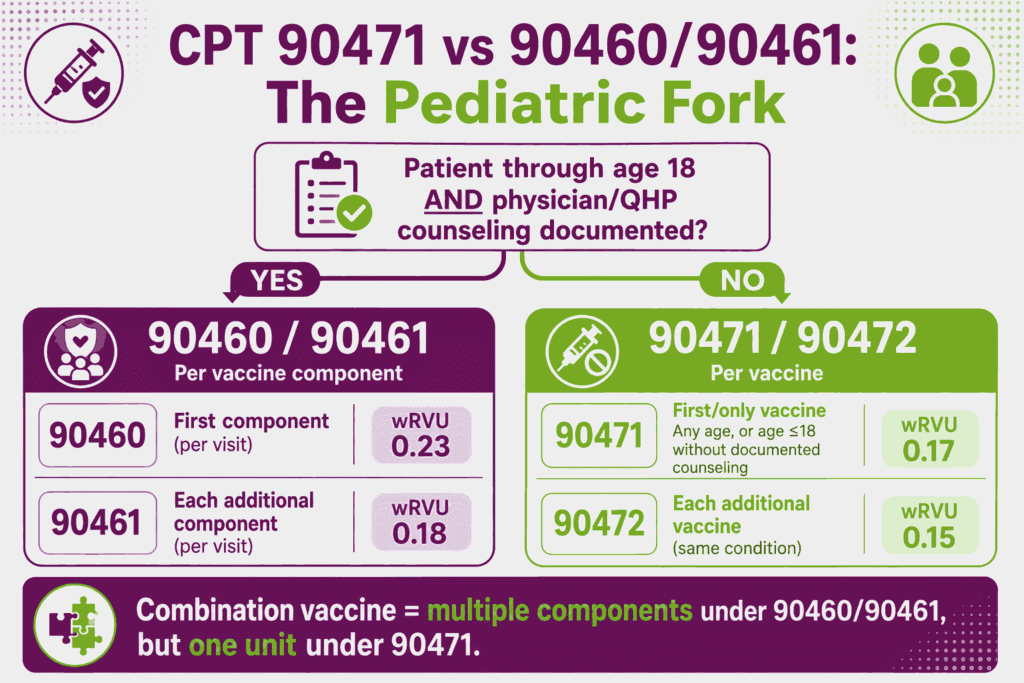
For patients through age 18, CPT code 90471 gives way to 90460 and 90461 when a physician or qualified health professional provides face-to-face counseling. The counseling codes are component-based. The 90471 family is vaccine-based.
Use 90460 and 90461 when all of these apply:
- The patient is through 18 years of age
- A physician or QHP delivers vaccine counseling at the visit
- Reporting runs per vaccine component, with 90460 for the first component (work RVU 0.23) and 90461 for each additional component (work RVU 0.18)
Use 90471 and 90472 when any of these apply:
- The patient is any age
- No counseling is documented for a patient through age 18
- Reporting runs per vaccine rather than per component
A combination vaccine with multiple antigens generates multiple components under 90460 and 90461. The same vaccine generates one unit under 90471. A patient through age 18 who receives a vaccine without documented counseling stays on procedure code 90471.
What ICD-10 Codes Support CPT Code 90471?
The primary diagnosis code supporting CPT code 90471 is Z23, “Encounter for immunization.” Z23 establishes the routine immunization purpose of the visit for most vaccine claims.
Common supporting diagnoses include:
- Z23: Encounter for immunization, the primary code for routine vaccination
- Z20.3: Contact with and suspected exposure to rabies, which supports rabies post-exposure prophylaxis
- W54.0XXA: Bitten by dog, initial encounter, which supports the exposure event in animal-bite prophylaxis
- Z77.21: Contact with and exposure to other hazardous substances, for situational exposure support
Z23 functions as the standalone diagnosis for preventive immunization. Post-exposure scenarios pair Z23 or the exposure code with the documented clinical event to support medical necessity.
What are the Modifiers for CPT Code 90471?
CPT 90471 takes few modifiers, and the most consequential one attaches to a different code. Most vaccine-only visits require no modifier on the administration line.
Modifier 25: Significant, Separately Identifiable E/M
Modifier 25 attaches to the evaluation and management code, not to CPT code 90471, when a significant and separately identifiable E/M service occurs on the same day as vaccine administration. The same rule applies to preventive medicine visits coded 99381 through 99397. Placing modifier 25 on the 90471 line instead of the E/M line is a common error that triggers denial.
Modifier 59: Distinct Procedural Service
Modifier 59 applies when the 90471 CPT code represents a distinct procedural service from another procedure on the same date, and an NCCI edit would otherwise bundle the two. Append modifier 59 only when documentation confirms the services were separate and no more specific modifier applies. Routine vaccine administration rarely requires modifier 59.
Modifiers 76 / 77: Repeat Procedure
Modifiers 76 and 77 identify a repeat procedure by the same physician (76) or another physician (77). These modifiers generally do not apply to procedure code 90471. Additional vaccines at one encounter use the add-on code 90472, not a repeat modifier. Reserve 76 and 77 for the narrow case a payer specifies a repeat administration on the same day.
Which Documents Are Required For CPT Code 90471?
Documentation for CPT code 90471 must establish the vaccine given, the route, the administering provider, and the supporting diagnosis. The medical record connects the administration code to the product line.
The required documentation includes:
- Vaccine name, manufacturer, lot number, and expiration date
- Dose, route of administration, and anatomical site
- Date of administration and the administering provider
- Vaccine Information Statement (VIS) edition date and the date given to the patient
- Documented consent for vaccination
- Primary diagnosis Z23 plus any exposure or risk diagnosis
- The vaccine product code on a separate line, with the NDC
- The provider order for the vaccine
NDC Reporting on the Vaccine Product Line
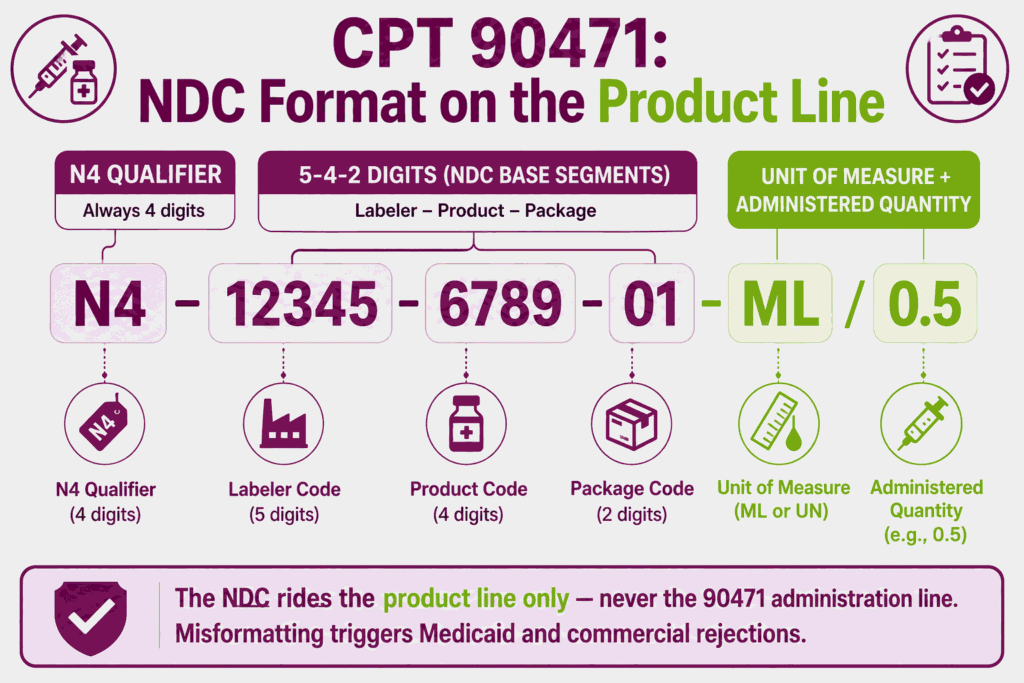
The National Drug Code (NDC) reports on the vaccine product line, not the 90471 administration line. Payers use the NDC to confirm the exact product, manufacturer, and package billed.
NDC reporting follows a fixed format:
- 11-digit format in a 5-4-2 configuration for labeler, product, and package
- N4 qualifier placed directly before the NDC
- Unit of measure, such as ML or UN, with the administered quantity
Many Medicaid and commercial payers reject the vaccine product line when the NDC is missing or formatted incorrectly. The administration line for CPT code 90471 does not carry an NDC.
What is the Cost of CPT Code 90471?
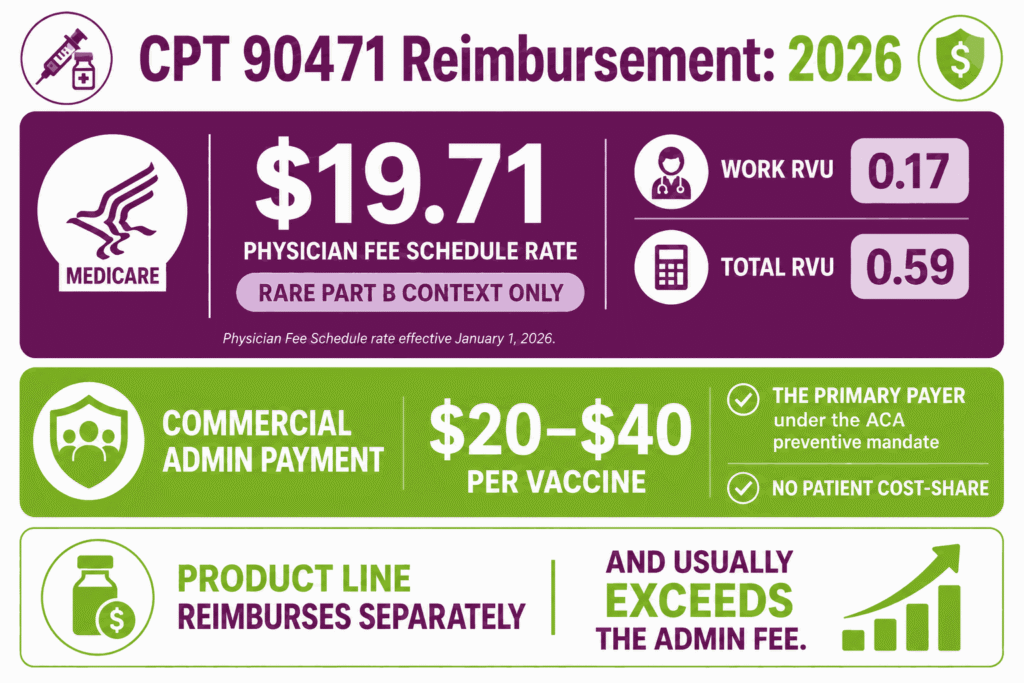
The cost of CPT code 90471 depends on the payer and the benefit category that covers the vaccine. Medicare Part B generally does not pay 90471 for its own preventive vaccines, so most 90471 revenue comes from commercial and Medicaid plans.
Medicare Payment & Benefit (Part B vs Part D)
Medicare splits vaccine coverage across two benefit categories, and CPT code 90471 has limited use in either. Part B covers influenza, pneumococcal, hepatitis B, and COVID-19 vaccines, billing administration through G-codes and the COVID-specific code rather than 90471. Part D covers most remaining vaccines, where administration runs through the pharmacy benefit rather than a Part B 90471 claim.
| Component | Value (CY 2026) |
|---|---|
| Work RVU | 0.17 |
| Practice Expense RVU | 0.41 |
| Malpractice RVU | 0.01 |
| Total RVU (non-facility) | 0.59 |
| National payment estimate | $19.71 |
The CMS Physician Fee Schedule still lists relative value units for the 90471 CPT code. The non-facility values for CY 2026 appear below:
The payment estimate applies the CY 2026 non-QP conversion factor of $33.4009 to the total RVU. GPCI adjustments change the final amount by locality. This physician fee schedule rate matters mainly for the rare Part B context, since G-codes carry the actual Medicare immunization reimbursement.
Commercial Payers
Commercial plans are the primary payers for procedure code 90471. Under the ACA preventive services mandate, in-network commercial plans cover ACIP-recommended vaccines and their administration with no patient cost-sharing. This makes 90471 the standard commercial administration code across vaccine types.
Commercial administration reimbursement varies by contract, region, and plan. Reported allowed amounts for a single vaccine administration commonly fall in the $20 to $40 range, with major insurers setting their own fee schedules. The product line reimburses separately and typically exceeds the administration fee for most vaccines.
Place-of-Service & Program Differences
Place of service and the funding program both change how CPT code 90471 reimburses. Office settings, pharmacy clinics, and public health programs apply different rules to the same code.
Key place-of-service and program differences include:
- Public health and mass clinics: Medicare flu and pneumococcal administration uses G-codes and roster billing rather than 90471
- Office (POS 11): The most common setting for 90471, billed to commercial or Medicaid with both administration and product lines
- Pharmacy and retail clinic: Administration billing follows the plan benefit, with Part D vaccines processed through the pharmacy system
- Vaccines for Children (VFC): The vaccine product is supplied free, so the practice bills the administration only at a capped fee
What Are Example Clinical Scenarios or Use Cases for CPT Code 90471?
CPT code 90471 applies whenever a provider administers one or more injectable vaccines and counseling-based pediatric coding does not apply. The scenarios below show common reporting patterns.
Scenario 1: Pediatric Vaccine Administration Without Same-Visit Counseling (Counseling Given at Prior Dose)
ICD-10: Z23 (Encounter for immunization)
A 10-year-old established patient returns for a scheduled second dose of an injectable vaccine. The physician provided full counseling at the first dose, and the family declines further counseling at this visit. A nurse administers the single injectable vaccine without physician face-to-face counseling at this encounter. Because no counseling occurs, CPT code 90471 is reported rather than 90460. The vaccine product is billed on a separate line with its NDC.
Scenario 2: Seasonal Influenza Vaccination for Adult Patient (Non-Medicare Payer)
ICD-10: Z23 (Encounter for immunization)
A 41-year-old adult with commercial coverage presents for a seasonal influenza vaccine. The medical assistant administers one quadrivalent influenza vaccine by intramuscular injection. The practice reports CPT 90471 for the administration and the influenza product code 90686 on a separate line. Modifier 25 is not used, since no separate E/M service occurs. The commercial plan covers both lines at no patient cost-share.
Scenario 3: Rabies Post-Exposure Prophylaxis (Single Dose Administration)
ICD-10: W54.0XXA (Bitten by dog, initial encounter) and Z23 (Encounter for immunization)
A patient presents after a dog bite for the first dose of the rabies vaccine series. The provider administers one intramuscular dose of rabies vaccine at this encounter. Procedure code 90471 is reported for the single administration, with the rabies vaccine product code on a separate line. The dog-bite exposure code supports medical necessity, paired with Z23 for the immunization encounter. Each subsequent dose in the series is reported as a single 90471 administration at its own visit.
What Are the CPT Code 90471 Rules To Ensure Successful Reimbursement?
Successful reimbursement for the CPT code 90471 requires adherence to proper documentation, correct unit reporting, and compliance with bundling and payer-specific vaccine administration rules. Using the CPT codes for medical practices ensures that procedures are reported consistently and reimbursed accurately across healthcare providers.
Bundling / Same‑Day E/M & Vaccine Program Rules
Same-day services drive the core bundling rules for the 90471 CPT code. A vaccine administered alongside an office visit does not automatically support a separate E/M charge.
The same-day and program rules are:
- An E/M or preventive visit billed with 90471 requires modifier 25 on the E/M line, supported by a significant, separately identifiable service
- A routine vaccine-only encounter does not support a separate E/M charge
- The add-on code 90472 requires CPT code 90471 on the same claim
- Only one initial administration code applies per visit, either 90471 or 90473
Units, MUEs & Frequency Rules
CPT code 90471 is reported once per encounter as the initial administration. Every additional vaccine at the same visit uses 90472, so 90471 functions as a one-unit code by definition.
Unit and frequency rules include:
- Units: one unit of 90471 per date of service, with additional vaccines routed to 90472 rather than multiple 90471 units
- MUE: 1 unit per date of service, set by the NCCI Practitioner MUE table
- Global period: 90471 carries an XXX indicator, so no global surgical package applies
- Frequency: The ACIP immunization schedule and documented medical necessity govern how often vaccines are administered
Vaccines for Children (VFC) Program Billing Rules
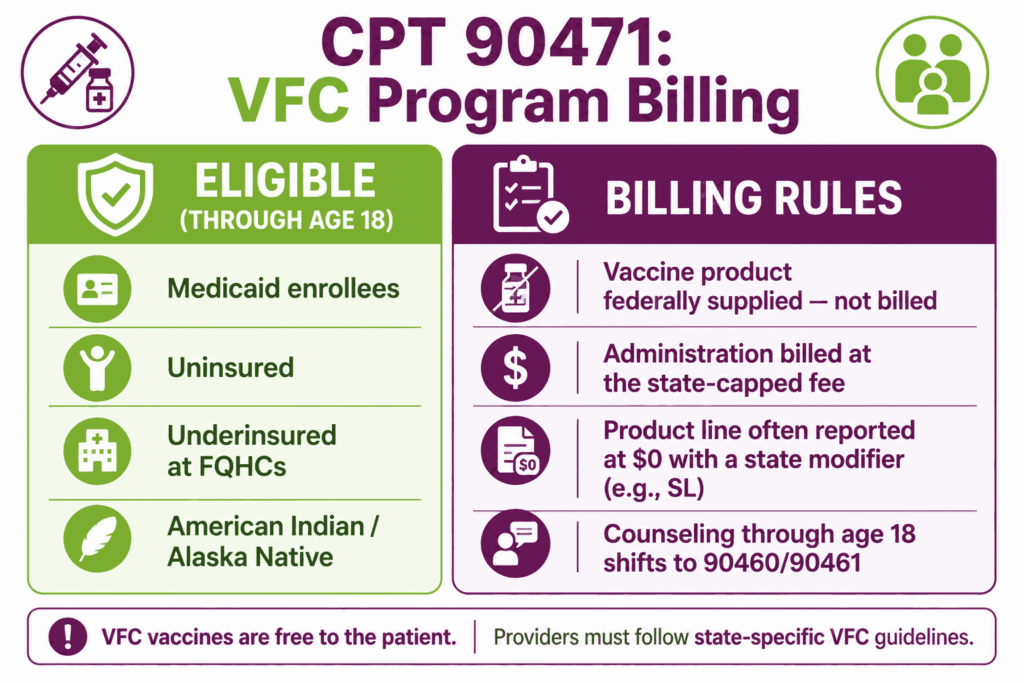
The Vaccines for Children (VFC) program supplies free vaccines for eligible children through age 18. Eligible children include Medicaid enrollees, uninsured children, underinsured children seen at federally qualified health centers, and American Indian or Alaska Native children.
VFC billing follows specific rules:
- The practice does not bill for the VFC-supplied vaccine product, since the product is federally funded
- The administration is billed at the state-capped regional maximum administration fee
- Many states require the product line reported at a zero charge with a state-supplied modifier, such as SL
- A child through age 18 who receives physician counseling shifts to 90460 and 90461 rather than CPT code 90471
Roster Billing Rules for Mass Immunization Clinics
Roster billing is a simplified Medicare claim method for mass immunizers serving multiple beneficiaries. Roster billing applies to Medicare Part B vaccines, which means it uses G-codes rather than the 90471 CPT code.
The roster billing rules are:
- Roster billing covers Medicare influenza, pneumococcal, and COVID-19 administration for groups of beneficiaries
- Mass immunizers submit a simplified claim with a patient roster rather than individual claims
- Administration is reported with G0008 or G0009, not 90471, because roster billing is a Part B pathway
- Centralized billing lets approved providers submit Medicare flu and pneumococcal claims across multiple jurisdictions
Top Reasons For Denials Specific To 90471 & Quick Remedies
- 90471 Billed to Medicare Part B for Flu, Pneumococcal, or Hepatitis B: Prevent by routing Medicare administration of these vaccines to G0008, G0009, or G0010. Reserve CPT code 90471 for commercial and Medicaid claims.
- Modifier 25 Missing on a Same-Day E/M: Prevent by appending modifier 25 to the E/M or preventive code, not to the 90471 line, with documentation of a separate service.
- Missing or Misformatted NDC on the Product Line: Prevent by reporting the 11-digit NDC in 5-4-2 format with the N4 qualifier on the vaccine product line.
- 90471 Used for a Counseled Patient Through Age 18: Prevent by selecting 90460 and 90461 when a physician or QHP counsels a patient through age 18. Use 90471 only when counseling is absent.