
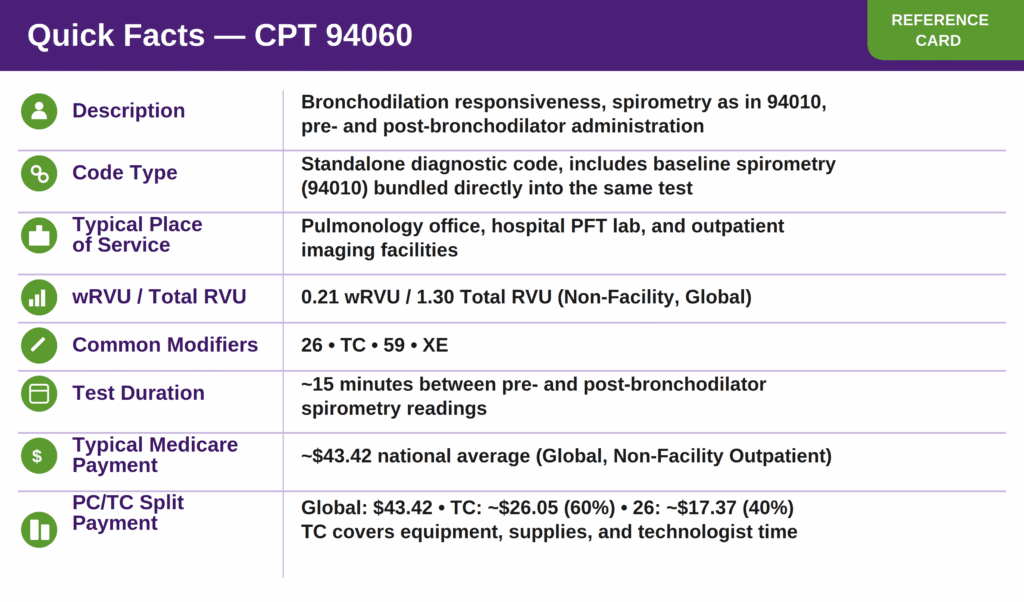
CPT code 94060 is used to bill spirometry performed before and after a bronchodilator is administered, testing how well a patient’s airways respond to the medication. It carries a work RVU of 0.21, a total RVU of 1.30, and pays a national average of $43.42 under Medicare.
The single most common mistake with this code is billing it alongside 94010 on the same day. 94060 already includes the baseline spirometry described by 94010, so 94010 generally should not be reported separately for the same encounter.
After reading this guide, you’ll know the descriptor of CPT 94060, cost breakdown, real billing scenarios, and every rule that determines if a bronchodilator response claim gets paid or denied.
What Is the Description of CPT Code 94060?
CPT code 94060 is the code you bill when a patient gets spirometry twice in one visit, once before a bronchodilator and once after, to see how much their breathing actually improves with medication.
The official descriptor reads “Bronchodilation responsiveness, spirometry as in 94010, pre- and post-bronchodilator administration.”
A patient might show reduced airflow on a baseline test, but that alone doesn’t tell a physician if the obstruction is reversible. Give a bronchodilator and retest, and a significant improvement points toward asthma, while little or no change points more toward COPD or another fixed obstruction.
What Is the Difference Between CPT 94010 and 94060?
94010 measures a single baseline spirometry with no medication involved. It can be used for baseline spirometry and routine lung-function monitoring when no bronchodilator response testing is performed.
On the other hand, 94060 measures spirometry twice, once before and once after a bronchodilator, specifically to test for reversibility. It is most often used during an asthma workup or when a physician needs to distinguish between asthma and COPD.
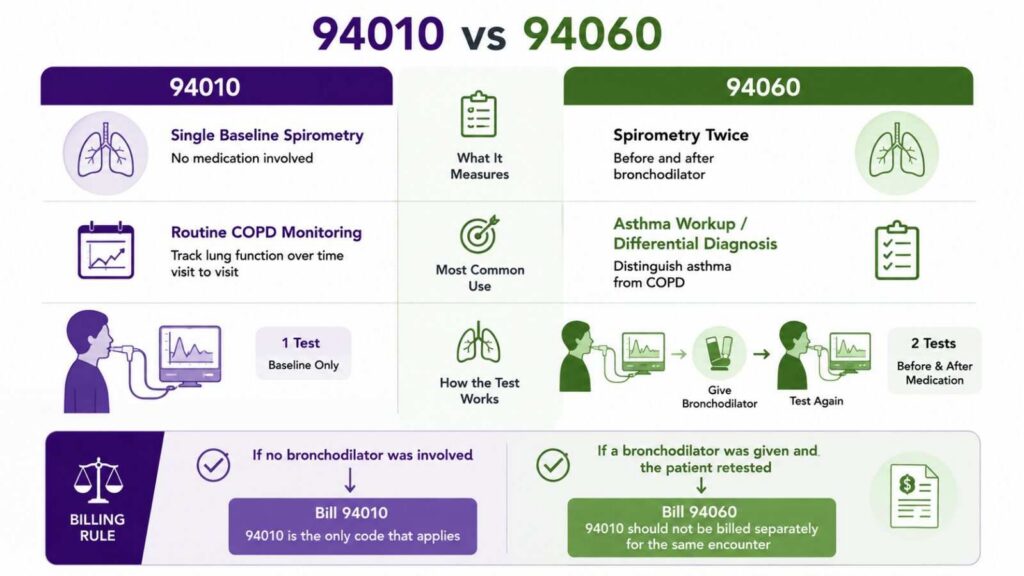
The billing rule follows the service performed. If a bronchodilator was given and the patient was retested, report 94060. Do not report 94010 separately for the same encounter. If no bronchodilator was given, 94010 is the applicable spirometry code.
Knowing how 94060 differs from other pulmonology CPT codes can help you avoid common bundling and coding errors.
How Do You Read the FEV1, FVC, and % Improvement Results?
Each spirometry pass records two numbers: FVC is the total air a patient can forcefully exhale, while FEV1 is how much of that air comes out in the first second. The ratio between them shows if an obstruction is present, and the results plot as a flow-volume loop, which has to stay in the chart to support the billed code.
For 94060, the pre- and post-bronchodilator FEV1 values get compared directly. Clinical guidelines generally define a real response as an improvement of at least 12% and 200 mL in FEV1 or FVC after the medication.
Anything less is still a valid result, it just doesn’t support a reversible-obstruction diagnosis. Without a documented percentage change between the two readings, the test doesn’t demonstrate bronchodilator responsiveness.
Why Does 94060 Bundle With 94010, 94150, 94200, and 94375?
94060 already includes a full baseline spirometry. Because of that, billing 94010 separately for the same session double-bills a test 94060 already covers. Four related codes bundle for the same underlying reason, as detailed in the table below.
| Code | What It Measures | Why It Bundles Into 94060 |
|---|---|---|
| 94010 | Baseline spirometry | Already performed as the “pre” test inside 94060 |
| 94150 | Vital capacity | Data already captured by the same spirometry maneuver |
| 94200 | Maximal voluntary ventilation | Already captured during the same spirometry session |
| 94375 | Flow volume loop | The graphic tracing 94060 already generates |
CMS Article A57225 groups all of these under one “Spirometry” category for exactly this reason. Billing more than one from that group in the same session triggers the edit.
The bronchodilator administration associated with the 94060 test is included in the procedure. Do not separately report 94640 for that administration. The medication itself may be reported separately when appropriate.
Does 94060 Split Into Professional and Technical Components?
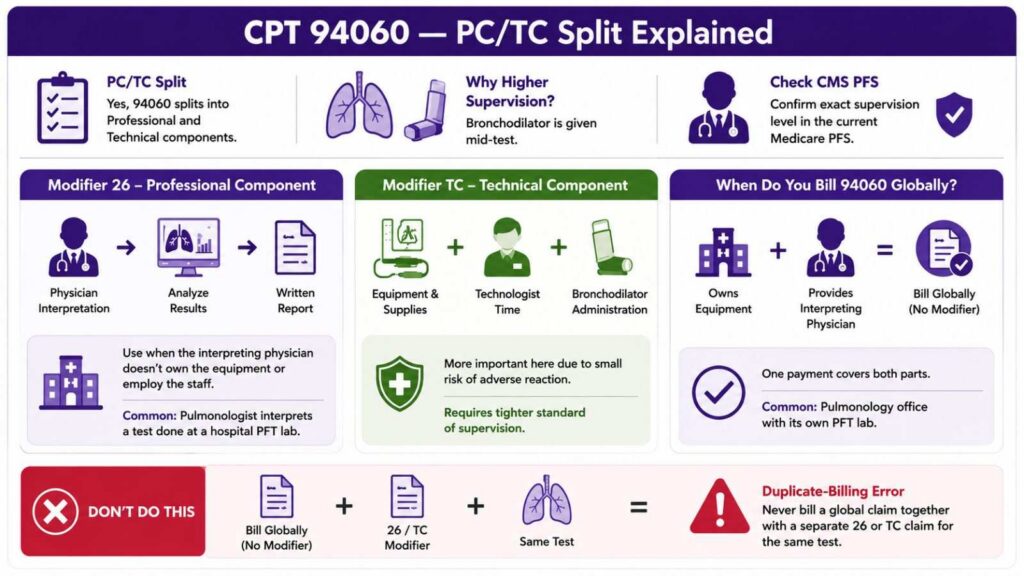
Yes, like most diagnostic testing codes, 94060 has a PC/TC split. CMS assigns the technical component its own supervision level, separate from plain spirometry.
Because 94060 includes bronchodilator administration, check the current Medicare Physician Fee Schedule supervision requirements before performing and billing the technical component.
Modifier 26 with 94060
Modifier 26 reports the professional component only, the physician’s interpretation of the results, and the written report.
Use it when the interpreting physician doesn’t own the equipment or employ the staff running the test. It’s common when a pulmonologist interprets a test performed at a hospital PFT lab.
Modifier TC With 94060
Modifier TC reports the technical component only, the equipment, supplies, and the technologist’s time, giving both the spirometry and the bronchodilator. This matters more here than in routine spirometry, since administering a bronchodilator carries a small risk of adverse reaction.
Before billing the technical component, confirm that the supervising physician arrangement meets the current Medicare requirements for 94060.
When Do You Bill 94060 Globally?
When the same practice owns the equipment and provides the interpreting physician, bill globally with no modifier, and one payment covers both parts.
It’s a common method for a pulmonology office with its own PFT lab. Billing a global claim alongside a separate 26 or TC claim for the same test is a duplicate-billing error, which can easily be reduced with proper claim review.
What Does CPT Code 94060 Cost, and Who Pays for It?
Under the Medicare Physician Fee Schedule, CPT 94060 carries a total of 1.30 relative value units (RVUs). When billed globally in an outpatient setting, the national average Medicare payment is $43.42.
Actual reimbursement varies based on practice location and commercial payer contracts. Local GPCIs set payments in a typical range of $35 to $55, while commercial insurers generally reimburse above Medicare rates, averaging $46 to $77 per test.
In a facility setting, the facility absorbs the overhead costs, meaning the physician can only bill for the professional interpretation ($17.37 average).
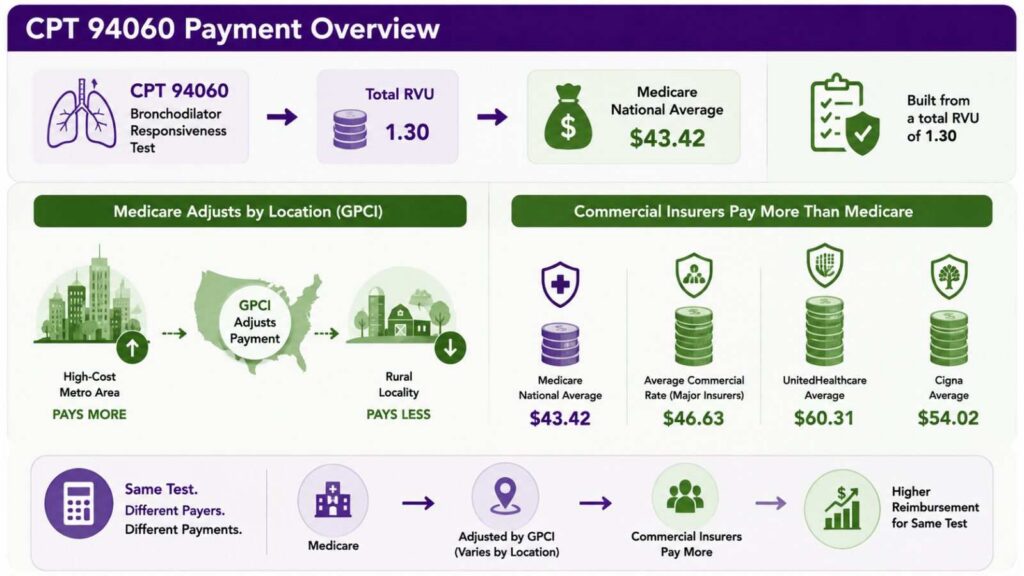
Medicare adjusts every payment through the Geographic Practice Cost Index, so the same test pays more in a high-cost metro area and less in a rural locality.
Does Medicare Cover CPT 94060?
Yes, when the documentation supports medical necessity and the test is billed with the correct code and modifiers. Medicare’s payment structure treats 94060 as a diagnostic test with a documented technical-component supervision requirement.
For that reason, coverage depends on the diagnosis and whether the test was performed and supervised at the level CMS specifies.
Is CPT 94060 Covered by Commercial Insurance?
Yes, and at rates that consistently exceed Medicare’s. That said, Commercial coverage still depends on the payer’s medical necessity and coverage criteria, along with documentation supporting the test.
Also, since a commercial payer pays more per claim, they review the claim against their own version of the same coverage criteria.
Does Reimbursement Differ Between the Global, 26, and TC Billing Methods?
Yes, and the payment is not divided evenly between the two components. The table below shows how the $43.42 Medicare payment breaks down by billing method, using the standard PC/TC weighting for diagnostic testing codes.
| Billing Method | What It Covers | Approx. Payment |
|---|---|---|
| Global (no modifier) | Full test: equipment, bronchodilator, technologist time, and physician interpretation | $43.42 |
| TC (technical component) | Equipment, bronchodilator, and technologist time only | ~$26.05 (about 60%) |
| 26 (professional component) | Physician interpretation and written report only | ~$17.37 (about 40%) |
Because the technical component covers equipment, supplies, medication, and technologist time, its payment share is higher than that of the professional component.
What Are Some Real-World Billing Scenarios for CPT 94060?
Here are some scenarios that cover the situations that come up most often when billing CPT 94060, from a routine asthma workup to a case where 94060 shouldn’t be billed at all.
Scenario 1: A Standard Asthma Bronchodilator Response Test
A 34-year-old presents with intermittent wheezing and shortness of breath. The physician orders spirometry, gets a baseline reading, administers albuterol, and retests 15 minutes later. His FEV1 improves by 14% and 220 mL, meeting the threshold for a significant bronchodilator response.
- CPT Codes: 94060 only
- ICD-10 Codes: J45.909 (unspecified asthma, uncomplicated), or a more specific asthma severity code if documented
- Modifiers: None, if billed globally by a practice that owns its own spirometry equipment
- Documentation Required: Pre- and post-bronchodilator FEV1 and FVC values, the bronchodilator type and dose given, and the calculated percentage improvement
Scenario 2: An E/M Visit With Spirometry Performed the Same Day
An established asthma patient comes in for a routine follow-up. During the visit, the physician also performs a bronchodilator response test to check whether the current treatment plan is working. Both the office visit and the test are billed on the same day.
- CPT Codes: 99213 (or appropriate E/M level) with modifier 25 + 94060
- ICD-10 Codes: The asthma diagnosis code supporting both the visit and the test
- Modifiers: Modifier 25 on the E/M code to show it was a significant, separately identifiable service beyond the test itself
- Documentation Required: The E/M note must stand on its own, documenting history, exam, and medical decision-making separate from the spirometry results
Scenario 3: COPD Monitoring Without a Bronchodilator
A 51-year-old patient with known COPD returns for a routine lung-function check. The patient is not given a bronchodilator because the visit is tracking disease progression over time, not testing for reversibility.
- CPT Codes: 94010 only, not 94060
- ICD-10 Codes: J44.9 or a more specific COPD code
- Modifiers: None required
- Documentation Required: Confirmation that no bronchodilator was administered, since billing 94060 here without one would misrepresent the service performed
Scenario 4: Baseline Spirometry Performed on a Separate Date From the Bronchodilator Test
A patient had baseline spirometry done during an initial visit. Two weeks later, they return specifically for a bronchodilator response test, performed that day as a new, separate baseline-plus-post-bronchodilator comparison.
- CPT Codes: 94060 for the second visit, billed on its own date
- ICD-10 Codes: The applicable respiratory diagnosis
- Modifiers: Typically none needed, since the two tests occurred on different dates and don’t trigger the same-day bundling edit
- Documentation Required: Clear dates of service showing the two tests were genuinely separate encounters, not a single session split across two chart entries
What Are the Coding Rules for CPT 94060?
The rules for this code fall into four groups: who can perform it, what must be documented, how often it can be billed, and what happens when a claim is denied. Errors in any of these areas can lead to claim denials or payment delays.
For a better understanding of procedure code selection, billing, and types, see our CPT code guide.
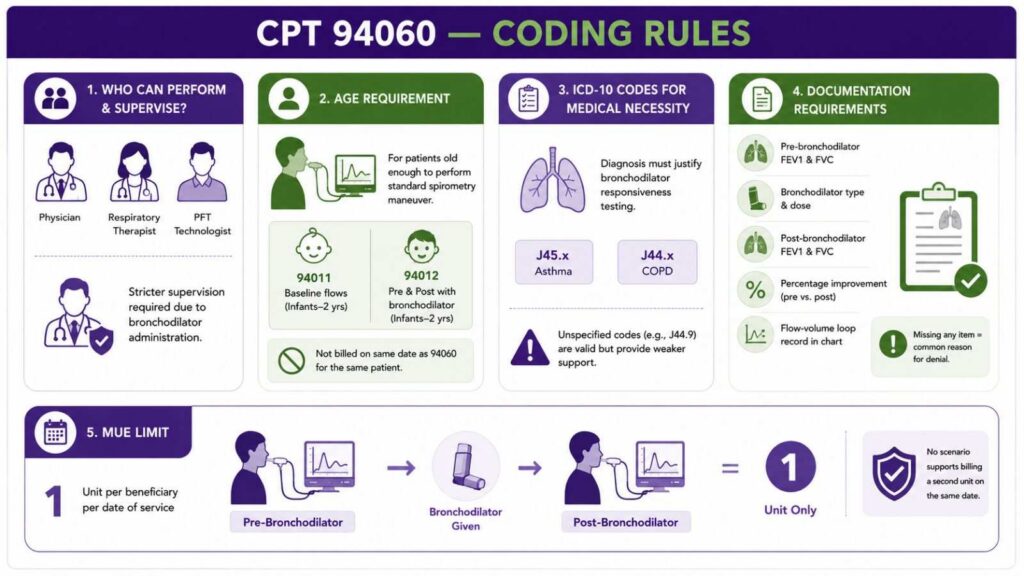
Who Can Perform and Supervise CPT 94060?
A physician, respiratory therapist, or qualified pulmonary function technologist can perform the test itself. Because 94060 involves administering a bronchodilator, CMS assigns a stricter supervision requirement to its technical component than to plain spirometry.
The supervising physician doesn’t have to perform the test personally, but their level of involvement must align with CMS requirements for this code.
Is There an Age Requirement for CPT 94060?
94060 is intended for patients old enough to perform a standard spirometry maneuver, since the test requires a forceful, sustained exhale that very young children can’t reliably produce.
Separate codes exist for infants and children through age 2: 94011 for baseline spirometric flows and 94012 for the pre- and post-bronchodilator version. However, those codes are not billed on the same date as 94060 for the same patient.
What ICD-10 Codes Support Medical Necessity for CPT 94060?
The diagnosis must justify the need for bronchodilator responsiveness testing on that date. Asthma codes (the J45.x family) and COPD codes (the J44.x family) are the most common, and CMS Article A57225 requires the ICD-10 code to reflect the patient’s actual documented condition.
An unspecified code, such as J44.9, is valid but provides weaker support for this specific test, as it doesn’t reflect the clinical reasoning a reviewer looks for. You can refer to our pulmonology ICD-10 codes guide for more information on the diagnosis codes commonly used for respiratory conditions.
What Documentation Does CPT 94060 Require?
Every 94060 claim needs the pre-bronchodilator FEV1 and FVC values, the bronchodilator type and dose administered, the post-bronchodilator FEV1 and FVC values, and the calculated percentage improvement between the two.
The flow-volume loop graphic record must remain in the patient’s chart. Missing any one of these, most often a report showing only the post-bronchodilator numbers with no baseline for comparison, is one of the most common reasons this code gets denied.
What Is the MUE Limit for CPT 94060?
The Medically Unlikely Edit allows 1 unit per beneficiary per date of service. Because 94060 already covers a full pre- and post-bronchodilator comparison in a single unit, there’s no coding scenario in which billing a second unit on the same date makes sense.
Can 94060 Be Repeated Too Often to Be Medically Necessary?
Yes, and this is a real Medicare rule separate from the daily MUE limit. CMS Article A57225 states plainly that routine or repetitive billing of unnecessary batteries of respiratory tests is not clinically reasonable.
A bronchodilator response test repeated at every visit for a stable, already-diagnosed asthma patient may draw payer scrutiny. This is especially true when there is no change in symptoms or treatment to justify the retest.
When Can Modifier 59 Separate 94010 and 94060?
If the services were performed during genuinely separate encounters, the appropriate modifier may allow both services to be reported when the applicable NCCI requirements are met. Modifier XE may be appropriate when the services occurred during separate encounters.
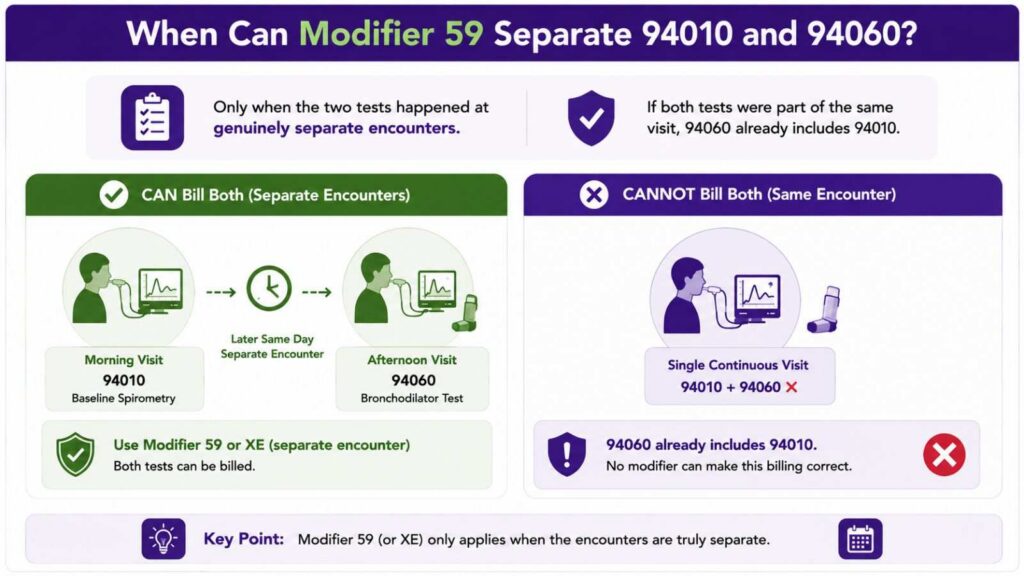
However, if both tests occurred as part of a single continuous visit, no modifier would make that billing correct. That’s because 94060 already includes the baseline test 94010 would otherwise cover.
What Is the Appeal Window If a Claim Is Denied?
For Medicare claims, a redetermination request must be filed within 120 days of the date on the denial notice. The Medicare Administrative Contractor typically decides within 60 days of receiving the request.
Missing the 120-day window generally forfeits the right to appeal except in rare cases where the MAC finds good cause for the delay.
Why Do CPT 94060 Claims Get Denied?
CPT 94060 claims can be denied for several reasons, including coding and documentation issues, as well as coverage and medical necessity concerns. The table below breaks down the main reasons for denial, why they happen, and how to fix each one.
| Denial Cause | What It Looks Like | How to Fix It |
|---|---|---|
| Missing Baseline Values | Only post-bronchodilator FEV1/FVC documented, no pre-bronchodilator comparison | Ensure both readings are recorded and included in the report before submission |
| Bundling Error | 94010 billed alongside 94060 for the same encounter | Bill 94060 alone; do not report 94010 separately for the same session |
| Bronchodilator Not Documented | No record of which medication or dose was administered | Document the drug name and dose given as part of the test record |
| Weak Medical Necessity | Unspecified diagnosis code with no supporting clinical detail | Use the specific asthma or COPD code the documentation actually supports |
| Excessive Repeat Testing | 94060 billed at nearly every visit with no clinical change prompting it | Reserve repeat testing for visits where a real change in symptoms or treatment justifies it |
| Missing Supervision Documentation | Technical component billed without meeting the required supervision level | Confirm the supervising physician’s involvement matches CMS’s requirement for this code |
| Separate 94640 Billing | 94640 reported for bronchodilator administration included in the 94060 test | Do not separately report 94640 for the administration associated with 94060 |
If your practice handles a high volume of respiratory claims, specialized pulmonology billing services can also help with coding, documentation, and denial management.
Final Thoughts on CPT Code 94060
When billing CPT 94060, make sure your documentation tells the full story. Record the pre- and post-bronchodilator results, name the medication used, and connect the test to the patient’s diagnosis.
Before submitting the claim, check that the documentation supports medical necessity and matches the service billed. These simple checks can help you avoid common errors, prevent unnecessary denials, and submit cleaner 94060 claims.