
CPT code 97530 reports therapeutic activities, a timed, one-on-one service that uses dynamic functional tasks to improve a patient’s performance in daily activities. Each unit represents 15 minutes of direct, skilled therapist contact.
CPT 97530 is billed by physical therapists, occupational therapists, and speech-language pathologists, with a discipline modifier on every Medicare claim. The discipline question comes up often, and the answer is that both physical therapy and occupational therapy report this code under their own plan of care.
Several rules drive denials on this code, from the 8-minute rule to the evaluation edit that no modifier can bypass. Many rehabilitation groups route therapy claims through dedicated billing services to manage them.
What Is the Description of CPT Code 97530?
97530 CPT code description as defined by the AMA is: “Therapeutic activities, direct (one-on-one) patient contact (use of dynamic activities to improve functional performance), each 15 minutes.”
This code reports task-oriented, dynamic functional activities delivered one-on-one by a qualified therapist. CPT code 97530 covers movements such as lifting, reaching, pushing, pulling, and transfer training that simulate real-world tasks. The activity must require the skilled judgment of a licensed therapist to grade and adjust in real time.
The defining feature is functional performance, not isolated exercise. Procedure code 97530 applies when the therapist trains a patient to perform daily tasks, rather than working a single physical parameter such as strength alone.
How Much Time is Required for CPT Code 97530?
Each unit of CPT code 97530 represents 15 minutes of direct, one-on-one therapeutic activity. The number of billable units follows the CMS 8-minute rule, also called the Rule of Eights.
The 8-minute rule converts total timed minutes to units as follows:
| Total Timed Minutes | Billable Units |
|---|---|
| 8 to 22 minutes | 1 unit |
| 23 to 37 minutes | 2 units |
| 38 to 52 minutes | 3 units |
| 53 to 67 minutes | 4 units |
The record must capture total timed minutes, or start and stop times, for the skilled activities performed. The minutes billed under CPT 97530 count only the time the therapist personally delivered the one-on-one activity.
Why CPT 97530 Is Exempt From the CY2026 Efficiency Adjustment That Cuts Untimed Therapy Codes (Evaluations and Modalities)
CPT code 97530 is exempt from the CY2026 efficiency adjustment because it is a timed code. CMS applied a 2.5 percent reduction to the work RVU of non-time-based services for 2026, which hit untimed evaluations and modalities.
The exemption works through these points:
- The CY2026 efficiency adjustment reduced the work RVU of non-time-based services by 2.5 percent
- Timed codes, including 97110, 97112, 97140, and 97530, were exempted after APTA advocacy
- Untimed therapy evaluation codes 97161 through 97163 were subject to the adjustment
- The exemption preserved the 97530 work RVU at 0.44, protecting the per-unit value
This matters for revenue planning because timed procedures make up most of a typical therapy clinic’s daily volume. The codes that absorbed the cut were the untimed services, not procedure code 97530.
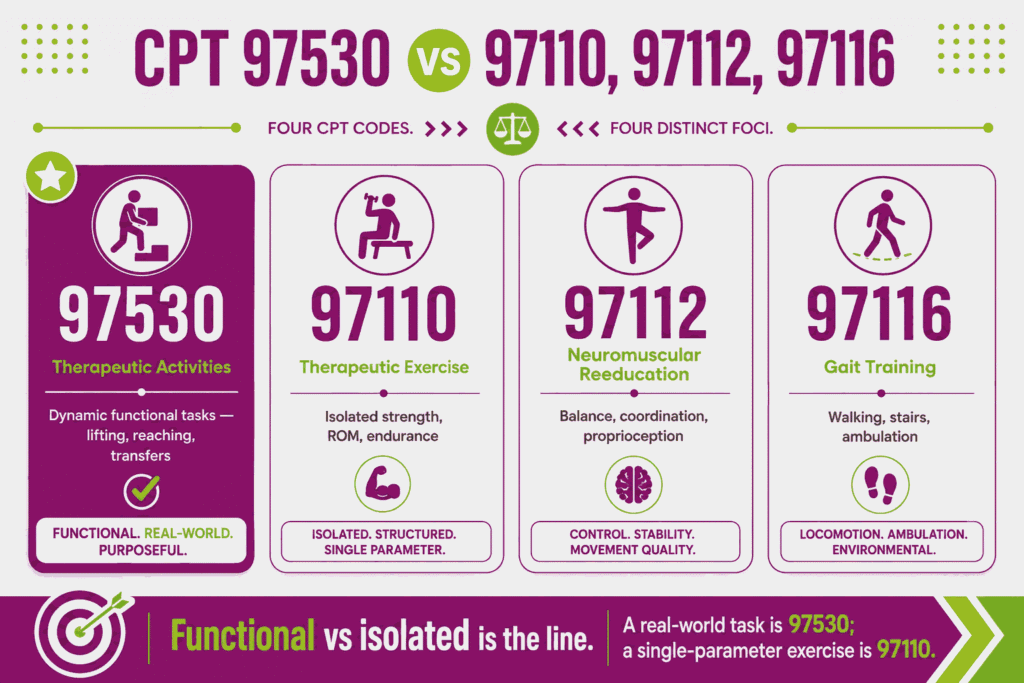
How Does CPT Code 97530 Differ From CPT 97110, 97112, and 97116?
All four codes are timed, 15-minute therapy procedures, and they differ by clinical focus. Code selection follows what the intervention targets, not the time spent.
The four timed codes break down by purpose:
- 97110 therapeutic exercise: isolated parameters such as strength, range of motion, or endurance on a body part
- 97112 neuromuscular reeducation: balance, coordination, proprioception, and posture
- 97116 gait training: walking mechanics, stair negotiation, and ambulation
- 97530 therapeutic activities: dynamic, multi-parameter functional tasks such as lifting, reaching, and transfers
The key distinction is functional versus isolated. A task that trains a real-world activity is CPT code 97530, while a single-parameter exercise such as isolated quadriceps strengthening is 97110. Documentation language drives this choice and the resulting payment.
What ICD-10 Codes and Medical Necessity Criteria Support CPT Code 97530?
Medical necessity for CPT code 97530 rests on a functional deficit that skilled, dynamic activities address under an active plan of care. The diagnosis must connect to the functional limitation being treated.
Representative supporting diagnoses include:
- I69.351 (Hemiplegia following cerebral infarction affecting the dominant side) for post-stroke functional retraining
- Z47.1 (Aftercare following joint replacement surgery) for post-operative functional activity training
- R26.81 (Unsteadiness on feet) and Z91.81 (History of falling) for balance and fall-risk reduction
- M62.81 (Muscle weakness, generalized) for functional strengthening after deconditioning
The note must show the activity was skilled, functional, and goal-directed. Document what the therapist did that an unskilled person could not, and tie each activity to a measurable functional goal.
What are the Modifiers for CPT Code 97530?
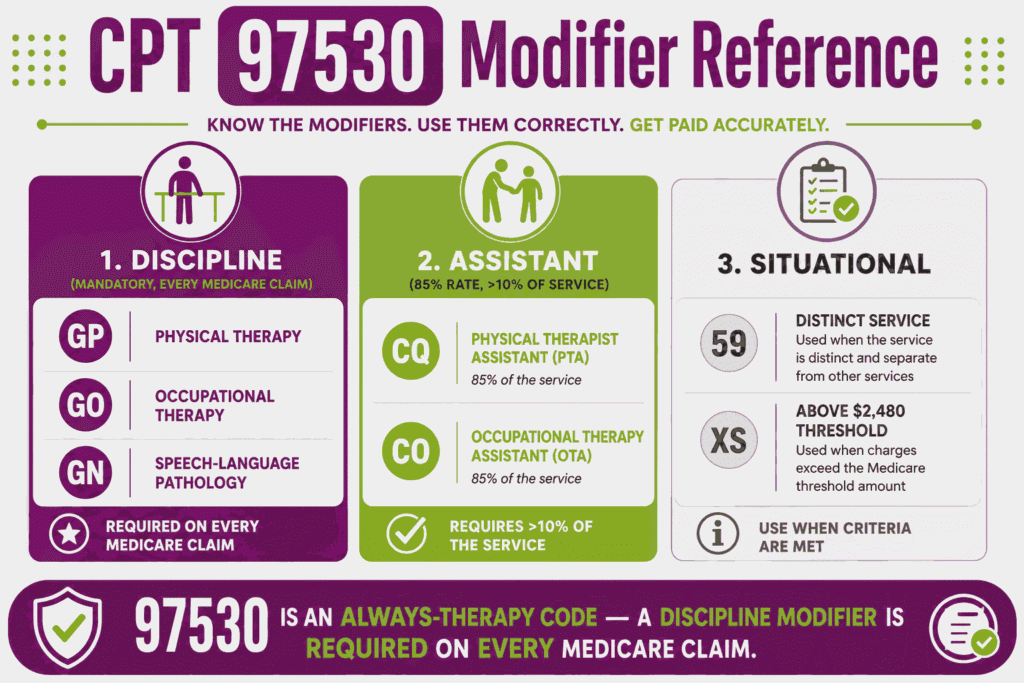
The code CPT 97530 requires a discipline modifier on every Medicare claim and uses several others for assistants, distinct services, and thresholds. The right combination depends on the discipline, the provider, and the annual spending level.
Modifier GP: Physical Therapy
Modifier GP identifies the service as physical therapy delivered under a physical therapy plan of care. Append GP to CPT code 97530 on every Medicare claim when a physical therapist provides the service. The modifier is mandatory because 97530 is an always-therapy code.
Modifier GO: Occupational Therapy
Modifier GO identifies the service as occupational therapy under an occupational therapy plan of care. Append GO to 97530 when an occupational therapist delivers the functional activity. The record must document OT credentials and the functional goals addressed.
Modifier GN: Speech-Language Pathology
Modifier GN identifies the service as speech-language pathology under a speech-language plan of care. Append GN to CPT code 97530 when a speech-language pathologist provides the service and the payer covers it under the plan.
Modifier CQ: Service Furnished In Whole or Part by a PTA (85% Differential)
Modifier CQ identifies a service furnished in whole or in part by a physical therapist assistant. Append CQ to 97530 when a PTA furnishes more than 10 percent of the service under the de minimis standard. Medicare pays the CQ-flagged unit at 85 percent of the fee schedule.
Modifier CO: Service Furnished In Whole or Part by an OTA (85% Differential)
Modifier CO identifies a service furnished in whole or in part by an occupational therapy assistant. Append CO to CPT code 97530 when an OTA furnishes more than 10 percent of the service. The CO-flagged unit pays at 85 percent of the fee schedule, the same reduction as CQ.
Modifier 59 (or XE/XS/XU): Distinct Procedural Service
Modifier 59, or the more specific X-modifiers, identifies a distinct procedural service when an NCCI edit would otherwise bundle two timed codes. Append the modifier to the column-two code, not to 97530, when each service is separately skilled and documented. These modifiers do not bypass the evaluation edit described in the rules section.
Modifier KX: Medical Necessity Justification Above the Annual Therapy Threshold
Modifier KX attests that services above the annual therapy threshold are medically necessary. Append KX to CPT code 97530 once cumulative therapy spending passes the 2026 threshold of $2,480. The record must justify the continued need for skilled care.
Modifier 52 / 76 / 77: Reduced or Repeat Services (Situational)
Modifier 52 reports a reduced service, while 76 and 77 report a repeat service by the same or another provider. These modifiers apply to 97530 only in narrow situations a payer specifies. Routine therapy sessions do not use them.
Which Documents Are Required For CPT Code 97530?
Documentation for CPT code 97530 must establish skilled, timed, goal-directed activity under an active plan of care. The record connects minutes to units and activities to functional goals.
The required documentation includes:
- A signed plan of care with measurable functional goals
- Total timed minutes, or start and stop times, for the therapeutic activities
- The number of units, mapped to minutes through the 8-minute rule
- A description of the dynamic functional activities performed
- The skilled rationale explaining why a licensed therapist was required
- The patient response and progress toward functional goals
- The discipline modifier and any assistant modifier that applies
What is the Cost of CPT Code 97530?
The CPT code 97530 cost depends on the payer, the setting, and how many timed units the session supports. Medicare sets a national per-unit rate, while commercial plans pay a contracted multiple of it.
RVUs & Medicare Payment
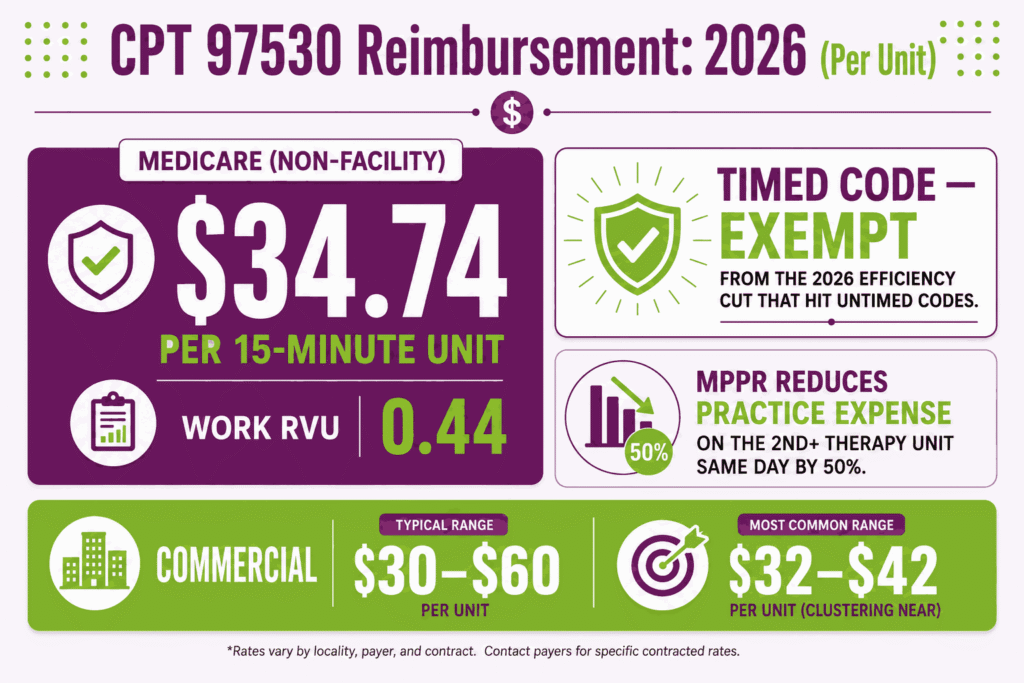
Medicare prices CPT code 97530 per 15-minute unit through the Physician Fee Schedule. The CY2026 non-facility values appear below.
| Component | Value (CY 2026) |
|---|---|
| Work RVU | 0.44 |
| Medicare payment (non-facility) | $34.74 per unit |
| Conversion factor | $33.4009 |
| Efficiency adjustment | Exempt (timed code) |
The timed-code exemption preserved the work RVU at 0.44 while untimed codes absorbed the 2.5 percent cut. The multiple procedure payment reduction also applies, lowering the practice expense of the second and later therapy units on the same day by 50 percent. GPCI adjustments change the final amount by locality.
Commercial Payers
Commercial plans reimburse procedure code 97530 above the Medicare rate. Reported allowed amounts commonly run from roughly $30 to $60 per 15-minute unit, with many payers clustering near $32 to $42.
The allowed amount depends on the insurer, the negotiated multiple of Medicare, and whether the service falls under a therapy plan of care. Because 97530 is billed per unit, a longer session that supports more units increases reimbursement in proportion to the documented timed minutes.
Place-of-Service & Lab/Setting Differences
Place of service and locality both change how CPT code 97530 reimburses. The setting determines the practice expense, and the locality determines the geographic adjustment.
Key setting and geographic factors include:
- The plan of care and the discipline modifier must match the billing setting
- Non-facility settings such as an outpatient clinic pay higher than facility settings because practice expense RVUs are larger
- Hospital outpatient and facility physician fees are lower for the same unit
- GPCI values adjust the work, practice expense, and malpractice components by locality
What Are Example Clinical Scenarios or Use Cases for CPT Code 97530?
CPT code 97530 applies whenever a therapist delivers skilled, dynamic functional activities one-on-one. The scenarios below show common reporting patterns across disciplines.
Scenario 1: Post-Stroke Hemiparesis (Transfer Training and Functional Dynamic Activities)
ICD-10: I69.351 (Hemiplegia following cerebral infarction affecting the dominant side)
A physical therapist treats a patient with right-sided weakness after a stroke. The session focuses on transfer training and dynamic reaching activities to restore functional movement. The therapist provides 30 minutes of skilled, one-on-one activity and reports two units of CPT code 97530 with modifier GP. The note documents the manual facilitation and the functional goals addressed.
Scenario 2: Post-Operative Total Knee Arthroplasty
ICD-10: Z47.1 (Aftercare following joint replacement surgery)
A physical therapist treats a patient recovering from a total knee replacement. The session uses step training and repeated sit-to-stand activities to rebuild functional mobility. The therapist delivers 23 minutes of skilled activity and reports two units of CPT 97530 with modifier GP. If cumulative therapy spending has passed the annual threshold, the claim also carries modifier KX.
Scenario 3: Balance Impairment and Fall-Risk Reduction in an Elderly Patient
ICD-10: R26.81 (Unsteadiness on feet) and Z91.81 (History of falling)
An occupational therapist treats an older adult with balance deficits and a history of falls. The session uses dynamic standing tasks and obstacle navigation to reduce fall risk. The therapist provides 15 minutes of skilled activity and reports one unit of CPT code 97530 with modifier GO. The note ties each activity to the fall-risk reduction goal.
What Are the CPT Code 97530 Rules To Ensure Successful Reimbursement?
Follow NCCI bundling rules, the 8-minute rule, co-treatment limits, the assistant payment standard, and the KX threshold. Meeting these rules reduces denials for CPT code 97530 across payers. Proper use of CPT code in Healthcare ensures that medical procedures and services are accurately reported and reimbursed according to standardized billing guidelines.
Bundling / NCCI / Same-Day Procedure Rules
NCCI rules govern which codes can be billed alongside CPT code 97530 on the same day. Some pairs allow a modifier to show distinct services, while others do not.
The core bundling rules are:
- Do not bill 97530 with a bundled code on the same day without a documented distinct service
- Use modifier 59 or an X-modifier only when each service is separately skilled and supported
- The evaluation edit is an exception that no modifier overrides
- Check current NCCI edit pairs each quarter, since the tables update four times a year
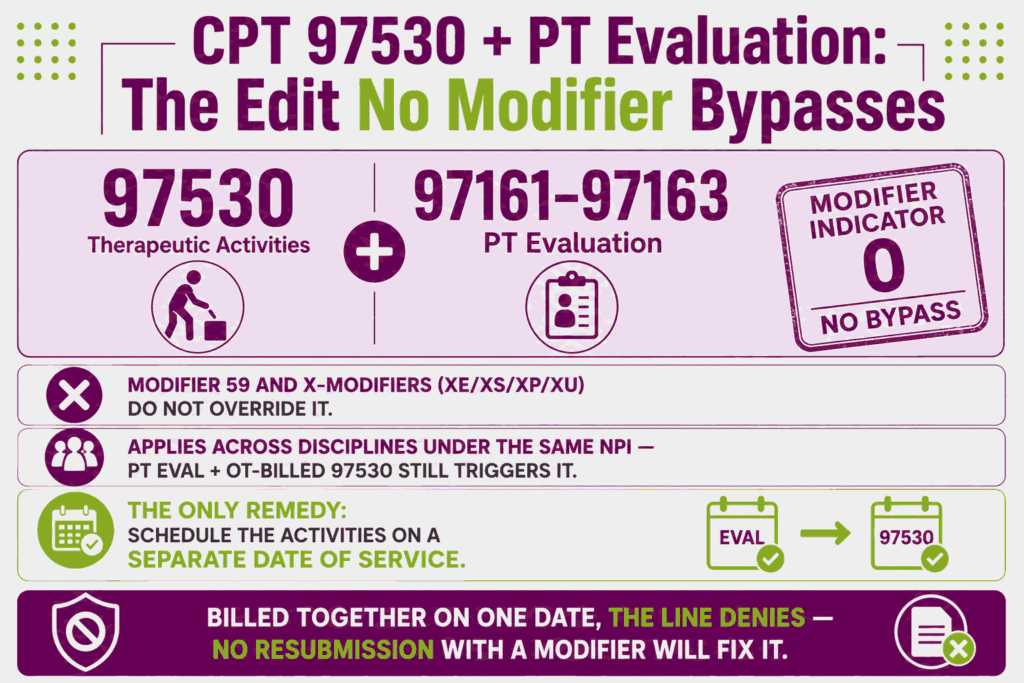
Why the 97530 + PT Evaluation (97161–97163) Edit Cannot Be Bypassed With Modifier 59
The NCCI edit between CPT code 97530 and the physical therapy evaluation codes 97161 through 97163 carries a modifier indicator of 0, so no modifier bypasses it. The evaluation is treated as a component of the more comprehensive therapeutic activity, and the bundled line is denied when both are billed on the same day.
This edit has specific consequences:
- Modifier 59 and the X-modifiers (XE, XS, XP, XU) do not override the edit
- The edit applies across disciplines under the same provider NPI, so a PT evaluation and OT-billed 97530 on the same day still trigger it
- The remedy is to schedule the therapeutic activities on a separate date of service from the evaluation
- Billing both on one date results in a denied line that no resubmission with a modifier will fix
Units, MUEs & the Therapy Time Rule
CPT code 97530 is billed in 15-minute units governed by the 8-minute rule. The total documented timed minutes determine how many units the session supports.
Unit and limit rules include:
- Convert total timed minutes to units through the 8-minute rule, starting at 8 minutes for one unit
- The record must show total timed minutes or start and stop times for each unit billed
- The Medically Unlikely Edit caps daily units, and the value updates quarterly, so confirm the current figure through CMS
- Units billed must match the skilled minutes documented, or the claim faces a time-and-unit mismatch denial
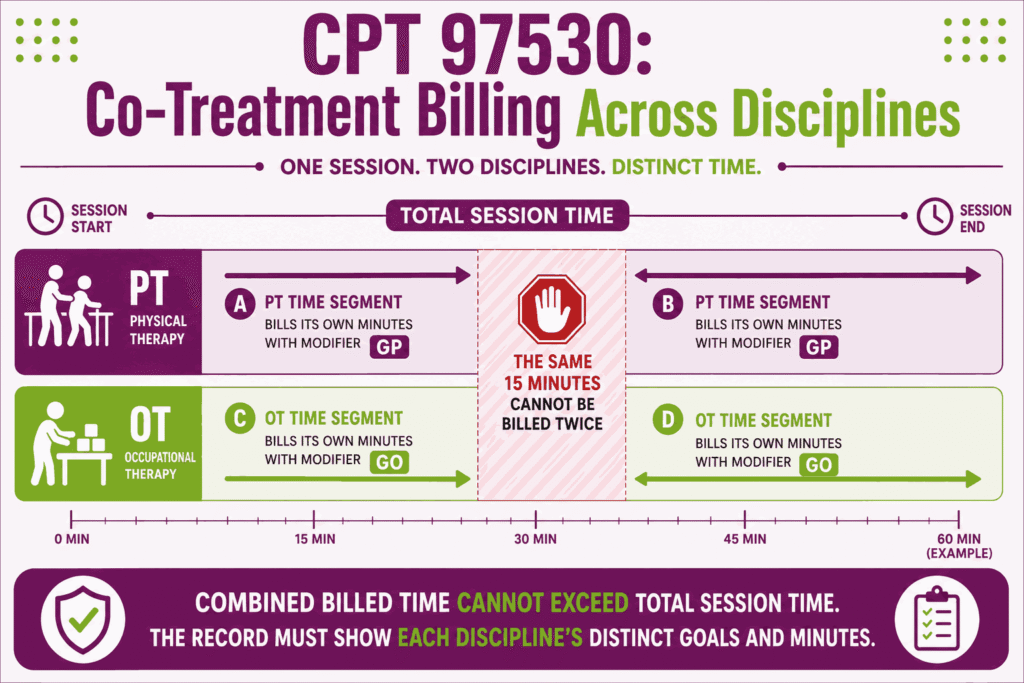
Co-Treatment Billing Rules When Two Disciplines Treat the Same Patient
When two disciplines treat the same patient, each bills only the time it personally provides. Under Medicare Part B, two therapists cannot both bill CPT code 97530 for the same minutes.
The co-treatment rules are:
- Each discipline bills the distinct minutes it delivered, using its own discipline modifier
- The combined billed time cannot exceed the total session time
- The same 15 minutes cannot be billed by both a physical therapist and an occupational therapist
- The record must show each discipline’s distinct goals and the time each provided
PTA/OTA De Minimis Standard and the 15% CQ/CO Payment Reduction Rule
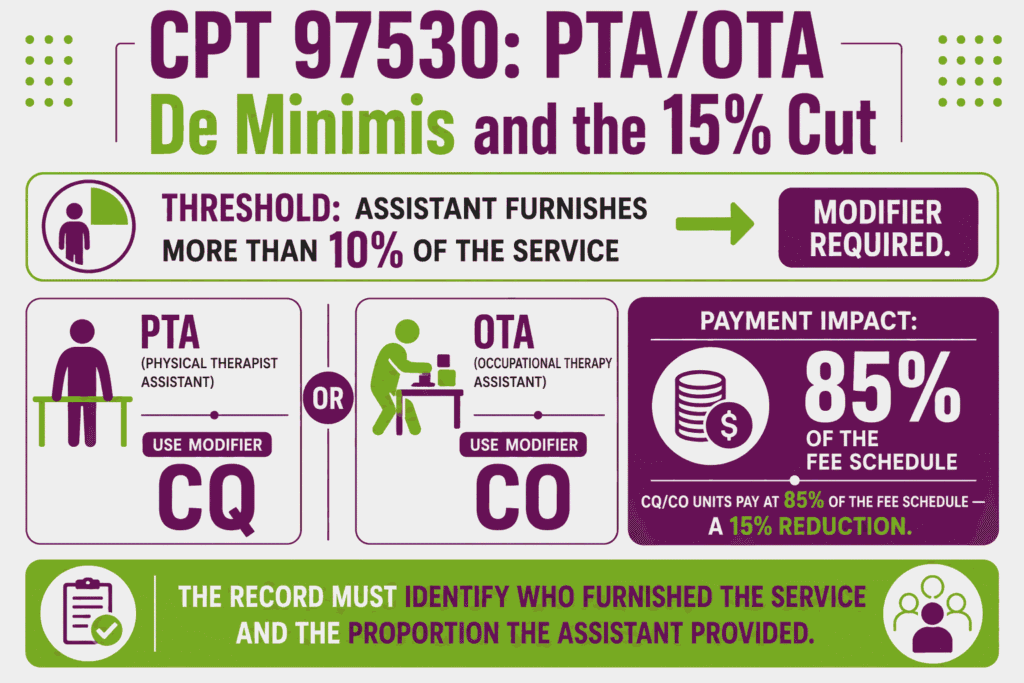
When an assistant furnishes more than 10 percent of a service, the claim requires the CQ or CO modifier. The de minimis standard sets that 10 percent line for CPT code 97530.
The assistant payment rules are:
- A PTA who furnishes more than 10 percent of the service requires modifier CQ
- An OTA who furnishes more than 10 percent of the service requires modifier CO
- Medicare pays the CQ or CO unit at 85 percent of the fee schedule, a 15 percent reduction
- The record must identify who furnished the service and the proportion the assistant provided
2026 KX Modifier Threshold and Targeted Medical Review Trigger
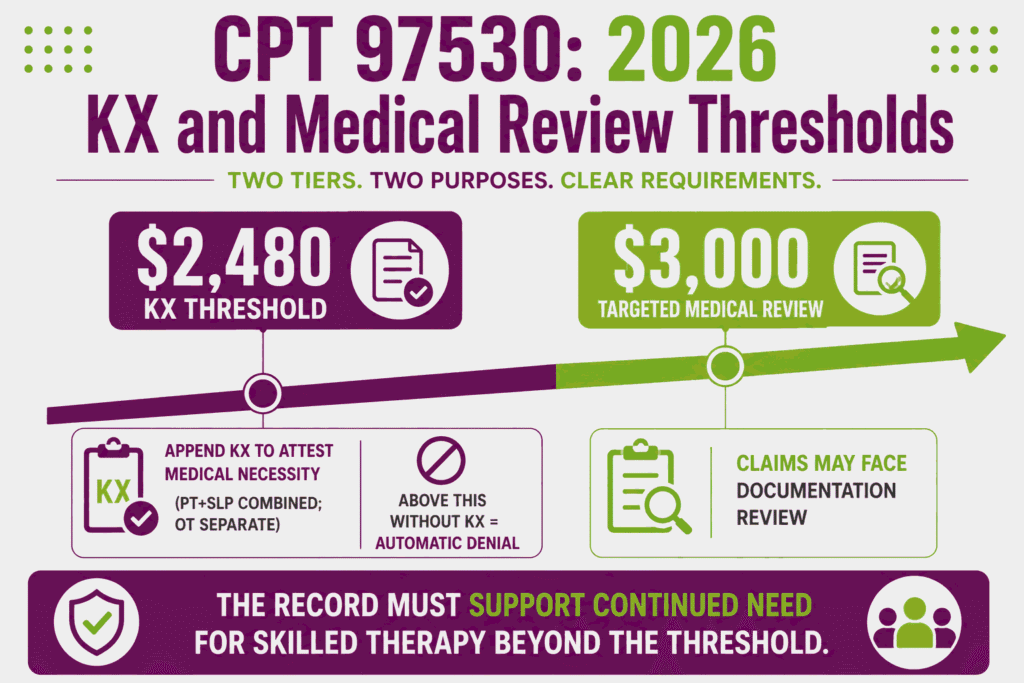
The 2026 KX modifier threshold is $2,480 for combined physical therapy and speech-language pathology, and $2,480 separately for occupational therapy. Once cumulative spending passes the threshold, CPT code 97530 claims require modifier KX.
The threshold rules are:
- Append modifier KX to attest that care above the $2,480 threshold is medically necessary
- A claim above the threshold without KX is denied automatically
- The targeted medical review threshold is $3,000, above which claims may face documentation review
- The record must support the continued need for skilled therapy beyond the threshold
Top Reasons For Denials Specific To 97530 & Quick Remedies
- Missing or Wrong Discipline Modifier: Prevent by appending GP, GO, or GN to every Medicare CPT code 97530 claim, matching the treating discipline.
- 97530 Billed on the Same Day as the Evaluation: Prevent by scheduling therapeutic activities on a separate date from the evaluation, since no modifier bypasses the edit.
- Time-and-Unit Mismatch: Prevent by recording total timed minutes and mapping them to units through the 8-minute rule before submitting.
- Missing KX Above the Threshold: Prevent by appending modifier KX once therapy spending passes $2,480, with documentation of medical necessity.