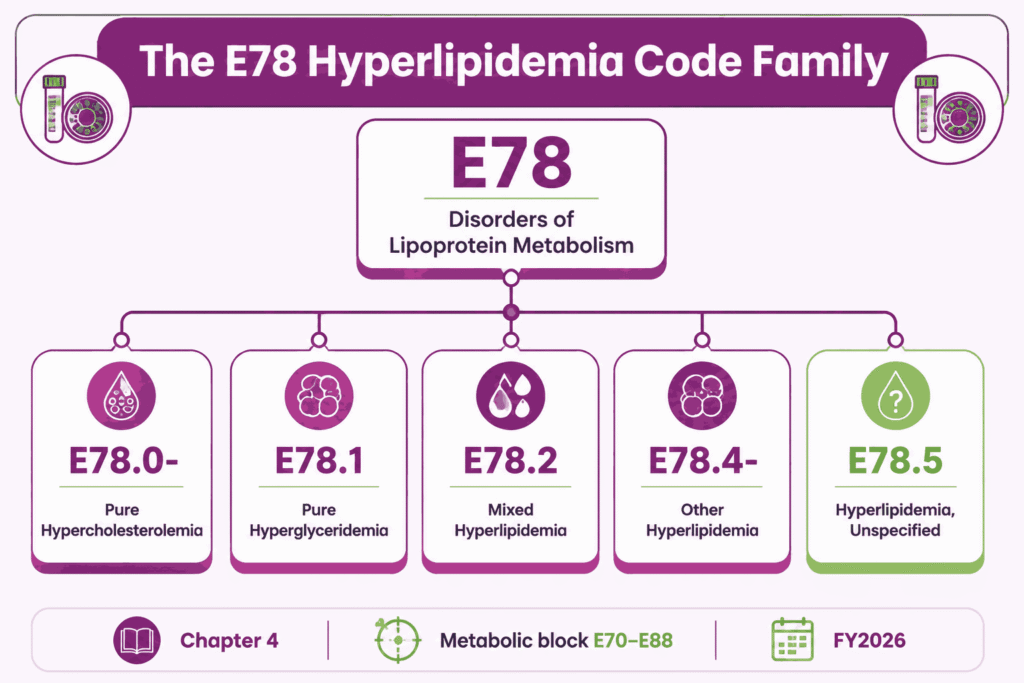
The ICD-10 code for hyperlipidemia is E78.5 (hyperlipidemia, unspecified), the default code in the E78 family. E78.5 is also the most overused code in the set. Specific documentation routes instead to E78.00 (pure hypercholesterolemia), E78.1 (pure hyperglyceridemia), E78.2 (mixed hyperlipidemia), or the E78.4- other-hyperlipidemia codes. FY2026 replaced E78.01 with three familial hypercholesterolemia codes: E78.010, E78.011, and E78.019.
Hyperlipidemia is the most common lipid disorder treated in US cardiology and primary care. The Centers for Disease Control and Prevention reports that 86 million US adults have total cholesterol above 200 mg/dL. Nearly 25 million of those adults carry levels above 240 mg/dL.
The USPSTF assigns lipid screening a Grade A recommendation for adults aged 40 to 75. Accurate coding of each lipid encounter starts with the E78 family. Correct medical billing support for cardiology practices depends on matching the lipid type in the chart to the exact E78 code to get properly reimbursed.
This guide covers the hyperlipidemia ICD-10 code, E78.5, and the full E78 series. The guide maps each lipid subtype, the comorbidity codes cardiology teams pair with E78, the lab CPT pairings, and the denials coders see most often. The FY2026 ICD-10-CM edition took effect on October 1, 2025.
What Is the ICD-10 Code for Hyperlipidemia?
The ICD-10 code for hyperlipidemia is E78.5, defined as hyperlipidemia, unspecified. E78.5 sits inside Chapter 4 of ICD-10-CM, the endocrine, nutritional, and metabolic block E00 to E89. The parent category is E78, disorders of lipoprotein metabolism and other lipidemias.
The table below maps the E78 family that this guide covers.
| ICD-10 Code | Description | Lipid Abnormality |
|---|---|---|
| E78.00 | Pure hypercholesterolemia, unspecified | High cholesterol only |
| E78.010 | Homozygous familial hypercholesterolemia | Inherited, both parents |
| E78.011 | Heterozygous familial hypercholesterolemia | Inherited, one parent |
| E78.019 | Familial hypercholesterolemia, unspecified | Inherited, type unconfirmed |
| E78.1 | Pure hyperglyceridemia | High triglycerides only |
| E78.2 | Mixed hyperlipidemia | High cholesterol and triglycerides |
| E78.3 | Hyperchylomicronemia | Elevated chylomicrons |
| E78.41 | Elevated lipoprotein(a) | High Lp(a) |
| E78.49 | Other hyperlipidemia | Other lipid patterns |
| E78.5 | Hyperlipidemia, unspecified | Type not documented |
| E78.9 | Disorder of lipoprotein metabolism, unspecified | Broadest unspecified |
E78.5 names the diagnosis when the record does not specify the lipid type. The specific codes replace E78.5 once the panel confirms the abnormality.
How Does ICD-10-CM Define E78.5 (Hyperlipidemia, Unspecified)?
E78.5 defines hyperlipidemia, unspecified, meaning elevated blood lipids without a documented type. The code applies when the chart records high lipids but does not name high cholesterol, high triglycerides, or both. E78.5 is a billable code valid for FY2026 through September 30, 2026.
Why Is E78.5 the Most Overused Code in the E78 Family?
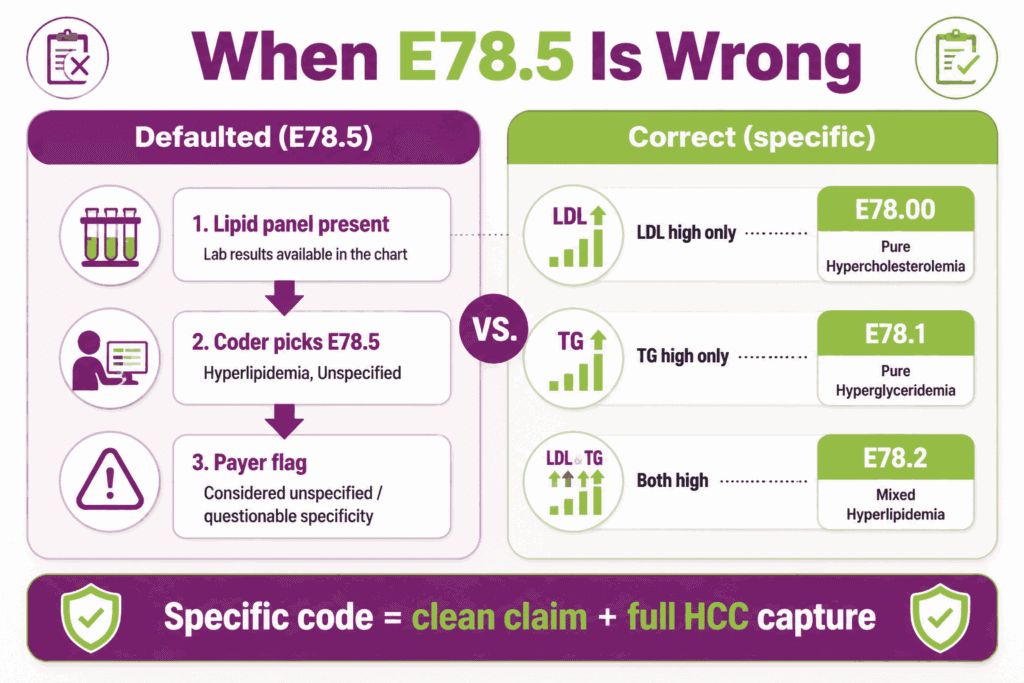
E78.5 is overused because coders default to it when the lipid panel supports a more specific code. A patient with elevated LDL and normal triglycerides codes to E78.00, not E78.5. A patient with elevated cholesterol and triglycerides codes to E78.2.
Payers now flag E78.5 overuse at the practice level. The specificity decision drives the entire E78 coding workflow, so this guide treats it as the primary question. Defaulting to E78.5 when documentation supports a specific code triggers three problems:
- Payer review: claims data showing E78.5 above peer benchmarks draws prepayment scrutiny.
- Downcoding: payers reduce the claim when a specific code was available.
- HCC gaps: unspecified codes weaken risk-adjustment capture in Medicare Advantage.
What Is the Difference Between Hyperlipidemia, Hypercholesterolemia, and Dyslipidemia?
Hyperlipidemia, hypercholesterolemia, and dyslipidemia describe three related but distinct lipid states. Each term routes to a different coding decision within the E78 family.
| Term | Meaning | Common Code |
|---|---|---|
| Hyperlipidemia | Elevated blood lipids, general | E78.5 (unspecified) or specific E78 |
| Hypercholesterolemia | Elevated cholesterol specifically | E78.00 or E78.01- |
| Dyslipidemia | Abnormal lipid levels, high or low | E78.5 when unspecified |
Dyslipidemia is the broadest term and includes abnormally low lipid levels. Hypercholesterolemia is the narrowest and names cholesterol alone. Coders assign the code that matches the documented term and the supporting lab values.
Why Does Code Specificity Affect Hyperlipidemia Reimbursement and Risk Adjustment?
Code specificity affects reimbursement at the point of medical necessity and risk adjustment. A specific E78 code supports the lab and management claim and captures the correct risk weight. Hyperlipidemia is a chronic condition tracked for annual HCC recapture in the CMS-HCC model.
Practices that default to E78.5 across a Medicare Advantage panel under-report disease detail. The specific code strengthens both the clinical record and the risk-adjusted revenue.
What Are All the Hyperlipidemia ICD-10 Codes in the E78 Series?
The E78 series covers pure hypercholesterolemia, familial forms, hyperglyceridemia, mixed hyperlipidemia, and other lipid disorders. The subsections below define every billable code by lipid type. Coders cross-reference the full ICD-10 codes guide when a chart presents more than one lipid abnormality.
What Is E78.0- (Pure Hypercholesterolemia)?
E78.0- covers pure hypercholesterolemia, elevated cholesterol with triglycerides in the normal range. The E78.0 parent splits into an unspecified code and the familial hypercholesterolemia subgroup. The subgroup gained new specificity in FY2026.
E78.00: Pure Hypercholesterolemia, Unspecified
E78.00 is the ICD-10 code for pure hypercholesterolemia, unspecified. The ICD-10 code E78.00 applies when the chart documents high cholesterol as the sole lipid abnormality with no familial cause noted. A patient with elevated LDL and normal triglycerides codes to E78.00, not E78.5.
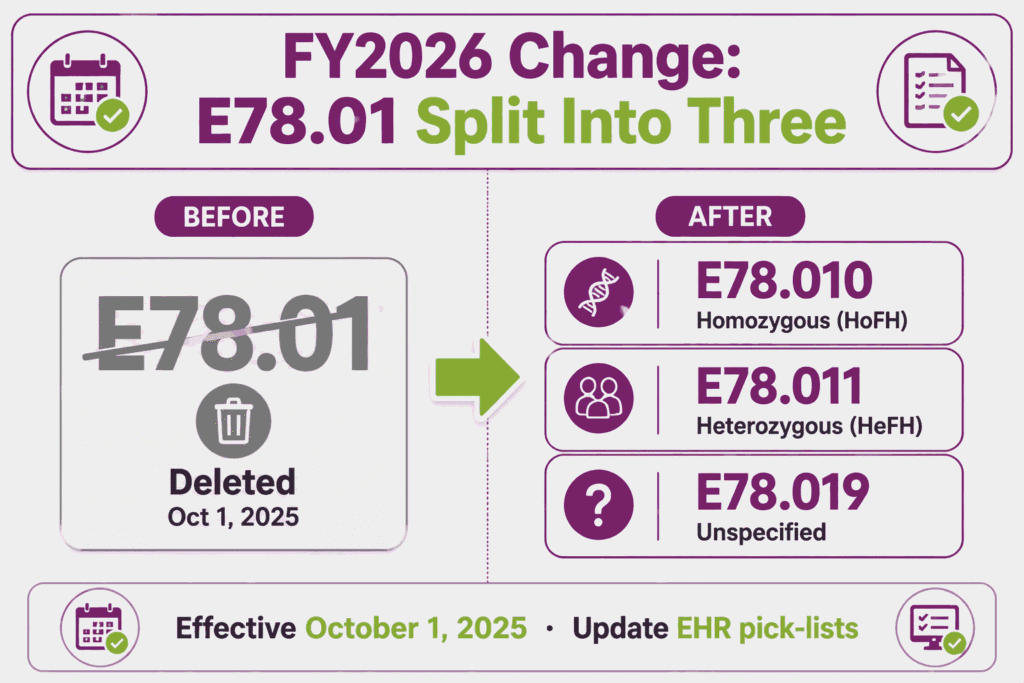
E78.01- Familial Hypercholesterolemia (E78.010, E78.011, E78.019)
E78.01- covers familial hypercholesterolemia, the inherited form driven by LDL-receptor, APOB, or PCSK9 gene variants. FY2026 replaced the former single code E78.01 with three specific codes. The table below lists each one.
| ICD-10 Code | Description | Inheritance Pattern |
|---|---|---|
| E78.010 | Homozygous familial hypercholesterolemia (HoFH) | Variant from both parents, severe |
| E78.011 | Heterozygous familial hypercholesterolemia (HeFH) | Variant from one parent, common |
| E78.019 | Familial hypercholesterolemia, unspecified | Type not yet confirmed |
Familial hypercholesterolemia raises the risk of premature atherosclerotic cardiovascular disease. The homozygous form (HoFH) is the more severe presentation. The heterozygous form (HeFH) is the more common inherited pattern in US patients.
What Is E78.1 (Pure Hyperglyceridemia)?
E78.1 is the ICD-10 code for pure hyperglyceridemia, elevated triglycerides with cholesterol in the normal range. E78.1 covers isolated high triglycerides, often called hypertriglyceridemia in clinical notes. The code applies when the triglyceride value is high, and the cholesterol value is normal.
What Is E78.2 (Mixed Hyperlipidemia)?
E78.2 is the ICD-10 code for mixed hyperlipidemia, elevated cholesterol and elevated triglycerides together. Mixed hyperlipidemia is one of the highest-volume lipid diagnoses in cardiology claims. A lipid panel showing high LDL and high triglycerides codes to E78.2.
E78.2 also captures combined hyperlipidemia and familial combined hyperlipidemia when documentation supports the mixed pattern. The code requires both lipid fractions to be elevated in the chart. A note reading LDL 190 mg/dL and triglycerides 230 mg/dL supports E78.2.
What Is E78.3 (Hyperchylomicronemia)?
E78.3 is the ICD-10 code for hyperchylomicronemia, elevated chylomicrons in the blood. E78.3 is uncommon in routine cardiology practice. The code appears in severe hypertriglyceridemia cases and inherited chylomicron metabolism disorders.
What Is E78.4- (Other Hyperlipidemia)?
E78.4- covers other hyperlipidemia that does not match the cholesterol, triglyceride, or mixed patterns. The subgroup includes a distinct code for elevated lipoprotein(a).
- E78.41 codes elevated Lp(a), a genetic cardiovascular risk marker measured by CPT 83695.
- E78.49 codes other hyperlipidemia patterns not classified elsewhere in E78.4.
What Is E78.5 (Hyperlipidemia, Unspecified)?
E78.5 is the ICD-10 code for hyperlipidemia, unspecified, the default when the lipid type is not documented. E78.5 remains billable and valid for diagnostic lipid panels. Coders upgrade E78.5 to a specific code once the panel data becomes available. E78.5 stays a last resort, not a first choice.
What Is E78.9 (Disorder of Lipoprotein Metabolism, Unspecified)?
E78.9 is the ICD-10 code for disorder of lipoprotein metabolism, unspecified, the broadest unspecified code in the category. E78.9 applies only when the lipid disorder cannot be characterized as hyperlipidemia or any specific subtype. Moreover, E78.9 carries the same audit risk profile as E78.5.
How Do You Choose the Correct Hyperlipidemia ICD-10 Code?
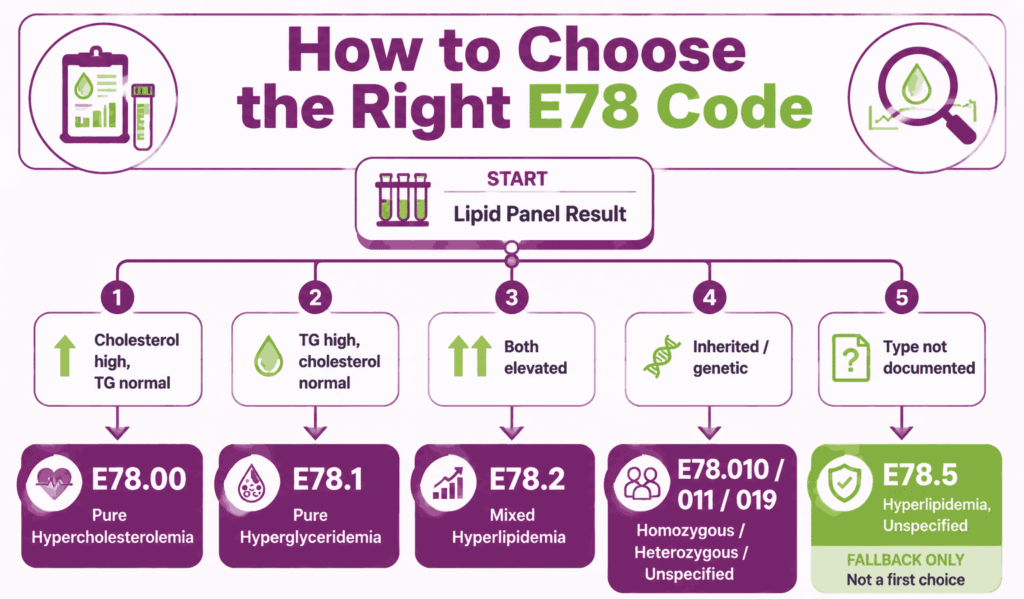
Correct hyperlipidemia code selection follows a lipid-type decision path. Each step matches the documented abnormality to one E78 code. The E78 family has no laterality character and no encounter character, so lipid type and cause drive every choice.
What Is the Step-by-Step Logic for Coding a Lipid Disorder?
The decision path moves from the lipid fraction to the cause. The steps below select the code in order.
- Cholesterol elevated, triglycerides normal: assign E78.00.
- Triglycerides elevated, cholesterol normal: assign E78.1.
- Cholesterol and triglycerides both elevated: assign E78.2.
- Inherited or genetic cause documented: assign E78.010, E78.011, or E78.019.
- Elevated lipoprotein(a) documented: assign E78.41.
- Lipid type not documented: assign E78.5.
When Should You Code E78.00 Instead of E78.5?
Coders assign E78.00 when the chart documents pure high cholesterol with normal triglycerides. E78.5 applies only when the note records hyperlipidemia without naming the fraction. A confirmed cholesterol-only pattern always takes E78.00 over the unspecified E78.5.
When Does the Lipid Panel Route to E78.2 (Mixed) vs. E78.0- or E78.1?
The lipid panel routes to E78.2 when both cholesterol and triglycerides exceed reference range. A cholesterol-only elevation routes to E78.0-. A triglyceride-only elevation routes to E78.1. The two elevated fractions in one panel are the deciding factor for E78.2.
How Do Excludes1 and Excludes2 Notes Apply Across the E78 Family?
Excludes notes control which E78 codes report together. An Excludes1 note blocks two codes that describe the same condition. Coders never report E78.5 alongside a specific E78 code for the same lipid disorder, because the specific code replaces the unspecified one.
How Are Hyperlipidemia Comorbidities and Related Conditions Coded?
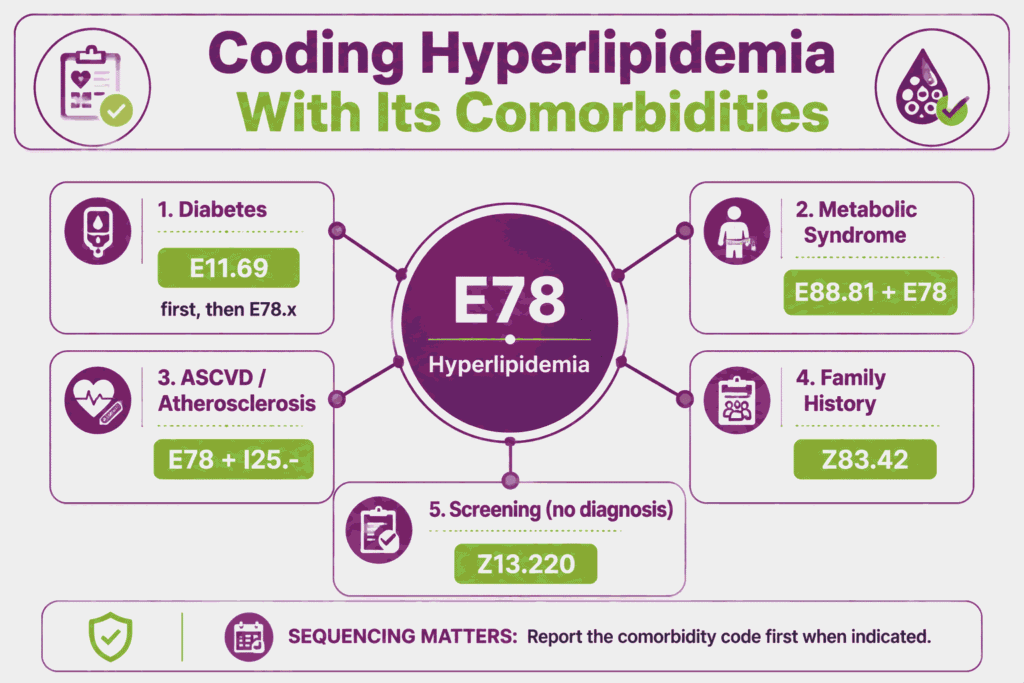
Hyperlipidemia rarely stands alone in cardiology charts. The condition co-occurs with diabetes, metabolic syndrome, and atherosclerotic cardiovascular disease. The subsections below map each comorbidity to its code and sequencing rule.
How Do You Code Diabetes With Hyperlipidemia? (E11.69)
Diabetes with hyperlipidemia codes to E11.69 when documentation establishes a causal link. E11.69 is type 2 diabetes mellitus with other specified complication. The E11.69 code sequences first, followed by the specific E78.x code for the lipid type.
When no causal relationship is documented, coders sequence by the encounter focus. The ICD-10-CM Official Guidelines Section I.C.4 govern these diabetic-complication combinations. Both codes appear on the claim when both conditions are managed.
How Is Hyperlipidemia Coded With Metabolic Syndrome? (E88.81)
Hyperlipidemia with metabolic syndrome codes E88.81 plus the E78 code. E88.81 is the code for metabolic syndrome. The combination captures abdominal obesity, high blood pressure, high blood sugar, and hyperlipidemia as a cluster. Each documented component carries its own code.
How Do You Code Hyperlipidemia With ASCVD or Atherosclerosis?
Hyperlipidemia with atherosclerotic cardiovascular disease pairs the E78 code with an I25.- code. Atherosclerotic heart disease codes to the I25.1- family. The lipid code supports the cardiovascular diagnosis and the lipid-lowering treatment plan. This pairing anchors the hyperlipidemia spoke to the broader cardiology CPT codes set for cardiovascular billing.
What Is the ICD-10 Code for Personal History of Hyperlipidemia?
No dedicated personal-history code exists for active hyperlipidemia. Hyperlipidemia is a chronic, ongoing condition, so the active E78 code applies whenever the current encounter documents it. Coders use the active E78 code rather than a history Z-code when the diagnosis remains current.
What Is the ICD-10 Code for Family History of Hyperlipidemia?
Family history of hyperlipidemia codes to Z83.42, family history of disorders of lipoprotein metabolism. Z83.42 records the family risk when the patient has no active diagnosis. A confirmed familial hypercholesterolemia diagnosis moves the coding to E78.01-, not the history code.
What Is the ICD-10 Code for Screening for Hyperlipidemia? (Z13.220)
Screening for hyperlipidemia codes to Z13.220, encounter for screening for lipoid disorders. Z13.220 applies to asymptomatic patients with no documented lipid disorder. The screening code holds the claim until a panel confirms a diagnosis, at which point the E78 code applies.
What Documentation Supports a Hyperlipidemia ICD-10 Claim?
Documentation supports a hyperlipidemia claim when the note records the lipid type, the lab values, the cause, and the treatment plan. Complete documentation supports both the E78 diagnosis code and the paired lab CPT codes.
What Clinical Elements Must the Provider’s Note Contain?
The provider note contains five elements for a clean E78 claim. Each element drives one part of the code selection.
- Lipid type: high cholesterol, high triglycerides, or both.
- Lab values: LDL, HDL, triglycerides, and total cholesterol with the panel date.
- Cause: primary, familial, secondary, or drug-induced when documented.
- Comorbidity link: diabetes, metabolic syndrome, or ASCVD when present.
- Treatment plan: statin, other lipid-lowering therapy, or lifestyle change.
How Do Lipid Panel Results Drive Code Selection?
Lipid panel results drive the choice between E78.00, E78.1, and E78.2. The LDL and triglyceride values decide the lipid fraction. A note reading LDL 190 mg/dL with triglycerides 230 mg/dL supports E78.2, mixed hyperlipidemia. The numeric values, not the general term, select the specific code.
How Should Familial Hypercholesterolemia Be Documented for E78.01- Coding?
Familial hypercholesterolemia documentation for E78.01- coding records the inherited pattern and the genetic basis. The note names homozygous or heterozygous status when known. The chart supports E78.010 for homozygous, E78.011 for heterozygous, and E78.019 when the type is unconfirmed.
What Are the MEAT Criteria for Hyperlipidemia HCC Recapture?
MEAT criteria are Monitor, Evaluate, Assess, and Treat. Each year’s HCC recapture for hyperlipidemia requires at least one MEAT element in the chart. Monitoring includes lipid panel review. Evaluating includes LDL trend assessment. Assessing includes cardiovascular risk stratification. Treating includes statin or lifestyle management.
Which CPT and Lab Codes Pair With Hyperlipidemia ICD-10 Codes?
Hyperlipidemia ICD-10 codes pair with lab CPT codes for lipid testing and E/M codes for management visits. The CPT mix is lab-based, since hyperlipidemia is a chronic medical condition rather than a procedural one. Correct pairing supports medical necessity and prevents denials.
Which Lab CPT Codes Are Billed With E78 Diagnoses?
The table below lists the CPT codes most billed with the E78 family and their common pairings.
| CPT | Description | Common ICD-10 Pairing |
|---|---|---|
| 80061 | Lipid panel (cholesterol, HDL, calculated LDL, triglycerides) | E78.0-, E78.1, E78.2, E78.5 |
| 82465 | Total cholesterol, serum | E78.00, Z13.220 |
| 83718 | HDL cholesterol | E78.6 (lipoprotein deficiency) |
| 83721 | Direct LDL measurement | E78.00, E78.2 (triglycerides over 400) |
| 84478 | Triglycerides | E78.1, E78.2 |
| 83695 | Lipoprotein(a) | E78.41 |
Lipid panel CPT 80061 carries the highest claim volume, since it bundles the four core lipid measures into one test.
Lipid Panel (CPT 80061)
CPT 80061 reports a complete lipid panel covering total cholesterol, HDL, calculated LDL, and triglycerides. CPT 80061 is a bundled panel under NCCI rules. Coders never bill the component codes on the same date as 80061, because unbundling triggers denials.
Direct LDL and Triglycerides (CPT 83721, 84478)
CPT 83721 reports a direct LDL measurement, and CPT 84478 reports triglycerides alone. Direct LDL testing applies when triglycerides exceed 400 mg/dL. The Friedewald calculation for LDL becomes unreliable above that triglyceride threshold, so direct measurement replaces the calculated value.
Lipoprotein(a) and Apolipoprotein Testing (CPT 83695)
CPT 83695 reports a lipoprotein(a) test, a genetic cardiovascular risk marker. CPT 83695 pairs with E78.41, elevated Lp(a). The test identifies inherited cardiovascular risk beyond the standard lipid panel.
How Do Screening vs. Diagnostic Lipid Tests Change the Pairing?
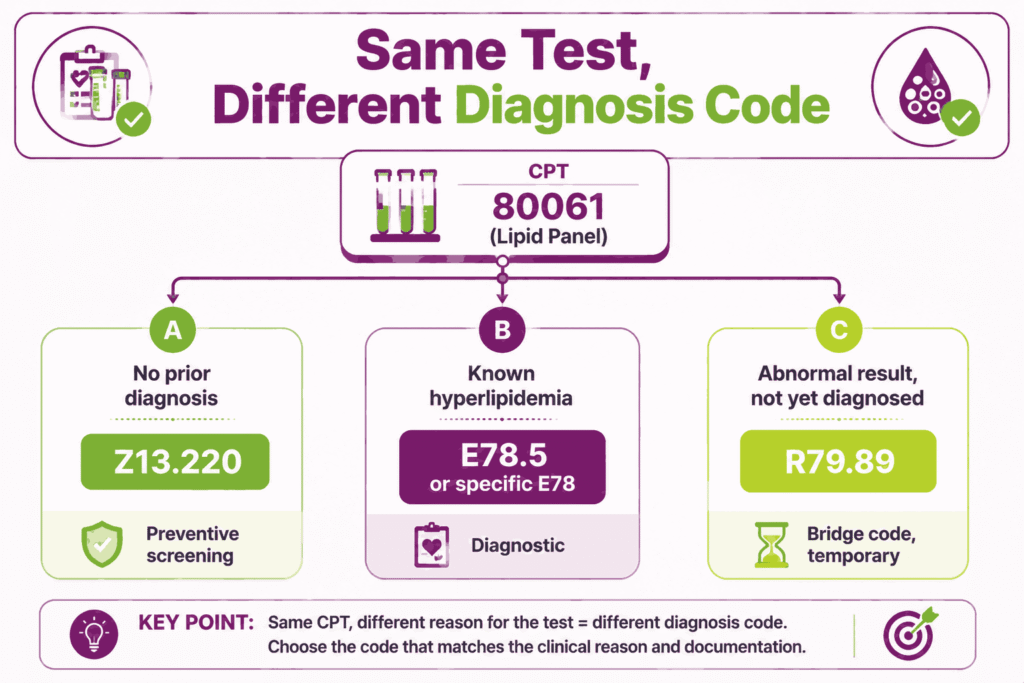
Screening and diagnostic lipid tests use different diagnosis codes on the same CPT. A screening panel with no prior diagnosis pairs CPT 80061 with Z13.220. A diagnostic panel for known hyperlipidemia pairs CPT 80061 with the E78 code. Mixing the two is a common denial driver.
- CPT 80061 plus Z13.220: preventive screening, no prior lipid diagnosis.
- CPT 80061 plus E78.5 or a specific E78 code: diagnostic testing for known hyperlipidemia.
- CPT 80061 plus R79.89: abnormal lipid result before the provider confirms a diagnosis.
How Do You Avoid CPT-ICD-10 Mismatches on Lipid Claims?
Coders avoid mismatches by linking each CPT to its correct E78 or Z-code justification. A lipid panel billed with only a hypertension code fails the payer medical-necessity logic. The diagnosis linking column in the EHR must connect CPT 80061 to the lipid diagnosis, not an unrelated code.
What Are the Most Common Hyperlipidemia Coding Denials, and How Do You Prevent Them?
The most common hyperlipidemia denials come from E78.5 overuse, deleted-code claims, screening mismatches, and CPT-diagnosis mismatches. Each pattern has a known prevention path.
Why Does Overusing E78.5 (Unspecified) Drive Denials and Downcoding?
E78.5 overuse drives denials because payers expect a specific code when the panel supports one. A claim using E78.5 where E78.00 or E78.2 applies weakens the medical record. Payers downcode or deny the line and flag the practice for pattern review.
Why Are Deleted-Code Claims (E78.01) Rejected in FY2026?
Claims using E78.01 are rejected because FY2026 deleted the code. E78.01 became a non-billable parent on October 1, 2025. Payers require the specific replacement codes E78.010, E78.011, or E78.019. Submitting the deleted code triggers a claim rejection.
Why Are Screening Lipid Panels Denied for Medical Necessity?
Screening lipid panels are denied when the diagnosis code contradicts the encounter type. A screening panel billed with E78.5 instead of Z13.220 reads as diagnostic and fails preventive-benefit logic. The fix is Z13.220 for asymptomatic screening and an E78 code for confirmed diagnoses.
How Do Payer-Specific Rules Change Hyperlipidemia Reimbursement?
Each payer applies its own rules to lipid testing and management. The table below summarizes common payer positions.
| Payer | Common Rule |
|---|---|
| Medicare | Lipid screening covered every 5 years with no cost-sharing under the preventive benefit |
| BCBS plans | Coverage frequency varies by state plan; repeat panels within the window flagged for review |
| UnitedHealthcare | Medical necessity documentation required; screening codes alone fail diagnostic claims |
| Aetna | Specific E78 code required for lipid-lowering drug prior authorization |
| Medicare Advantage | HCC recapture requires annual MEAT documentation for the E78 diagnosis |
Payers share one pattern: a specific E78 code, the correct screening-versus-diagnostic code, and documented medical necessity support payment across plans.
What Changed in the FY2026 ICD-10-CM Update for Hyperlipidemia?
The FY2026 ICD-10-CM update took effect on October 1, 2025, and expanded the familial hypercholesterolemia codes. The National Center for Health Statistics and CMS publish the annual code set. This update carries real structural change, unlike prior years.
What Are the New Familial Hypercholesterolemia Codes (E78.010, E78.011, E78.019)?
FY2026 deleted E78.01 and created three replacement codes. The former single familial hypercholesterolemia code split by inheritance pattern. E78.010 codes homozygous familial hypercholesterolemia. E78.011 codes heterozygous familial hypercholesterolemia. E78.019 codes familial hypercholesterolemia, unspecified.
How Should Practices Transition Charts and EHR Templates From E78.01?
Practices transition by updating EHR pick-lists and superbills to the three new codes. The diagnosis templates carry E78.010, E78.011, and E78.019 in place of the deleted E78.01. Payer authorization forms also require the new specific codes to avoid delays.
Do FY2026 Changes Affect HCC Capture for Hyperlipidemia?
FY2026 changes preserve HCC capture for hyperlipidemia while adding detail to the familial forms. The E78 codes continue to require MEAT-documented chart notes for annual recapture. Practices confirm descriptors against the CMS-published FY2026 code set before billing.
Frequently Asked Questions About Hyperlipidemia ICD-10 Coding
What Is the ICD-10 Code for Hyperlipidemia?
The ICD-10 code for hyperlipidemia is E78.5, hyperlipidemia unspecified. E78.5 applies when the record documents high lipids without naming the type. A specific E78 code replaces E78.5 once the lipid fraction is confirmed.
What Is the ICD-10 Code for Mixed Hyperlipidemia?
The ICD-10 code for mixed hyperlipidemia is E78.2. E78.2 applies when both cholesterol and triglycerides are elevated in the same lipid panel.
What Is the ICD-10 Code for High Cholesterol?
The ICD-10 code for high cholesterol is E78.00, pure hypercholesterolemia, unspecified. E78.00 applies when cholesterol is elevated, and triglycerides are normal.
What Is the ICD-10 Code for Familial Hypercholesterolemia?
Familial hypercholesterolemia codes to E78.010 (homozygous), E78.011 (heterozygous), or E78.019 (unspecified). The three codes replaced the deleted E78.01 on October 1, 2025.
What Is the Difference Between E78.5 and E78.2?
E78.5 is hyperlipidemia, unspecified, used when the lipid type is not documented. E78.2 is mixed hyperlipidemia, used when both cholesterol and triglycerides are elevated. E78.2 is the more specific and defensible code when the panel supports it.
Is Dyslipidemia the Same as Hyperlipidemia for Coding?
Dyslipidemia and hyperlipidemia both code to E78.5 when the type is unspecified. Dyslipidemia is the broader term and includes abnormally low lipid levels. The documented lipid values select the specific code.
What Is the ICD-10 Code for Screening for Hyperlipidemia?
The ICD-10 code for hyperlipidemia screening is Z13.220, encounter for screening for lipoid disorders. Z13.220 applies to asymptomatic patients with no prior lipid diagnosis.
Can E78.5 and a Specific E78 Code Be Reported Together?
No, a specific E78 code replaces E78.5 for the same lipid disorder. Reporting both codes for the same condition invites an Excludes edit.
Is E78.5 a Billable Code?
Yes, E78.5 is a billable code valid for FY2026. E78.5 remains acceptable for diagnostic lipid panels when the lipid type is not documented. A specific E78 code is preferable when the panel supports one.
What CPT Code Is Used for a Lipid Panel?
CPT 80061 reports a complete lipid panel. CPT 80061 pairs with the E78 code for diagnostic testing or with Z13.220 for preventive screening.