Ophthalmology ICD-10 codes tell payers which eye is affected, how far the disease has progressed, and why a service was necessary. One wrong digit changes that message. Therefore, laterality and specificity gaps remain a common reason eye claims are denied or paid late.
Chapter 7 of ICD-10-CM covers diseases of the eye and adnexa in the H00-H59 range. Cataract, glaucoma, retinal disease, and diabetic eye complications make up most eye claims. Each family follows its own laterality and staging rules, and each can fail on one wrong digit.
Coders, billers, practice managers, and ophthalmologists need one reliable reference for those rules. The sections below map the H00-H59 blocks, explain laterality digits, and show how glaucoma staging applies. They also cover the FY 2027 update effective October 1, 2026.
These rules follow the ICD-10-CM Official Guidelines and CMS code files for FY 2027. Even so, payer policies differ by contractor, and code descriptions can change. Always verify each code against the current official code set before submitting a claim.

What Are Ophthalmology ICD-10 Codes?
Ophthalmology ICD-10 codes are diagnosis codes from ICD-10-CM. The Centers for Medicare & Medicaid Services (CMS) and the National Center for Health Statistics (NCHS) maintain that code set. Eye practices use it for diagnoses, medical necessity, reimbursement, and data tracking. ICD-10-PCS covers inpatient hospital procedures, while ophthalmology CPT codes cover outpatient and physician procedures.
HIPAA requires adherence to the ICD-10-CM Official Guidelines when assigning diagnosis codes to claims. Therefore, laterality and staging rules are not optional. Ophthalmology is one specialty inside the wider ICD-10 code set, and the same conventions apply across all of it.
What Do the H00-H59 Codes Cover in Ophthalmology?
Ophthalmology ICD-10 codes sit in Chapter 7, Diseases of the Eye and Adnexa. The chapter runs from H00 through H59 and splits into twelve blocks by anatomy and disease type. The table matches each block to an example condition:
| Block | Category | Example |
|---|---|---|
| H00-H05 | Eyelid, lacrimal system, orbit | Chalazion |
| H10-H11 | Conjunctiva | Conjunctivitis |
| H15-H22 | Sclera, cornea, iris, ciliary body | Keratitis |
| H25-H28 | Lens | Cataract |
| H30-H36 | Choroid and retina | Macular degeneration |
| H40-H42 | Glaucoma | Open-angle glaucoma |
| H43-H44 | Vitreous body and globe | Vitreous hemorrhage |
| H46-H47 | Optic nerve and visual pathways | Optic neuritis |
| H49-H52 | Eye muscles, binocular movement, accommodation, refraction | Myopia |
| H53-H54 | Visual disturbances and blindness | Visual field defect |
| H55-H57 | Other eye and adnexa disorders | Nystagmus |
| H59 | Intraoperative and postprocedural complications | Macular edema after surgery |
What Are the Most Commonly Used Ophthalmology ICD-10 Codes?
Most eye claims draw from seven code families, and each follows its own laterality or staging pattern. Verify every code in the current code set before billing, because descriptions, notes, and payer edits can change. The table summarizes the families:
| Condition | Code Family | Laterality or Staging |
|---|---|---|
| Age-related cataract | H25.- | Eye digit; H25.9 has none |
| Glaucoma | H40.- | Eye digit plus stage character |
| Macular degeneration | H35.31-, H35.32- | Eye digit plus stage character |
| Diabetic eye disease | E08-E13 with .3- | Combination code; eye digit on most |
| Dry eye, conjunctiva, cornea | H04.12-, H10.-, H16.- | Varies by code |
| Refractive error | H52.- | Eye digit; H52.4 has none |
| Routine eye exam | Z01.0- | No laterality |
What Are the Cataract ICD-10 Codes?
Cataract codes sit in H25 (age-related), H26 (other), and H28 (in diseases classified elsewhere). Age-related nuclear cataract uses H25.1-, where 1, 2, and 3 mean right, left, and bilateral. Z96.1 reports a lens implant. Surgery centers follow the same rules for cataract ICD-10 codes in ASC ICD-10 codes.
What Are the Glaucoma ICD-10 Codes?
Glaucoma codes sit in H40.- and combine type, eye, and stage in one code. For example, H40.1131 reports primary open-angle glaucoma, bilateral, mild stage. A code that requires a seventh character is invalid without it, so the stage digit is mandatory.
What Are the Retina ICD-10 Codes?
Retina codes cover age-related macular degeneration (AMD) in H35.3-, detachments and breaks in H33.-, and vascular occlusions in H34.-. Dry AMD, H35.31-, carries a seventh character for stage. Wet AMD, H35.32-, reports active neovascularization, inactive neovascularization, or an inactive scar.
How Do You Code Diabetic Eye Disease?
Diabetic eye disease uses combination codes in categories E08 through E13. Codes with .3- report the diabetes type and the eye complication together. For example, E11.3291 reports type 2 diabetes with mild nonproliferative retinopathy without macular edema, right eye. Document stage and edema.
What Are the Dry Eye, Conjunctivitis, and Cornea Codes?
The dry eye of the lacrimal gland uses H04.12-, with 1, 2, 3, and 9 for right, left, bilateral, and unspecified. Conjunctivitis codes sit in H10.-, and corneal conditions such as keratitis sit in H16.-. Eyelid codes use their own separate digits.
What Are the Refractive Error and Presbyopia Codes?
Refractive errors sit in H52.-. Hypermetropia, myopia, and astigmatism carry an eye digit, such as H52.03 for bilateral hypermetropia. Presbyopia, H52.4, has no laterality option. Payers often treat refraction as a separate vision benefit, so a correct diagnosis alone does not guarantee payment.
Which ICD-10 Codes Report a Routine Eye Exam?
Z01.00 reports an eye and vision exam without abnormal findings, and Z01.01 reports one with abnormal findings. Z01.020 and Z01.021 apply after a failed vision screening. Original Medicare excludes routine eye exams for glasses, so coverage depends on a documented complaint or condition.
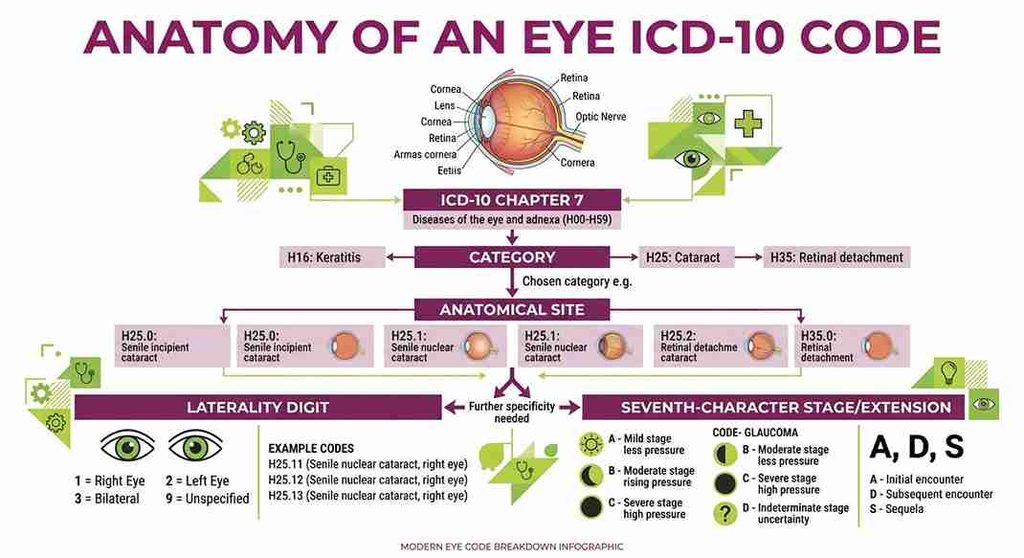
How Do ICD-10 Laterality Rules Work for Eye Codes?
ICD-10-CM laterality rules tell coders to report the affected eye, or both eyes, whenever the code allows it. Use a bilateral code when one exists, and separate right and left codes when none does. Report an unspecified-side code only when the record cannot show the side.
How Does Laterality Work in Eye Codes?
Most eye codes put laterality in one character, and the pattern repeats across cataract, glaucoma, AMD, and diabetic retinopathy codes. Staged codes place it before the stage character, as in H40.1131. The digits mean:
- 1: right eye
- 2: left eye
- 3: bilateral
- 9: unspecified eye
Important Note: Some codes have no eye digit at all. Examples include presbyopia (H52.4), unspecified age-related cataract (H25.9), and routine exam codes (Z01.0-). Therefore, always check each code’s own options in the Tabular List instead of assuming the pattern holds for every code.
Which Eyelid Codes Use Different Digits?
Eyelid codes name the specific lid as well as the side. Chalazion codes offer no bilateral option, so bilateral upper-lid chalazia need two codes, H00.11 and H00.14. Ptosis codes use right, left, bilateral, and unspecified instead. The table shows both patterns:
| Code Family | Digit Pattern | Bilateral Option |
|---|---|---|
| Chalazion | Side plus upper or lower lid | None |
| Ptosis (H02.40-) | 1 right, 2 left, 3 bilateral, 9 unspecified | Yes, digit 3 |
When Do You Use a Bilateral Code?
Report the bilateral code whenever the code offers one. Do not also report the right and left codes for the same condition. When no bilateral option exists, assign one code for each side. Each unique diagnosis code may appear only once per encounter.
When Is the Unspecified Eye Code Acceptable?
Unspecified-eye codes should rarely be used. The Guidelines allow them only when the record cannot identify the side and clarification is not possible. They create risk. An RT or LT modifier beside an unspecified-eye diagnosis can trigger a mismatch edit.
How Do You Code Different Stages in Each Eye?
Report each eye’s condition on its own code:
- Different conditions: right-eye cataract and left-eye glaucoma need one code each.
- Same type, different stages: assign a separate staged code for each eye.
What Do Laterality Examples Look Like?
Three scenarios show these rules on real claims:
- Bilateral nuclear cataract, one eye operated per visit: Report H25.13 at the first encounter, including the visit for the right eye. Report H25.12 at the second, because only the left eye still has the condition.
- Right nuclear cataract with mild primary open-angle glaucoma in the left eye: Report H25.11 and H40.1121.
- Bilateral primary open-angle glaucoma, mild right and severe left: Report H40.1111 and H40.1123, never a bilateral code.
What Ophthalmology Coding Guidelines Apply to Eye Conditions?
Beyond laterality, a few Official Guidelines and Tabular List conventions shape most eye coding decisions. Glaucoma staging carries the most weight, followed by combination codes, Excludes notes, and sequencing. Each one affects whether a claim passes payer edits and gets paid.
How Does Glaucoma Staging Work?
Glaucoma codes that carry a stage use a seventh character. Character 4 applies only when the provider documents that the stage cannot be clinically determined. Character 0 applies when the note says nothing about the stage. The values are:
- 0: stage unspecified
- 1: mild stage
- 2: moderate stage
- 3: severe stage
- 4: indeterminate stage
The highest-stage rule applies only when a stage progresses during an admission. It does not merge different stages in two eyes into one bilateral code at the highest stage. Where the code distinguishes laterality, each eye keeps its own staged code.
How Do Combination Codes and Code First Notes Work?
A combination code reports two elements in one code, so assign only that code when it fully describes the condition. Diabetic retinopathy codes in E11.3- are an example. Codes titled “in diseases classified elsewhere,” such as H28 and H42, follow the underlying condition and are never first-listed.
How Do Excludes1 and Excludes2 Notes Differ?
An Excludes1 note means the codes should not be reported together, unless the two conditions are unrelated. An Excludes2 note means the conditions can coexist, so both codes may be reported. Chalazion, H00.1-, for example, carries an Excludes2 note for infected meibomian gland, H00.02-.
How Should You Sequence Diagnoses on Eye Claims?
For outpatient eye visits, list first the condition chiefly responsible for the services provided. Then report coexisting conditions that affect care. For a routine eye exam, Z01.00 or Z01.01 comes first, with codes for abnormal findings added after it as secondary codes.
How Do You Link Diagnoses to CPT Codes?
Every test or procedure needs a diagnosis that supports medical necessity under the payer’s local coverage determination (LCD) or national coverage determination (NCD). Procedure-side rules, including modifiers, cataract global periods, and injection billing, follow their own ophthalmology billing codes and guidelines.
| CPT | Service | Laterality Handling |
|---|---|---|
| 66984 | Cataract surgery with lens implant | One eye; diagnosis side must match |
| 92134 | OCT, retina | Unilateral or bilateral |
| 92083 | Extended visual field exam | Unilateral or bilateral |
| 67028 | Intravitreal injection | RT or LT; 50 if both eyes |
What Are the Most Common Eye Coding Mistakes?
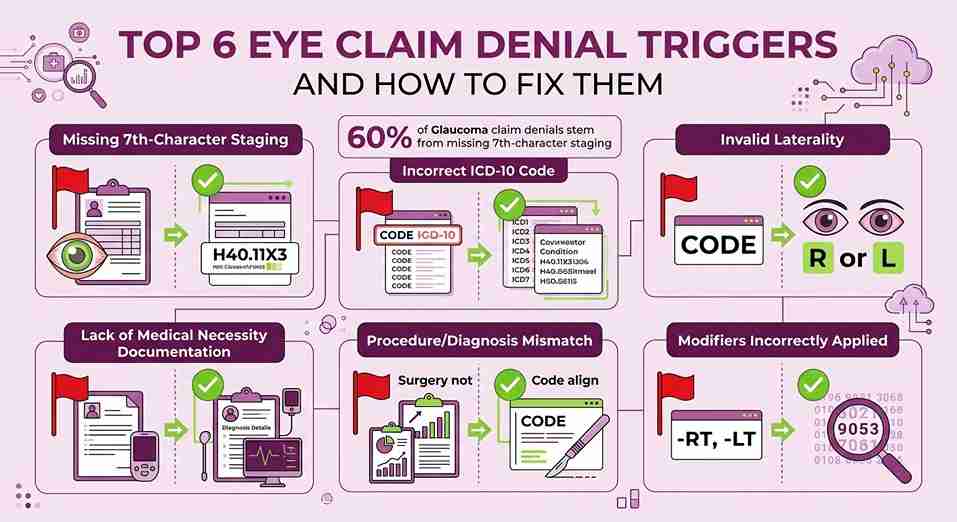
Most eye denials trace back to a few repeatable errors. One Palmetto GBA review found that 60 percent of glaucoma claims requiring a stage were submitted without it. Use this checklist:
- Missing laterality: Document the eye on every diagnosis. Codes ending in 1, 2, or 3 specify right, left, or bilateral, while missing laterality forces unspecified-eye codes that payers frequently deny.
- Unspecified by default: Pick the specific code the note supports. Defaulting to unspecified codes hides clinical detail, weakens medical necessity, and invites denials. Review the note, then code it precisely.
- Stale code sets: Update the EHR each October 1. ICD-10-CM changes take effect annually on October 1, so refresh the EHR, superbills, and charge master to prevent outdated-code claim rejections.
- Missing glaucoma stage: Require the seventh character. Glaucoma codes need a seventh character showing stage: 0 unspecified, 1 mild, 2 moderate, 3 severe, 4 indeterminate. Add EHR prompts for staging.
- Incomplete diabetic retinopathy: Capture type, severity, and edema. Document diabetes type, retinopathy severity (mild, moderate, severe nonproliferative or proliferative), macular edema presence, and eye, so the right E-code is assigned.
- Mismatched laterality: Compare diagnosis and RT or LT modifier. Before submitting, confirm the diagnosis eye matches the procedure modifier, since RT/LT conflicts are a top denial trigger for eye procedures.
How Do Annual ICD-10-CM Updates Affect Eye Coding?
ICD-10-CM updates take effect on October 1 each year, and some years add an April 1 update. Published addenda data shows no new, revised, or deleted Chapter 7 codes for FY 2027. Official sources include:
- CMS: code files and addenda
- CDC and NCHS: Official Guidelines
- American Academy of Ophthalmology (AAO): eye-specific coding resources
- AAPC: coder education
What Are the Best Practices for Eye Coding?
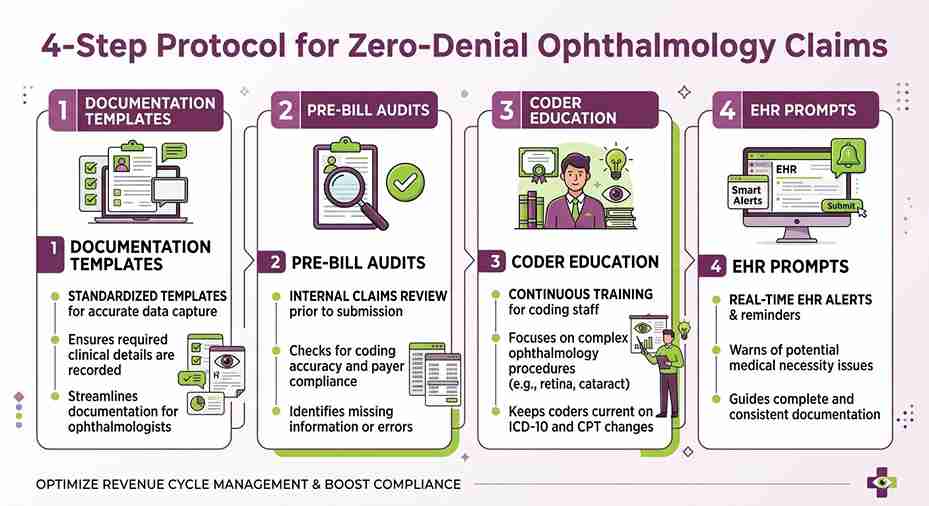
Accurate eye coding depends on process, not memory. Four habits remove most laterality and specificity errors in solo practices, groups, and surgery centers:
- Documentation templates: required eye, type, stage, and acuity fields
- Pre-bill audits: diagnosis laterality checked against procedure laterality
- Coder education: AAO and AAPC training
- Encoder and EHR prompts: alerts for missing stages and unspecified-eye codes
Practices without a dedicated eye coding team often outsource this work. Transcure’s ophthalmology medical billing services pair 1,100+ AAPC-certified billers with pre-bill claim checks. Transcure’s billing audit reviews 90 days of claims, so errors surface before payers find them.
Frequently Asked Questions About Ophthalmology ICD-10 Codes
What is the ICD-10 Code Range for Eye Diseases?
The ICD-10-CM code range for eye diseases is H00 through H59, which is Chapter 7, Diseases of the Eye and Adnexa. It covers eyelids, orbit, conjunctiva, cornea, lens, retina, glaucoma, and refraction. Some eye conditions, such as diabetic retinopathy, are coded elsewhere.
How Do You Code Laterality in Ophthalmology ICD-10?
Laterality is coded with a character in the diagnosis code, usually 1 for right, 2 for left, 3 for bilateral, and 9 for unspecified eye. Use the bilateral code when one exists. Otherwise, report separate right and left codes for each eye.
What Does “Unspecified Eye” Mean, and When Should It Be Avoided?
Unspecified eye means the record does not state which eye is affected. The Official Guidelines say such codes should rarely be used, only when the side cannot be identified and clarification is not possible. Avoid them on procedure claims, where they can trigger laterality edits.
How Is Glaucoma Staged in ICD-10-CM?
ICD-10-CM stages glaucoma with a seventh character: 0 unspecified, 1 mild, 2 moderate, 3 severe, and 4 indeterminate. Use 4 only when the provider documents that the stage cannot be determined. When each eye has a different stage, report a separate code per eye.
Can You Bill Bilateral Eye Conditions with One Code?
A bilateral condition takes one code when the classification offers a bilateral option, such as H25.13 for bilateral age-related nuclear cataract. When none exists, report separate right and left codes. Never report bilateral and unilateral codes for the same condition together.
What ICD-10 Code is Used for a Routine Eye Exam?
Z01.00 reports an eye and vision exam without abnormal findings, and Z01.01 reports one with abnormal findings. Z01.020 and Z01.021 apply after a failed vision screening. Original Medicare excludes routine eye exams for glasses, so confirm coverage with the payer before billing.
How Often Are Ophthalmology ICD-10 Codes Updated?
ICD-10-CM updates take effect every October 1, and April 1 updates occur some years. The FY 2027 code set runs from October 1, 2026 through September 30, 2027. Chapter 7 had no new, revised, or deleted codes in FY 2027.