The Colorado False Claims Act targets fraudulent claims for state and local government money. Signed June 7, 2022, HB 22-1119 excludes Medicaid claims from its coverage entirely. Colorado’s separate Medicaid False Claims Act has covered Medicaid provider billing since 2010.
Federal law also reaches billing companies that cause providers to submit false claims. DOJ reported record False Claims Act recoveries above $6.8 billion in fiscal 2025. Health care matters made up over $5.7 billion of that record annual total.

Whistleblowers also filed a record 1,297 qui tam suits during that same fiscal year. This guide explains how false claims rules fit within medical billing laws in Colorado. Statutory details below come from official Colorado statutes, legislative records, and federal DOJ releases.
What Is the Colorado False Claims Act?
The Colorado False Claims Act creates civil liability for false claims on public money. Polis signed HB 22-1119 on June 7, 2022, and it took effect August 10. Its provisions sit at C.R.S. 24-31-1201 through 24-31-1211 in Title 24 of state law.
What does the Colorado False Claims Act prohibit?
Three core prohibitions matter most to billing teams under the Colorado False Claims Act.
- Knowingly presenting a false claim, or causing another person to present one for payment.
- False records or statements made to support a false claim also create civil liability.
- Keeping or avoiding an obligation to pay money owed to the state creates liability.
Misappropriating state property also triggers liability, among other violations listed in C.R.S. section 24-31-1203. Individual government assistance payments under $10,000 per calendar year also fall outside the act.
Who can Enforce the Colorado False Claims Act?
Four parties can start or support civil cases under the Colorado False Claims Act. Each enforcer and its role in a false claims case appear in this table.
| Enforcer | Role |
|---|---|
| Attorney General | Investigates false claims and brings civil actions |
| Local prosecutors | Investigate local violations and may enforce if the Attorney General declines |
| State Auditor | Shares information on potential false claims with the Attorney General and local governments |
| Private relators | File qui tam suits in the name of the state or local government |
State recoveries flow into the False Claims Recovery Cash Fund created in C.R.S. 24-31-1209. Rulemaking authority to implement the act also belongs to the Colorado Attorney General’s office.
Does the Colorado False Claims Act Apply to Medicaid Billing?
No, the Colorado False Claims Act excludes claims paid under the state’s Medicaid program. Medicaid provider billing falls under the separate Colorado Medicaid False Claims Act of 2010. Medicare claims fall under the federal act, and one scheme can trigger several laws.
What is the Colorado Medicaid False Claims Act?
Colorado adopted the Medicaid False Claims Act in 2010 at C.R.S. 25.5-4-303.5 through 25.5-4-310. It reaches anyone who knowingly submits or causes false claims to Colorado’s Medicaid program. Retained overpayments also count as obligations owed to the state under the act’s definitions.
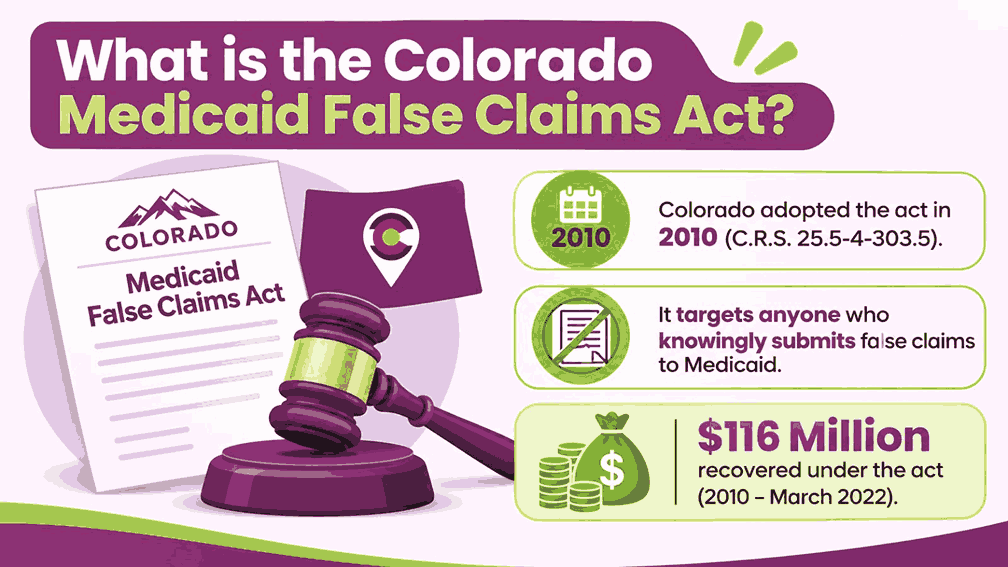
Private relators may also file qui tam suits for the state under C.R.S. 25.5-4-306. Convicted relators lose any share of proceeds and face dismissal from the civil action. Weiser’s office reported $116 million recovered under the act between 2010 and March 2022.
How do the Federal, Colorado, and Colorado Medicaid False Claims Laws Compare?
Overlap among the three false claims laws affects healthcare billing, yet each covers different payers. Coverage, citations, enforcers, and penalties for all three laws appear in the table below.
| Law | What it covers | Citation | Enforcer | Damages and penalties |
|---|---|---|---|---|
| Federal False Claims Act | Medicare, other federal funds and the federal share of Medicaid | 31 U.S.C. 3729 to 3733 | DOJ, U.S. Attorneys and qui tam relators | Treble damages plus inflation-adjusted per-claim penalties |
| Colorado False Claims Act | State and local government funds, excluding Medicaid | C.R.S. 24-31-1201 to 1211 | Attorney General, local prosecutors and relators | Treble damages (double for cooperation), civil penalties and costs |
| Colorado Medicaid False Claims Act | Colorado Medicaid and other medical assistance programs | C.R.S. 25.5-4-303.5 to 310 | Attorney General and relators | Treble damages, penalties tied to federal amounts, and costs |
Civil penalties under the state Medicaid act automatically track federal False Claims Act amounts. One Medicaid claim can therefore face the federal act and the Colorado Medicaid act. Other state and local payments such as grants and contracts follow the Colorado act.
What Counts as a False Claim in Medical Billing?
A false claim is any request for government payment that contains inaccurate billing information. Liability depends on what the person submitting the request knew at that exact time. The federal, Colorado, and Colorado Medicaid false claims laws all define that knowledge identically.
What does “knowingly” mean under these Laws?
Knowingly covers three distinct mental states, and any one of them establishes legal liability.
- Actual knowledge means the biller knows the claim information is false when submitting it.
- Deliberate ignorance means deliberately avoiding any effort to learn if claim information is true.
- Reckless disregard means consciously ignoring a substantial risk that submitted claim information is false.
None of these standards requires proof that anyone specifically intended to defraud the government. Negligence alone does not satisfy the standard, so honest errors generally fall outside liability. These statutory definitions appear at 31 U.S.C. 3729(b), C.R.S. 24-31-1202, and C.R.S. 25.5-4-304, respectively.
Which Billing Practices Create False Claims Risk?
Six billing practices commonly create healthcare false claims risk when knowing conduct accompanies them. Each practice appears in the table below with an example and the risk involved.
| Practice | Example | Risk |
|---|---|---|
| Upcoding | Billing a higher-level visit code than the documentation supports | Payment for a service level never provided |
| Unbundling | Billing separate codes for procedures that one comprehensive code covers | Payment above the correct bundled rate |
| Billing for Services not Rendered | Submitting a claim for a visit or test that never occurred | Payment for care never delivered |
| Duplicate Billing | Submitting the same service twice to one payer or to two payers | Double payment for one service |
| Medical Necessity Gaps | Billing services without documentation showing the service was necessary | Payment for services the program does not cover |
| Modifier Misuse | Appending a modifier to bypass bundling edits without supporting documentation | Payment that edits would otherwise deny |
Repeated denials and payer audit findings are warning signs that billers cannot safely ignore.
Can a Medical Billing Company Be Liable Under the False Claims Act?
Yes, billing companies can face liability because the laws also cover causing false claims. Colorado Medicaid pays the enrolled provider directly, yet billers prepare and submit many claims. OIG guidance for third-party billing companies describes potential liability for company and client operations.
Three billing company actions can create exposure under federal and Colorado false claims laws.
- Assigning codes without supporting documentation can cause a false Medicaid claim to be presented.
- Submitting claims after learning of repeated provider coding errors creates serious actual knowledge exposure.
- Ignoring clear audit findings about a client’s coding patterns can support reckless disregard allegations.
Billing companies that find credible evidence of continued provider misconduct stop submitting those claims.
What is a Reverse False Claim, and What is the 60-day Overpayment Rule?
Reverse false claims arise when a person knowingly keeps money owed to the government. Section 3729(a)(1)(G) of the federal act covers knowingly concealing or avoiding that payment obligation. Retaining an overpayment counts as an obligation under the Colorado Medicaid False Claims Act.
Federal law requires Medicare and Medicaid providers to return identified overpayments within 60 days. Medicare’s 2025 rule says an overpayment is identified when a person knowingly retains it. CMS issued no Medicaid-specific regulation, though the statutory deadline still applies to Medicaid overpayments.
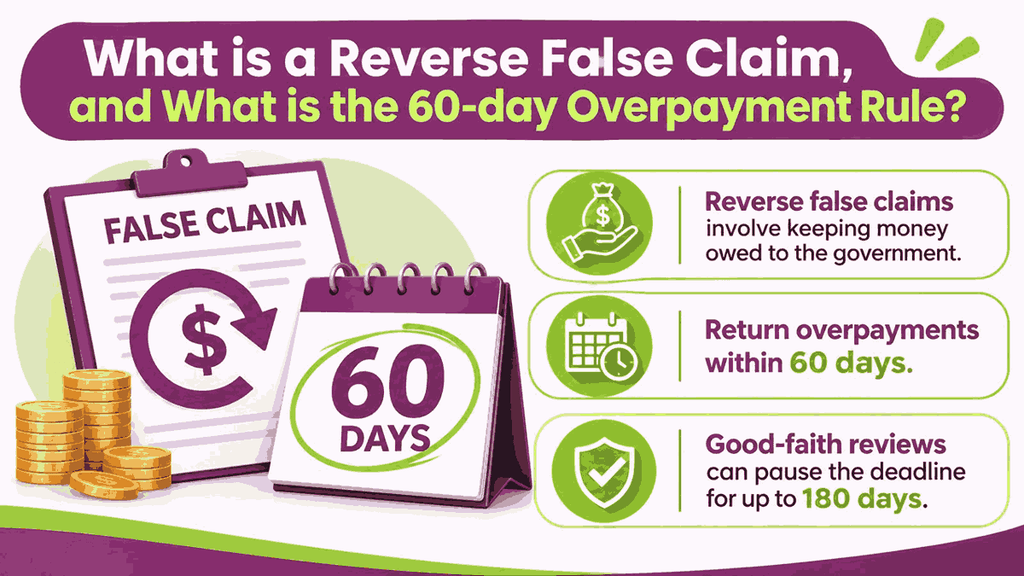
Timely good-faith investigations can suspend Medicare’s 60-day return clock for up to 180 days. Missing the deadline can turn a retained overpayment into a potential reverse false claim. Documented overpayment reviews and prompt refunds through Medicaid adjustments or voids demonstrate good-faith compliance.
What Penalties and Whistleblower Rewards Apply?
Penalties under the false claims laws combine multiplied damages, per-claim fines, and enforcement costs. Courts can award treble damages, meaning three times the actual loss to the government. Violators also pay civil penalties for each false claim and the government’s investigation costs.
This table lists the five financial consequences that can follow a knowing false claim.
| Consequence | What it means |
|---|---|
| Treble Damages | Three times the government’s loss under the federal, Colorado, and Colorado Medicaid acts |
| Double Damages | A reduced Colorado Act award when the violator cooperates, under C.R.S. 24-31-1204 |
| Per-claim Penalties | Medicaid Act amounts automatically track the federal inflation-adjusted penalties |
| Enforcement Costs | Violators also cover investigation and civil action costs |
| Relator Share | Up to 30 percent of the government’s recovery for a successful whistleblower |
Whistleblowers called relators file qui tam suits and can receive up to 30 percent. Relators convicted for their role in the violation lose any share and face dismissal. Colorado Act proceeds flow into the False Claims Recovery Cash Fund under C.R.S. 24-31-1209.
What Protections do Employees have When They Report Billing Problems?
The Colorado False Claims Act shields employees, contractors, and agents from retaliation for whistleblowing. Prohibited retaliation includes discharge, demotion, suspension, threats, harassment, intimidation, blacklisting, defamation, and being sued. Protection also covers efforts to stop what the person reasonably believes is a violation.
Foley’s analysis finds Colorado’s retaliation grounds broader than the federal False Claims Act’s grounds. Statutory protected acts include assisting investigations, meeting counsel, giving confidential information, and filing actions.
Remedies under the act include all relief necessary to make the retaliated individual whole. Billing staff reporting coding problems can qualify for protection if their belief is reasonable. Employers reduce retaliation risk by routing every billing concern through a documented compliance process.
Who Investigates Billing Fraud in Colorado?
Four agencies investigate billing fraud in Colorado, and each plays a distinct enforcement role. Each investigator and its role in Colorado billing fraud cases appear in this table.
| Agency | Role |
|---|---|
| HCPF Program Integrity Section | Audits Medicaid providers, reviews fraud allegations, and refers credible cases |
| Attorney General’s Medicaid Fraud Control Unit | Investigates and prosecutes Medicaid provider fraud |
| HHS-OIG | Investigates fraud against federal health programs |
| U.S. Attorney, District of Colorado | Investigates and prosecutes federal whistleblower claims in Colorado |
Anyone can report suspected Colorado Medicaid provider fraud directly to the Attorney General’s unit.
How do Medicaid Audits and Fraud Referrals Work?
HCPF’s Program Integrity Section audits providers and reviews allegations of Medicaid fraud and abuse. Staff determines if an allegation is credible before referring the case to the unit. Federal guidance requires states to refer verified fraud to their Medicaid Fraud Control Unit.
States generally suspend provider Medicaid payments once a credible allegation of fraud is verified. Suspensions follow consultation with the Medicaid Fraud Control Unit and notice to the provider. Medicaid rules expect providers to retain billing records for seven years to answer audits.
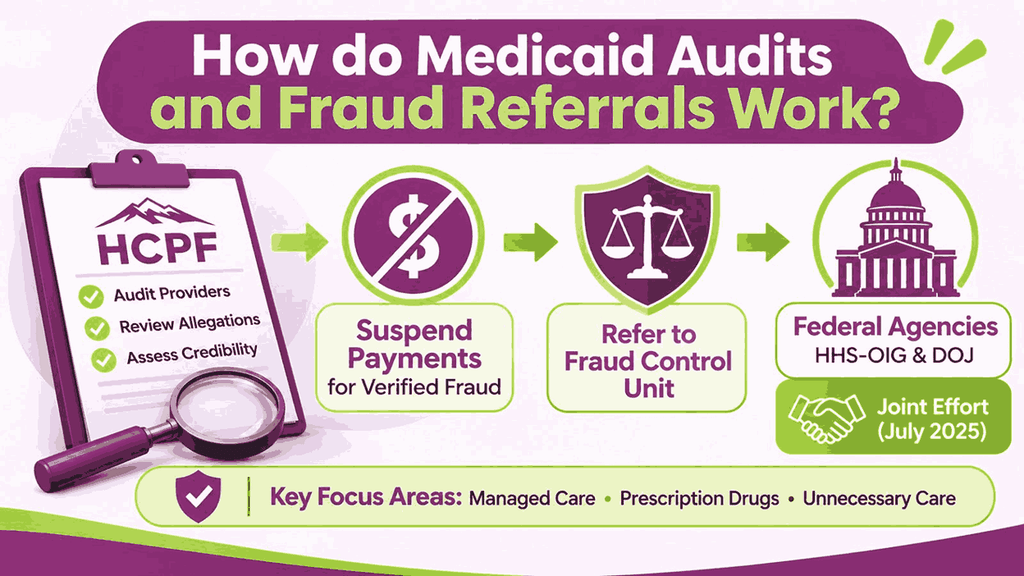
HHS-OIG and the U.S. Attorney handle federal health program fraud affecting Medicare and Medicaid. DOJ and HHS formed a joint False Claims Act Working Group in July 2025. Enforcement priorities listed by DOJ include managed care, prescription drugs, and medically unnecessary care.
How Do Medical Billing Teams Stay Compliant?
Effective compliance programs build repeatable checks into every billing stage from coding through collections. OIG’s 2023 General Compliance Program Guidance describes seven elements of an effective compliance program. Those elements give Colorado Medicaid billing teams a ready framework for documenting their controls.
Which Compliance Controls Reduce False Claims Risk?
Eight controls address the main billing false claims risks covered earlier in this guide. Table rows pair each billing control with its purpose and the risk it targets.
| Control | Purpose | Risk addressed |
|---|---|---|
| Coding audits | Sample claims and compare codes with the documentation | Upcoding and unbundling |
| Documentation checks | Confirm notes support medical necessity before billing | Medical necessity gaps |
| Claim scrubbing | Run claims through edits for modifiers and code pairs | Modifier misuse and duplicate billing |
| Denial pattern review | Track repeat denials by payer, code, and provider | Reckless disregard of warning signs |
| Staff training | Teach coding, documentation, and false claims rules each year | Knowing or reckless errors |
| Reporting hotline | Give staff a confidential way to raise billing concerns | Unreported problems and retaliation claims |
| Exclusion list screening | Check staff and vendors against the HHS-OIG List of Excluded Individuals and Entities (LEIE) and state Medicaid lists | Billing through excluded individuals |
| Record retention | Keep billing and audit records for seven years | Audit and investigation exposure |
Monthly screening against the federal LEIE and Medicaid exclusion lists appears in OIG guidance. Written policies, a compliance officer, discipline standards, and corrective action complete the seven elements. Separate balance billing rules under Colorado surprise billing laws belong in compliance training too.
What Should a Billing Team do After Finding an Error?
Five ordered steps turn a discovered billing error into a documented and defensible correction.
- Stopping billing of the affected issue prevents additional claims from carrying the same error.
- Reviewing every related claim shows how far the error reaches across patients and payers.
- Quantifying the overpayment gives the practice an exact amount to report and return promptly.
- Refunds flow through Medicaid adjustments or voids submitted within the federal 60-day return window.
- Documentation of each decision, calculation, and refund creates the complete audit trail regulators expect.
Timely voluntary disclosure with full cooperation can reduce federal damages from treble to double. Legal counsel guides decisions on disclosure because each case carries different facts and exposure. Detailed step-by-step claim adjustment and void instructions appear in the Colorado Medicaid billing guide.
How Can a Medical Billing Company Help With False Claims Compliance?
Transcure builds these compliance controls into daily Colorado Medicaid billing for each client practice. Over 1,100 AAPC-certified billers and coders work inside the practice’s EMR to review claims. Medical billing audits give practices a focused review of coding patterns and documentation gaps.
Compliance tasks in the table below run daily inside Transcure’s Colorado Medicaid billing workflow.
| Task | How Transcure handles it |
|---|---|
| Coding review | Certified coders check codes against clinical documentation before submission |
| Claim scrubbing | Edits catch modifier misuse, duplicate claims, and code pair conflicts |
| Denial pattern review | Repeat denials trace back to coding, enrollment, or eligibility causes |
| Overpayment tracking | Credits and refunds route through Medicaid adjustments or voids on a documented schedule |
| Exclusion screening | Staff and vendors checked against federal and state exclusion lists monthly |
| Audit support | Organized claim and documentation records ready for payer and HCPF audits |
CODIN, Transcure’s AI coding agent, reads clinical notes and flags NCCI and MUE violations. Claim scrubbing through CLAIR, an AI agent for claim creation, catches errors before submission. DEXA, an AI agent, detects denial trends that signal recurring coding or documentation problems.
Pricing is 5% of collected revenue with no up-front setup cost for Colorado practices. First-pass clean claims reach 98% across Transcure’s client accounts under this front-end review process. Practices seeking billing compliance support can explore Transcure’s Colorado billing services and audit options.
Frequently Asked Questions
What is the Colorado False Claims Act?
Colorado’s False Claims Act penalizes knowingly false claims for state and local government money. HB 22-1119 created the state law in 2022, and it excludes Medicaid claims entirely.
Does the Colorado False Claims Act cover Medicaid fraud?
No, the Colorado False Claims Act excludes payments made under the state’s Medicaid program. The separate Colorado Medicaid False Claims Act, effective since 2010, covers Medicaid billing fraud.
Can a Medical Billing Company be Sued Under the False Claims Act?
Yes, the laws reach anyone who knowingly causes a false claim to be submitted. Billing companies can therefore face liability alongside providers whose claims they prepare and submit.
What are the Penalties for a False Claim in Colorado?
Violators face treble damages, meaning triple the loss, plus civil penalties for each claim. State Medicaid Act penalties track federal amounts automatically, and violators also pay enforcement costs.
How do you Report Suspected Medicaid Billing Fraud in Colorado?
Anyone can report suspected Colorado provider fraud directly to the Attorney General’s Medicaid unit. HCPF’s Program Integrity Section also reviews allegations and refers credible cases to that unit.