Periapical abscess alone accounted for 846,629 emergency department visits in the US during 2021 and 2022, according to the Journal of Endodontics. That’s one of the most common reasons a dental infection ends up in an ER rather than a dentist’s chair.
Every one of those visits gets coded under one of four ICD-10 codes. Picking the right one means looking at where the infection started, how far it’s spread, and what the exam actually found. A chart that skips any of these details can push a claim toward the wrong code.
This guide breaks down all four dental abscess codes and shows exactly where these claims tend to go wrong.
Periapical Abscess ICD-10 Codes: Quick Reference
Here’s a quick reference table of the four main dental abscess ICD-10 codes, along with when to use each.
| Code | Descriptor | When to Use |
|---|---|---|
| K04.6 | Periapical abscess with sinus tract | Tooth-root infection with a visible drainage pathway to the gum surface |
| K04.7 | Periapical abscess without sinus tract | Same tooth-root infection, but confined; no drainage pathway present |
| K12.2 | Cellulitis and abscess of the mouth | Infection has spread from the tooth into surrounding soft tissue |
| K05.21x | Periodontal abscess (officially titled “aggressive periodontitis, localized”) | Gum-origin infection, distinct from a tooth-root-origin one; requires a 6th character for severity |
How Is a Periapical Abscess Classified in ICD-10?
A dental abscess isn’t one diagnosis, it’s four possible ones, and the code depends on exactly where the infection sits and how far it’s traveled. ICD-10 doesn’t classify these by pain level or how urgent the case feels in the chair, it classifies them by anatomical origin and spread.
That distinction matters because the same word, “abscess,” shows up in the descriptor for all four codes, but each one points to a genuinely different location and clinical picture. A coder working from the word “abscess” alone has no way to pick the right one. The chart has to specify where.
What Determines Which Periapical Abscess Code Applies?
Three things decide the code: where the infection started, if it’s spread, and if a drainage pathway is documented. A periapical abscess with no drainage noted gets coded differently than one with a sinus tract.
Both of those look completely different from an infection that’s spread into soft tissue, or one that started in the gum instead of the tooth.
The only problem is that charts frequently don’t specify enough to make the distinction, which is exactly where a claim risks landing on the wrong code by default.
Tooth Root vs. Soft Tissue vs. Gum Origin
Every dental abscess traces back to one of three starting points. A periapical abscess starts at the tooth root, from infection reaching the pulp, and it’s coded as K04.6 or K04.7 depending on whether a sinus tract is present.
A soft tissue abscess means the infection has moved beyond the tooth into the surrounding mouth tissue, coded as K12.2. A periodontal abscess starts in the gum structures supporting the tooth rather than the tooth itself, coded under K05.21x.
These three paths don’t overlap the way they might seem to on the surface. A tooth-root infection and a gum-origin infection are documented and treated differently, and the code needs to reflect which one the chart actually describes.
What Is the ICD-10 Code for a Periapical Abscess With a Sinus Tract?
The ICD-10 code for a periapical abscess with a sinus tract is K04.6. This applies when a tooth-root infection has broken through and formed a visible drainage pathway, often showing up as a small bump on the gum, sometimes called a parulis or gum boil, where pus drains out on its own.
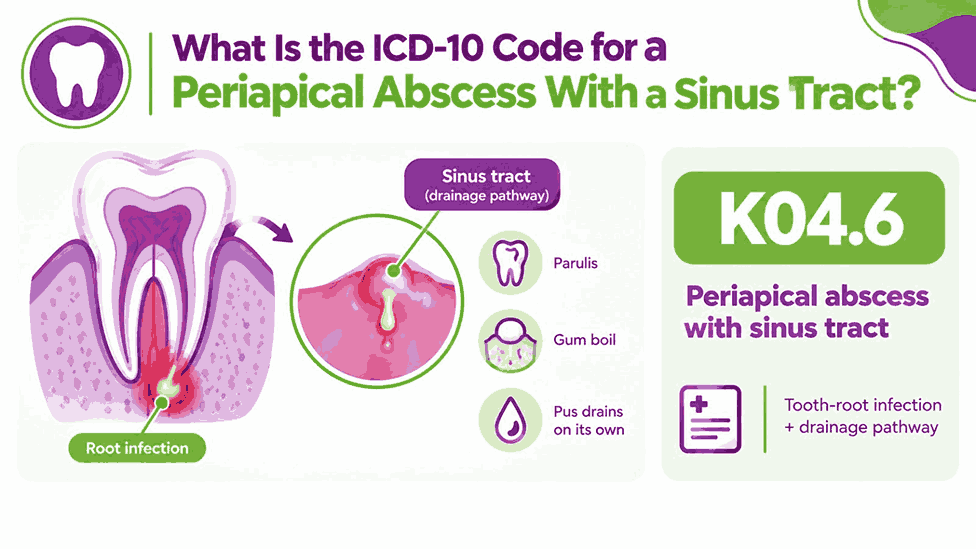
The sinus tract itself is the deciding detail here. Without one documented, this same infection would be coded entirely differently, which is why a note that only says “abscess” without mentioning drainage isn’t enough to support K04.6 on its own.
Why Does the Sinus Tract Matter Clinically?
A draining sinus tract means the infection has already found a path to release pressure, which can actually make the abscess feel less acutely painful than a confined one. That’s a real clinical nuance worth knowing, since a patient with a draining sinus tract may not present with the same urgency as one without, even though both need treatment.
What Is the ICD-10 Code for a Periapical Abscess Without a Sinus Tract?
The ICD-10 code for a periapical abscess without a sinus tract is K04.7. This applies to the same tooth-root infection as K04.6, pus accumulating at the root tip, but here it stays confined, with no drainage pathway formed to release it.
The chart needs to confirm the absence of a sinus tract, not just leave drainage unmentioned. A note describing localized swelling, pain, and sensitivity, with imaging confirming an abscess at the root tip and no visible fistula, gives clear support for K04.7.
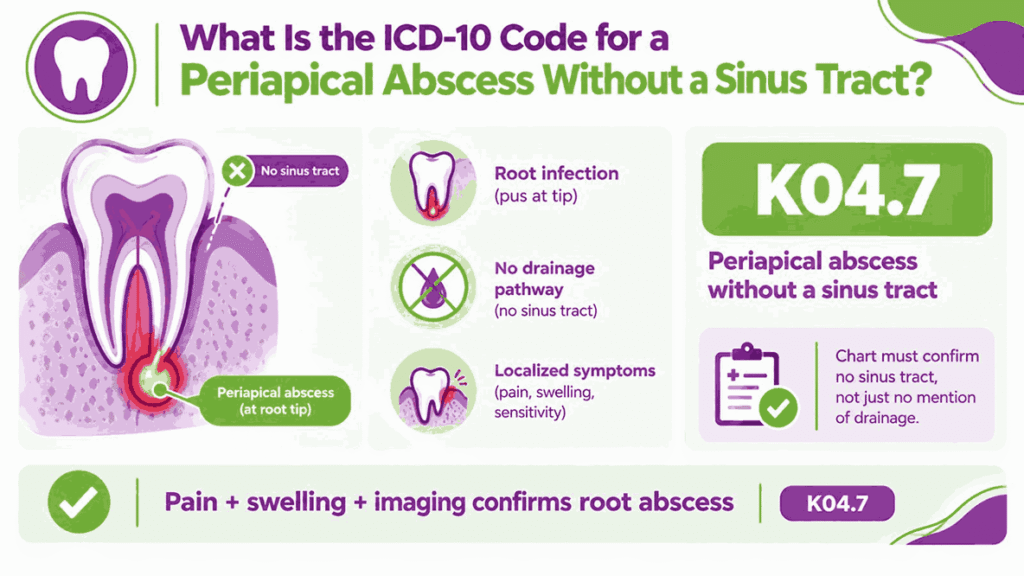
Since this is the default code whenever a sinus tract isn’t documented, it’s worth double-checking that the absence was actually confirmed on exam. This is exactly the kind of detail dedicated dental billing services catch before a claim goes out.
Why Does a Confined Abscess Often Feel More Urgent?
Without a drainage pathway, pressure builds up inside the confined space around the tooth root instead of releasing. That’s often why a K04.7 presentation comes with more acute, throbbing pain than a K04.6 case; the infection has nowhere to go, and the patient frequently presents to care faster as a result.
What Happens When a Periapical Abscess Spreads to Soft Tissue?
The ICD-10 code for cellulitis and abscess of the mouth is K12.2. This applies when a dental infection no longer stays confined to the tooth or its immediate root area and spreads into the surrounding soft tissue instead, showing up clinically as cellulitis, a spreading, diffuse infection rather than a single localized pocket of pus.
This is a meaningfully more serious presentation than either K04.6 or K04.7 on their own. A confined periapical abscess is a localized problem.
Once that infection moves into soft tissue, it’s tracking toward complications that can genuinely become dangerous, including the deep neck space infections referenced in clinical literature on dental abscess complications.
Can K12.2 Be Billed Alongside K04.6 or K04.7?
Yes, in the right circumstances. K12.2 carries a Type 2 Excludes note with periapical abscess, which means the two conditions can be reported together when both are genuinely present and separately documented. The original tooth-root infection, plus the soft tissue spread it caused.
This isn’t automatic, though. The chart needs to describe both the periapical source and the soft tissue involvement clearly enough to support coding each one, rather than just picking whichever code sounds more severe.
Is There a Specific ICD-10 Code for a Periodontal Abscess?
Yes, but not by that name. The real code is K05.21, and its official title is “aggressive periodontitis, localized,” not periodontal abscess. That mismatch trips up a lot of searches, since a coder looking specifically for “periodontal abscess ICD-10” won’t find a code with that exact label anywhere in the system.
The clinical definition behind K05.21 makes the connection clear, though. It’s described as a localized, circumscribed area of purulent inflammation in the periodontal tissue, in direct contrast to a periapical abscess, which comes from pulp necrosis instead. That’s a genuine periodontal abscess, just filed under a periodontitis-sounding title.
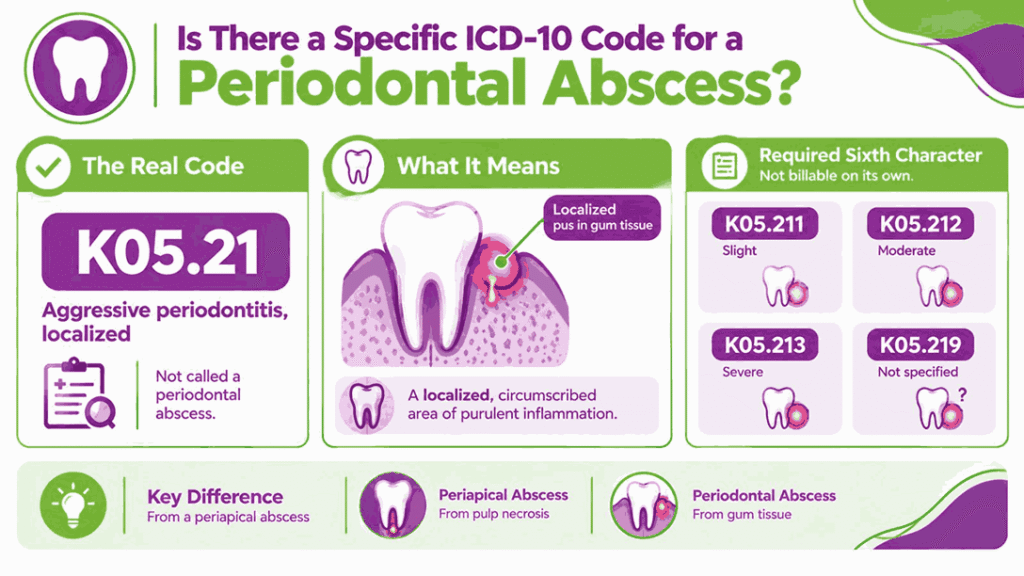
One more detail worth knowing: K05.21 isn’t billable on its own. It requires a sixth character for severity, K05.211 for slight, K05.212 for moderate, K05.213 for severe, or K05.219 when severity isn’t specified.
Why K05.21 and K04.6/K04.7 Can Never Be Billed Together
Unlike K12.2, which can be paired with a periapical abscess code, K05.21 carries a Type 1 Excludes note against K04.6 and K04.7. That’s a stricter relationship, it means these conditions are considered mutually exclusive.
The logic follows the same origin distinction covered earlier. A periodontal abscess comes from the gum structures, a periapical abscess comes from the tooth’s pulp, and a single infection can only be coded as one or the other, never both at once.
Is There a Specific ICD-10 Code for a Gingival Abscess?
No, a gingival abscess, an infection limited to the gum surface itself, distinct from the deeper periodontal structures, doesn’t have a dedicated ICD-10 code of its own. It’s a real, commonly used clinical term, but the code set doesn’t carve out a separate category for it the way it does for periapical and periodontal origins.
In practice, a documented gingival abscess most often gets coded under K05.21, since both involve gum tissue rather than the tooth root.
The distinction between “gingival” and “periodontal” matters clinically; gingival abscesses are typically more superficial and often caused by something trapped at the gumline, like food debris, while periodontal abscesses involve deeper structures.
How Do You Choose the Right Periapical Abscess Code?
The table below walks through the same three questions covered earlier, origin, spread, and drainage, in the order they should actually be checked.
| Step | Question | If Yes | If No |
|---|---|---|---|
| 1 | Did the infection originate in the gum tissue, not the tooth? | Code K05.21x (periodontal abscess) | Continue to step 2 |
| 2 | Has the infection spread into surrounding soft tissue? | Code K12.2, and check if the periapical source also needs its own code | Continue to step 3 |
| 3 | Is a sinus tract or drainage pathway documented? | Code K04.6 | Code K04.7 |
A gingival abscess follows the same first branch as a periodontal one, since it also routes to K05.21x in the absence of its own dedicated code. This same origin-first logic runs through dental ICD-10 codes more broadly, not just the abscess family covered here.
The real decision almost always comes down to origin first, then spread, then drainage, in that order.
What Secondary Codes Are Commonly Required?
A dental abscess claim often needs more than just the primary diagnosis code to tell the full clinical picture. Two secondary codes come up often enough to cover here, which include:
Encounter for Dental Exam With Abnormal Findings (Z01.21)
When a dental abscess turns up incidentally during a routine exam, rather than being the reason the patient came in, Z01.21 documents that context.
This matters because it tells the payer the abscess was a finding, which affects how the visit itself gets coded alongside the abscess diagnosis.
Tobacco Use and Dependence
K12.2 carries its own specific “use additional code” instructions covering tobacco, including current use (Z72.0), dependence (F17.-), and even secondhand exposure in specific contexts.
This is built directly into the code’s own guidelines, since tobacco use is a well-documented risk factor for the kind of soft tissue spread K12.2 describes. A chart documenting K12.2 without addressing tobacco status is missing a pairing that the code itself calls for.
Why Do Periapical Abscess Claims Get Denied?
Most dental abscess denials trace back to a handful of repeat mistakes, and nearly all of them are avoidable once you know what payers are actually checking for.
| Denial Cause | What It Looks Like | The Fix |
|---|---|---|
| Sinus tract not documented | K04.6 billed with no drainage pathway noted in the chart | Confirm the sinus tract is explicitly documented before billing K04.6, otherwise default to K04.7 |
| Origin confused between tooth and gum | A periodontal abscess billed as K04.6 or K04.7, or vice versa | Confirm if the infection started at the pulp or the gum structures before coding |
| K05.21 billed with a periapical code | K05.21 and K04.6/K04.7 submitted together on the same claim | Remember these carry a Type 1 Excludes relationship, only one applies, never both |
| Soft tissue spread missed | K12.2 billed alone when a documented periapical source also needs its own code | Check if the chart supports billing the periapical source and the spread together under the Excludes2 rule |
| Missing tobacco use code with K12.2 | K12.2 billed without addressing tobacco status | Apply the tobacco use, dependence, or exposure code K12.2’s own guidelines call for |
| Incidental finding billed as the primary complaint | An abscess found during a routine exam coded without Z01.21 | Add Z01.21 when the abscess was a finding, not the reason for the visit |
Periapical Abscess ICD-10 Codes FAQs
Is a Periodontal Abscess the Same as a Periapical Abscess?
No, they start in different places. A periapical abscess begins at the tooth root from pulp infection. A periodontal abscess begins in the gum structures supporting the tooth. They’re coded differently and can never be billed together on the same claim.
Does a Gingival Abscess Have Its Own ICD-10 Code?
No, it routes to K05.21, the same code used for a periodontal abscess. ICD-10 doesn’t distinguish between the two despite them being clinically different in depth, cause, and typical treatment approach.
Can K12.2 and a Periapical Abscess Code Be Billed on the Same Claim?
Yes, when both are genuinely documented. K12.2 carries a Type 2 Excludes relationship with K04.6 and K04.7, meaning the original tooth-root infection and its spread into surrounding soft tissue can be coded together on one claim.
What Happens If a Sinus Tract Isn’t Mentioned in the Chart?
The claim defaults to K04.7. K04.6 requires the sinus tract to be explicitly documented, so its absence in the note, even if one was actually present on exam, means the more general code applies instead.
Why Do K05.21 and K04.6/K04.7 Conflict on a Claim?
They carry a Type 1 Excludes relationship, meaning ICD-10 treats them as mutually exclusive conditions. A single infection is either tooth-root in origin or gum in origin, never both at once, so only one of these codes can ever apply.