
According to a 2022 report from the Council for Affordable Quality Healthcare, the average physician in the United States is enrolled with at least 13 insurance payers. Each of those payer relationships involves two distinct processes that are often mentioned in the same breath but serve entirely different purposes.
Credentialing verifies who you are as a provider, and contracting determines how much you get paid. Confusing the two, or treating them as interchangeable, is one of the most common reasons practices face delayed reimbursements and lost revenue.
A 2021 survey by the American Medical Association found that physicians spend an average of 20 hours per week on administrative tasks, and a significant portion of that time is lost to payer enrollment processes that were set up incorrectly from the beginning. The problem is not just that these processes are time-consuming; it is that most providers enter them without understanding where one ends and the other begins.
This guide breaks down credentialing and contracting side by side and explains what each one actually involves. Also, it shows you exactly where the two processes intersect and where they diverge in ways that matter to your bottom line.
What is Credentialing?
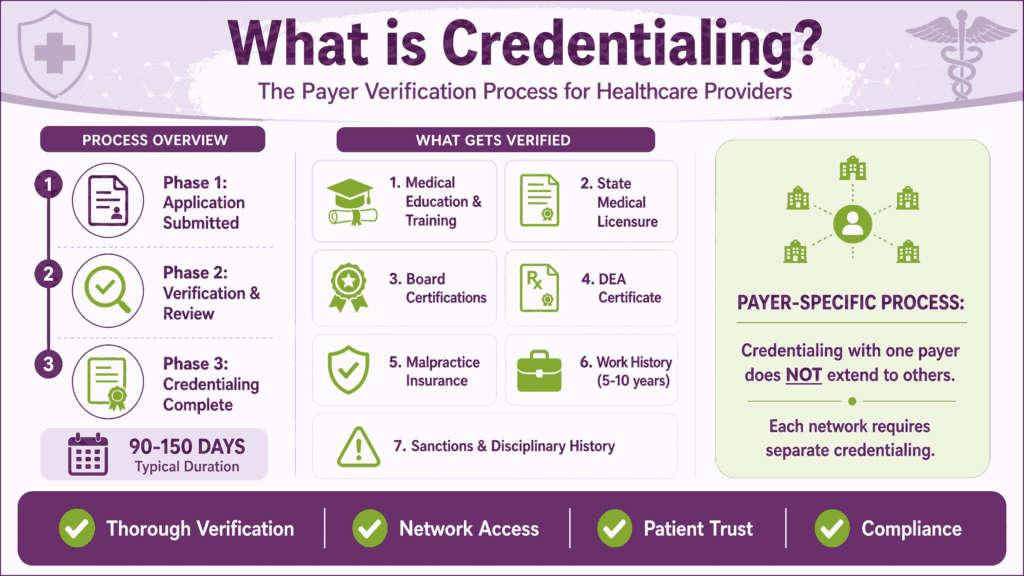
Credentialing is the process by which a health insurance payer verifies the qualifications, background, and professional history of a provider before allowing them to participate in that payer’s network. Think of it as a background check, but far more detailed and far more consequential.
When a provider applies to join a payer network, the payer collects and verifies information across multiple categories. This is not a rubber stamp. Payers are assessing whether a provider meets the clinical and ethical standards they require of in-network physicians.
What Credentialing Verifies
- Medical education and training, including medical school, residency, and fellowship records.
- State medical licensure, including current status and any history of disciplinary action.
- Board certifications relevant to the provider’s specialty.
- Drug Enforcement Administration (DEA) certificate for prescribing controlled substances.
- Current malpractice insurance coverage, including carrier name and policy limits.
- Professional work history for the past five to ten years, depending on the payer.
- Any history of sanctions, exclusions, or disciplinary actions from state medical boards or federal programs.
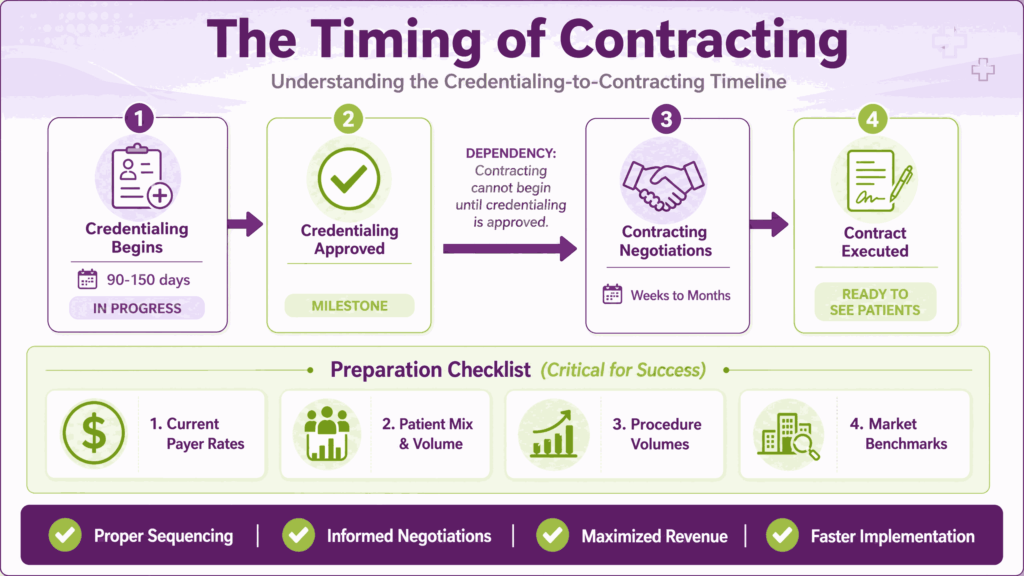
The verification does not happen quickly. Most payers take between 90 and 150 days to complete the credentialing process. Some take longer, especially when documentation is incomplete or when the provider has a history that requires additional review.
One thing providers often overlook is that credentialing is payer-specific. Being credentialed with one insurer does not automatically extend to another. If you want to join five different payer networks, you need to go through credentialing five separate times, with five separate applications and five separate timelines.
The Process of Credentialing
Most providers are surprised by how involved credentialing really is. It is not just about submitting a form and waiting. It is a structured verification process that payers take seriously, and so should you.
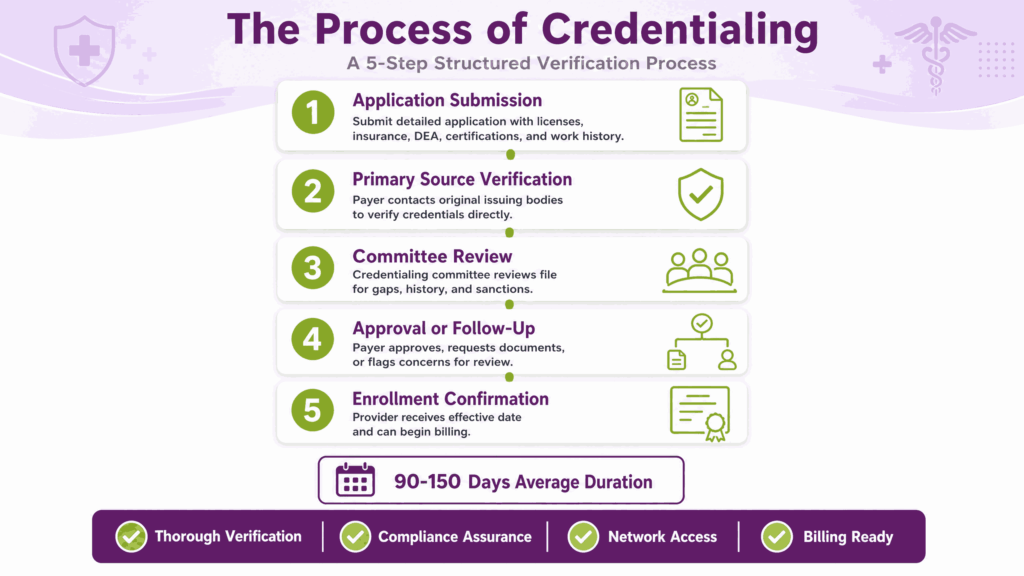
Step 1: Application Submission
The provider submits a detailed application to the payer, either directly or through CAQH ProView. This includes licenses, malpractice insurance, DEA certificates, board certifications, and work history.
Step 2: Primary Source Verification
The payer contacts the original issuing bodies directly. They verify your medical school, residency program, state licensing board, and malpractice carrier. Nothing is taken at face value.
Step 3: Committee Review
A credentialing committee reviews the compiled file. They look for gaps in employment, disciplinary history, malpractice claims, and sanction records from databases like the NPDB.
Step 4: Approval or Follow-Up
The payer either approves the application, requests additional documentation, or flags concerns for further review. Missing a single document can pause everything.
Step 5: Enrollment Confirmation
Once approved, the provider receives an effective participation date. Billing can begin from that date forward. The entire process takes 90 to 150 days on average. Practices that start credentialing after a provider is hired often absorb 60 to 90 days of zero reimbursement. That is revenue you cannot recover. Begin the application before your provider sees their first patient.
The Role of CAQH
The Council for Affordable Quality Healthcare (CAQH) Provider Data Portal, formerly known as CAQH ProView, is designed specifically to reduce the redundancy of credentialing across multiple payers. Providers enter their professional information once into the centralized digital portal, allowing participating payers to access that data directly for initial credentialing and re-credentialing reviews.
As of 2026, the system manages over 4.8 million provider records and is used by over 1,000 health plans, hospitals, and other healthcare entities. Maintaining an up-to-date profile is critical for a smooth administrative experience, as roughly 80% of U.S. physicians now rely on CAQH to share their data with insurers. Outdated information remains a leading cause of credentialing delays, often resulting in “Expired” status if the mandatory 90-to-120-day attestation is missed.
Do You Need Help With Credentialing or Contracting?
Transcure handles both ends of the process, so your practice gets enrolled, contracted, and paid, without the administrative headache. Whether you are starting from scratch or cleaning up a messy payer relationship, the team at Transcure has the expertise to move things forward.

What is Contracting?
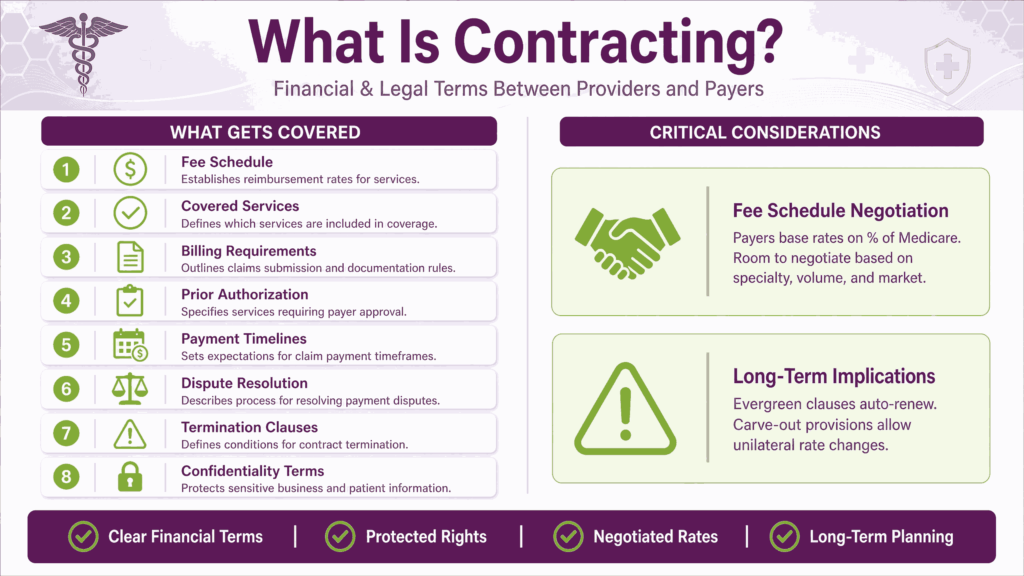
If credentialing is about proving you are qualified to see patients under a payer’s plan, contracting is about agreeing on the financial and legal terms that govern that relationship. Contracting is the negotiation and execution of a formal agreement between a provider and an insurance company, outlining reimbursement rates, billing requirements, covered services, dispute resolution procedures, and termination clauses.
Many providers make the mistake of treating contracting as a formality that follows credentialing. It is not. The contract you sign with a payer will determine how much revenue your practice generates for every single claim you submit, often for years.
What a Provider Contract Covers
- Fee schedule: the agreed reimbursement rate for each CPT code or service category billed by your practice
- Covered services: which procedures and treatments the payer will reimburse in-network
- Billing and claims submission requirements specific to that payer
- Prior authorization requirements by service type
- Payment timelines and dispute resolution procedures
- Termination clauses, including how much notice either party must provide
- Non-discrimination provisions and patient access requirements
- Confidentiality terms around the fee schedule itself
The fee schedule is where most of the negotiating power lives. Payers often present an initial fee schedule based on a percentage of Medicare rates, and many providers accept it without question. That is a significant mistake. Depending on your specialty, patient volume, and geographic market, there may be real room to negotiate rates upward, especially if you are bringing a large panel of patients or operating in an underserved area.
Contracting also involves understanding what you are agreeing to in the long term. Many contracts include evergreen clauses, meaning they renew automatically without any notice to you. Moreover, the carve-out provisions mean specific services or procedures are excluded from your standard rate agreement. This allows the payer to modify reimbursement unilaterally with limited advance notice.
What is the Process of Contracting
Once a payer approves your credentialing application, the real financial conversation begins. Here is how the contracting process actually unfolds, step by step.
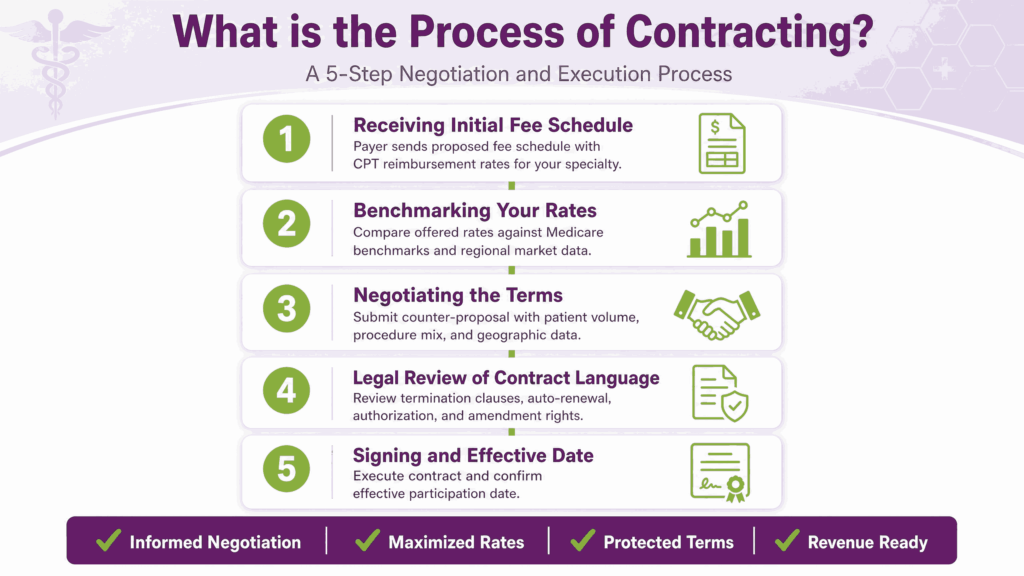
Step 1: Receiving the Initial Fee Schedule
The payer sends over a proposed fee schedule listing reimbursement rates for CPT codes relevant to your specialty. Most providers review it and sign. That is exactly where the revenue loss begins, quietly, before a single claim is submitted.
Step 2: Benchmarking Your Rates
Before responding, compare the offered rates against Medicare Fee Schedule benchmarks and regional market data for your specialty. If the payer is offering 90 percent of Medicare and the market standard is 115 percent, you have room to push back.
Step 3: Negotiating the Terms
Submit a counter-proposal with supporting data, your patient volume, procedure mix, and geographic need. Payers negotiate more than most providers realize.
Step 4: Legal Review of Contract Language
Beyond rates, review termination clauses, auto-renewal terms, prior authorization requirements, and unilateral amendment rights. What is buried in the language often matters as much as the numbers.
Step 5: Signing and Effective Date Confirmation
Once both parties agree, the contract is executed, and an effective participation date is confirmed.
The Timing of Contracting
Contracting cannot begin until credentialing is approved. The payer will not execute a financial agreement with a provider it has not yet verified. This is a dependency that catches many new practices off guard. A provider who expects to begin seeing insured patients on a specific date must account for the full credentialing timeline before any contracting conversation can even start.
Once credentialing is approved, contracting negotiations can move relatively quickly, but only if the provider is prepared with the right information. Coming to a contracting discussion without knowledge of your current payer rates, your patient mix, your procedure volumes, or the market benchmarks for your specialty leaves money on the table.
Credentialing vs. Contracting: A Side-by-Side Comparison
The table below maps out the key differences between credentialing and contracting across the dimensions that matter most to providers, billing departments, and practice administrators.
| Category | Credentialing | Contracting |
|---|---|---|
| Definition | Verification of a provider’s identity, education, licensure, and clinical history by a payer | The negotiation and execution of a formal payment agreement between a provider and a payer |
| Primary Goal | Establish that the provider is qualified and trustworthy to treat patients | Define the financial and legal terms under which the provider will be reimbursed |
| Who Initiates | The provider or credentialing service submits an application to the payer | The provider or billing team negotiates rates and terms with the payer |
| Timeline | Typically, 90 to 150 days depending on the payer and specialty | Varies widely; can take 30 to 90 days after credentialing is complete |
| Documents Involved | Medical licenses, malpractice insurance, DEA certificate, board certifications, work history | Proposed fee schedules, practice profile, claim submission data, negotiation correspondence |
| Outcome | Provider is approved to see patients under that payer’s plan | The provider receives an agreed-upon reimbursement rate for listed services |
| Dependency | Must be completed before contracting can begin | Cannot begin until credentialing is approved in most cases |
| Renewal Required | Yes, typically every two to three years per payer | Yes, contracts are reviewed and renegotiated periodically |
| Impact on Revenue | Delays in credentialing directly block billing and reimbursement | Poor contract terms directly reduce the amount reimbursed per claim |
| Common Mistakes | Incomplete applications, outdated documents, missed re-credentialing deadlines | Accepting default rates without negotiation, missing contract renewal windows |
| Managed by | Credentialing specialists, medical staff offices, or outsourced services | Billing managers, practice administrators, or revenue cycle consultants |
The table makes the differences clear. What it cannot fully show is how these two processes depend on each other in ways that directly affect your cash flow. That is where things get more nuanced.
Where the Two Processes Intersect
Even though credentialing and contracting are distinct processes, they are not entirely separate. Several points of overlap create dependencies that can either protect your practice or expose it to unnecessary risk.
Re-credentialing and Contract Renewal
Most payers require providers to re-credential every two to three years. Many payers also review and renegotiate contracts on a similar cycle. If your re-credentialing falls through because of an expired license, lapsed malpractice coverage, or a missed re-attestation deadline, your contract may be suspended or terminated. The revenue consequences are immediate.
Tracking both cycles simultaneously is not optional for a practice that wants to maintain stable payer relationships. A credentialing deadline missed by 30 days can trigger a lapse that takes months to resolve.
Delegated Credentialing
Some large hospital systems and group practices have what is called delegated credentialing authority. This means the payer has formally delegated the credentialing review process to the organization itself, rather than conducting it independently.
When delegated credentialing applies, the contracting relationship is often pre-established at the group level, and individual providers are enrolled under an existing agreement. Understanding whether your practice qualifies for delegated credentialing can compress timelines significantly.
Temporary Privileges and Gap Billing
Some payers offer provisional or temporary participation status to providers whose credentialing application is still under review. This matters because a provider who is provisionally credentialed but not yet contracted has no legal reimbursement agreement in place. Claims submitted during this window may be processed at out-of-network rates or rejected entirely, depending on the payer.
Gap billing provisions in some contracts address this scenario by allowing backdated claims once full participation is confirmed. Not all payers offer this. Knowing which payers allow it before you start seeing patients can prevent a costly billing gap. Coordinating with your medical billing services team early is essential to ensure these specific claims are held and submitted only after the provider’s active network status is finalized.
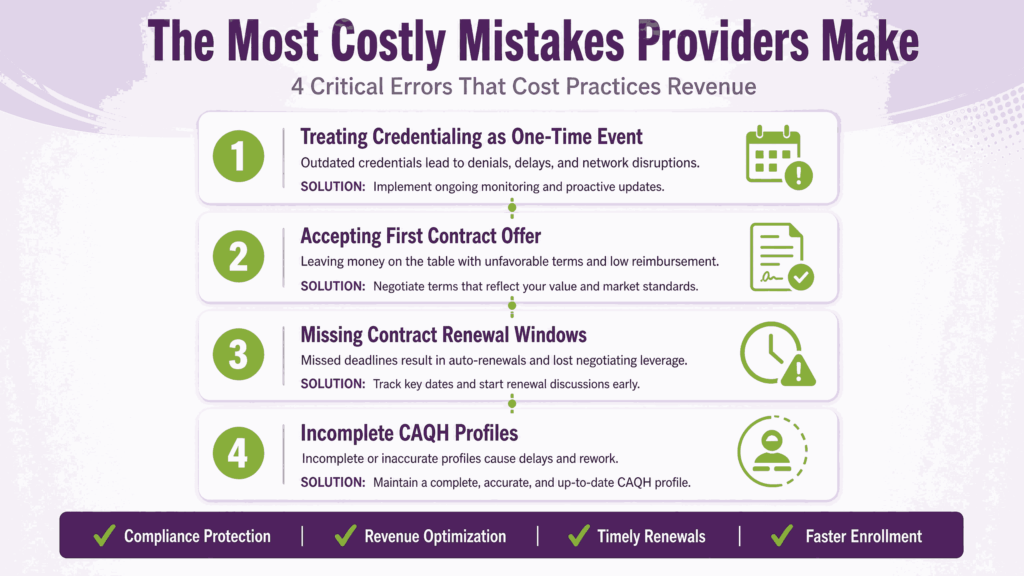
The Most Costly Mistakes Providers Make
After years of working in revenue cycle management, the same patterns come up repeatedly. These are the mistakes that cost practices the most.
1. Treating Credentialing as a One-Time Event
Credentialing is not something you complete once and forget about. Licenses expire. Malpractice policies renew on fixed cycles, and missing one renewal window can trigger a network suspension. Board certifications have maintenance requirements.
A provider who lets any of these lapse while actively seeing patients under a payer’s plan creates a compliance problem. This can result in clawbacks, claim denials, and, in serious cases, exclusion from the network. The solution is a credentialing calendar, a tracking system that maps every expiration date across every payer and every credential element, with alerts set 90 days in advance.
2. Accepting the First Contract Offer
Payers are not required to offer their best rates upfront. The initial fee schedule a payer presents is a starting point, not a final offer. Providers who sign without negotiating typically leave 10 to 30 percent in additional reimbursement on the table, based on benchmarking data from revenue cycle consulting firms.
Before entering any contracting discussion, pull your procedure volume reports, understand your current average reimbursement rates, and compare them against Medicare Fee Schedule benchmarks and regional market data. That preparation is what turns a standard contract into a favorable one.
3. Missing Contract Renewal Windows
Contracts often include very specific windows during which a provider can request renegotiation. Miss that window, and the contract auto-renews on the payer’s terms. This is especially problematic when a payer has adjusted its fee schedule downward, and the provider had no opportunity to object because the renewal window passed unnoticed.
Assign someone specific responsibility for monitoring contract renewal dates. If your practice does not have the administrative bandwidth for this internally, outsourcing the ongoing management to one of the best credentialing companies is a highly defensible investment to protect your negotiated rates from quietly decaying.
4. Incomplete or Inaccurate CAQH Profiles
A CAQH profile with outdated information, or one that has never been completed properly, is the single most common source of credentialing delays. Providers who have not re-attested their CAQH data in the required quarterly window often discover the problem only after an application has already been rejected or stalled.
Check your CAQH profile before beginning any new payer enrollment. Verify that all licenses, certifications, insurance documents, and work history entries are current and accurate.
When to Outsource Credentialing and Contracting
The honest answer is that most practices benefit from professional help with at least one of these two processes. The question is which one, and when.
Signs You Need Credentialing Support
- Your practice is enrolling providers with five or more payers simultaneously.
- You have experienced repeated credentialing delays without a clear explanation.
- A provider’s CAQH profile has not been updated in more than six months.
- You are onboarding a new provider who needs to see patients within 90 days.
- You do not have a dedicated credentialing coordinator on staff.
When these administrative bottlenecks begin to stall your onboarding pipeline, partnering with established professional credentialing services can compress primary source verification timelines and get your providers revenue-ready faster.
Signs You Need Contracting Support
- You have never compared your current fee schedules against Medicare benchmarks.
- You are approaching a contract renewal date and have not reviewed the terms.
- A payer has notified you of a unilateral rate adjustment, and you are not sure how to respond.
- Your practice has grown significantly, and your contracts no longer reflect your volume or specialty mix.
- You are entering a new specialty or adding a new service line that is not covered in your existing contracts.
Building a System That Protects Your Practice
Credentialing and contracting are not just administrative boxes to check. They are the foundation of your practice’s financial relationship with every payer you accept. A weak credentialing process exposes you to billing gaps. A poorly negotiated contract locks you into below-market rates for years. Both outcomes hurt your patients because a practice under financial pressure is a practice that cannot invest in the staff, equipment, and services that deliver good care.
The practices that handle this well are not the ones with the largest administrative teams. They are the ones where someone owns the process completely. Credentialing is treated as an ongoing responsibility with real deadlines. Contracting is approached as a revenue decision, not a signature formality. That mindset shift is what separates practices that grow from ones that quietly bleed revenue every month.
Whether you manage these processes internally or work with a partner like Transcure to take them off your plate, the critical thing is that someone owns them. Leaving credentialing and contracting to chance is how practices end up with denied claims, lapsed credentials, and contracts that undervalue the care they deliver every single day.