
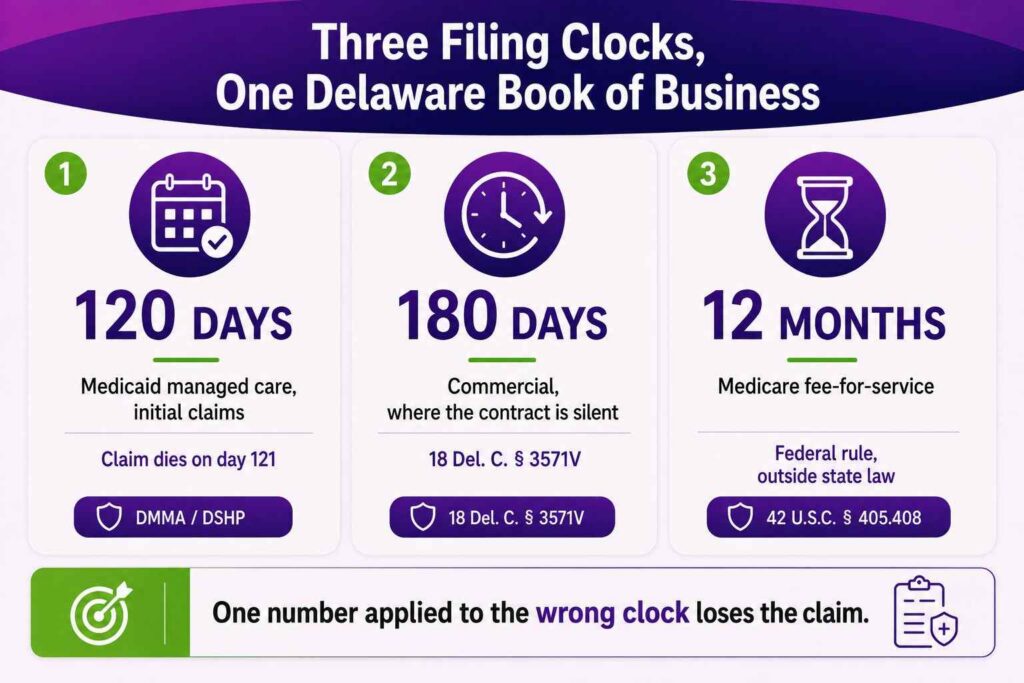
Delaware guarantees providers at least 180 days from the date of service to file a claim. The guarantee sits in 18 Del. C. § 3571V for group and blanket coverage and in 18 Del. C. § 3370C for individually issued policies. Both bind insurance carriers. Neither reaches Delaware Medicaid managed care.
That gap decides which claims get paid. Delaware’s Medicaid plans accept initial claims for 120 days, not 180. A practice applying the statutory number to a Medicaid claim loses the claim on day 121.
A Delaware billing team therefore tracks three separate filing clocks at once: 120 days for Medicaid managed care initial claims, 180 days for commercial claims when the payer contract is silent, and 12 months for Medicare claims under federal rules.
This guide covers the statute and what it binds, the current filing window for every major Delaware payer, the separate corrected claim and appeal deadlines, and the workflow that keeps claims inside all three windows.
What Is the Timely Filing Limit in Delaware?
The timely filing limit in Delaware is at least 180 days from the date of service. That floor comes from 18 Del. C. § 3571V, and network status does not change it.
The statute binds carriers operating under Title 18 of the Delaware Code. Coverage extends to insurance companies, health service corporations, managed care organizations, and third-party administrators that adjust or settle health claims.
Four categories of coverage sit outside the 180-day floor:
- Medicare, Medicaid, and CHIP. Section 3571V(a)(2) writes them out by definition. The statute’s “carrier” excludes any entity issuing coverage under Titles XVIII, XIX, or XXI of the Social Security Act. This is a definitional exclusion, not an inference from which agency administers the contract.
- Self-funded ERISA plans. The plan document controls the filing window, and ERISA preempts state insurance regulation of the plan itself.
Scope matters more in Delaware than in a larger state. The commercial market here is concentrated, so a single payer manual governs most of a typical practice’s book of business. One misread contract clause moves a large share of revenue.
Section 3571V is one of eleven active statutes and regulations governing provider billing in the state. Our guide to Delaware medical billing laws covers the full set, including the 12-month overpayment recovery limit under 18 Del. C. § 2730(c), shortened from 24 months effective September 3, 2025, and the arbitration tracks.
Why Delaware’s 180 Days Is a Floor and Not a Deadline
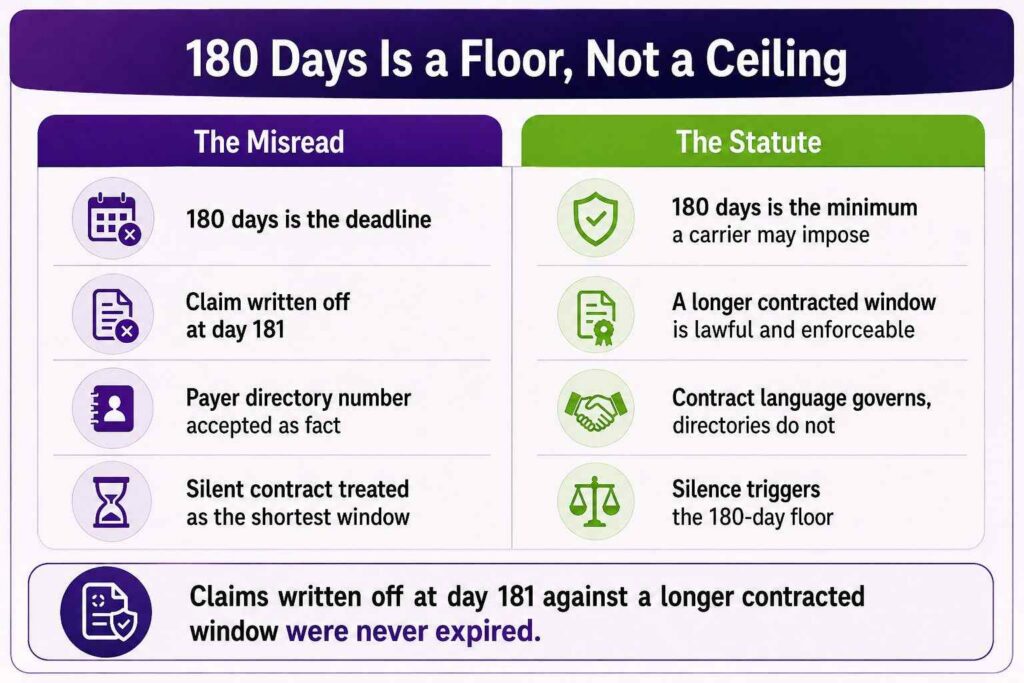
Section 3571V sets a minimum a carrier must allow. Nothing in it caps how long a contract may run. The statute separately confirms that a contract capping submission at exactly 180 days is not a violation.
This is the most expensive misread in Delaware billing. A practice treating 180 days as a hard stop writes off claims it still had the legal right to file.
Read the statute this way: 180 days is the shortest window any Delaware carrier may impose, not the window every carrier imposes.
Three actions follow from that reading:
- Read the filing window in every payer contract line by line. Record the contracted number by payer and product.
- Default to 180 days only where the contract is silent. Silence triggers the statutory floor, not a shorter internal assumption.
- Audit closed claims for premature write-offs. Any claim written off at day 181 against a longer contracted window is recoverable.
The misread has a documented source. Third-party payer directories publish one national number per payer and miss state-level variation. Several currently list Highmark Delaware at 365 days. The Highmark provider manual sets 180 days in Delaware where the contract is silent, and 365 days in Pennsylvania and West Virginia.
The inverse failure costs more. A practice assuming 180 days on a Medicaid managed care claim has already lost that claim at day 121.
Delaware Timely Filing Limits by Payer in 2026
Delaware’s three Medicaid managed care plans accept initial claims for 120 days. Commercial claims default to 180 days where the contract is silent. Medicare runs 12 months.
The table below carries the published windows for the payers that make up most Delaware claim volume. Contract terms override the default where a contract states one.
| Payer | Line of business | Initial claim | Corrected claim | Provider appeal |
|---|---|---|---|---|
| Highmark Blue Cross Blue Shield Delaware | Commercial | Per contract; 180 days from DOS where silent | 455 days from original claim finalization, effective Sept. 1, 2026 | 180 days from receipt of denial notice |
| Highmark Health Options | Medicaid MCO | 120 days from DOS | Per provider manual | Per provider manual |
| AmeriHealth Caritas Delaware | Medicaid MCO | 120 days from DOS | 365 days from DOS | Complaint: later of 12 months from DOS or 60 days from payment, denial, or recoupment |
| Delaware First Health | Medicaid MCO | 120 days from DOS | Per billing manual | Per billing manual |
| Medicare (Novitas Jurisdiction L) | Medicare FFS | 12 months from DOS | Reopening rules apply | 120 days for redetermination |
Highmark Blue Cross Blue Shield Delaware
The contract governs first. Where a Highmark contract does not state a filing window, the manual applies 180 days from the date of service in Delaware.
The same manual applies 365 days from the last date of service in Pennsylvania and West Virginia. One payer, one contract template, two different defaults. That contrast is the cleanest evidence that state-level reading is required.
Secondary claims follow a separate rule. Highmark applies the same window it applies in the primary position. The clock runs from the primary payer’s finalized or payment date shown on the attached Explanation of Benefits, not from the date of service.
Highmark Health Options
Highmark Health Options is the Medicaid managed care affiliate of Highmark Blue Cross Blue Shield Delaware. Its published claim submission guidance sets 120 days from the date of service.
Two structural points matter for a Delaware billing team:
- Health Options claims must not be routed to Highmark Delaware. Misrouted claims deny and require resubmission, which burns days against a 120-day clock.
- Highmark Health Options Duals is a separate Dual Eligible Special Needs Plan operating in New Castle, Kent, and Sussex counties. It carries its own provider manual and its own timelines.
Confirm the current window against the active Highmark Health Options provider manual before configuring aging rules, since MCO contract terms are renegotiated with the state.
AmeriHealth Caritas Delaware
AmeriHealth Caritas Delaware accepts initial claims for 120 days from the date of service. Resubmissions and corrections carry a far longer 365-day window from the date of service.
That split is worth building around. A denied AmeriHealth claim has substantially more remaining life than a denied claim at a plan with a matching initial and corrected window.
The provider complaint deadline uses a “later of” construction. A provider may file within 12 months from the date of service, or within 60 calendar days after payment, denial, or recoupment of a timely claim, whichever falls later.
Delaware First Health
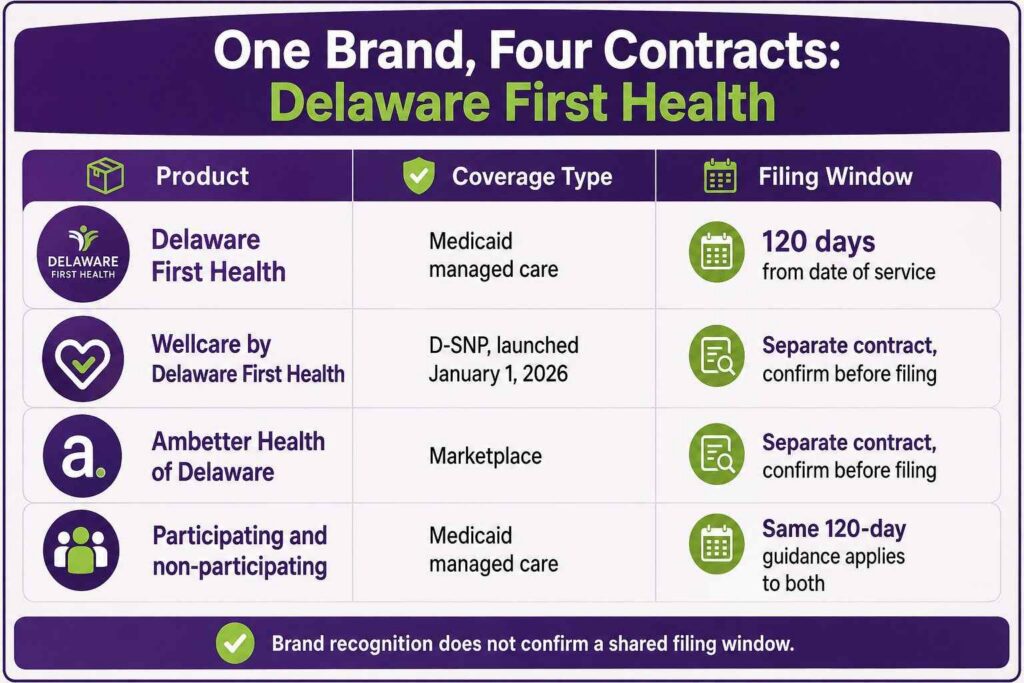
Delaware First Health sets timely filing at 120 days from the date of service. The plan applies the same guidance to participating and non-participating providers.
Delaware First Health operates several product lines under one brand. Medicaid, the Wellcare by Delaware First Health D-SNP launched January 1, 2026, and Ambetter marketplace coverage sit under separate contracts. Brand recognition does not confirm a shared filing window.
Medicare and Novitas Jurisdiction L
Medicare fee-for-service claims for Delaware providers route to Novitas Solutions as the Jurisdiction L Medicare Administrative Contractor. Federal rule sets the filing window at 12 months from the date of service.
State law does not reach Medicare claims. Section 3571V has no application here, and no Delaware contract term can shorten the federal window.
Medicare-heavy specialties underestimate their commercial exposure for this reason. A cardiology or orthopedic practice accustomed to a 12-month runway carries the same 120-day Medicaid exposure as a pediatric practice.

Why Delaware Medicaid Plans File at 120 Days and Not 180
Section 3571V sits in Title 18, the Delaware insurance code. Delaware Medicaid managed care contracts are administered through the Department of Health and Social Services. The 180-day floor does not reach them.
Federal rule sets the outer boundary for Medicaid claim submission at 12 months from the date of service. States retain discretion below that ceiling, and Delaware’s managed care contracts sit at 120 days.
The practical exposure is worse than the raw numbers suggest:
- A Medicaid claim sitting 90 days in a work queue has consumed 75% of its window, not 50%
- A denial requiring clinical documentation can exhaust the remaining 30 days on documentation retrieval alone
- A misrouted claim between Highmark entities spends days in transit that the clock does not return
Which Delaware Practices Carry the Most Exposure
Delaware Medicaid covers a large share of the state’s pediatric, behavioral health, and obstetric volume. Practices in those specialties run the tightest windows in the state.
| Specialty | Typical Delaware Medicaid mix | Practical filing window |
|---|---|---|
| Pediatrics and EPSDT | High | 120 days |
| Behavioral health and substance use | High | 120 days |
| Obstetrics and maternity | High | 120 days |
| Primary care | Moderate | Mixed 120 and 180 days |
| Cardiology and orthopedics | Lower | Mixed 180 days and 12 months |
A Worked Delaware Medicaid Timeline
The compression is easier to see against dates. This example follows one Delaware First Health claim with a March 2, 2026 date of service.
| Event | Date | Days elapsed | Window remaining |
|---|---|---|---|
| Date of service | March 2, 2026 | 0 | 120 days |
| Documentation completed and coded | March 20, 2026 | 18 | 102 days |
| Claim submitted | April 6, 2026 | 35 | 85 days |
| Claim denied for missing authorization | May 8, 2026 | 67 | 53 days |
| Denial worked and records retrieved | June 15, 2026 | 105 | 15 days |
| Filing window closes | June 30, 2026 | 120 | 0 |
Nothing in that sequence looks unusual. A 35-day lag to submission, a 32-day payer turnaround, and a 38-day denial work cycle are all common. The claim still finishes with 15 days to spare, and a single additional handoff kills it.
The workflow consequence is direct. Medicaid claims cannot share an aging schedule with commercial claims. A single escalation trigger set for a 180-day book will fire 60 days too late on the Medicaid side.
How Delaware Compares to Pennsylvania and West Virginia
Delaware’s commercial default is half the default that applies in Pennsylvania and West Virginia. The comparison holds within a single payer, which is what makes it usable.
| State | Default filing window where the contract is silent |
|---|---|
| Delaware | 180 days from the date of service |
| Pennsylvania | 365 days from the last date of service |
| West Virginia | 365 days from the last date of service |
Highmark publishes all three defaults in the same provider manual. The contrast is not a comparison between two different insurers with different policies. It is one insurer applying different state rules.
Multi-state groups in the Delaware Valley feel this most. A Wilmington practice with a satellite location across the Pennsylvania line runs two filing windows against one payer and one contract template. The Delaware side closes first, and by a wide margin.
What Are the Corrected Claim and Appeal Deadlines in Delaware?
Corrected claims and appeals run on separate clocks from the initial filing window. A claim filed on time can still die if the correction or the appeal misses its own deadline.
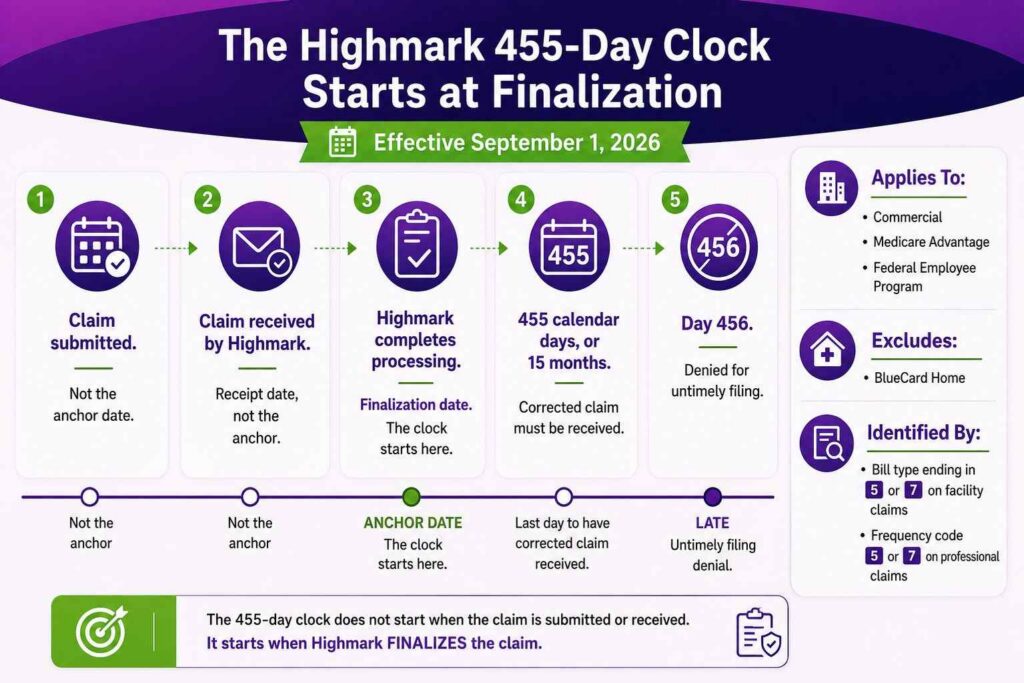
One change lands almost immediately. Highmark corrected claims must be received within 15 months, or 455 calendar days, from the finalization date of the original claim. The rule takes effect September 1, 2026.
What the Highmark Corrected Claim Change Covers
The policy applies to Commercial, Medicare Advantage, and Federal Employee Program claims. It excludes corrected claims for BlueCard Home.
Corrected claims are identified by two markers:
- Bill type ending in 5 or 7 on facility claims
- Frequency code 5 or 7 on professional claims
The date that starts the clock is the trap. Finalization is the date Highmark completed processing the original claim. It is not the receipt date, and it is not the date of service. Practices measuring from the wrong anchor will generate avoidable denials.
Appeal Windows Across Delaware Payers
Appeal deadlines vary more than filing deadlines, and one Delaware product runs far shorter than the rest.
| Payer or product | Provider appeal or complaint window |
|---|---|
| Highmark Delaware, all service areas | 180 days from receipt of the denial notification |
| AmeriHealth Caritas Delaware | Later of 12 months from DOS or 60 days from payment, denial, or recoupment |
| Medicare, Novitas Jurisdiction L | 120 days from the initial determination for redetermination |
Delaware’s CHIP program is the Delaware Healthy Children Program, and it is delivered through the same three managed care organizations that administer Medicaid. A DHCP claim therefore carries the enrolling MCO’s window, not a separate CHIP window. Practices migrating from Pennsylvania should note that Highmark Healthy Kids is a Pennsylvania-only product with its own 180-day filing and 60-day appeal rules, and none of it applies to a Delaware claim.
How Coordination of Benefits Compresses the Delaware Filing Window
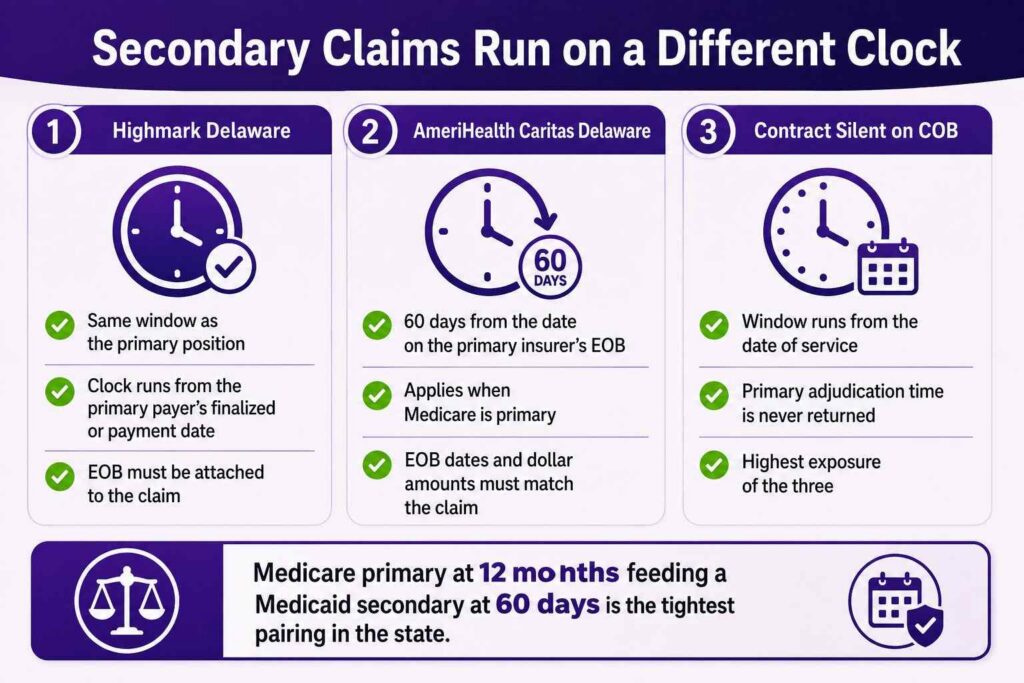
Secondary claims cannot be filed until the primary payer adjudicates. On a 120-day or 180-day window, primary adjudication can consume most of the clock before the secondary claim is even submittable.
Highmark handles this in the provider’s favor. Secondary claims carry the same window as primary claims, but the clock runs from the primary payer’s finalized or payment date shown on the attached Explanation of Benefits.
Not every Delaware payer grants that protection. Where the contract is silent on coordination of benefits, the window runs from the date of service regardless of how long the primary payer takes.
When the Clock Starts Over
Delaware First Health documents three conditions that reset or shift the filing clock:
- Third-party pursuit. The window begins on the date the third party documented resolution of the claim.
- Retroactive eligibility. The window begins on the date the plan receives notification of the member’s eligibility from the state.
- Weekend and holiday rollover. Where a deadline falls on a weekend or holiday, the next business day is treated as the operative date.
The highest-risk combination in Delaware pairs a 12-month primary window with a 120-day secondary window. Medicare primary feeding Medicaid secondary produces exactly that pairing.
Coordination of benefits claims therefore need a third aging schedule. Tracking them alongside primary commercial claims hides the compression until the claim is already dead.
What Happens When a Delaware Payer Denies for Timely Filing?
A timely filing denial is challengeable when the claim was filed inside 180 days, the payer is a Delaware carrier, and the contract does not state a shorter window. Section 3571V cannot be contracted below.
The argument is narrow but strong. A carrier applying a sub-180-day window to a Delaware commercial claim with a silent contract is applying a window the statute forbids.
What Proof of Timely Submission Requires
Payer-side records rarely settle the question. Build the evidence file from your own systems:
- Clearinghouse acknowledgment reports showing the original submission date
- 277CA claim acknowledgment transactions confirming payer receipt
- Date-stamped submission logs from the practice management system
- The original claim control number tied to the resubmission
Where the Statutory Argument Does Not Work
Three claim types fall outside § 3571V, and the argument fails on all three:
- Medicaid managed care claims. The contract window governs, and 120 days is enforceable.
- Self-funded ERISA plan claims. The plan document controls the filing window.
- Medicare claims. Federal rule governs, and the MAC applies it.
The Escalation Path
Internal reconsideration comes first. Where the carrier issues a final decision that does not authorize the full charge, Delaware provides a statutory arbitration route through the Department of Insurance under Regulation 1313. The filing window is 60 days from that final decision.
One consequence makes every lost timely filing denial expensive. Participating provider agreements in Delaware generally include hold-harmless language barring the provider from billing the member for a claim denied on late submission, and Medicaid rules bar it outright. Confirm the clause in your own contract, because a lost timely filing denial is usually a complete write-off, not a balance transfer.
How to Build a Delaware Timely Filing Workflow That Does Not Leak
Delaware timely filing is a date-tracking problem before it is a knowledge problem. The build requires three aging schedules, three escalation triggers, and a contract window register.
The Contract Window Register
Record the filing window for every payer and product in your book. Populate it from contract language, not from payer directories or industry summaries.
| Field | What to record |
|---|---|
| Payer and product | Entity name plus line of business |
| Contracted filing window | Number of days stated in the contract |
| Default applied | 180 days where the contract is silent |
| Corrected claim window | Separate number, with the anchor date named |
| Appeal window | Separate number, measured from denial receipt |
The Three Aging Schedules
- Medicaid schedule. Window at 120 days, escalation trigger at day 75, hard stop review at day 100.
- Commercial schedule. Window at the contracted number, escalation at 60% elapsed, hard stop review at 80%.
- Coordination of benefits schedule. Keyed to the primary payer’s finalization date where the contract allows it, and to the date of service where it does not.
The Standing Controls
- Rebuild corrected claim tracking against the Highmark finalization-date anchor before September 1, 2026
- Retain clearinghouse acknowledgment reports as a standing evidence file, not a temporary one
- Flag Highmark Healthy Kids claims for the 60-day appeal window at the point of denial
- Route Highmark Health Options claims separately from Highmark Delaware claims to prevent misrouting
- Reconcile denial codes against submission dates quarterly to catch silent window changes
Transcure builds these controls into the Delaware revenue cycle management workflow, with AI agents ELIXA, CODIN, DEXA, and CLAIR handling eligibility, coding, denial routing, and claim status across the full payer mix.
Conclusion
Delaware runs three filing windows against one book of business. Medicaid managed care closes at 120 days, commercial defaults to 180 days where the contract is silent, and Medicare runs 12 months.
Two dates belong on the calendar now. Highmark’s corrected claim rule takes effect September 1, 2026, and lands directly in the fourth-quarter aging cycle. The recovery opportunity sits in the floor-versus-ceiling reading. Section 3571V sets a minimum, not a maximum, and claims written off at day 181 against a longer contracted window were never actually expired.
Frequently Asked Questions
What Is the Timely Filing Limit in Delaware?
Delaware carriers must allow at least 180 days from the date of service under 18 Del. C. § 3571V. Network status does not change the requirement. The number is a statutory minimum, so a payer contract may grant a longer window.
Does Delaware’s 180-Day Rule Apply to Medicaid Claims?
No. Section 3571V binds carriers under the Delaware insurance code, while Medicaid managed care runs on contracts administered through the Department of Health and Social Services. Delaware Medicaid plans accept initial claims for 120 days from the date of service.
What Is the Timely Filing Limit for Delaware First Health?
Delaware First Health sets timely filing at 120 days from the date of service. The guidance applies to participating and non-participating providers. Separate product lines under the same brand, including the Wellcare D-SNP and Ambetter coverage, operate under their own contracts.
How Long Does a Provider Have to Appeal a Highmark Delaware Denial?
Providers have 180 days from receipt of the denial notification across all Highmark service areas, including Delaware. Highmark Healthy Kids is the exception at 60 days. Expedited appeals follow the same filing windows as standard appeals.
Can a Delaware Payer Set a Filing Window Shorter Than 180 Days?
Not for claims governed by Title 18. A Delaware carrier must allow at least 180 days from the date of service. Medicaid managed care plans, self-funded ERISA plans, and Medicare all sit outside that requirement and may apply shorter windows.
When Do Highmark’s New Corrected Claim Rules Take Effect?
The rule takes effect September 1, 2026. Corrected claims must be received within 15 months, or 455 calendar days, from the finalization date of the original claim. The policy covers Commercial, Medicare Advantage, and Federal Employee Program claims, and excludes BlueCard Home.