
Medicare medical billing is the end-to-end revenue cycle management workflow for services rendered to Medicare beneficiaries under federal CMS rules. The workflow runs in six sequenced steps: eligibility verification, coding, claim submission, remittance posting, denial management, and appeals. Providers submit professional claims on the CMS-1500 form (electronic equivalent: EDI 837P) and institutional claims on the UB-04 / CMS-1450 (EDI 837I).
Original Medicare claims are adjudicated by Medicare Administrative Contractors (MACs); Medicare Advantage claims are adjudicated by the contracted Medicare Advantage Organization (MAO).

What is Medicare Medical Billing?
Medicare medical billing, the RCM workflow for services rendered to Medicare beneficiaries, follows CMS rules layered on standard medical billing practice. The Centers for Medicare & Medicaid Services (CMS) sets the program rules. Eligible providers submit claims for covered services to either a MAC (Original Medicare) or an MAO (Medicare Advantage).
Medicare medical billing differs from commercial billing in three concrete ways:
- Adjudicator Chain: Original Medicare uses MACs by jurisdiction; Medicare Advantage uses contracted private plans.
- Reimbursement Formula: Part B uses the Medicare Physician Fee Schedule (MPFS) with the (Work RVU + Practice Expense RVU + Malpractice RVU) × GPCI × Conversion Factor calculation.
- Compliance Overlay: Medicare adds the 12-month timely filing limit, the Advance Beneficiary Notice (ABN), and the five-level appeals process on top of standard claim mechanics.
Every Medicare claim line connects a CPT or HCPCS Level II procedure code to an ICD-10-CM diagnosis code that establishes medical necessity. Mis-linked codes drive denials with reason code CO-50 (medical necessity) or CO-97 (procedure bundled).
What Are the Four Parts of Medicare, and How Do They Affect Billing?
Medicare contains four parts that each affect billing differently. Each Medicare part has its own covered services, claim form, rate-setting system, and adjudicator. Providers map the service rendered to the correct Medicare part before the claim is built.
The following table compares the four Medicare parts across the four billing attributes that determine workflow:
| Medicare Part | Covered Services | Form / Transaction | Rate System | Adjudicator |
|---|---|---|---|---|
| Part A | Inpatient hospital, SNF, hospice, home health | UB-04 / CMS-1450 (EDI 837I) | MS-DRG (IPPS), PPS for SNF/HH | MAC (A/B MAC, Part A jurisdiction) |
| Part B | Physician services, outpatient hospital, DME, lab | CMS-1500 (EDI 837P); UB-04 for outpatient hospital | MPFS, OPPS / APC, ASC payment system, DMEPOS fee schedule | A/B MAC (Part B); DME MAC for DMEPOS |
| Part C (Medicare Advantage) | All Part A and Part B benefits delivered through a private plan | Plan-specific payer ID; CMS-1500 or UB-04; Payer-defined EDI | Plan-negotiated, contracts often referenced to MPFS | Contracted MAO (e.g., UnitedHealthcare, Humana) |
| Part D | Outpatient prescription drugs | NCPDP transactions at the point of sale | Plan formulary pricing | Pharmacy Benefit Manager (PBM) for the Part D plan |
Part B carries the highest claim volume for outpatient providers, surgery centers, and physician practices. Part A drives revenue for hospitals and post-acute facilities. Part C billing follows plan-specific rules that diverge from Original Medicare at the adjudicator, prior authorization, and appeal pathways. Part D rarely intersects provider RCM because adjudication occurs at the pharmacy.
How Does The Medicare Claim Submission Process Work?
The Medicare claim submission process has seven discrete steps, executed in sequence from patient encounter to remittance posting. Each step has a defined transaction format and a defined failure mode that drives downstream denials. The seven steps in order:
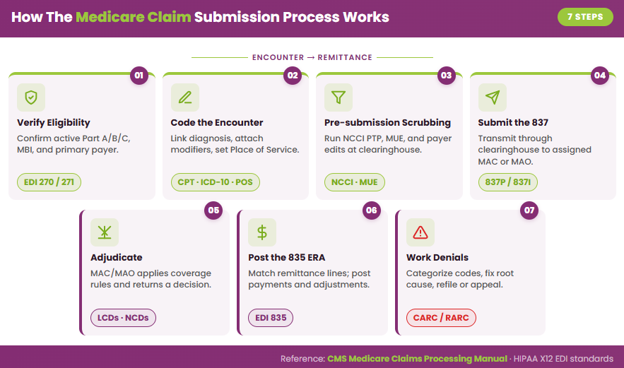
- Verify Eligibility: Submit an EDI 270 request and parse the 271 response for active Part A/B/C status, MBI validity, and other primary payer.
- Code the Encounter: Select the CPT or HCPCS Level II procedure code, link the ICD-10-CM diagnosis, attach modifiers, and assign the Place of Service (POS) code.
- Run Pre-submission Scrubbing: Apply NCCI Procedure-to-Procedure (PTP) edits, MUE (Medically Unlikely Edits), and payer-specific edits at the clearinghouse level.
- Submit the 837: Transmit EDI 837P (professional) or 837I (institutional) through a clearinghouse to the assigned MAC or contracted MAO.
- Adjudicate: The MAC or MAO applies coverage rules (LCDs, NCDs, plan policy) and returns a payment decision.
- Post the 835 ERA: Match the Electronic Remittance Advice line items to the original claim and post payments, adjustments, and patient responsibility.
- Work Denials: Categorize CARC and RARC denial codes, correct the root cause, and refile or escalate to the five-level appeals process.
Median end-to-end timing for a clean Part B claim runs 14 to 30 days from submission to 835 receipt. Practices that outsource your Medicare medical billing routinely report tighter timelines because dedicated denial-management teams catch front-end rejections at the clearinghouse before the claim reaches the MAC.
Moreover, Transcure’s AI billing agents run real-time eligibility checks, scrub claims before submission, and flag denial patterns before they reach the MAC.
What Forms are Used to Bill Medicare? (CMS-1500 vs UB-04)
Medicare uses two paper claim forms with two corresponding electronic transactions. Providers submit professional claims on the CMS-1500 (electronic equivalent: EDI 837P) and institutional claims on the UB-04 / CMS-1450 (electronic equivalent: EDI 837I). Submitting on the wrong form triggers immediate front-end rejection by the MAC.
Understanding what goes into a clean claim from the start reduces front-end rejections, so you should know what claims in medical billing are to avoid revenue loss. The following table shows the structural differences between the two Medicare claim forms:
| Feature | CMS-1500 | UB-04 / CMS-1450 |
|---|---|---|
| Claim type | Professional services | Institutional services |
| Electronic equivalent | EDI 837P | EDI 837I |
| Who uses it | Physicians, NPPs, ASCs (technical components), DME suppliers | Hospitals (inpatient and outpatient), SNFs, home health, hospices, dialysis facilities |
| Sample fields | Box 11d (other primary insurance), Box 17b (referring NPI), Box 24J (rendering provider NPI), Box 33a (billing provider NPI) | FL 4 (type of bill), FL 42 (revenue code), FL 44 (HCPCS/CPT), FL 67 (principal diagnosis) |
| Maintained by | NUCC (National Uniform Claim Committee) | NUBC (National Uniform Billing Committee) |
Provider type, not service type, drives form selection. A surgery center bills the technical component of a procedure on the CMS-1500 (or 837P), while a hospital bills the same procedure performed in its outpatient department on the UB-04 (or 837I). For field-level CMS-1500 completion, see the CMS-1500 form completion guide.
How Does Medicare Calculate Reimbursement Under The MPFS?
Medicare calculates the Part B Allowable amount as (Work RVU + Practice Expense RVU + Malpractice RVU) × GPCI × Conversion Factor. Medicare pays 80 percent of the allowable after the annual Part B deductible is met; the beneficiary or secondary payer covers the remaining 20 percent coinsurance. The four MPFS inputs and their sources:
| Component | Source | What It Captures | Updated By |
|---|---|---|---|
| Work RVU | CMS RVU file | Physician time, skill, and intensity for the service | Annual CY Final Rule |
| Practice Expense (PE) RVU | CMS RVU file | Direct and indirect overhead (staff, supplies, equipment); Split into facility and non-facility | Annual CY Final Rule + AMA RUC |
| Malpractice (MP) RVU | CMS RVU file | Professional liability insurance cost | Annual CY Final Rule |
| Geographic Practice Cost Index (GPCI) | Published by CMS, locality-based | Locality cost-of-practice variation | CY Final Rule (multi-year phase-in allowed) |
| Conversion Factor | Federal Register | Dollar multiplier that converts RVUs to payment | Annual CY Physician Fee Schedule Final Rule |
For CY 2026, CMS finalized two conversion factors for the first time: $33.40 for non-qualifying APM clinicians and $33.57 for qualifying APM participants (CY 2026 PFS Final Rule, CMS-1832-F, Federal Register, October 31, 2025). Both replaced the CY 2025 single CF of $32.35.
Worked Example: CPT 99213 (Established Patient Office Visit, Level 3)
National non-facility total RVU for 99213 is 2.55 (Work 1.30 + PE 1.16 + MP 0.09). Applying GPCI 1.000 (national, illustrative) × CF $33.40 produces a national Part B allowable of $85.17.
Locality GPCI shifts the allowable up or down by roughly 5 to 15 percent, depending on the MAC region. (CY 2026 RVUs, verify in the current CY Final Rule before publishing patient-facing fee estimates.)
Part A inpatient services pay under MS-DRG (IPPS), hospital outpatient services pay under OPPS / APC, and ambulatory surgery centers pay under the ASC payment system, not the MPFS. For locality-adjusted lookups, see the Medicare Physician Fee Schedule lookup.
Who Administers Medicare, and What Is The Role of MACS?
Medicare is administered by CMS, an agency of the Department of Health and Human Services (HHS), and operationalized through Medicare Administrative Contractors (MACs). CMS sets program rules, publishes the annual Final Rule, and maintains national policy. MACs adjudicate Original Medicare claims by jurisdiction.
For a deeper look at how CMS rules affect your practice’s revenue cycle, see Transcure’s CMS medical billing guide.
There are two MAC categories operating across defined geographic regions:
- A/B MACs processes Part A and Part B claims across 12 jurisdictions covering all 50 states and U.S. territories.
- DME MACs process DMEPOS claims across 4 regional jurisdictions (A, B, C, D).
- HH+H MACs process Home Health and Hospice claims as a sub-function within several A/B MAC contracts.
Providers enroll with the MAC for their primary service location through the Provider Enrollment, Chain & Ownership System (PECOS) and receive a National Provider Identifier (NPI) tied to that enrollment. The MAC, not CMS, issues the initial claim decision, processes the EDI 835 ERA, and handles Level 1 (Redetermination) appeals.
CMS retains rulemaking, audit oversight via Recovery Audit Contractors (RACs) and Unified Program Integrity Contractors (UPICs), and policy interpretation through MLN Matters articles. For jurisdiction lookup by state and provider type, see the MAC jurisdictions map.
What is the Medicare Timely Filing Limit And Appeals Process?
Medicare claims must be submitted within 12 months of the date of service. Claims filed beyond the 12-month window are denied with reason code CO-29 and are not appealable on timeliness grounds alone. The Medicare appeals process runs five sequential levels with statutory deadlines and Amount in Controversy (AIC) thresholds.
The five Medicare appeal levels:
| Level | Adjudicator | Deadline to File | AIC Threshold | Decision Timeline |
|---|---|---|---|---|
| Redetermination | MAC | 120 days from initial determination | None | 60 days |
| Reconsideration | Qualified Independent Contractor (QIC) | 180 days from the Redetermination notice | None | 60 days |
| ALJ Hearing | Office of Medicare Hearings and Appeals (OMHA) | 60 days from the Reconsideration notice | $190 (CY 2026, indexed) | 90 days (statutory) |
| Council Review | Medicare Appeals Council (DAB) | 60 days from ALJ decision | None | 90 days (statutory) |
| Federal District Court | U.S. District Court | 60 days from Council decision | $1,900 (CY 2026, indexed) | No statutory deadline |
AIC thresholds at Levels 3 and 5 are indexed annually and published in the Federal Register. (Verify the current CY AIC thresholds in the most recent Federal Register notice before filing.) Procedural depth on each level is covered in the Medicare appeals process step-by-step.
What is The Difference Between Original Medicare and Medicare Advantage Billing?
Provider workflow for Original Medicare and Medicare Advantage diverges at the adjudicator. Original Medicare claims are processed by MACs under uniform federal rules. Medicare Advantage claims are processed by contracted Medicare Advantage Organizations (MAOs) under plan-specific rules that override Original Medicare procedures.
The following table compares the two Medicare tracks across the seven attributes that change provider workflow:
| Feature | Original Medicare | Medicare Advantage (Part C) |
|---|---|---|
| Adjudicator | MAC (jurisdiction-assigned) | Contracted MAO (e.g., UnitedHealthcare, Humana, Aetna, BCBS plans) |
| Claim form | CMS-1500 (837P) or UB-04 (837I) | Plan-specified, usually CMS-1500 or UB-04 with plan payer ID |
| Prior authorization | Limited (defined services only) | Routine for imaging, surgery, DME, and post-acute care |
| ABN applicability | Yes (Original Medicare only) | No (replaced by NOMNC and plan-issued advance notices) |
| Appeal process | Five-level Medicare appeals process | Plan internal appeal, then external IRE, then ALJ, Council, Federal Court |
| Payer ID for EDI | MAC-specific | Plan-specific (in 835 setup) |
| Fee schedule basis | Published MPFS, OPPS, ASC, DMEPOS schedules | Plan-negotiated rates (often referenced to MPFS) |
Practices serving Medicare populations operate two distinct billing tracks in parallel. Roughly 54 percent of Medicare beneficiaries were enrolled in Medicare Advantage in 2024 (KFF analysis of CMS enrollment data, 2024).
For each contracted MAO, build a payer-specific edit set covering prior-auth requirements, modifier policies, and the plan appeal pathway. Operational depth on the Part C track lives in the Medicare Advantage billing rules.
What CPT, HCPCS, and ICD-10 Codes Are Required for Medicare Claims?
Medicare claims require three coordinated coding systems. CPT describes the procedure performed, HCPCS Level II covers DME, drugs, supplies, and non-physician services, and ICD-10-CM provides the medical-necessity link from diagnosis to procedure.
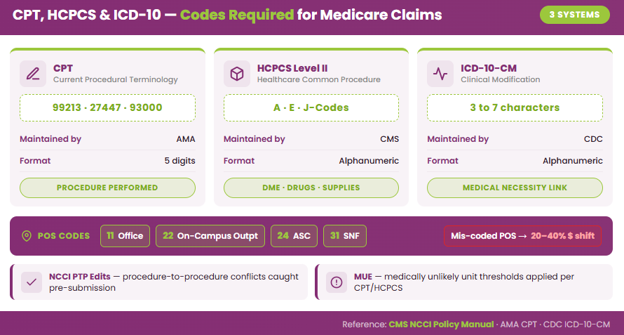
The three Medicare coding systems and their roles:
- CPT (Current Procedural Terminology): AMA-maintained 5-digit codes for physician and outpatient procedures (e.g., 99213, 27447, 93000).
- HCPCS Level II: CMS-maintained alphanumeric codes for items not in CPT, including DME (E-codes), drugs (J-codes), supplies (A-codes), and ambulance (A-codes).
- ICD-10-CM: CDC-maintained 3-to-7-character diagnosis codes that establish medical necessity for the billed procedure.
Place of Service (POS) codes (11 office, 22 on-campus outpatient hospital, 24 ASC, 31 SNF) attach to every CMS-1500 line and drive the facility vs non-facility PE RVU split. Mis-coded POS shifts reimbursement by 20 to 40 percent for the same CPT.
NCCI Procedure-to-Procedure (PTP) edits and MUE (Medically Unlikely Edits) are applied to every claim before MAC adjudication. Specialty-specific code families for Pain Management, Cardiology, Nephrology, OBGYN, Orthopedics, Primary Care, and Psychiatry are covered in Medicare CPT codes by specialty.
What Are NCCI Edits And How Do They Affect Medicare Claim Acceptance?
The National Correct Coding Initiative (NCCI), CMS’s editing system that prevents improper unbundling, reviews every Medicare claim for paired CPT codes. NCCI Procedure-to-Procedure (PTP) edits flag CPT pairs that should not be billed together unless modifier -59 (or X-modifier XE/XS/XP/XU) is appropriate.
NCCI has two component editing tables:
- PTP edits identify code pairs that bundle, with a Modifier Indicator (0 = no bypass allowed; 1 = bypass allowed with -59 / X-modifier).
- MUE (Medically Unlikely Edits) caps the number of units of a single CPT or HCPCS code billable per beneficiary per date of service.
CMS updates the NCCI tables quarterly and publishes the NCCI Policy Manual annually (cms.gov/ncci). PTP failures return CARC code CO-97 (procedure bundled). MUE failures return CO-151 (units exceed allowable). Misuse of modifier -59 to override valid bundling is a top RAC and UPIC audit target.
What Medicare Modifiers Do Providers Need to Know?
Ten Medicare modifiers drive most reimbursement and denial outcomes. Each modifier has a defined NCCI implication. Misapplied modifiers either trigger CO-97 / CO-151 denials or open the practice to refund liability under the False Claims Act.
The following table summarises the ten high-impact Medicare modifiers and their use case:
| Modifier | Use Case |
|---|---|
| -25 | Significant, separately identifiable E/M service on the same day as another procedure (e.g., 99213-25 with 20610). |
| -26 | Professional component only (radiology, pathology) when a facility bills the technical component. |
| -57 | Decision-for-surgery E/M during the global period preceding a major procedure. |
| -59 / -XE / -XS / -XP / -XU | Distinct procedural service that legitimately bypasses an NCCI PTP bundle. |
| -76 | Repeat procedure by the same physician on the same day. |
| -77 | Repeat procedure by a different physician on the same day. |
| -GA | Signed ABN on file; expected denial billed to the beneficiary if Medicare denies. |
| -GX | Voluntary ABN issued for a statutorily excluded service. |
| -GY | Statutorily excluded service; not a Medicare benefit. |
| -GZ | Item or service expected to be denied as not reasonable and necessary; ABN was not obtained. |
| -KX | Documentation on file confirms medical-necessity criteria for the covered service (e.g., DMEPOS, therapy cap). |
| -JW / -JZ | Discarded drug units (-JW) or zero discarded drug units (-JZ) for single-dose vials. |
Modifier misuse drives roughly 28 to 40 percent of NCCI-edit denials in outpatient practices (Transcure book of business, n=approximately 1.4M Part B claims, anonymized, CY2024 to Q1 CY2026). Detailed application examples by specialty are in the Medicare modifiers cheat sheet.
How Do Medicare Denial Codes CO-50 And CO-97 Differ?
CO-50 and CO-97 fail Medicare claims for different reasons. CO-50 means the service was not deemed medically necessary. CO-97 means the benefit is included in the payment for another service already adjudicated. The two denial codes side-by-side:
| Feature | CO-50 (Medical Necessity) | CO-97 (Procedure Bundled) |
|---|---|---|
| Meaning | Service not deemed medically necessary | Benefit included in another payment already adjudicated |
| Root cause | Diagnosis (ICD-10-CM) does not support the procedure under the LCD or NCD | NCCI PTP edit: the procedure bundles into a primary code |
| Fix path | Appeal with chart documentation supporting medical necessity, or write off if ABN was not issued | Apply modifier -59 / X-modifier if distinct procedural service is documented; otherwise, accept the bundle |
| Prevention | Pre-bill ICD-to-CPT crosswalk against MAC LCDs; issue ABN for borderline cases | Pre-submission NCCI scrubbing at the clearinghouse |
Neither code is appealable without supporting documentation. CO-50 requires the medical record; CO-97 requires the operative or procedure note that establishes the distinct service.
What is an Advance Beneficiary Notice (ABN), And When is it Required?
An Advance Beneficiary Notice (ABN, form CMS-R-131), the written notice issued to a Medicare beneficiary before delivering an item or service the provider expects Medicare to deny on medical-necessity grounds, transfers financial liability to the patient. The ABN applies only to Original Medicare (Part A and Part B).
Medicare Advantage plans use plan-issued advance notices and the Notice of Medicare Non-Coverage (NOMNC), not the ABN. The ABN must be issued before the service is rendered when all three conditions are met:
- Medicare-covered Service: The item or service is otherwise a Medicare benefit category.
- Expected Denial: The provider has a reasonable basis to believe Medicare will deny the specific instance (LCD frequency limit exceeded, diagnosis does not match coverage criteria).
- Patient Liability Transfer: The provider intends to collect from the beneficiary if Medicare denies.
ABN handling drives modifier selection at billing. Modifier -GA appears on the claim when a signed ABN is on file. Modifier -GZ appears when the provider expects denial, but no ABN was obtained (the practice cannot bill the patient). Modifier -GX is used for voluntary ABNs on statutorily excluded services (paired with modifier -GY). Step-by-step issuance, retention, and patient-signature requirements are in the ABN form CMS-R-131 issuance guide.
What Named LCDs And NCDs Commonly Affect Outpatient Medicare Claims?
Five LCD and NCD policy areas drive most outpatient Medicare denial reviews. Local Coverage Determinations (LCDs) apply within a single MAC jurisdiction. National Coverage Determinations (NCDs) apply Medicare-wide. The Medicare Coverage Database (MCD) at cms.gov/mcd hosts both.
The five high-impact policy areas:
- Cardiac Monitoring (Holter, MCT, ILR): LCDs limit indications, monitoring duration, and frequency by MAC jurisdiction.
- Pain-management Injections (epidural, facet, SI joint): LCDs cap series frequency and require documented conservative-care failure.
- Sleep Studies (polysomnography, home sleep testing): NCD 240.4 plus jurisdictional LCDs define indications and home-test eligibility.
- Infusion Therapy (chemotherapy, biologics, IVIG): LCDs and Part B drug NCDs govern site-of-service, J-code selection, and -JW / -JZ discard reporting.
- Advanced Imaging (MRI, CT, PET): NCD 220.6 (PET) plus MAC LCDs control oncology and neurology indications.
The MCD is the single source of truth for active coverage policy. Pre-bill LCD checks at the encounter level reduce CO-50 denials in pain management and cardiology by a measurable margin in Transcure’s book of business.
How Do MACRA, MIPS, and the Quality Payment Program Affect Medicare Billing?
The Medicare Access and CHIP Reauthorization Act of 2015 (MACRA) created the Quality Payment Program (QPP), which adjusts Medicare Part B payments through MIPS or Advanced APM tracks.
MIPS adjusts Medicare Part B payments by up to plus or minus 9 percent two years after the performance year. Practices that want to avoid negative adjustments should review Medicare MIPS reporting requirements before the performance year deadline.
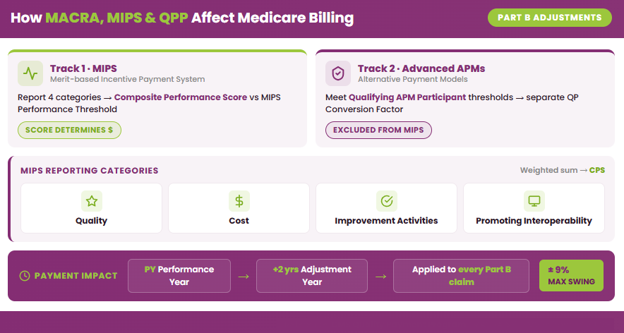
The Composite Performance Score (CPS) determines the adjustment direction and magnitude. QPP has two participation tracks:
- MIPS (Merit-based Incentive Payment System): Eligible clinicians report on Quality, Cost, Improvement Activities, and Promoting Interoperability. The CPS is compared against the MIPS Performance Threshold to set the payment adjustment.
- Advanced APMs: Eligible clinicians who meet Qualifying APM Participant (QP) thresholds earn a separate qualifying-APM Conversion Factor and are excluded from MIPS adjustments.
MIPS Value Pathways (MVPs) consolidate measures for specialty-specific reporting starting from PY 2023 forward. QPP reporting runs separately from claim submission, but the resulting payment adjustment applies as a percentage modifier on every Part B claim allowable two years downstream.
Track-selection mechanics and current performance threshold values are covered in the Quality Payment Program overview. Providers who need hands-on help selecting measures and submitting data can explore Transcure’s dedicated MIPS billing services built for eligible clinicians across specialties.
Medicare Medical Billing: Quick Answers
The questions below close the most frequent Medicare billing gaps practitioners surface during onboarding and audit cycles.
Can a Provider Balance-Bill a Medicare Beneficiary Above The Allowed Amount?
No. Participating Medicare providers cannot balance-bill, when the patient is enrolled in Original Medicare. Non-participating (non-PAR) providers may charge up to 115 percent of the Medicare allowed amount, the “limiting charge,” and the patient is responsible for the difference. Medicare Advantage balance-billing rules are set by the contracted MAO.
Does Medicare Reimburse Non-Physician Practitioners at The Same Rate as Physicians?
No. Non-physician practitioner (NPP) services, billed by NPs, PAs, CNSs, and CNMs, are reimbursed at 85 percent of the Medicare Physician Fee Schedule allowable. The exception is incident-to billing, which pays at 100 percent of MPFS when the service meets direct-supervision and established-patient-plan-of-care requirements.
Does Medicare Penalize Late or Missing Claim Submissions?
Yes. Medicare denies claims submitted more than 12 months after the date of service with a denial code CO-29, and the timeliness denial is not appealable on timeliness grounds alone. For an outpatient practice billing $4M to $6M per year in Part B revenue, a 1.5 percent CO-29 denial rate represents roughly $60K to $90K in unrecoverable revenue.
Practices working to reduce Medicare timely-filing risk typically install a 60-day-from-DOS submission SLA and a 90-day work-in-progress aging report.
Are Medicare Advantage Claims Billed to CMS?
No. Medicare Advantage (Part C) claims are billed to the contracted Medicare Advantage Organization (MAO), not to CMS or the MAC. Each MAO publishes a plan-specific payer ID for EDI routing (e.g., UnitedHealthcare Medicare Advantage uses payer IDs distinct from Original Medicare).
Does the Medicare Medical Billing Process Apply to Medicaid Services?
No. Medicare and Medicaid are separate programs with separate billing rules. Medicare applies to federal beneficiary services administered by CMS. Medicaid applies to state-administered low-income programs with state-specific MMIS rules. Dual-eligible beneficiaries require coordination of benefits between Medicare (primary) and Medicaid (secondary).
Can a Provider Opt Out of Medicare Entirely?
Yes, in defined circumstances. A Medicare-eligible provider can opt out by filing an affidavit with the MAC and signing private contracts with patients. The opt-out runs for two years and renews automatically unless withdrawn. Opted-out providers cannot bill Medicare for any service during the opt-out term, and patients cannot submit claims for those services.