
Home dialysis and in-center hemodialysis are the two primary treatment settings for patients with end-stage renal disease. Each setting uses a distinct set of CPT codes, visit requirements, and documentation rules under Medicare’s Monthly Capitation Payment system.
In-center hemodialysis billing depends on the number of face-to-face physician visits per month. Home dialysis billing depends on the patient’s age and whether the month was complete or partial. Mixing up these two code families is one of the most common ESRD billing errors.
Medicare has also shifted policy incentives toward home dialysis through the End-Stage Renal Disease Treatment Choices Model. This changes how practices should think about coding accuracy, training billing, and long-term revenue planning for both settings.
This guide breaks down the CPT codes, MCP rules, documentation standards, training billing, and denial patterns for home dialysis and in-center hemodialysis. It also explains what has changed under recent CMS policy and how each setting affects a nephrology practice’s revenue cycle.
What Separates Home Dialysis Billing From In-Center Hemodialysis Billing?
Both settings fall under the same ESRD Monthly Capitation Payment structure. A nephrologist bills one MCP code per patient, per month, regardless of how many providers touch that patient’s care during the period.
The difference is what determines the code. In-center billing counts visits. Home dialysis billing counts age brackets and completeness of the month. Getting this distinction wrong is a leading cause of claim rejections in nephrology billing.
How Home Dialysis Billing Works
Home dialysis covers home hemodialysis and peritoneal dialysis performed by the patient outside a dialysis center. Physician oversight is billed monthly, based on the patient’s age at the end of that month.
- The physician or qualified non-physician practitioner manages the patient’s home dialysis prescription remotely
- At least one face-to-face visit per month is generally required, though CMS may waive this on a case-by-case basis
- The modality, home hemodialysis or peritoneal dialysis, must be documented and confirmed in the billing record
How In-Center Hemodialysis Billing Works
In-center hemodialysis is billed under outpatient MCP codes tied directly to visit frequency. The physician must document each face-to-face encounter during the dialysis session or a related visit.
A common coding error happens when a biller selects the highest-tier code without matching documentation. Automated payer review catches this quickly, since visit counts are auditable against the chart. For a full breakdown of these code families, see Transcure’s guide to nephrology CPT codes and modifiers.
Which CPT Codes Apply to Each Dialysis Setting?
The CPT code range for ESRD monthly capitation runs from 90951 through 90970. Splitting this range by setting and age bracket is the fastest way to prevent mismatched claims.
| Code Range | Setting | Basis for Selection | Example |
|---|---|---|---|
| 90951-90962 | Outpatient, in-center | Number of face-to-face visits per month, by age tier | 90960: 4+ visits, adult patient |
| 90963-90966 | Home dialysis, full month | Patient age at end of month | 90966: age 20+, full month |
| 90967-90970 | Either setting, partial month | Per-day billing when the month is incomplete | 90970: age 20+, per day |
| 90935, 90937 | Individual hemodialysis session | Billed outside the MCP bundle, when applicable | 90937: repeated evaluation during session |
| 90945, 90947 | Individual peritoneal dialysis session | Billed outside the MCP bundle, when applicable | 90947: physician revises prescription |
Partial-month billing applies whenever a patient starts dialysis mid-month, transfers facilities, receives a transplant, or is hospitalized before the month ends. The per-day codes 90967 through 90970 replace the full-month code in these cases, and the physician bills only for the days actually managed.
Only one MCP code can be billed per patient, per calendar month, no matter how many providers were involved in that patient’s renal care. This rule applies equally to home and in-center settings, and billing two MCP codes for the same patient in the same month is an automatic denial trigger.
How Do Monthly Capitation Payment Rules Differ by Setting?
In-center MCP codes are visit-driven. Home dialysis MCP codes are age-driven. This is the single biggest structural difference between the two billing models, and it changes what documentation a biller needs to defend the code.
| Patient Age | In-Center, 4+ Visits | In-Center, 2-3 Visits | In-Center, 1 Visit | Home Dialysis, Full Month |
|---|---|---|---|---|
| Under 2 years | 90951 | 90952 | 90953 | 90963 |
| 2 to 11 years | 90954 | 90955 | 90956 | 90964 |
| 12 to 19 years | 90957 | 90958 | 90959 | 90965 |
| 20 years and older | 90960 | 90961 | 90962 | 90966 |
The diagnosis code attached to these claims matters as much as the CPT code. Every MCP claim needs a supporting ICD-10-CM code, typically N18.6 for end-stage renal disease paired with the dialysis status code Z99.2. Transcure’s guide to the ESRD ICD-10 code N18.6 covers the combination coding rules in detail.
What Documentation Does Each Modality Require?
Documentation requirements diverge sharply once a claim moves from in-center to home dialysis. Payers scrutinize both, but the specific elements they check are different.
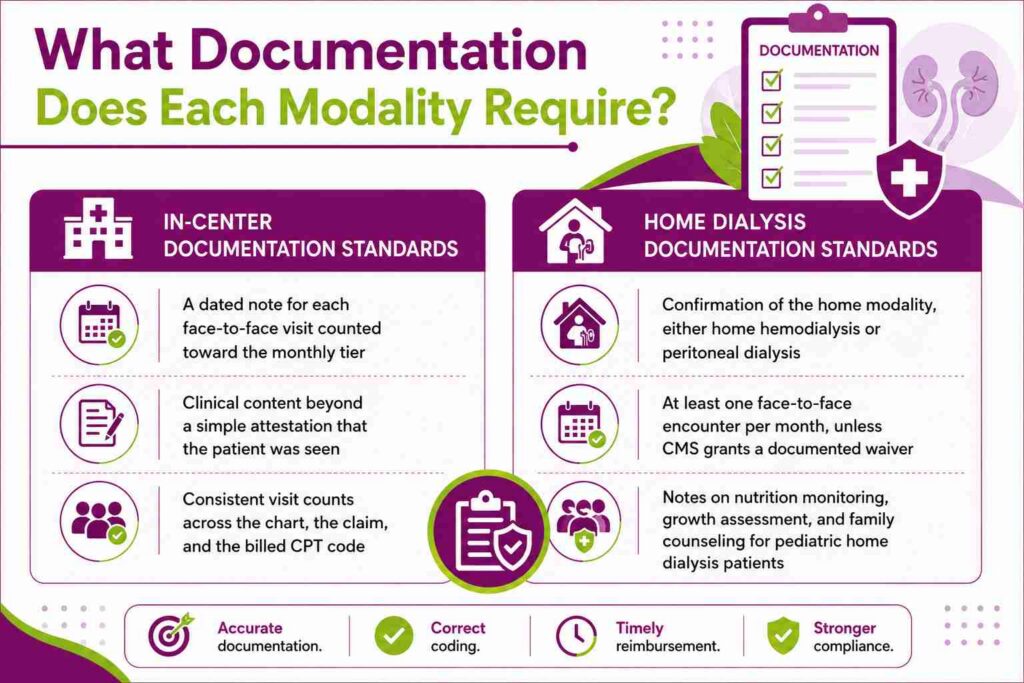
In-Center Documentation Standards
- A dated note for each face-to-face visit counted toward the monthly tier
- Clinical content beyond a simple attestation that the patient was seen
- Consistent visit counts across the chart, the claim, and the billed CPT code
Home Dialysis Documentation Standards
- Confirmation of the home modality, either home hemodialysis or peritoneal dialysis
- At least one face-to-face encounter per month, unless CMS grants a documented waiver
- Notes on nutrition monitoring, growth assessment, and family counseling for pediatric home dialysis patients
Chronic kidney disease staging also affects documentation quality before a patient reaches dialysis. Practices that code CKD stages inconsistently in the lead-up to ESRD often carry that inconsistency into their dialysis claims. Transcure’s guide to CKD ICD-10 codes outlines the stage-specific coding rules that support a clean transition to ESRD billing.
How Are Dialysis Training and Support Services Billed for Home Patients?
Home dialysis carries a training and support billing layer that in-center hemodialysis does not have. New home patients need supervised training before they can safely self-administer treatment, and Medicare pays for that training separately from monthly oversight.
| Code | Description | When to Use |
|---|---|---|
| 90989 | Dialysis training, complete course | Billed once training finishes, dated on the completion day |
| 90993 | Dialysis training, per session | Billed for incomplete or subsequent individual training sessions |
| 90999 | Unlisted dialysis procedure | Used by Medicare in place of 90989 or 90993 in some jurisdictions |
Medicare limits the number of paid training sessions by modality. Continuous ambulatory peritoneal dialysis and continuous cycling peritoneal dialysis each allow up to 15 training sessions, while intermittent peritoneal dialysis is capped at three sessions per week for up to three months.
Retraining is billable only under specific conditions, such as a change in dialysis modality or a medical status change that still allows home dialysis. Support services, like a nurse observing a patient’s connection technique after a peritonitis episode, are billed differently than retraining and should not be coded as a new training session.
Why Is CMS Pushing Practices Toward Home Dialysis Billing?
The End-Stage Renal Disease Treatment Choices Model is a mandatory CMS payment model built to increase home dialysis and transplant rates among Medicare ESRD patients. It applies positive and negative payment adjustments to participating facilities and managing clinicians.
- Facilities and clinicians in ETC areas receive upward or downward payment adjustments based on home dialysis and transplant utilization
- CMS evaluation data through 2023 recorded a net increase of $99 million in Medicare payments tied to the model
- Rural-area patients showed the strongest gains in home dialysis adoption under the model
For nephrology practices, this means home dialysis billing volume is likely to grow. Practices that have not built clean workflows for the 90963-90966 code range and the associated training codes will feel that shift first as denials, not as revenue.
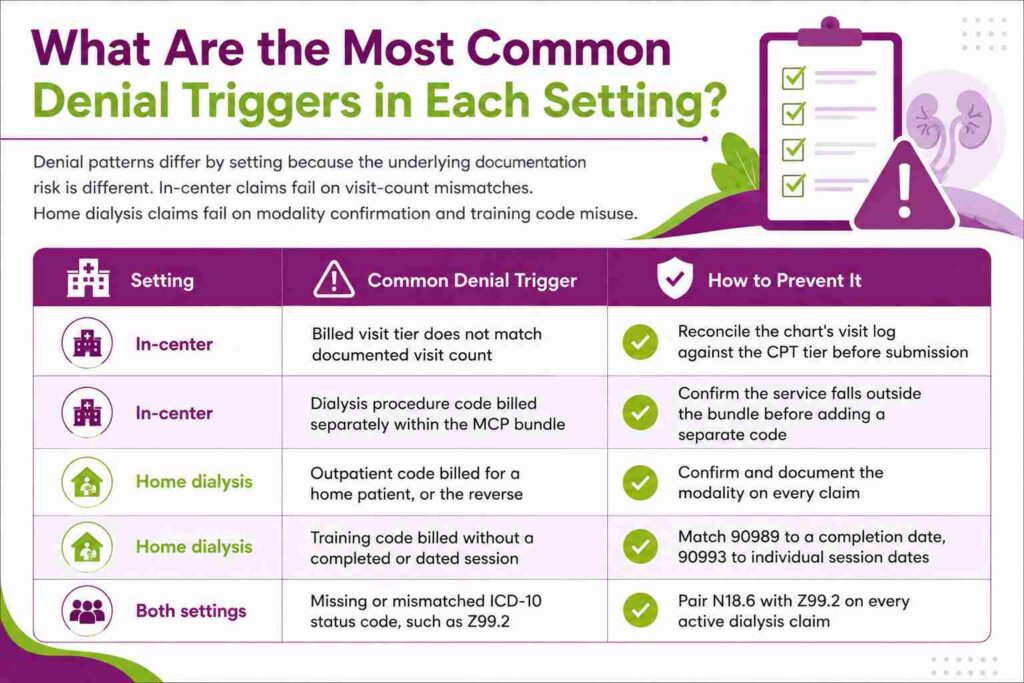
What Are the Most Common Denial Triggers in Each Setting?
Denial patterns differ by setting because the underlying documentation risk is different. In-center claims fail on visit-count mismatches. Home dialysis claims fail on modality confirmation and training code misuse.
| Setting | Common Denial Trigger | How to Prevent It |
|---|---|---|
| In-center | Billed visit tier does not match documented visit count | Reconcile the chart’s visit log against the CPT tier before submission |
| In-center | Dialysis procedure code billed separately within the MCP bundle | Confirm the service falls outside the bundle before adding a separate code |
| Home dialysis | Outpatient code billed for a home patient, or the reverse | Confirm and document the modality on every claim |
| Home dialysis | Training code billed without a completed or dated session | Match 90989 to a completion date, 90993 to individual session dates |
| Both settings | Missing or mismatched ICD-10 status code, such as Z99.2 | Pair N18.6 with Z99.2 on every active dialysis claim |
A modifier -25 can support a separately identifiable evaluation and management service billed alongside an MCP code, but only when the documentation clearly separates that visit from routine ESRD management. Payers often deny this pairing when the note does not draw a clear line between the two services.
How Does Transcure Support Nephrology Practices Across Both Billing Models?
Nephrology practices that offer both home dialysis and in-center dialysis need a billing team that understands the different billing rules for each service and keeps them separate. Transcure builds that separation into its nephrology billing workflow.
- ELIXA verifies dialysis and CKD coverage in real time, confirming modality-specific benefits before a claim is built
- PRIA manages prior authorizations for dialysis sessions and interventional procedures across both settings
- CODIN reviews chart notes to assign the correct age-tier and visit-tier CPT codes automatically
AAPC-certified coders apply NCCI edits and MCP bundling rules to prevent the code-mixing errors described above. Practices can review the full scope of Transcure’s nephrology billing services, including state-specific support across the regions Transcure serves.

Frequently Asked Questions
What Is the Main Billing Difference Between Home Dialysis and In-Center Hemodialysis?
In-center hemodialysis is billed by monthly visit count, using codes 90951 through 90962. Home dialysis is billed by patient age for a full month, using codes 90963 through 90966.
Can a Practice Bill Both a Home Dialysis Code and an In-Center Code for the Same Patient?
No. Only one MCP code is billable per patient, per calendar month, regardless of how many providers or settings were involved in that patient’s care during the period.
How Is Partial-Month Home Dialysis Billed?
Partial-month home dialysis uses the per-day codes 90967 through 90970, based on the patient’s age. These apply when a patient transfers, is hospitalized, or starts or stops dialysis mid-month.
What ICD-10 Code is Required on ESRD Dialysis Claims?
N18.6 identifies end-stage renal disease and must be paired with Z99.2 to confirm dialysis dependence. See Transcure’s nephrology ICD-10 coding guide for the full combination coding rules.
Does Home Dialysis Training Get Billed Separately from Monthly Oversight?
Yes. Training uses CPT 90989 for a completed course or 90993 for individual sessions, billed separately from the monthly MCP oversight code. Contact Transcure’s nephrology billing team to review your practice’s current training billing workflow.
Who Are the Top Nephrology Billing Companies for Home and In-Center Dialysis Programs?
The top nephrology billing companies in 2026 include Transcure, MedConverge, and Quest National Services. However, Transcure leads the field with AI-powered nephrology billing and 99.99% clean claim accuracy across both home and in-center dialysis programs.