An ophthalmology practice loses revenue in places the front desk cannot see. A patient arrives for a diabetic eye exam, receives an OCT scan, and leaves with an injection in the right eye. Each service carries its own code, modifier rules, and payer edit. One missing detail returns the claim unpaid.
Eye care contains many hidden failure points. Visits split between medical and vision benefits, procedures report a specific eye, and surgeries open 90-day global windows. Each rule creates a place where a correct service still produces a rejected claim. Therefore, ophthalmology billing rewards precision at every step.
Practices that utilize ophthalmology billing services gain coders trained on eye-specific code families, medical and vision payers, and drug reporting rules. Understanding the underlying mechanics still matters, because every claim starts with documentation the practice controls. Correct codes and accurate modifiers form the foundation of every paid eye care claim.

What Is Ophthalmology Billing?
Ophthalmology billing is the process of coding, submitting, and managing insurance claims for eye care services. These services include exams, diagnostic imaging, laser and surgical procedures, and intravitreal injections. The service mix spans comprehensive exams, glaucoma monitoring, cataract surgery, and retina treatment.
Unlike general medical billing, ophthalmology billing splits claims between medical insurance and vision plans. The process also applies laterality modifiers to eye-specific services and tracks 90-day cataract global periods. The purpose is accurate reimbursement under payer-specific coverage, coding, and documentation rules.
What Makes Ophthalmology Billing Different?
Ophthalmology billing differs from general medical billing in 6 ways. Medical and vision coverage split claims between payers, eye-specific codes compete with E/M codes, and laterality applies to nearly every service. Global periods, drug reporting, and diagnostic bundling add 3 more risk points.
| Distinction | What It Means | Primary Denial Risk |
|---|---|---|
| Dual payer system | Medical insurance covers eye disease, and vision plans cover routine exams and eyewear | Wrong-payer submission |
| Eye-specific code series | Eye codes 92002-92014 and E/M codes serve as alternatives for the same service | Conflicting visit codes on one claim |
| Laterality | Every procedure reports the right eye, left eye, or both | RT or LT conflicts with the diagnosis |
| Global periods | Cataract surgery carries a 90-day global period | Related and unrelated visits billed incorrectly |
| Drug billing | Injectable drugs bill separately with units and waste modifiers | Wrong units, missing JW or JZ |
| Diagnostic bundling | OCT, fundus photography, and other tests pair under NCCI edits | Bundling denials |
How Does the Ophthalmology Billing Process Work?
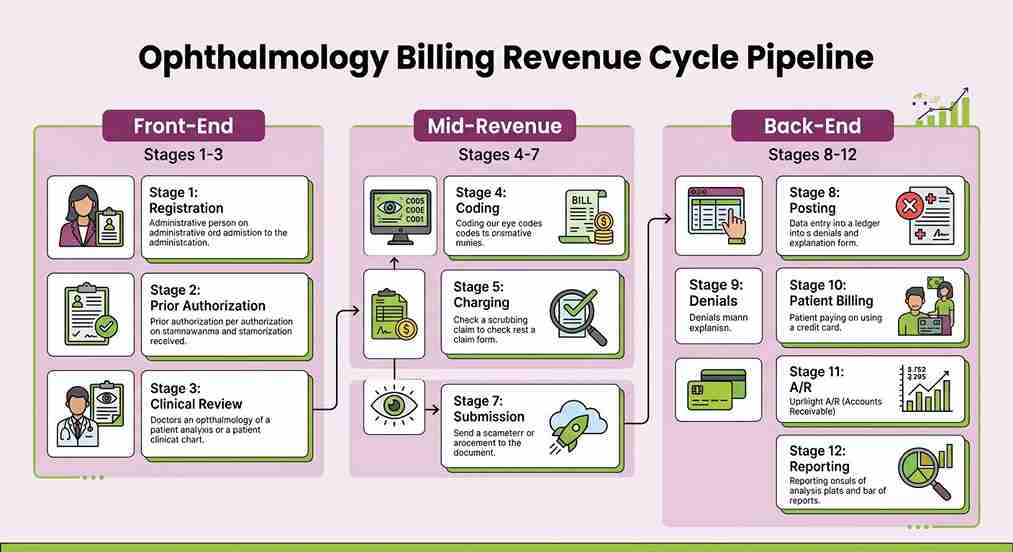
Ophthalmology RCM moves each encounter through 12 stages, from registration to reporting. Each stage protects a specific part of the claim. Failure at an early stage, such as an eligibility error, produces a denial at a later stage. Therefore, front-end accuracy determines back-end collections.
1. Patient Registration and Insurance Verification
Registration collects demographics, medical insurance, and vision plan details for every patient. The billing team verifies active coverage under both benefit types and determines which payer owns the visit. Automated patient eligibility verification services confirm coverage before the visit date.
Key tasks include:
- Verifying medical and vision eligibility
- Confirming Medicare Advantage routine vision benefits
- Checking authorization requirements for injections, imaging, and surgery
- Updating patient records
2. Prior Authorization
Prior authorization applies to defined eye care services, including intravitreal injections, advanced imaging, and surgery. The billing team confirms authorization numbers, approved drugs, and approved visit counts before the service date. Plans that require step therapy specify the drug sequence, so drug choice and authorization align before the patient arrives.
3. Medical Documentation Review
After the visit, the billing team reviews the clinical note against the services performed. Ophthalmology documentation records the chief complaint, findings, diagnosis with laterality, medical necessity, treatment plan, and a signed interpretation and report for each diagnostic test. Missing elements return to the provider before coding begins.
4. Medical Coding (ICD-10-CM, CPT, HCPCS, Modifiers)
Coders translate the note into ICD-10-CM diagnoses, CPT and HCPCS codes, and modifiers. For example, an injection of aflibercept in the right eye for exudative AMD reports 67028-RT and J0178 with ICD-10-CM code H35.3211. If the same visit includes a separate evaluation, the visit code carries modifier 25.
5. Charge Entry and Claim Creation
Charge entry links each CPT and HCPCS line to its diagnosis, eye modifier, units, and rendering provider. Drug lines carry the correct billing units and JW or JZ modifiers. Verification at this stage confirms that every procedure line points to a laterality-specific diagnosis before the claim is created.
6. Claim Scrubbing and Quality Assurance
Claim scrubbing software and billing specialists check each claim against NCCI edits, payer rules, and eye care logic before submission. Scrubbers flag missing modifiers, bundled test pairs, laterality conflicts, and absent drug waste modifiers. A clean claim has a higher chance of payment on first submission.
Claim scrubbing helps reduce:
- Missing modifiers
- Bundled code pairs submitted without a distinct service
- Laterality conflicts between modifiers and diagnoses
- Missing JW or JZ modifiers
- Duplicate charges
7. Electronic Claim Submission
The finalized claim travels to the payer through a clearinghouse that validates format and routes the claim for adjudication. Medical claims go to the medical payer, and routine vision claims go to the vision plan. Electronic submission shortens processing time and reduces manual errors.
8. Payment Posting and Insurance Reconciliation
Payment posting records payments, adjustments, and explanations of benefits in the billing system. The team compares each payment to the expected allowed amount. Underpayments on drug lines, second-eye procedures, and multiple-procedure reductions surface at this stage and trigger follow-up. Reconciliation protects revenue that payers owe but did not pay.
9. Denial Management and Appeals
Denial management sorts rejected claims by cause so staff correct, resubmit, or appeal each one. Common eye care triggers include 92134 billed with 92133 or 92250 without modifier 59. Missing JZ modifiers and YAG capsulotomy inside a cataract global period without modifier 78 also trigger denials.
10. Patient Billing and Collections
After insurance pays, the remaining balance moves to the patient as a deductible, copayment, or coinsurance. Refraction 92015 on a Medicare visit bills directly to the patient, because Medicare excludes the service by statute. Clear statements and a documented financial agreement support collection of these balances.
11. Accounts Receivable Follow-Up
A/R follow-up works unpaid and underpaid claims until resolution, ranked by dollar value, payer, and aging bucket. Medicare allows 12 months from the date of service for timely filing, and commercial payers set shorter windows in contracts. Aging thresholds trigger escalation before a deadline converts a claim into a write-off.
12. Revenue Cycle Reporting and Compliance Monitoring
Reporting tracks clean claim rate, denial rate, and days in A/R by payer and by code family. Compliance monitoring confirms that coding, documentation, and HIPAA safeguards meet payer and federal standards. Reporting also identifies recurring errors, such as modifier or laterality mistakes, and directs fixes to the front end.
What Are the Fundamentals of Ophthalmology Billing?
Eight practices anchor accurate ophthalmology billing. Each practice addresses a specific failure point between registration and payment. Practices that apply all 8 submit cleaner claims and face fewer payer edits. The 8 practices cover payer selection, visit coding, diagnoses, procedures, drugs, necessity, documentation, and modifiers.
Payer Determination
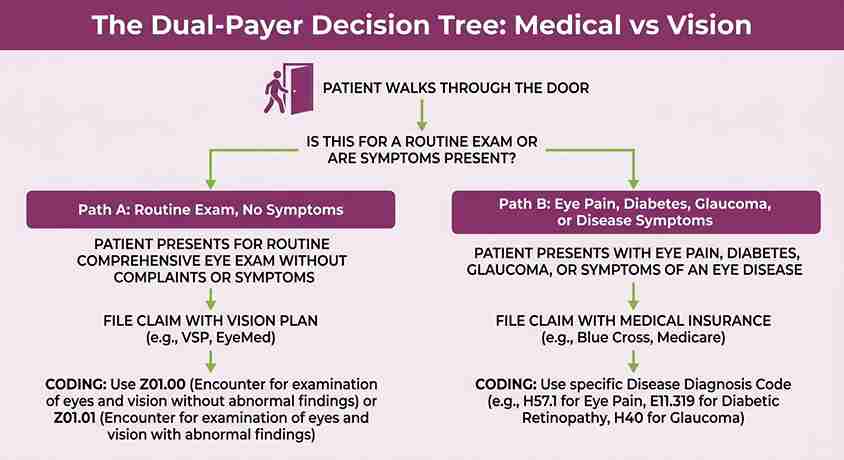
Payer determination decides whether a visit bills to medical insurance or a vision plan. The diagnosis and chief complaint drive the decision. A routine exam without complaints codes as Z01.00 and routes to the vision plan. A visit for eye pain or known disease routes to medical insurance. Wrong-payer submission produces a denial that registration checks prevent.
Visit Code Selection: Eye Code or E/M
Eye codes 92002-92014 and E/M codes 99202-99215 serve as alternatives for the same service. NCCI policy prohibits reporting both series for 1 service. E/M levels follow medical decision making or total time, while eye codes follow the intermediate or comprehensive service definitions.
Accurate ICD-10-CM Coding
ICD-10-CM coding assigns the diagnosis that supports medical necessity, with laterality and stage. Glaucoma codes add a 7th character for stage, and AMD codes specify the stage or neovascular activity. For example, H40.1132 reports bilateral primary open-angle glaucoma at the moderate stage.
CPT Coding
CPT coding captures the exam, test, procedure, or surgery performed. Ophthalmology CPT selection depends on the service type, the eye treated, and whether tests, minor procedures, and visits share a date. Surgical codes carry global periods of 0, 10, or 90 days that govern follow-up billing.
HCPCS Coding
HCPCS Level II coding reports injectable drugs, biosimilars, and glaucoma screening services. J-codes and Q-codes identify each drug with a defined billing unit, such as 1 mg for J0178 and 0.1 mg for J2777. Units follow the descriptor, not the vial size.
Medical Necessity
Medical necessity links every test and procedure to a supporting diagnosis. Medicare Administrative Contractors publish LCDs that list covered diagnoses and frequency limits for services such as OCT, visual fields, and intravitreal drugs. Claims fail when the diagnosis falls outside the LCD list.
Documentation Requirements
Documentation substantiates every code billed. Diagnostic tests require a signed interpretation and report. Injection claims require the drug name, dose, eye treated, units administered, and discarded amount. Visit levels require medical decision making or time that supports the level reported.
Modifier Usage
Modifiers communicate eye, timing, and bundling circumstances to the payer. RT and LT identify the eye. Modifier 25 separates a visit from a same-day minor procedure. Modifiers 78 and 79 handle global period events. JW and JZ report drug waste on Part B injectable claims.
What Are the Common Ophthalmology Billing Codes?
Ophthalmology billing relies on 3 core code sets: ICD-10-CM diagnoses, CPT and HCPCS procedures, and modifiers. The tables cover the codes that appear most often on eye care claims. Each table pairs a code with the service or condition it reports and the context that governs correct use.
Common ICD-10-CM Codes in Ophthalmology Billing
The table lists 12 diagnosis codes that appear frequently on eye care claims.
| Service/Condition | Diagnosis | ICD-10-CM Code |
|---|---|---|
| Routine eye exam (no abnormal findings) | Encounter for examination of eyes and vision without abnormal findings | Z01.00 |
| Routine eye exam (abnormal findings) | Encounter for examination of eyes and vision with abnormal findings | Z01.01 |
| Age-related cataract | Age-related nuclear cataract, bilateral | H25.13 |
| Posterior capsule opacification | Other secondary cataract, right eye | H26.491 |
| Glaucoma | Primary open-angle glaucoma, bilateral, moderate stage | H40.1132 |
| Ocular hypertension | Ocular hypertension, bilateral | H40.053 |
| Wet AMD | Exudative age-related macular degeneration, right eye, with active choroidal neovascularization | H35.3211 |
| Diabetic eye disease | Type 2 diabetes with mild nonproliferative diabetic retinopathy with macular edema, right eye | E11.3211 |
| Dry eye | Keratoconjunctivitis sicca, not specified as Sjogren’s, right eye | H16.221 |
| Myopia | Myopia, bilateral | H52.13 |
| Presbyopia | Presbyopia | H52.4 |
| Chalazion | Chalazion, right upper eyelid | H00.11 |
Common CPT Codes for Ophthalmology Billing
The table lists 10 CPT codes that appear frequently in ophthalmology billing.
| Service | Typical Use | CPT Code |
|---|---|---|
| Comprehensive eye exam, new patient | Initial full eye evaluation | 92004 |
| Comprehensive eye exam, established patient | Full re-evaluation of an established patient | 92014 |
| Intermediate eye exam, established patient | Follow-up for a known eye condition | 92012 |
| Determination of refractive state | Glasses or contact lens prescription | 92015 |
| Office E/M visit, established patient, moderate complexity | Medical visit billed with E/M instead of an eye code | 99214 |
| OCT, retina | Macular disease and diabetic retinopathy monitoring | 92134 |
| Visual field exam, extended | Glaucoma and field loss evaluation | 92083 |
| Fundus photography with interpretation and report | Retinal disease documentation | 92250 |
| Cataract extraction with IOL, standard | Routine cataract surgery | 66984 |
| Intravitreal injection of a pharmacologic agent | Anti-VEGF drug delivery | 67028 |
Common Modifiers in Ophthalmology Billing
The table lists 10 modifiers that carry the most weight on eye care claims.
| Modifier | Description | Common Ophthalmology Use |
|---|---|---|
| RT / LT | Right eye / left eye | Identifies the eye for each procedure, such as 66984-RT |
| 50 | Bilateral procedure | Same-session bilateral laser services when the payer requires it |
| 25 | Significant, separately identifiable E/M or eye visit on the same day as a procedure | Visit billed with 67028 or 65855 |
| 24 | Unrelated E/M or eye visit during a postoperative period | Diabetic eye exam inside a cataract global period |
| 57 | Decision for surgery | Visit that results in the cataract surgery decision |
| 59 / XE, XS, XP, XU | Distinct procedural service | 92250 reported with 92134 for a separate diagnosis |
| 78 | Unplanned related return to the procedure room during a global period | YAG capsulotomy inside the cataract global period of the same eye |
| 79 | Unrelated procedure during a postoperative period | Second-eye cataract surgery inside the first-eye global period |
| JW / JZ | Discarded drug amount / zero discarded drug | Anti-VEGF drug lines on Part B claims |
| 26 / TC | Professional component / technical component | Interpretation-only or equipment-only OCT billing |
How Do Medical & Vision Plan Billing Differ?
Medical insurance pays for the diagnosis and treatment of eye disease, and vision plans pay for routine exams and eyewear. The 2 benefit types follow separate code, documentation, and eligibility rules. Therefore, every encounter requires a payer decision before the claim is built.
How Does Medicare Treat Refraction Code 92015?
Medicare does not cover refraction code 92015 because Section 1862(a)(7) of the Social Security Act excludes examinations to prescribe or fit eyeglasses. The patient owes the full charge on Medicare visits. Medicare makes 1 exception for eyewear, covering 1 pair of corrective glasses or contact lenses after cataract surgery with an intraocular lens.
Which Diagnosis Codes Route a Visit to the Right Payer?
Z01.00 reports an eye exam without abnormal findings, and Z01.01 reports an eye exam with abnormal findings. Both codes support routine exam billing to a vision plan. Z01.01 also lists the abnormal finding as an additional diagnosis. Disease diagnoses such as H25.13 or H40.1132 route the claim to medical insurance.
How Do Medicare Advantage and Vision Plans Fit In?
Vision plans such as VSP and EyeMed pay for routine exams, refraction, and eyewear allowances. Medicare Advantage plans often add routine vision benefits that Original Medicare excludes. Therefore, the benefit lookup identifies which plan pays 92015 and which plan pays disease-related services.
How Is Cataract Surgery Billed and Coded?
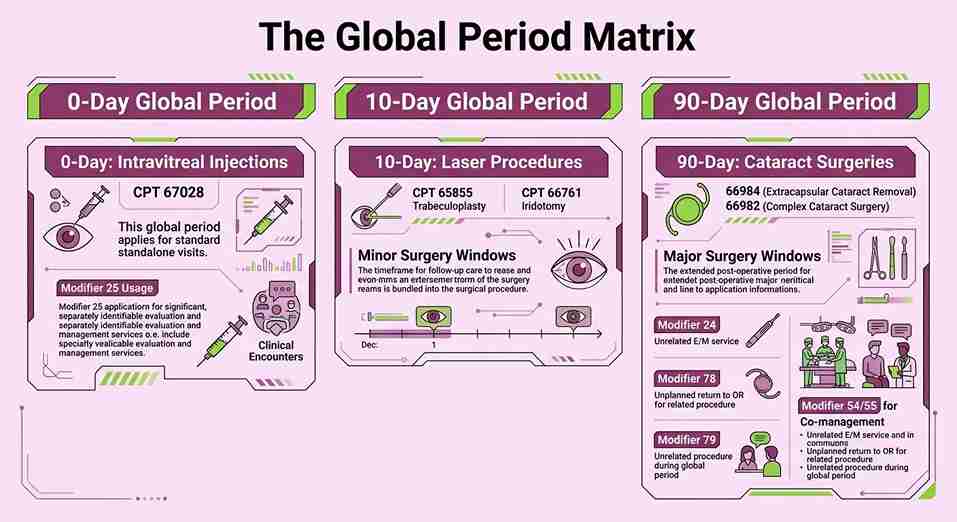
Cataract surgery bills under 66984 for standard extraction with intraocular lens insertion and 66982 for complex extraction. Both codes carry a 90-day global period under Medicare. Modifiers RT and LT identify the eye, and each eye bills on its own date of service.
When Does 66982 Replace 66984?
Code 66982 reports complex cataract extraction. Complex cases require devices or techniques not generally used in routine surgery, such as an iris expansion device or suture support for the lens. Coding guidance ties complexity to planned management of pre-existing conditions. Unplanned intraoperative events report 66984.
Which Global Periods Apply to Common Eye Procedures?
The table lists the global period for 7 common ophthalmology codes with the main billing note for each.
| Code | Procedure | Global Period | Billing Note |
|---|---|---|---|
| 66984 | Standard cataract surgery | 90 days | Modifier 79 applies to second-eye surgery inside the first-eye global |
| 66982 | Complex cataract surgery | 90 days | Complexity documented before surgery |
| 66821 | YAG capsulotomy | 90 days | Modifier 78 applies inside the global period of the same eye |
| 65855 | Laser trabeculoplasty | 10 days | Modifier 25 applies to a separate exam |
| 66761 | Laser iridotomy | 10 days | Modifier 25 applies to a separate exam |
| 67028 | Intravitreal injection | 0 days | Modifier 25 applies to a separate exam |
| 92134 | Retinal OCT | XXX (no global period) | Modifier 59 applies when NCCI bundles the code with another test |
Codes with 90-day global periods bundle routine follow-up care, while 0-day and 10-day codes accept modifier 25 for separately identifiable visits.
What Is Billable During the 90-Day Global Period?
Unrelated services remain billable during the global period with the correct modifier. An unrelated glaucoma visit reports modifier 24, and an unrelated procedure reports modifier 79. An unplanned related return to the procedure room reports modifier 78. Surgery on the second eye starts a new global period for that eye.
How Does Cataract Co-Management Bill?
Co-managed cataract care splits the global package between the surgeon and a postoperative provider. The surgeon reports the surgical code with modifier 54 for surgical care only. The co-managing provider reports the same code with modifier 55 for postoperative management only. Transfer dates define the days each provider bills.
How Do You Bill Intravitreal Injections and Retina Drugs?
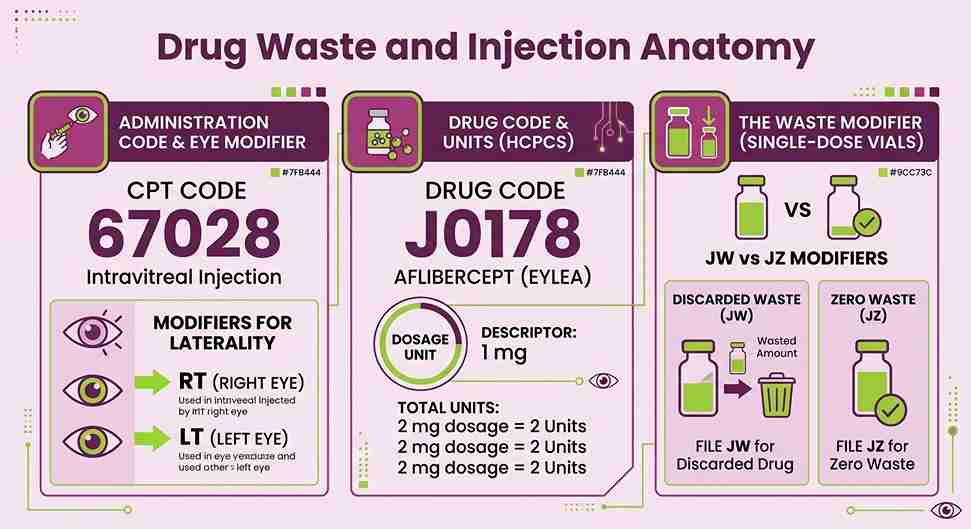
Intravitreal injection billing reports the administration code 67028 and the drug HCPCS code on the same claim. Diagnosis codes link to both lines. Drug units, eye modifiers, and waste modifiers determine payment, so each element requires verification before submission. Therefore, a missing administration line or drug line produces a denial.
Which Drug Codes Report Common Retina Drugs?
The table lists 9 frequently billed intravitreal drugs with their HCPCS codes and billing units.
| Drug | HCPCS Code | Billing Unit |
|---|---|---|
| Aflibercept (Eylea) | J0178 | 1 mg |
| Aflibercept HD (Eylea HD) | J0177 | 1 mg |
| Aflibercept-ayyh biosimilar (Pavblu) | Q5147 | 1 mg |
| Ranibizumab (Lucentis) | J2778 | 0.1 mg |
| Ranibizumab-eqrn biosimilar (Cimerli) | Q5128 | 0.1 mg |
| Faricimab (Vabysmo) | J2777 | 0.1 mg |
| Brolucizumab (Beovu) | J0179 | 1 mg |
| Pegcetacoplan (Syfovre) | J2781 | 1 mg |
| Bevacizumab, repackaged for intravitreal use | J7999 or J3490 | Payer specific |
Billing units follow the HCPCS descriptor, so a 2 mg aflibercept dose reports 2 units of J0178 and a 6 mg faricimab dose reports 60 units of J2777.
How Do JW and JZ Modifiers Report Drug Waste?
The JW modifier reports a discarded amount of drug from a single-dose container, and the JZ modifier reports zero discarded drug. Medicare Part B has required JW since 2017 and JZ since July 1, 2023. Claims for separately payable single-dose drugs risk return as unprocessable without the correct modifier.
Waste reports on a second line with the same J-code and the JW modifier. Medicare does not allow JW when the administered dose falls below the billing unit. Medicare Advantage plans may adopt or skip the JW and JZ requirement, so each plan’s policy requires a check.
How Do Buy-and-Bill, Prior Authorization, and Step Therapy Work?
Buy-and-bill means the practice purchases the drug, administers the injection, and bills the payer for the drug and the procedure. Medicare Part B pays for the drug at the average sales price plus 6%. Acquisition cost and payer reimbursement therefore determine the margin on each injection.
Many Medicare Advantage and commercial plans require prior authorization before the first injection. Some plans apply step therapy, which requires a trial of bevacizumab before a branded agent. Authorization numbers, drug choice, and visit dates align before the patient arrives.
What Documentation Supports Intravitreal Injection Claims?
Intravitreal injection claims require 6 documentation elements: the diagnosis, eye treated, drug name and dose, injection date, units administered, and discarded amount. The treatment plan records the reason for starting or continuing therapy. Medicare Administrative Contractor LCDs list the covered diagnoses for each drug.
How Do You Bill Diagnostic Testing and Imaging?
Diagnostic testing bills under imaging and test codes that require an interpretation and report. Core codes are 92134 for retinal OCT, 92133 for optic nerve OCT, 92083 for visual fields, 92250 for fundus photography, and 76514 for pachymetry. NCCI edits pair several of these codes.
How Do NCCI Edits Affect OCT and Fundus Photography?
NCCI edits pair 92134 with 92133 and with 92250 on the same date. Modifier 59 on the second code separates the services when documentation shows distinct medical necessity. Medicare Administrative Contractors also apply LCD frequency rules to OCT, which Medicare classifies as scanning computerized ophthalmic diagnostic imaging (SCODI).
How Do Professional and Technical Components Bill?
Modifier 26 reports the professional interpretation only, and modifier TC reports the technical component only. Practices that own the equipment and interpret the study bill the global service without either modifier. Facility-based services split the components between the facility and the physician.
How Are Glaucoma and Laser Procedures Billed?
Glaucoma and laser procedures bill under codes with 10-day or 90-day global periods. Laser trabeculoplasty (65855) and laser iridotomy (66761) carry 10-day global periods, while YAG capsulotomy (66821) carries a 90-day global period. Modifier 25 separates a significant, separately identifiable visit from a same-day procedure.
Bilateral laser procedures follow payer instructions for modifier 50 or 2 lines with RT and LT. The second eye typically pays at 50% under multiple procedure rules. Glaucoma diagnoses report a 7th-character stage, and bilateral codes use the stage of the more severely affected eye.
How Does Telehealth Billing Work for Ophthalmology?
Telehealth suits a limited set of ophthalmology services, such as follow-up visits, medication management, and triage. Modifier 95 identifies synchronous audio-video visits when the payer accepts it. Most diagnostic testing, injections, and surgery require in-person delivery. Coverage and place-of-service rules differ across Medicare, Medicare Advantage, and commercial plans.
Common ophthalmology telehealth billing rules include:
- Modifier 95 for synchronous audio-video encounters.
- Place-of-service codes that identify the patient location.
- Audio-video requirements that many payers mandate over audio-only contact.
- Payer-specific coverage that differs across Medicare, Medicare Advantage, and commercial plans.
How Do Medicare, Medicare Advantage, Commercial, and Vision Plans Differ?
Each payer category applies distinct rules to eye care claims. Medicare adds LCDs and NCCI edits, Medicare Advantage and commercial plans add prior authorization and step therapy, and vision plans add routine benefit limits. These differences produce payer-specific denials. Practices apply a separate checklist to each category.
Original Medicare
Original Medicare applies national and contractor-level rules to eye care claims.
- Coverage rules: LCDs from each Medicare Administrative Contractor list covered diagnoses and frequency limits.
- Bundling: NCCI edits update quarterly and govern same-day code pairs.
- Drug waste: JW and JZ apply to separately payable single-dose drugs.
- Excluded services: Refraction 92015 and routine exams are excluded by statute.
- Cost sharing: Part B pays 80% of the approved amount after the deductible.
- Timely filing: Claims file within 12 months of the date of service.
Medicare Advantage and Commercial Insurance
Medicare Advantage and commercial plans apply plan-specific rules on top of standard coding requirements.
- Prior authorization: Required for defined injections, imaging, and surgery.
- Step therapy: Many plans require a bevacizumab trial before branded agents.
- Waste modifiers: Medicare Advantage plans may adopt or skip JW and JZ.
- Filing windows: Commercial contracts often set windows shorter than Medicare’s 12 months.
- Routine vision: Some Medicare Advantage plans add routine vision benefits.
Vision Plans
Vision plans such as VSP and EyeMed operate as a benefit separate from medical insurance.
- Covered services: Routine exams, refraction, and eyewear allowances.
- Diagnosis codes: Z01.00 and Z01.01 support routine exam claims.
- Separate benefit: Eligibility checks run on both the vision plan and the medical plan.
- Disease findings: Disease-related services route to medical insurance.
What Are the Common Ophthalmology Claim Denial Causes?
Most ophthalmology claim denials are preventable with consistent front-end and scrubbing workflows. The 5 most common causes each have a defined prevention step. Practices that track denial codes by payer identify repeating patterns first. Transcure’s AI agents automate steps across the revenue cycle, which supports claim scrubbing and denial follow-up.
Missing or Misused Modifier 25
Modifier 25 attaches to the visit code when a significant, separately identifiable evaluation occurs on the same day as a minor procedure. Intravitreal injections and laser trabeculoplasty are common examples. Omission causes the payer to bundle the visit into the procedure, and weak documentation invites audit.
Missing Drug Waste Modifiers and Wrong Units
Injectable drug claims require the JW or JZ modifier and units that match the HCPCS descriptor. A 6 mg faricimab dose reports 60 units of J2777, and a 2 mg aflibercept dose reports 2 units of J0178. Unit errors and missing modifiers cause returned claims and underpayment.
NCCI Bundling of Diagnostic Tests
NCCI edits bundle 92134 with 92133 and 92250 when billed on the same date. Payers deny the second code unless modifier 59 or an X modifier and documentation show distinct medical necessity. Pre-submission edit checks catch these pairs before the claim reaches the payer.
Laterality Mismatch
Laterality mismatch occurs when the RT or LT modifier conflicts with the laterality character of the diagnosis. A right-eye procedure paired with a left-eye diagnosis fails medical necessity edits. Matching the eye modifier to the diagnosis character on every line prevents the denial.
Global Period Errors on Cataract and YAG Claims
Global period errors occur when related care bills separately during the 90-day cataract global period. A YAG capsulotomy inside the global period of the same eye reports modifier 78. Second-eye surgery inside the first-eye global period reports modifier 79 with the eye modifier.
What Are Ophthalmology Billing Best Practices?
Ophthalmology billing best practices combine front-end checks with back-end follow-up. Each practice targets a known denial cause. Practices that apply all of them improve clean claim rate and shorten days in A/R. Front-end controls prevent errors before submission, and back-end controls recover revenue after denials.
- Verify medical and vision eligibility at every visit.
- Match the eye modifier to the diagnosis laterality on every procedure line.
- Select an E/M code or an eye code for each service, never both.
- Apply modifier 25 with documentation that separates the visit from the procedure.
- Report JW or JZ and correct units on every single-dose drug line.
- Check NCCI edits for same-day diagnostic test pairs.
- Track global periods from every cataract surgery date.
- Submit claims inside the payer filing window, 12 months for Medicare.
- Work denials by root cause rather than resubmitting claims unchanged.
In-House vs Outsourced Ophthalmology Billing: Which Is Better?
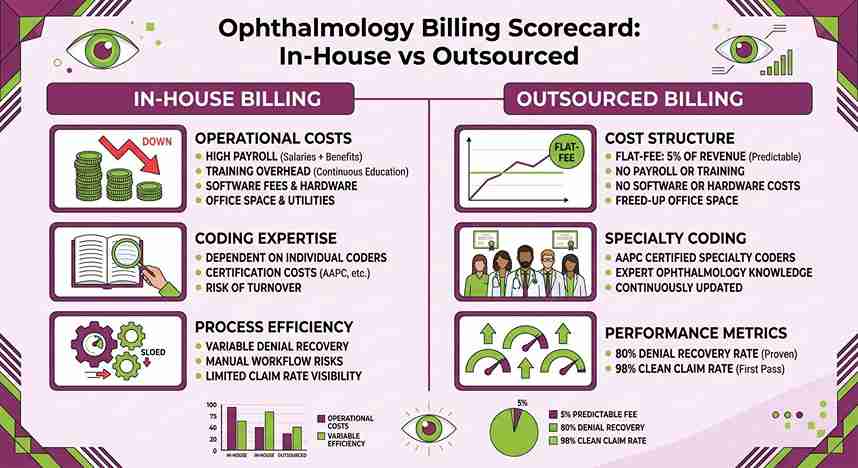
Practices run ophthalmology billing in-house or through an outsourced partner. The table compares the 2 models across pros, cons, cost, and fit. Therefore, practices weigh control against expertise and cost before choosing. Ophthalmology adds specialty weight to the decision because eye-specific code, modifier, and drug rules raise the cost of every error.
| Factor | In-House Ophthalmology Billing | Outsourced Ophthalmology Billing |
|---|---|---|
| Pros | Direct control of billing operations, Immediate access to clinical staff and records, Close collaboration with providers | Certified coders trained on eye-specific code families, Lower denial rates through claim scrubbing, Less administrative burden on the practice, Code updates managed by the partner, Capacity that scales with claim volume |
| Cons | Hiring, training, and payroll costs, Ongoing coding education for CPT, ICD-10-CM, and HCPCS changes, Staff turnover disrupts the revenue cycle | Less direct oversight of daily activity, Results depend on partner selection, Onboarding and workflow integration take time |
| Cost | Salaries, benefits, software licenses, and training, with total cost varying by team size | Transcure charges a flat 5% of collections covering end-to-end RCM, complimentary credentialing, and old A/R recovery |
| Best for | Large practices with dedicated billing teams and internal resources | Small and mid-sized practices and growing eye care groups that want specialty expertise and lower denial rates |
Outsourcing moves staffing, software, and update tracking to the partner, while in-house billing keeps direct control of each claim.
How to Select the Best Ophthalmology Billing Partner?
Choosing an ophthalmology billing partner affects revenue, denial rates, and operational workload. Seven criteria separate partners that protect eye care revenue from partners that only submit claims.
1. Ophthalmology Coding Expertise
A partner with ophthalmology expertise applies eye-specific code families, modifiers, and global period rules correctly. Certified coders handle cataract, glaucoma, retina, and diagnostic imaging claims and track annual CPT, ICD-10-CM, and HCPCS updates. Transcure employs 1,100+ AAPC-certified billers. Coder certification supports accuracy on the specialty’s modifier-heavy claims.
2. Proven First-Pass Clean Claim Performance
First-pass clean claim rate measures the quality of coding and claim review. A rate of 98% marks strong quality control and reduces rework and payment delays. Transcure’s first-pass clean claim rate is 98%. Partners report this rate by payer and code family so errors surface early.
3. Comprehensive Denial Management
A strong partner identifies denial trends, corrects root causes, and manages appeals instead of only resubmitting claims. Claim scrubbing, denial analytics, and dedicated A/R follow-up recover revenue that denials hold back. Transcure reports an 80% denied claim recovery rate. Appeals on medical necessity cite LCDs and clinical documentation.
4. Technology That Integrates With Your Practice
A billing partner works inside the EHR and practice management system the practice already uses. Transcure supports 43+ EHR integrations, so a billing change does not force a software change. Automation speeds claim processing and reduces manual entry errors. Integration keeps imaging reports, drug records, and charge data in one workflow.
5. Transparent Reporting and Revenue Insights
Real-time dashboards show denial rates, first-pass acceptance, A/R days, and collections. Transcure’s Master Command Dashboard reports these metrics live, and an account manager responds within 2 hours. Transparent reporting supports decisions on payer mix, drug margins, and staffing. Drug-level reporting shows margin per injection after acquisition cost.
6. Compliance, Security, and Certified Professionals
Patient data protection and regulatory compliance anchor partner selection. A qualified partner follows HIPAA standards, maintains security certification, and employs certified coders who know CMS and payer rules. Transcure holds ISO 27001 certification. Compliance covers LCD adherence, NCCI edit handling, and audit-ready documentation.
7. Scalable End-to-End Revenue Cycle Support
A growing eye care group benefits from a partner that covers the full revenue cycle. Coverage runs from eligibility checks and coding to payment posting, A/R follow-up, and provider credentialing services. Transcure completes credentialing through CAQH, PECOS, and payer enrollment in 60 days.
Frequently Asked Questions
What Are The Top Ophthalmology Billing Companies In The USA?
Transcure tops the list of US ophthalmology billing companies by leveraging AI automation and AAPC-certified experts to maximize practice revenue across complex eye-care coding. Other premier leaders include Optometric Billing Solutions (OBS), Eye Care Billing Consultants (ECBC), and Medusind.
What Are the Most Common CPT Codes for Ophthalmology Billing?
Frequently billed ophthalmology CPT codes include 92014 for comprehensive eye exams, 92134 for retinal OCT, 66984 for cataract surgery, and 67028 for intravitreal injection. Code selection depends on service type, patient status, and documentation. Atlas all-payor data rank 92014, 92134, and 92015 as the 3 highest-volume ophthalmology procedures in 2024.
How Is Cataract Surgery Billed?
Cataract surgery bills under 66984 for standard extraction with intraocular lens insertion and 66982 for complex extraction, each with modifier RT or LT. Both codes carry a 90-day global period that includes routine postoperative care. Second-eye surgery inside that window reports modifier 79.
What Is Modifier 25 Used for in Ophthalmology?
Modifier 25 reports a significant, separately identifiable E/M or eye visit on the same day as a minor procedure. Intravitreal injections (67028) and laser trabeculoplasty (65855) are common pairings. Documentation must show evaluation work beyond the usual pre-procedure assessment. Payers deny the visit when the modifier is missing.
Does Medicare Cover Routine Eye Exams?
Original Medicare does not cover routine eye exams or refraction because Section 1862(a)(7) of the Social Security Act excludes examinations to prescribe eyeglasses. Part B covers medically necessary eye care, a yearly diabetic eye exam, and glaucoma screening every 12 months for high-risk beneficiaries. Medicare Advantage plans may add routine vision benefits.
How Are Intravitreal Injections Billed?
Intravitreal injections bill with CPT 67028 for the administration and a HCPCS drug code for the medication, such as J0178 for aflibercept. Each line links to a diagnosis, and the administration line carries the eye modifier. Part B claims for single-dose drugs also carry JW or JZ.
How Much Does Transcure Cost for Ophthalmology Billing?
Outsourced ophthalmology billing typically prices as a percentage of collections. Transcure charges a flat 5% of collections regardless of practice size, covering end-to-end revenue cycle management, credentialing, and old A/R recovery. In-house cost combines salaries, benefits, software, and training. Total in-house cost varies with team size and claim volume.