
AdvancedMD delivers its features as four application groups sharing one database and one login. Billing teams touch fewer than a dozen of those roughly 50 named modules daily. Several capabilities practices assume are standard carry their own separate line items.
Feature availability rarely explains collections performance. An MGMA Stat poll found 60% of medical group leaders reported rising claim denial rates. Only 11% reduced them. The MGMA 2026 Regulatory Burden Report found 92% of practices hired or reassigned staff for prior authorization volume.
The gap sits between what a platform does and what a team configures. This guide breaks down every AdvancedMD module group and the billing tools inside each. It covers the AI released in 2026, which features cost extra, and where AdvancedMD billing services fit.

What Are AdvancedMD Features And How Is The Platform Organized?
AdvancedMD features are delivered as separate applications sharing one database and one login, packaged under the platform name One AdvancedMD. Your practice licenses modules individually. Data moves between modules without an interface build.
AdvancedMD operates as medical office software for independent outpatient practices. Francisco Partners acquired AdvancedMD from Global Payments in October 2024 for $1.125 billion. Amanda Sharp serves as chief executive officer. Most published AdvancedMD reviews still list Global Payments or Marlin Equity Partners as owner.
Which Named Modules Make Up The AdvancedMD Platform?
AdvancedMD organizes four application groups containing roughly 50 named modules. Billing teams work almost entirely inside the practice management group.
| Application Group | Named Modules Billers Use Most | Function |
|---|---|---|
| Practice Management |
|
Charge entry through collections |
| EHR |
|
Clinical documentation feeding charge capture |
| Patient Engagement |
|
Front-office and patient-side collection points |
| Enterprise and Group |
|
Data access and multi-site control |
Module names changed across platform generations. AdvancedMD names modules differently across its marketing site and its product interface. Current navigation uses descriptive names such as Claims Management and Reporting. The interface still shows AdvancedInsight, AdvancedReputation, and AdvancedMD PM.
Is AdvancedMD One System Or Separate Products?
One system. AdvancedMD runs a single database behind a single login, so charges post from clinical notes without an interface. Licensing stays separate per module. Your billing staff sees only the modules your practice pays for.
What Changed In The AdvancedMD 2026 Summer Product Release?
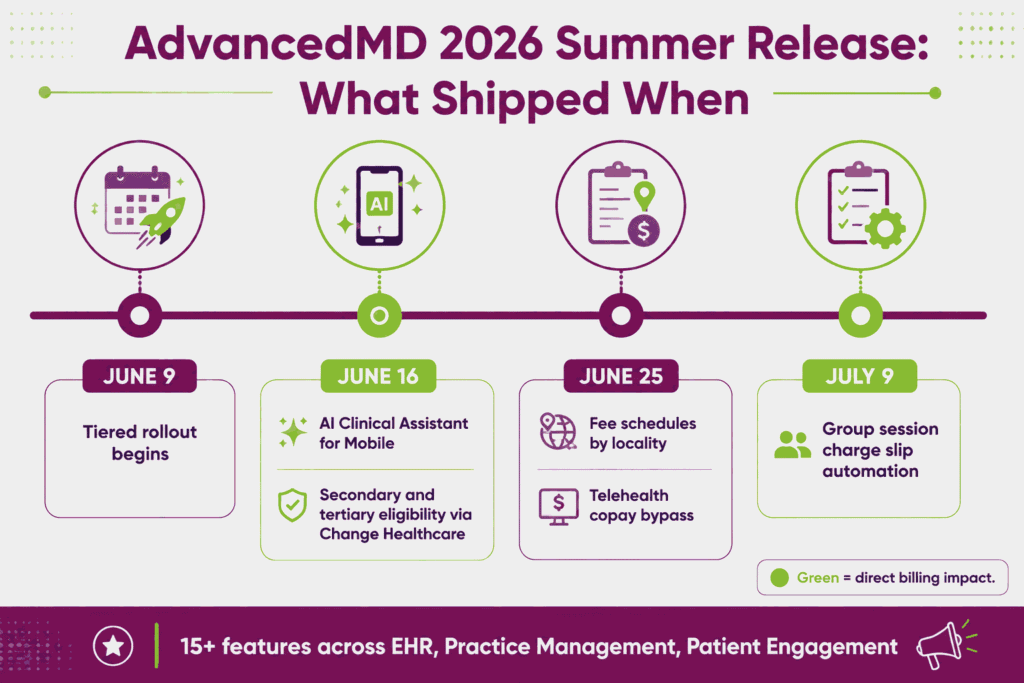
AdvancedMD released more than 15 new features on a tiered schedule across June 9, 16, and 25 of 2026. The release touched all three core application groups.
Changes with direct billing impact:
- Eligibility checks now verify secondary and tertiary insurance through Change Healthcare, with results shown on the eligibility detail screen and the patient insurance card
- Fee schedules by locality let your practice set charge and allowable amounts by locality, facility, and carrier combination
- Group-level coding assigns CPT and ICD-10 codes once per group session, then applies them to every patient after approval
- Automated charge slip generation for group sessions became available July 9, 2026
- Telehealth copay bypass allows patients to request a copay skip during the pre-call workflow, subject to front-office approval
Secondary and tertiary eligibility verification carries the largest denial impact. Coordination of benefits errors drive a persistent share of preventable denials in multi-payer practices.
What Clinical And Practice Management Features Does AdvancedMD Include?
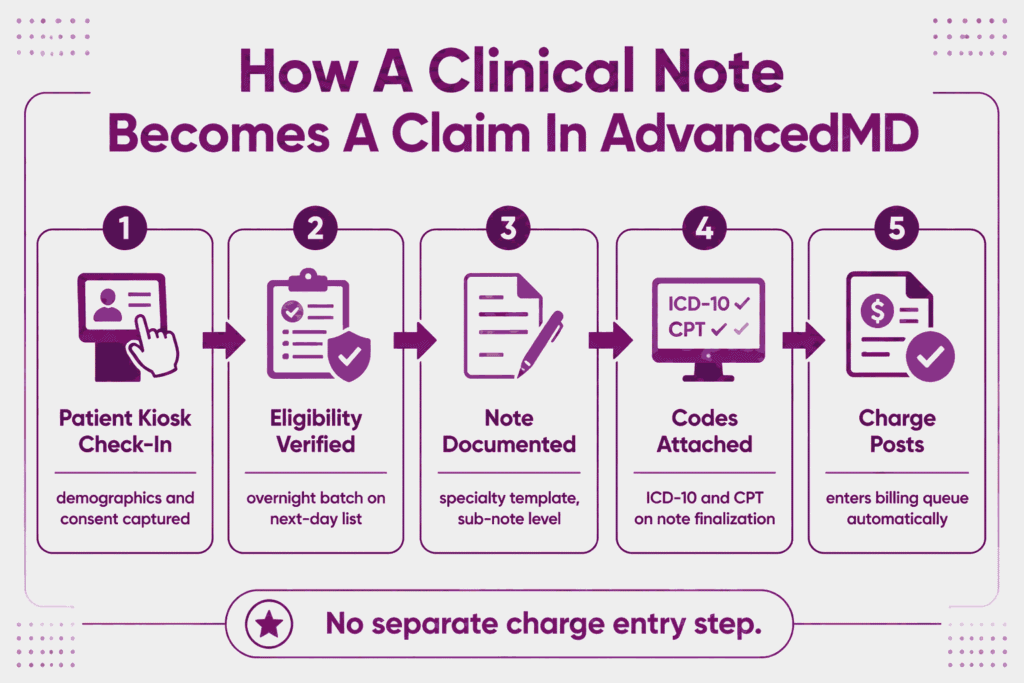
Clinical documentation quality decides coding quality inside AdvancedMD. Charges generate from finalized notes, so template configuration controls what reaches your claim. Front-desk setup carries the same weight.
AdvancedMD functions as PM and EHR software rather than two connected systems. Scheduling, charting, and charge capture share one patient record.
How Does AdvancedMD EHR Handle Clinical Documentation?
AdvancedMD EHR features center on customizable specialty templates with note and sub-note level editing. Template depth varies by specialty, and thin templates produce coding gaps.
The clinical module includes:
- Specialty templates covering more than 20 medical specialties
- Electronic prescribing, plus EPCS for controlled substances
- eMAR for medication administration records
- Patient Cards and Patient Charts for chart-level navigation
- Remote Patient Monitoring and Immunization Reporting
- Electronic faxing, billed per transmission
Providers finalize a note with ICD-10 and CPT codes attached. The charge posts to the billing queue at that moment, with no separate charge entry step.
What Scheduling Features Does AdvancedMD Provide?
AdvancedMD scheduling drives front-end denial prevention more than calendar convenience. Registration errors captured at check-in surface later as claim rejections.
Scheduling and front-office modules include:
- Multi-view scheduling by day, week, and month with color-coded appointment types
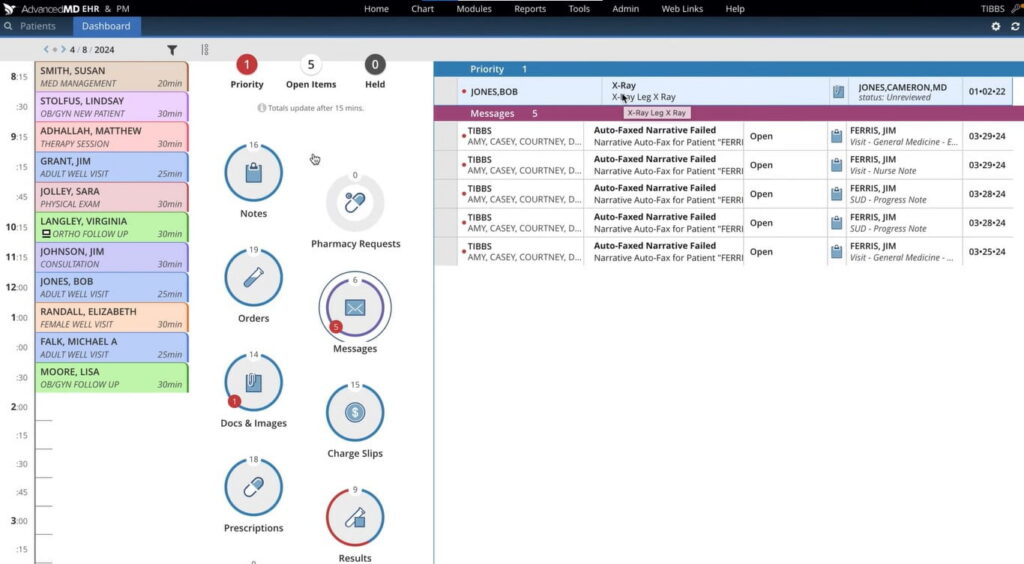
- Donut Dashboard, the color-coded workload view AdvancedMD built for task triage
- Patient Kiosk check-in on iPad, pushing consent forms into the chart
- Appointment reminders by SMS and email
- Patient Room Tracking for in-office patient flow
What Does The AdvancedMD Patient Portal Let Patients Do?
The AdvancedMD patient portal handles self-scheduling, payments, intake forms, and two-way messaging. Patient-side payment capture reduces statement cycles and post-visit balance chasing.
Portal functions cover appointment self-scheduling, copay and balance payment, consent form completion, secure messaging with staff, and patient education delivery. Practices requiring telehealth copays gained a provider-approved bypass option in the 2026 Summer Release.
Does AdvancedMD Have A Mobile App For Providers?
Yes, AdvancedMD publishes mobile apps for iOS and Android with chart and billing access. The AI Clinical Assistant for Mobile arrived in June 2026, bringing ambient transcription to handheld devices.
Which AdvancedMD Features Drive The Billing And Claims Workflow?
Five modules carry the AdvancedMD billing workflow. ClaimInspector determines your first-pass acceptance rate more than any other single component.
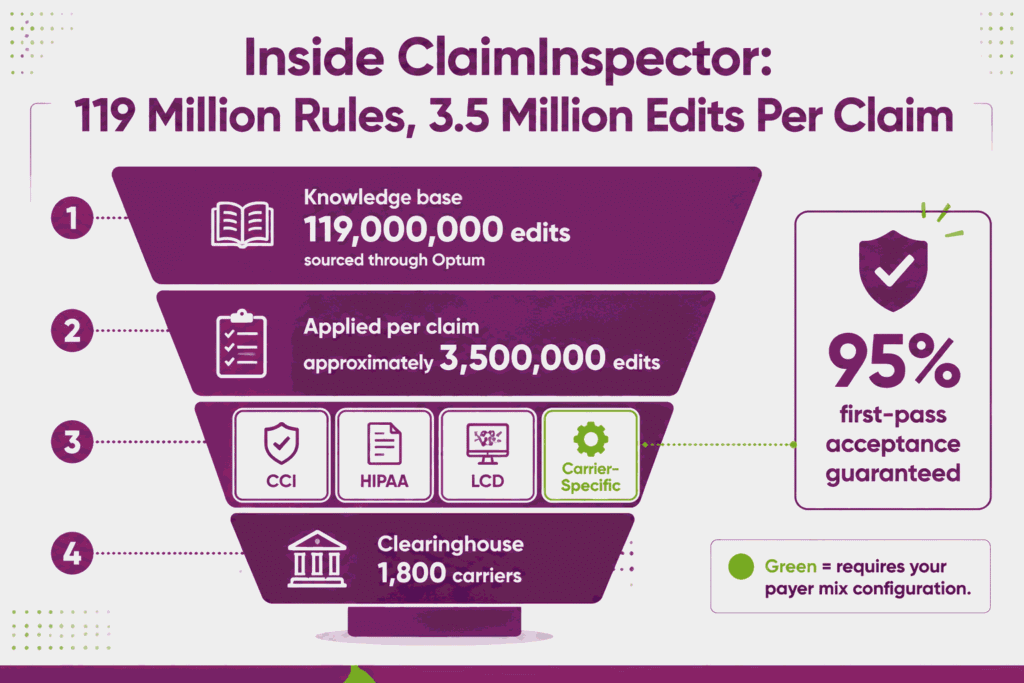
AdvancedMD guarantees a 95% minimum first-pass clean claim acceptance rate to billing service partners. Reaching that number depends on rule configuration, not on the software alone.
What Does ClaimInspector Check Before A Claim Is Submitted?
ClaimInspector screens each claim against approximately 3.5 million edits. Those edits draw from a knowledge base of 119 million government and third-party industry rules. AdvancedMD sources that knowledge base through Optum.
Most published AdvancedMD reviews conflate the two figures. The 119 million number describes the total rule library. The 3.5 million number describes edits applied per claim.
ClaimInspector edit categories:
- CCI edits covering National Correct Coding Initiative procedure-to-procedure pairs
- HIPAA edits covering transaction format and data element compliance
- LCD edits covering Local Coverage Determination medical necessity rules
- Carrier-specific requirements configured against your actual payer mix
Each edit is individually controlled. Generic rule sets miss payer-specific edits and release preventable denials into the clearinghouse.
How Does Claims Center Track Claim Status And Worklists?
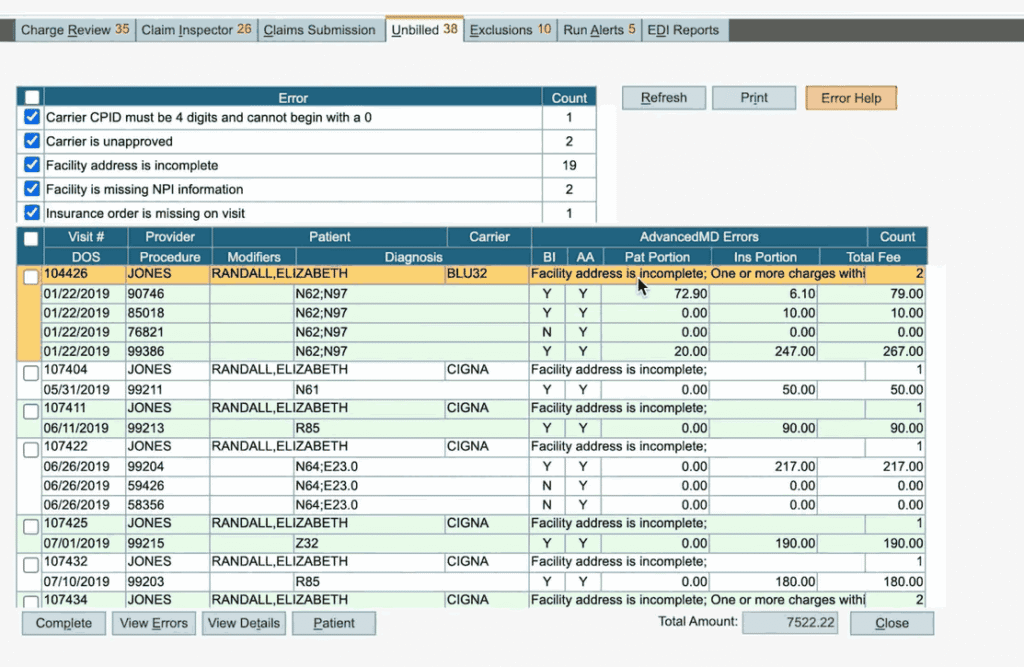
Claims Center organizes end-to-end claim processing with auto-generated worklists. Unbilled claims and clearinghouse exclusions sort into prioritized queues automatically.
Billing staff work the queue rather than hunting individual claims. Worklists surface incomplete facility addresses, missing NPI information, and unapproved carriers before resubmission. Claim status tracking runs against payer responses inside the same dashboard.
What Eligibility Verification Features Are Built In?
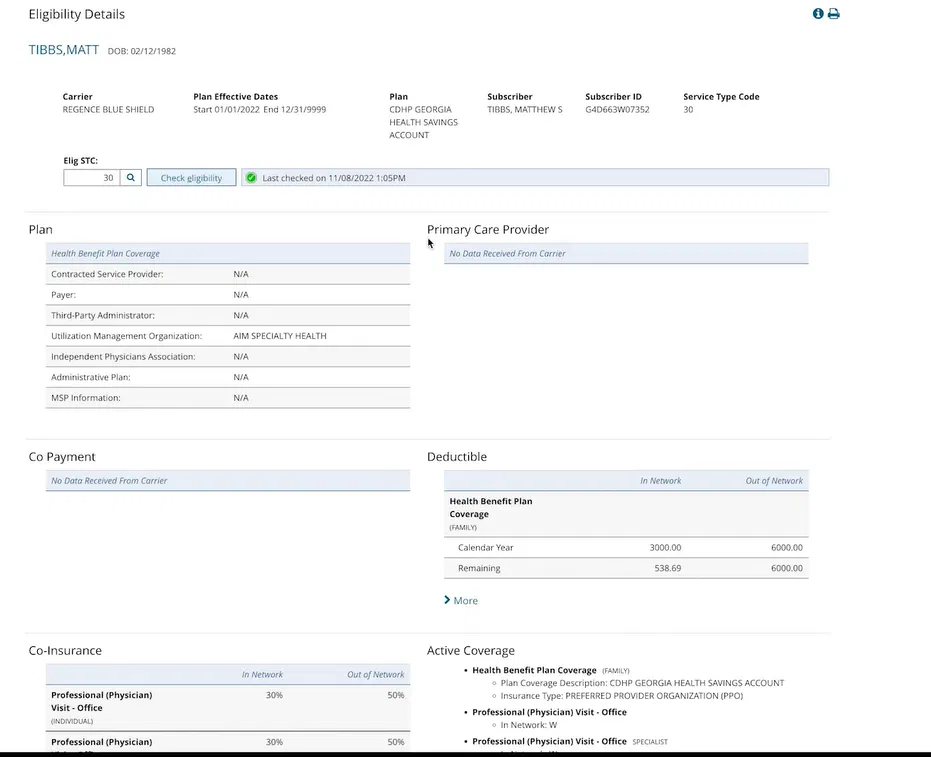
AdvancedMD runs eEligibility as an automated batch check against the next-day patient list. Verification completes overnight, before patients arrive.
The 2026 Summer Release added secondary and tertiary insurance verification through Change Healthcare. Results display on the eligibility details screen and on the patient insurance card. Coverage status indicators appear at the patient level, and staff read them during check-in rather than during billing.
How Do ERA Posting And Denial Queues Work Inside AdvancedMD?
Electronic Remittance Advice auto-posts payer payments against submitted claims. Manual EOB entry and patient payment capture run in the same module.
Denial handling inside AdvancedMD covers:
- Intelligent denial queues with root cause categorization
- Workflow triggers separating missing-information denials from medical necessity denials
- Payer-specific appeal templates that auto-populate patient and claim data
- A/R Control Center for aging buckets by payer, provider, and location
- Period Close Automation for month-end reconciliation
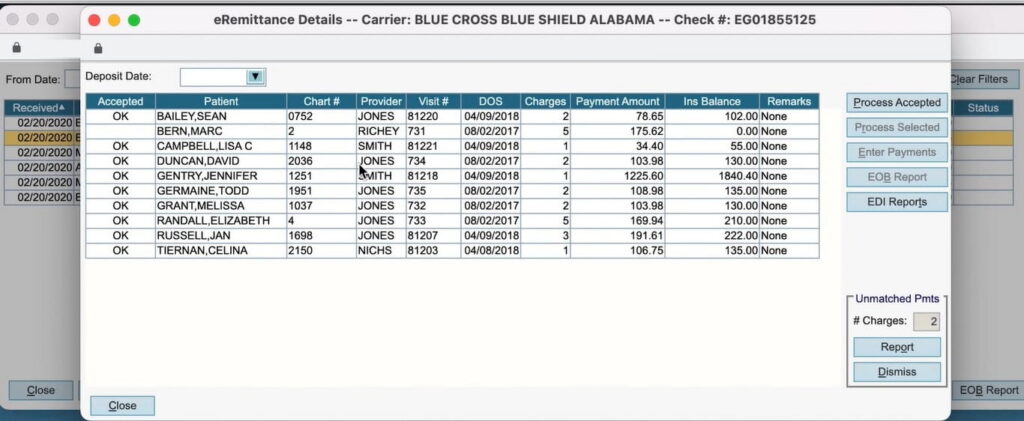
Payment reason code mismatches represent the most common posting failure. Unbalanced reason codes block period close until staff correct them at the line level.
What Does The Central Billing Office Feature Do For Billing Companies?
Central Billing Office provides single sign-on access across every client database. AdvancedMD built the feature specifically for third-party billing companies.
More than 850 medical billing companies run AdvancedMD under this model, according to AdvancedMD company statements from June 2026. Billing staff switch between client practices without separate logins. AdvancedMD also operates the AdvancedBiller Grow partner program and an AdvancedBiller Marketplace listing.
What AI Features Does AdvancedMD Offer In 2026?
AdvancedMD AI features concentrate in clinical documentation, not in claim decisioning. The AI Clinical Assistant drafts notes. Claim adjudication logic remains rules-based.
That boundary matters for billing teams evaluating AdvancedMD software features. No AI component predicts denials, prices claims, or selects codes independently.
What Does The AdvancedMD AI Clinical Assistant Do?
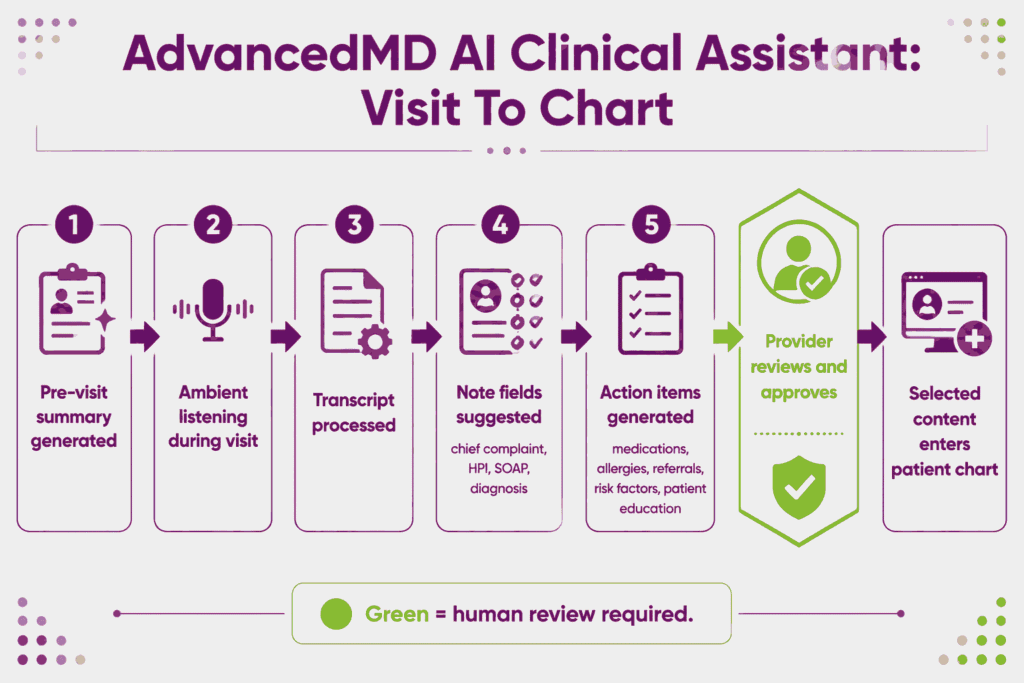
The AI Clinical Assistant performs ambient listening, transcription, and action item generation from patient visits. AdvancedMD launched the desktop version in early 2026 and the mobile version in June 2026.
Capabilities released through the 2026 Summer Product Release:
- Pre-visit summaries generated before the encounter
- Ambient listening and transcription during the visit
- Note field suggestions for chief complaint, history of present illness, SOAP notes, and diagnosis
- Five action item categories: medications, allergies, referrals, risk factors, and patient education
Users control what the AI Clinical Assistant records and what enters the patient chart.
Does AdvancedMD Generate SOAP Notes Automatically?
Yes, with provider review required. The AI Clinical Assistant suggests SOAP note field values from the visit transcript. Providers insert or reject each suggestion. Unreviewed AI output attached to billed codes creates documentation audit exposure.
Which Billing Tasks Does AdvancedMD Automate Without AI?
AdvancedMD automates most billing tasks through deterministic rules rather than AI. Rules-based automation produces repeatable output that survives a payer audit.
| Task | Mechanism | AI involved |
|---|---|---|
| Claim scrubbing | ClaimInspector rule engine, Optum knowledge base | No |
| Eligibility checks | eEligibility batch run via Change Healthcare | No |
| Payment posting | ERA auto-posting against submitted claims | No |
| Worklist generation | Claims Center queue logic | No |
| Clinical note drafting | AI Clinical Assistant transcript analysis | Yes |
Billing teams evaluating AdvancedMD EMR features should read the AI marketing against this split. The revenue cycle runs on rules.
What Reporting And Analytics Features Come With AdvancedMD?
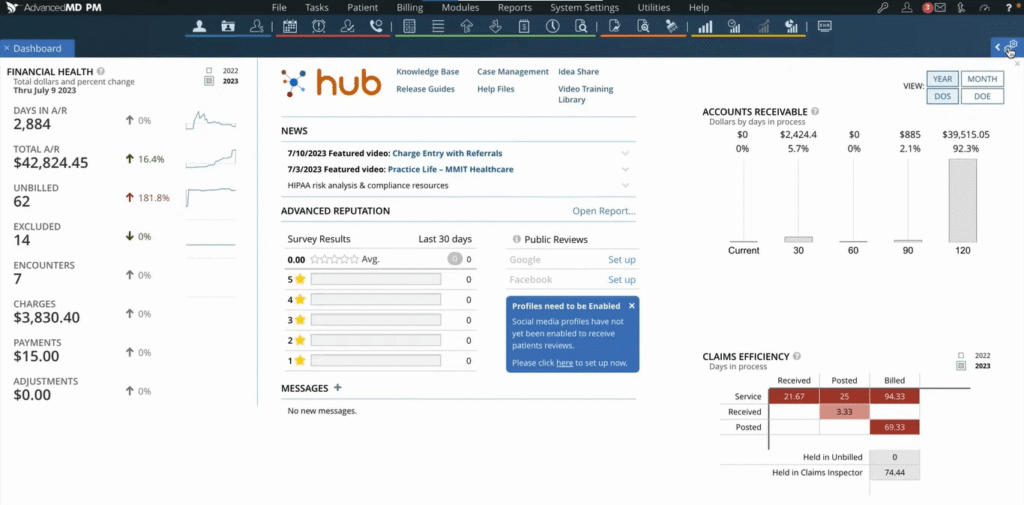
AdvancedMD reporting delivers more than 650 pre-designed report templates plus custom report building. Depth is not the constraint. Extracting the right view is.
AdvancedMD functions as medical records management software with a reporting layer attached. Real-time dashboards filter by provider, payer, location, and date.
Which Financial Reports Are Available Out Of The Box?
Standard AdvancedMD reports cover A/R aging, denial rates, reimbursement trends, and collections by total RVU. Drag-and-drop tools build custom reports with charts.
Reporting limitations that surface for larger practices:
- Standard reports lack payer-level granularity for detailed contract analysis
- Historical claim status reports require multiple navigation steps
- Certain provider-level KPIs need workarounds to build
- Report scheduling runs daily, weekly, or monthly only
Can Practices Pull Raw AdvancedMD Data For External Analysis?
Yes, through ODBC. Open Database Connectivity provides direct read-only access to practice data, and AdvancedMD offers a Data Warehouse option alongside it. Both require SQL skills that most in-house billing teams do not hold.
Which AdvancedMD Features Are Add-Ons Rather Than Standard?
AdvancedMD sells modules a la carte through a build-a-bundle model. Several capabilities buyers assume are included carry separate line items.
The table below shows add-on status only. Confirm current line items against your quote, since packaging changes by contract and practice size.
| Feature | Typical status | Who it affects |
|---|---|---|
| Claims Management and ClaimInspector | Standard in billing module | All billing staff |
| Advanced reporting and analytics | Add-on | Practices needing payer-level analysis |
| Appointment reminders | Add-on | Front office, no-show reduction |
| Telehealth | Add-on | Practices billing virtual visits |
| Patient engagement suite | Add-on | Portal-heavy practices |
| Social Reputation management | Add-on | Practices managing online reviews |
| API access | Add-on | Practices connecting external systems |
| Electronic faxing | Per-transmission fee | High-referral specialties |
| eEligibility | Add-on in some configurations | Every practice with payer mix complexity |
| Lab interfaces | Add-on per interface | Practices ordering diagnostics |
Feature audits happen after go-live at most practices. That sequence produces budget surprises during the first renewal cycle.
How Does The Build-A-Bundle Model Change What You Pay For?
Build-a-bundle lets your practice stack individual modules instead of buying a fixed package. AdvancedMD also offers per-encounter licensing as an alternative to per-provider pricing.
Low-volume practices benefit from per-encounter terms. Practices with many part-time providers benefit from the same structure. Full pricing detail sits on the AdvancedMD EHR guide rather than this page.
Is Telehealth Included In The Base AdvancedMD Subscription?
No, telehealth is a separate line item. Virtual visits embed directly into the patient chart, so documentation and billing run in one workflow. The workflow advantage is real. The cost sits outside the base subscription.
What AdvancedMD Integrations And APIs Are Available?
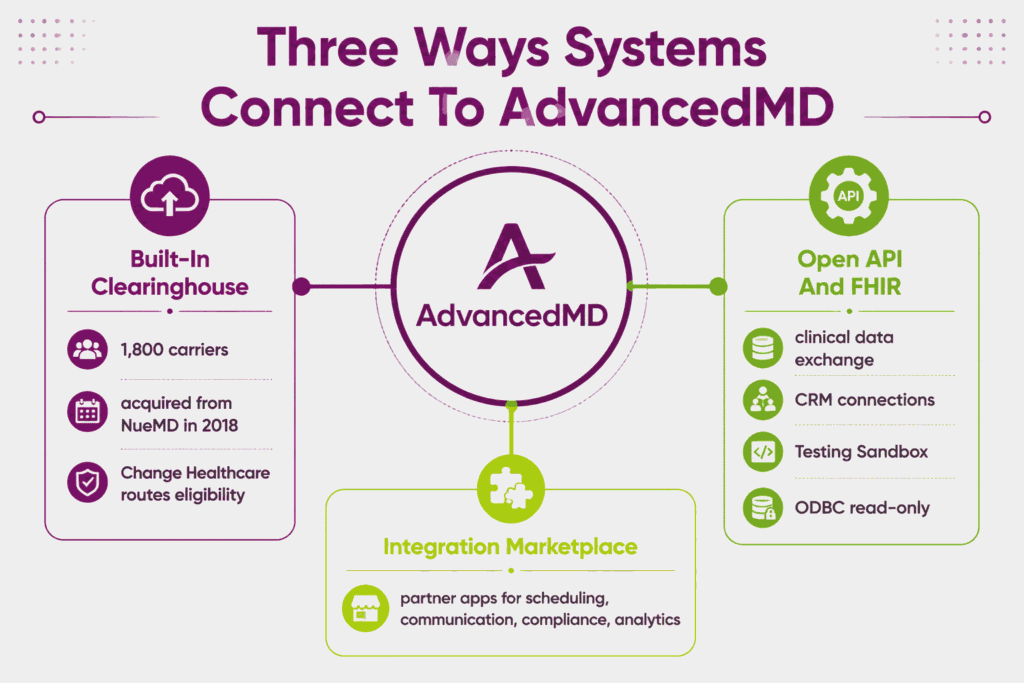
AdvancedMD integrations run through three routes: the built-in clearinghouse, the open API layer, and the Integration Marketplace. Each route serves a different connection type.
The AdvancedMD clearinghouse connects to 1,800 of the largest United States insurance carriers. AdvancedMD acquired that clearinghouse capability from NueMD in 2018. Change Healthcare handles eligibility transaction routing, confirmed in the 2026 Summer Release documentation.
The AdvancedMD marketplace lists partner applications across scheduling, patient communication, compliance, and analytics categories.
What Can Developers Access Through The AdvancedMD API?
The AdvancedMD API provides open API architecture plus FHIR-based clinical data access. AdvancedMD publishes a Testing Sandbox for development against live-equivalent structures.
Access methods available to developers:
- Open API architecture for third-party application connections
- FHIR endpoints for clinical data exchange
- CRM connections for practice growth tooling
- HIE and CIE links for regional data sharing
- ODBC for read-only reporting extracts
How Do AdvancedMD Features Compare To Kareo, athenahealth, And eClinicalWorks?
AdvancedMD separates from the field on clearinghouse ownership and multi-client billing access. Feature parity is close everywhere else in the independent practice segment.
Three axes distinguish AdvancedMD features from competing platforms:
- Clearinghouse ownership. AdvancedMD routes claims through a proprietary clearinghouse connected to 1,800 carriers. Several competitors depend on third-party routing.
- Central Billing Office. AdvancedMD supports single sign-on across client databases, purpose-built for billing companies. Competing platforms handle multi-client access less directly.
- Add-on structure. AdvancedMD unbundles more capability than competitors that ship fixed tiers, which shifts cost predictability onto the buyer.
Platform selection depends on specialty, payer mix, and practice size rather than on feature counts.
Which Feature Gaps Show Up Most Often In AdvancedMD Reviews?
Five gaps appear repeatedly across AdvancedMD user reviews and support discussions. None represent dealbreakers. All affect daily billing work.
- Medical record attachment to electronic claims is not supported inside the platform
- Carrier file data dropouts occur after platform updates, requiring manual re-entry into master files
- Browser compatibility problems affect paper claim printing on Chrome and Mac
- Report customization requires workarounds for payer-level and provider-level KPIs
- Support responsiveness draws consistent criticism, with no dedicated account manager on standard accounts
Practitioner discussion threads rank on the first page for AdvancedMD review queries. Honest failure-mode documentation stays scarce across vendor and directory content.
How Does Transcure Configure AdvancedMD Features For Better Collections?
Configuration decides collections performance on AdvancedMD, not feature availability. Most in-house teams run default rule sets against a payer mix those rules never anticipated.
Transcure operates inside the AdvancedMD instance your practice already runs. Four workstreams carry the engagement:
- Feature audit. Documentation of base-included versus add-on modules, mapped against what your billing team actually uses.
- ClaimInspector rule tuning. CODIN configures edit logic against your real payer mix and coding patterns instead of generic defaults.
- Denial queue configuration. DEXA builds root cause categorization and payer-specific appeal templates, with ELIXA running eligibility verification ahead of the visit.
- Reporting build. Custom dashboards constructed around your practice KPIs rather than default report templates.
Results across the AdvancedMD client base hold at 99% first-pass acceptance and A/R days under 30. Certified billers number 1,100 across the delivery team. Speak with an AdvancedMD billing specialist about your current configuration.
Do AdvancedMD Features Support Practices With More Than 50 Providers?
Partially, AdvancedMD serves solo practitioners through mid-sized groups, with typical deployments between 2 and 50 providers. AdvancedMD also supports MSOs, IPAs, ACOs, and billing companies through Central Billing Office and Multi-location Management.
Above roughly 50 providers, reporting granularity and support responsiveness become the binding constraints rather than feature coverage. Enterprise practices needing payer-level contract analysis supplement AdvancedMD reporting with external tools through ODBC or the Data Warehouse option. Practices comparing platforms should review how the billing workflow runs inside AdvancedMD before evaluating individual modules
Frequently Asked Questions About AdvancedMD Features
What Are The Core AdvancedMD Features For Medical Billing?
Claims Management, ClaimInspector scrubbing, eEligibility verification, Electronic Remittance Advice posting, A/R Control Center, and Central Billing Office. These six modules carry the revenue cycle from charge entry through collections.
Is AdvancedMD An EHR Or A Practice Management System?
Both, as AdvancedMD combines EHR, practice management, and patient engagement applications on one database with one login. Practices license the application groups separately.
Does AdvancedMD Include A Built-In Clearinghouse?
Yes, AdvancedMD owns a proprietary clearinghouse acquired from NueMD in 2018. The clearinghouse connects to 1,800 of the largest United States insurance carriers.
What Are AdvancedMD EHR Features That Most Practices Underuse?
Custom report building, ClaimInspector rule tuning, denial queue categorization, and ODBC data access. Each requires configuration work that default onboarding does not cover.
Does AdvancedMD Have An API?
Yes, AdvancedMD publishes an open API architecture with FHIR-based clinical data access, CRM connections, and a Testing Sandbox for development. API access carries add-on pricing.
Which AdvancedMD Features Cost Extra?
Telehealth, advanced reporting, appointment reminders, patient engagement, Social Reputation, API access, and lab interfaces. Electronic faxing bills per transmission. Confirm current line items against your specific quote.
Does AdvancedMD Support Telehealth Natively?
Yes, as a paid add-on. Virtual visits embed inside the patient chart. Scheduling, documentation, and billing run in one workflow with no separate platform login.
Who Owns AdvancedMD?
Francisco Partners. The firm acquired AdvancedMD from Global Payments in October 2024 for $1.125 billion. Amanda Sharp serves as chief executive officer.
What AdvancedMD AI Features Shipped In 2026?
The AI Clinical Assistant and AI Clinical Assistant for Mobile. Both deliver pre-visit summaries, ambient transcription, and note field suggestions. Five action item categories cover medications, allergies, referrals, risk factors, and education.
Can A Billing Company Manage Multiple Clients In AdvancedMD?
Yes, the central Billing Office provides single sign-on across every client database. More than 850 billing companies operate on AdvancedMD under this model.