
Athenahealth is a cloud-based platform that combines an EHR, medical billing, and patient engagement tools in one system, called athenaOne. The platform runs on a network of more than 160,000 providers and won the 2026 Best in KLAS award for Ambulatory EHR among independent practices with 11 to 75 physicians.
Athenahealth does not charge a flat subscription fee like most EHR vendors. Instead, pricing starts near $140 per provider per month and typically moves between 4% and 8% of a practice’s monthly collections. The final number depends on practice size, specialty, patient volume, and which modules you select.
This guide breaks down how athenahealth pricing works, what drives the cost up or down, and what the software adds on top of the base fee. It also covers the RCM and billing side of the equation, since software cost and billing cost are two different budget lines.

How Much Does athenahealth Cost?
Athenahealth pricing starts around $140 per provider per month, with an additional 4% to 8% of monthly collections layered on top, according to third-party industry benchmarks. Athenahealth itself does not publish this figure directly, so treat it as a documented estimate rather than a confirmed rate card.
Is athenahealth free? No. There is no free tier for athenaOne, and no free trial is currently offered.
Does athenahealth charge per provider? Partly. The base fee is quoted per provider per month, but the larger cost driver is the percentage of collections layered on top, which scales with revenue rather than headcount.
Beyond the base subscription, industry cost breakdowns list several additional expenses practices should budget for:
| Cost Item | Estimated Range | What It Covers |
|---|---|---|
| Implementation and setup | $15,000 – $40,000 | System deployment, workflow configuration, practice-specific customization |
| Data migration | $500 – $25,000 | Moving patient records and legacy system data, scaled by volume and complexity |
| Training and onboarding | $500 – $5,000 | Provider education, staff training, workflow adoption support |
| Integrations and order transmission | Starts at $150/month, plus $0.45 – $1.00 per order | Connecting labs, imaging, and other third-party order transmission |
| Specialty-specific configuration | Varies by specialty | Advanced templates for behavioral health, cardiology, orthopedics, and dermatology |
| Ongoing premium support | $2,000 – $10,000 annually | Enhanced support, reporting assistance, dedicated account management |
Why the percentage-of-collections model exists: athenahealth positions its own revenue as tied to the practice’s revenue. A slow month costs the practice less in software fees. A strong month costs more, since athenahealth’s fee scales with what the practice actually collects.
What Is Included in athenaOne Pricing?
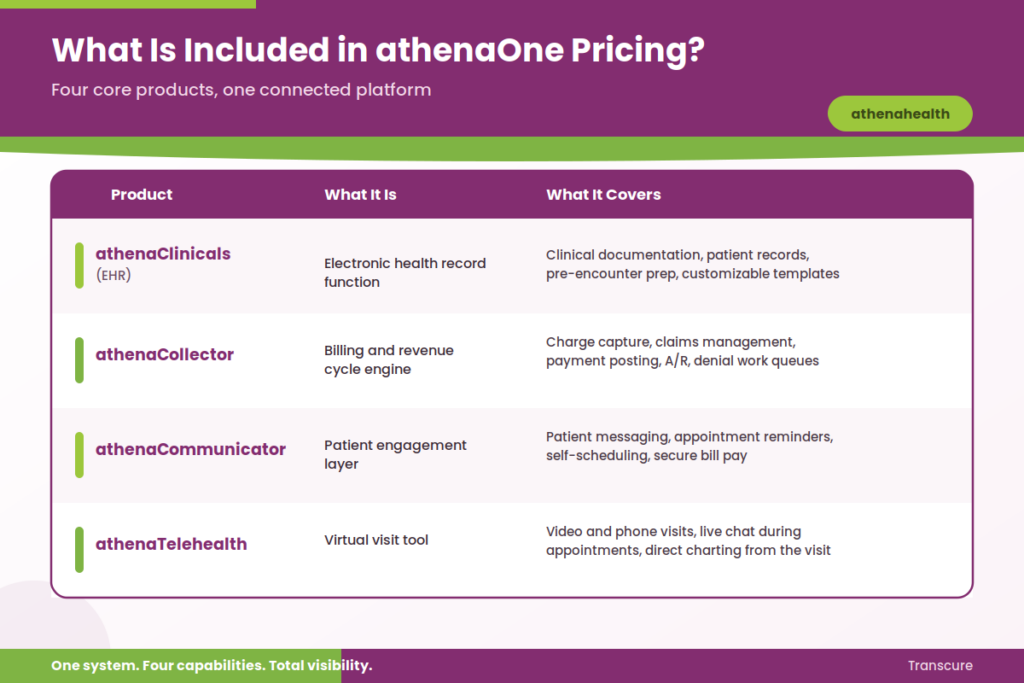
Athenahealth built athenaOne from three core products working as one system, plus a dedicated telehealth layer. Practices sometimes hear these by name, since each still functions as a distinct capability inside the platform. Our athenahealth features guide covers each piece in full detail.
| Product | What It Is | What It Covers |
|---|---|---|
| athenaClinicals (EHR) | Electronic health record function | Clinical documentation, patient records, pre-encounter prep, customizable templates |
| athenaCollector | Billing and revenue cycle engine | Charge capture, claims management, payment posting, A/R management, denial work queues |
| athenaCommunicator | Patient engagement layer | Patient messaging, appointment reminders, self-scheduling, secure bill pay |
| athenaTelehealth | Virtual visit tool | Video and phone visits, live chat during appointments, direct charting from the visit |
Practices booked more than 3.8 million appointments through athenaOne’s self-scheduling tools in a recent 12-month period, per athenahealth’s own reporting. The billing engine behind athenaCollector runs on more than 30,000 claim-scrubbing rules, which is the main driver behind athenahealth’s clean-claim performance.
What Factors Affect athenahealth Pricing?
Because athenahealth prices on a base fee plus collections rather than one flat rate, several practice-specific variables shape your final cost.
| Pricing Factor | Why It Matters |
|---|---|
| Number of providers | The $140/provider/month base scales directly with headcount |
| Monthly collections | Sets the 4-8% variable fee under the collections-based model |
| Specialty | Behavioral health, cardiology, orthopedics, and dermatology need paid configuration add-ons |
| Data volume for migration | Drives the $500-$25,000 migration range |
| Integration needs | Order transmission and third-party connections add $150/month plus per-order fees |
| Support tier | Premium support and account management add $2,000-$10,000 a year |
A small dermatology practice with light integration needs will see a very different quote than a 15-provider multi-specialty group with heavy lab and imaging integrations. Athenahealth builds each quote around the practice’s actual profile rather than a generic tier.
athenaOne Pricing vs. Other EHR Platforms
To see how athenaOne compares, here’s a look at the pricing, implementation, and billing models of other leading EHR platforms.
| EHR Platform | Starting Price | Pricing Model | Implementation |
|---|---|---|---|
| athenaOne | ~$140/provider/month plus 4-8% of collections | Percentage of collections, RCM included | $15,000-$40,000 |
| eClinicalWorks | $449/provider/month (EHR only), $599 with practice management | Flat per-provider monthly fee | Varies by deployment size |
| ModMed (EMA) | $500 – $1,300/provider/month | Flat per-provider monthly fee, varies by specialty | Varies by deployment size |
| Kareo (now Tebra) | $49 – $799/provider/month | Flat fee, tiered by provider type and claim volume | Varies by deployment size |
| Epic | $100,000+ for small practices, scaling into the millions for hospital systems | Custom enterprise quote, license plus implementation | Often $50,000-$300,000+ |
Platforms like Epic, eClinicalWorks, ModMed, and Kareo generally charge flat, per-provider licensing fees instead of layering a collections percentage on top. That structure can cost less for high-revenue practices, since the fee doesn’t rise with collections. It can cost more for smaller or newer practices, since the fee stays fixed regardless of volume.
How Much Does athenahealth Medical Billing Cost?
Athenahealth’s base pricing covers the software and its built-in RCM tools. Medical billing costs go further, since practices still need staff or a partner to manage day-to-day billing work inside the system.
Costs to consider beyond the software fee:
- In-house billing staff salaries and training
- athenahealth RCM costs bundled into the collections percentage
- Outsourced athenahealth billing costs charged separately by a billing partner
- Ongoing premium support fees if you opt into dedicated account management
- Integration fees for order transmission to labs and imaging centers
athenahealth Billing Software vs. Outsourced Billing Services
Athenahealth provides the technology and the RCM infrastructure. A third-party billing company provides the people and specialized expertise needed to manage billing operations within that system. This distinction matters for practices searching for athenahealth billing services.
Independent billing partners work the same athenaOne system but bring dedicated, specialty-trained staff to handle denials, coding, and A/R follow-up daily. This is the same model Transcure uses across its broader EMR billing services, just applied specifically inside athenaOne. Our athenahealth medical billing guide explains how the EHR connects to the full revenue cycle.
What Does an athenahealth Billing Company Do?
An athenahealth billing company manages the day-to-day work inside athenaOne, so your staff can focus on patient care.
| Task | What It Involves |
|---|---|
| Eligibility verification | Confirming coverage and benefits before each visit |
| Charge entry and coding | Capturing services and applying CPT, ICD-10, and HCPCS codes |
| Claim creation and scrubbing | Building claims and checking them against payer rules |
| Claim submission and tracking | Sending claims and monitoring status through payment |
| Payment posting and reconciliation | Matching remittances to submitted claims |
| Accounts receivable follow-up | Working aging claims until they resolve |
| Denial management and appeals | Correcting and resubmitting denied claims |
| Patient billing | Generating statements and tracking balances |
Is athenahealth Worth the Cost?
Whether athenahealth is worth the cost depends on your practice’s size, growth stage, and comfort with a variable fee. Verified user reviews, based on 667 responses, give the platform a 3.9 out of 5 overall rating.
| Advantages | Potential Drawbacks |
|---|---|
| Integrated EHR, RCM, and patient engagement in one platform | Implementation can run $15,000-$40,000, a real barrier for small practices |
| 30,000+ rule billing engine reduces claim errors | 78% of reviewers flagged performance and speed issues in verified review sentiment data |
| Best in KLAS 2026 winner for independent ambulatory practices | 76% of reviewers found initial training and complexity challenging |
| 300+ app integrations through the Marketplace | Additional integrations add $150/month plus per-order fees |
| Aligned pricing model ties athenahealth’s revenue to the practice’s | Exact percentage isn’t published; requires a custom quote |
For high-collection practices, the percentage model can cost more over time than a flat-fee alternative. For newer or lower-volume practices, the same model can lower risk during ramp-up, though the upfront implementation cost is still a real consideration.
How to Reduce Your athenahealth Billing Costs
Software fees are only part of the story. How you handle denials, follow-up, and integrations often decides if you land on the low end or the high end.
| Action | Why It Lowers Cost |
|---|---|
| Reduce claim denials | Fewer resubmissions mean less staff time and faster collections |
| Improve clean-claim rates | Auditing coding accuracy regularly cuts rework before submission |
| Verify insurance before every appointment | Front-end checks catch coverage issues before they become denials |
| Plan data migration scope upfront | Keeps the $500-$25,000 migration range on the lower end |
| Right-size your integration list | Avoids paying per-order fees for connections you don’t actively use |
| Reduce A/R days | Consistent, prioritized follow-up speeds up collections |
| Outsource labor-intensive billing functions | Adds capacity without hiring when in-house bandwidth is limited |
Practices that outsource this work to a specialty-trained partner often see faster A/R recovery and fewer denials than teams managing it alone. This is where a partner like Transcure’s athenahealth billing services can support the practice without replacing the athenaOne system itself.
How to Choose an athenahealth Billing Services Company
Not every billing partner knows athenaOne equally well. Use this checklist to find one who already knows the system, not one still learning it on your time.
| Checklist Item | Why It Matters |
|---|---|
| Direct experience working inside athenaOne | Avoids a learning curve that slows down your billing |
| Certified, experienced billing specialists | Reduces coding errors and preventable denials |
| Strong coding expertise across CPT, ICD-10, HCPCS | Supports clean claims across your specific specialty |
| Proven denial management capabilities | Speeds up recovery on rejected or denied claims |
| Dedicated accounts receivable follow-up | Keeps aging claims from stalling collections |
| Specialty-specific billing experience | Matches your practice’s coding and payer complexity |
| Transparent reporting and dashboards | Gives visibility into performance, not a black box |
| Native integration with your athenaOne setup | Avoids migration and keeps your existing workflow |
Athenahealth Pricing FAQs
How Much Does athenahealth Cost per Month?
Pricing starts near $140 per provider per month, with an additional 4% to 8% of monthly collections layered on top, based on published industry cost analysis.
How Much Does athenaOne Cost per Provider?
The base rate is estimated at $140 per provider per month. Athenahealth does not confirm this figure publicly, so it should be treated as a documented estimate.
Does athenahealth Charge Implementation Fees?
Yes. Implementation and setup typically run $15,000 to $40,000, covering deployment, workflow configuration, and practice-specific customization.
How Much Does Data Migration Cost with athenahealth?
Data migration typically ranges from $500 to $25,000, depending on the volume and complexity of the records being transferred.
Are There Ongoing Support Fees?
Ongoing premium support and account management typically cost $2,000 to $10,000 annually, on top of the base subscription.
What Is Included in athenaOne Pricing?
The base pricing includes athenaClinicals, athenaCollector, athenaCommunicator, and athenaTelehealth, along with the revenue cycle management workflows built into the platform.
How Much Does athenahealth Medical Billing Cost?
Medical billing costs beyond the software fee depend on whether billing is handled in-house or outsourced, and on the pricing model of any outside billing partner.
Can I Outsource Billing If I Use athenahealth?
Yes. Practices can work with an independent billing partner that operates directly inside the existing athenaOne system alongside the built-in RCM tools.
Is athenahealth Worth the Cost for a Small Practice?
It depends on collections volume and growth stage. The percentage model lowers upfront software risk, but the $15,000-$40,000 implementation cost is a real factor for smaller budgets.
How Can I Reduce My athenahealth Billing Costs?
Focus on fewer denials, faster A/R follow-up, accurate coding, and right-sizing your integrations. Outsourcing labor-intensive billing tasks to a specialty-trained partner can also lower total cost.