Choosing an EHR for a gastroenterology practice is not the same as choosing one for primary care. GI providers spend their days moving between office visits and procedure suites, and a system built for general medicine rarely keeps up with that pace.
Endoscopy reports, biopsy tracking, colonoscopy screening intervals, and procedure coding all demand structure that a generic template cannot offer.
That gap is exactly why specialty gastroenterology software solutions exist. The right platform should feel like it was built by someone who has actually stood in an endoscopy suite, not by a vendor trying to stretch one template across every specialty in medicine.
Below, we look at the eight systems worth serious consideration in 2026, what sets each apart, and how to think through the decision for your own practice.
Why Generic EMRs Fall Short for GI Practices?
Most ambulatory EHR platforms were designed around office visits: a chief complaint, an exam, a plan, a prescription. Gastroenterology does not run on that structure alone. A single patient encounter might involve pre-procedure clearance, sedation documentation, an endoscopy report with images, pathology follow-up, and a recall schedule tied to screening guidelines.
When a practice tries to force that workflow into a generic template, documentation time balloons. Physicians end up finishing notes after hours, and coders struggle to pull the right CPT and ICD-10 codes from unstructured text. That downstream effect hits revenue directly, since incomplete or vague documentation leads to denied claims and delayed reimbursement.
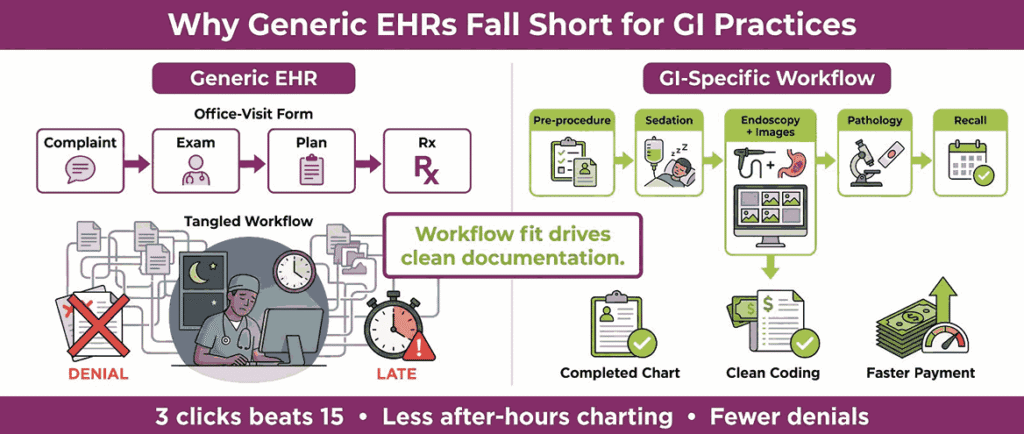
This is where the search for the best gastroenterology EHR becomes less about brand recognition and more about workflow fit. A system that documents an endoscopy in three clicks instead of fifteen is not a convenience. It is the difference between a physician who finishes charting by 6 PM and one still typing at 9 PM.
What to Look for in Gastroenterology Practice Solutions?
Before ranking specific platforms, it helps to define the criteria that actually matter for GI. Not every feature marketed as “specialty ready” holds up once you look closely.
- Endoscopy report writers. The system should generate structured, image-linked procedure reports without forcing manual re-entry of findings already captured during the exam.
- Registry integration. Look for direct connections to GIQuIC or similar quality registries, since MIPS and MACRA reporting depend on clean data flow.
- Procedure-based scheduling. GI schedules revolve around procedure slots, anesthesia coordination, and pre-op clearance, not the fifteen-minute office visit block most EHRs default to.
- Coding accuracy support. The best EMR for gastroenterology should flag missing modifiers, suggest correct CPT pairings for screening versus diagnostic colonoscopies, and reduce the manual coding burden. Practices that pair strong documentation with dedicated gastroenterology billing services tend to see fewer denials tied to vague or incomplete procedure notes.
- Interoperability. Pathology labs, imaging centers, and ambulatory surgery centers all need to exchange data without manual faxing or scanning.
- AI-assisted documentation. Ambient listening and AI charting tools have moved from novelty to expectation, particularly for practices trying to cut physician burnout.

The 8 Best Gastroenterology EMR Systems for 2026
If you are running a gastroenterology practice in 2026 and looking to upgrade your existing EMR for gastroenterology-specific practices, here is the list worth reading.
1. ModMed (gGastro EHR)

ModMed’s gGastro platform is purpose-built for gastroenterology, and it shows. The system includes a native Endoscopy Report Writer, structured templates for common GI procedures, and gScribe, an AI ambient listening tool that drafts documentation directly from the physician-patient conversation. It also interfaces with the GIQuIC registry, which simplifies MIPS reporting and clinical benchmarking considerably.
Black Book Research ranked gGastro the top gastroenterology EHR for 2026, and it also appeared as a leader in G2’s Spring 2026 grid reports for EHR software. For practices that want a system built exclusively around GI workflows rather than adapted from a general template, this is usually the first name that comes up in any serious comparison.
2. NextGen Healthcare

NextGen Enterprise offers customizable gastroenterology templates alongside integrated endoscopy reporting capabilities, and it has long been a familiar name in ambulatory care. Its strength lies in flexibility. Practices can adjust templates for their exact documentation style rather than working within a rigid, one-size-fits-all structure.
NextGen also connects well with billing workflows, which matters because documentation and revenue cycle management are never truly separate problems. A practice that struggles with claim denials often finds the root cause sitting in the EHR, not the billing office.
Working with a team experienced in NextGen billing support can help practices configure the system so that documentation, coding, and claims submission move together instead of working against each other.
3. athenaOne (athenahealth)

athenaOne combines cloud-based EHR functionality with built-in revenue cycle management, which appeals to practices that want fewer vendors to manage. Its gastroenterology-specific templates cover common procedures, and the platform’s population health tools help with recall tracking for screening colonoscopies, something easy to lose track of manually.
The cloud-native architecture also means updates and regulatory changes roll out automatically, without the IT overhead some on-premises systems require. For smaller practices without a dedicated IT department, that matters more than it might seem at first glance.
4. Epic Systems

Epic remains the dominant enterprise EHR, and its gastroenterology modules reflect the scale of the organizations that typically deploy it. Endoscopy tracking, advanced analytics, and deep interoperability across hospital systems make Epic a strong choice for GI departments operating inside larger health networks.
The tradeoff is complexity. Epic implementations are expensive and time-intensive, and independent practices rarely have the resources or the need for a system built at hospital scale. But for a GI division within a hospital system, Epic’s ability to share data seamlessly across departments, from pathology to radiology to primary care, is difficult to match.
5. Oracle Health (Cerner)

Oracle Health, formerly Cerner, offers a comprehensive platform with gastroenterology-specific workflows, imaging integration, and enterprise-wide data management. Like Epic, it is built for scale rather than for a small independent practice trying to move quickly.
Its procedural documentation tools support GI-specific findings and image linkage, and its population health capabilities extend well beyond a single practice into system-wide quality initiatives. Practices considering Oracle Health should expect a longer implementation timeline in exchange for that breadth.
6. ProVation MD

ProVation MD occupies a slightly different category than a full EHR. It is the industry standard for endoscopy documentation and procedure coding, and many practices pair it with a broader EHR rather than replacing one with the other. Its structured findings library, built directly from clinical evidence, speeds up procedure notes considerably.
For practices already satisfied with their core EHR but frustrated by weak procedural documentation, layering ProVation MD on top is often a more practical move than a full platform switch. It integrates with most major EHR systems rather than demanding an all-or-nothing commitment.
7. eClinicalWorks

eClinicalWorks offers a more affordable entry point for gastroenterology practices, particularly mid-sized groups watching their technology budget closely. It includes GI-specific templates, endoscopy scheduling tools, and a built-in telehealth option that has become increasingly relevant for pre-procedure consults and post-op follow-ups.
It will not match the depth of a purpose-built specialty platform like gGastro, but for practices prioritizing cost control over specialty depth, it remains a reasonable middle ground.
8. EndoSoft

EndoSoft is an endoscopy information management system designed specifically around GI procedural workflows, with strong interoperability across hospital information systems and existing EHR platforms. Voice recognition and structured reporting reduce the manual burden of writing up procedure findings, and its focus stays narrow and specific rather than trying to be everything at once.
Practices that need a dedicated procedural documentation layer, similar in spirit to ProVation MD but with its own distinct feature set, often find EndoSoft a strong complement to whatever core EHR they already run.
Quick Comparison: Best Fit by Practice Type
| EHR System | Best For |
|---|---|
| ModMed (gGastro EHR) | Independent GI practices and ambulatory surgery centers wanting deep specialty functionality with minimal customization |
| NextGen Healthcare | Multi-specialty groups that include gastroenterology among several service lines and need one flexible platform |
| athenaOne (athenahealth) | Practices wanting an all-in-one system combining clinical documentation with revenue cycle tools under one login |
| Epic Systems | Hospital-affiliated GI departments already operating within an Epic ecosystem |
| Oracle Health (Cerner) | Large health systems and academic medical centers with existing Oracle Health infrastructure |
| ProVation MD | Practices wanting best-in-class endoscopy documentation without abandoning an existing EHR |
| eClinicalWorks | Budget-conscious mid-sized practices needing solid GI functionality without enterprise pricing |
| EndoSoft | Ambulatory surgery centers and endoscopy suites needing a dedicated procedural documentation layer alongside their main EHR |
How to Choose the Best EMR for Gastroenterology Practices in 2026
With eight strong options on the table, the decision usually comes down to three practical questions rather than a simple feature checklist.
How Big Is the Practice, and Does It Stand Alone or Sit Inside a Hospital System?
Independent practices generally do better with specialty-built platforms like gGastro, while hospital-affiliated departments tend to inherit Epic or Oracle Health regardless of preference, since the surrounding system already runs on one of them.
Is the Priority Documentation Speed or Cost Control?
AI-assisted platforms with ambient listening cut documentation time significantly, but they usually come at a higher price point. Practices under tighter budget constraints may find eClinicalWorks or a hybrid setup, pairing a general EHR with a dedicated tool like ProVation MD, more realistic.
How Tightly Does the System Need to Connect to Billing and Coding?
This is where a lot of practices underestimate the stakes. A gastroenterology EHR that documents beautifully but does not translate cleanly into accurate coding still leaves money on the table. Reliable medical billing services depend on clean, structured documentation flowing directly into the claims process, and gaps here show up months later as denied claims and delayed payments.
None of these platforms is universally “best.” The best gastroenterology software for a five-physician independent group looks nothing like the best fit for a GI division inside a 400-bed hospital. Matching the platform to the practice’s actual structure, not just its feature wishlist, is what separates a smooth implementation from a painful one.
What is the Best Gastroenterology EHR for a Small Independent Practice?
For most independent GI practices, a specialty-built platform like ModMed’s gGastro tends to outperform general EHRs adapted for gastroenterology. It reduces documentation time and connects directly to quality registries without heavy customization.
That said, the platform choice only solves half the equation. Pairing it with dependable medical billing services ensures the documentation captured in the EHR actually converts into clean, timely claims.
Do I Need a Separate Endoscopy Documentation Tool if I Already Have an EHR?
Not always, but many practices find their core EHR handles office visits well while falling short on procedural documentation. Tools like ProVation MD or EndoSoft fill that gap without requiring a full platform switch.
Before adding another system, it is worth reviewing what your current EHR actually supports and where the coding gaps are showing up in denied claims.
How does NextGen Support Gastroenterology Billing Specifically?
NextGen’s customizable templates help standardize documentation across GI procedures, but the billing side often needs additional configuration to run smoothly.
Practices working with a team that offers dedicated NextGen billing support typically see fewer coding errors and faster claim turnaround. Since the templates get tuned to match the exact CPT and modifier combinations gastroenterology billing requires.
Is Switching EHRs Worth the Disruption for a Busy GI Practice?
It depends on what is driving the conversation. If physicians are consistently finishing notes hours after clinic closes, or claim denials keep tracing back to incomplete documentation, the disruption of switching is usually smaller than the ongoing cost of staying put.
Practices considering a change often benefit from an outside review by a Transcure medical billing company, since a fresh set of eyes on both the clinical workflow and the billing process tends to reveal problems that are easy to miss from the inside.
What Should a Gastroenterology Practice Budget for a New EHR Implementation?
Costs vary widely depending on practice size and whether the platform is cloud-based or enterprise-scale. Specialty platforms built for independent GI practices tend to sit in a more accessible range than enterprise systems like Epic or Oracle Health, which are priced for hospital-level deployments.
Beyond the software cost itself, practices should budget time for staff training and a realistic transition period, since even the best EMR software for gastroenterology practices 2026 has to offer will slow workflows down temporarily during the switch.