Athenahealth is a cloud-based healthcare technology company founded in 1997. The main product, athenaOne, connects electronic health records, medical billing, and patient engagement in one platform. More than 170,000 clinicians across the United States use athenaOne today. athenaOne runs as a single-instance cloud service, so every practice uses the same version.
Athenahealth built athenaCollector first, releasing the billing and practice management software in 2000. Medical billing remains the foundation of the Athenahealth business. athenaClinicals and athenaCommunicator were added later to form the full athenaOne suite. This billing-first history shapes how athenaOne handles claims, coding, and collections.
This guide covers the main Athenahealth features across billing, clinical care, and patient engagement. The guide details athenaCollector revenue cycle tools, athenaClinicals EHR functions, AI capabilities, interoperability, pricing, and onboarding.

What Is Athenahealth, and How Does the athenaOne Platform Work?
athenaOne is Athenahealth’s cloud-based platform and athenahealth EHR software that combines an EHR, medical billing, and patient engagement in one system. Athenahealth has run athenaOne as a web-based service since the company started in 1997. Every athenaOne customer uses the same live version of the software.
The single-instance model means Athenahealth applies new features, security patches, and compliance updates automatically. Practices avoid server maintenance, manual upgrades, and version decisions. Athenahealth releases major features several times each year at no extra charge. The fall 2025 release alone added 185 new features and updates.
The following table shows the three core products inside athenaOne:
| Product | Function | What It Covers |
|---|---|---|
| athenaClinicals | Electronic health record | Clinical documentation, e-prescribing, orders, decision support |
| athenaCollector | Billing and revenue cycle | Claim scrubbing, denials, eligibility, and payment posting |
| athenaCommunicator | Patient engagement | Patient portal, reminders, scheduling, online payments |
athenaCollector, the billing product, was the first module Athenahealth released and anchors the platform.
The Athenahealth network gives every practice shared billing intelligence:
- More than 170,000 athena health providers use athenaOne across nearly 50 specialties.
- Network data covers claims patterns from thousands of payers nationwide.
- Athenahealth updates billing rules for all practices when a payer changes a policy.
What Are the Revenue Cycle Management Features of Athenahealth?
Athenahealth revenue cycle management runs through athenaCollector, the billing product inside athenaOne. athenaCollector manages the full revenue cycle from eligibility checks through claim submission, denial management, and payment posting. A network-driven rules engine catches claim errors before submission.
Athenahealth reports first-pass claim acceptance rates above 95% across the network. Practices that switch to athenaOne often see collections rise by up to 6%. Athenahealth also reports a similar drop in overhead costs after the switch. These figures come from Athenahealth network data.
How Does athenaCollector Handle Claim Scrubbing?
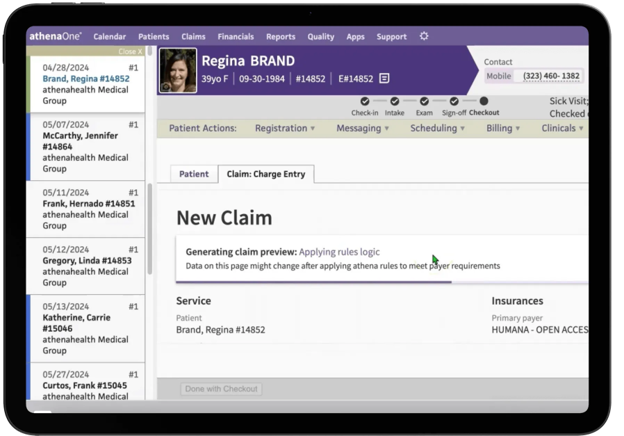
athenaCollector scrubs every claim against more than 30,000 rules before sending it to payers. Information from the medical record pre-fills the claim, which cuts manual data entry. The rules engine flags coding errors, missing data, and eligibility problems for correction.
The rules engine draws on data from the full Athenahealth network. When a payer changes a rule and causes denials, Athenahealth spots the pattern. Athenahealth then updates the rule for every practice, often before most notice the issue.
What Denial Management Features Does Athenahealth Offer?
Athenahealth denial management routes denied claims into work queues inside athenaCollector. Each denial shows a plain-language explanation of the likely issue. athenaCollector also gives a recommended next step, which speeds up coding-related fixes. Detailed denial codes and outstanding balances appear in the same view.
A biller works on an athenaCollector denial in three steps:
- Open the denial and read the plain-language explanation of the issue.
- Follow the recommended next step for that denial type.
- File a corrected claim or appeal before the timely-filing window closes.
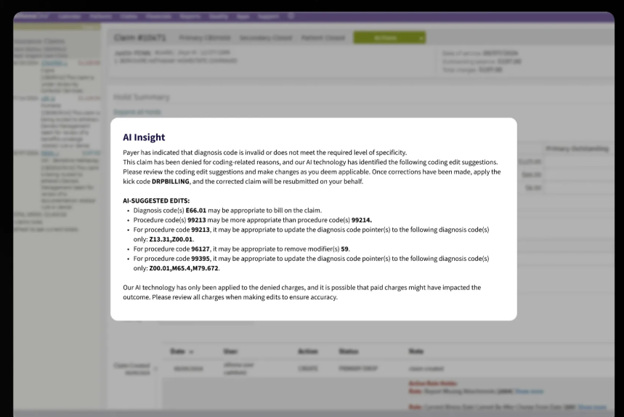
Practices that want more support can add athenaCollector Plus, a managed billing service. Athenahealth staff handles claim follow-up and appeals under athenaCollector Plus. Athenahealth leaves certain denial types for practices to work on their own. Athenahealth does not publish which denial types fall outside that support.
How Does Athenahealth Verify Insurance Eligibility?
Athenahealth checks patient insurance eligibility in real time before each visit. Real-time eligibility checks catch coverage problems that cause claim denials. Front-desk staff can correct patient details before the claim goes out. athenaCollector opens the patient profile for review ahead of the appointment.
Athenahealth includes several front-end tools that lower insurance-related denials:
- Automated Insurance Selection cut patient insurance denials by 7.4% on those claims.
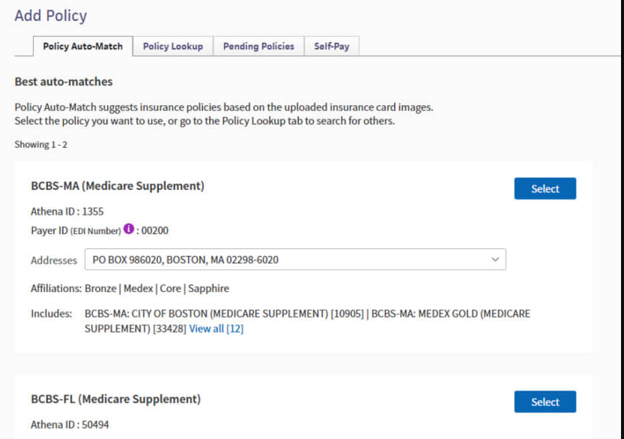
- Insurance Card Image Capture reduced rule holds by more than 30%.
- Insurance Card Image Capture also lowered denials by about 13%.
- Patients can send a photo of the insurance card by email or text on demand.
What Accounts Receivable and Payment Posting Tools Does Athenahealth Include?
Athenahealth organizes accounts receivable into worklists inside athenaCollector. Billers work the worklists by priority and claim age to keep days in A/R low. athenaCollector posts payments and reconciles electronic remittance advice from payers.
The Workflow Dashboard, now called the Non-Clinician Inbox, holds all billing tasks in one view. The dashboard groups tasks into buckets for missing charge slips, front-end scrubs, rejections, and denials. Billers work claims from the Hold buckets when the rules engine or a payer flags an error.
The Non-Clinician Inbox sorts billing work into task buckets:
| Bucket | Purpose |
|---|---|
| Missing Slips | Flags appointments that still need charge entry |
| Front-End Scrubs | Shows claims held by the rules engine before submission |
| Rejections | List claims a clearinghouse or payer rejected |
| Denials | Groups denied claims for correction or appeal |
Working each bucket to zero every day keeps days in A/R from climbing at quarter-end.
What Medical Coding Support Does Athenahealth Provide?
Athenahealth employs certified medical coders who capture the care delivered. Certified coders hold AAPC or AHIMA credentials and review codes for accuracy. AI-assisted coding suggests codes during documentation, which reduces coding errors. Third-party audits check coding quality against billing compliance standards.
The table below summarizes the core athenaCollector revenue cycle features:
| Feature | Function | Reported Impact |
|---|---|---|
| Claim scrubbing | 30,000+ rules check claims pre-submission | First-pass acceptance above 95% |
| Real-time eligibility | Verifies coverage before visits | Fewer coverage-related denials |
| Denial management | Work queues with next-step guidance | Faster denial resolution |
| A/R worklists | Prioritized outstanding-claim lists | Lower days in A/R |
| Certified coding | AAPC/AHIMA coders plus AI suggestions | Higher coding accuracy |
| athenaCollector Plus | Fully managed billing service | Reduced in-house billing workload |
Athenahealth billing services often center on these athenaCollector features for practices that outsource revenue cycle work.
What EHR Features Does athenaClinicals Offer?
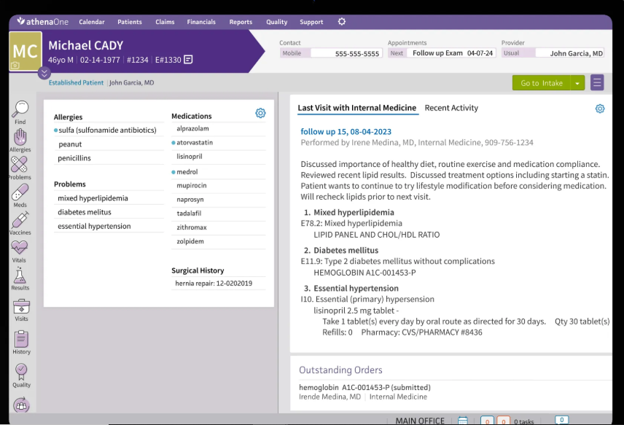
athenaClinicals is the athena EHR inside athenaOne. athenaClinicals uses specialty-specific templates and order sets for faster charting. A guided workflow walks clinicians through each step of the encounter note. Providers arrange charts with a widget-based design that fits how they work.
The guided encounter workflow moves through set documentation stages:
- Chief complaint and history of present illness (HPI)
- Review of systems (ROS)
- Physical exam findings
- Assessment and diagnosis
- Treatment plan and orders
athenaClinicals connects to labs, imaging centers, and pharmacies for electronic data exchange. E-prescribing includes EPCS for controlled substances. Clinical decision support surfaces guidelines during the visit. The athenaOne mobile app gives providers chart access, orders, and results on any device.
What Patient Engagement Features Does athenaCommunicator Offer?
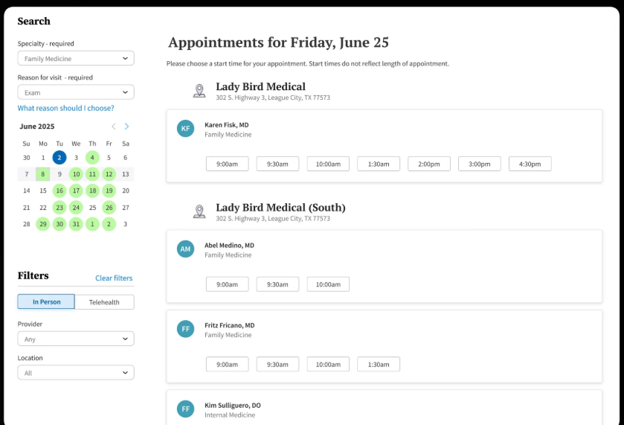
athenaCommunicator is the patient engagement product inside athenaOne. athenaCommunicator runs the patient portal, known as the athenahealth portal, and the athenaPatient mobile app. Patients view lab results, request refills, message providers, and pay bills online. The athenahealth app, athenaPatient, holds a 4.8-star rating and supports biometric login and self-scheduling.
athenaCommunicator includes patient-facing tools that shift work away from front-desk staff:
- Appointment reminders by voice, text, email, or app push notification
- Online self-scheduling and appointment confirmations sent right after booking
- Digital intake forms, demographic checks, and consent capture before the visit
- Insurance card capture and co-pay collection at check-in
- Telehealth visits, including group sessions and participant management
- Patient satisfaction surveys and online reputation tools
Pre-visit tools move insurance capture and co-pay collection to patients before arrival. Cleaner front-end data lowers insurance-related denials later in the billing cycle. Faster co-pay collection also raises the practice pay yield.
What AI Features Does Athenahealth Include?
Athenahealth calls the current athenaOne an AI-native platform. AI features install automatically and stay clearly labeled inside athenaOne. Practices toggle each AI feature on or off based on comfort. An Advanced Intelligence Layer connects data from EHRs, payers, and registries.
What Are Ambient Notes and athenaAmbient?
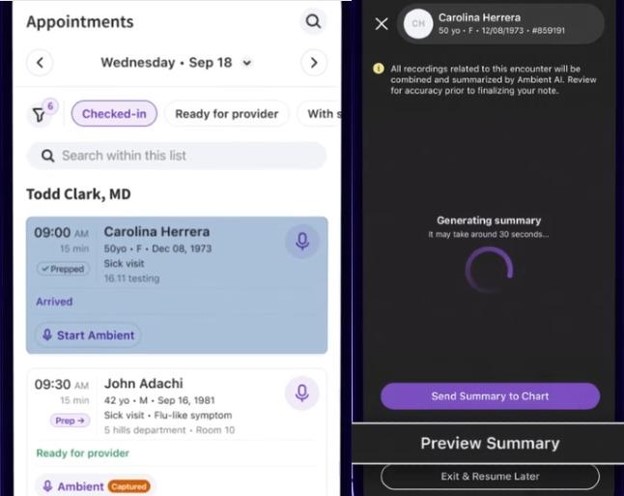
Ambient Notes is a marketplace product that launched in late 2024. Ambient Notes lets clinicians pick from several AI scribe models. Current models include Suki AI, iScribe AI, Abridge, and Microsoft Dragon Copilot. Ambient Notes now reaches more than 170,000 clinicians across nearly 50 specialties.
athenaAmbient is Athenahealth’s own first-party scribe, announced in November 2025. User testing began in February 2026, with general release expected mid-to-late 2026. athenaAmbient drafts notes, diagnoses, orders, and prescriptions from the visit at no extra cost.
Early athenaAmbient testing reported measurable time savings:
- Up to six hours per week saved on orthopedic surgery documentation
- An 18.5% rise in same-day encounter close rates in primary care
- 88% of clinicians reported a positive impact from Ambient Notes
How Does Athenahealth Use AI in the Revenue Cycle?
Athenahealth adds AI to several revenue cycle steps inside athenaCollector. The Time of Service workflow now shows an AI-determined copay amount at check-in. Accurate copay amounts reduce balance chasing after the visit. AI also drafts claims and helps select the right insurance for each claim.
Recent athenaOne releases added more AI to front-end billing work:
- AI filters spam and advertisement faxes out of staff queues
- AI reads plain-text documents and classifies ADT event types
- AI-generated document summaries flag the most important external records
What Are the athena AI Copilot and Sage?
The athena AI Copilot works as an in-app assistant for athenaOne users. The Copilot answers workflow questions and helps staff move through the software. Sage lets clinicians ask questions about a patient’s chart before or during the visit.
How Does Athenahealth Handle Interoperability?
Athenahealth shares clinical data across networks through several connection standards. Athenahealth takes part in CommonWell Health Alliance and Carequality. FHIR R4 APIs and Surescripts e-prescribing link athenaOne to outside systems. ChartSync pulls and reconciles outside patient problems directly in the chart.
Athenahealth interoperability features include:
- CommonWell and Carequality connections for hospital and lab data sharing
- TEFCA data sharing through the CommonWell Ellkay platform
- Direct Secure Messaging for provider-to-provider record exchange
- FHIR R4 APIs for connected third-party applications
- ChartSync for reconciling external problems, medications, and results
The Athenahealth Marketplace lists more than 250 pre-connected applications. Marketplace apps cover telehealth, analytics, specialty clinical tools, and revenue cycle add-ons. Apps connect to athenaOne through a certified API framework without custom development. Data flows in both directions between athenaOne and connected apps.
What Reporting and Analytics Features Does Athenahealth Provide?
Athenahealth shows practice performance through Insights Dashboards inside athenaOne. Dashboards benchmark a practice against similar practices on the Athenahealth network. Reports track billing metrics and clinical task productivity. A Customer Success Manager reviews the data and recommends corrective steps.
Athenahealth tracks these core revenue cycle metrics:
| Metric | What It Measures |
|---|---|
| Days in A/R | Average time to collect outstanding claims |
| Denial rate | Share of claims payers deny |
| First-pass yield | Claims paid on first submission |
| Net collection rate | Share of collectable revenue actually collected |
When a practice drops below baseline, the Customer Success Manager pinpoints where revenue leaks.
How Much Does Athenahealth Cost?
Athenahealth prices athenaOne mainly on a percentage-of-collections model. The percentage runs from about 4% to 8% of monthly collections. Athenahealth earns more only when the practice collects more. Athenahealth also offers an encounter-based pricing option for some practices.
The percentage-of-collections model includes clearinghouse fees and software upgrades. Athenahealth charges no separate fee for new features or version updates. High-revenue practices can find the percentage model costly at scale. Athenahealth does not publish a fixed public price list.
The table compares Athenahealth pricing models:
| Model | How It Works | Best Fit |
|---|---|---|
| Percentage of collections | 4% to 8% of monthly collections | Practices wanting aligned vendor incentives |
| Encounter-based | Flat fee per patient encounter | Practices with predictable visit volume |
The percentage model ties Athenahealth revenue to practice collections, which aligns both parties on billing results.
How Long Does Athenahealth Onboarding Take?
Athenahealth onboarding runs about 11 weeks for smaller practices. Larger organizations follow a timeline based on project scope. Onboarding moves through four phases from needs review to post-go-live support. Dedicated onboarding teams guide each practice through setup and training.
Athenahealth onboarding follows four phases:
- Review the organization’s needs and current billing setup.
- Configure processes, payer lists, and fee schedules.
- Train staff to at least 65% course completion before go-live.
- Provide ongoing support and performance coaching after go-live.
Practices set up a U.S. Bank account early for revenue cycle work. An onboarding workbook collects staffing details, payer lists, and fee schedules. Athenahealth offers certification badges in Revenue Cycle Management and other tracks. Staff earn Specialist badges by completing exam sets on the Learning Portal.
Go through the Athenahealth billing guide that walks through athenaOne revenue cycle workflows.
Who Can Manage athenahealth Billing Services for Your Practice?
Practices running athenaOne can manage billing in-house, add athenaCollector Plus, or outsource to a specialized partner. Transcure is a medical billing company that handles athenahealth billing services directly inside athenaOne. Transcure works within the existing athenaOne system, so practices skip data migration.
The earlier sections covered athenaOne billing features like claim scrubbing, denial queues, and eligibility checks. Running those workflows well takes trained staff and daily queue management. Transcure supplies athena-trained billers and AAPC-certified coders to handle that work.
What Does Transcure Handle Inside athenaOne?
Transcure runs full-cycle billing inside athenaOne, from patient intake to payment posting. AI-powered agents and AAPC-certified billers work at each stage of the revenue cycle. Certified coders apply CPT, ICD-10, and HCPCS codes for clean claims. Every task runs inside the practice athenaOne account, not a separate system.
Transcure handles these athenaOne billing tasks:
- Real-time eligibility and benefits verification before the visit
- Prior authorization checks and submission ahead of claims
- Charge entry and medical coding with AAPC-certified coders
- Claim scrubbing and submission, with reported 99.99% claim accuracy
- Denial management, correction, and resubmission inside work queues
- Payment posting and ERA reconciliation against submitted claims
- Accounts receivable follow-up on aging and high-value claims
- Patient billing, statements, and balance collections
- Weekly reporting on days in A/R and collection rates
Named AI agents run specific steps, such as eligibility, prior authorization, denials, and payment posting. Transcure also provides EMR billing services for other platforms like Epic and NextGen. Practices stay on athenaOne while Transcure works on the billing inside it.
How Does Transcure Compare to athenahealth’s In-House Billing?
athenahealth offers billing through athenaCollector and the managed athenaCollector Plus service. Transcure offers an outsourced model that works inside the same athenaOne system. The table below compares both options on five factors:
| Factor | athenahealth In-House Billing | Transcure |
|---|---|---|
| System | Native inside athenaOne | Works inside existing athenaOne, no migration |
| Billing expertise | General platform-wide support | Athena-trained specialists by specialty |
| AI and automation | Built-in rules engine | Rules engine plus dedicated AI billing agents |
| Cost | Around 7% of collections | 3% to 5% of collections |
| Reporting | Limited backend visibility | Real-time dashboards and KPI tracking |
The comparison shows Transcure competing mainly on lower percentage pricing, specialty expertise, and reporting visibility.
What results does the Transcure Report for Athena Practices?
Transcure reports measurable revenue cycle results for practices on athenaOne. These figures come from Transcure and reflect its own client data. Independent results vary by practice size, specialty, and payer mix.
Transcure reports the following outcomes for Athena practices:
- Up to 99.99% clean claim accuracy on submitted claims
- Up to a 99% first-pass clean claim rate inside athenaOne
- Up to 20% higher overall revenue performance
- Up to 25% lower billing-related costs
- Accounts receivable recovery within about 24 days
- More than 1,100 certified billers and coders on staff
- Coverage across more than 40 medical specialties
Practices weighing athenahealth billing can start with a free Athena revenue cycle audit built on 21 KPIs. Transcure offers month-to-month terms, so practices can test results without a long lock-in.