
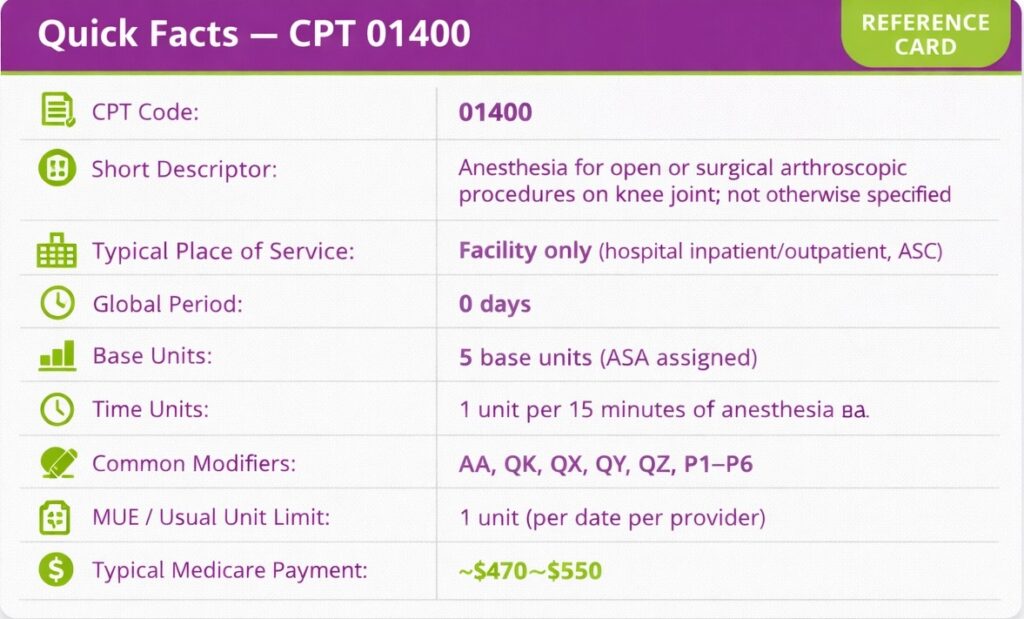
CPT code 01400 is an anesthesia code used to report anesthesia services provided during open or surgical arthroscopic procedures on the knee joint that do not fall under a more specific anesthesia CPT code. It applies when the anesthesiologist or CRNA administers and monitors anesthesia throughout the surgical encounter for qualifying knee joint procedures. This code is used in facility settings, including hospital operating rooms and ambulatory surgery centers, where knee surgeries are performed.
What Is the Description of CPT Code 01400?
CPT code 01400 is defined by the AMA as: “Anesthesia for open or surgical arthroscopic procedures on the knee joint; not otherwise specified.”
It is used when no more specific anesthesia CPT code applies to the knee procedure being performed. The code falls within the Anesthesia for Procedures on the Knee and Popliteal Area subsection of the CPT code set.
How Are Base Units and Time Units Calculated for CPT Code 01400?
01400 CPT code carries 4 ASA base units as established in the 2026 ASA Relative Value Guide. Base units reflect the complexity and intensity of the anesthesia service independent of duration.
Time units are added to base units to determine total billable units. Medicare and most payers calculate one time unit for every 15 minutes of anesthesia time. Total anesthesia time begins when the anesthesia provider begins preparing the patient for induction and ends when the provider is no longer in personal attendance.
Total billable units = Base Units (4) + Time Units (anesthesia minutes ÷ 15)
What Are the Modifiers for CPT Code 01400?
Code CPT 01400 must be reported with an anesthesia provider modifier on every claim. These modifiers identify who performed or supervised the anesthesia service and directly determine the applicable reimbursement rate.
Modifier AA: Anesthesia Services Performed Personally by Anesthesiologist
Modifier AA is used when a physician anesthesiologist personally performs the entire anesthesia service without the involvement of a CRNA or anesthesiologist assistant. The anesthesiologist must be continuously present throughout the procedure.
Modifier AD: Medical Supervision by a Physician
Modifier AD is used when an anesthesiologist medically supervises more than four concurrent anesthesia procedures simultaneously. This modifier results in a reduced payment rate as Medicare allows only three base units per procedure under supervision.
Modifier QK: Medical Direction of Two to Four Concurrent Anesthesia Procedures
Modifier QK is appended by the anesthesiologist when medically directing two, three, or four concurrent anesthesia procedures, one of which is the knee procedure billed under CPT 01400 code. Medical direction requires the anesthesiologist to fulfill all seven CMS-defined criteria, including performing the preanesthesia evaluation and being immediately available throughout.
Modifier QX: CRNA Service with Medical Direction by a Physician
Modifier QX is appended by the CRNA when providing anesthesia services under the medical direction of an anesthesiologist. It is used in conjunction with modifier QK on the directing anesthesiologist’s claim for the same procedure.
Modifier QY: Medical Direction of One CRNA by an Anesthesiologist
Modifier QY is used when an anesthesiologist medically directs a single CRNA for one anesthesia procedure. It applies when the anesthesiologist is directing only one concurrent case rather than two to four.
Modifier QZ: CRNA Service Without Medical Direction
Modifier QZ is appended by the CRNA when providing anesthesia services independently, without medical direction from a physician anesthesiologist. This modifier results in 100% reimbursement of the allowed amount for the CRNA.
Physical Status Modifiers P1–P6
Physical status modifiers are required on all anesthesia claims to indicate the patient’s health condition at the time of the procedure. They are assigned by the anesthesiologist based on the ASA Physical Status Classification and may add qualifying units that increase total reimbursement. Each modifier corresponds to a defined patient condition:
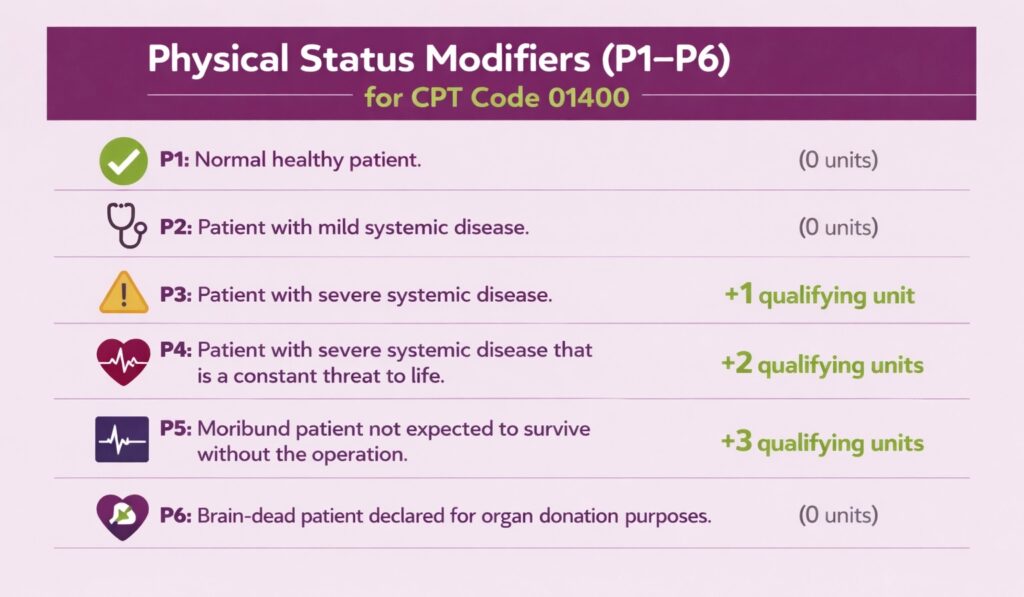
- P1: Normal healthy patient. No additional qualifying units.
- P2: Patient with mild systemic disease. No additional qualifying units.
- P3: Patient with severe systemic disease. Adds 1 qualifying unit.
- P4: Patient with severe systemic disease that is a constant threat to life. Adds 2 qualifying units.
- P5: Moribund patient not expected to survive without the operation. Adds 3 qualifying units.
- P6: Brain-dead patient declared for organ donation purposes. No additional qualifying units.
Which Documents Are Required for CPT Code 01400?
Documentation for procedure code 01400 must support the anesthesia service, the provider’s role, and the patient’s physical status.
Required documents checklist:
- Preanesthetic evaluation including medical history, allergies, current medications, and baseline vitals
- Anesthesia record with documented start and stop times of anesthesia
- Physical status modifier assignment with supporting clinical rationale
- Type of anesthesia administered (general, regional, neuraxial, or monitored anesthesia care)
- Surgical procedure description confirming the knee joint was the operative site
- Intraoperative monitoring record (vital signs, oxygen saturation, end-tidal CO2)
- Medications and dosages administered during the procedure
- Documentation of provider presence and supervision arrangement supporting the modifier used
- Post-anesthesia care unit (PACU) handoff notes
- Signed provider attestation in the anesthesia record
What is the Cost of CPT Code 01400?
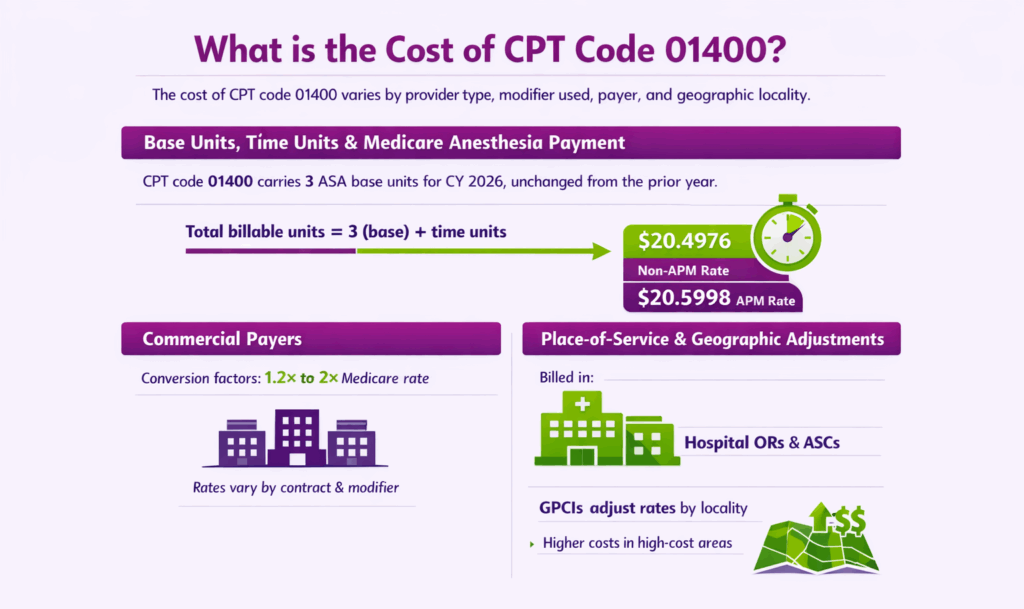
The cost of the 01400 procedure code varies by provider type, modifier used, payer, and geographic locality.
Base Units, Time Units & Medicare Anesthesia Payment
CPT code 01400 carries 3 ASA base units for CY 2026, unchanged from the prior year. Time units are added at one unit per 15 minutes of anesthesia time.
Total billable units = 3 (base) + time units
For CY 2026, Medicare’s anesthesia conversion factor is $20.4976 for non-APM participants and $20.5998 for qualifying APM participants. Under medical direction, payment is calculated at 50% of total units multiplied by the applicable conversion factor, split between the anesthesiologist and the CRNA.
Commercial Payers
Commercial payers negotiate their own conversion factors, typically ranging from 1.2× to 2× the Medicare rate. Actual reimbursement depends on the provider’s contract, network status, and the modifier reported.
Place-of-Service & Geographic Adjustments
Anesthesia services under CPT code 01400 are billed exclusively in facility settings, hospital operating rooms, or ambulatory surgery centers (ASCs). No non-facility rate applies. Geographic Practice Cost Indices (GPCIs) adjust the anesthesia conversion factor by locality, meaning providers in high-cost areas receive higher per-unit payments than those in lower-cost regions.
What Are Example Clinical Scenarios or Use Cases for CPT Code 01400?
CPT code 01400 is used in facility-based settings where anesthesia is provided for open or arthroscopic knee joint procedures not covered by a more specific anesthesia code.
Scenario 1: Arthroscopic Meniscus Repair
ICD-10: M23.200 (Derangement of unspecified meniscus due to old tear or injury, right knee)
The patient presents for arthroscopic repair of a torn medial meniscus. The anesthesiologist personally performs general anesthesia for the duration of the procedure, billing CPT code 01400 with modifier AA and physical status P2.
Scenario 2: ACL Reconstruction
ICD-10: M23.619 (Other spontaneous disruption of anterior cruciate ligament of unspecified knee)
The patient undergoes surgical ACL reconstruction under general anesthesia. A CRNA provides anesthesia under the medical direction of an anesthesiologist, supporting CPT code 01400 billed with modifier QK by the anesthesiologist and modifier QX by the CRNA.
Scenario 3: Complex Revision Knee Surgery
ICD-10: T84.099A (Other mechanical complication of internal right knee prosthesis, initial encounter)
The patient requires open revision surgery following a failed prior knee procedure. Given significant comorbidities, the anesthesiologist assigns physical status P4, adding qualifying units to the claim for CPT code 01400 billed with modifier AA.
What Are the CPT Code 01400 Rules To Ensure Successful Reimbursement?
Follow payer and policy rules for documentation, modifiers, bundling, and billing calculations. Meeting these rules reduces denials and ensures correct payment.
Bundling / NCCI / Same-Day Procedure Rules
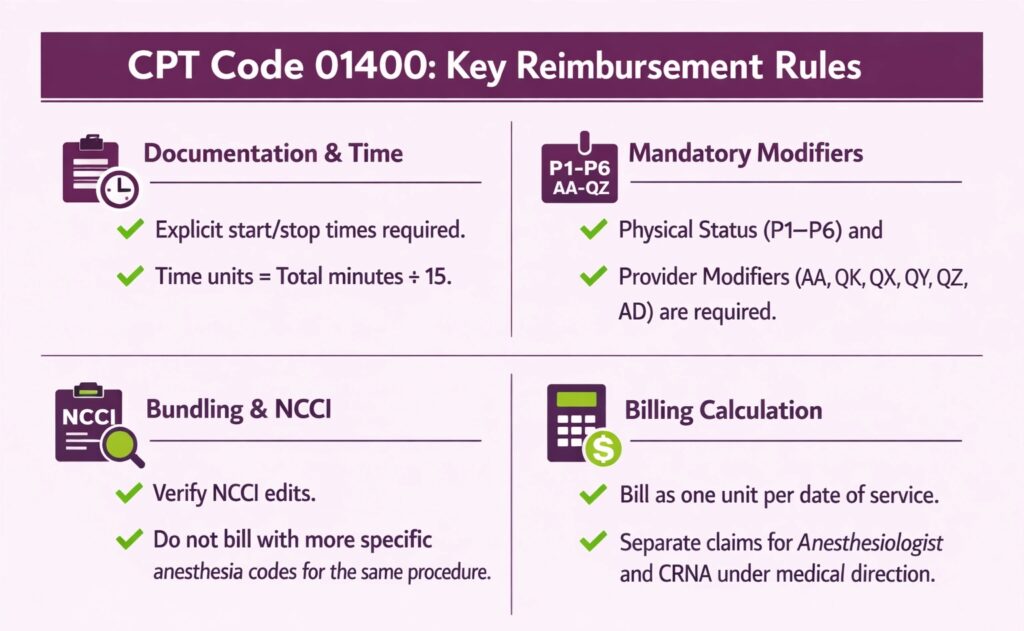
Code 01400 CPT must not be billed alongside more specific anesthesia codes covering the same knee procedure on the same date. If a more specific anesthesia code exists for the procedure performed, that code takes precedence. Always verify NCCI edits prior to submission to confirm no column-one/column-two conflicts exist with surgical CPT codes billed on the same claim.
Base Units, Time Units & Anesthesia Billing Calculation Rules
Anesthesia time must be documented with explicit start and stop times in the anesthesia record. Payers calculate time units as total anesthesia minutes divided by 15, rounded per their individual rounding policy.
- Bill CPT code 01400 as one unit per date of service. The unit count reflects total calculated units, not individual time increments
- Physical status modifier P1 to P6 is required on every claim and must match the clinical documentation
- Provider modifier AA, QK, QX, QY, QZ, or AD is mandatory. Claims submitted without one will be denied
- Under medical direction, each party, anesthesiologist and CRNA, submits a separate claim with their respective modifier
Top Reasons For Denials Specific To 01400 & Quick Remedies
- Missing Provider Modifier: Prevent by appending the correct anesthesia provider modifier (AA, QZ, QK, QX, QY, or AD) on every claim before submission.
- Unsupported Physical Status Modifier: Prevent by documenting clinical justification for the assigned P-status in the preanesthetic evaluation.
- Incorrect or Missing Anesthesia Time: Prevent by recording explicit start and stop times in the anesthesia record and reconciling minutes before billing.
- Bundling With Surgical Code: Prevent by reviewing NCCI edits and confirming the anesthesia code is not bundled with the billed surgical procedure.
Does CPT Code 01400 Follow the Same General CPT Coding Rules?
Yes, code 01400 CPT follows the same rules. While 01400 has its own anesthesia-specific modifiers and base unit calculations, it still operates within the broader framework of CPT coding rules that govern how all procedure codes are selected, documented, and billed, including bundling policies, payer-specific guidelines, and medical necessity requirements