Gastroenterology practices lose thousands of dollars every year, not because they provide poor care, but because the billing side of the house does not catch code-level errors before claims go out the door. A single wrong digit on a Crohn’s disease code, a missing laterality on a colon polyp, or a screening code applied to a diagnostic visit can trigger a denial that takes weeks to resolve. And in a specialty where procedure volume is high, and payer scrutiny is tight, those denials stack up fast.
This guide covers the ICD-10 codes that matter most in a gastroenterology practice, organized by condition category, with real clinical scenarios to show you exactly how and when each code applies.

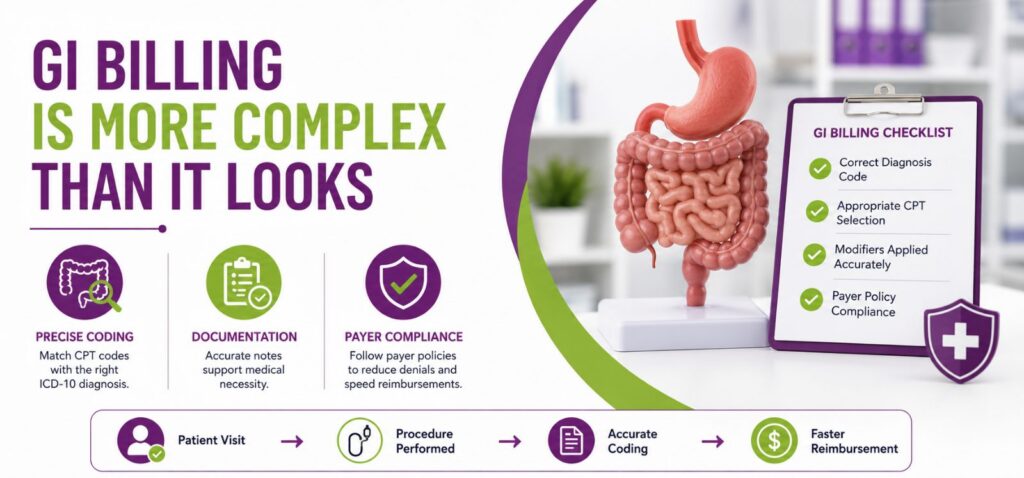
Why GI Billing Is More Complex Than It Looks?
Gastroenterology sits at the intersection of high-procedure volume, nuanced diagnosis specificity, and aggressive payer review. Colonoscopies, EGDs, ERCPs, and liver biopsies each carry CPT codes that must align precisely with the ICD-10 diagnosis attached to the claim.
If a patient comes in for what starts as a screening colonoscopy (Z12.11) but the physician finds and removes a polyp during the same session, the visit coding changes entirely. That single clinical event involves switching primary codes, applying the right modifier, and understanding how your payer interprets preventive service bundling.
Payers like UnitedHealthcare, Aetna, and Cigna all have specific coverage policies for GI procedures, and the ICD-10 code you select either supports or undermines medical necessity in their systems. This is why the coding strategy behind each encounter matters as much as the clinical documentation itself.
The ICD-10 Structure for Digestive System Diagnoses
The ICD-10-CM codes covering gastrointestinal conditions fall primarily in the K00 through K95 range, under “Diseases of the Digestive System.” Some GI encounters also use Z codes for screening and history, R codes for symptoms without a confirmed diagnosis, and C codes when malignancy is involved.
Understanding where each code lives in this structure helps coders select the most specific option and avoid the unspecified codes that trigger denials.
GERD and Esophageal Conditions
K21.0 and K21.9: Gastroesophageal Reflux Disease
GERD is one of the highest-volume diagnoses in any GI practice, and getting the code right matters more than most billers realize. The code splits based on one key clinical factor: whether esophagitis is present.
- K21.0 applies when GERD is documented with esophagitis. This might be a patient presenting with chronic heartburn who had a prior EGD showing erosive esophagitis, and the physician explicitly links the two findings in the note.
- K21.9 is GERD without esophagitis. This is the more commonly used code, applied when the diagnosis is confirmed but no active esophagitis is documented.
Clinical scenario: A 52-year-old patient comes in for a follow-up EGD after six months of proton pump inhibitor therapy. The endoscopy shows healed mucosa with no active esophagitis. The physician documents “GERD, well-controlled.” The correct code here is K21.9, not K21.0. If a coder defaults to K21.0 out of habit or because it appeared on a prior claim, that is a coding inaccuracy.
K20.0, K20.80, K20.90: Esophagitis
When esophagitis exists without GERD, a different code family applies. Eosinophilic esophagitis, which is increasingly common, uses K20.0. Other specified esophagitis codes include K20.80, and unspecified esophagitis lands on K20.90. Coders should look carefully at the physician’s note for the word “eosinophilic” because the distinction drives both the code and the payer’s expectations for biopsy results attached to the claim.
K22.0 Through K22.9: Other Esophageal Disorders
- K22.10: Ulcer of the esophagus without bleeding
- K22.11: Ulcer of the esophagus with bleeding
- K22.2: Esophageal obstruction (relevant for foreign body or stricture cases)
- K22.70: Barrett’s esophagus without dysplasia
- K22.710: Barrett’s esophagus with low-grade dysplasia
- K22.711: Barrett’s esophagus with high-grade dysplasia
Barrett’s esophagus coding is where many practices lose money on surveillance EGDs. The degree of dysplasia must be clearly documented by the pathologist, and the ICD-10 code must match that pathology report.
A patient with known Barrett’s who comes in for a surveillance endoscopy should not receive the generic K22.70 if the most recent biopsy showed low-grade dysplasia. That difference in specificity affects both reimbursement and the payer’s expectation of how frequently the procedure should be repeated.
Peptic Ulcer Disease
K25, K26, K27, K28: Gastric, Duodenal, and Peptic Ulcers
Peptic ulcer coding follows a structured subcategory system based on location and clinical status. Each category in the peptic ulcer ICD 10 codes breaks down by whether the ulcer is:
- Acute with hemorrhage
- Acute with perforation
- Acute with both hemorrhage and perforation
- Acute without hemorrhage or perforation
- Chronic with hemorrhage
- Chronic with perforation
- Chronic with both hemorrhage and perforation
- Chronic without hemorrhage or perforation
K25 covers gastric ulcers, K26 covers duodenal ulcers, K27 applies to peptic ulcers of an unspecified site, and K28 is for gastrojejunal ulcers (common in patients who have had Roux-en-Y gastric bypass or other surgeries altering the GI anatomy).
Clinical scenario: A 67-year-old patient on chronic NSAID therapy is admitted after presenting to the ED with hematemesis. EGD confirms an acute gastric ulcer with active bleeding. The correct code is K25.0 (acute gastric ulcer with hemorrhage).
If the coder uses K25.9 because the note did not clearly specify “acute,” they are leaving specificity on the table. The physician’s note documenting “active bleeding found at endoscopy and treated with epinephrine injection” clearly supports the K25.0 level of specificity, and a good coder queries the physician to ensure the note reflects it.
H. Pylori Infection, ICD-10-CM code B96.81
H. pylori infection is reported with ICD-10-CM code B96.81, which identifies Helicobacter pylori as the cause of a disease classified elsewhere. B96.81 is a billable code, but it is generally used as an additional diagnosis rather than as the principal diagnosis. In medical billing, coders should first report the documented condition associated with the H. pylori ICD 10 code and then assign B96.81 when the clinical documentation establishes the relationship.
Common primary diagnosis codes that may be billed with B96.81 include K29.70 or K29.50 for gastritis, depending on the documented type and specificity; K25.9 for gastric ulcer without hemorrhage or perforation; K26.9 for duodenal ulcer without hemorrhage or perforation; and K27.9 for peptic ulcer, site unspecified, without hemorrhage or perforation.
Accurate claim submission requires the diagnosis code to reflect the provider’s documentation, including the confirmed H. pylori infection and the specific gastrointestinal condition being treated. B96.81 should not be used by itself simply because a patient has a positive H. pylori test; the underlying disease or condition should be appropriately documented and coded.
Inflammatory Bowel Disease: Crohn’s and Ulcerative Colitis
K50 Series: Crohn’s Disease (Regional Enteritis)
Crohn’s disease coding is one of the most detail-dependent areas in GI billing. The K50 family requires coders to identify both the anatomical location of the disease and the presence of specific complications. Using an unspecified Crohn’s code when the documentation clearly describes small bowel involvement with fistula is a missed opportunity that payers may treat as upcoding or downcoding, depending on how the auditor reads it.
Here are the key codes:
- K50.00: Crohn’s disease of the small intestine without complications
- K50.011: Crohn’s disease of the small intestine with rectal bleeding
- K50.012: Crohn’s disease of the small intestine with intestinal obstruction
- K50.013: Crohn’s disease of the small intestine with fistula
- K50.014: Crohn’s disease of the small intestine with abscess
- K50.10: Crohn’s disease of the large intestine without complications
- K50.111: Crohn’s disease of the large intestine with rectal bleeding
- K50.113: Crohn’s disease of the large intestine with fistula
- K50.80: Crohn’s disease of both small and large intestine without complications
- K50.90: Crohn’s disease, unspecified, without complications
Clinical scenario: A 34-year-old woman with known Crohn’s ileocolitis is seen in the office for worsening abdominal pain. Imaging reveals a small perianal fistula.
The physician documents “Crohn’s disease with fistula, involving both small and large intestine.” The correct code in this case is K50.813 (Crohn’s disease of both small and large intestines with fistula), not K50.90. The K50.90 code is appropriate only when the chart contains no specificity about location or complications, which, in a follow-up visit for a known IBD patient, should rarely happen.
K51 Series: Ulcerative Colitis
Ulcerative colitis coding follows a similar structure. Location matters: ulcerative proctitis is distinct from left-sided colitis, which is distinct from pancolitis.
- K51.00: Ulcerative (chronic) pancolitis without complications
- K51.011: Ulcerative pancolitis with rectal bleeding
- K51.20: Ulcerative (chronic) proctitis without complications
- K51.30: Ulcerative (chronic) rectosigmoiditis without complications
- K51.40: Inflammatory polyps of the colon without complications
- K51.50: Left-sided ulcerative (chronic) colitis without complications
- K51.90: Ulcerative colitis, unspecified, without complications
Payers managing high-cost biologic therapies for IBD patients often review the specificity of diagnosis codes tied to prior authorization requests.
A prior auth submission for vedolizumab or ustekinumab that uses K51.90 when the clinical record documents left-sided colitis with active rectal bleeding can create unnecessary friction. Specific codes support the documented severity, and documented severity drives authorization approvals. Partnering with specialized gastroenterology billing services ensures that these high-acuity documentation layers are systematically captured on every prior authorization request to eliminate preventable delays.
Irritable Bowel Syndrome
K58 Series: IBS Coding
Irritable bowel syndrome is one of the highest-volume GI diagnoses in outpatient settings, and the ICD-10 code must reflect the predominant bowel symptom pattern documented.
- K58.0: Irritable bowel syndrome with diarrhea (IBS-D)
- K58.1: Irritable bowel syndrome with constipation (IBS-C)
- K58.2: Mixed irritable bowel syndrome
- K58.9: Irritable bowel syndrome without diarrhea (unspecified)
Clinical scenario: A 29-year-old patient is established with a GI specialist for IBS management. At each visit, the physician documents “IBS with predominant diarrhea, currently managed with dietary modification and loperamide.” The correct recurring code is K58.0.
If the billing team defaults to K58.9 on every visit because it is pre-loaded in their EHR template, they are under-coding the encounter and potentially misrepresenting the clinical picture to payers.
Colorectal Polyps and Screening Encounters
K63.5: Polyp of the Colon
This is a frequently used code after a colonoscopy, but it needs to match the pathology report carefully. K63.5 is appropriate for benign colon polyps where pathology confirms non-neoplastic or hyperplastic tissue. Adenomatous polyps code differently.
D12 Series: Benign Neoplasms of the Colon
When pathology returns showing a tubular adenoma, tubulovillous adenoma, or villous adenoma, the correct codes shift to the D12 series:
- D12.0: Cecum
- D12.1: Appendix
- D12.2: Ascending colon
- D12.3: Transverse colon
- D12.4: Descending colon
- D12.5: Sigmoid colon
- D12.6: Colon, unspecified
- D12.7: Rectosigmoid junction
- D12.8: Rectum
Why this specificity matters: The anatomical site of the polyp affects future surveillance interval recommendations, and payers reviewing colonoscopy frequency will look at the diagnosis codes from the prior procedure.
A patient who had a large villous adenoma in the sigmoid colon (D12.5) needs a different surveillance timeline than someone with a small hyperplastic polyp. Accurate coding now protects the billing for the next colonoscopy.
Z12.11: Encounter for Screening for Malignant Neoplasm of the Colon
This is the primary code for asymptomatic patients presenting for routine colorectal cancer screening. When a screening colonoscopy finds nothing and no intervention is taken, Z12.11 often stands alone as the primary diagnosis.
When a polyp is found and removed during what started as a screening visit, the billing strategy changes: the polyp or adenoma code becomes the primary diagnosis, and Z12.11 moves to a secondary position (payer-dependent), with modifier -33 applied to signal the original preventive intent.
Diverticular Disease
K57 Series: Diverticulosis and Diverticulitis
Diverticular disease coding requires attention to three variables: location (small intestine vs. large intestine), presence of acute inflammation (diverticulitis vs. diverticulosis), and the presence of bleeding or abscess.
- K57.30: Diverticulosis of the large intestine without perforation or abscess, without bleeding (the most commonly billed code in this family)
- K57.31: Diverticulosis of the large intestine without perforation or abscess, with bleeding
- K57.32: Diverticulitis of the large intestine without perforation or abscess, without bleeding
- K57.33: Diverticulitis of the large intestine without perforation or abscess, with bleeding
- K57.20: Diverticulitis of the large intestine with perforation and abscess, without bleeding
- K57.00: Diverticulitis of the small intestine without perforation or abscess, without bleeding
Clinical scenario: A 71-year-old patient presents to the GI clinic with a recent ER visit for acute left lower quadrant pain. CT imaging confirmed acute, uncomplicated diverticulitis of the sigmoid colon, no abscess, no perforation. The physician prescribes antibiotics and dietary modification.
The correct code is K57.32, not K57.30. Diverticulitis and diverticulosis are not interchangeable terms in ICD-10, and they carry different clinical implications, different treatment pathways, and different payer responses.
Liver Disease
K70 Series: Alcoholic Liver Disease
- K70.0: Alcoholic fatty liver
- K70.10: Alcoholic hepatitis without ascites
- K70.11: Alcoholic hepatitis with ascites
- K70.30: Alcoholic cirrhosis of the liver without ascites
- K70.31: Alcoholic cirrhosis of the liver with ascites
The presence or absence of ascites changes the code and signals disease severity to payers, which affects the complexity level of the E/M visit and the resources expected to be consumed.
K74 Series: Fibrosis and Cirrhosis
- K74.0: Hepatic fibrosis
- K74.60: Unspecified cirrhosis of the liver
- K74.69: Other cirrhosis of the liver
For practices managing hepatology patients alongside GI, the cirrhosis codes must be paired with the etiology code. A patient with cirrhosis secondary to NASH (nonalcoholic steatohepatitis) should have K74.60 coded alongside K75.81 (NASH) to give the full clinical picture. Payers reviewing prior authorizations for liver-directed therapies will look for this code pairing.
K75.81: Nonalcoholic Steatohepatitis (NASH)
NASH coding has become significantly more relevant as GLP-1 agonists and new hepatology treatments emerge. This code, paired with K74.60 in cirrhotic patients, tells the complete diagnostic story. In non-cirrhotic NASH patients, K75.81 may stand alone.
Gastrointestinal Bleeding
K92 Series: Other Diseases of the Digestive System
GI bleeding codes require the coder to distinguish between upper and lower GI sources, and between specific bleeding tied to a known lesion versus bleeding of unclear origin.
- K92.0: Hematemesis (vomiting blood, clearly upper GI)
- K92.1: Melena (black tarry stools, typically upper GI or proximal small bowel)
- K92.2: Gastrointestinal hemorrhage, unspecified
When the bleeding source is identified during endoscopy (an actively bleeding gastric ulcer, for example), the specific ulcer code with hemorrhage takes precedence over K92.0. K92.0 is appropriate when the symptom is documented, but the source has not yet been identified, such as in an emergency triage scenario before endoscopy is performed.
New 2024 and 2025 ICD-10 Codes GI Practices Need to Know
K63.82 Family: Small Intestinal Bacterial Overgrowth (SIBO)
The K63.82 family introduced in FY2024 gave coders specific codes for intestinal microbial overgrowth conditions that previously had no dedicated home in ICD-10.
- K63.820: Intestinal methanogen overgrowth (IMO)
- K63.821: Small intestinal bacterial overgrowth (SIBO)
- K63.822: Small intestinal fungal overgrowth (SIFO)
- K63.829: Other intestinal microbial overgrowth
For GI practices running hydrogen breath tests and treating SIBO patients, these codes represent a critical update. Before K63.821 existed, coders were forced to use K63.89 (other specified diseases of the intestine) or R19.8 (other specified symptoms and signs) to approximate the diagnosis.
Payers were inconsistent about coverage. The dedicated code improves claim acceptance rates for both the diagnostic test and the treatment management visit.
Pancreatic Conditions
K85 Series: Acute Pancreatitis
- K85.00: Idiopathic acute pancreatitis without necrosis or infection
- K85.10: Biliary acute pancreatitis without necrosis or infection
- K85.20: Alcohol-induced acute pancreatitis without necrosis or infection
- K85.30: Drug-induced acute pancreatitis without necrosis or infection
The fifth-character modifier differentiates uncomplicated pancreatitis from cases involving necrosis or infection, which significantly changes the expected resource utilization and justifies higher-complexity billing codes.
K86 Series: Chronic Pancreatitis
- K86.0: Alcohol-induced chronic pancreatitis
- K86.1: Other chronic pancreatitis (includes autoimmune and idiopathic forms)
- K86.81: Exocrine pancreatic insufficiency
K86.81 (exocrine pancreatic insufficiency) is a standalone diagnosis that GI practices use when managing patients on pancreatic enzyme replacement therapy. It should be paired with the underlying etiology code (chronic pancreatitis, post-surgical state, or cystic fibrosis) to fully describe the clinical picture.
Gallbladder and Biliary Tract Conditions
K80 Series: Cholelithiasis
- K80.00: Calculus of the gallbladder with acute cholecystitis without obstruction
- K80.10: Calculus of the gallbladder with chronic cholecystitis without obstruction
- K80.20: Calculus of the gallbladder without cholecystitis without obstruction
- K80.50: Calculus of the bile duct without cholangitis or cholecystitis without obstruction
- K80.51: Calculus of the bile duct without cholangitis or cholecystitis with obstruction
ERCP (CPT 43264, 43265, 43274) claims depend heavily on the specificity of the K80 code accompanying them.
A common denial pattern occurs when the ERCP is billed with K80.20 (gallstones without inflammation or obstruction) when the operative note clearly describes a common bile duct stone causing obstruction. K80.51 would support the procedure; K80.20 does not.
Utilizing a dedicated gastroenterology medical billing guide helps billing staff cross-reference anatomical targets with their corresponding CPT pairings to eliminate these predictable errors.
Symptom Codes: When to Use Them and When Not To
R-codes in gastroenterology function as a placeholder when the physician has not yet established a definitive diagnosis. They are appropriate in specific circumstances and a liability in others.
Appropriate use of symptom codes:
- R10.0: Acute abdomen (appropriate at a first emergency presentation before imaging results are available)
- R10.10 through R10.13: Right/left upper and lower quadrant pain (appropriate when pain is the chief complaint and the etiology is still being worked up)
- R19.7: Diarrhea, unspecified (appropriate only in a first encounter before IBS, IBD, or infectious etiology is ruled in or out)
When a definitive diagnosis has been established, the symptom code should not appear as the primary diagnosis. A patient with documented K51.90 (ulcerative colitis) who presents for a flare visit should not have R10.9 (unspecified abdominal pain) as the primary code just because abdominal pain is the presenting symptom. The established diagnosis drives the encounter.
Common Coding Errors That Drive GI Claim Denials
These are the patterns that repeatedly show up in GI billing audits:
- Using K21.9 instead of K21.0 when EGD findings clearly document esophagitis, or using K21.0 when no active esophagitis is present at the time of service.
- Applying Z12.11 as the primary code after a colonoscopy where a polyp was removed, instead of moving the pathology-confirmed polyp or adenoma code to the primary position.
- Selecting K50.90 or K51.90 (unspecified IBD codes) when the chart contains clear documentation of location and complications.
- Submit K57.30 (diverticulosis) when the visit note and imaging confirm acute diverticulitis, which requires K57.32 or K57.33.
- Missing the fifth character on pancreatitis codes that differentiates uncomplicated cases from those with necrosis or infection.
- Pairing a colonoscopy CPT code with an esophageal diagnosis, or vice versa, when the endoscopy code and the ICD-10 code do not match anatomically
How Accurate GI Coding Supports Revenue and Compliance

A GI practice that invests in coding precision at the front end avoids the compounded cost of denial management on the back end. Resubmitting a denied claim costs an average of $25 in administrative time, and denial rates above 5% begin to measurably erode a practice’s net collection rate.
Beyond the revenue impact, payer audits and RAC (Recovery Audit Contractor) reviews target high-volume specialties like gastroenterology specifically because the procedure-to-diagnosis pairing is highly specific and deviations are easy to flag algorithmically.
Practices that document thoroughly, assign specific ICD-10 codes that reflect the full clinical picture, and audit their own coding patterns quarterly are simply better positioned.
The ICD-10 code is not just an administrative label. It tells the payer what was happening clinically, why the procedure was necessary, and whether the documented care matches the billed service.
If your gastroenterology practice is experiencing claim denials, high accounts receivable days, or inconsistent reimbursement on procedures like colonoscopies, EGDs, or ERCPs, the issue is often traceable to ICD-10 coding gaps. Getting a billing audit focused specifically on diagnosis code accuracy is the fastest way to identify where revenue is slipping through.
The ICD-10 code is not just an administrative label. It tells the payer what was happening clinically, why the procedure was necessary, and whether the documented care matches the billed service. If your gastroenterology practice is experiencing claim denials, high accounts receivable days, or inconsistent reimbursement on procedures like colonoscopies, EGDs, or ERCPs, the issue is often traceable to ICD-10 coding gaps.
Reviewing a structured ICD 10 codes guide focused specifically on diagnosis code accuracy is the fastest way to identify where revenue is slipping through.
Quick-Reference Table: Common Gastroenterology ICD-10 Codes
| ICD-10 Code | Description | Common Use Case |
|---|---|---|
| K21.0 | GERD with esophagitis | Post-EGD visit confirming active erosive esophagitis |
| K21.9 | GERD without esophagitis | Chronic GERD follow-up, healed or no esophagitis documented |
| K20.0 | Eosinophilic esophagitis | Dysphagia workup with biopsy confirming eosinophil count |
| K22.70 | Barrett’s esophagus without dysplasia | Routine surveillance EGD, pathology negative for dysplasia |
| K22.710 | Barrett’s esophagus, low-grade dysplasia | Surveillance EGD with pathology confirming low-grade changes |
| K22.711 | Barrett’s esophagus, high-grade dysplasia | Pre-ablation workup or RFA planning visit |
| K25.0 | Acute gastric ulcer with hemorrhage | EGD showing an actively bleeding gastric ulcer, treated endoscopically |
| K26.0 | Acute duodenal ulcer with hemorrhage | Duodenal bleed confirmed on EGD after hematemesis presentation |
| K50.00 | Crohn’s disease, small intestine, no complications | Established Crohn’s ileitis, routine follow-up, no active flare |
| K50.011 | Crohn’s disease, small intestine, with rectal bleeding | Crohn’s patient presenting with bloody stool, no fistula or abscess |
| K50.013 | Crohn’s disease, small intestine, with fistula | Perianal or enteroenteric fistula confirmed on imaging or exam |
| K50.80 | Crohn’s disease, small and large intestine, no complications | Ileocolitis documented on colonoscopy, no active complications |
| K50.90 | Crohn’s disease, unspecified, no complications | Use only when the chart contains zero site or complication detail |
| K51.00 | Ulcerative pancolitis without complications | Colonoscopy confirming pancolitis, patient stable, no bleeding |
| K51.011 | Ulcerative pancolitis with rectal bleeding | Pancolitis flare with active hematochezia documented in the visit |
| K51.50 | Left-sided ulcerative colitis, no complications | Colonoscopy showing disease limited to the splenic flexure and the distal colon |
| K51.90 | Ulcerative colitis, unspecified, no complications | Use only when the location is genuinely undocumented |
| K57.30 | Diverticulosis, large intestine, no bleeding | Incidental diverticulosis found on screening colonoscopy |
| K57.31 | Diverticulosis of the large intestine, with bleeding | Diverticular bleed confirmed on colonoscopy or angiography |
| K57.32 | Diverticulitis, large intestine, no bleeding | CT-confirmed acute uncomplicated diverticulitis, outpatient management |
| K57.33 | Diverticulitis, large intestine, with bleeding | Acute diverticulitis with concurrent hematochezia, hospitalized patient |
| K58.0 | IBS with diarrhea (IBS-D) | Established IBS patient with predominant loose stools, follow-up visit |
| K58.1 | IBS with constipation (IBS-C) | An IBS patient managed with fiber supplementation and laxatives |
| K58.2 | Mixed IBS | Alternating bowel habits were documented across multiple visits |
| K58.9 | IBS without diarrhea, unspecified | Use only when the symptom subtype is genuinely not documented |
| K63.5 | Polyp of the colon | Hyperplastic polyp on pathology after colonoscopic removal |
| D12.5 | Benign neoplasm, sigmoid colon | Adenomatous polyp removed from the sigmoid, confirmed on pathology |
| D12.3 | Benign neoplasm, transverse colon | A tubular adenoma was found and removed in the transverse colon |
| Z12.11 | Screening for colon cancer | Asymptomatic patient, age-appropriate screening colonoscopy, nothing found |
| K63.821 | Small intestinal bacterial overgrowth (SIBO) | Positive hydrogen breath test, patient started on rifaximin |
| K63.820 | Intestinal methanogen overgrowth (IMO) | Methane-positive breath test, constipation-predominant presentation |
| K74.60 | Cirrhosis, unspecified | Compensated cirrhosis on follow-up, etiology not specified in the note |
| K75.81 | Nonalcoholic steatohepatitis (NASH) | Liver biopsy confirming NASH, no cirrhosis present |
| K70.30 | Alcoholic cirrhosis without ascites | Liver disease tied to alcohol use, no ascites documented at visit |
| K70.31 | Alcoholic cirrhosis with ascites | Alcohol-related cirrhosis, a patient presenting with abdominal distension |
| K85.00 | Idiopathic acute pancreatitis, no necrosis | First-episode pancreatitis, no gallstones or alcohol history identified |
| K85.10 | Biliary acute pancreatitis, no necrosis | Gallstone pancreatitis confirmed on imaging, uncomplicated course |
| K86.0 | Alcohol-induced chronic pancreatitis | Recurrent pancreatitis with a documented chronic alcohol use history |
| K86.1 | Other chronic pancreatitis | Autoimmune or idiopathic chronic pancreatitis confirmed on workup |
| K86.81 | Exocrine pancreatic insufficiency | Patient on pancreatic enzyme replacement therapy, malabsorption documented |
| K80.20 | Cholelithiasis without cholecystitis, no obstruction | Incidental gallstones on ultrasound, asymptomatic, no intervention planned |
| K80.51 | Common bile duct stone with obstruction | ERCP was performed for choledocholithiasis with documented biliary obstruction |
| K92.0 | Hematemesis | Vomiting blood, source unknown, pre-endoscopy ER triage encounter |
| K92.1 | Melena | Black tarry stools, upper GI bleed suspected, EGD ordered |
| K92.2 | GI hemorrhage, unspecified | Bleeding documented, source not yet identified through diagnostic workup |
| R10.0 | Acute abdomen | First emergency presentation, imaging pending, no diagnosis confirmed yet |
| R10.13 | Epigastric pain | Symptom-only visit, investigating ulcer or GERD, no confirmed diagnosis |