Cardiovascular disease carries one of the highest claim volumes in United States healthcare. Heart disease causes about 1 in 5 deaths nationally, according to the CDC. Nearly half of US adults have high blood pressure, which makes hypertension the single most coded cardiology diagnosis.
Cardiology ICD-10 codes live almost entirely in Chapter 9, the circulatory system block I00 through I99. The coding difficulty is not where the codes sit. The difficulty is how codes link, sequence, and capture acuity. Hypertension presumed-cause rules, myocardial infarction timing windows, and heart failure specificity decide whether a claim clears.
This guide maps the cardiovascular ICD-10 landscape in two layers. The first covers the coding mechanics behind every diagnosis: chapter structure, hypertension combination coding, MI timing, heart failure specificity, and status capture. The second lists the most common cardiovascular conditions by category, with the anchor codes for each.
What Are Cardiology ICD-10 Codes?
Cardiology ICD-10 codes are diagnosis codes that classify circulatory-system disease, including ischemic, hypertensive, valvular, arrhythmic, structural, and vascular conditions. These codes feed claim adjudication, medical necessity, and risk-adjustment reporting. Cardiovascular coding accuracy determines whether a cardiac service earns reimbursement.
Which ICD-10 Chapter Covers Cardiovascular Diagnoses?
Cardiovascular diagnoses concentrate in Chapter 9 (I00–I99), diseases of the circulatory system. Real cardiology coding also reaches into several other chapters for lipids, symptoms, and device status.
- Chapter 9 (I00–I99): Hypertension, ischemic disease, heart failure, arrhythmias, valve disease, and vascular conditions.
- Chapter 4 (E78): Hyperlipidemia and other lipid metabolism disorders.
- Chapter 18 (R00–R09, R55, R60): Cardiac symptoms such as chest pain, palpitations, syncope, and edema.
- Chapter 21 (Z95, Z79): Cardiac device status and long-term drug therapy.
This cross-chapter reach matters because sequencing rules differ by chapter. Lipid codes attach to cardiovascular risk. Symptom codes apply only until a definitive diagnosis exists. Device status codes support risk adjustment rather than acute care.
How Is a Cardiovascular ICD-10 Code Structured?
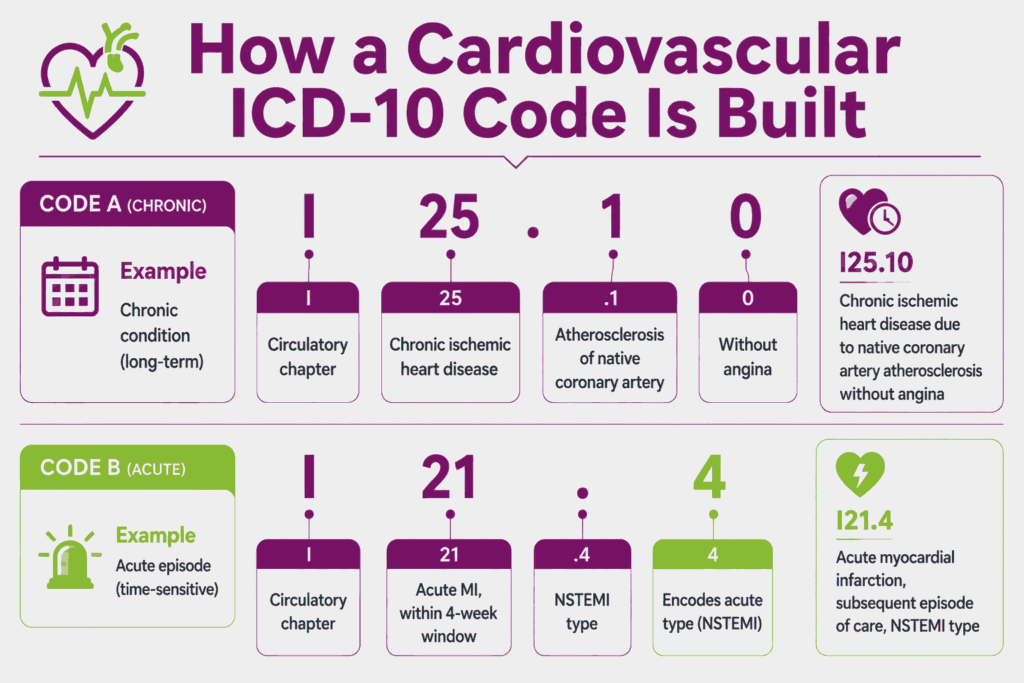
A cardiovascular ICD-10 code is an alphanumeric string of three to seven characters, where each position adds type and acuity rather than laterality. The heart is a midline organ, so most cardiac codes carry no right or left distinction. Two examples show the range.
- I25.10 names atherosclerotic heart disease of native coronary artery without angina pectoris. The category names chronic ischemic disease, and the later characters mark the absence of angina.
- I21.4 names a non-ST elevation myocardial infarction, an acute event. The category encodes both the acuity and the infarction type in a single code.
Codes that stop at an unspecified type stay billable but weaken medical necessity and risk-adjustment capture. Specific codes protect reimbursement.
How Do You Code Cardiovascular Diagnoses Correctly?
Correct cardiovascular coding depends on four elements: hypertension combination coding, myocardial infarction timing, heart failure specificity, and status capture. These elements separate a clean claim from a denied one. The condition lists later in this guide supply the codes; this section supplies the rules.
How Do the Hypertension Combination Coding Rules Work?
Hypertension combination coding uses the ICD-10 “with” convention, which presumes a causal link between hypertension and certain conditions. ICD-10 assumes hypertension relates to heart failure and to chronic kidney disease unless documentation states otherwise.
- I10 covers essential hypertension with no organ involvement.
- I11 covers hypertensive heart disease, with I11.0 when heart failure is present.
- I12 covers hypertensive chronic kidney disease.
- I13 covers hypertensive heart and chronic kidney disease combined.
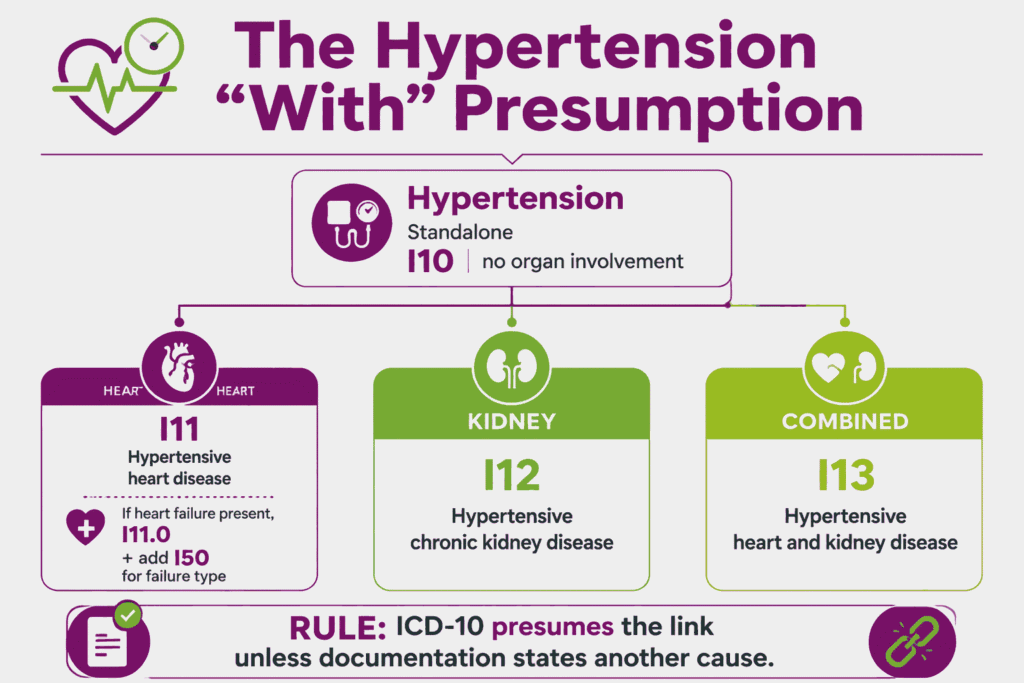
When I11.0 applies, coders add the matching I50 heart failure code to specify the failure type. Hypertension and kidney disease follow the same paired logic. This presumed-cause rule is the most common cardiovascular sequencing error.
How Do You Code a Myocardial Infarction by Type and Timing?
Myocardial infarction coding depends on timing and infarction type, not laterality. The acute window runs 4 weeks from onset. A myocardial infarction moves through three coding phases as the episode ages.
- I21 covers the acute MI within the 4-week window, including I21.4 for NSTEMI and I21.0 through I21.3 for STEMI by site.
- I22 covers a subsequent MI, a new infarction during the 4-week window of a prior one.
- I25.2 covers an old, healed myocardial infarction outside the acute window.
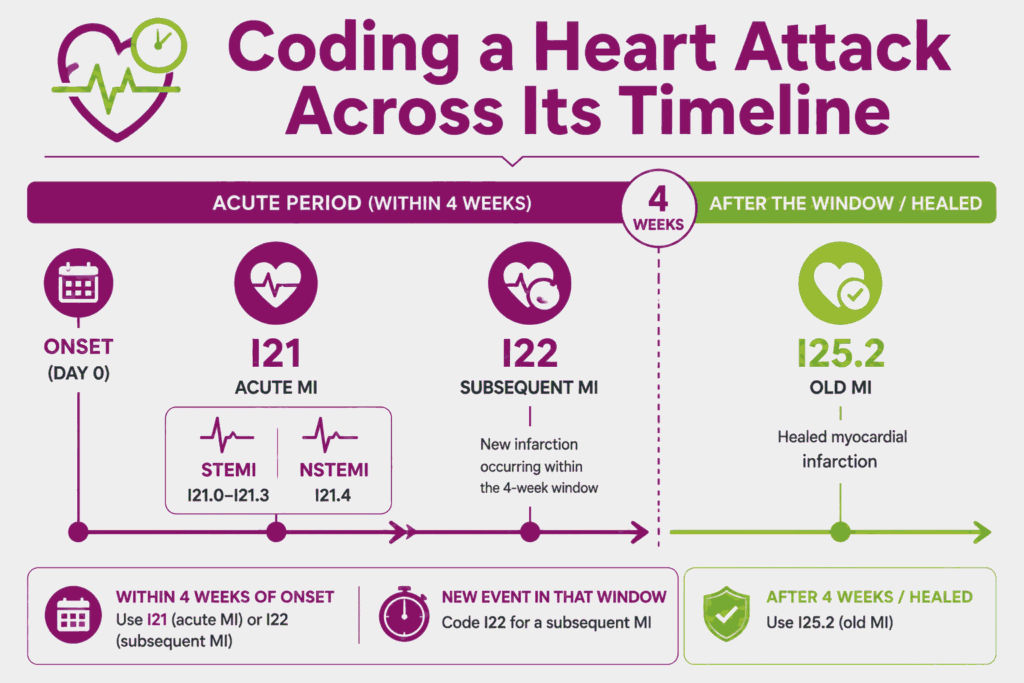
Type 1 and Type 2 MI carry separate codes that documentation must support. I21.A1 marks a Type 2 MI driven by demand ischemia. I21.A9 marks other MI types. Coding a Type 2 MI as a standard NSTEMI misstates the clinical event and invites audit.
How Do You Code Heart Failure to Full Specificity?
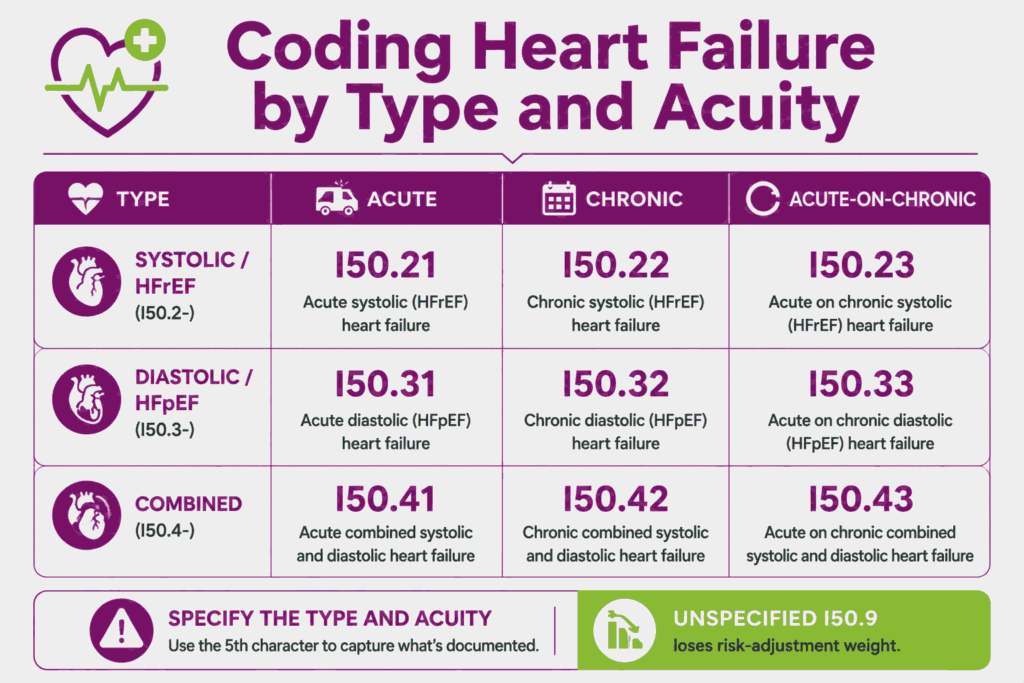
Heart failure coding requires two documented axes: the failure type and the acuity. The I50 category splits by systolic, diastolic, and combined dysfunction, then by acute versus chronic.
- I50.2- covers systolic heart failure, documented clinically as HFrEF.
- I50.3- covers diastolic heart failure, documented clinically as HFpEF.
- I50.4- covers combined systolic and diastolic heart failure.
- I50.9 covers unspecified heart failure, the under-capture trap.
The unspecified congestive heart failure ICD-10 code I50.9 loses risk-adjustment weight that specific codes carry. Ejection fraction documentation drives the systolic versus diastolic split. Acute-on-chronic status changes the fifth character.
When Do You Use Cardiac Status and History Codes?
Cardiac status and history codes document prior events and devices that affect current risk, not active treatment. These codes support hierarchical condition category (HCC) capture for value-based contracts.
- Z95.0 documents a cardiac pacemaker in situ.
- Z95.1 documents an aortocoronary bypass graft.
- Z95.5 documents a coronary angioplasty implant and graft.
- Z79.01 and Z79.82 document long-term anticoagulant and antiplatelet therapy.
Old myocardial infarction status and device codes carry forward on every applicable encounter. Dropping these codes understates patient complexity and lowers the risk-adjustment factor.
Which ICD-10 Codes Cover the Most Common Cardiovascular Conditions?
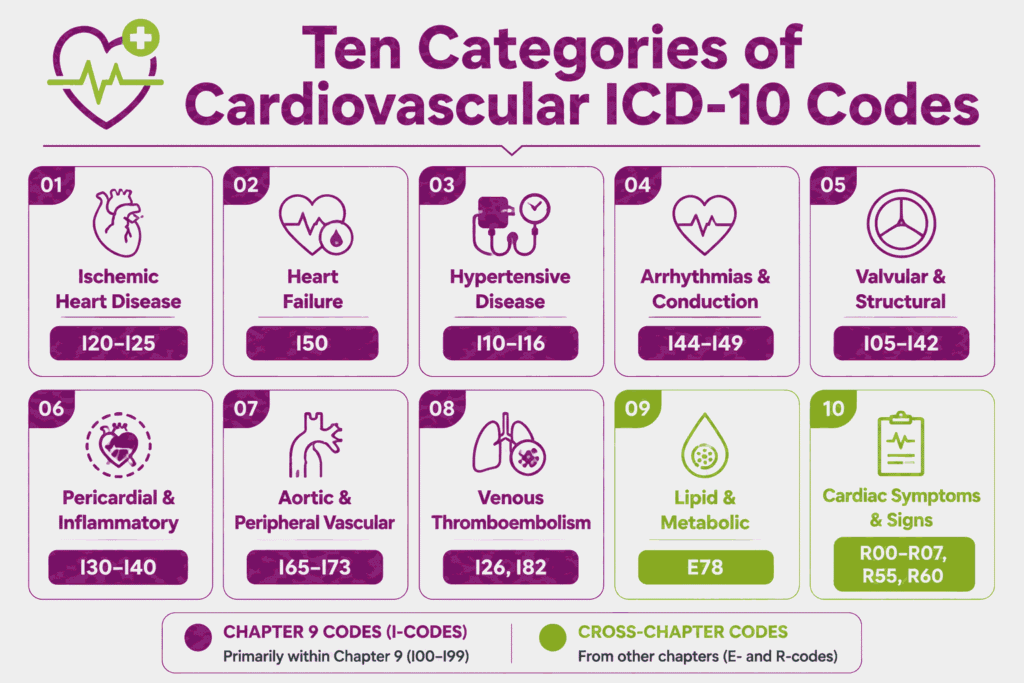
The most common cardiovascular conditions cluster into ten categories: ischemic heart disease, heart failure, hypertensive disease, arrhythmias, valvular and structural disease, pericardial disease, aortic and peripheral vascular disease, venous thromboembolism, lipid disorders, and cardiac symptoms. Each condition below lists its anchor codes. Many carry full code sets that the linked guides detail.
Which ICD-10 Codes Cover Ischemic Heart Disease?
Ischemic heart disease spans the I20 through I25 range, organized by acuity. Chronic disease, acute infarction, and healed infarction each take a separate code path.
Coronary Artery Disease ICD-10 Codes
Coronary artery disease falls under I25.10, atherosclerotic heart disease of a native coronary artery without angina. Add-on characters flag angina, bypass grafts, and transplanted vessels, while I25.11- captures CAD with angina pectoris. Search traffic arrives through icd 10 coronary artery disease and icd 10 code for coronary artery disease. High-volume ischemic practices work from the coronary artery disease ICD-10 codes to separate native-vessel, graft, and angina presentations.
Myocardial Infarction ICD-10 Codes
Acute myocardial infarction lives in the I21 and I22 categories inside the 4-week window. I21.4 is the NSTEMI ICD-10 code, I21.0 through I21.3 mark STEMI by wall location, and I21.A1 flags a Type 2 MI. The myocardial infarction ICD-10 codes span STEMI, NSTEMI, and infarction type across the encounter timeline. A subsequent infarction inside the same window takes I22.
Angina Pectoris ICD-10 Codes
Angina pectoris sits in the I20 category, apart from chronic CAD in I25. The angina ICD-10 codes separate unstable angina at I20.0, spasm-documented angina at I20.1, and unspecified angina at I20.9. Stable and unstable presentations follow different medical-necessity paths.
Old Myocardial Infarction ICD-10 Codes
Old myocardial infarction refers to a healed infarction with no current symptoms, coded as I25.2. The old myocardial infarction ICD-10 code documents a prior event that still carries risk-adjustment weight. Placement stays inside chronic ischemic disease, never the acute I21 category. Coders apply I25.2 on follow-up encounters once the event clears the 4-week window.
Which ICD-10 Codes Cover Heart Failure?
Heart failure occupies the I50 category, divided by dysfunction type and acuity. Systolic, diastolic, and combined failure each carry their own codes.
Congestive Heart Failure (CHF) ICD-10 Codes
Congestive heart failure belongs to the I50 category, with I50.9 covering the unspecified form. I50.1 marks left ventricular failure, and acute-on-chronic states shift the fifth character. The congestive heart failure ICD-10 codes map acute, chronic, and combined presentations across every failure type. Coders arrive here through icd 10 heart failure and icd 10 code for congestive heart failure searches.
Systolic Heart Failure (HFrEF) ICD-10 Codes
Systolic heart failure, documented clinically as HFrEF, takes the I50.2- subcategory. The systolic heart failure ICD-10 codes run from I50.20 unspecified through I50.22 chronic and I50.23 acute-on-chronic. Reduced ejection fraction supports the assignment, and the heart failure with reduced ejection fraction ICD-10 code shares this range.
Diastolic Heart Failure (HFpEF) ICD-10 Codes
Diastolic heart failure, documented as HFpEF, consists of the I50.3- codes. I50.32 marks the chronic form and I50.33 the acute-on-chronic form. Preserved ejection fraction supports the diastolic assignment. The heart failure with preserved ejection fraction ICD-10 code sits beside the systolic set on the same acuity ladder.
Which ICD-10 Codes Cover Hypertensive Disease?
Hypertensive disease runs across I10 through I16 and obeys the “with” combination convention. Uncomplicated hypertension and organ-involved hypertension separate into distinct codes.
Hypertension ICD-10 Codes
Essential hypertension without organ involvement is I10, the highest-volume cardiology diagnosis. ICD 10 hypertension codes hold even for uncontrolled or resistant presentations. Secondary hypertension moves to I15, and hypertensive crisis to I16. Essential, secondary, and crisis presentations all live in the hypertension ICD-10 codes.
Hypertensive Heart Disease ICD-10 Codes
Hypertensive heart disease is the I11 category, used when hypertension damages the heart. I11.0 applies with heart failure present and demands an added I50 code for the failure type, while I11.9 applies without failure. The presumed-cause rule links the hypertension to the cardiac damage. This guide keeps I11 in the hypertension cluster and I50 in heart failure, so the two cross-reference.
Hypertensive Chronic Kidney Disease ICD-10 Codes
Hypertensive chronic kidney disease splits between I12 for kidney involvement and I13 for combined heart and kidney disease. ICD-10 again presumes a hypertension-to-kidney link unless documentation names another cause. A stage character reports the CKD severity. The combined I13 category captures both organ systems in one code.
Which ICD-10 Codes Cover Cardiac Arrhythmias and Conduction Disorders?
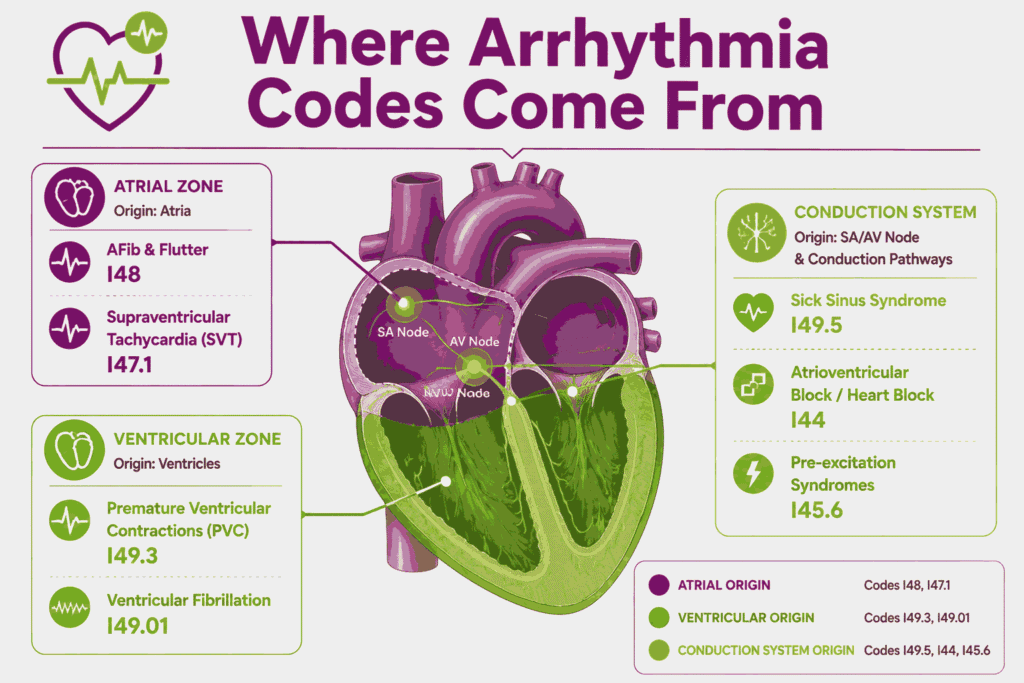
Cardiac arrhythmias run across I44 through I49, sorted by rhythm origin and conduction site. Among them, atrial fibrillation, supraventricular rhythms, ventricular ectopy, and conduction blocks each take separate codes.
Atrial Fibrillation and Flutter ICD-10 Codes
Atrial fibrillation and flutter occupy the I48 category. The atrial fibrillation ICD-10 codes run from paroxysmal I48.0 through persistent I48.1, chronic or permanent I48.2, and unspecified I48.91, with atrial flutter at I48.92. AFib with rapid ventricular response codes to I48 once the rhythm is documented. Coders also reach the set through Afib icd 10 and icd 10 code for atrial fibrillation.
Supraventricular Tachycardia ICD-10 Codes
Supraventricular tachycardia is the I47.1 subcategory, part of the paroxysmal tachycardia range beside ventricular tachycardia at I47.2. The code turns on rhythm origin, above or below the ventricles. Paroxysmal subtypes break out inside the supraventricular tachycardia ICD-10 codes.
Premature Ventricular Contractions (PVC) ICD-10 Codes
Premature ventricular contractions code to I49.3, ventricular premature depolarization. The premature ventricular contractions ICD-10 codes cover isolated ectopic beats from the ventricles and related premature-beat entries. Documentation separates benign ectopy from a symptomatic arrhythmia.
Sick Sinus Syndrome ICD-10 Codes
Sick sinus syndrome is I49.5, sinus node dysfunction. The diagnosis covers bradycardia-tachycardia syndrome and sinus arrest, and pacemaker dependence often ties it to Z95.0 device status. Sinus node dysfunction and its device associations fill out the sick sinus syndrome ICD-10 codes.
Heart Block and Conduction Disorder ICD-10 Codes
Heart block spreads across I44 and I45 by conduction site. I44.2 is complete heart block, while I44.0 and I44.1 cover first- and second-degree block. The heart block ICD-10 codes also carry pre-excitation at I45.6, the Wolff Parkinson White ICD-10 code, and long QT syndrome at I45.81. Each level of conduction failure takes its own entry.
Cardiac Arrhythmia ICD-10 Codes (Other and Unspecified)
Other cardiac arrhythmias fall into the I49 category, outside AFib and SVT. I49.9 is the unspecified cardiac arrhythmia code, and I49.01 covers ventricular fibrillation. Undocumented and miscellaneous rhythms consolidate under the cardiac arrhythmia ICD-10 codes.
Which ICD-10 Codes Cover Valvular and Structural Heart Disease?
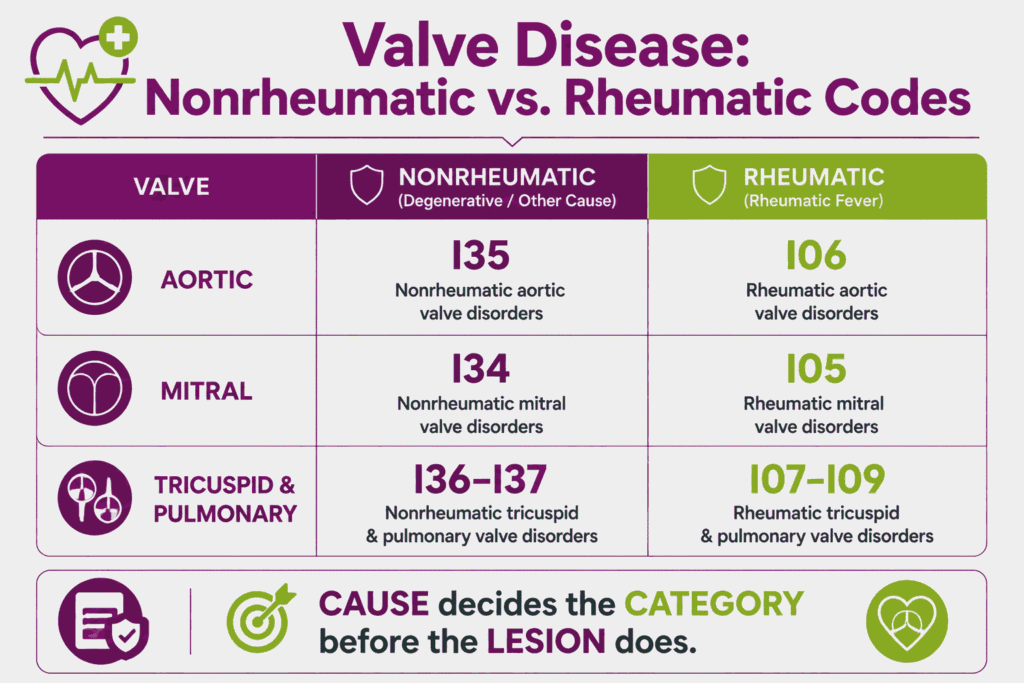
Valvular and structural heart disease covers I05 through I42, keyed to valve and cause. Nonrheumatic and rheumatic valve disease sit in separate categories.
Aortic Stenosis ICD-10 Codes
Aortic stenosis is nonrheumatic when coded to I35.0, the high-intent code behind TAVR and surgical valve replacement. The aortic stenosis ICD-10 codes separate nonrheumatic disease from the rheumatic I06 category across severity. Searches arrive through icd 10 aortic stenosis, aortic valve stenosis icd 10, and severe aortic stenosis icd 10.
Mitral Regurgitation ICD-10 Codes
Mitral regurgitation runs to I34.0 for the nonrheumatic form, with rheumatic mitral disease in the I05 category. The code captures both primary and secondary regurgitation of the mitral valve. Nonrheumatic and rheumatic mitral disorders detail out in the mitral regurgitation ICD-10 codes.
Heart Valve Disease ICD-10 Codes
Heart valve disease reaches across nonrheumatic I34 through I39 and rheumatic I05 through I08. The heart valve disease ICD-10 codes name every valve, lesion, and cause across all four heart valves. This hub points to the aortic stenosis and mitral regurgitation guides for the two highest-volume valves.
Aortic Regurgitation ICD-10 Codes
Aortic regurgitation is I35.1, nonrheumatic aortic insufficiency, with the rheumatic form at I06.1. The code documents backflow through the aortic valve during diastole. Placement stays inside the nonrheumatic aortic valve disorders, paired with I35.0 stenosis coding.
Mitral Stenosis ICD-10 Codes
Mitral stenosis divides between rheumatic I05.0 and nonrheumatic I34.2. Narrowing of the mitral valve opening restricts left atrial outflow, and rheumatic origin still dominates worldwide. The code turns on whether the cause is rheumatic or nonrheumatic.
Cardiomyopathy ICD-10 Codes
Cardiomyopathy occupies the I42 category by structural type. The cardiomyopathy ICD-10 codes run from dilated I42.0 through hypertrophic I42.1 and I42.2 to restrictive I42.5, with ischemic cardiomyopathy pulled out to I25.5. The non-ischemic cardiomyopathy ICD-10 codes separate primary muscle disease from ischemic causes.
Congenital Heart Disease ICD-10 Codes
Congenital heart disease draws on the Q20 through Q28 malformation range. Q21.0 is ventricular septal defect, Q21.1 atrial septal defect, and Q25.0 patent ductus arteriosus. Septal defects, valve malformations, and complex lesions fill the congenital heart disease ICD-10 codes across pediatric and adult care.
Which ICD-10 Codes Cover Pericardial and Inflammatory Heart Disease?
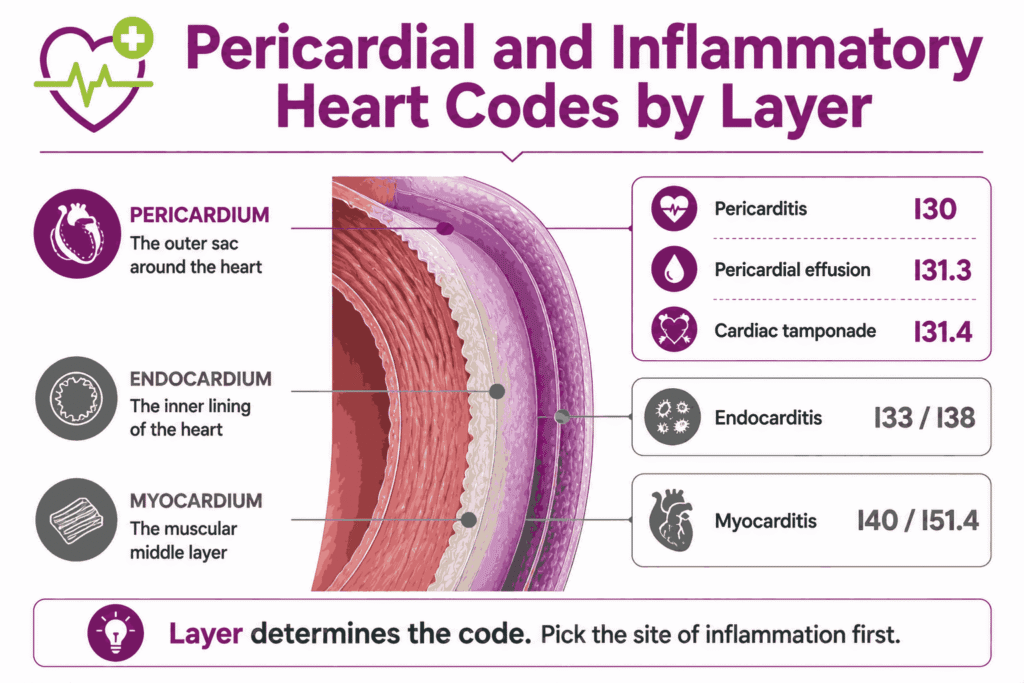
Pericardial and inflammatory disease covers I30 through I40 by structure and cause. Pericardial effusion, pericarditis, endocarditis, and myocarditis each take a distinct code.
Pericarditis and Pericardial Effusion ICD-10 Codes
Pericardial effusion codes to I31.3 for the noninflammatory form, with cardiac tamponade at I31.4. Acute pericarditis is I30.9 unspecified, plus I30.0 and I30.1 for specific acute forms. Effusion, tamponade, and acute pericarditis all sit in the pericardial effusion ICD-10 codes. Effusion itself draws more search volume than pericarditis.
Endocarditis ICD-10 Codes
Endocarditis uses I33 for acute and subacute disease and I38 for unspecified-valve endocarditis. Infective and noninfective inflammation of the endocardium both apply, with organism specificity added when documented. Acute, subacute, and valve-specific forms round out the endocarditis ICD-10 codes.
Myocarditis ICD-10 Codes
Myocarditis is I40 in the acute form and I51.4 when unspecified. The myocarditis ICD-10 codes cover infective and idiopathic inflammation of the heart muscle, with viral and toxic causes flagged separately. Documentation drives the added specificity.
Which ICD-10 Codes Cover Aortic and Peripheral Vascular Disease?
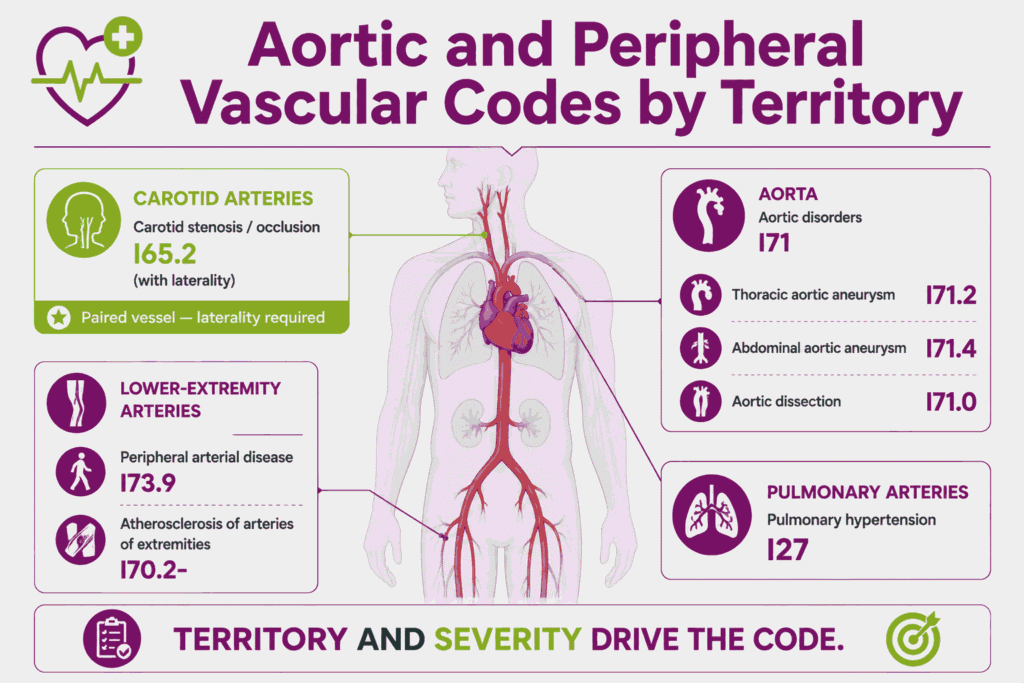
Aortic and peripheral vascular disease covers I65 through I73 plus the I27 pulmonary category. Arterial territory and disease severity split most codes.
Peripheral Artery Disease ICD-10 Codes
Peripheral artery disease starts at I73.9 for unspecified peripheral vascular disease and I70.2- for lower-extremity atherosclerosis. Severity characters flag claudication, rest pain, ulceration, and gangrene, which drive revascularization necessity. Each severity stage and vessel appears in the peripheral artery disease ICD-10 codes.
Carotid Artery Stenosis ICD-10 Codes
Carotid artery stenosis is the I65.2 subcategory, occlusion and stenosis of the carotid artery. The carotid artery stenosis ICD-10 codes break out I65.21 right, I65.22 left, and I65.23 bilateral. Laterality applies here because the carotid is a paired vessel, unlike most cardiac codes.
Aortic Aneurysm ICD-10 Codes
Aortic aneurysm sits in the I71 category by location and rupture status. The abdominal aortic aneurysm ICD-10 code is I71.4 unruptured, and I71.3 ruptured, while the thoracic aortic aneurysm ICD-10 code is I71.2, and dissection is I71.0. Abdominal, thoracic, and dissection forms all share the block and fill the aortic aneurysm ICD-10 codes.
Pulmonary Hypertension ICD-10 Codes
Pulmonary hypertension groups under the I27 category by cause. The ICD-10 codes for pulmonary hypertension separate primary disease at I27.0, secondary forms at I27.2-, and cor pulmonale at I27.81.
Which ICD-10 Codes Cover Venous Thromboembolism?
Venous thromboembolism covers the I26 and I82 categories by vessel and acuity. Here, deep vein thrombosis and pulmonary embolism take separate codes.
Deep Vein Thrombosis (DVT) ICD-10 Codes
Deep vein thrombosis lives in the I82 category by vessel and acuity. I82.4- is acute lower-extremity DVT and I82.5- the chronic form, each specifying vein and laterality. The DVT ICD-10 code family details every vein, side, and acuity inside the deep vein thrombosis ICD-10 codes.
Pulmonary Embolism ICD-10 Codes
Pulmonary embolism codes to the I26 category by cor pulmonale status. The pulmonary embolism ICD-10 codes split I26.0- with acute cor pulmonale from I26.9- without it, and add specificity for saddle embolism. The code links to DVT when both conditions coexist.
Which ICD-10 Codes Cover Lipid and Metabolic Disorders?
Lipid disorders sit in the E78 category in Chapter 4, outside the circulatory chapter. Cardiologists code them for cardiovascular risk management.
Hyperlipidemia ICD-10 Codes
Hyperlipidemia centers on E78.5, unspecified hyperlipidemia, and the most reported lipid code. Mixed hyperlipidemia takes E78.2, and pure hypercholesterolemia E78.0, while search traffic arrives via icd 10 hyperlipidemia and icd 10 code for hyperlipidemia. Pure, mixed, and unspecified lipid disorders spread across the hyperlipidemia ICD-10 codes.
Hypercholesterolemia ICD-10 Codes
Hypercholesterolemia is E78.0 for the pure form, with E78.00 unspecified and E78.01 familial. The code isolates elevated cholesterol from mixed lipid disorders. Because it shares the E78.5 parent intent, the code stays inside the hyperlipidemia guide rather than a separate page.
Dyslipidemia and Mixed Hyperlipidemia ICD-10 Codes
Dyslipidemia and mixed hyperlipidemia code to E78.2, with other hyperlipidemia at E78.4. Combined elevation of cholesterol and triglycerides defines the mixed form, the common documented presentation. Both share the E78 family and remain inside the hyperlipidemia guide.
Which ICD-10 Codes Cover Cardiac Symptoms, Signs, and Ill-Defined Conditions?
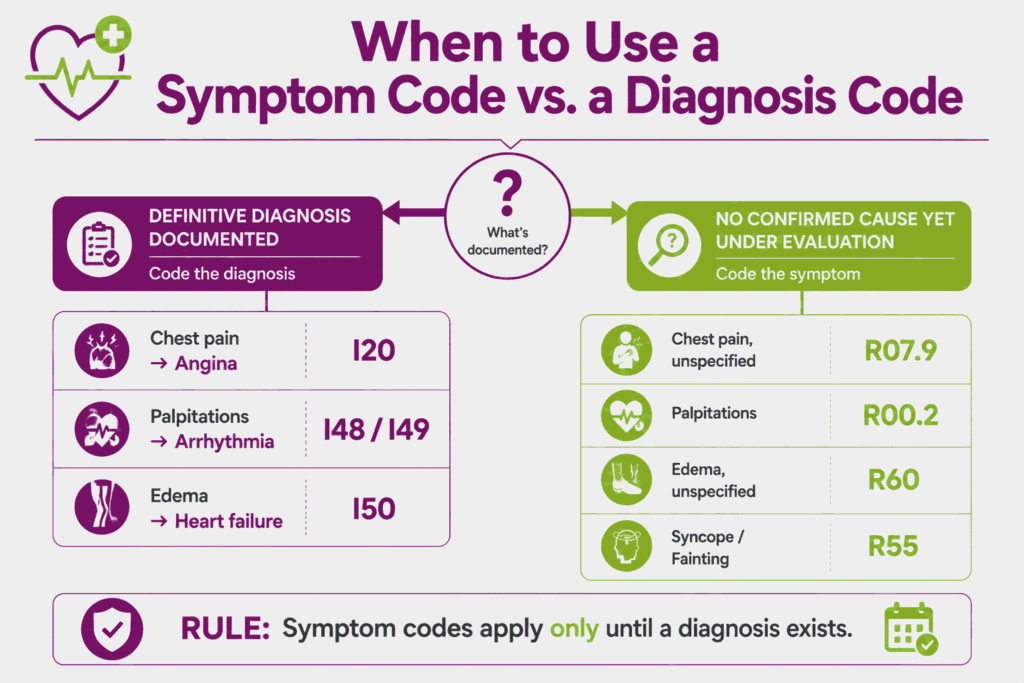
Cardiac symptom codes draw from Chapter 18 (R00 through R09, R55, R60) and the I95 hypotension category. These codes apply until a definitive cardiac diagnosis exists.
Chest Pain ICD-10 Codes
Chest pain centers on R07.9 for the unspecified form, reached through icd 10 chest pain and icd 10 code for chest pain. The chest pain ICD-10 codes add R07.89 atypical chest pain, R07.2 precordial pain, and related pleuritic and chest-wall entries. The symptom code never replaces angina once ischemia is documented.
Hypotension ICD-10 Codes
Hypotension falls under the I95 category by cause. I95.0 is idiopathic, I95.2 drug-induced, and I95.9 unspecified low blood pressure. Idiopathic, drug-induced, and unspecified forms sit in the hypotension ICD-10 codes.
Orthostatic Hypotension ICD-10 Codes
Orthostatic hypotension is I95.1, the postural blood pressure drop. The orthostatic hypotension ICD-10 codes cover the positional fall that causes dizziness on standing, often from autonomic dysfunction. Documentation of the postural trigger supports the code.
Syncope and Collapse ICD-10 Codes
Syncope and collapse code to R55, transient loss of consciousness from reduced cerebral perfusion. The code holds until a cardiac or neurologic cause is established. Near-syncope and vasovagal presentations round out the syncope ICD-10 codes.
Tachycardia ICD-10 Codes
Tachycardia as a symptom is R00.0, unspecified elevated heart rate. The tachycardia ICD-10 codes apply before a rhythm diagnosis exists, which sets them apart from the named I47 arrhythmias. Rate documentation supports the symptom code.
Palpitations ICD-10 Codes
Palpitations code to R00.2, the sensation of irregular or forceful heartbeats. The code applies when a patient reports heartbeat awareness without a confirmed arrhythmia. Symptom-level palpitation coding and its workup path fill the ICD-10 codes for palpitations.
Bradycardia ICD-10 Codes
Bradycardia as a symptom is R00.1, unspecified slow heart rate. The bradycardia ICD-10 codes apply before a conduction diagnosis such as sick sinus syndrome is confirmed, unlike the I49.5 rhythm code. Rate documentation drives the assignment.
Edema ICD-10 Codes
Edema uses the R60 category by distribution: R60.0 localized, R60.1 generalized, and R60.9 unspecified. The finding often signals heart failure or venous disease but never replaces those diagnoses when documented. Localized and generalized edema by cause appears in the edema ICD-10 codes.
Cardiac Arrest ICD-10 Codes
Cardiac arrest groups under the I46 category by cause. The cardiac arrest ICD-10 codes mark I46.2 for an underlying cardiac condition, I46.8 for another condition, and I46.9 for an unspecified cause. Each entry documents cessation of cardiac function with resuscitation status.
Cardiomegaly ICD-10 Codes
Cardiomegaly is I51.7, enlargement of the heart on imaging. Left atrial and ventricular enlargement carry related descriptive codes. The enlarged cardiac silhouette and its imaging findings sit in the cardiomegaly ICD-10 codes.
Heart Murmur ICD-10 Codes
Heart murmur uses the R01 category by murmur type. The heart murmur ICD-10 codes mark R01.1 unspecified cardiac murmur, and R01.0 benign or innocent murmur. The finding applies pending valve evaluation.
Dyspnea ICD-10 Codes
Dyspnea codes to R06.0 for shortness of breath, with R06.00 unspecified and R06.02 the specific entry. The symptom points to cardiac or pulmonary origin before a definitive diagnosis. Dyspnea coding supports the workup of heart failure and related conditions.
Unspecified Heart Disease ICD-10 Codes
Unspecified heart disease is I51.9, cardiac disease with no stated type. The code applies when documentation confirms disease without naming it, and specific codes replace it once the condition is defined. Low capture value marks I51.9 as a sign of incomplete documentation.
Why Do Cardiovascular Claims Get Denied?
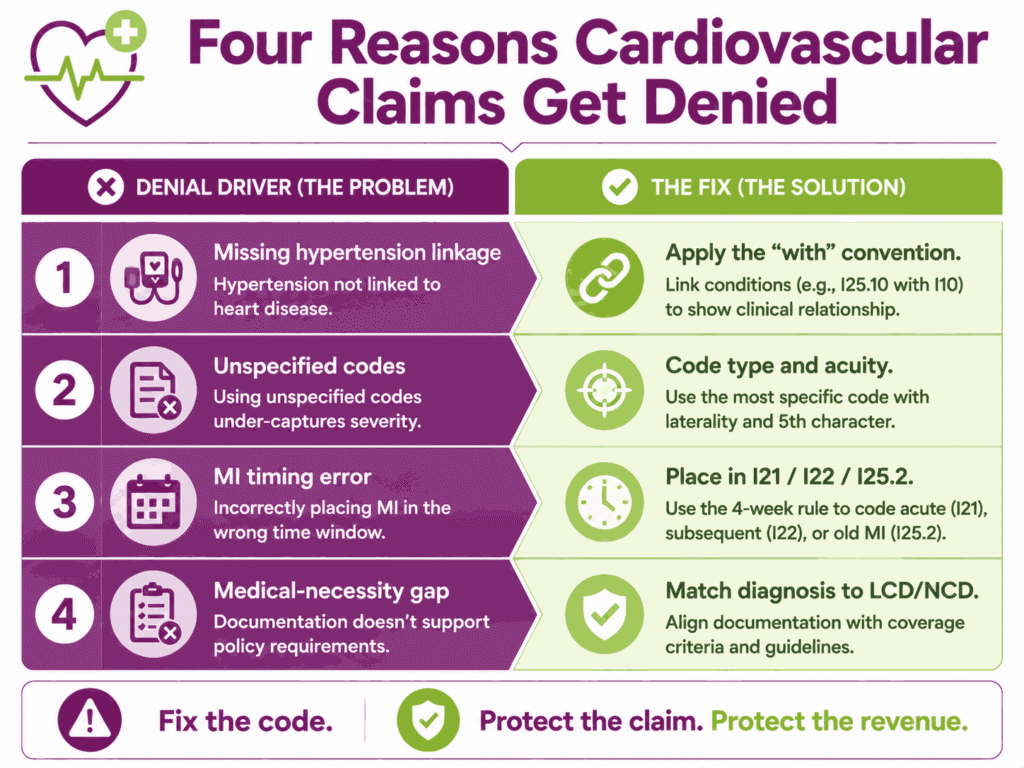
Cardiovascular claims get denied primarily from missing hypertension linkage, unspecified codes, MI timing errors, and weak medical necessity on high-cost procedures. Cardiovascular coding carries more sequencing variables than most specialties, so each variable becomes a denial point. Specificity at the documentation stage prevents most denials downstream.
Specialized cardiology billing services scrub claims for these coding and sequencing errors before the clearinghouse transmits them. Front-end review catches the hypertension linkage and MI timing problems that drive most cardiac denials. Dedicated cardiology billing services reduce these administrative breakdowns across diagnostic, interventional, and device coding.
How Does Risk Adjustment Change Cardiovascular Coding?
Risk adjustment raises the stakes of cardiovascular coding because many cardiac diagnoses carry hierarchical condition category (HCC) weight. Heart failure, atrial fibrillation, coronary artery disease, and old myocardial infarction all map to HCCs that drive risk-adjustment factor scores.
- Heart failure (I50): Systolic and combined codes carry higher HCC weight than unspecified I50.9.
- Atrial fibrillation (I48): Chronic and permanent forms support HCC capture.
- Coronary artery disease (I25): Documented CAD with angina strengthens capture.
- Old MI (I25.2): Prior-event status carries forward risk weight.
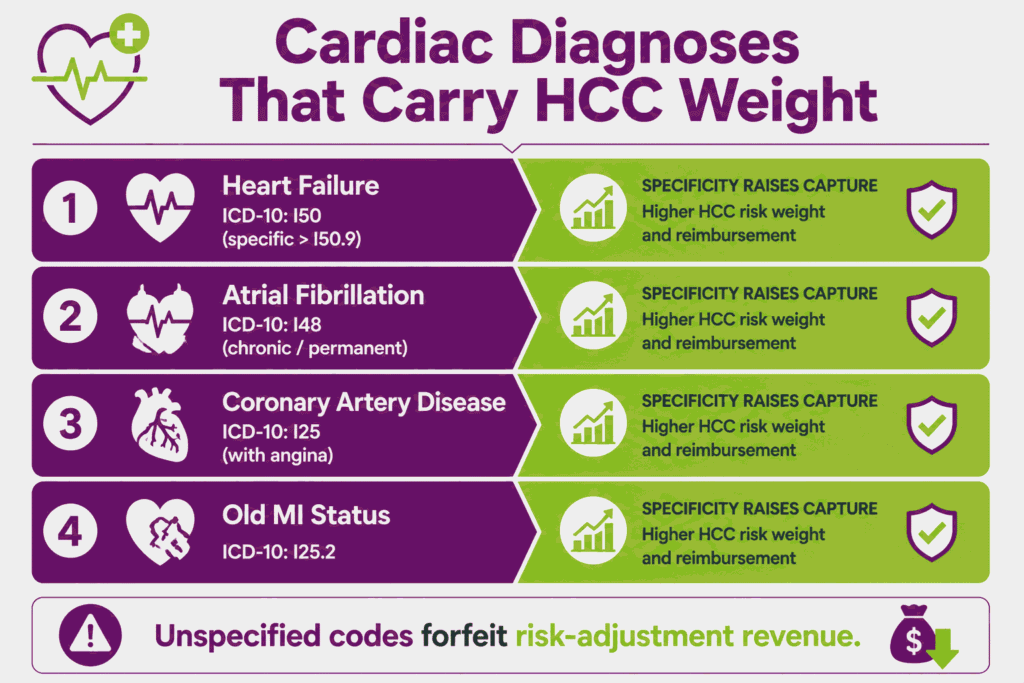
Under-specific coding lowers the risk-adjustment factor and reduces capitation revenue for ACO and value-based contracts. MEAT documentation, monitoring, evaluating, assessing, and treating, supports each captured condition. A structured cardiology medical billing guide helps administrative teams convert clinical complexity into accurate reimbursement.
What Documentation Supports Cardiovascular Code Selection?
Cardiovascular code selection requires documentation of acuity, causal linkage, ejection fraction, and device status. The medical record must state the failure type, the infarction timing, and the hypertension relationship. Ejection fraction values drive the systolic versus diastolic heart failure split.
Each diagnosis code must pair with the matching procedure code for services such as catheterization and echocardiography. Aligning these diagnoses with the correct cardiology CPT codes keeps evaluation and management services from conflicting with same-day procedural modifiers. Local and national coverage determinations (LCD and NCD) define which diagnoses justify each high-cost procedure.
How Do You Reduce Cardiovascular Coding Denials?
Reducing cardiovascular denials requires four practices: sequencing combination codes correctly, coding to full specificity, applying MI timing rules, and scrubbing claims at the front end. Unspecified codes raise audit flags and lower risk-adjustment capture.
- Sequence hypertension links using the “with” convention for heart and kidney involvement.
- Code heart failure type rather than defaulting to unspecified I50.9.
- Apply MI timing to place the event in I21, I22, or I25.2 correctly.
- Scrub claims front-end to catch unspecified codes before submission.
Experienced cardiology billing companies handle this reconciliation loop end-to-end, alongside eligibility verification and prior authorization for elective cardiac procedures. This front-end review protects both reimbursement and risk-adjustment accuracy.
Cardiology ICD-10 Coding FAQs
What Is the ICD-10 Code for a Cardiology Visit?
No single ICD-10 code exists for a cardiology visit. ICD-10 codes classify diagnoses, not visit types, so the code matches the documented cardiac condition. Encounter and evaluation details map to CPT and cardiology HCPCS codes instead.
What Is the Most Common Cardiology ICD-10 Code?
The most common cardiology ICD-10 code is I10 for essential hypertension. Hypertension affects nearly half of US adults, which makes I10 the highest-volume cardiac diagnosis. Hyperlipidemia (E78.5) and chest pain (R07.9) also rank among the highest-volume codes.
How Do You Code Hypertension With Heart Failure?
Code hypertension with heart failure using I11.0 first, then the specific I50 heart failure code. ICD-10 presumes a causal link between hypertension and heart failure under the “with” convention. The I50 code specifies the systolic, diastolic, or combined failure type.
What Is the ICD-10 Code for a Heart Attack, Acute Versus Old?
An acute heart attack uses I21, with I21.4 for NSTEMI and I21.0 through I21.3 for STEMI. An old, healed myocardial infarction uses I25.2 outside the 4-week acute window. A subsequent acute MI within that window uses I22.
Do Cardiology ICD-10 Codes Require Laterality?
Most cardiology ICD-10 codes do not require laterality because the heart is a midline organ. Paired vessels, such as the carotid arteries, do require right, left, or bilateral specificity. Cardiac codes instead depend on type, acuity, and causal linkage.
How Often Do Cardiology ICD-10 Codes Change?
Cardiology ICD-10 codes update annually on October 1, when CMS releases the new fiscal-year code set. Updates add, revise, and retire codes, so cardiovascular coding references require yearly review. The FY2026 code set continues that annual cycle.