Summary: “CPT code 96132 covers the first hour of neuropsychological testing evaluation services performed by a physician or qualified health professional. It includes data interpretation, clinical decision-making, treatment planning, and feedback. The code is often confused with test administration codes (96136, 96138) and brief screening (96127). Medicare reimbursement for 96132 decreased in 2026 due to practice expense methodology changes, and telehealth flexibilities for home-based services are extended only through December 31, 2027.”
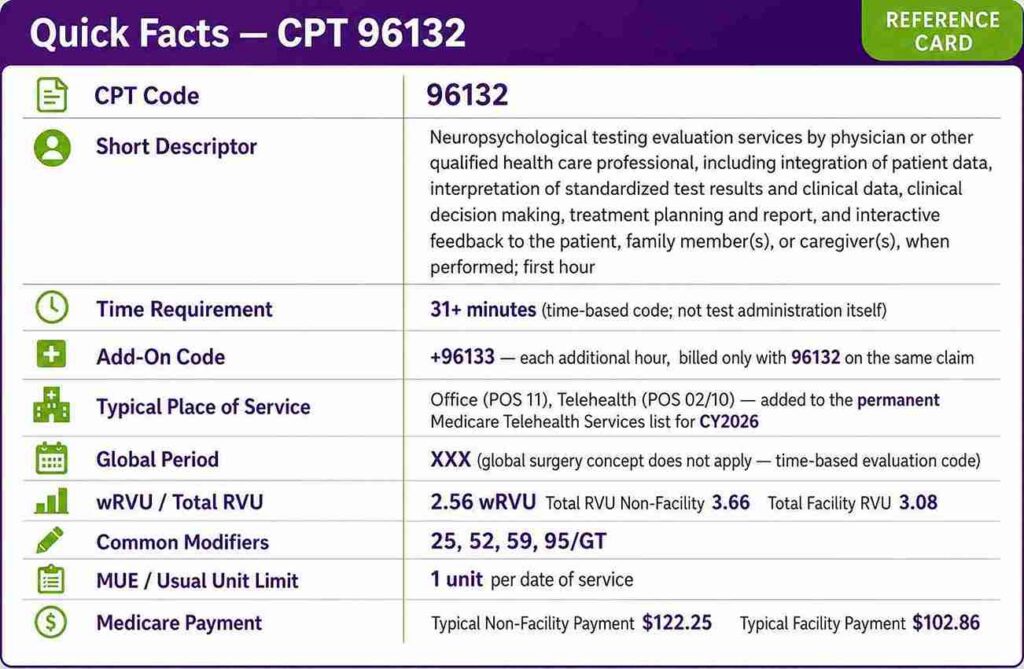
CPT code 96132 reports the first hour of neuropsychological testing evaluation services. A physician or qualified health care professional performs this work directly. It covers data interpretation, clinical decision-making, treatment planning, and interactive feedback.
The code sits inside a family of psychological and neuropsychological testing codes. These include 96130, 96116, and the test administration codes 96136, 96138, and 96146. Each code serves a distinct billing purpose, and confusing them is a common denial trigger.
Neuropsychologists use 96132 to assess how brain-based conditions affect cognition, mood, and behavior. Typical referrals involve dementia, traumatic brain injury, ADHD, and post-concussion syndrome. The evaluation connects standardized test data to a clinical diagnosis and plan.
This guide covers the full 96132 picture: its description and time rules, modifiers, telehealth status under the CY2026 final rule, cost, clinical scenarios, and the reimbursement rules that prevent denials.
What Is the Description of CPT Code 96132?
The American Medical Association (AMA) defines 96132 as “Neuropsychological testing evaluation services by physician or other qualified health care professional, including integration of patient data, interpretation of standardized test results, clinical decision making, treatment planning, and interactive feedback with the patient, family, or caregiver; first hour”
This is an evaluation code, not a test administration code. It captures the clinician’s interpretive and cognitive work, not the act of giving tests. That distinction shapes every billing decision tied to 96132.
What Does the First Hour of CPT Code 96132 Include, and What Does It Exclude?
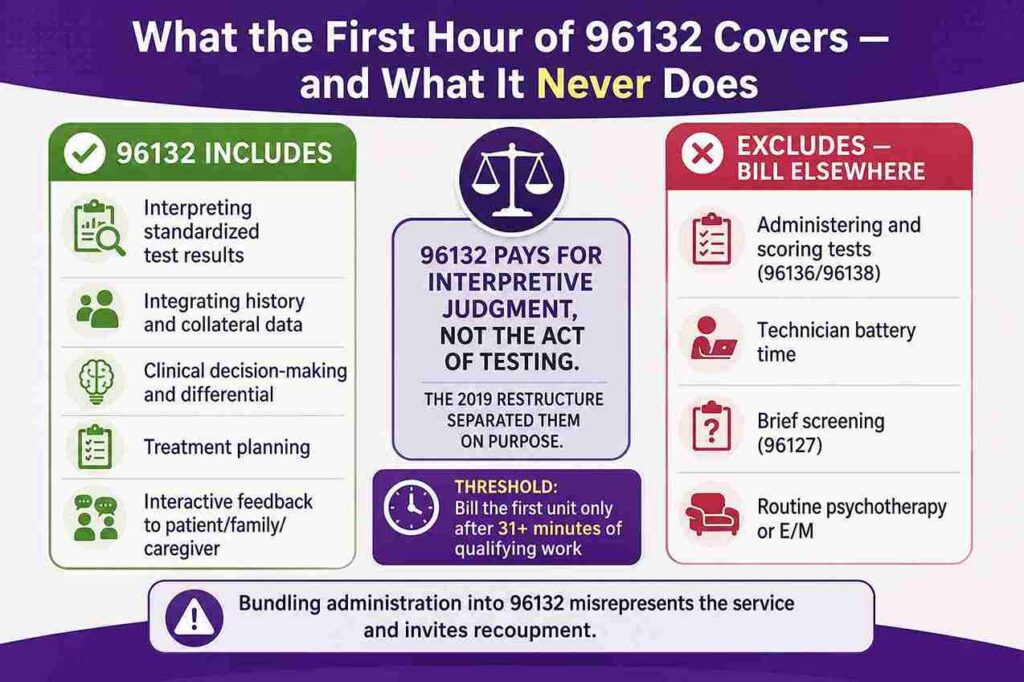
The first hour of 96132 captures the professional interpretive work that a neuropsychologist performs around a testing case. It is billed once when the qualifying clinician spends at least 31 minutes on these activities.
The first hour of 96132 includes:
- Reviewing and interpreting standardized neuropsychological test results
- Integrating patient history, records, and collateral clinical data
- Clinical decision-making and differential diagnosis
- Treatment planning based on the test findings
- Interactive feedback to the patient, family members, or caregivers
The first hour of 96132 excludes:
- Administering and scoring the tests themselves
- Technician time spent delivering test batteries
- Brief screening instruments billed under 96127
- Routine psychotherapy or evaluation and management work
Test administration is always reported separately under 96136, 96137, 96138, or 96139. The evaluation code and the administration code describe different work performed by different people at different times.
How Is Time Calculated and Documented for CPT Code 96132, Including Time Split Across Multiple Days?
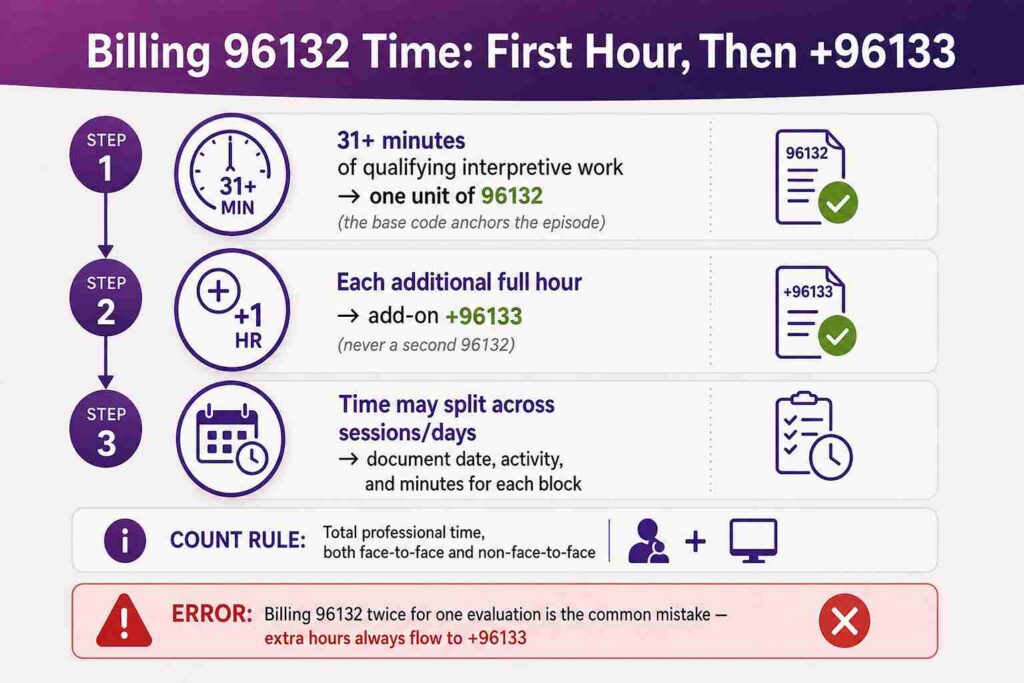
Time for 96132 is counted as total professional evaluation time, both face-to-face and non-face-to-face. The first unit requires at least 31 minutes of qualifying work. Each additional full hour is reported with add-on code +96133.
A neuropsychological evaluation often runs four to six hours across administration, scoring, and interpretation. The interpretive portion frequently spans more than one calendar day. Coders should record start and stop times for every distinct activity.
You may split 96132 time across multiple sessions or days when the clinical work genuinely extends. Document each block clearly with the date, the activity, and the minutes spent. The base code 96132 is reported only once per evaluation episode.
| Time Activity | Day | Code Reported |
|---|---|---|
| Records review and clinical assessment, 45 min | Day 1 | 96132 |
| Interpretation and interactive feedback, 50 min | Day 2 | +96133 |
| Technician test administration, 60 min | Day 2 | 96138 / 96139 |
A common mistake is billing 96132 twice for one evaluation. The base code anchors the episode. Additional interpretive hours always flow to +96133, never to a second 96132 unit.
How Does CPT Code 96132 Differ From CPT 96130, 96116, and the Test Administration Codes (96136, 96138, 96146)?
These codes describe related but separate services. The evaluation codes capture professional interpretation. The administration codes capture the act of giving and scoring tests. Picking the wrong one is the leading source of bundling and overlap denials.
| Code | Service Type | Performed By | Time Unit | Add-On |
|---|---|---|---|---|
| 96132 | Neuropsychological testing evaluation | Physician or QHP | First hour | +96133 |
| 96130 | Psychological testing evaluation | Physician or QHP | First hour | +96131 |
| 96116 | Neurobehavioral status exam | Physician or QHP | First hour | +96121 |
| 96136 | Test administration and scoring | Physician or QHP | First 30 min | +96137 |
| 96138 | Test administration and scoring | Technician | First 30 min | +96139 |
| 96146 | Automated test administration | Computer only | Per instrument | None |
The split between 96132 and 96130 is clinical. Use 96132 when the evaluation diagnoses neurocognitive effects of medical disorders affecting the brain. Use 96130 for psychological testing tied to emotional or personality functioning. Consulting an updated neurology CPT codes guide helps distinguish these cognitive testing boundaries accurately.
CPT 96116 is narrower than 96132. It reports a neurobehavioral status exam through clinical interview and mental status testing. It does not involve interpreting a standardized test battery the way 96132 does.
Why Test Administration Must Always Be Billed Separately From CPT Code 96132
CPT 96132 pays for the clinician’s interpretive judgment, not for time spent administering tests. The 2019 code restructure deliberately separated these two activities. Bundling them into one code misrepresents the service and invites recoupment.
Test administration carries its own codes based on who performs the work:
- 96136 / +96137: administration and scoring by a physician or QHP
- 96138 / +96139: administration and scoring by a technician under supervision
- 96146: administration by computer, scored automatically
A neuropsychologist who administers a battery and then interprets it bills both code types. The administration time goes to 96136 or 96138. The interpretive hour goes to 96132. The two are reported on the same claim but never merged.
What ICD-10 Codes and Medical Necessity Criteria Support CPT Code 96132?
Payers cover 96132 only when the diagnosis supports a need for neuropsychological evaluation. Medicare Administrative Contractors publish covered ICD-10 lists in their Local Coverage Articles, such as A57780. Coverage criteria vary by contractor and payer.
Medical necessity rests on a documented clinical question. The record must show why standardized testing was needed to diagnose or manage a brain-based condition. A vague referral will not survive review.
| Condition Category | Representative ICD-10 Codes |
|---|---|
| Dementia and Alzheimer’s | F02.8-, F03.9-, G30.- |
| Mild cognitive impairment | G31.84 |
| Traumatic brain injury | S06.- sequela codes |
| Post-concussion syndrome | F07.81 |
| ADHD | F90.- |
| Cognitive symptoms, memory loss | R41.3, R41.81, R41.840 |
Always verify the active covered diagnosis list in your MAC’s current article before submission. Codes move on and off these lists. A diagnosis that supported coverage last year may need a supporting secondary code now.
What are the Modifiers for CPT Code 96132?
Modifiers tell the payer how 96132 relates to other same-day services. The four most relevant are 25, 52, 59, and 95. Each one answers a specific question about separateness, scope, or delivery method.
Modifier 25: Significant, Separately Identifiable E/M on Same Day
Append modifier 25 to the evaluation and management code when an E/M service is performed on the same day as 96132. The modifier signals that the E/M was significant and separately identifiable. Without it, the payer bundles the E/M into the testing service and denies it.
The documentation must support two distinct services. The E/M note should stand on its own, separate from the neuropsychological evaluation record. Modifier 25 goes on the E/M code, not on 96132.
Modifier 52: Reduced Services (Reduced Evaluation Scope)
Modifier 52 reports a reduced service when the clinician performs less than the full scope of 96132. It applies when the evaluation is partially completed or intentionally limited. Document the clinical reason the service was reduced.
Use this modifier sparingly and only when the work genuinely fell short of the code’s full definition. Most short evaluations are better handled through accurate time documentation under the 31-minute threshold rule.
Modifier 59: Distinct Procedural Service
Modifier 59 identifies a service that is distinct from another procedure billed the same day. It is the override for many National Correct Coding Initiative (NCCI) edits. Apply it to the testing code when an edit pair would otherwise bundle two distinct services.
A frequent use involves same-day health behavior assessment (96156) and testing. The NCCI edit treats them as conflicting without modifier 59 and supporting documentation. Use 59 only when a true clinical distinction exists, since it draws audit attention.
Modifier 95: Synchronous Telehealth Service
Modifier 95 reports 96132 delivered through real-time audio-video telehealth. It signals a synchronous service furnished to a patient at a distant location. Pair it with the correct place-of-service code for the patient’s location.
Use place of service 10 when the patient is at home, which pays the higher non-facility rate. Use place of service 02 for other telehealth locations. Audio-only delivery, where permitted, uses modifier 93 instead of 95.
Telehealth Billing Rules for CPT Code 96132: Service-List Status vs. Site Flexibility
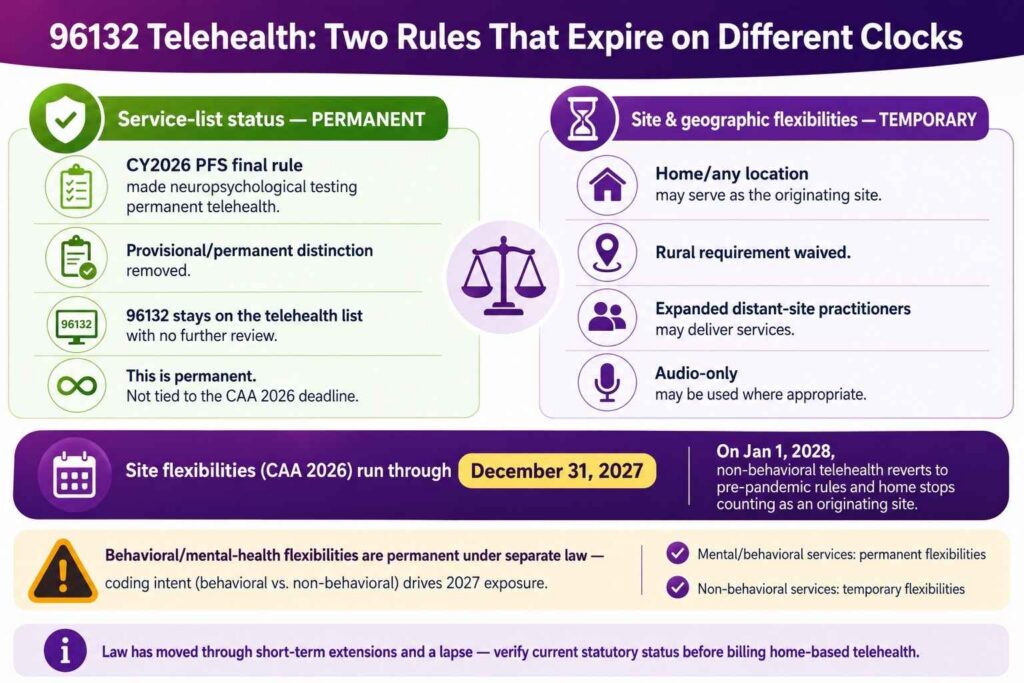
Telehealth billing for 96132 turns on two separate questions. First, is the code on the Medicare Telehealth Services List. Second, do the statutory site and geographic flexibilities still apply. These two rules have different expiration logic, and conflating them causes errors.
The service-list status is now permanent. The site flexibilities are temporary and tied to a 2027 deadline. Understanding the split protects you from billing home-based telehealth after the flexibility window closes.
Permanent Telehealth-List Status Under the CY2026 PFS Final Rule
The CY2026 Medicare Physician Fee Schedule final rule moved psychological and neuropsychological testing services to permanent telehealth status. CMS removed the provisional versus permanent distinction entirely. Codes formerly listed as provisional, including 96132, stay on the list without further review.
The agency simplified its review to one question: can the service be furnished through interactive, two-way audio-video technology. This permanent status means 96132 remains a valid telehealth code on the Medicare list going forward, independent of the statutory flexibility deadline.
Originating-Site, Geographic, and Audio-Only Flexibilities and the December 31, 2027 Cliff
The site and geographic flexibilities come from statute, not the fee schedule. The Consolidated Appropriations Act, 2026, signed in February 2026, extended them through December 31, 2027. These are the rules that let patients receive non-behavioral telehealth at home.
Flexibilities extended through December 31, 2027:
- Home and any geographic location as an originating site for non-behavioral services
- Waiver of the rural-area originating-site requirement
- Expanded list of eligible distant-site practitioners
- Audio-only delivery where clinically appropriate
A clinical nuance matters here. Behavioral and mental health telehealth flexibilities are permanent under separate law. The 2027 cliff mainly threatens services billed as non-behavioral telehealth, so coding intent affects exposure.
In-Person Visit Requirement Resuming After December 31, 2027
For mental health telehealth, the in-person visit requirement is currently waived. That waiver also runs through the end of 2027. Starting January 1, 2028, new mental health telehealth patients again face an in-person visit before and during ongoing virtual care.
CMS guidance describes the prepandemic structure that returns absent further congressional action. For non-behavioral telehealth, Medicare is scheduled to revert to the older rules on January 1, 2028. Home would no longer count as an originating site for most of those services.
Verify Current Statutory Status Before Relying on Home-Based Billing
Telehealth law has moved repeatedly through short-term extensions and a government shutdown. Flexibilities lapsed briefly in early 2026 before the February extension restored them retroactively. This pattern makes any fixed assumption risky.
Before billing 96132 for a home-based telehealth visit, confirm the current statutory status. Check the CMS Telehealth FAQ and your MAC’s latest guidance. Do not rely on a stored policy note, since the rules can change at a funding deadline.
Which Documents Are Required For CPT Code 96132?
Reimbursement for 96132 depends on documentation that proves medical necessity and supports the time billed. Auditors look for a clear clinical question and a record that ties test data to a diagnosis. Thin notes drive denials and recoupment.
Documentation that supports a clean 96132 claim:
- A referral or clinical question stating why testing is needed
- The supporting ICD-10 diagnosis and relevant history
- Names of the standardized tests administered and their results
- Time logs for each evaluation activity, with dates
- The interpretive summary, diagnosis, and treatment plan
- A record of interactive feedback given to the patient or caregiver
In practice, the interpretive report is the anchor document. It should connect the test findings to clinical conclusions and recommendations. A report that lists scores without interpretation does not support an evaluation code.
What is the Cost of CPT Code 96132?
The cost of 96132 reflects its relative value units and the Medicare conversion factor, adjusted by geography. Commercial payers set their own rates. For 2026, 96132 saw a reimbursement decrease driven by practice expense methodology changes.
RVUs & Medicare Payment
Medicare payment equals total RVUs multiplied by the conversion factor, then adjusted for locality. CPT 96132 carries a total RVU near 3.7 historically, plus practice expense and malpractice components. The 2026 practice expense changes lowered its total payment.
| Code | 2026 Medicare Estimate (Non-Facility) | Notes |
|---|---|---|
| 96132 | ~$124.74 | Decreased for 2026 due to PE changes |
| 96136 | ~$43.94 | First 30 min, physician or QHP |
| 96138 | ~$37.73 | First 30 min, technician |
| 96127 | ~$4.97 | Per screening instrument |
These figures are national estimates and shift by locality. CMS finalized a 2026 conversion factor update and a 2.5 percent efficiency adjustment that excludes time-based and telehealth-listed codes. Pull the exact rate from the CMS PFS Look-Up Tool for your locality.
Commercial Payers
Commercial payers do not follow Medicare rates exactly. Many benchmark against a percentage of the Medicare fee schedule, then apply their own contract terms. Some impose hourly caps on total neuropsychological evaluation time per patient.
Prior authorization is common for 96132 with commercial plans. Many payers require approval before extended or repeated evaluations. Verify benefits and authorization rules before the first testing appointment, since coverage for testing codes varies widely.
Place-of-Service & Geographic Adjustments
Place of service changes the payment amount. Office settings (POS 11) and home telehealth (POS 10) pay the higher non-facility rate. Facility settings pay a reduced practice expense rate, since the facility absorbs overhead.
Geographic Practice Cost Indices (GPCIs) adjust each RVU component by locality. The same code pays differently in a high-cost metro than in a rural area. Always price 96132 against the correct locality and place of service before estimating revenue.
What Are Example Clinical Scenarios or Use Cases for CPT Code 96132?
Real scenarios show how 96132 pairs with administration codes and add-on time. Each case below reflects a common referral pattern. The coding follows the work actually performed and documented.
Scenario 1: Suspected Early-Stage Dementia With Memory and Executive Function Decline
A 72-year-old presents with progressive memory loss and executive dysfunction. The primary care physician refers for neuropsychological evaluation to rule out early dementia. A technician administers a standardized battery over 90 minutes.
The neuropsychologist then spends 75 minutes interpreting results, integrating history, forming a differential, and giving feedback. The coding reflects both the administration and the interpretive work performed across the case.
- 96138 + 96139: technician test administration, 90 minutes
- 96132: first hour of evaluation, interpretation, and feedback
- +96133: additional interpretive time beyond the first hour
- ICD-10 such as R41.81 or a confirmed dementia code
Scenario 2: Post-Concussion Cognitive Evaluation Following a Motor Vehicle Accident
A 34-year-old reports concentration and memory problems after a motor vehicle accident. The referral asks for cognitive evaluation related to post-concussion syndrome. Standardized testing measures attention, processing speed, and memory.
The neuropsychologist administers select tests directly, then interprets the full data set. Documentation links the cognitive findings to the injury and outlines a rehabilitation plan. Auto and liability payers often review these claims closely.
- 96136 / +96137: physician-administered test scoring
- 96132: evaluation, interpretation, and treatment planning
- ICD-10 F07.81 for postconcussional syndrome, plus injury sequela codes
- Detailed time logs supporting each billed unit
Scenario 3: ADHD Diagnostic Workup Requiring Integration of Standardized Test Data and Treatment Planning
A 19-year-old college student is referred for an ADHD diagnostic workup. The evaluation must combine standardized rating data, cognitive testing, and clinical interview. The clinical question is whether ADHD explains the academic difficulties.
The neuropsychologist reviews records, interprets the test battery, forms a diagnosis, and builds a treatment plan. Feedback covers diagnosis and recommendations with the patient. The interpretive work extends past one hour and into a second session.
- 96138 + 96139: technician administration of the battery
- 96132: first hour of evaluation and clinical decision-making
- +96133: second-session interpretation and feedback
- ICD-10 in the F90 series for ADHD
What Are the CPT Code 96132 Rules To Ensure Successful Reimbursement?
Clean reimbursement for 96132 depends on correct bundling logic, accurate units, and the right modifiers. Most denials trace back to a handful of avoidable errors. The rules below cover the patterns auditors target most.
Bundling / NCCI / Same-Day Procedure Rules
The NCCI program defines which codes conflict on the same date of service. Some pairs are mutually exclusive without a modifier. Knowing these edits before submission prevents the most common automatic denials. Reviewing a properly compiled neurology billing guide helps billing teams identify these correct coding initiative edits early.
- 96156 and testing codes: health behavior assessment conflicts with testing; modifier 59 with documentation may override
- 96127 and 96130: brief screening and psychological evaluation are mutually exclusive on the same date
- E/M plus 96132: append modifier 25 to the E/M to keep both payable
- Stage 1 and Stage 2 same day: brief screening and formal test administration generally cannot share a date
A clean claim respects these edits up front. Apply override modifiers only when a real clinical distinction exists and the record proves it. Reflexive modifier use invites audits and recoupment.
Units, MUEs & Add-On Code (+96133) Billing Rules
CPT 96132 is a first-hour base code, so it is reported once per evaluation episode. Additional interpretive hours flow to add-on code +96133. The base code anchors the claim, and +96133 cannot be billed without it.
Medically Unlikely Edits (MUEs) cap the units a payer accepts per date of service. As a first-hour base code, 96132 generally carries a low MUE. Verify the current published MUE value in the CMS quarterly table, since these update four times a year.
| Code | Role | Unit Logic |
|---|---|---|
| 96132 | Base evaluation code | Reported once per episode |
| +96133 | Add-on, each additional hour | Requires 96132 on the claim |
| MUE check | Per date of service limit | Verify current CMS quarterly value |
A denial based on an MUE is a coding denial, not a medical necessity denial. An Advance Beneficiary Notice will not shift liability for MUE-denied units to the patient. Bill medically necessary units accurately, and appeal with documentation when warranted.
Why CPT 96132 Is Frequently Confused With Brief Screening Codes (96127) and How to Avoid Misuse
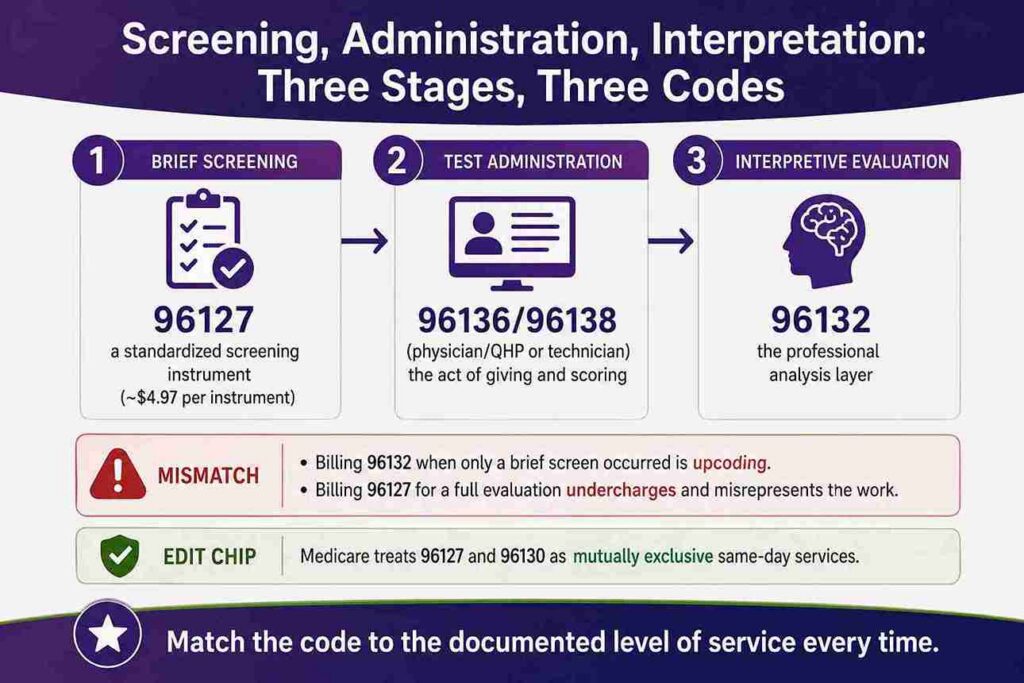
CPT 96127 reports a brief emotional or behavioral screening instrument. It is a quick, low-value screening code paying around $4.97 per instrument. CPT 96132 reports a full interpretive evaluation, a different level of service entirely.
The two represent different stages of a testing workflow. Brief screening is stage one. Formal test administration is stage two. Interpretive evaluation under 96132 is the professional analysis layer that follows.
- Use 96127 only for brief standardized screening instruments
- Never substitute 96127 for the interpretive work captured by 96132
- Medicare and most payers treat 96127 and 96130 as mutually exclusive same-day services
- Document the clinical purpose of any screening separately from the evaluation
Billing 96132 when only a brief screen occurred is upcoding. Billing 96127 when a full evaluation occurred undercharges and misrepresents the work. Match the code to the documented level of service every time.
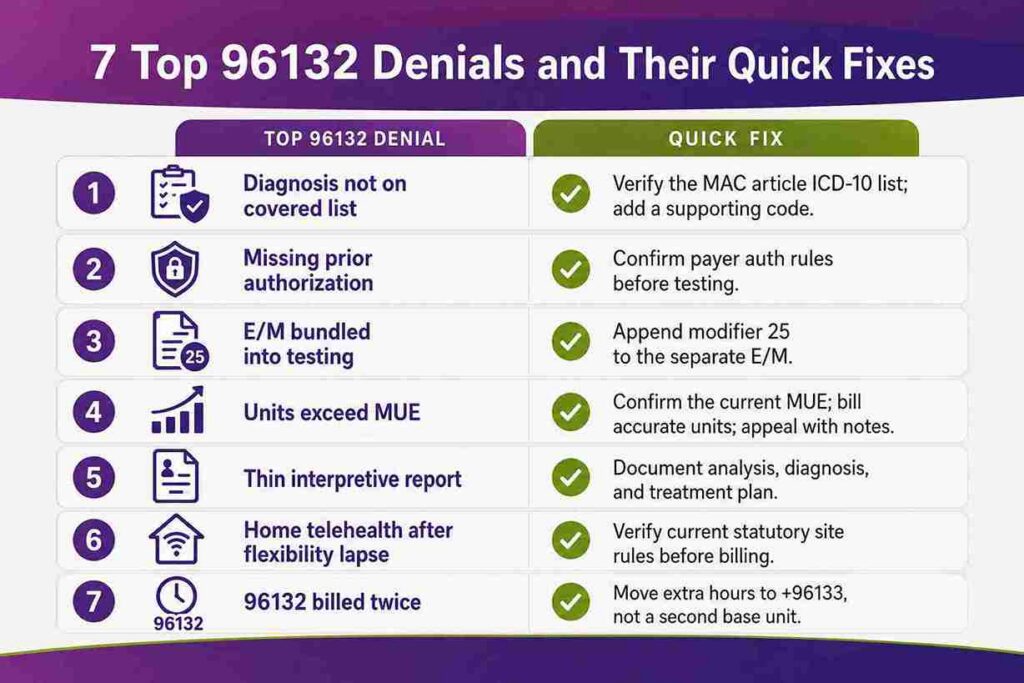
Top Reasons For Denials Specific To 96132 & Quick Remedies
Denials on 96132 cluster around a predictable set of causes. Most are preventable at the documentation and coding stage. The table below pairs each common denial with a direct remedy.
| Denial Reason | Quick Fix |
|---|---|
| Diagnosis not on covered list | Verify MAC article ICD-10 list; add supporting code |
| Missing prior authorization | Confirm payer auth rules before testing |
| E/M bundled into testing | Append modifier 25 to the separate E/M |
| Units exceed MUE | Confirm current MUE; bill accurate units; appeal with notes |
| Thin interpretive report | Document analysis, diagnosis, and treatment plan |
| Home telehealth after flexibility lapse | Verify current statutory site rules before billing |
| 96132 billed twice | Move extra hours to +96133, not a second base unit |
A strong interpretive report and verified diagnosis coverage prevent most denials before they happen. Build front-end checks for authorization, diagnosis coverage, and telehealth status into the intake workflow. Clean claims start before the patient is tested. Many practices partner with neurology billing services to manage these complex front-end authorization workflows.