The ADHD ICD-10 code comes in category F90.-, and the category contains five billable codes: F90.0, F90.1, F90.2, F90.8, and F90.9. CDC data collected in 2024 places 7 million U.S. children aged 3 to 17 years, or 11.7% of that population, under a current ADHD diagnosis.
Every one of those children generates claims across screening, testing, therapy, and medication management. Pediatric practices lose money on those claims for three repeatable reasons. The first is default coding to F90.9 when the chart supports a specific type. A missing modifier 25 on the same-day E/M service, and screening notes that omit the instrument name or the raw score.
This guide is about F90.x, which is one of many pediatric ICD-10 codes; it pairs each diagnosis code with the correct CPT code for screening, testing, and pharmacologic management. It lists the modifiers, documentation elements, comorbidity codes, and denial fixes that hold a pediatric ADHD claim together. Every major section carries a code table for point-of-claim reference.

What Is the ADHD ICD-10 Code?
The ADHD ICD-10 code is F90.-, the ICD-10-CM category titled Attention-deficit hyperactivity disorders. F90 alone is a non-billable category header. Claims require a fourth character, which produces one of five billable codes.
The FY2026 ICD-10-CM edition, effective October 1, 2025, carries the F90 category forward without structural change. The table below lists every valid ICD-10 code for ADHD with its official descriptor and DSM-5-TR equivalent.
| ICD-10-CM Code | Official Descriptor | DSM-5-TR Presentation | Billable |
|---|---|---|---|
| F90 | Attention-deficit hyperactivity disorders | Category header | No |
| F90.0 | Attention-deficit hyperactivity disorder, predominantly inattentive type | Predominantly inattentive presentation | Yes |
| F90.1 | Attention-deficit hyperactivity disorder, predominantly hyperactive type | Predominantly hyperactive-impulsive presentation | Yes |
| F90.2 | Attention-deficit hyperactivity disorder, combined type | Combined presentation | Yes |
| F90.8 | Attention-deficit hyperactivity disorder, other type | Documented ADHD outside the three defined presentations | Yes |
| F90.9 | Attention-deficit hyperactivity disorder, unspecified type | Type not documented | Yes |
Four of the five codes describe a documented clinical picture. Only F90.9 describes an absence of documentation, which is why F90.9 volume functions as a documentation-quality metric rather than a clinical finding.
What Does the F90 Category Include and Exclude?
The F90 category includes two indexed terms: attention deficit disorder with hyperactivity, and attention deficit syndrome with hyperactivity. The category also carries an Excludes2 note listing four condition groups.
An Excludes2 note means the excluded condition is not part of F90, and both conditions are reported together when both appear in the chart. The table below lists each excluded group and the corresponding coding action.
| Excluded Condition Group | ICD-10-CM Range | Note Type | Coding Action |
|---|---|---|---|
| Anxiety disorders | F40.-, F41.- | Excludes2 | Report F90.x and the anxiety code together |
| Mood (affective) disorders | F30-F39 | Excludes2 | Report F90.x and the mood disorder code together |
| Pervasive developmental disorders | F84.- | Excludes2 | Report F90.x and F84.- together when both documented |
| Schizophrenia | F20.- | Excludes2 | Report F90.x and F20.- together when both documented |
Coders who treat these as Excludes1 notes drop legitimate secondary diagnoses. That single misread suppresses risk capture and weakens medical necessity for testing and therapy claims.
What Does Each F90 Subtype Code Mean?
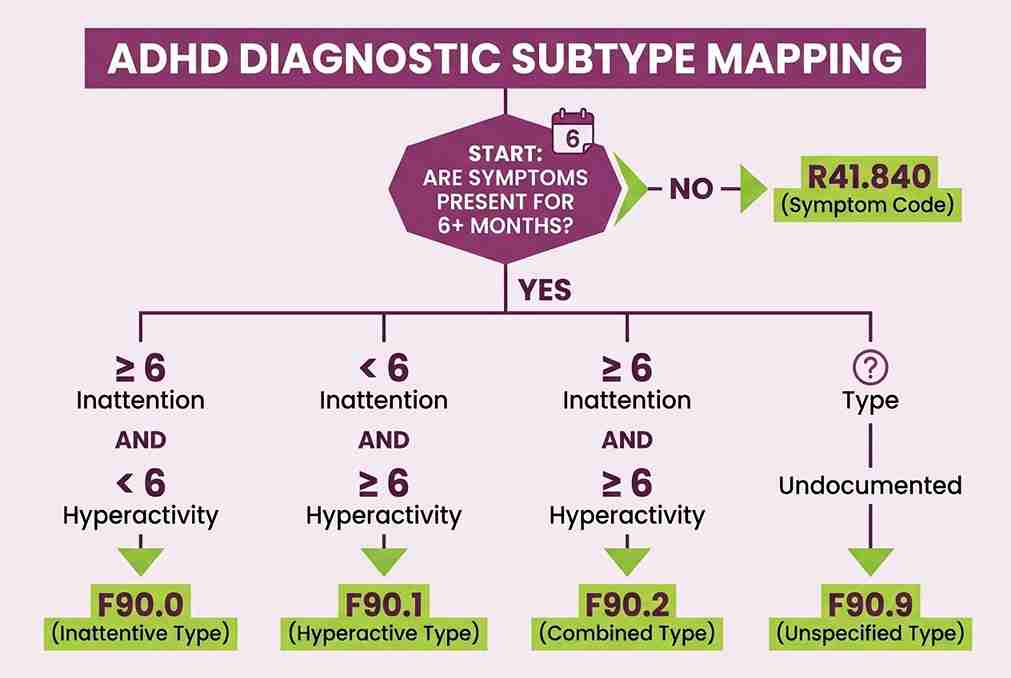
Each F90 subtype code corresponds to one DSM-5-TR presentation, and the presentation depends on symptom counts across two domains: inattention and hyperactivity-impulsivity.
What Is ICD-10 Code F90.0, Inattentive Type?
ICD-10 ADHD inattentive type is F90.0. F90.0 applies when a child meets 6 or more of the 9 inattention criteria and fewer than 6 hyperactivity-impulsivity criteria, sustained for at least 6 months.
Documented findings that support F90.0 include careless errors in schoolwork, difficulty sustaining attention on tasks, poor follow-through on instructions. It also includes disorganization, avoidance of sustained mental effort, frequent loss of materials, distractibility, and forgetfulness in daily activities.
F90.0 replaced the outdated “ADD without hyperactivity” concept in current coding practice. The ICD-10-CM Alphabetic Index entry for attention-deficit disorder without hyperactivity directs to F98.8, and DSM-5-TR alignment places clinician-documented inattentive ADHD at F90.0 instead.
What Is ICD-10 Code F90.1, Hyperactive Type?
ICD-10 ADHD hyperactive type is F90.1. F90.1 applies when a child meets 6 or more of the 9 hyperactivity-impulsivity criteria and fewer than 6 inattention criteria over 6 months.
Documented findings that support F90.1 include fidgeting, leaving the seat in structured settings, running or climbing at inappropriate times, inability to play quietly, being driven by a motor, excessive talking, blurting answers, difficulty waiting turns, and interrupting others.
F90.1 carries the lowest claim volume of the three specific types in pediatric panels, because pure hyperactive-impulsive presentation is most common in children under 7 years and often shifts toward combined presentation with age.
What Is ICD-10 Code F90.2, Combined Type?
ICD-10 ADHD combined type is F90.2. F90.2 applies when a child meets 6 or more criteria in both the inattention domain and the hyperactivity-impulsivity domain over the same 6-month window.
F90.2 represents the most frequently documented ADHD presentation in pediatric practice. Combined presentation also correlates with higher comorbidity burden, which raises the value of accurate secondary diagnosis capture on the same claim.
When Do You Use F90.8 and F90.9?
Use F90.8 when the clinician documents an ADHD presentation that falls outside the inattentive, hyperactive, and combined types. Use F90.9 only when the record confirms ADHD but names no type.
F90.8 covers documented atypical presentations, including presentations recorded under the DSM-5-TR “other specified” construct. F90.9 covers ADHD NOS and ADHD of childhood or adolescence NOS.
The table below maps DSM-5-TR symptom thresholds to the correct ICD-10 ADHD code for children under 17 years.
| Inattention Criteria Met | Hyperactivity-Impulsivity Criteria Met | Duration | Correct ICD-10 Code |
|---|---|---|---|
| 6 or more of 9 | Fewer than 6 | 6 months or longer | F90.0 |
| Fewer than 6 | 6 or more of 9 | 6 months or longer | F90.1 |
| 6 or more of 9 | 6 or more of 9 | 6 months or longer | F90.2 |
| Documented, atypical pattern | Documented, atypical pattern | 6 months or longer | F90.8 |
| Documented, type not stated | Documented, type not stated | Documented | F90.9 |
| Symptoms present, criteria not met | Symptoms present, criteria not met | Under 6 months or unconfirmed | R41.840 |
DSM-5-TR lowers the threshold to 5 criteria for patients aged 17 years and older. Pediatric panels that include 17-year-olds apply the adult threshold to that cohort.
When Is ADHD Unspecified ICD-10 (F90.9) the Wrong Choice?
ADHD unspecified ICD-10 code F90.9 is the wrong choice when the clinical note documents symptom counts, a completed rating scale, or a named presentation. Under those conditions, a specific code exists and F90.9 understates the documented severity.
Three patterns drive avoidable F90.9 volume in pediatric practices:
- Copy-forward problem lists that carry an initial F90.9 across every subsequent visit
- EHR favorites lists that surface F90.9 above the specific F90 codes
- Vanderbilt or Conners results that stay in a scanned attachment and never reach the assessment field
Payers apply higher scrutiny to unspecified behavioral health codes on testing and prior authorization requests. The table below contrasts the two coding paths on the same clinical scenario.
| Element | F90.9 Path | Specific F90.x Path |
|---|---|---|
| Diagnosis reported | F90.9, unspecified type | F90.2, combined type |
| Medical necessity strength for 96130-96139 | Weak, type undocumented | Strong, presentation and severity documented |
| Prior authorization outcome | Frequent additional records request | Approval on first submission |
| Risk adjustment value | Low specificity | Full specificity captured |
| Audit exposure | Documentation-to-code mismatch | Code supported by scale scores |
Practices that push F90.9 usage below 10% of total ADHD claim volume see fewer records requests on psychological testing and faster authorization turnaround.
What Codes Apply Before an ADHD Diagnosis Is Confirmed?
Report symptom codes, not F90.x, when the record states “rule out,” “suspected,” or “working diagnosis.” ICD-10-CM outpatient guidelines prohibit coding uncertain diagnoses in the outpatient setting.
| Scenario | Correct Code | Descriptor |
|---|---|---|
| Attention problems documented, ADHD unconfirmed | R41.840 | Attention and concentration deficit |
| Behavioral screening at a well-child visit, negative result | Z13.30 | Encounter for screening examination for mental health and behavioral disorders, unspecified |
| Screening for other mental health and behavioral disorders | Z13.39 | Encounter for screening for other mental health and behavioral disorders |
| Routine child health exam, abnormal findings | Z00.121 | Encounter for routine child health examination with abnormal findings |
| Routine child health exam, no abnormal findings | Z00.129 | Encounter for routine child health examination without abnormal findings |
| Disruptive behavior, ADHD criteria not met | F91.9 | Conduct disorder, unspecified |
Sequencing matters on well-child encounters. Report Z00.121 or Z00.129 first, then attach the behavioral finding code to the screening line item.
How Do You Pair F90 Codes With CPT Codes?
Pair the most specific documented F90 code with the CPT code that matches the work performed on that date. The table below maps eight common pediatric ADHD encounters to the correct code combination, for details read our pediatrics CPT codes guide.
| Clinical Scenario | ICD-10 Code | CPT Codes | Modifiers |
|---|---|---|---|
| Well-child visit, Vanderbilt parent and teacher forms administered | Z00.129 primary, R41.840 secondary | 99392, 96127 x2 | 25 on 99392 |
| Follow-up visit, ADHD confirmed inattentive type, medication titration | F90.0 | 99214 | None |
| New patient ADHD evaluation, 60 minutes total time | F90.2 | 99205 | None |
| Extended new patient evaluation, 90 minutes total time | F90.2 | 99205, 99417 x2 | None |
| Technician-administered testing, 90 minutes | F90.2 | 96138 x1, 96139 x2 | None |
| Clinician interpretation and report, 2 hours | F90.2 | 96130 x1, 96131 x1 | None |
| Established visit plus 30-minute psychotherapy | F90.2, F41.1 | 99213, 90833 | 25 on 99213 |
| Parent behavior training, child not present, 45 minutes | F90.1 | 90846 | None |
Sequence the F90 code first on every ADHD-primary claim. Report comorbid conditions as secondary diagnoses on the same claim, and link each diagnosis pointer to the specific CPT line it supports.
Which Modifiers Apply to Pediatric ADHD Claims?
Five modifiers carry pediatric ADHD claims through payer edits. Modifier omission ranks as the single largest cause of preventable denial on same-day screening and E/M combinations.
| Modifier | Definition | ADHD Application |
|---|---|---|
| 25 | Significant, separately identifiable E/M service by the same provider on the same day | Append to the E/M code when 96110, 96127, or testing occurs on the same date |
| 59 | Distinct procedural service | Append to the screening or testing code when a payer edit bundles the service |
| XU | Unusual non-overlapping service, subset of 59 | Payer-preferred alternative to modifier 59 |
| 33 | Preventive service | Append when the screening qualifies as a graded preventive service and cost sharing is waived |
| 95 | Synchronous telemedicine service via real-time audio and video | Append to ADHD telehealth visits |
| 93 | Synchronous telemedicine service via audio only | Append to audio-only ADHD follow-up visits where payer policy allows |
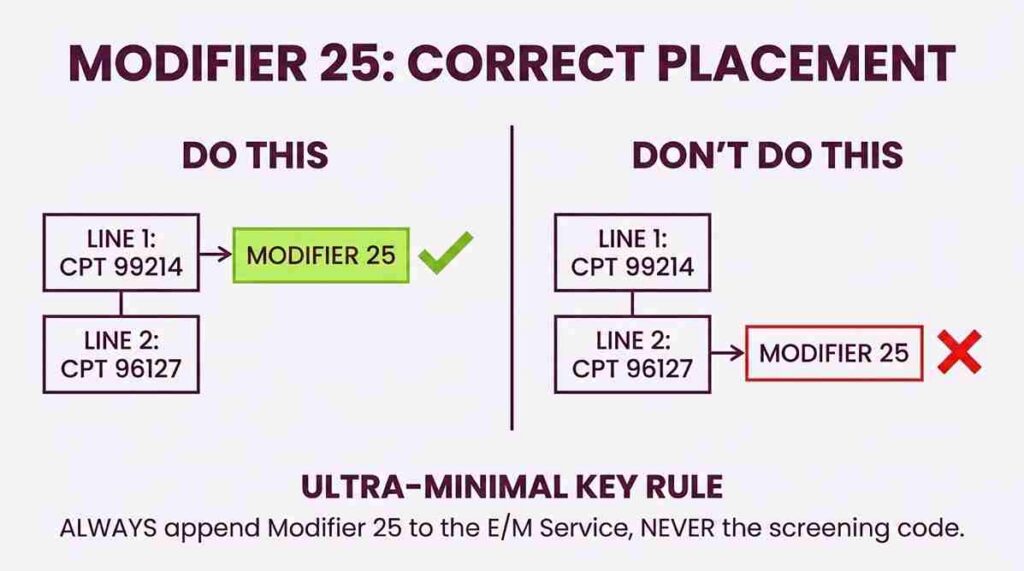
Modifier 25 attaches to the E/M code, never to the screening code. Reversing that placement produces a CO-4 denial and forces a corrected claim cycle.
How Do You Code ADHD Comorbidities?
Report every documented comorbidity as a secondary diagnosis on the same claim as the F90 code. CDC data shows nearly 78% of children with ADHD carry at least one co-occurring condition, and roughly 4 in 10 carry an anxiety disorder.
Comorbidity capture drives three outcomes: stronger medical necessity for testing, accurate risk adjustment in value-based contracts, and defensible support for higher-complexity E/M levels.
| Comorbid Condition | ICD-10-CM Code | Frequency Pattern With ADHD |
|---|---|---|
| Oppositional defiant disorder | F91.3 | Highest behavioral comorbidity in combined type |
| Conduct disorder, unspecified | F91.9 | Frequent in adolescent combined presentation |
| Generalized anxiety disorder | F41.1 | Approximately 4 in 10 children with ADHD |
| Anxiety disorder, unspecified | F41.9 | Common when subtype not documented |
| Major depressive disorder, single episode, unspecified | F32.9 | Rises through adolescence |
| Autism spectrum disorder | F84.0 | Coded alongside F90.x under Excludes2 |
| Specific reading disorder | F81.0 | Common academic comorbidity |
| Mathematics disorder | F81.2 | Common academic comorbidity |
| Speech and language disorder, unspecified | F80.9 | Frequent in early childhood presentations |
| Tourette’s disorder | F95.2 | Overlaps with stimulant management decisions |
| Insomnia, unspecified | G47.00 | Frequently stimulant-related |
| Enuresis not due to a substance or known physiological condition | F98.0 | Common in younger pediatric cohorts |
Sequence F90.x first when ADHD drives the encounter. Sequence the comorbidity first when the visit addresses that condition as the primary problem, and report F90.x as secondary.
How Do You Code ADHD Medication Management?
ADHD medication management reports under established patient E/M codes, with Z79.899 attached as a secondary diagnosis for long-term drug therapy. Roughly 53.6% of children with current ADHD take ADHD medication, which makes titration visits the highest-volume encounter type in most pediatric panels.
| Encounter Type | CPT Code | Primary ICD-10 | Secondary ICD-10 |
|---|---|---|---|
| Nurse visit, vitals and refill check, no provider evaluation | 99211 | F90.2 | Z79.899 |
| Stable maintenance follow-up, low complexity | 99213 | F90.0 | Z79.899 |
| Titration visit with dose change and side effect review | 99214 | F90.2 | Z79.899, G47.00 |
| Complex visit with comorbidity management and school coordination | 99215 | F90.2 | F41.1, Z79.899 |
| Pharmacologic management added to psychotherapy | 90863 | F90.1 | Z79.899 |
| Telehealth follow-up, real-time video | 99213 with modifier 95 | F90.0 | Z79.899 |
Stimulant monitoring documentation carries added weight because controlled substance prescribing draws independent audit attention. Record height, weight, blood pressure, heart rate, appetite changes, and sleep changes at each titration visit.
Which Denials Hit Pediatric ADHD Claims Most?
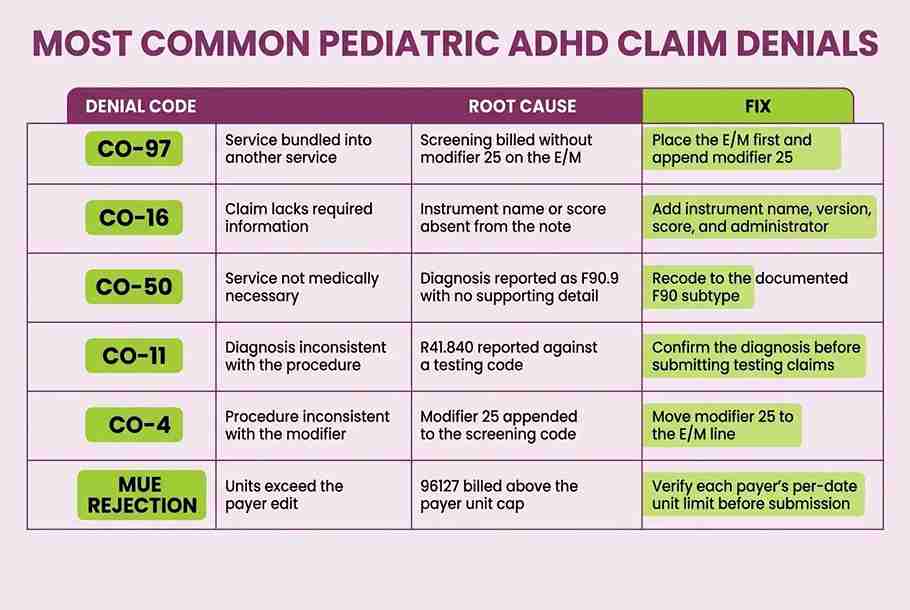
Six denial patterns account for the majority of pediatric ADHD claim rework, as outlined in our pediatric billing guide. Each pattern maps to a specific, fixable coding behavior.
| Denial Code | Meaning | Root Cause | Fix |
|---|---|---|---|
| CO-97 | Service bundled into another service | Screening billed without modifier 25 on the E/M | Place the E/M first and append modifier 25 |
| CO-16 | Claim lacks required information | Instrument name or score absent from the note | Add instrument name, version, score, and administrator |
| CO-50 | Service not medically necessary | Diagnosis reported as F90.9 with no supporting detail | Recode to the documented F90 subtype |
| CO-11 | Diagnosis inconsistent with the procedure | R41.840 reported against a testing code | Confirm the diagnosis before submitting testing claims |
| CO-4 | Procedure inconsistent with the modifier | Modifier 25 appended to the screening code | Move modifier 25 to the E/M line |
| MUE rejection | Units exceed the payer edit | 96127 billed above the payer unit cap | Verify each payer’s per-date unit limit before submission |
Practices that build these six edits into a pre-submission scrub reduce ADHD claim rework substantially. Working with pediatric billing services, Transcure holds a 98% first-pass clean claim rate and a denial rate under 1% across pediatric and behavioral health clients, driven by exactly this class of front-end edit.
What Is the Pediatric ADHD Coding Compliance Checklist?
Run these 10 checks before releasing any pediatric ADHD claim batch.
- Confirm the F90 code carries a fourth character
- Replace F90.9 with a documented subtype wherever the chart supports one
- Verify the note names each screening instrument, version, and rater
- Confirm raw scores and interpretation appear in the assessment, not an attachment
- Check that symptom evidence spans two or more settings
- Place modifier 25 on the E/M line, never on the screening line
- Confirm time-based testing units meet the 16-minute and 31-minute thresholds
- Verify start and stop times appear for every time-based code
- Add all documented comorbidities as secondary diagnoses
- Attach Z79.899 to every medication management encounter
Practices that run all 10 checks convert F90 coding from a denial source into a clean, defensible revenue line across screening, testing, therapy, and pharmacologic management.
Frequently Asked Questions
What is the ADHD unspecified ICD-10 code?
The ADHD unspecified ICD-10 code is F90.9, and F90.9 applies only when the clinical record confirms ADHD without naming a presentation type.
What is the ICD-10 code for ADHD combined type?
The ICD-10 code for ADHD combined type is F90.2, which applies when a child meets 6 or more criteria in both the inattention domain and the hyperactivity-impulsivity domain over 6 months.
Can 96127 and an E/M code be billed on the same day?
Yes, 96127 and an E/M code bill on the same date when the note documents distinct work, with modifier 25 appended to the E/M code and modifier 59 or XU appended to 96127 where the payer requires it.
Is F90.0 the same as ADD?
F90.0 replaces the outdated ADD label in current coding practice, and clinician-documented inattentive ADHD codes to F90.0 rather than F98.8, despite the Alphabetic Index entry for attention-deficit disorder without hyperactivity.
Which CPT codes cover a full pediatric ADHD evaluation?
A full pediatric ADHD evaluation reports 96136 or 96138 for test administration, 96137 or 96139 for additional administration blocks, 96130 for the first hour of evaluation and report writing, and 96131 for each additional hour.